
Demand-Side Innovation and Market Opportunities
The contemporary landscape of economic growth and technological advancement has long been dominated by supply-side paradigms. In this traditional framework, innovation is conceptualized as a linear progression: capital is injected into research and development (R&D), resulting in new technological capabilities that are subsequently pushed into the market 12. However, a growing consensus across innovation studies, behavioral economics, and public policy suggests that this supply-centric approach is insufficient for addressing complex systemic challenges or predicting market adoption 12. Demand-side innovation reorients the locus of value creation, positing that user needs, market articulation, and systemic deployment environments are the primary drivers of technological progress 34. By shifting the analytical focus from the underlying capability of the supply side to the precise functional requirements of the demand side, organizations and governments can unlock overlooked market opportunities, mitigate adoption risks, and achieve sustainable competitive advantages.
Theoretical Foundations of Innovation Policy
The theoretical underpinnings of demand-side innovation diverge fundamentally from traditional R&D metrics. While supply-side policies are primarily designed to generate new knowledge and correct market failures related to the non-excludability of scientific research - such as through R&D grants, tax incentives, and intellectual property protection - demand-side policies intervene downstream 156.
Evolution from Technology Push to Market Pull
Demand-side innovation encompasses all measures intended to induce innovations or accelerate their diffusion by increasing demand, defining new functional requirements, or improving the articulation of buyer needs 3. The rationale for this transition is rooted in the recognition that markets alone frequently fail to provide sufficient incentives for the deployment of novel solutions, particularly when addressing broad societal challenges 1.
Scholarly literature identifies up to six generations of innovation policy. Early generations relied heavily on linear models of technology push, assuming that addressing market failures through basic research funding would automatically yield economic growth 1. By the 1990s, second-generation policies began addressing systemic failures within national innovation systems, though the focus remained predominantly on supply-side capabilities. The current paradigm, often termed transformative innovation policy, explicitly shifts attention toward addressing grand societal challenges 1. This requires a directional approach where demand-side interventions alter market incentives to achieve sustainable transitions, rather than merely relying on indiscriminate technological advancement 137.
A primary differentiator between these two paradigms is their mechanism of legitimacy. Supply-side interventions traditionally rely on "input legitimacy," which is justified by a policy's contribution to macroeconomic growth, patent counts, and general innovation performance 38. Conversely, demand-side measures are assessed via "output legitimacy." Their effectiveness is measured by their capacity to overcome information asymmetries, reduce uncertainty for early adopters, and successfully transform markets to meet specific, directional societal needs 3.
Table 1 summarizes the core differences between supply-side and demand-side innovation paradigms based on recent innovation policy literature 391012.
| Feature | Supply-Side Innovation | Demand-Side Innovation |
|---|---|---|
| Core Mechanism | Technology push via R&D investment | Market pull via need articulation |
| Primary Policy Tools | R&D subsidies, tax credits, lab funding | Public procurement, regulations, standards |
| Risk Profile | High technical risk, lower market certainty | Lower technical risk, addresses known demands |
| Market Goal | Generate "new-to-world" product categories | Solve existing user problems; accelerate diffusion |
| Legitimacy Metric | Input Legitimacy (R&D spend, patent filings) | Output Legitimacy (societal impact, adoption rates) |
Network Externalities and Returns to Scale
Modern demand-side economic theories frequently emphasize the role of network externalities, particularly within digital platforms and digital ecosystems. Demand-side network externalities occur when participation in a network becomes progressively more attractive to marginal users as the total number of users - and the volume of data they generate - increases 511.
This dynamic fundamentally alters the optimal growth problem for firms. Traditional industrial economics posited that supply-side economies of scale dictated market structure, limiting industries to a few coexisting firms 14. However, in digital economies governed by demand-side externalities, concentration is driven by the demand side. The marginal cost of acquiring more data decreases as the platform scales, creating a feedback loop that lowers the platform's barter cost for user acquisition 11. If data accumulation is treated as a nonrival input - akin to endogenous growth models where ideas generate sustained growth - the economy can achieve increasing returns to scale based purely on demand-side network effects 1112. Firms managing these networks must carefully balance supply and demand stock levels, utilizing price levers and subsidies to maximize total market value without suffering attrition across user cohorts 1216.
Methodologies for Identifying Latent Market Demand
Shifting focus to the demand side requires robust methodologies to identify latent market needs. Traditional demographic segmentation and focus groups often fall short because they correlate consumer attributes rather than identifying the causal mechanisms driving purchase behavior 1318. To rigorously uncover overlooked opportunities, researchers and strategists deploy specialized frameworks.
User-Driven Identification Strategies
Pioneered by Eric von Hippel at the Massachusetts Institute of Technology, the "Lead User" methodology is predicated on the empirical finding that users, rather than manufacturers, frequently initiate breakthrough innovations 19. This "free innovation paradigm" challenges the assumption that innovation must be driven by expected commercial returns; instead, it observes that innovating users are self-rewarded by solving their own immediate, acute problems without concern for the broader extent of the market 14.
Lead users possess two defining characteristics. First, they face needs that will eventually become general in the marketplace, but they experience them months or years before the bulk of the market encounters them. Second, they are positioned to benefit significantly by obtaining a solution, which incentivizes them to invest their own time and resources into iterative trial-and-error development 2115. By identifying and collaborating with lead users through toolkits and co-creation platforms, organizations can bypass the guesswork of traditional R&D. Empirical studies demonstrate that innovations generated via lead-user inputs possess significantly higher commercial attractiveness and reduce the risk of market failure 1914. Modern approaches increasingly utilize semantic network analysis and memory models powered by artificial intelligence to efficiently identify these user-generated innovations across vast datasets of user content 1415.
Causal Frameworks for Consumer Choice
While lead user theory focuses on the vanguard of the market, the "Jobs to Be Done" (JTBD) framework, developed by Clayton Christensen and Bob Moesta, focuses on the causal mechanisms behind everyday consumer choices 1823. The core insight of JTBD is that customers do not buy products; they "hire" them to make progress in specific circumstances 2425.
A "Job" operates independently of the supply-side technology utilized to solve it. For example, the underlying demand for portable music remained constant across the eras of traveling musicians, transistor radios, compact disc players, and digital streaming devices 18. The technology evolved, but the core demand-side requirement did not. By conducting qualitative JTBD interviews, researchers uncover the forces acting upon a consumer during a purchasing decision: the "push" of their current struggle, the "pull" of a new solution, the anxiety of the unknown, and the habit of present behavior 1823.
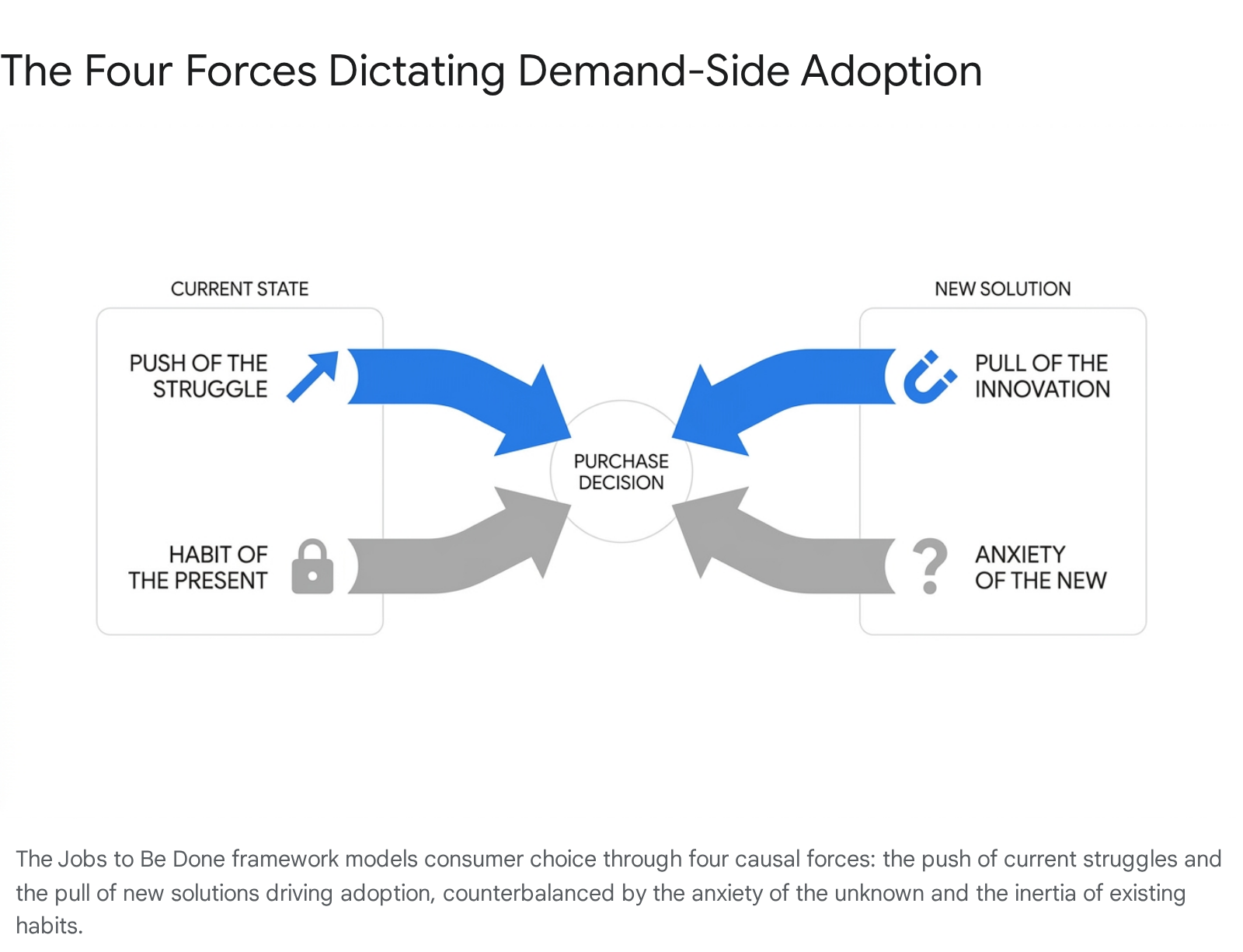
Understanding these forces allows organizations to find opportunities in "non-consumption" - instances where consumers opt to do nothing because existing market solutions fail to adequately address their required progress 25. This framework redirects competitive analysis away from direct product comparisons and toward the functional and emotional dimensions of user progress, thereby neutralizing the "customer understanding paradox" where stated preferences in surveys consistently fail to predict actual purchase behavior 24.
Econometric Evaluation of Market Behavior
To quantify and predict demand-side behaviors at scale, modern market research is increasingly reliant on causal inference and structural modeling. While traditional econometrics might identify a positive correlation between an R&D grant and firm innovation, such correlations are often confounded by selection bias, as grants are frequently awarded to firms that are already highly innovative 26.
Causal Inference in Policy Evaluation
Causal inference focuses on identifying the true causal relationship by estimating the "counterfactual" - what would have occurred in the absence of the intervention 1628. Because researchers cannot observe the same entity simultaneously receiving and not receiving a treatment, they must rely on methods to simulate randomized controlled trials using observational data 16. Through techniques such as regression discontinuity, difference-in-differences, and instrumental variables, researchers can isolate the specific impact of demand-side shocks while controlling for underlying environmental confounders 1617. In marketing research, this formal axiomatization process logically ensures that researchers can infer true causal estimands from data, rather than relying on spurious correlations 17.
Structural Modeling for Counterfactual Analysis
While causal inference is highly effective for identifying "reduced-form" relationships (direct associations between variables), structural modeling goes a step further by utilizing economic and game theory to specify the mathematical models that generate the observed data 28. Structural models aim to uncover "deep parameters," such as fundamental consumer preferences, technological constraints, and strategic market interactions 28.
By estimating these deep parameters using techniques like maximum likelihood estimation or generalized method of moments, researchers can construct robust simulations. This allows firms and policymakers to perform counterfactual policy analyses and predict demand elasticity in scenarios that have not yet occurred historically, providing a significant advantage in forecasting the adoption rates of entirely new product categories 28.
Strategic Ecosystem Alignment and Architecture
Recognizing a demand-side opportunity is necessary but insufficient for market success; the innovation must be successfully deployed within an interdependent market structure. Ron Adner's research on ecosystem strategy highlights that an ecosystem is defined by the structure through which partners interact to deliver a specific value proposition to the end consumer 30.
Managing Co-Innovation and Adoption Chain Risks
In demand-side theory, the ultimate value proposition acts as the anchor. Traditional supply-side strategies focus heavily on internal execution risk (e.g., whether a technology can physically be built to specification). Ecosystem strategy, however, introduces two critical external risks that frequently derail technologically superior products: 1. Co-innovation Risk: The extent to which the commercialization of an innovation depends on the successful parallel development of other innovations by external partners 1819. 2. Adoption Chain Risk: The extent to which intermediate partners across the value chain must adopt the innovation before the end consumer has an opportunity to assess the value proposition 1819.
Adner illustrates this through the "generic value blueprint," a mapping tool that identifies the locations and dependencies of all actors required to bring a demand-side solution to market 1819. When companies ignore the ecosystem, they suffer from an "innovation blind spot." They may deliver a technologically superior product that ultimately fails because upstream complementors or downstream distributors lack the economic incentive to adopt it 19.
Reconfiguring the Value Chain
To successfully orchestrate a demand-side shift, firms must align critical partners whose visions of market structure may conflict 30. Disruptors do not simply compete within existing supply chains; they reconfigure the ecosystem by subtracting unwanted elements and recombining actors to create novel value architectures 18. For example, early attempts at electric vehicle (EV) commercialization by startups like Better Place sought to solve the demand-side problem of high battery costs by structurally separating battery ownership from car ownership 18. While Better Place ultimately failed, its ecosystem approach highlighted that overcoming demand-side adoption hurdles frequently requires structural realignment rather than purely incremental supply-side engineering.
Public Sector Procurement and Market Creation
Governments are increasingly utilizing their vast purchasing power to actively shape markets, moving beyond supply-side subsidies to deploy demand-side policy instruments. The most prominent mechanism for this is Public Procurement for Innovation (PPI).
Mechanisms of Pre-Commercial Procurement
Public Procurement for Innovation occurs when the public sector acts as an early adopter of innovative solutions that are not yet commercially available on a large scale 320. By guaranteeing a critical mass of demand, the government reduces uncertainty for private firms, incentivizing them to scale up production and commercialize technologies to address specific public needs 520.
The PPI process frequently begins with Pre-Commercial Procurement (PCP). In PCP, public buyers procure R&D services from multiple competing suppliers in phases, steering the development of solutions toward explicit demand-side requirements through iterative prototyping and testing 2021. Following the successful conclusion of a PCP phase, the optimal solutions can be widely deployed through standard PPI contracts.
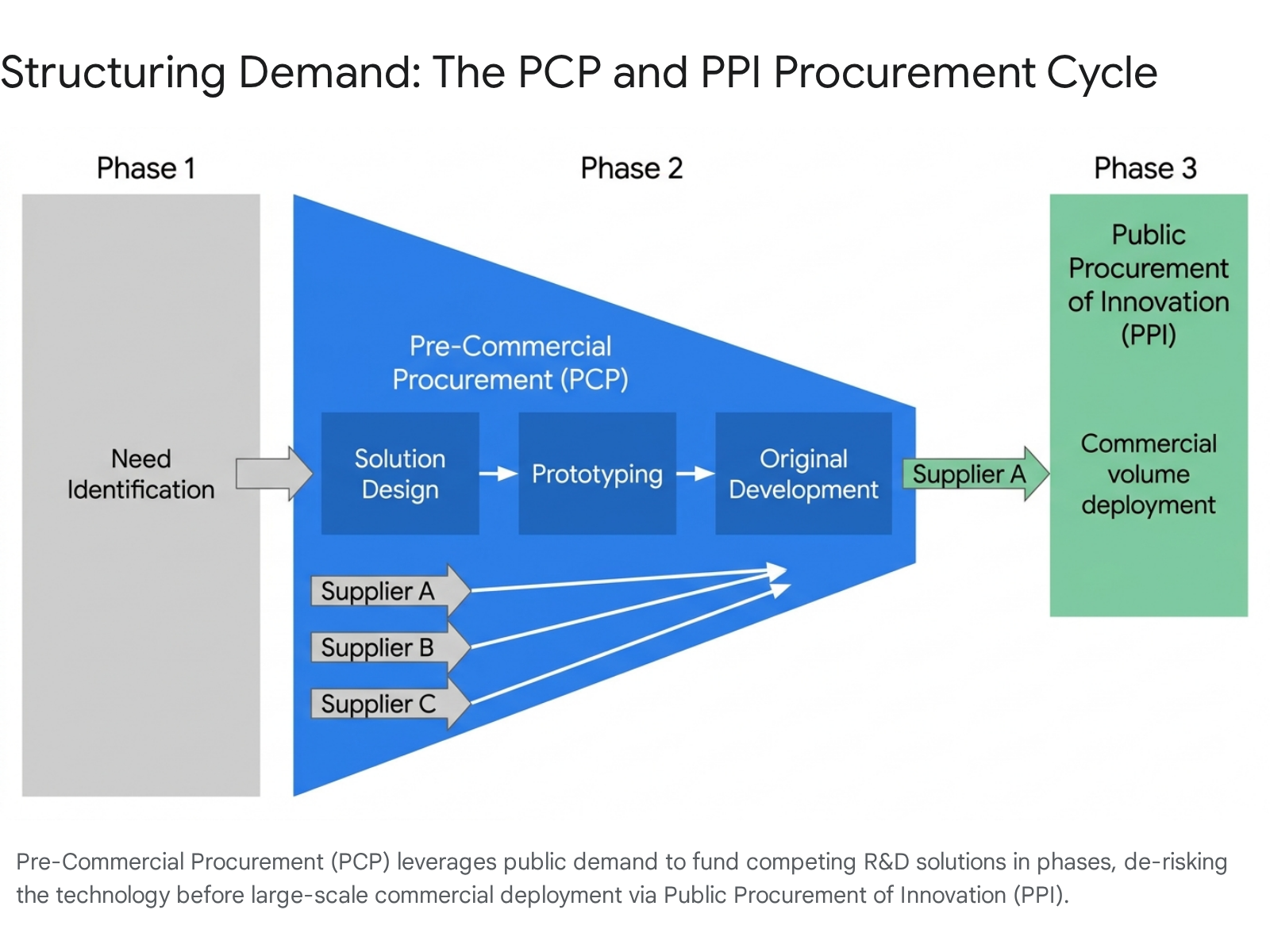
Evidence suggests that public procurement can be a far more potent stimulus for industrial innovativeness than a policy of generalized R&D subsidies, as it directly addresses coordination problems and provides immediate market validation 922.
Transnational Industrial Strategy in Europe
In the European Union, demand-side innovation policy has gained critical urgency. A succession of analyses, culminating in the September 2024 report by Mario Draghi on "The Future of EU Competitiveness," identifies a severe "innovation gap" between the EU and its global competitors, the United States and China 2324. Despite possessing substantial supply-side capabilities and accounting for high levels of basic research, the EU has consistently struggled to translate scientific breakthroughs into commercially dominant market products 2324.
Draghi's 400-page report warns of "slow agony" without decisive action to address an €800 billion investment gap. The report highlights that the EU's fragmented single market dilutes demand-side scale, deterring the commercialization of high-growth technologies 242539. To rectify this, the report advocates for a cohesive industrial strategy that explicitly links supply-side support with demand-side measures across ten strategic sectors. Recommendations include establishing a "Competitiveness Coordination Framework," accelerating AI integration, leveraging collective public procurement to level the playing field, and implementing "selective conditionality" for foreign direct investment to ensure local value creation and technology transfer 253926.
The maturity of these demand-side frameworks varies significantly across member states. The 2024 European Innovation Procurement Observatory benchmarking study evaluated national policy frameworks across 30 European countries. The assessment evaluated ten policy areas, including official definitions, investment targets, monitoring frameworks, and incentives.
Table 2 highlights the varying maturity of policy frameworks across select European nations, demonstrating the uneven deployment of demand-side strategies 2728.
| Country | European Benchmark Ranking | Benchmark Score (2024) | Framework Strengths / Weaknesses |
|---|---|---|---|
| Finland | 1st | 70.23% | Comprehensive IPP framework; strong horizontal and sectoral integration |
| Germany | 8th | 42.97% | Strong support from ICT/R&D policies; lacks financial incentives for procurers |
| Latvia | 17th | 32.05% | Implemented only roughly one-third of necessary policy measures |
| Denmark | 21st | 25.81% | Improved from previous cycles, but support activities remain underdeveloped |
Despite variations, specific regional initiatives demonstrate the efficacy of targeted procurement when properly executed. For example, the Murcia Health Service in Spain utilized the inDemand co-creation model to rapidly procure 22 digital health solutions (including the EPICO epilepsy communication channel), demonstrating that demand-driven pre-commercial procurement can bypass the burdensome overheads of traditional R&D 29. Similarly, Transport for London achieved a 25% reduction in whole life-cycle costs by structuring its lighting procurement around strict energy and carbon parameters, forcing the market to innovate to meet explicit functional demand rather than prescribing a specific technology 29.
National Resilience and Infrastructure Demands
At the national level, Singapore exemplifies how acute systemic constraints can be transformed into global innovation opportunities via demand-side policy. Historically constrained by severe water scarcity, Singapore's Public Utilities Board (PUB) elevated water resilience to a strategic national priority 3045. Moving beyond basic research funding, PUB operates as an anchor institution, establishing clear "Challenge Statements" that articulate highly specific operational demands to the global market 3031.
Over recent decades, Singapore has expanded its water catchment area to two-thirds of its landmass and pioneered desalination and water recycling technologies. However, the nation now faces an existential shift from water dependency to energy dependency in its processing capabilities 45. Recent iterations of Singapore's Global Innovation Challenge focus heavily on reducing this energy dependency and enhancing the resilience of its 6,000-kilometer potable water pipeline network 4531. For example, PUB explicitly sought demand-driven solutions to leverage 3D printing for the rapid manufacturing of critical infrastructure components, and internal repair methods for pipe leaks that eliminate the need for disruptive ground excavation 31.
Similarly, in the renewable energy sector, EDP Renewables APAC utilized the National Innovation Challenge to solicit data-driven monitoring solutions aimed at reducing water consumption. Operating approximately 3,000 solar sites across Singapore, EDPR sought non-uniform, automated cleaning systems capable of achieving at least a 70% reduction in water use compared to traditional calendar-based manual cleaning 32. By guaranteeing milestone-based pilot funding and providing explicit site access for testing, Singapore uses institutional demand to de-risk commercialization for startups and SMEs globally 32.
Private Sector Disruption and Business Model Evolution
Beyond government policy, private sector enterprises routinely use demand-side insights to disrupt entrenched industries. A demand-side strategy looks downstream toward product markets and consumers, anticipating managerial decisions that increase value creation within a complex value system 33.
Exploiting Non-Consumption and Demographic Shifts
Overlooking demand-side nuances frequently leaves substantial market segments unserved. When products are designed solely based on advancing internal supply-side capabilities, they often overshoot the actual functional requirements of the user, leaving room for disruptive entrants 2534.
Identifying overlooked demand requires assessing populations that are structurally locked out of consumption. In demographic contexts, sectors such as the aging population or individuals with disabilities are frequently dismissed by incumbent firms as unprofitable niches 50. However, inclusive design that addresses genuine functional barriers in these populations frequently scales to benefit broader markets, expanding total addressable revenue 50. In specialized consumer goods, artisanal products historically dismissed by mainstream supply chains - such as regional spirits like Oaxacan Mezcal - have achieved explosive global growth when localized demand-side narratives are appropriately amplified to international audiences 35.
Similarly, in the digital economy, ride-sharing platforms did not disrupt the taxi industry by inventing vastly superior automobiles (a supply-side innovation); they disrupted the market by addressing profound demand-side friction. By utilizing digital interfaces to eliminate pricing opacity, poor availability, and a lack of accountability, platforms like Uber and Lyft addressed the consumer's core functional requirement 52. Direct-to-Consumer (DTC) brands such as Warby Parker and Casper executed similar strategies, identifying consumer frustration with traditional retail markups and offering streamlined, personalized shopping experiences that circumvented legacy distribution ecosystems 52.
The Transition Toward Service-Based Business Models
A major paradigm shift facilitated by demand-side innovation is the transition toward Everything-as-a-Service (XaaS) business models. XaaS models fundamentally separate the utility of a product from its physical ownership, directly addressing the commercial customer's desire for functional results rather than burdensome capital expenditure 36.
This shift is a critical enabler of the circular economy. In result-oriented models, the provider retains ownership of the asset and is compensated purely for output - for instance, paying for hours of thrust rather than purchasing an entire aircraft engine, or paying for illumination rather than purchasing lighting fixtures 36. Because the provider internalizes the long-term costs of maintenance, energy consumption, and disposal, they are financially incentivized to utilize supply-side innovations that maximize durability, dematerialization, and high-value recycling 36. Here, the demand-side requirement for off-balance sheet financing and guaranteed uptime directly dictates the supply-side engineering architecture, ensuring that sustainability becomes a profit driver rather than a compliance cost 36.
Artificial Intelligence and Workflow Automation
The deployment of Artificial Intelligence (AI) serves as a contemporary test case for demand-side adoption dynamics. The emergence of agentic AI - systems capable of autonomous perception, reasoning, and multi-step action - represents a shift from generating content to executing complex workflows 37. While the supply-side development of Large Language Models has been rapid, the actual market adoption depends heavily on solving specific demand-side productivity constraints.
A 2025 global survey conducted by MIT Sloan Management Review and Boston Consulting Group, polling 3,467 respondents across 21 industries, found that 35% of organizations had adopted AI agents by 2023, with another 44% expressing immediate plans to deploy the technology 3738. Interestingly, the research indicates a shift in strategic prioritization as organizations move from experimentation to practical deployment. While 61% of respondents viewed AI as core to their strategy in 2023, this figure dropped to 38% in 2024, as executives reassessed the specific, tangible roles Generative AI would play in resolving actual operational friction 38.
Despite concerns regarding workforce displacement, demand-side attitudes remain largely optimistic; the survey noted that 84% of workers are hopeful that AI can assist with their tasks, while only 20% expressed fear of job replacement 38. Chief Human Resources Officers are increasingly tasked with managing this transition, navigating the boundaryless nature of AI-augmented workflows while ensuring continuous learning and upskilling for employees facing rapid technological obsolescence 39.
Measurement Frameworks and Data Infrastructure
As organizations and governments increasingly adopt demand-side innovation policies, the rigorous evaluation of their outcomes has become a central challenge. The inherent complexity of measuring systemic market shifts necessitates sophisticated empirical frameworks and advanced data infrastructure.
Distinguishing Supply and Demand Metrics
Econometric analyses of policy interventions often contrast the efficacy of traditional R&D subsidies against demand-pull policies like public procurement. Current empirical literature suggests that while government R&D subsidies can boost internal R&D expenditure - often acting as a signal to private investors - demand-side procurement is frequently more effective at stimulating actual market commercialization and product innovation 2240.
Because demand-side innovation focuses on systemic outcomes, traditional Key Performance Indicators (KPIs) like R&D intensity or patent filings are insufficient. Institutions evaluating procurement policies must develop metrics that capture market engagement, competition dynamics, and societal impact. In its comprehensive review of Innovation Procurement in Croatia, the OECD established an evaluation framework featuring distinct demand-side KPIs 41.
Table 3 outlines a comparison of traditional supply-side evaluation metrics against modern demand-side KPIs used in institutional procurement 341.
| Evaluation Category | Traditional Supply-Side Metrics | Demand-Side (Innovation Procurement) KPIs |
|---|---|---|
| Financial Allocation | Total R&D expenditure; grant volume | Share of innovation procurement vs. total public procurement |
| Ecosystem Impact | Number of patent filings; publications | Share of contracts awarded to SMEs; market diversification |
| Market Engagement | Academic-industry partnerships | Frequency of open market consultations prior to tender |
| Outcome Efficacy | Prototypes developed; technical milestones | Share of pre-commercial procurement triggering successful downstream deployment |
| Strategic Alignment | Contribution to macroeconomic GDP | Share of procedures integrating green, social, or digital transformation criteria |
Constraints in Data Collection and Analysis
Despite the development of advanced frameworks, significant gaps in impact measurement persist. A primary challenge lies in quantifying the actual environmental or societal impact of demand-side policies. For instance, in September 2024, the European Commission launched the Public Procurement Data Space (PPDS), aggregating procurement data from Tenders Electronic Daily (TED) and national systems into a single analytical environment 42.
While this represents a monumental improvement in data infrastructure, evaluating the true impact of "green" procurement remains highly problematic. Most current systems track the intent of the buyer - such as whether a contracting authority tagged a procedure for "reduction of environmental impacts" - rather than the quantifiable, ton-for-ton reduction of CO2 emissions delivered by the deployed solution 42. Without structural data confirming whether demand-side requirements lead to measurable real-world results, policymakers cannot accurately scale successful interventions or convince suppliers to invest heavily in environmental compliance 42. Closing this gap between stated ambition and empirical validation remains the primary frontier for maximizing the efficacy of demand-side innovation strategies.