
Community-led growth in B2B startups and enterprise software
The business-to-business (B2B) software landscape has undergone a fundamental structural shift in its go-to-market mechanics. Historically, software companies relied on sales-led growth (SLG) heavily dependent on outbound prospecting, or product-led growth (PLG) driven by self-service friction reduction. However, diminishing returns on digital advertising, the proliferation of AI-assisted buying agents, and rising customer acquisition costs (CAC) have forced a reevaluation of how software is sold and adopted. Community-led growth (CLG) has emerged as a strategic imperative, leveraging networks of practitioners to drive awareness, acquisition, retention, and expansion.
Structural Shifts in Software Go-To-Market Strategies
To understand the effectiveness of community-led growth, it must be contextualized within the broader evolution of B2B software distribution models. B2B buyer behavior has changed; modern decision-makers increasingly reject traditional marketing broadcasts in favor of peer validation and asynchronous research.
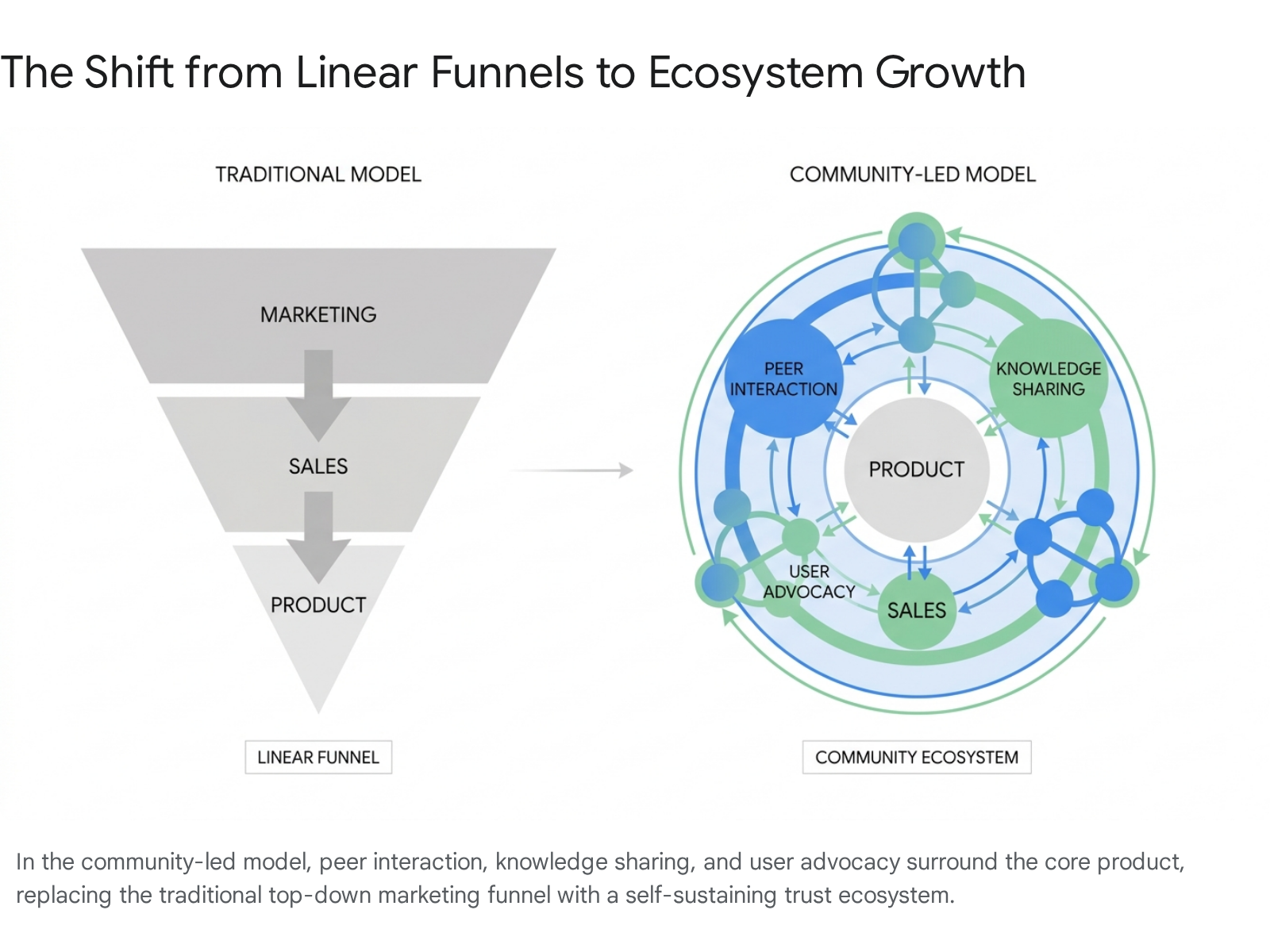
Limitations of Traditional Acquisition Models
For years, the standard playbook for B2B software involved building a product, hiring sales development representatives (SDRs), and funding paid digital acquisition 1. This approach is increasingly financially unsustainable for many firms. Between 2019 and 2024, B2B SaaS customer acquisition costs rose by approximately 70%, while organic conversion rates on cold outbound channels dropped below 2% 1. Furthermore, B2B buyers now conduct extensive independent research. Analysts estimate that up to 80% of B2B software purchases will occur through online channels and self-directed research by 2025, with buyers defining their requirements 83% of the time before ever interacting with a sales representative 23.
The average B2B buying committee has also expanded significantly. Complex software purchases routinely involve 6 to 10 stakeholders, and enterprise deals can require consensus among 13 to 17 cross-functional decision-makers spanning multiple departments 24. These buyers do not seek traditional sales pitches; they demand authentic social proof, transparent product experiences, and the ability to consult peer networks 5. With 94% of buyers utilizing large language models (LLMs) during their research process, visibility within community discussions that feed these AI engines has become critical 2.
Mechanisms of the Community-Led Model
Community-led growth operates on the principle that the relationships between people serve as an accelerant for product awareness, adoption, and retention 3. It differs fundamentally from product-led growth. While PLG utilizes the software itself - through freemium tiers, free trials, and self-serve onboarding - as the primary acquisition vehicle, CLG utilizes the knowledge network surrounding the software 67.
The effectiveness of CLG stems from several core mechanisms. B2B purchases carry high professional risk, and buyers trust recommendations from practitioners in similar roles far more than vendor-produced marketing collateral 85. Approximately 86% of B2B buyers state they trust peer communities when evaluating solutions 6. Within an active community, questions about implementation, security, or edge-case workflows are frequently answered by existing customers. This peer-to-peer exchange handles sales objections organically before a vendor's sales team is involved 78. Additionally, B2B software often requires navigating a steep learning curve. Communities provide user-generated tutorials, templates, and best practices, effectively crowdsourcing customer success and onboarding 713.
The Intersection of Product-Led and Sales-Led Growth
The strategic question for modern software companies is rarely a binary choice between PLG and SLG. Hybrid motions have become the default for almost every B2B SaaS company exceeding $10 million in Annual Recurring Revenue (ARR) 9. By 2026, companies are recognizing the need to blend PLG, CLG, and SLG to capture different segments of the market 10.
Data supports this integrated approach. Hybrid PLG and SLG companies hit their net revenue retention (NRR) targets at a rate of 67%, compared to 58% for pure-PLG organizations 9. Community-led growth acts as a multiplier on top of these models. PLG facilitates low-friction initial adoption, CLG drives continuous engagement and peer advocacy, and SLG navigates procurement complexity to expand high-value accounts 13911. The community functions as the connective tissue, accelerating the user's journey from a free trial to an enterprise evangelist 711.
Application in Early-Stage B2B Startups
For early-stage B2B startups, community-led growth primarily functions as a highly efficient acquisition and market-validation engine. Because early-stage companies often lack a mature product required to support a pure PLG motion, community serves as the initial value proposition, establishing trust and gathering market intelligence prior to writing extensive code 1.
Pre-Launch Audience Development
A defining characteristic of successful early-stage CLG is the pre-launch audience methodology. Rather than developing a product in isolation, startups cultivate an audience of 5,000 to 50,000 target practitioners prior to general availability 1. This audience is gathered around shared professional challenges, thought leadership, and niche expertise rather than the product itself.
The operational playbook for this early-stage motion typically spans 12 months. Months one and two are dedicated to defining the practitioner identity. Months three through six focus on publishing thought leadership at a sustainable cadence. By months seven through nine, the audience is transitioned into a private digital space (such as Slack or Discord) governed by community rituals. Finally, months ten through twelve focus on mobilizing the community for a coordinated product launch 1.
Skipping these stages often results in hollow communities, while executing them correctly transforms the financial profile of an early-stage launch. HubSpot research analyzing 2,400 SaaS launches indicates that community-driven launches generate 12 times more day-one signups compared to cold market launches 1.
Capital Efficiency and Pipeline Generation
At the startup phase, capital efficiency is paramount. Benchmark data demonstrates that early-stage startups utilizing CLG can significantly reduce their reliance on paid media and outbound sales. Startups that successfully execute pre-launch community building report cutting their first-year customer acquisition costs by 38% on average 1. For products with an Annual Contract Value (ACV) under $25,000, an active community can generate 80% to 100% of the sales pipeline through the first two years of operation 1.
In a market environment where median annual revenue growth for SaaS startups has slowed - dropping from 47% in 2024 to 28% in 2025 - and where sales and marketing (S&M) multipliers have halved, the organic pipeline generated by community members provides a critical competitive advantage 12. The median S&M multiple in 2025 was approximately 3x, meaning a startup spending $150,000 on sales and marketing generated $450,000 in annual revenue 12. CLG mitigates this declining efficiency by utilizing the community as a demand capture mechanism, a research panel for product-market fit, and a credibility engine simultaneously 1.
Resource Allocation and Startup Budgeting
Community-led growth is not a zero-cost strategy. It requires dedicated headcount, specific skill sets, and strategic budget allocation. In 2024 and 2025, average B2B marketing budgets represent approximately 7.7% to 8.7% of total company revenue 13142021. Within this budget, digital channels account for the majority of spend, but organizations are increasingly reallocating funds away from underperforming outbound tactics toward community building 1420. Approximately 45% of B2B marketers now invest in community building as a direct lead generation channel 21.
From a headcount perspective, B2B SaaS companies operate under stringent efficiency guidelines. A reliable benchmark is the ARR-to-Headcount ratio, which suggests that a healthy SaaS company should generate approximately $100,000 (±$50,000) in ARR per employee 15. To maintain this ratio, startups must operate leanly. The minimal B2B pre-launch technology stack for CLG consists of four highly efficient tools: a newsletter platform (e.g., Substack or Beehiiv), a community space (Slack or Discord), a free-tier CRM, and a member-graph analytics layer (e.g., Common Room or Orbit) 1. Organizations utilizing proper member-graph analytics shorten their time-to-pipeline by 41% compared to those managing community data manually 1.
| Budget/Headcount Metric | 2024-2025 Benchmark Target | Contextual Relevance |
|---|---|---|
| Marketing Budget as % of Revenue | 7.7% - 8.7% | B2B average; SaaS firms may trend slightly higher (11-15%) depending on funding stage 1421. |
| ARR-to-Headcount Ratio | $100,000 (±$50,000) | A critical gut-check for startup financial models; achieving less indicates unsustainable cash burn 15. |
| Digital Channel Allocation | 54.8% - 61.1% | Digital continues to dominate marketing spend, though attribution to dark social and communities is rising 1423. |
| S&M Multiple | ~3.0x | Represents the ARR generated per dollar of sales and marketing spend; halved from 2024 levels 12. |
| First-Year CAC Reduction via CLG | 38% | Average savings realized by B2B SaaS companies utilizing active pre-launch communities 1. |
Application in Enterprise Software
As B2B software companies mature into the enterprise space, the strategic utility of community-led growth shifts. While acquisition remains a factor, the primary value of CLG for enterprise software lies in deal acceleration, customer retention, account expansion, and customer support deflection.
Deal Acceleration and Sales Velocity
Enterprise sales cycles are notoriously lengthy and highly structured. In 2025, the average B2B sales cycle expanded to 6.5 months, with enterprise deals (>$100k ACV) regularly taking 90 to over 180 days to close 4. Furthermore, overall B2B win rates hover around 20% to 21%, indicating a highly competitive and cautious purchasing environment 416.
Community-led growth dramatically alters these enterprise deal dynamics. Because community-engaged prospects have often received peer education and validation prior to entering the formal sales pipeline, they move through the funnel much faster. Data from enterprise community platforms indicates that community-engaged deals close 20% faster than deals led exclusively by sales and marketing 17.
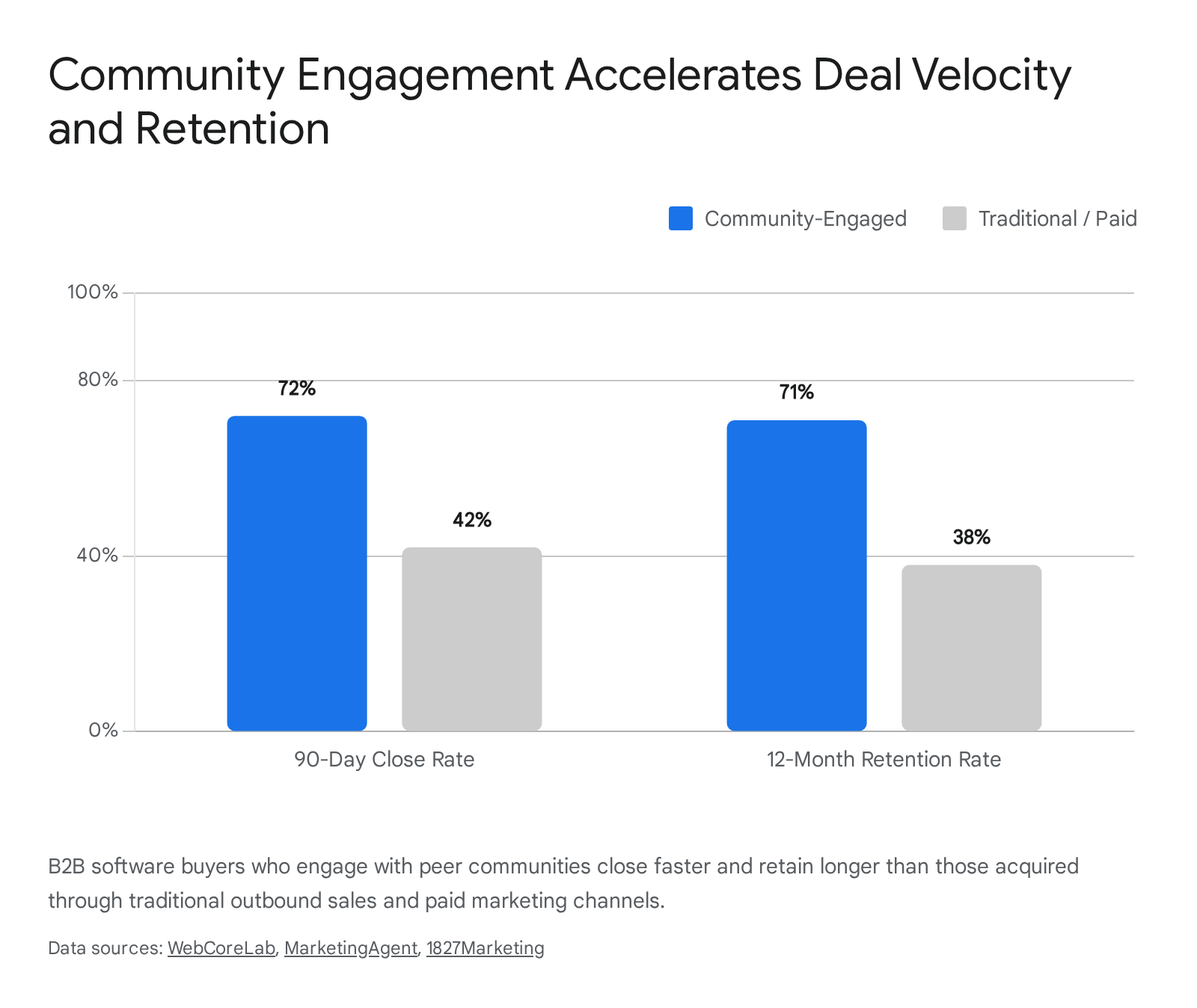
More striking data reveals that 72% of community-engaged enterprise deals close within 90 days, compared to only 42% of traditional sales and marketing-led deals 38. In certain specific case studies, deals involving community mentions closed in 72 days versus 120 days for purely sales-led cycles - a 40% reduction in sales cycle length 8. This velocity is achieved because the community has already front-loaded the consensus-building required among the diverse buying committee, transforming the sales representative's role from persuader to facilitator 8.
Customer Retention and Account Expansion
In the enterprise sector, net revenue retention (NRR) and customer lifetime value (CLV) are the primary indicators of financial health. Acquiring a new customer can cost 5 to 25 times more than retaining an existing one, making churn prevention a strategic imperative 1819. Increasing customer retention rates by just 5% can increase overall profitability by 25% to 95% 18192021.
Communities serve as a structural barrier to churn. Customers who actively participate in a vendor's community exhibit a 12-month retention rate of 71%, compared to only 38% for customers acquired through paid channels 1.
Other analyses suggest that community members exhibit 40% higher retention rates and a 2.8x higher lifetime value than non-community customers 8. This increased retention is driven by continuous education, peer-to-peer support, and a deeper emotional connection to the vendor's ecosystem 1121.
Furthermore, robust enterprise communities reduce operational costs. By crowdsourcing troubleshooting and best practices, peer-to-peer support can reduce a company's customer support ticket volume significantly, deflecting up to 20% to 40% of standard inquiries 7.
Organizational Structure and Enterprise Headcount
As community operations scale into the enterprise, headcount modeling must adapt. A single community manager is insufficient for organizations managing complex software implementations across diverse verticals. Successful enterprise community teams establish specialized roles: a community strategist develops the measurement framework, technical moderators handle platform integrations, and content creators produce educational resources 22.
This expanding team must integrate cross-functionally. Product management utilizes community feedback to inform roadmaps, customer success teams route struggling clients toward community resources, and marketing operations amplify user-generated case studies 22. Advanced organizations anchor their headcount strategy to business outcomes rather than seasonal hiring. For example, enterprise teams calculate optimal ratios of customer success managers or community moderators needed for every $4 million in net new ARR 23.
Artificial Intelligence in Churn Prediction and Retention
The integration of artificial intelligence has significantly enhanced the effectiveness of community-led growth, particularly regarding churn prediction and customer success within B2B SaaS. B2B SaaS operations experience average churn rates of approximately 12.5% 24. Protecting this recurring revenue demands proactive intervention.
Algorithmic Approaches to Customer Success
Historically, identifying churn risk relied on lagging indicators, such as negative Net Promoter Score (NPS) surveys, manual reviews of renewal dates, or anecdotal feedback 2025. By the time these signals emerge, a customer's decision to cancel is often already finalized. AI models flip this paradigm by utilizing predictive analytics to identify subtle behavioral shifts that precede cancellation 1825.
Modern AI customer intelligence platforms aggregate structured data - such as login frequency, feature usage drops, and billing anomalies - alongside unstructured data, including sentiment analysis from support tickets, community forum posts, and email transcripts 182025. The technological foundation of these predictions relies on several established machine learning algorithms tailored for B2B datasets: * Logistic Regression: Serves as a trusted, highly interpretable baseline for predicting the binary probability of churn 3426. * Decision Trees and Random Forests: Provide clear rules that explain precisely why an account is at risk, allowing community and success teams to take targeted action without needing to interpret "black box" models 193426. * Neural Networks and Gradient Boosting Machines (e.g., XGBoost): Excel at finding complex non-linear patterns within unstructured behavioral data, routinely achieving 85% to 92% accuracy in predicting churn when backed by strong feature engineering 2627. * Survival Models: Advanced algorithms that predict not just if a customer will churn, but when, enabling precise timing for retention interventions 26.
Operationalizing Predictive Insights
By establishing individual usage baselines, AI algorithms can flag a user as high-risk if their behavior deviates. For example, if a user who typically participates in community forums daily suddenly shifts to weekly engagement, the system flags the account, even if overall software usage metrics appear normal 20.
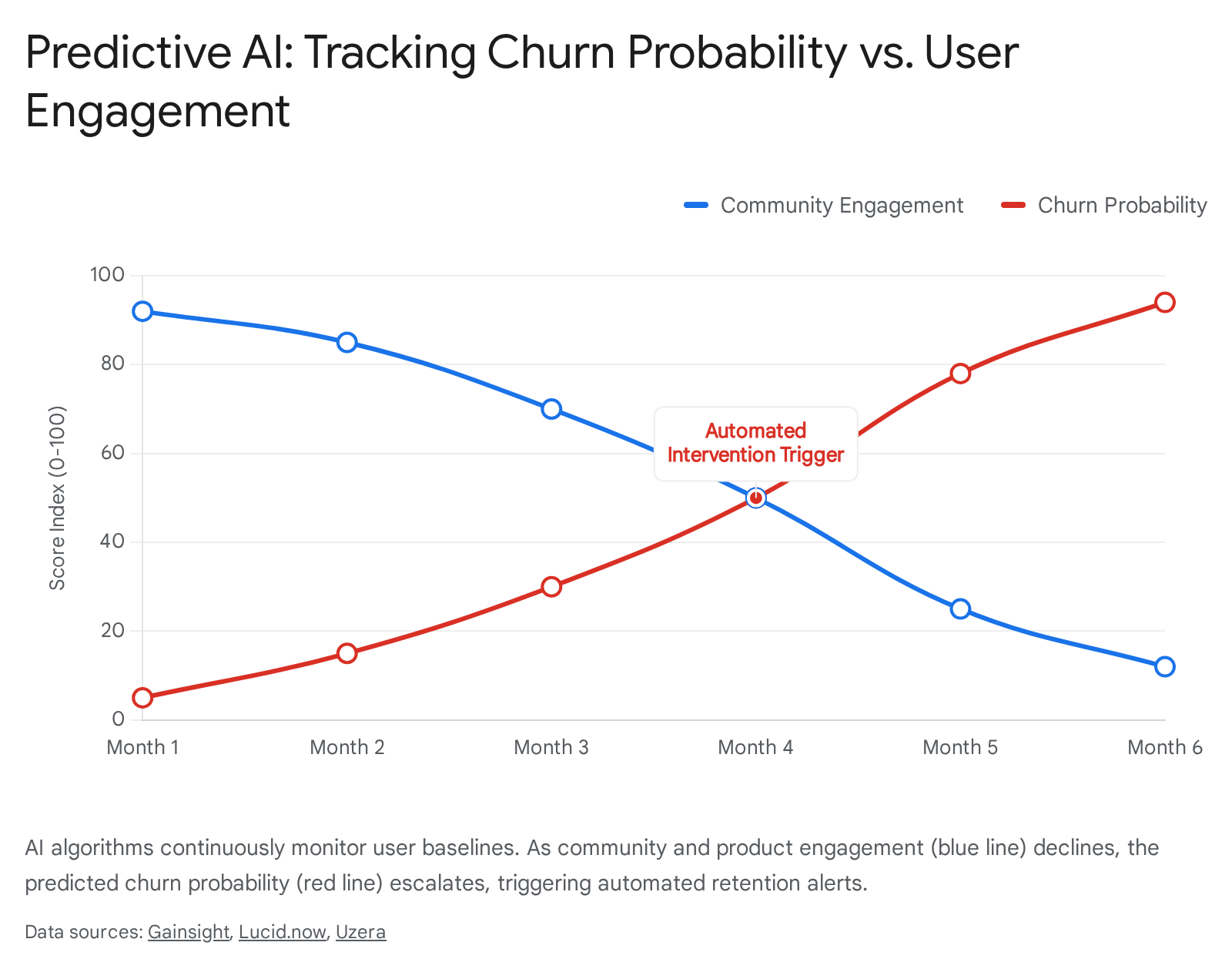
The business impact of implementing AI for churn prediction is substantial. Organizations leveraging AI for customer success report a 25% improvement in retention rates and can detect churn risks up to 60% earlier than manual methods 18. Once an AI system identifies a high-risk account, it triggers automated workflows. This allows community managers to initiate personalized outreach, route support tickets more effectively, or invite highly engaged users into advocacy and referral programs to bolster expansion revenue 252737. Automated retention workflows triggered by these prediction scores can directly reduce overall churn by 15% to 25% 27.
Regional Variations in Community Engagement
While community-led growth is a global strategy, its execution and effectiveness vary significantly by geographic region. Global B2B macroeconomic data indicates differing levels of optimism, digital maturity, and buyer behavior across North America, Europe, and the Asia-Pacific (APAC) regions.
North American and European Market Dynamics
North America currently leads in aggressive B2B marketing investments, particularly concerning customer acquisition and AI adoption. According to recent surveys of senior-level B2B marketing leaders, 74% of the B2B marketing budget in North America is directed toward new customer acquisition, outpacing Latin America (71%) and EMEA (71%) 38. Furthermore, 43% of B2B leaders in North America intend to use AI for competitive advantage, compared to 37% in the Asia-Pacific region and 32% in Europe 38.
In Europe, the B2B economic outlook is categorized as one of "cautious optimism," scoring an average outlook of 64%, which trails the 83% and 86% positivity rates seen in the Americas and APAC, respectively 28. While European innovation continues to grow steadily - led by countries like Denmark, Sweden, and Switzerland - strict data privacy regulations force B2B marketers to adapt 29. With 76% of marketers acknowledging that the deprecation of third-party cookies will complicate traditional advertising, European firms are accelerating investments in owned communities and first-party data capture as compliant alternatives for demand generation 1041.
Asia-Pacific Sourcing and Buying Behaviors
The Asia-Pacific region presents unique challenges and opportunities for community-led growth. Market research highlights a fundamental shift in buyer power within APAC: buyers in this region engage vendors significantly later in the purchasing journey, often waiting until they are 73% of the way through the decision-making process before making formal contact 41.
Because marketers have less opportunity to influence these buyers directly through traditional outbound sales, establishing strong, discoverable peer communities is crucial. APAC buyers rely heavily on independent research and peer networks to shape their perceptions during this extended evaluation phase 41. Notably, despite broader global economic uncertainties, APAC planners demonstrate a strong preference for localized and intra-regional engagement. In 2024, APAC event planners organized 56.2% of their business within Asia, seeking ease of convenience and budgetary control amidst geopolitical fluctuations 42.
| Region | Regional Characteristics and B2B Strategies | Innovation and Technology Adoption |
|---|---|---|
| North America | High focus on new customer acquisition (74% of budget). High expected engagement rates across B2B channels 38. | Leads in AI adoption for competitive advantage (43% of leaders planning usage) 38. |
| Europe (EMEA) | Cautious economic optimism (64%). Heavily affected by third-party cookie deprecation, driving owned-community investments 2841. | Steady innovation growth led by Nordic countries. Moderate AI adoption (32%) 3829. |
| Asia-Pacific (APAC) | Buyers engage late in the cycle (73% complete). High intra-regional sourcing (56.2%) for events and partnerships 4142. | Fast-growing infrastructure. 37% AI adoption rate. High optimism (86%) 3828. |
The Resurgence of In-Person Community Events
Despite the rapid digitization of B2B software sales and the rise of digital community platforms, physical community building remains highly effective and deeply necessary. In an era marked by digital fatigue and algorithmic volatility, B2B software buyers increasingly crave authentic, high-fidelity human interactions to establish trust 43.
Event Strategy and Budget Allocation
Recent event industry benchmarking reveals a strong reaffirmation of physical gatherings. A comprehensive survey of 1,500 B2B event organizers and attendees found that 78% of organizers consider in-person events the most impactful marketing channel for their organization 3031. Furthermore, 83% state that in-person B2B conferences, summits, and conventions are the single most effective way to build and grow a professional community 30.
This sentiment is matched by budget allocations. Overall, 53% of B2B event organizers expect their budgets to increase in 2025, with 39% of respondents operating with event budgets exceeding $1 million 3031. However, the nature of these events is shifting. While large-scale trade shows remain relevant, the fastest-growing event type is the small, owned-and-hosted in-person event. Approximately 58% of marketers plan to hold more of these localized, intimate gatherings, seeking to foster niche micro-communities rather than broad, low-conversion awareness 32.
Integrating Digital and Physical Ecosystems
In-person touchpoints are not replacing digital communities; rather, they serve as high-leverage acceleration mechanisms within the broader CLG ecosystem. Academic research from institutions like the University of Michigan confirms that face-to-face sessions result in more impactful problem-solving discussions and stronger collaborative bonds than virtual meetings 47. An overwhelming 95% of professionals acknowledge that meeting face-to-face is crucial for ensuring business relationships endure long-term 47.
For B2B software companies, integrating these channels is essential. A well-executed in-person event functions as an acquisition node, generating relationships that subsequently migrate into the digital community. These physical interactions foster a high degree of loyalty that fuels asynchronous digital discussions, user-generated content, and product advocacy throughout the remainder of the year 43.
Measurement and Performance Benchmarks
To move beyond theoretical strategy, B2B software executives rely on precise metrics to gauge community health and justify ongoing investments. The industry has formalized a set of key performance indicators (KPIs) that define a successful community-led growth motion in 2024 and 2025 148.
Health and Engagement Indicators
A community's health is measured by the sustained activity of its members. The primary metric utilized is Weekly Active Members (WAM). For a B2B SaaS company, a healthy community at the 12-month mark should maintain a WAM rate of 25% to 35% 1. Additionally, organizations track the Daily Active User to Monthly Active User (DAU/MAU) ratio, which should ideally sit at or above 20% to indicate that the community is providing consistent daily value to its core practitioners 48.
Content-to-application ratios are also monitored for communities that utilize gated access to maintain quality. A standard benchmark is generating approximately one community application for every 50 to 80 newsletter or content subscribers 1.
Revenue Attribution and Financial Outcomes
Ultimately, community engagement must translate to commercial outcomes. Top-performing B2B communities achieve an 8% to 15% member-to-pipeline conversion rate within the first 90 days of a practitioner joining the group 1.
Revenue attribution remains the most critical lagging indicator. In the first year post-launch, startups successfully executing a CLG playbook expect 30% to 55% of their new ARR to be directly attributable to community sources 1. For mature organizations tracking complex pipeline influence, data reveals that up to 61% of total open pipeline is community-engaged. Crucially, 21% of this open pipeline originates entirely within the community environment before ever being recorded as a lead in a formal CRM system, highlighting the community's role in capturing demand that traditional marketing software cannot immediately observe 17.
| Metric Category | Key Performance Indicator | 2024-2025 Target Benchmark |
|---|---|---|
| Community Health | Weekly Active Members (WAM) | 25% to 35% of total membership 1. |
| Community Health | DAU/MAU Ratio | ≥ 20% (indicates sustained daily relevance) 48. |
| Acquisition | Content-to-Application Ratio | 1 application per 50 to 80 subscribers 1. |
| Acquisition | Member-to-Pipeline Conversion | 8% to 15% within the first 90 days 1. |
| Revenue Impact | Year-One Community ARR | 30% to 55% of total new ARR 1. |
| Pipeline Influence | Community-Engaged Pipeline | Up to 61% of total open pipeline 17. |
Conclusion
Community-led growth represents a mature, highly efficient structural evolution in B2B software go-to-market strategy. Its effectiveness, however, is not uniform; it manifests differently depending on company stage, regional dynamics, and technological infrastructure.
For early-stage B2B startups, CLG functions as an aggressive, capital-efficient acquisition engine. By building an audience of practitioners before the software product is fully launched, startups can bypass the escalating costs of paid digital media, reduce their initial customer acquisition costs by nearly 40%, and generate substantial pipeline organically.
For enterprise software companies, the value of CLG pivots toward defense, sales acceleration, and account expansion. In complex enterprise sales environments involving expanding buying committees and cautious procurement cycles, community engagement accelerates deal velocity, frequently shortening sales cycles by up to 40%. Furthermore, by crowdsourcing technical knowledge and utilizing advanced AI-driven predictive analytics to monitor behavioral shifts, enterprises can drastically reduce support burdens, identify churn risks early, and boost net revenue retention rates well beyond the capabilities of traditional account management.
Ultimately, community-led growth is not a replacement for strong product-led mechanics or strategic sales-led execution. The most successful B2B software organizations in 2024 and 2025 operate on a hybrid model. The product provides the utility, the sales team navigates the corporate procurement complexity, but it is the community that builds the initial trust, drives the continuous education, and sustains the competitive moat in an increasingly saturated market.