
What Is Product-Led Growth and When Does It Work for SaaS
In the contemporary software-as-a-service (SaaS) landscape, growth is no longer exclusively constrained by the size of a sales team, the budget allocated to outbound marketing, or the persuasive power of account executives. Over the past decade, a profound paradigm shift has democratized software buying power, shifting the center of gravity away from top-down executive purchasing and toward bottom-up, end-user adoption 123. This shift has culminated in the widespread adoption of Product-Led Growth (PLG), a go-to-market (GTM) strategy that leverages the software product itself as the primary engine for customer acquisition, activation, conversion, and expansion 145.
However, as the SaaS industry has matured through the economic volatility of the mid-2020s and the explosive advent of generative artificial intelligence, the strict dogmas of PLG have been forced to evolve. The binary debate between Product-Led Growth and Sales-Led Growth (SLG) has given way to sophisticated, hybrid Product-Led Sales (PLS) models that acknowledge the indispensable role of human intervention in complex enterprise deals 78. Furthermore, the emergence of "Agentic PLG" - where AI agents rather than human users interact with software interfaces - is radically redefining fundamental metrics such as time-to-value, shifting the user's role from a creator to an editor 67.
This comprehensive research report explores the foundational mechanics of PLG, dispels prevailing misconceptions regarding the avoidance of sales teams, examines global case studies across diverse economic contexts, analyzes the impact of post-2023 macroeconomic shifts, and provides actionable frameworks for modern SaaS founders navigating the complex transition from user-led to agent-led growth.
What Is Product-Led Growth (PLG), and How Does It Contrast with Sales-Led Growth?
Coined in 2016 by Blake Bartlett of OpenView Venture Partners, Product-Led Growth represents a fundamental departure from traditional, human-mediated software sales 111. In a PLG organization, the product is deliberately designed to communicate its own value autonomously, acting as the primary vehicle for growth 1213. Users are empowered to discover, adopt, and derive measurable value from the software before ever encountering a paywall or interacting with a sales representative 414.
The core philosophy underlying PLG is the realization that business-to-business (B2B) users are essentially "consumers at work" 114. Conditioned by the seamless, frictionless experiences of consumer technology, modern professionals expect immediate utility, intuitive user interfaces, and highly transparent pricing. The strategy relies on minimizing friction to access, allowing prospective customers to explore the product at their own pace, thereby creating a self-sustaining cycle of organic growth 51516.
Everyday Hooks: The Mechanics of Zoom and Spotify
To understand the practical mechanics of PLG, one must analyze everyday digital staples like Zoom and Spotify, which have perfected the art of product-led acquisition and retention.
Zoom achieved unprecedented global scale - growing to hundreds of millions of daily meeting participants during the global pandemic - without relying on an impossibly large army of outbound sales representatives. If the company had operated on a traditional sales-led model during its rapid expansion, accommodating that volume would have required an estimated 131,000 salespeople 138. Instead, Zoom's viral loop is embedded directly into its core functionality: every time an existing user sends a meeting link to an external participant, the product markets itself organically to a new potential user 9. The famous 40-minute limit on free group calls serves as an elegant, usage-based monetization trigger. Users experience the platform's superior video quality, low-bandwidth resilience, and reliability for free, reaching their defining "Aha!" moment long before the call drops, making the frictionless upgrade to a paid tier a logical and highly compelling choice 5810.
Similarly, Spotify demonstrates the power of a consumer-centric PLG model translated into massive recurring revenue. The platform offers immediate, unlimited access to its core music streaming functionality via a freemium model supported by advertisements. By allowing users to meticulously curate personalized playlists, discover new artists through algorithmic recommendations, and deeply integrate the application into their daily routines, Spotify creates immense "ability debt" and habituation 20. The transition to a premium subscription is driven not by an aggressive sales pitch, but by the user's organic desire to remove friction (advertisements) and unlock enhanced features (offline listening) once the product's value has become an indispensable part of their daily life.
The Contrast: Product-Led vs. Sales-Led Growth
Sales-Led Growth (SLG) is the traditional enterprise software model where dedicated sales teams - typically composed of Sales Development Representatives (SDRs) and Account Executives (AEs) - prospect, qualify, and close deals through customized demonstrations, intensive negotiations, and rigorous procurement reviews 5711. SLG relies heavily on outbound marketing, human persuasion, relationship building, and proactive account management 512.
While PLG decentralizes software buying by empowering front-line employees and individual contributors (a bottom-up motion), SLG focuses on mitigating financial and operational risk for C-suite economic buyers and IT directors (a top-down motion) 1412.
A conceptual framework frequently used to determine strategy relies on plotting Average Contract Value (ACV) against product complexity. In such a strategic quadrant matrix, pure Product-Led Growth occupies the bottom-left zone, thriving in environments with low friction, low complexity, and lower contract values that drive high volume. Conversely, pure Sales-Led Growth occupies the top-right zone, remaining essential for highly complex, high-value enterprise deployments that require significant change management. The modern SaaS landscape, however, increasingly converges in a diagonal band stretching across the middle, representing hybrid Product-Led Sales models that leverage PLG to initially land users and SLG to expand those relationships into enterprise-wide contracts.
The table below outlines the fundamental differences between the two motions across key operational dimensions:
| Strategic Dimension | Product-Led Growth (PLG) | Sales-Led Growth (SLG) |
|---|---|---|
| Primary Growth Engine | The product itself acts as the main driver (Self-serve, Freemium, Free Trials) 45. | The sales and marketing team drives growth (Outbound outreach, Demos, Relationships) 511. |
| Customer Acquisition Cost (CAC) | Generally lower. Growth heavily relies on viral loops, SEO, and organic peer-to-peer sharing 51223. | Generally higher. Requires significant capital allocation for sales headcount and paid marketing channels 1223. |
| Sales Cycle Velocity | Accelerated. Users reach value instantly and convert on their own self-serve timeline 512. | Extended. Deals routinely require multiple stakeholder meetings, legal reviews, and extensive negotiations 1112. |
| Average Contract Value (ACV) | Typically lower. Often tailored for SMBs or individual departmental credit cards (commonly $<5K ARR) 1224. | High. Designed for enterprise-wide contracts, multi-year commitments, and customized implementations ($>50K ARR) 12. |
| User Journey Focus | Time-to-Value (TTV), Activation rates, In-app engagement signals, Product Qualified Leads (PQLs) 912. | Marketing Qualified Leads (MQLs), Sales Qualified Leads (SQLs), Pipeline velocity, Win rates 1125. |
| Implementation Complexity | Low. Out-of-the-box functionality requiring minimal to no configuration or human assistance 1213. | High. Requires bespoke integrations, rigorous security audits, and dedicated Customer Success teams 1223. |
| Pricing Strategy | Transparent, modular, and frequently tied to usage-based metrics or clearly defined feature tiers 414. | Often opaque, requiring a custom quote, and highly negotiable based on volume and relationship 1415. |
Does Adopting PLG Mean Firing the Sales Team, and What Is the "PLG Trap"?
A pervasive and damaging misconception in the startup ecosystem is that adopting a PLG strategy necessitates the outright elimination of the sales team. Founders often falsely assume that a superior product will entirely "sell itself" to Fortune 500 enterprises, allowing the company to indefinitely avoid the high personnel costs associated with human-led sales motions 829.
This assumption leads directly into what Harvard Business Review analysts term the "PLG Trap" 163132. Research from McKinsey & Company consistently demonstrates that pure-play PLG models rarely achieve outsize, sustainable enterprise valuations in isolation 33. While a pure PLG motion is highly efficient for acquiring individual users or small and medium-sized businesses (SMBs) at a low Customer Acquisition Cost, it inevitably hits a hard revenue ceiling when attempting to move upmarket into the enterprise sector 1116.
Enterprise deals involve complex organizational requirements that no self-serve onboarding flow or intuitive interface can navigate alone. These include customized security questionnaires, rigorous legal and compliance reviews, multi-stakeholder procurement processes, and complex integrations with legacy systems 111223. When PLG companies rigidly ignore these realities, they experience rapid initial "hockey stick" user growth followed by severe revenue stagnation. Companies caught in this trap often struggle to surpass the $5 billion valuation mark and find themselves 10% to 15% less profitable than their sales-led counterparts due to stalled expansion efforts and the inability to navigate procurement 16.
The Dominance of Product-Led Sales (PLS) and Hybrid Models
To avoid the PLG trap, the most successful SaaS companies in the modern era do not choose between PLG and SLG; they meticulously orchestrate both through a hybrid model known as Product-Led Sales (PLS) 3735.
In a PLS architecture, the product acts as the highly efficient top of the funnel. It handles the cost-intensive work of mass lead generation, initial product education, and preliminary value realization via self-serve mechanics 37. However, once a free user or a small departmental team exhibits high engagement - triggering a behavioral status known as a Product Qualified Lead (PQL) or Product Qualified Account (PQA) - the human sales team is deployed strategically to capture the value 11131.
Sales representatives in a PLS motion do not make cold calls pitching abstract software benefits to unaware executives; instead, they reach out to users who have already integrated the product into their daily workflows and experienced its value firsthand 1235. The sales team's role shifts fundamentally from persuasion to facilitation - helping the internal product champion navigate procurement, consolidating fragmented shadow IT into lucrative enterprise-wide licenses, and unlocking advanced security, administration, or compliance features required by the broader organization 1112.
According to 2024 SaaS Benchmarks by OpenView, the data overwhelmingly supports this approach: 67% of hybrid PLG+SLG companies successfully hit their net revenue retention (NRR) targets, compared to only 58% of pure-PLG companies 6. The data proves that human-led sales processes are far from obsolete; they have simply moved further down the funnel to drive strategic, high-value expansion 323.
The Canva Case Study: Escaping the PLG Trap
Canva, the global graphic design platform, provides a masterclass in evolving from pure PLG to enterprise sales without losing its foundational identity 41516. Canva initially dominated the market through aggressive PLG, building a massive base of 185 million monthly active users by offering immediate, frictionless value to individual creators and small teams 16.
However, to capture high-value enterprise contracts, Canva's leadership recognized that Chief Information Officers (CIOs) and IT directors had entirely different requirements than freelance designers. To conquer the enterprise space without diluting their core PLG roots, Canva treated their enterprise push almost like launching a separate company 16. They spent two years building a dedicated "pure Enterprise product" featuring Single Sign-On (SSO), data encryption, AI-driven security shields, and robust brand control governance necessary for large corporations 16.
Crucially, Canva implemented a two-pronged sales and marketing strategy. They maintained automated, product-led upgrades for individuals and small teams, while simultaneously hiring specialized enterprise sellers to target C-level executives 16. They utilized their massive free user base as a Trojan horse to identify internal enterprise champions, allowing sales representatives to approach IT leaders with powerful, data-backed messaging: highlighting that hundreds of employees were already utilizing Canva, and offering to help the enterprise secure, manage, and standardize that usage 1416. By establishing dedicated post-sales customer success teams to ensure maximum value realization early on, Canva successfully bridged the gap between bottom-up love and top-down ROI 1636.
When Does Product-Led Growth Actually Work for SaaS Companies?
While undeniably powerful, PLG is not a universal panacea suitable for every software product. Implementing a product-led motion - such as thoughtlessly slapping a free trial onto a complex legacy software platform - without fundamentally re-engineering the underlying user experience is the primary reason PLG transitions fail 1015.
Determining whether a product is suited for PLG requires a rigorous, objective assessment of the market dynamics, the buyer persona, and the product's fundamental architecture.
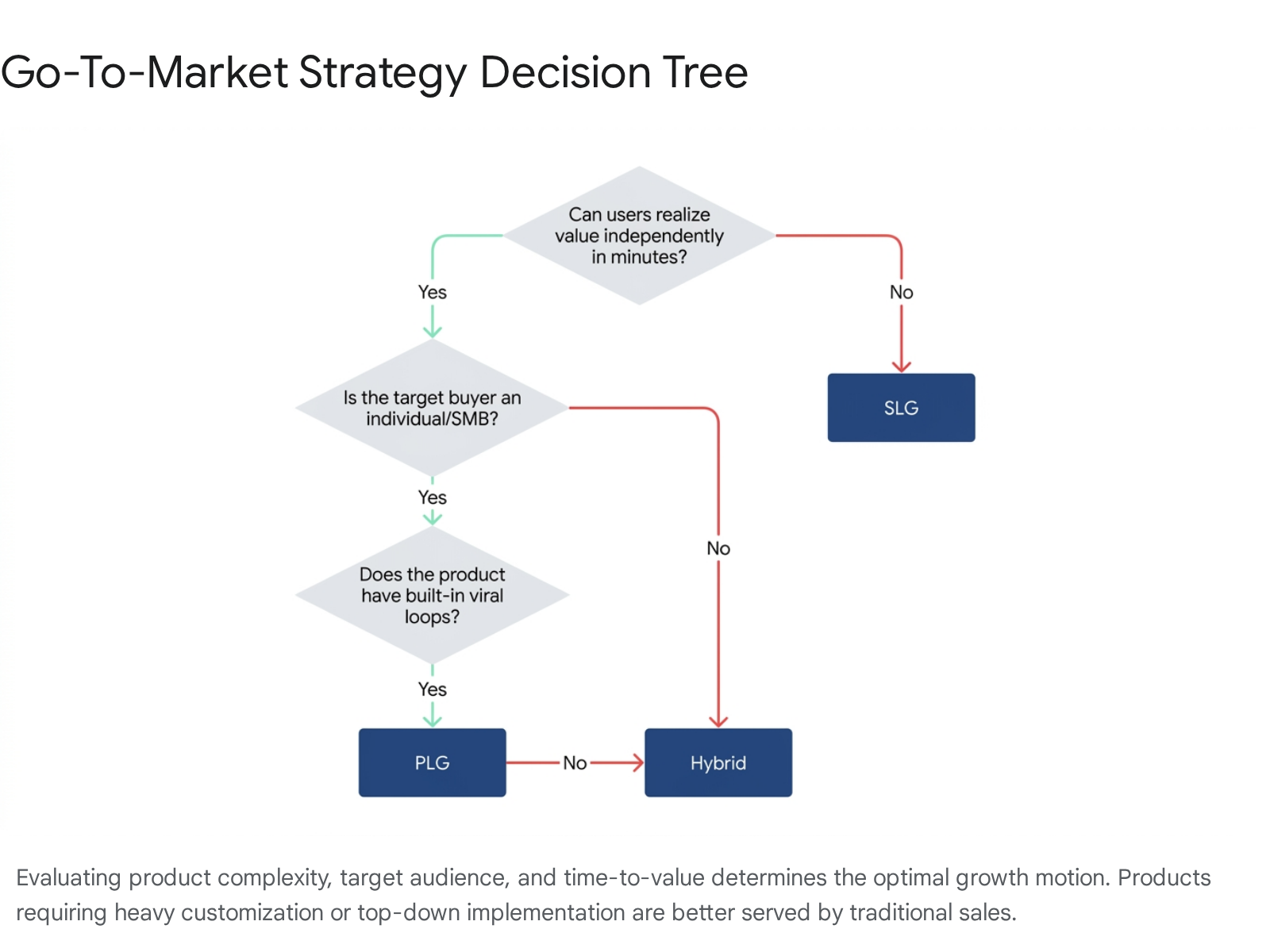
The RevenueML Diagnostic Framework
Consulting frameworks, such as the comprehensive diagnostic proposed by RevenueML, evaluate go-to-market readiness across multiple dimensions. In their scoring system, SaaS executives answer a series of strategic questions regarding product complexity, audience, and market conditions to yield a directive score:
- 18 or more "Yes" answers: The business represents a strong fit for a pure or PLG-dominant GTM motion. The product likely delivers rapid value and targets end-users directly 4.
- 10 to 17 "Yes" answers: The business is best suited for a Hybrid GTM (PLG + SLG). The company should utilize PLG to efficiently capture SMBs and individual end-users, while deploying SLG to handle complex enterprise expansion and procurement 4.
- 9 or fewer "Yes" answers: Sales-Led Growth remains the most effective and necessary motion. The product is likely too complex, highly customized, or targets risk-averse executives who require high-touch consultation 4.
Core Criteria for PLG Success
Regardless of the specific framework utilized, successful PLG adoption hinges on several non-negotiable criteria:
- Rapid Time-to-Value (TTV): The product must deliver a tangible "Aha!" moment almost immediately 51610. If setting up the software requires a multi-week implementation process, custom coding, API configuration, or extensive training, free trial users will inevitably churn before experiencing the core value 710. The engagement step is crucial; monetization attempts must follow value realization, never precede it 1014.
- Intuitive, Frictionless Onboarding: PLG products are explicitly designed for self-service 414. They rely on exceptional User Experience (UX), interactive in-app guidance, tooltips, and robust knowledge bases rather than dedicated account managers to educate the user 121137.
- Bottom-Up Appeal and Democratized Utility: The software must solve an immediate, painful problem for the individual contributor or small team 14. If the product's value is only realized when an entire enterprise adopts it simultaneously (e.g., an ERP system), SLG is absolutely required to orchestrate that complex, top-down change management.
- Built-in Viral Loops and Network Effects: The most efficient PLG products become inherently more valuable as more people use them, naturally driving customer acquisition without marketing spend 938. Communication tools (like Slack) or collaboration tools (like Figma and Miro) naturally force users to invite colleagues or external partners to collaborate, continuously lowering the Customer Acquisition Cost (CAC) and driving organic word-of-mouth growth 91138.
- Transparent, Usage-Aligned Pricing: PLG requires highly transparent pricing tiers that allow users to easily understand costs and upgrade via a credit card without needing to request a quote or speak to sales 414. Pricing is usually tied directly to a value metric - such as active users, data volume processed, or API calls - rather than arbitrary feature gates, enabling small teams to begin paying only as they derive tangible utility 4939.
Conversely, companies should categorically avoid PLG and default to SLG when their product is highly complex, requires deep legacy system integrations, operates in heavily regulated industries with strict compliance demands (like healthcare or finance, where security audits precede any software deployment), or demands significant, painful behavioral changes across an entire enterprise 111223.
How Have Global SaaS Companies Successfully Executed PLG Strategies?
While Silicon Valley effectively birthed the PLG movement, the strategy has since been weaponized globally by SaaS companies operating across diverse economic environments and industry verticals. By examining international implementations, the nuanced mechanics of product-led growth become explicitly clear.
Calendly (United States): Monetizing the Viral Loop
Calendly, valued at over $3 billion with less than 250 initial employees, represents the pinnacle of utilizing the core product as an acquisition channel 4159. The scheduling platform's genius lies in its inherent, frictionless virality. Every time a Calendly user shares a booking link with a prospect, client, or colleague, the recipient is exposed to the product's elegant value proposition 9. Crucially, the recipient does not need to register an account to book the meeting, resulting in an immediate realization of value (fast TTV) 9. Calendly's growth teams meticulously track metrics like "sharing velocity" and "meeting completion rates" rather than just static sign-ups, continuously optimizing the product to ensure that every active user acts as a highly effective, unpaid marketer 9.
Miro vs. Mural (Europe/Global): The Battle for the Digital Whiteboard
The fierce rivalry between digital whiteboard platforms Miro (founded by developers with roots in Russia, scaling globally via Amsterdam and the US) and Mural provides a stark, real-world contrast in GTM strategies 384041.
Miro embraced an aggressive, horizontal PLG strategy focused heavily on individual end-users and designers. They systematically removed all friction from the onboarding process, allowing users to invite unlimited team members on their free plan to experience the collaborative "magic" immediately 3817. To combat the blank-canvas anxiety that typically causes early-stage churn in design tools, Miro built a massive, community-driven library of over 2,500 templates (the "Miroverse"), effectively turning user-generated content into an acquisition and activation engine 4117. This relentless bottom-up approach resulted in explosive 472% year-over-year growth during the pandemic, capturing over 60 million users and penetrating 99% of the Fortune 100 384041.
In stark contrast, Mural optimized for a more structured, top-down enterprise approach, functioning as a specialized "scalpel" compared to Miro's broad "Swiss Army knife" 4143. Mural focused deeply on advanced facilitation tools for structured design thinking sessions, private modes, and voting mechanics 4143. Furthermore, Mural prioritized deep, joint-roadmap integrations with enterprise staples like Microsoft Teams 1341. While Mural successfully captures high-ACV enterprise clients who require expert guidance and customized deployment, Miro's flawless execution of PLG mechanics allowed it to achieve vastly superior global volume and omnipresent market awareness 1340.
RD Station (Brazil): Adapting PLG for Emerging Markets
RD Station, Latin America's leading CRM and marketing automation platform, highlights how PLG can scale massively in emerging markets where the economics of traditional enterprise sales are often prohibitive for serving SMBs 184519. Recognizing that global SaaS companies frequently ignore emerging market SMBs due to high acquisition costs and lower purchasing power, RD Station shifted toward PLG to serve this exact demographic, enabling triple-digit ARR growth 1819. By prioritizing a low-friction freemium model and heavily investing in seamless, native integrations (via partners like Albato) to ensure their platform functioned perfectly with local e-commerce infrastructure like Nuvemshop and VTEX, RD Station created an accessible ecosystem that allowed Brazilian SMBs to self-serve, generate leads, and grow predictably 4519.
Zoho vs. Freshworks (India): Walled Garden vs. Best-of-Breed PLG
The Indian SaaS ecosystem provides a fascinating dual case study in growth philosophies. Zoho, a bootstrapped giant generating over $1 billion in revenue, utilized a unique, highly patient growth model 24. Rejecting VC-fueled blitzscaling, Zoho built a massive, deeply integrated ecosystem of over 55 applications (Zoho One) encompassing CRM, finance, HR, and collaboration 2447. Their GTM relies on offering comprehensive, highly customizable solutions at SMB-friendly prices, effectively locking users into a "walled garden." While Zoho leverages free trials, its depth requires a more guided, SLG-adjacent approach for complex, multi-departmental rollouts 244720.
Freshworks, conversely, took a modern, venture-backed approach focused on rapid deployment, modern design, and exceptional UX 4721. Freshworks (via products like Freshsales and Freshdesk) targets the mid-market with an agile, PLG-friendly interface that requires minimal training and boasts a free tier to eliminate entry friction 4720. While Zoho excels for organizations seeking deep, end-to-end process customization from a single vendor, Freshworks wins by reducing complexity, offering an intuitive self-serve experience, and integrating seamlessly with a broad range of external, popular business applications 472050.
How Have Post-2023 Economic Shifts and the "Rule of 40" Reshaped PLG Metrics?
The macroeconomic climate of 2023 and 2024 fundamentally altered how venture capitalists and public markets evaluate and value SaaS companies. The preceding era of Zero Interest-Rate Policy (ZIRP) - which lavishly rewarded top-line growth at all costs, regardless of cash burn or operating margins - has definitively ended 225223.
The Ascendance of Efficiency Metrics and the Rule of 40
In the current restrictive capital landscape, growth must be inextricably linked to rigorous capital efficiency. Bessemer Venture Partners' 2024 State of the Cloud and Cloud 100 benchmark reports reveal a drastic market reset. While the top 100 private cloud companies rebounded to an impressive 70% average revenue growth rate in 2024, valuation multiples remained severely compressed at an average of 23x (down 31% from the 2021 peak of 34x) 5424. Investors now heavily scrutinize metrics like the "BVP Efficiency Ratio" (Net New ARR / Net Burn) and Annual Recurring Revenue (ARR) per Full-Time Employee (FTE), which targets roughly $180K per employee to prove sustainable leverage 562558.
The defining metric for SaaS survival and valuation has unequivocally become the Rule of 40. This financial principle states that a software company's annual revenue growth rate, when added to its free cash flow (or EBITDA) margin, should equal or exceed 40% 5859.
$$Growth Rate + Profit Margin \geq 40\%$$
Under this framework, a scaling startup growing at 60% with a -20% margin is considered healthy (scoring 40), just as a mature enterprise company growing at 15% with a 25% profit margin is highly valued 60.
PLG strategies have proven exceptionally resilient and attractive under the stringent Rule of 40 framework. Because PLG systematically decouples revenue growth from linear headcount expansion - relying on automated, self-serve infrastructure rather than hiring an expensive Account Executive for every new deal - these companies structurally maintain higher gross margins (often scaling toward 75%) and lower customer acquisition costs 7122356.
The Retention-First Era: NRR and CAC Payback
According to OpenView's 2024 SaaS Benchmarks report, the median growth rate for SaaS companies has stabilized at significantly lower tiers than the boom years. For instance, companies between $10M and $20M ARR saw median growth drop from 35% in 2023 to 30% in 2024, while companies over $50M ARR slowed to 15% 52. Furthermore, the median SaaS company now spends $2.00 to acquire $1.00 of new ARR, driving median CAC payback periods up to roughly 18 months - three months longer than in 2023 61.
Consequently, aggressive top-of-funnel customer acquisition is no longer sufficient; the industry has entered a definitive "retention-first" era 6061.
Net Revenue Retention (NRR) - a vital metric calculating retained revenue from existing customers, including upgrades and cross-sells, minus all churn and downgrades - is now the single strongest predictor of long-term SaaS success 13960. The 2024 benchmark for elite, top-quartile SaaS companies demands an NRR between 115% and 125%, a significant increase from previous years 39.
This stringent economic reality strongly favors the deployment of hybrid PLS models. While pure PLG is excellent for low-cost, initial acquisition, proprietary data indicates that at $50M+ ARR, approximately 50% to 60% of all new ARR generated comes from existing customers 61. A hybrid model, where sophisticated sales teams actively manage strategic expansion, negotiate enterprise-wide licenses, and drive cross-selling within successful product-led accounts, is absolutely necessary to push NRR above the critical 110% benchmark and achieve best-in-class valuations 75960.
What Is "Agentic PLG," and How Is AI Transforming Onboarding and Time-to-Value?
The most disruptive and rapid development in the SaaS go-to-market landscape since 2023 is the deep integration of generative AI, foundational Large Language Models (LLMs), and autonomous AI agents, leading to the emergence of what industry analysts term "Agentic PLG" or "PLG 2.0" 6723.
The Fundamental Shift from Builder to Editor
In the original era of Product-Led Growth (PLG 1.0), the burden of work remained entirely on the human user 67. The user had to willingly sign up, dedicate time to learn specific UI paradigms, navigate complex software architectures, and manually input data or design assets to reach a desired outcome. A Time-to-Value (TTV) of ten minutes was considered the gold standard of onboarding 67.
In the era of PLG 2.0, artificial intelligence assumes the heavy lifting. The user's role fundamentally shifts from being a builder from scratch to an editor of generated content 67. Users simply provide a natural language prompt, the AI agent autonomously generates the desired output (be it code, a presentation, or a functional web app), and the human refines and verifies the result 6.
This dynamic causes Time-to-Value to collapse dramatically from minutes to mere seconds 67.
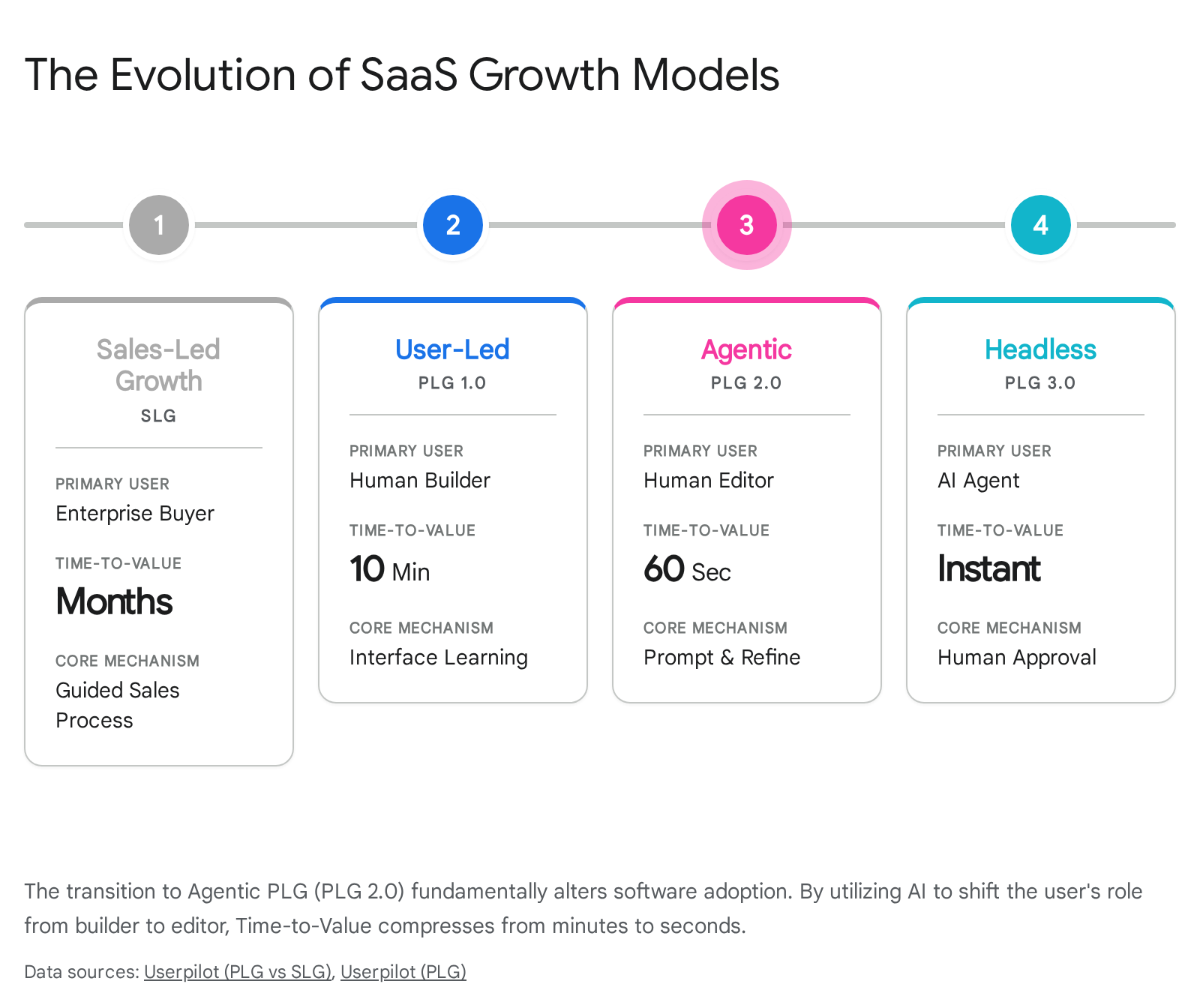
Consequently, the core activation metric is no longer measured by asking, "Did the user click through the five-step onboarding tutorial?" but rather, "Did the AI successfully generate the user's first desired output accurately?" 6.
Real-World PLG 2.0 Successes and the Horizon of PLG 3.0
The financial impact and growth velocity of Agentic PLG are staggering, routinely surpassing legacy SaaS benchmarks by orders of magnitude.
- Cursor, an AI-powered code editor, reached a remarkable $2 billion valuation in just three years by seamlessly embedding AI to write code autonomously, increasing developer productivity by over 30% and redefining the coding experience 662.
- Lovable reached $200 million ARR in a mere 12 months with only 100 employees, allowing users to generate fully functional software applications in seconds via prompts 6.
- Other tools like Gamma (AI presentation generation) and Perplexity (AI search) have exploded in popularity precisely because they remove not just user friction, but the actual laborious work itself 663.
Looking forward to the imminent phase of PLG 3.0, the industry anticipates "Headless PLG," where traditional human user interfaces become secondary or obsolete. In this era, AI agents themselves become the primary software operators and even buyers 67. Companies like Netlify are already experiencing the leading edge of this shift, noting that an astonishing 80% of their new signups are AI agents accessing their services via APIs, rather than humans navigating a website 67. In this approaching reality, a company's competitive moat is no longer a beautiful UI, but rather machine-readable documentation, highly structured API access, and the proprietary data context the product provides to the autonomous AI 7.
What Are the Practical Takeaways for Founders Implementing a PLG Strategy?
Transitioning to, or scaling, a Product-Led Growth strategy is not merely a marketing tactic or the simple addition of a free trial button; it is a profound organizational transformation. It requires absolute, cross-functional alignment across product development, engineering, sales, and customer success teams 51020. For SaaS founders looking to navigate the modern, efficiency-driven landscape, several core tenets must be rigorously adopted:
1. Relentlessly Optimize Time-to-Value (TTV) and Eliminate "Ability Debt" Free trials and freemium models fail universally when users are unable to achieve an early, meaningful win 1029. Founders must precisely identify the product's "Aha!" moment and systematically eliminate every point of friction - unnecessary form fields, mandatory credit card entries, bloated feature menus, or complex tutorials - that delays it 141610. In the emerging era of Agentic PLG, founders must ask themselves a critical question: Can a new user reach profound value in under 60 seconds? If the answer is no, the product risks being rapidly outpaced by AI-native competitors that execute the heavy lifting on behalf of the user 67.
2. Establish Robust Product Analytics to Identify PQLs A PLG motion operates entirely blind without deep, real-time telemetry. Companies cannot rely on superficial vanity metrics like total website sign-ups; they must track granular product engagement and user behavior 9. Founders must definitively establish what constitutes a Product Qualified Lead (PQL) - such as a user inviting three teammates, completing a core workflow five times in a week, or hitting a specific data threshold - and integrate these behavioral signals directly into the CRM 11159. This discipline ensures that the sales team only expends expensive human capital on accounts that are statistically primed for conversion and enterprise expansion 1159.
3. Implement Usage-Based or Modular Pricing Frameworks PLG demands a pricing architecture that aligns directly with customer success and perceived value. Value metrics - charging based on API calls, active monthly users, computational hours, or data processed - ensure that the customer only pays more as they derive tangibly more value from the platform 4939. As the industry shifts toward PLG 3.0 and AI agents begin evaluating and purchasing software autonomously, pricing pages must be inherently transparent, self-serve, and entirely machine-readable, devoid of opaque "contact us for a quote" barriers 67.
4. Embrace the Hybrid PLS Architecture Early Founders should swiftly abandon the ideological purity of the "PLG vs. SLG" debate. The financial data unequivocally proves that orchestrating a hybrid model - combining low-cost, self-serve acquisition at the bottom of the funnel with targeted, consultative sales-assist at the top - drives superior Net Revenue Retention and capital efficiency 76. Culturally, this requires re-training traditional enterprise sales representatives to abandon high-pressure outbound closing tactics. Instead, they must operate as strategic consultants who utilize product data to facilitate frictionless upgrades and navigate procurement for existing, highly engaged power users 1135.