
Psychology and neuroscience of charitable giving
The phenomenon of charitable giving presents a persistent anomaly within classical evolutionary frameworks, which traditionally posit that organisms act primarily to maximize their own survival and reproductive success. Despite this biological imperative, human beings consistently allocate substantial personal resources - including capital, time, and labor - to unrelated individuals, distant populations, and abstract causes. Research spanning the disciplines of behavioral economics, psychology, evolutionary biology, and neuroscience indicates that altruism is not a monolithic behavioral trait. Rather, it is a complex, multi-dimensional behavior driven by an intersecting matrix of affective states, social cognition, cultural frameworks, and neurobiological reward mechanisms.
Neurobiological Systems of Prosocial Behavior
Recent advances in functional magnetic resonance imaging (fMRI) have elucidated the neural architecture that supports philanthropic behavior. The decision to sacrifice personal resources for the benefit of another is largely mediated by three interacting neural systems: reward processing, social cognition, and cognitive control 1.
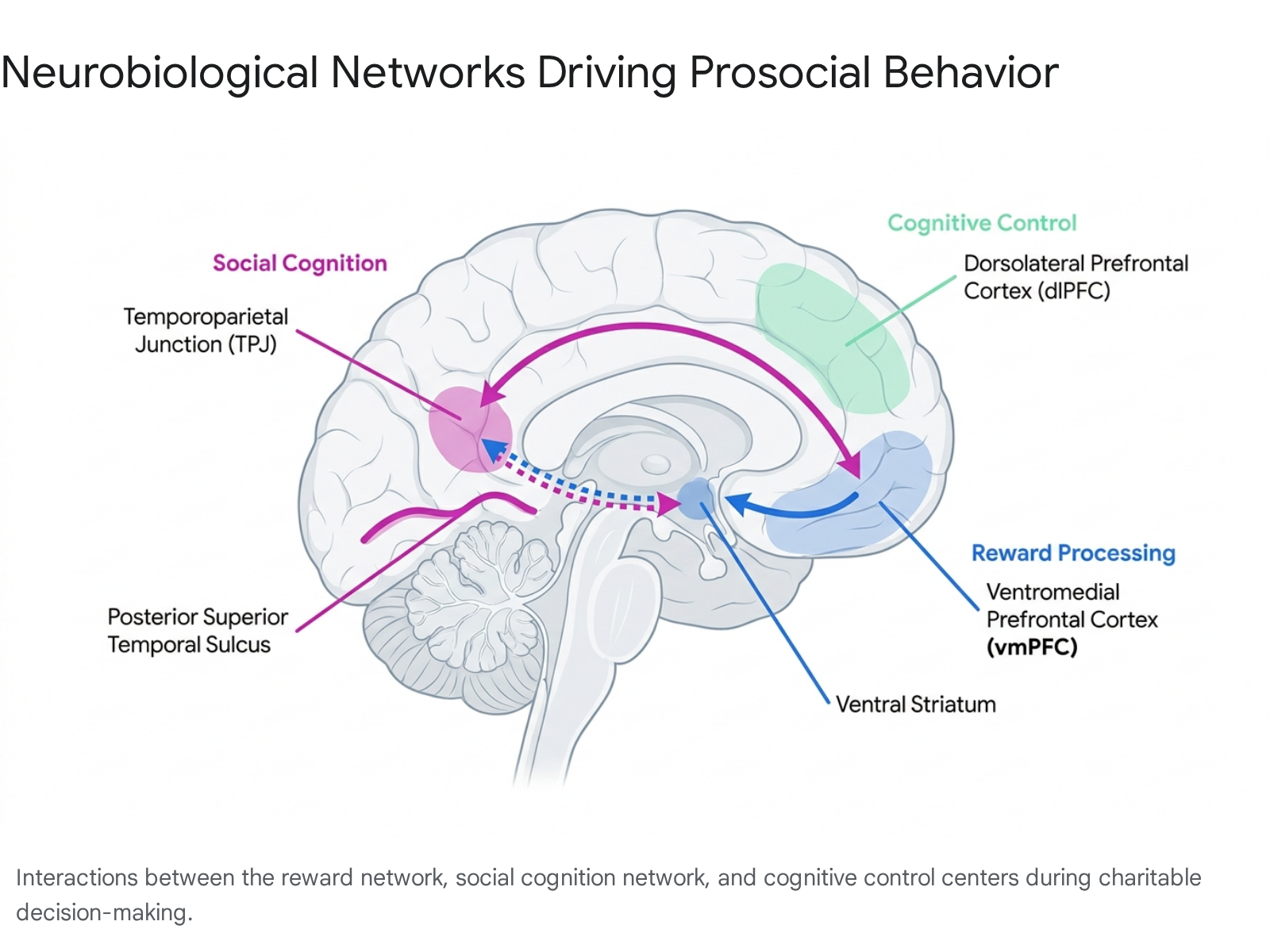
Together, these systems form what is often referred to as the "social brain," a network of cortical and subcortical structures adapted to navigate the complex interpersonal dynamics required for communal survival 2.
Reward Processing and the Valuation of Giving
The intrinsic satisfaction derived from giving, often referred to in behavioral economics as the "warm glow" effect, corresponds directly with the activation of the mesolimbic reward network 1. When individuals engage in charitable acts, neuroimaging reveals heightened activity in the nucleus accumbens (NAcc) and the ventral tegmental area (VTA) 13. These specific regions are responsible for the release of dopamine, a critical neurotransmitter heavily implicated in positive reinforcement, motivation, and the experience of pleasure 14.
Experimental evidence demonstrates that the magnitude of activation in the NAcc actively predicts subsequent donation decisions, serving as a functional neuro-affective bridge between the evaluation of a charitable stimulus and the execution of a giving behavior 3. Furthermore, studies indicate that affective congruence - when the emotional features of a charitable appeal align coherently - significantly heightens NAcc activity, independent of whether the appeal relies on positive storytelling or negative distress signaling 3. The hormonal milieu of the brain also plays a critical regulatory role; charitable actions stimulate the release of oxytocin, which facilitates social bonding, empathy, and trust, alongside serotonin, which contributes to overall mood regulation and a persistent sense of emotional uplift 4.
Empathic Mentalizing and Social Cognition
To initiate an altruistic action, an individual must first possess the cognitive architecture required to recognize and simulate another's need. This requires advanced social cognition, specifically the capacity for empathy (sharing another's affective state) and theory of mind (inferring the mental states of others) 2. Key structural components in this network include the temporoparietal junction (TPJ) and the posterior superior temporal sulcus (pSTS) 15.
A seminal 2017 study by Kahnt and colleagues demonstrated a direct neural mechanism linking generosity to subsequent subjective happiness. In their experimental paradigm, 50 participants were informed they would receive a sum of Swiss francs over four weeks and were randomly assigned to either spend the money on themselves or pledge to spend it on others. During a subsequent, unrelated decision-making task conducted under fMRI, participants who had pledged generosity exhibited significantly increased activity in the TPJ 5. Crucially, the researchers observed enhanced functional connectivity between the TPJ and the ventral striatum in the generous cohort. This increased connectivity suggests a distinct biological mechanism by which the cognitive act of understanding another's state (via the TPJ) is directly translated into a personal sense of reward (via the striatum) 5.
Additional cortical and subcortical regions, such as the anterior insula (aINS) and the subgenual anterior cingulate cortex (sgACC), are tasked with processing the emotional distress of others 16. This network essentially allows the potential donor to experience a simulated, vicarious version of the beneficiary's pain or disadvantage, thereby providing the emotional momentum required to initiate relief efforts 16.
Neural Divergence in Modalities of Giving
While giving is universally prosocial, the brain processes different types of sacrifices through varying neural pathways. Neuroscientific investigations have recently begun to differentiate the neural representations of specific giving modalities, most notably the distinction between donating one's time versus donating financial resources. A 2023 fMRI study by Kwon et al. investigated whether these distinct modalities rely on identical or divergent neurobiological mechanisms 7.
In the study, 40 participants were tasked with contributing their time or their money to various local charities. At the neural level, both forms of giving activated regions associated with cognitive control (such as the dorsolateral prefrontal cortex, which balances self-interest against prosocial goals) and affective processing (such as the dorsal anterior cingulate cortex) 17. However, significant neurobiological divergence emerged in how the brain assigned value to the resource being sacrificed 7.
Donating time recruited regions associated with reward valuation (the ventral striatum and ventromedial prefrontal cortex) and mentalizing (the temporal pole) to a significantly greater extent than donating money 7. This neural signature suggests that contributing time is processed by the brain as an inherently interpersonal, highly rewarding social exchange. Conversely, the precuneus - a region associated with perspective-taking and self-referential processing - was more strongly activated when tracking the magnitude of money donated 7. Researchers hypothesize that the precuneus is required to help contextualize financial giving, which is fundamentally an abstract, non-social exchange, translating it into a socially meaningful action that the brain can comprehend as altruistic 7.
| Functional Network | Primary Brain Regions | Functional Role in Charitable Giving |
|---|---|---|
| Reward Processing | Nucleus Accumbens (NAcc), Ventral Tegmental Area (VTA), Ventromedial Prefrontal Cortex (vmPFC) | Evaluates the psychological payoff of an action; releases dopamine to generate the "warm glow" effect; highly active when donating time. |
| Social Cognition | Temporoparietal Junction (TPJ), Posterior Superior Temporal Sulcus (pSTS), Anterior Insula (aINS) | Facilitates empathy, perspective-taking, and theory of mind; assesses the beneficiary's emotional state and material need. |
| Cognitive Control | Dorsolateral Prefrontal Cortex (dlPFC), Dorsal Anterior Cingulate Cortex (dACC) | Regulates goal pursuit; resolves internal conflicts between egoistic self-interest and prosocial behavior; manages cost-benefit calculations. |
| Self-Referential Processing | Precuneus | Contextualizes non-social, abstract exchanges (such as monetary donations) into socially meaningful frameworks. |
Psychological Drivers of Altruism and Egoism
The neurobiological capacity for altruism is mobilized by a complex array of psychological drivers. While traditional behavioral models often sought to divide human motivations into strict binary categories of pure altruism (exclusive concern for the welfare of the recipient) and egoism (exclusive concern for self-benefit or self-enhancement), modern psychological consensus overwhelmingly suggests that human giving is characterized by a blend of mixed motivations 8910.
The Empathy-Altruism Hypothesis and Mixed Motivations
The empathy-altruism hypothesis, most notably advanced by psychologist C. Daniel Batson, posits that empathic concern for an individual in need produces a genuinely altruistic motivation to reduce their suffering, operating entirely independently of the donor's desire for personal gain 11. Under this theoretical framework, the ultimate goal of the action is the amelioration of another's distress. However, extensive field research and meta-analyses reveal that this pure motivation is rarely isolated; it frequently coexists with egoistic drivers, such as the desire to gain social approval, enhance one's reputation, adhere to personal moral standards, or alleviate the personal distress caused by witnessing suffering 81213.
The complexity of these mixed motivations has been observed in high-stakes environments, such as human challenge trials (HCTs) for infectious diseases. In studies surveying volunteers willing to participate in COVID-19 or malaria HCTs - where participants face significant personal health risks for societal benefit - researchers found that individuals consistently reported a blend of motivations. While the desire to help others and contribute to scientific advancement was prevalent, these altruistic aims were frequently intertwined with non-altruistic motivations, including financial compensation 914.
Interestingly, research indicates that engaging in volunteerism or philanthropy in an attempt to satisfy multiple, divergent motivations simultaneously can occasionally result in adverse psychological outcomes. A longitudinal field study by Kiviniemi, Snyder, and Omoto (2002) found that volunteers operating under multiple distinct motivational goals reported higher levels of stress, greater perceived personal costs, and lower overall satisfaction with their volunteer experience compared to those driven by a single, primary motive 10. This psychological friction suggests that managing competing cognitive frameworks (e.g., attempting to satisfy a desire for public recognition while simultaneously striving to fulfill an internal standard of selfless empathy) requires executive resources that can ultimately detract from the inherently rewarding nature of the prosocial act 10.
Guilt Aversion and Negative Affective States
While empathy and the anticipation of a positive "warm glow" are frequently highlighted as the primary affective catalysts for giving, negative emotional states - specifically guilt and shame - are equally powerful, if not stronger, predictors of charitable behavior 1315. Guilt operates through two primary regulatory pathways in the context of charity: proactive relief (donating in order to alleviate an existing state of guilt) and anticipated guilt (donating proactively to avoid feeling guilty in the future) 1516.
Recent experimental economics research by Ridinger and McBride (2025) demonstrates that an individual's proneness to guilt and shame positively correlates with increased giving in dictator games. However, they found that this behavior is heavily mediated by an individual's beliefs about prevailing social norms and the giving behavior of their peers 1317. According to the reference-point model of guilt, individuals are highly sensitive to the normative benchmarks set by their community. When an individual believes that others in their cohort are donating at a high level, the expectation of matching that contribution becomes a reference point. Falling below this established benchmark triggers "reference-point guilt," prompting the individual to increase their own contribution primarily to avoid this deeply uncomfortable affective state, rather than out of pure concern for the charity's beneficiaries 1317.
Persuasion Knowledge and Guilt Appeals
Recognizing the motivating power of negative affect, non-profit organizations and fundraising campaigns frequently leverage "guilt appeals." These campaigns intentionally highlight the stark disparities between the comfortable, affluent potential donor and the suffering recipient, often utilizing vivid storytelling and explicit imagery of need 18.
However, the efficacy of guilt-inducing solicitation is highly moderated by demographic factors, cultural beliefs, and the target's "persuasion knowledge" - their awareness that they are being subjected to a marketing tactic. An experimental study by Rijn et al. tested the effectiveness of traditional guilt appeals against positive, similarity-based appeals. The results revealed dramatic gender differences: while the guilt appeal successfully increased donations among women (more than doubling their average contribution), it actively depressed donations among men 18. This divergence is largely attributed to "manipulation aversion." When individuals perceive a guilt appeal as a deliberate, heavy-handed tactic to coerce financial compliance, it often triggers psychological reactance, leading to a defensive refusal to give 1819.
Cultural and spiritual frameworks also intersect closely with guilt appeals. Research shows that donors who possess a high chronic belief in karma are significantly more responsive to guilt-based appeals, but only when the charitable organization is stereotyped as highly competent rather than merely "warm" 20. For these individuals, the donation serves as a "remedy demerit" - a strategic psychological transaction aimed at offsetting past misdeeds and avoiding future karmic punishment. A competent organization is preferred because it guarantees that the "remedy" will be efficacious 20.
Reluctant Altruism and Willful Ignorance
The power of guilt and social expectation as drivers of giving is most clearly evidenced by the phenomenon of "reluctant altruism" and the strategic avoidance of charitable requests. In many instances, individuals do not give out of an inherent desire to improve global welfare, but because they feel trapped by social scrutiny or internalized moral obligations 21.
In a seminal field experiment by Andreoni, Rao, and Trachtman (2015), researchers stationed Salvation Army bell ringers at the entrances of a supermarket. When the solicitors actively asked passing shoppers to "please give," total donations increased dramatically compared to a non-verbal control condition. However, the presence of the vocal solicitor also caused a massive 26% to 32% increase in active avoidance behavior, with shoppers intentionally utilizing alternative, less convenient doors to bypass the request entirely 22. This avoidance behavior indicates that individuals possess a sophisticated awareness of the empathy-altruism link; they recognize that being directly asked will trigger an unavoidable cost - either a psychological cost (the guilt of saying no) or a financial cost (making a donation). Consequently, they strategically avoid the stimulus altogether to protect both their self-image and their financial resources 22.
This dynamic is formally studied through the "willful ignorance" paradigm developed by Dana and colleagues. When individuals in experimental settings are given the choice to learn how their financial decisions will impact an anonymous recipient, a significant portion actively choose to remain ignorant 21. By deliberately avoiding the information, they maintain a plausible psychological excuse to act selfishly, bypassing the internal guilt or damage to their self-concept that would inevitably occur if they knowingly harmed or ignored another person 21.
Evolutionary Explanations for Prosocial Action
From a strict Darwinian perspective, the allocation of resources to non-kin presents a puzzle. Evolutionary biology generally explains prosocial behavior through mechanisms such as kin selection (helping genetic relatives to ensure the propagation of shared genes) and reciprocal altruism (helping others with the explicit expectation of future returns, summarized as "I scratch your back, you scratch mine") 823. However, modern human philanthropy routinely extends to distant, unrelated strangers where direct reciprocity is impossible and genetic linkage is virtually non-existent.
This behavior is largely attributed to the evolution of the human "social brain," which adapted to foster intense cooperation within early, close-knit hunter-gatherer cohorts to ensure collective survival against environmental threats 2. This specific evolutionary history has resulted in a deep-seated tendency toward "parochial altruism" - a strong, innate bias to prioritize the welfare of the in-group over the out-group, often combined with out-group hostility 232425. While modern globalization, mass media, and telecommunications expose humans to suffering worldwide, our fundamental psychological mechanisms remain calibrated to respond most strongly to local, identifiable suffering within our perceived community 2325.
The Social-Rewards Account of Ineffective Giving
One of the most persistent paradoxes in modern philanthropy is the phenomenon of "ineffective altruism." Despite professed desires to help others, donors routinely fail to maximize the actual welfare impact of their monetary and temporal donations. They frequently prefer to support charities with high administrative overhead, redundant missions, or objectively low impact, simply because the specific cause feels emotionally resonant or visually salient 2526.
Burum, Nowak, and Hoffman (2020) offer a compelling evolutionary game theory explanation for this systemic inefficiency, termed the "social-rewards account" of ineffective altruism 252728. They argue that human altruism did not evolve primarily to maximize the objective welfare of the recipient. Rather, it evolved as a mechanism for the donor to signal their prosocial intent and cooperative disposition to their community, thereby garnering vital reputational benefits, social status, and future cooperative partners 252628.
For any behavior to be consistently rewarded in an evolutionary or social setting, it must meet three specific criteria: it must be well-defined, it must be easily observable, and it must be capable of generating "common knowledge" among third-party observers (meaning everyone agrees on what happened) 28. The physical act of giving - sacrificing time or money - perfectly meets these criteria. Observers can easily witness the financial or temporal cost the donor incurs and collectively agree to bestow praise 2528.
Conversely, the efficacy of a donation is virtually invisible. Determining whether a charitable intervention is highly effective requires complex data analysis, long-term tracking, and an understanding of counterfactuals (e.g., how many lives were saved per dollar compared to alternative interventions). Ordinary observers rarely have access to this information, and even if they do, they cannot be confident that their peers share this assessment 2528.
Because human evolutionary environments rarely rewarded individuals for the unobservable efficacy of their actions, humans evolved - either genetically or culturally - to be highly sensitive to the cost of an altruistic act but relatively blind to its impact 252728. In fact, emotional, empathy-driven giving acts as a reliable, highly visible signal of a genuinely cooperative disposition. In contrast, donors who engage in cold, rational, calculated giving to maximize impact are often viewed by observers with suspicion, as calculation is sometimes equated with a lack of genuine moral emotion, further disincentivizing highly effective philanthropy 25.
Philosophical Frameworks and the Effective Altruism Movement
The stark tension between emotionally driven, parochial giving and the objective desire to maximize human welfare has birthed distinct philosophical and socio-political frameworks regarding how global resources should be optimally allocated.
Utilitarian Foundations and Evolution of Effective Altruism
Effective Altruism (EA) emerged in the 21st century as both a rigorous philosophical framework and a mobilized social movement aimed at explicitly correcting the evolutionary and psychological biases of traditional giving. Pioneered by philosophers Peter Singer and William MacAskill, the EA movement attempts to apply stringent evidence, scientific reasoning, and economic cost-benefit analysis to determine how individuals can do the "most good" with their limited resources 2930.
The intellectual foundation of Effective Altruism is heavily indebted to utilitarianism and consequentialist ethics 313232. In his highly influential 1972 essay, "Famine, Affluence, and Morality," Peter Singer introduced the "drowning child" thought experiment, arguing that physical or geographic distance from suffering does not diminish an individual's moral obligation to alleviate it 29323435. Singer argued that if a person would not hesitate to ruin an expensive suit to save a drowning child in a nearby shallow pond, that same person is equally, morally obligated to donate the financial equivalent of that suit to save a child dying of preventable diseases across the globe 3435. Under this framework, charitable giving is shifted from an optional, supererogatory act of generosity to a strict moral imperative 34.
To operationalize these principles, MacAskill and philosopher Toby Ord founded organizations such as Giving What We Can and 80,000 Hours, which urge individuals to pledge at least 10% of their lifetime income to highly vetted, cost-effective meta-charities (such as those evaluated by GiveWell) that focus on measurable outcomes, like distributing anti-malarial bednets or providing direct cash transfers to the extreme poor 293533.
Longtermism and Resource Allocation Debates
While Singer's original focus remained heavily anchored in alleviating immediate global poverty and animal suffering, the Effective Altruism movement, under the increasing influence of MacAskill, expanded into a highly controversial sub-philosophy known as "longtermism" 29303534.
Outlined in MacAskill's book What We Owe the Future, longtermism posits that positively influencing the long-term trajectory of humanity is the paramount moral priority of our time 293035. The mathematical logic is straightforward: if humanity survives its current technological adolescence, the number of potential future humans who will exist over millions of years vastly outnumbers the eight billion people currently alive 35. Therefore, longtermist effective altruists argue that philanthropic resources should be heavily diverted toward mitigating existential risks (x-risks) - such as the misalignment of artificial general intelligence, engineered biological pandemics, and nuclear winter - rather than strictly focusing on immediate, proximate poverty alleviation 303534.
| Core Principle | Peter Singer's Foundational Utilitarianism | William MacAskill's Longtermist Effective Altruism |
|---|---|---|
| Primary Moral Focus | Alleviating immediate, acute suffering (global poverty, animal welfare) 323435. | Safeguarding the existence and quality of life of trillions of future humans 3035. |
| Key Thought Experiment | The Drowning Child (proximity does not negate moral duty) 34. | Existential Risk Assessment (evaluating threats that could cause human extinction) 3034. |
| Actionable Philanthropy | Direct interventions: anti-malarial nets, deworming, direct cash transfers, veganism advocacy 35. | Funding AI safety research, pandemic preparedness, and institutional biosecurity 3835. |
| Philosophical Posture | Focus on maximizing current welfare and minimizing current pain across sentient beings 2932. | Focus on ensuring the survival of the species to allow for future welfare generation 30. |
Critiques and Alternative Philanthropic Models
While Effective Altruism offers a mathematically rigorous and seemingly objective approach to maximizing welfare, it has faced severe and sustained criticism regarding its socio-political implications, its systemic blind spots, and its potential to perpetuate the very inequalities it seeks to solve 3436.
Global South Perspectives and Grassroots Philanthropy
Some of the most forceful critiques of the Effective Altruism movement originate from voices within the Global South, who argue that EA's insistence on quantifiable metrics systematically excludes the extreme poor from the philanthropic decision-making process.
Anthony Kalulu, a grassroots organizer based in Uganda's highly impoverished Busoga region, articulates that EA's strict criteria for what constitutes an "effective" charity heavily biases funding toward top-down, Western-run mega-charities 3436. According to Kalulu, the interventions favored by EA evaluators - such as the distribution of mosquito nets or highly restricted micro-grants - are often short-term, disposable solutions designed by foreign analysts that fail to address the root, systemic causes of chronic poverty 36. He points out that while Western charities focus on interventions that are easily measurable on a spreadsheet, local communities desperately need capital for sustainable, long-term agricultural initiatives (like transitioning to cash crops such as sugarcane) that build localized wealth 36.
Critics argue that in its relentless drive for statistical efficiency, EA marginalizes the lived experiences, agency, and indigenous knowledge of the poor. By channeling billions of dollars through Silicon Valley-based evaluation boards, the movement is accused of perpetuating neo-colonial power dynamics, where the wealthy Global North maintains total control over how wealth is transferred and dictating the terms of survival for the Global South 3437. Furthermore, the EA pivot toward longtermism is viewed with profound skepticism in regions facing immediate deprivation; prioritizing hypothetical, unborn humans living in digital simulations over currently starving populations is viewed by many grassroots organizers as a fundamental moral and ideological failure 3437.
Mutual Aid and Decentralized Support Systems
Simultaneously, movements organized around the concept of "Mutual Aid" present an ideological counter-narrative to both traditional philanthropy and Effective Altruism 38. Mutual Aid refers to horizontal, decentralized networks of community members who directly exchange material goods, wealth, and social support without the intervention of hierarchical charitable organizations 38.
Where Effective Altruism inherently views giving as a unidirectional obligation flowing from the wealthy benefactor to the impoverished recipient, Mutual Aid views resource sharing as a reciprocal act of community solidarity designed to dismantle existing class structures 38. Advocates argue that Mutual Aid possesses an inherent normative value that EA lacks: it fosters genuine human relationships, builds community resilience, and bridges socio-economic divides among participants, whereas top-down philanthropy inherently reaffirms the power disparity between the giver and the receiver 38.
Cross-Cultural and Religious Conceptions of Giving
The psychological and economic models of altruism developed in Western, Educated, Industrialized, Rich, and Democratic (WEIRD) societies do not universally apply across global populations. Cultural orientations deeply shape both the initial motivation for giving and the psychological outcomes experienced by the donor 1239.
Individualism Versus Collectivism
Research examining the link between altruistic behavior and subjective happiness across global cultures reveals significant structural divergences. In highly individualistic societies (such as the United States or Western Europe), the self is viewed as autonomous and distinct from the community. In these contexts, altruism is frequently "impure," meaning it is heavily linked to self-interest, the fulfillment of personal moral values, and the pursuit of individual emotional rewards (the warm glow) 12. Consequently, in individualistic cultures, helping others generally results in a sharp, measurable spike in personal happiness for the donor 12.
In contrast, collectivist cultures view individuals as fundamentally embedded within a dense social network. Altruism in these contexts is considered more "pure," driven by an internalized, structural duty to the recipient and the broader community rather than a desire for personal emotional payoff 12. Because giving is deeply normalized as a routine social expectation and an obligation of group membership, altruistic acts in collectivist societies are less likely to generate acute, individualistic happiness spikes. Instead, giving acts as a continuous maintenance mechanism for social harmony and relational stability 12.
African Humanism and the Ethics of Ubuntu
African philosophical frameworks offer robust, indigenous models of prosocial behavior that contrast sharply with Western, individualistic metrics. The concepts of Ubuntu (often translated as "I am because we are" or "A person is a person through other people") and Harambee (translated from Swahili as "all pulling together") emphasize a deeply interconnected, co-substantive view of humanity 404146.
Under the secular humanist ethos of Ubuntu, an individual's humanity is literally bestowed upon them through their continuous relationship with others; therefore, altruism is not an optional, supererogatory act of charity, but the fundamental art of being human 4146. Empirical studies of emerging adults in Namibia and Kenya show that the values of Ubuntu and Harambee remain deeply ingrained in contemporary society, even amidst globalization 40. Community members view the sharing of resources, mutual care for the elderly and vulnerable without the expectation of fees, and collective responsibility as basic survival and moral imperatives 4042. This philosophy creates a powerful, localized social safety net that reduces discrimination, fosters immense resilience, and addresses communal challenges without reliance on external philanthropic intervention 42.
Religious Doctrines of Charity and Obligation
Globally, religious adherence remains one of the strongest, most consistent predictors of charitable giving. Data indicates that people of faith give significantly more to charity and volunteer at higher rates than secular populations 48. Across the world's major faith traditions, giving is structured through distinct theological lenses that dictate the required volume, the specific intent, and the ideal psychological state of the donor 49.
| Faith Tradition | Core Charitable Concept | Nature and Structure of Giving | Psychological and Spiritual Driver |
|---|---|---|---|
| Hinduism, Buddhism, Jainism | Dana | Unconditioned, voluntary giving with no set percentage requirement. | Viewed primarily as a method of mental purification. Giving cultivates non-attachment to material wealth, offsets ego-driven self-centeredness, and generates positive spiritual merit (karma) 49434445. |
| Islam | Zakat & Sadaqah | Zakat: Mandatory religious tax (mathematically precise at 2.5% of annual savings). Sadaqah: Voluntary. | Giving purifies the donor's remaining wealth and soul. Zakat is a strict pillar of faith aimed at establishing communal equity and fulfilling a profound social responsibility to the Ummah 48494647. |
| Judaism | Tzedakah | Ethical obligation (traditionally calculated at ~10% of income). | Literally translated as "justice" or "righteousness," not mere charity. Driven by the moral obligation to correct systemic economic imbalance, restore fairness, and help recipients achieve self-sufficiency 48464748. |
| Christianity | Tithe / Caritas | Varies by denomination; historically an obligatory 10%, now largely voluntary. | Driven by the theological concept of caritas (divine, unconditional love), viewing the financial support of the poor and the church as the highest earthly expression of faith and neighborly devotion 484647. |
| Sikhism | Dasvandh & Seva | Mandatory religious duty (10% of income) alongside physical selfless service. | Deeply tied to the practice of Langar (free communal kitchens open to all). Emphasizes radical, universal equality and the active eradication of social and caste hierarchies 4849. |
While Western secular models of philanthropy often focus heavily on the financial optimization and external impact of a gift, Eastern traditions like Dana place the highest possible value on the internal psychological volition (the chetana) behind the act 45. In these frameworks, the absolute monetary size of the gift is secondary to the "abundance" of the gesture relative to the donor's means, and the willingness to completely relinquish ownership without any expectation of worldly or social reward 484345.
Conversely, Abrahamic traditions often structure giving through highly specific, obligatory quotas (tithes, zakat) to ensure a baseline, predictable flow of resources to the vulnerable. In these contexts, charity is frequently treated as a matter of divine legislation and socio-economic justice, operating independently of the donor's fluctuating emotional generosity 4948.
Human charitable behavior is the product of an intricate, ongoing evolutionary compromise. We are equipped with neurobiological networks that rapidly reward us with a dopamine-driven "warm glow" when we aid others, yet we are simultaneously bound by cognitive constraints that make us deeply averse to personal loss and highly susceptible to the avoidance of guilt. While our evolutionary pressures adapted us to care deeply and passionately about local, visible suffering - leading to a persistent prioritization of emotional narratives over statistical efficacy - modern philosophical frameworks like Effective Altruism attempt to override these ancient biases with cold, utilitarian calculus. However, as evidenced by powerful cross-cultural frameworks like Mutual Aid, Ubuntu, and millennia-old religious doctrines, charity is rarely viewed globally as a mere mathematical transfer of resources. It remains, fundamentally, a communicative act of solidarity, an essential mechanism for social cohesion, and a profound, necessary assertion of our shared humanity.