
Can You Actually Make a Living in the Creator Economy
Opening Direct Answer
The creator economy has transitioned from an unstructured digital frontier into a highly formalized, bifurcated, and heavily monetized global industry that closely mirrors the economic and structural dynamics of the traditional Hollywood studio system. In 2026, the global creator market is valued at over $250 billion, with projections from financial institutions like Goldman Sachs anticipating a surge to nearly $480 billion by 2027, and potentially reaching $1.49 trillion by 2034 123. However, the reality of this ecosystem stands in stark contrast to its glamorous public perception. While a fractional elite of creators captures the vast majority of revenue and brand partnerships, the remaining 99% face significant operational hurdles, including algorithmic volatility, severe financial instability, and profound mental health crises 4. Success in this landscape no longer relies on the antiquated metric of accumulating empty, viral views; rather, it demands a sophisticated understanding of geographic arbitrage, high-intent niche targeting, dynamic monetization thresholds, and the strategic deployment of artificial intelligence for workflow automation 678. To survive and thrive in 2026 and beyond, modern content creators must operate as diversified media executives, recognizing that platforms like YouTube, Instagram, and TikTok function merely as distribution channels, while true enterprise value is built through owned audiences and sustainable business operations.
How Does the Creator Economy Mirror the Hollywood Studio System?
To fully comprehend the structural realities and power dynamics of the creator economy in 2026, one must look to the traditional Hollywood ecosystem of the 20th century. For decades, the film and television industry operated on a rigid architecture distributed among studio executives, casting directors, talent agencies, A-list celebrities, and a massive underclass of struggling artists hoping for their big break. Today, the creator economy operates on a nearly identical architecture, albeit mediated by code, algorithms, and digital feeds rather than studio lots and physical casting rooms.
In this digital iteration of Hollywood, the platforms - Meta (Instagram, Facebook), Alphabet (YouTube), and ByteDance (TikTok) - act as the major studios 1. They own the distribution infrastructure, control the monetization pipelines, and dictate the overarching rules of engagement. The algorithms serve as the industry's new, ruthless casting directors. Rather than relying on human intuition, these algorithms elevate unknown talents to sudden stardom or bury established creators overnight based on strict, quantitative metrics such as audience retention, play duration, and click-through rates 910.
Furthermore, the institutionalization of the creator economy is cementing this Hollywood parallel. Talent management and influencer marketing agencies have exploded in number and capital valuation. In 2015, there were only 190 influencer marketing agencies globally; by 2021, that number had surged to nearly 19,000 1. In a clear signal of market maturation and corporate consolidation, legacy advertising conglomerates are placing massive bets on this infrastructure. This is perhaps most clearly evidenced by Publicis acquiring the influencer marketing agency Influential for $500 million in 2024, signaling that creator marketing is no longer a peripheral experiment but a core pillar of global advertising 1. Just as an aspiring actor cannot easily walk onto a studio lot without representation or union backing, the creator economy is rapidly professionalizing, requiring creators to navigate complex ecosystems of brand agencies, legal contracts, and strategic partnerships.
The sports industry offers another potent analogy. The creator economy has developed a strict hierarchy resembling the major and minor leagues of professional sports. Getting investor money or a massive brand deal is not akin to moving up a level in the same game; it often requires switching sports entirely 11. Minor league creators play for the love of the game and direct fan support, while major league creators play for corporate sponsors, venture capitalists, and strict profit margins, where the metrics of success shift from pure engagement to return on ad spend and conversion rates 11.
What Separates the Elite Influencers from the 99 Percent?
The external facade of the creator economy is one of boundless freedom, luxury travel, and effortless wealth. This narrative is actively perpetuated by social media algorithms that disproportionately surface the opulent lifestyles of the ultra-successful 1%, creating an illusion of democratization 56. However, independent labor studies and psychological research paint a distinctly darker picture of the invisible grind endured by the 99%.
Independent labor analyses and benchmark reports from institutions like Goldman Sachs, Citi, and Influencer Marketing Hub reveal a deeply stratified market. Out of the estimated 207 million individuals worldwide who identify as content creators, a staggering majority earn negligible income 27. The data indicates that the top 10% of creators capture 62% of the total payment volume, functioning as the digital A-listers 4. These macro-creators do not merely produce content; they launch consumer packaged goods, establish independent media companies, and secure massive licensing deals. Meanwhile, the median earnings from paid brand campaigns for the average creator sit at a stark $3,000 annually 4. Only 4% of global creators are deemed true professionals, pulling in more than $100,000 a year 8.
| Annual Creator Income Bracket | Percentage of Global Creator Population | Estimated Financial Reality |
|---|---|---|
| $1,000 or less | 26% | Unpaid hobbyists; generating free inventory for platforms. 7 |
| $1,000 - $10,000 | 26% | Part-time side hustle; insufficient for independent living. 7 |
| $10,000 - $50,000 | 27% | The "working class"; struggling with financial instability and burnout. 7 |
| $50,000 - $100,000 | 11% | Sustainable full-time career; often requiring diverse revenue streams. 7 |
| $100,000 - $500,000 | 7% | Upper-middle class; operating as small to mid-sized media businesses. 7 |
| $500,000 or more | 3% | The "A-list" elite; capturing the majority of global brand spend. 7 |
Source data synthesized from Influencer Marketing Hub and Goldman Sachs demographic research 27.
The Hidden Psychological Toll and the Isolation Paradox
Behind the ring lights and carefully curated feeds lies an escalating mental health crisis that platforms are largely unequipped to address. A comprehensive 2024 - 2025 study by Creators 4 Mental Health (C4MH), conducted alongside Lupiani Insights & Strategies, surveyed hundreds of creators across North America and revealed alarming statistics . Nearly two-thirds of creators (62%) report experiencing severe burnout, and more than half (52%) suffer from chronic anxiety directly linked to their digital work 16. Most distressingly, one in ten creators reported experiencing suicidal thoughts related to their careers - a rate nearly double that of the general adult U.S. population 16. Furthermore, data from the 2024 Mentally-Healthy Survey found that 70% of professionals in the broader media, marketing, and creative sectors experienced burnout in the past year, compared to just 53% of the general workforce 179.
This psychological deterioration is inherently tied to what researchers call the "Performance Trap." Creators who link their self-worth to algorithmic validation find themselves in a highly precarious psychological state. The data shows that 65% of creators obsessively monitor content performance, and 58% report a direct and immediate decline in their self-worth when a video underperforms 16. The isolation is profound; despite being surrounded by thousands of digital comments and interactions, 43% of creators report acute feelings of loneliness, trapped in a one-sided parasocial dynamic 16. Unlike traditional employment, which offers defined working hours, paid time off, and safety nets, the creator economy is an "always-on" environment. If a creator steps away for a vacation to recover from burnout, the algorithm often penalizes their absence by throttling the reach of subsequent posts, effectively holding their livelihood hostage to a relentless production schedule 17.
The Illusion of Time vs. Reward
Traditional labor models operate on a linear expectation: more hours worked generally equates to higher compensation or career advancement. The creator economy fundamentally breaks this correlation. According to comprehensive data sets from Linktree, 70% of creators spend 10 hours or less per week actively creating content, yet this includes many high earners 78. Conversely, many struggling creators work 40 to 60 hours a week curating, filming, lighting, and editing, only to earn less than minimum wage. The data reveals that 53% of creators earning less than $100 annually spend less than 5 hours a week, but a significant portion of those working grueling hours never cross the threshold of financial stability 78. Astoundingly, 52% of creators earning a highly sustainable $50,000 to $100,000 annually spend 10 hours or less per week on content creation, indicating that strategic efficiency, niche targeting, and audience monetization yield infinitely higher returns than sheer, brute-force volume 78.
Why Is the View-to-Income Equation Fundamentally Flawed?
The most pervasive and financially destructive fallacy in the creator economy is the assumption that high viewership automatically translates into high revenue. In the public consciousness, a video with 5 million views is assumed to have generated a windfall for its creator. In reality, advertiser demand, audience demographics, and the content's specific topical niche dictate the revenue, making raw view counts a deeply flawed and highly misleading metric for financial success.
To dismantle the view-to-income misconception, one must understand the economic mechanics of Cost Per Mille (CPM) and Revenue Per Mille (RPM). CPM is the gross amount an advertiser pays a platform per 1,000 ad impressions, determined through a real-time bidding auction. RPM is the net amount the creator actually takes home per 1,000 views after the platform extracts its revenue share (e.g., YouTube's standard 45% cut) and factors in views where no ads were served 10.
The gap in earning potential between different content niches is staggering. Throughout 2025 and 2026, the Personal Finance, Insurance, and Investing niches consistently command CPMs ranging from $15 to upward of $50 per 1,000 views, driven by aggressive bidding from fintech platforms and traditional brokerages 102011. Conversely, broad entertainment, prank videos, gaming playthroughs, or ASMR channels often yield dismal CPMs ranging from a mere $0.15 to $3.00 112223.
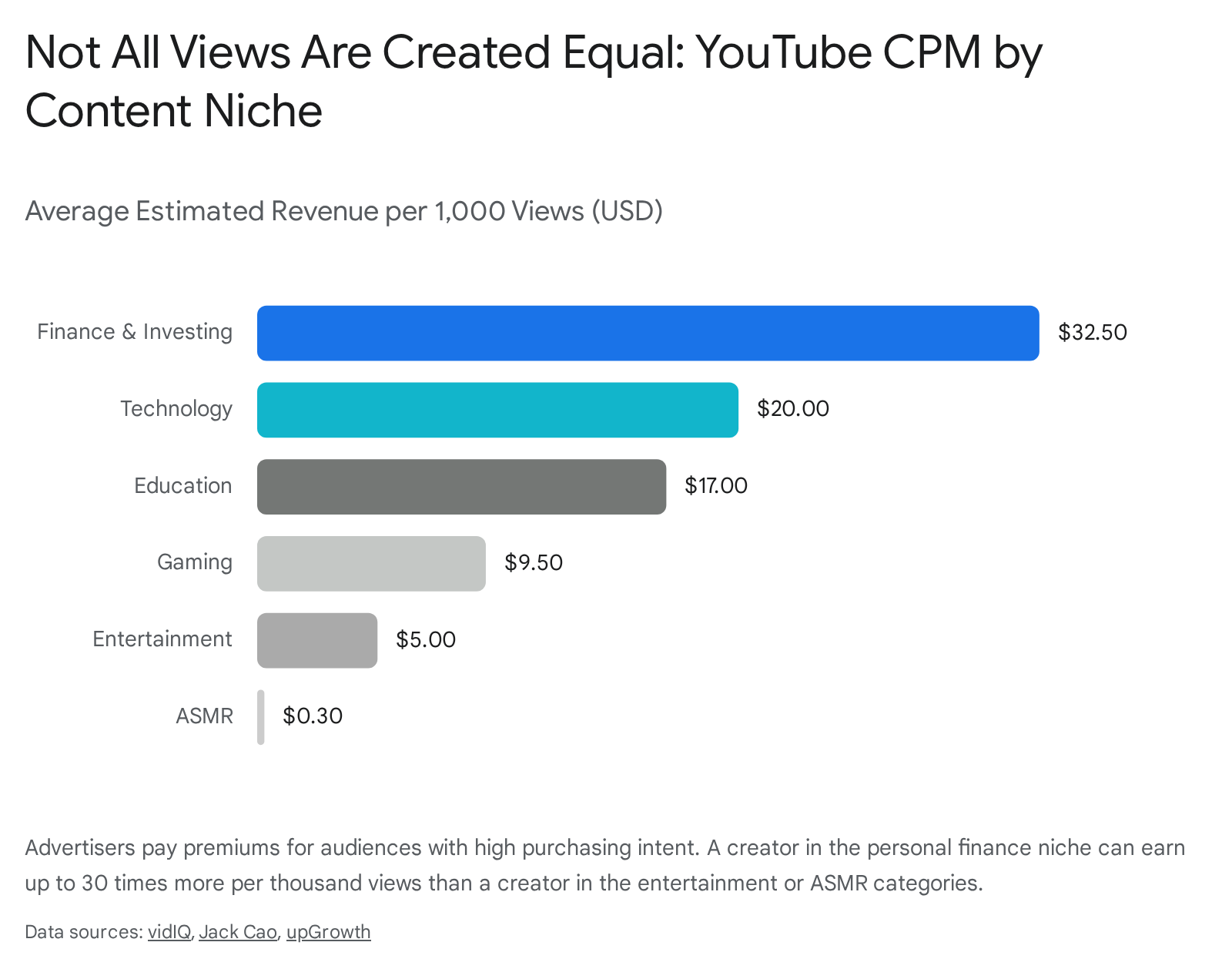
The economic logic governing this disparity is simple: viewer purchasing intent. A viewer watching a detailed, 20-minute tutorial on index fund investing or real estate tax strategies is likely an adult with disposable income, preparing to make a significant financial decision 11. An investment platform is willing to pay a massive premium - perhaps a $50 CPM - to place an advertisement in front of that specific viewer because acquiring a single customer could yield thousands of dollars in lifetime value 11. On the other hand, a viewer watching a gaming highlight compilation is likely younger, possesses less disposable income, and is in a passive state of entertainment. Therefore, a highly specialized finance creator with only 50,000 views can easily earn significantly more in programmatic ad revenue than a broad gaming channel with 1.5 million views 10.
The Micro-Niche Advantage and High-Value Sponsorships
Beyond programmatic ad revenue, micro-niche creators utterly dominate the direct sponsorship and affiliate marketing sectors. Independent case studies highlight how seemingly "boring" or highly specific niches - such as quiet "study-with-me" ambient videos, small-town travel documentaries, or intricate board game tutorials - generate immense, reliable revenue due to a lack of competition and highly qualified, dedicated audiences 82425.
For example, a creator who produces a targeted, highly detailed tutorial on specific B2B software or a complex tabletop game may only garner 4,000 views in a month. However, because those 4,000 viewers are highly qualified leads actively seeking solutions, software companies and game publishers will pay premium direct sponsorship rates that dwarf what a general lifestyle vlogger could command with ten times the viewership 826. As a result, the most profitable and sustainable approach in the modern creator economy is often to pursue a small, highly qualified audience rather than chasing the viral, lowest-common-denominator appeal that characterized the early, speculative days of social media.
How Do Monetization Models Compare Across Major Platforms?
For creators seeking to build stable, predictable enterprises, understanding the architectural differences between platform monetization models is not merely an advantage; it is a prerequisite for survival. Historically, TikTok was viewed primarily as an engine for top-of-funnel audience discovery, while YouTube served as the reliable engine for back-end revenue. However, rolling updates spanning 2024 to 2026 have radically altered how these major platforms distribute capital to their creative labor force.
TikTok: The Death of the Fixed Pool and the Rise of Dynamic RPM
In late 2023, TikTok officially sunset its heavily criticized, original Creator Fund 1228. The original fund operated on a fundamental structural flaw that penalized creators for the platform's own success: it utilized a static pool of money (initially $200 million) that was divided among all eligible views across the entire platform. As TikTok scaled globally and millions of new creators joined, the denominator grew exponentially, causing individual creator payouts to shrink drastically. This often resulted in abysmal payouts of $0.02 to $0.04 per 1,000 views, meaning a viral video with one million views might only yield $20 1229.
To rectify this public relations disaster and to compete directly with YouTube's highly lucrative AdSense model, TikTok launched the Creator Rewards Program in 2024 (fully maturing in 2025 and 2026). This new system completely abandoned the fixed pool in favor of a dynamic RPM based on ad revenue, paying out anywhere from $0.40 to over $1.00 per 1,000 qualified views (defined as organic views longer than 5 seconds from the "For You" feed) 101230. Crucially, TikTok shifted its algorithmic and financial priority to long-form content; to be eligible for monetization under the new program, videos must now strictly exceed one minute in length, fundamentally altering the pacing and style of TikTok content 2931.
YouTube's Two-Tiered Barrier to Entry
In response to the rising existential threat of short-form video competitors and the pressing need to retain early-stage talent before they abandon the platform, YouTube modified its notoriously strict monetization thresholds for the 2025/2026 period. YouTube now operates on a sophisticated two-tiered system for the YouTube Partner Program (YPP) 1334.
The first tier - specifically designed to unlock "fan funding" features like Super Thanks, Super Chats, Channel Memberships, and YouTube Shopping - requires a relatively accessible 500 subscribers, 3 valid public uploads in the past 90 days, and either 3,000 public watch hours annually or 3 million Shorts views in 90 days 131415. However, to unlock the true engine of creator wealth - traditional programmatic ad revenue (AdSense) before, during, and after videos - creators must still cross the higher historical threshold: 1,000 subscribers and either 4,000 watch hours or 10 million Shorts views 133437.
Instagram Reels and Twitch Live Streaming
Meta's Instagram has aggressively pushed its short-form video product, Reels, to combat TikTok. As of early 2026, data from Sensor Tower reveals that more than 50% of all advertisements shown on Instagram are now served within the Reels tab, up from just 35% in 2024, representing an annual revenue run rate of over $50 billion 3839. To incentivize creators, Instagram offers a 55% share of the interstitial ad revenue generated between Reels, provided the creator has at least 10,000 followers and consistently generates over 50,000 views per Reel in the first week 16. Despite this, raw CPMs on Instagram Reels often sit lower than YouTube's long-form content, typically generating $0.01 to $0.05 per 1,000 views natively, forcing creators to rely heavily on the platform's superior social commerce conversions and direct brand sponsorships 3916.
Twitch operates on an entirely different live-streaming paradigm, focusing heavily on direct audience financial support rather than programmatic ad RPM. Twitch strictly delineates its creators into Affiliates and Partners 4142. Affiliates, which require a modest 50 hours of streaming and an average of 3 concurrent viewers to unlock, receive a default 50/50 split on monthly viewer subscriptions 4243. Partners, who must sustain 75 concurrent viewers and undergo a manual review, gain priority access to lucrative brand-deal pipelines and can negotiate revenue splits up to 70/30, allowing top live-streamers to build highly predictable, recurring monthly revenue models entirely independent of ad market fluctuations 414244.
Platform Monetization Matrix (2025 - 2026)
| Platform & Program | Minimum Requirements for Full Ad Revenue | Core Content Format & Algorithmic Focus | Creator Revenue Split & Estimated RPM |
|---|---|---|---|
| YouTube (Partner Program) |
1,000 Subscribers; 4,000 Watch Hours or 10M Shorts Views 13 | High-retention, search-intent long-form video, and supplementary Shorts. 34 | 55% for Long-form; 45% for Shorts. RPM ranges wildly by niche ($2.00 - $50.00+). 1014 |
| TikTok (Creator Rewards) |
10,000 Followers; 100,000 views in the last 30 days 3031 | "Longer" short-form video (Must be strictly over 1 minute). | Dynamic RPM based on performance. Averages $0.40 - $1.00 per 1,000 qualified views. 1012 |
| Instagram (Reels Ad Share) |
10,000 Followers; 50,000 views per Reel in first week 16 | Infinite vertical scroll with heavy social commerce integration. 3945 | 55% of interstitial ad revenue. Averages $0.01 - $0.05 per 1,000 views. 16 |
| Twitch (Partner Program) |
75 average concurrent viewers; 25 hours streamed in 30 days 42 | Real-time, highly interactive live streaming and community building. 46 | 50/50 default, scaling up to 70/30 for top Partners on subscriptions. Custom Ad CPMs. 4142 |
What Are the Dominant Trends Redefining Content Creation in 2025 and 2026?
The Artificial Intelligence Catalyst (and the Crisis of Saturation)
By 2025, artificial intelligence has fundamentally rewired the production mechanisms of the creator economy. According to comprehensive reports by HubSpot and Skyword, nearly 90% of marketers and professional content creators are actively leveraging Generative AI (GenAI) for ideation, scripting, thumbnail generation, and audio editing, a massive leap from 55% in 2024 647.
AI has acted as a profound workflow accelerator. For the 52.5% of creators who prioritize video content, the standard tech stack now combines ChatGPT for scripting, ElevenLabs for voice synthesis, and platforms like CapCut or VEED for automated editing, allowing creators to scale their output exponentially without expanding their physical payrolls 48.
However, this hyper-efficiency has introduced a critical market vulnerability: unprecedented content saturation. As the financial and temporal barriers to high-quality production fall to near zero, the internet is rapidly flooding with repetitive, formulaic, and entirely synthetic material 49. The second-order effect of this AI saturation is a renewed market premium on absolute authenticity. In a sea of flawless, AI-generated avatars and perfectly paced, scripted voiceovers, human audiences are actively rebelling, gravitating instead toward unpolished, highly relatable human vulnerability and raw storytelling 4950.
Furthermore, while AI accelerates production, it does not alleviate the core psychological cause of creator burnout - the relentless pressure of the algorithm. Research indicates that 71% of creators report that AI has had little to no positive effect on reducing their mental burnout, as the baseline expectation for posting frequency and production quality has merely increased across the board in tandem with the new technology 9.
The Evolution of Brand Spend: From Bespoke Sponsorships to Scalable Media
Overall brand investment in creator marketing continues to surge at an unprecedented rate, growing four times as fast as the overall media industry. Estimates by the Interactive Advertising Bureau (IAB) project spending to hit $37 billion by the end of 2025 and $44 billion by 2026 1718. However, the manner in which this capital is distributed is undergoing a seismic shift.
In a tightening macroeconomic environment, brands are aggressively scrutinizing the Return on Investment (ROI) of every marketing dollar. Instead of relying solely on expensive, bespoke, one-off sponsored videos from top-tier macro-influencers, brands are reallocating massive linear TV budgets into scalable digital ecosystems. This includes shifting heavily into sophisticated affiliate marketing networks and paid media inventory that allows brands to boost existing creator content (such as Meta's partnership ads and TikTok's Spark Ads) 19. Over 70% of creators report that traditional, flat-fee sponsored posts will make up a significantly smaller fraction of their revenue going forward, replaced by performance-driven affiliate models that pay out based on actual consumer sales rather than mere brand awareness 19. Furthermore, highly engaged, leaned-in mediums like video podcasting are capturing premium advertising dollars, as they effectively circumvent traditional ad-avoidance behaviors exhibited by Gen Z and provide hours of uninterrupted audience retention 1720.
The Rise of the Creator-Athlete
A fascinating sub-trend in the broader creator economy is the integration of elite and amateur sports. According to Morning Consult, becoming an influencer is now the primary career aspiration for Gen Z, and athletes are uniquely positioned to capitalize on this desire due to their pre-existing fame and built-in fanbases 2156. The introduction of Name, Image, and Likeness (NIL) legislation in collegiate sports has fundamentally altered the trajectory of young athletes, transforming them into independent media entities before they ever reach professional leagues 57.
Corporations recognize this shift and are actively fostering it. Global brands like Visa are hosting dedicated "Creators boot camps" for Olympic athletes, teaching them how to transition their athletic prowess into compelling digital storytelling and sustainable brand partnerships 21. The creator-athlete dynamic represents a shift where sports are no longer just about competition, but about continuous, short-form entertainment, providing athletes with lucrative, alternative career paths that do not solely rely on making a professional roster 5657.
How Does Geographic Arbitrage Transform Creator Economics?
In traditional corporate environments, geographic arbitrage involves a multinational company outsourcing labor to a developing nation to capitalize on favorable exchange rates and lower operational costs. In the creator economy, this macroeconomic concept has been inverted, allowing independent, individual creators to weaponize globalization for personal financial independence.
Geo-arbitrage (or location arbitrage), a concept popularized in the early 2000s but truly actualized by the post-pandemic remote work boom, involves a creator designing their content to attract a high-value, Tier-1 audience (such as viewers in the United States, United Kingdom, or Australia) to secure high advertising CPMs, while physically residing in a country with a significantly lower cost of living 75859.
Because YouTube and TikTok distribute programmatic ad revenue based on the geographic location and purchasing power of the viewer, not the physical location of the creator, the financial leverage is immense. For example, a US viewer might generate a highly lucrative $32.75 CPM for a finance creator, whereas a viewer in a developing market like India might generate less than $1.00 11. A creator generating $4,000 a month from a US-based audience would struggle to pay rent and basic expenses in high-cost tech hubs like San Francisco or New York. However, by leveraging digital nomad visas (such as the D7 passive income visa in Portugal or long-term resident visas in Thailand, Mexico, or Colombia), that exact same $4,000 monthly income transforms into an upper-class lifestyle, allowing for aggressive savings and investment 758.
| Arbitrage Strategy | Target Location | Estimated Monthly Cost of Living | Key Strategic Benefits |
|---|---|---|---|
| High-Cost Base (No Arbitrage) | San Francisco, USA | $4,500 - $6,000+ | Close to industry networking; maximum financial pressure. 58 |
| Domestic Arbitrage | Boise, ID / Austin, TX | $1,400 - $2,500 | 30-50% expense reduction; zero state income tax benefits in specific states. 58 |
| International Arbitrage | Portugal (EU) | $1,800 - $2,500 | D7 Visa access; European lifestyle at a fraction of US costs. 58 |
| Maximized Arbitrage | Chiang Mai, Thailand | $900 - $1,500 | 70%+ expense reduction; strong digital nomad community; massive savings rate. 758 |
Cost estimates derived from Expatistan, Numbeo, and digital nomad benchmark data 758.
Beyond the immediate lifestyle upgrade, geo-arbitrage acts as a critical, structural safety net against the inherent algorithmic volatility of the creator economy. By dropping their baseline living expenses by 50% to 70%, creators buy themselves the psychological safety and financial "runway" needed to survive dry spells in brand sponsorships, seasonal ad rate drops, or algorithmic suppression 5860. Furthermore, U.S. citizens living abroad for 330+ days can leverage the Foreign Earned Income Exclusion (FEIE) to legally exclude over $126,000 (as of 2024) of earned income from federal taxes, supercharging their path to financial independence 58. However, this lifestyle is not without its risks; currency fluctuations, complex international tax compliance, and the psychological difficulty of reintegrating into high-cost native countries remain significant long-term hurdles 60.
What Must Parents and Policymakers Understand About Kidfluencers?
As the creator economy matures from a novel hobby into a cornerstone of global advertising, its regulatory blind spots are becoming glaringly apparent, none more so than in the highly sensitive realm of child labor. "Kidfluencing" - where parents build lucrative, corporate-level media empires centered entirely around their children's daily lives, toy unboxings, or family vlogs - is a massive and highly profitable segment of the industry 2223.
Independent legal analyses highlight a severe, systemic lack of protection for these digitally native minors. Under current United States federal law, specifically the Fair Labor Standards Act (FLSA), kidfluencers are largely unprotected 2324. While traditional child entertainers (such as television and film actors) operate under strict state laws regulating maximum work hours, mandatory financial trusts (such as Coogan Accounts in California, which ensure 15% of a child's gross earnings are set aside), and mandatory educational requirements, the decentralized, home-based nature of social media allows family vloggers to bypass these safeguards entirely 2324.
The legal ambiguity stems from the intentional blurring of "work" and "play." Because parents are constitutionally permitted to direct the upbringing of their children without state interference (a precedent set by Pierce v. Society of Sisters in 1925), and because filming a child playing with a toy in their own living room does not fit the traditional, industrial definition of oppressive labor, the state struggles to intervene 2224. However, as former child star and California legislator Sheila James Kuehl succinctly noted regarding the reality of the industry, "It is not play if you're making money off it" 24.
The invisible labor of kidfluencers exposes them to extreme psychological pressure, parasocial exploitation from anonymous online audiences, and a total loss of privacy before they are old enough to consent 2325. Without sweeping federal legislation mandating financial compensation trusts, strict limitations on hours filmed, and the establishment of a legal "right to deletion" (allowing children to scrub their digital footprint once they reach adulthood), millions of dollars generated by the labor of minors will continue to be legally sequestered by their parents. This regulatory failure highlights one of the darkest underbellies of the creator economy's explosive growth 2325.
What Are the Strategic Imperatives for Aspiring Creators?
For individuals aiming to transition from hobbyists to professional, full-time creators in 2026, relying on sheer luck or algorithmic virality is a guaranteed path to severe burnout. Sustainable careers in the modern creator economy demand the meticulous, diversified mindset of a startup founder. Based on the aggregate data of industry trends, platform shifts, and labor studies, several core strategic imperatives emerge for those entering the space:
The most critical imperative is to prioritize audience ownership over platform vanity metrics. Building a business exclusively on "rented land" - relying solely on a TikTok follower count or an Instagram feed - is inherently fragile, as these audiences can be severed instantly by a ban or a routine algorithm update. Professional creators proactively funnel their audience away from social feeds and onto assets they completely control, such as email newsletters (via platforms like Substack or Beehiiv) or exclusive, gated community platforms (like Patreon or Skool) 66566. Establishing a direct line of communication insulates a creator against sudden platform shifts and provides a stable foundation for direct monetization.
Secondly, creators must ruthlessly "niche down" to secure higher CPMs and premium brand deals. Broad, mass-appeal content requires millions of fleeting views to generate a sustainable income. By specializing in high-intent, hyper-specific verticals - such as B2B software tutorials, personal finance, specific health conditions, or specialized hobbyist crafts - creators attract premium advertisers and lucrative affiliate deals with a fraction of the audience size 101124. The riches in 2026 are undeniably in the niches.
Furthermore, creators must aggressively diversify their revenue streams from day one. AdSense and platform reward programs (like the TikTok Creator Rewards Program) should be viewed strictly as supplementary bonus income, never as the foundational pillar of a business. Creators must layer their income by integrating performance-based affiliate marketing, high-margin digital products (templates, courses), consulting, and direct brand sponsorships 104350.
Finally, creators must treat their own mental health and operational efficiency as critical business infrastructure. Content creation is a marathon with an incredibly high attrition rate. To avoid the industry's staggering 62% burnout rate, creators must establish strict working boundaries, utilizing batch-production techniques, scheduling mandatory time off, and resisting the urge to compulsively check real-time analytics 9. They must leverage AI tools for tedious tasks like SEO optimization, initial script outlining, and audio editing to scale their output 4767. However, they must never outsource their core creative voice or emotional vulnerability to an algorithm, as genuine, flawed human authenticity remains the ultimate premium in an increasingly synthetic digital world 4950.
The Bottom Line
The creator economy in 2026 is no longer a speculative digital gold rush; it has solidified into a mature, highly competitive, and ruthlessly stratified global industry that demands professional respect, deep resilience, and sharp business acumen. It perfectly mirrors the architecture of the traditional Hollywood studio system, complete with a tiny fraction of A-list megastars capturing the lion's share of the projected $480 billion market, while millions of aspiring creators endure extreme psychological, financial, and operational strain in the desperate pursuit of algorithmic favor.
For the 99%, the romanticized vision of earning millions from viral dances or casual vlogs is a statistical impossibility. The platforms dictate the rules, and raw views rarely translate to actual wealth. However, for those who treat content creation as a disciplined, strategic enterprise - focusing relentlessly on high-intent niches, securing off-platform audience ownership, leveraging geographic arbitrage to extend their financial runway, and diversifying revenue far beyond volatile ad payouts - the creator economy continues to offer unprecedented, decentralized economic mobility. Success in this new Hollywood is not determined by how many millions of people scroll past your face, but exactly who is watching, what their localized attention is worth to the global market, and how efficiently you can convert that targeted trust into a sustainable, independent business.