
Balancing artificial intelligence and deep academic thinking
Introduction
The rapid integration of generative artificial intelligence (AI) into the academic research lifecycle has precipitated a fundamental transformation in how scholarly knowledge is conceptualized, synthesized, and disseminated. Propelled by the proliferation of large language models (LLMs) and advanced machine learning algorithms, researchers and students are experiencing unprecedented gains in operational efficiency. Generative AI tools are increasingly deployed to automate administrative tasks, execute complex data cleaning operations, translate scholarly texts, and draft academic prose 122. However, this surge in technologically mediated productivity has surfaced a critical paradox: the very tools designed to reduce cognitive friction threaten to erode the foundational capabilities required for deep academic thinking.
Higher education and research institutions currently operate at a precarious intersection between technological enablement and cognitive atrophy 4. While AI systems demonstrate immense utility in reducing the time spent on routine academic labor, unconstrained reliance on these models introduces profound risks. The outsourcing of critical analytical processes to probabilistic algorithms has been linked to diminished metacognitive engagement, reduced long-term knowledge retention, and the systemic accumulation of "epistemic debt" 367. Consequently, the central challenge for modern academia is no longer determining whether to adopt AI, but rather defining the precise contours of a healthy human-AI synergy. A sustainable balance necessitates leveraging AI to automate "shallow" procedural tasks while intentionally preserving the "desirable difficulties" that foster original ideation, rigorous scientific judgment, and authoritative cognitive ownership 456.
Cognitive Frameworks for Technology Interaction
Understanding the impact of artificial intelligence on academic thinking requires analyzing the interaction through established psychological and cognitive science frameworks. The distinction between using AI as a supportive scaffold versus an autonomous replacement dictates whether the technology enhances or degrades intellectual capability.
Cognitive Offloading Versus Cognitive Outsourcing
The human cognitive architecture relies heavily on working memory to process novel information before it can be encoded into long-term memory schemas. "Cognitive offloading" refers to the long-standing practice of delegating mental tasks to external tools - such as using calculators for arithmetic, writing shopping lists, or utilizing software for statistical computation - to free up working memory for higher-order reasoning 678. When AI is utilized to manage "extraneous cognitive load," such as formatting citations, correcting grammar, or generating boilerplate code syntax, it performs a highly beneficial offloading function 49. Historical and comparative syntheses of human-computer interaction spanning the interactive era (2010 - 2024) to the emerging AI-mediated era demonstrate that such offloading can support working memory through adaptive feedback and flexible pacing 6.
However, empirical research identifies a critical threshold where beneficial offloading devolves into detrimental "cognitive outsourcing." This occurs when learners and researchers use generative AI to bypass the "intrinsic cognitive load" - the mental effort inherently required to comprehend complex concepts, structure logical arguments, and synthesize disparate literature 364. Recent studies evaluating AI tool usage among university students indicate a strong negative correlation between high frequencies of unregulated AI reliance and scores on standardized critical thinking assessments. For example, behavioral data mapping AI usage reveals a significant negative correlation (r = -0.68) between heavy AI tool usage and critical thinking scores, mediated entirely by the tendency to offload evaluative and analytical judgments 8. When students or researchers accept AI-generated recommendations without independent evaluation, they forfeit the active processing required to build expertise, resulting in superficial reasoning and diminished learner autonomy 310.
At a neurological level, generative AI tools redistribute rather than merely reduce cognitive load; they offload lower-level encoding processes traditionally handled by the phonological loop, but simultaneously elevate central-executive demands for critical evaluation and prompt management 6. A failure to meet these central-executive demands leads directly to skill atrophy.
The Principle of Desirable Difficulty
Central to the tension between AI efficiency and deep learning is the pedagogical concept of "desirable difficulty." Coined in cognitive psychology, the term describes the productive struggle that occurs when individuals engage in effort-heavy tasks that challenge their current capacities 41112. The effort expended in retrieving information, wrestling with conceptual contradictions, and structuring narratives is the exact mechanism by which long-term neural connections and intellectual resilience are forged 413. For instance, a classroom action study investigating second-language vocabulary acquisition found that students who were required to independently generate answers from a cue - a desirable difficulty - exhibited significantly better long-term retention than those who passively reviewed generated content 4.
Generative AI often short-circuits this productive struggle by providing immediate, highly fluent, and structured answers. The immediate gratification and polished output create an "illusion of competence" or "illusion of learning" 413. While short-term performance metrics may improve, long-term retention and the ability to transfer knowledge to novel problems severely decline 618. Experimental trials have demonstrated this dichotomy starkly: in one study, high school students given unrestricted access to AI tools without pedagogical guidance saw their performance drop by 17% compared to non-AI cohorts, whereas a separate deployment that required teachers to actively guide and challenge students alongside the AI accelerated learning timelines exponentially 13. To maintain a healthy balance, AI interfaces and academic workflows must be designed to preserve cognitive friction. Rather than acting as a solution engine that delivers finalized outputs, AI is most effective for cognitive development when utilized as a Socratic partner - prompting reflection, challenging assumptions, and forcing the human user to articulate the underlying logic 478.
Epistemic Debt and Algorithmic Gettier Cases
In professional research environments, over-reliance on generative models introduces systemic liabilities classified as "epistemic debt." Epistemic debt accumulates when researchers utilize AI to generate code, data visualizations, or literature summaries without fully understanding the underlying mechanics, sources, or logic of the generated artifacts 6714. While immediate output velocity increases, the human user loses the mental model of the complex problem space 20. Unrestricted access to AI tools, particularly in programming contexts like "vibe coding" (where users prioritize semantic intent over syntactic implementation), allows users to accumulate extreme epistemic debt, resulting in a total inability to correct or maintain the generated outputs over time 6.
Furthermore, researchers must navigate "Algorithmic Gettier Cases" - instances where a large language model generates a statement that happens to be factually true but is epistemically defective because it was derived probabilistically rather than through grounded reasoning 715. Relying on stochastic fluency without verifying the evidentiary chain fundamentally violates the rigors of scientific inquiry. Ungoverned AI systems that lack verification capabilities do not fail randomly; they systematically convert epistemic risk into financial, legal, and institutional liability 14. Therefore, a balanced approach strictly prohibits the abdication of epistemic ownership; the human must remain the absolute arbiter of truth, validity, and methodological soundness 22.
Theoretical Workflows for Synergy
To operationalize a balanced interaction with AI, several theoretical and operational models have emerged from the fields of computer science, productivity literature, and human-computer interaction. These models offer blueprints for structuring the academic workflow to maximize output while defending deep cognition.
Deep Work and Slow Productivity
Computer scientist and author Cal Newport frames the AI-productivity paradigm through the lenses of "Deep Work" and "Slow Productivity." Deep work is defined as the ability to focus without distraction on cognitively demanding tasks, pushing analytical capacities to their limits to produce high-value, irreplicable output 52324. In contrast, shallow work comprises low-effort logistical and administrative tasks - such as drafting routine emails, attending status meetings, and formatting citations - that fragment attention and require minimal specialized expertise 523.
In the context of modern academia, a healthy balance utilizes AI strictly to compress and automate shallow work, thereby reclaiming cognitive bandwidth for sustained, focused inquiry 25. However, Newport explicitly warns against using AI to simply pack more shallow tasks into the workday - a phenomenon that exacerbates burnout and perpetuates "pseudo-productivity" 161728. The rise of the knowledge economy resulted in highly amorphous job roles, leading institutions to use "visible activity" (e.g., rapid email responses, constant messaging) as a crude proxy for actual productivity 28. Generative AI can easily amplify this freneticism if misused. Instead, the integration of AI should facilitate "Slow Productivity": doing fewer things, working at a natural pace, and obsessing over quality 162918. AI cannot replace the fundamental, solitary struggle of deep intellectual synthesis, but it can clear the administrative underbrush that prevents academics from engaging in it 25.
Role-Based Interaction Models
The integration of AI into academic and professional workflows has necessitated the development of specific interaction frameworks. Ethan Mollick proposes viewing AI through four distinct functional roles: as an intern, a tutor, a coach, and a coworker 31. When treating AI as an intern, the human assumes the role of the senior manager. The researcher defines the "what" and the "why" (the hypothesis, the structural logic, the theoretical framework), while delegating the "how" (the initial literature sweep, the syntax generation, the code drafting) to the AI 22. The critical rule in this dynamic is that a manager must rigorously verify an intern's work, ensuring that human cognitive ownership remains intact 2232.
Further illuminating this dynamic, a major field experiment involving 758 consultants at the Boston Consulting Group (BCG) tested AI's impact on complex knowledge tasks. The study revealed the concept of the "Jagged Frontier" of AI capabilities 3133. For tasks falling inside the frontier of the AI's competence, consultants using AI completed tasks 25.1% faster and produced outputs rated 40% higher in quality 33. However, for tasks outside the frontier, consultants using AI were 19 percentage points less likely to produce correct solutions compared to those without AI, primarily due to an overreliance on the AI's highly fluent but analytically flawed language 33.
To navigate this jagged frontier, two effective human-AI collaboration models emerged from the BCG study: the "Centaur" and the "Cyborg" 33. The Centaur model involves a strict division of labor; the human researcher delegates highly specific, bounded tasks (e.g., executing a Python script for data visualization) to the AI, while handling all conceptual integration manually 33. The Cyborg model represents a tighter, more iterative integration, where the researcher continuously moves back and forth with the AI, utilizing it for rapid, micro-tasking operations at the sub-task level 33. Both models outperform traditional human-only workflows, provided the human retains high AI literacy and engages in active falsification testing 2233.
Task-Specific Impact and Empirical Evidence
The theoretical frameworks of cognitive offloading and deep work translate into highly specific performance outcomes depending on the academic task being performed. Achieving balance requires understanding where AI fundamentally accelerates research versus where it introduces hidden costs.
Procedural Operations and Data Processing
Generative AI demonstrates profound utility in highly structured, rule-bound tasks where variables can be clearly defined. In empirical studies evaluating clinical trial data cleaning - a traditionally manual, error-prone bottleneck in pharmaceutical and medical research - AI-assisted platforms have shown transformative results. A controlled study using the AI platform Octozi demonstrated a 6.03-fold increase in data processing throughput among medical reviewers 34. Furthermore, AI assistance decreased aggregate cleaning errors from 54.67% down to 8.48% (a 6.44-fold improvement), effectively neutralizing the gap between varying levels of human baseline experience 34.
For qualitative research, researchers increasingly rely on Small Language Models (SLMs) and LLMs to parse interview transcripts, extract categorical labels, and conduct thematic clustering 1920. When strict framework alignment is enforced and data dictionaries are clearly defined, these models execute formatting, anomaly detection, and normalization with high fidelity 19. Utilizing AI for these operations represents optimal cognitive offloading, preserving the human researcher's mental energy for advanced statistical interpretation, synthesis, and theoretical application.
Literature Synthesis and Sensemaking
In literature synthesis and scholarly discovery, AI tools offer the ability to rapidly organize vast corpuses of text. Advanced systems like PaperBridge and PaperWeaver leverage LLMs to extract factual claims, contextualize relationships among papers, and synthesize descriptions to support literature reviews 21. Across these systems, a key insight is the combination of top-down and bottom-up workflows 21. AI agents can perform broad data retrieval and summarization based on strict, predefined prompts designed by human experts 2223.
However, AI's reliance on historical training data poses risks to true originality. Because AI fundamentally recognizes and reconstructs existing patterns, its heavy use in ideation can constrain originality and reinforce dominant, historically established paradigms 24. Furthermore, when AI is used to map literature, the risk of hallucination - where the AI confidently generates plausible but factually inaccurate citations or medical claims - requires researchers to meticulously cross-validate AI summaries against the original source texts 22.
Drafting, Rework, and the Verification Shift
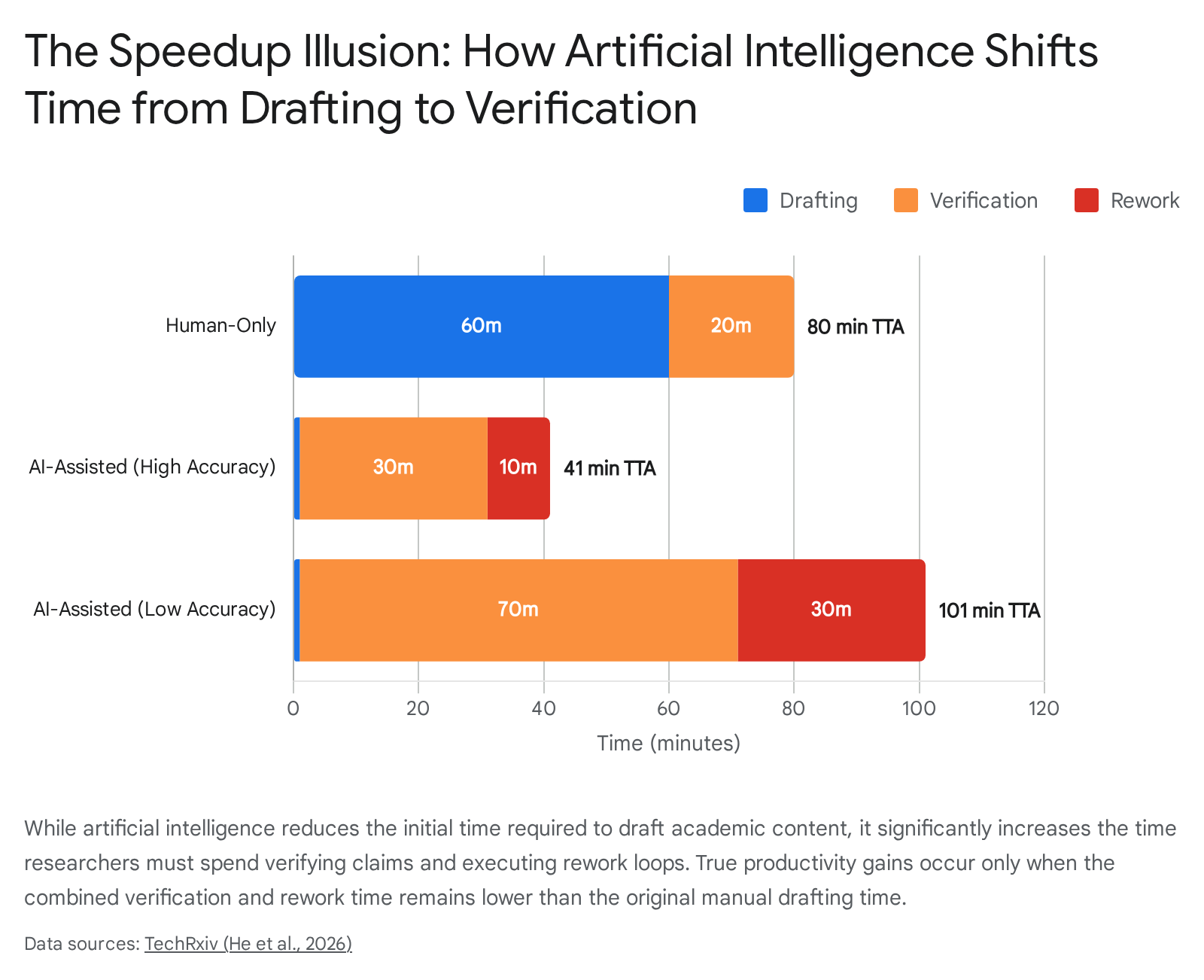
The application of AI to manuscript drafting reveals one of the most critical misunderstandings in academic productivity. While AI can rapidly generate initial drafts, relying on it for complex argumentation fundamentally shifts the workflow bottleneck from production to verification 41.
Recent empirical audits of human-AI productivity across coding and writing domains highlight a phenomenon termed the "Speedup Illusion." An AI tool may reduce the time required to draft a section of a literature review or a block of analytical code from 60 minutes down to 1 minute, implying a massive productivity spike 41. However, because AI outputs are stochastic and prone to subtle logical errors or fabricated evidence, the human researcher must spend an excessive amount of time rigorously verifying the text 2241. When factoring in the "Time-to-Acceptance" (TTA) - which accounts for necessary rework loops, governance checks, and debugging - the overall time spent can occasionally exceed the human-only baseline if the initial AI output was highly flawed 41.
Peer Review and Academic Assessment
The multibillion-dollar scholarly publishing industry relies on over 100 million hours of volunteer peer reviewer time annually 42. The strain on this system has driven extensive research into AI's capability to assist in manuscript evaluation. Frameworks such as Google's ScholarPeer and PaperVizAgent demonstrate high efficacy in evaluating academic papers and generating publication-ready figures by grounding reviews in live, web-scale literature 1.
In a comparative study conducted by researchers at Stanford University, the overlap in focus between review comments generated by GPT-4 and those of human experts was found to be between 30% and 40%, which is comparable to the average agreement between two independent human reviewers 25. Furthermore, 57.4% of authors found the GPT-4 feedback helpful, noting its consistency and stability 25. However, human reviews were noted to be stricter, more diverse, and capable of higher-level subjective academic judgments. The optimal application scenario is therefore a hybrid model: AI conducts automated reference-based verification and highlights logical gaps between data and text in the early stages, releasing the cognitive resources of human reviewers to focus entirely on high-level assessments of academic novelty and methodological soundness 25.
Overview of Optimal Delegation Strategies
Based on empirical performance outcomes, achieving a balanced academic workflow involves mapping specific research phases to either human or AI dominance.
| Academic Research Phase | Primary Actor | Role of Artificial Intelligence | Role of Human Researcher | Risk of Over-Reliance |
|---|---|---|---|---|
| Research Design & Hypothesis Formulation | Human | Generates alternate perspectives or counterarguments for stress-testing. | Defines the core intellectual question, methodology, and scientific logic. | Loss of originality; anchoring bias to AI suggestions. |
| Data Collection & Cleaning | AI | Executes formatting, anomaly detection, normalization, and semantic clustering. | Sets parameters, reviews automated logs, validates sample subsets. | Undetected systemic biases; algorithmic deletion of valid outliers. |
| Literature Discovery & Synthesis | Shared | Retrieves papers, generates baseline summaries, extracts specific claims. | Synthesizes overarching narratives, identifies theoretical gaps, cross-validates AI. | Epistemic debt; incorporation of fabricated citations. |
| Manuscript Drafting & Revision | Shared | Corrects grammar, optimizes syntax, checks structural coherence. | Drafts core arguments, maintains authorial voice, contextualizes findings. | Plagiarism; "stochastic eloquence" masking weak arguments. |
| Peer Review & Verification | Human | Automates reference checking, flags logical inconsistencies between data and text. | Evaluates novelty, assesses methodological soundness, provides final judgment. | Automation bias; rubber-stamping AI hallucinations. |
Institutional Policy and Governance Responses
The philosophical debate regarding AI's place in academia is actively being formalized into institutional policy. Over the last several years, the higher education sector has transitioned from reactionary prohibition toward pragmatic, literacy-focused integration frameworks 32444546.
The Shift from Prohibition to Integration
Early responses to generative AI (circa late 2022 to mid-2023) were dominated by panic over academic integrity, resulting in sweeping bans at various institutions 3226. The London School of Economics (LSE) famously instituted a school-wide ban on generative AI in all assessed work, only to lift the ban shortly after. LSE subsequently introduced the "Observed Assessment," wherein students write essays with AI tools available, but within a supervised room under time pressure, ensuring the tool is permitted but the thinking cannot be outsourced 32.
This evolution reflects broader administrative trends. Reports by EDUCAUSE and Ithaka S+R indicate a massive shift in institutional sentiment. While 23% of higher education professionals reported that their institutional leaders felt cautious about AI in 2024, that number dropped to 20% by 2025, with 81% of respondents feeling enthusiasm or a mix of caution and enthusiasm 27. Universities are now focusing on upskilling existing faculty and students, shifting the discourse from prohibition to leveraging AI responsibly 272829.
A major catalyst for this shift is the recognized failure of AI detection software. Institutions have increasingly abandoned automated AI detectors - such as GPTZero or Turnitin's AI module - due to their high rates of false positives, false negatives, and inherent biases against non-native English speakers 3031. Consequently, governance has pivoted away from policing final outputs toward supervising the research process itself, mandating transparency, and emphasizing human accountability 3232.
Regional Disparities in Policy Implementation
An analysis of university guidelines across different geographic regions reveals both a consensus on fundamental principles and distinct localized priorities. Across 30 leading global institutions analyzed, five core tenets of AI governance emerged universally: mandatory disclosure of AI use, human accountability for final outputs, the extension of existing academic integrity rules to AI, strict prohibitions against inputting confidential or private data into public models, and the allowance for local instructor discretion 32.
Despite these shared tenets, comparative analyses highlight differing regulatory anxieties. Western institutions predominantly orient their policies around mitigating academic misconduct, protecting intellectual property, and preserving traditional research integrity 5433. Nearly 70% of universities in the United States have adopted written policies regarding AI tools 30. Conversely, institutions in the Global South often frame AI integration as an issue of educational equity, capacity building, and preventing widening digital divides, even as formal policy implementation often lags behind massive student adoption 303334.
| Region / Institution | Policy Posture and Core Directives | Distinctive Policy Features |
|---|---|---|
| China (Tsinghua University) | Comprehensive, multi-level framework. AI must remain strictly an auxiliary tool. Prohibits mechanical paraphrasing or AI ghostwriting. | Warns explicitly against "cognitive complacency" and demands multi-source verification. Emphasizes addressing algorithmic bias to prevent digital divides 3435. |
| Japan (University of Tokyo) | Discretionary, non-prohibitive. Defers entirely to faculty judgment based on course objectives. | Emphasizes process-oriented assessment over final answers. Explicitly warns against relying on AI detection software 32. |
| India (IIT Delhi) | Strict transparency and integrity rules. Mandatory disclosure for any AI-assisted tables, images, or significant text. | Focuses heavily on the protection of sensitive data and the ultimate responsibility of the researcher to verify accuracy and avoid plagiarism 3637. |
| Brazil (USP, Unicamp) | Structured integration. Permits AI for efficiency (translation, grammar, ideation) but prohibits AI as a co-author. | Organizes policies into clear "What you CAN do" and "What you should NEVER do" categories. Stresses compliance with national data protection laws (LGPD) 3839. |
| Africa (UCT, UKZN) | Progressive, enabling frameworks within a broader continental policy vacuum. Focuses on ethical use and capacity building. | The University of Cape Town officially abandoned AI detectors due to unreliability, shifting to proactive AI literacy programs and oral defense assessments 304041. |
Publisher Guidelines and Scientific Integrity
Major academic publishers - including Elsevier, Springer Nature, Taylor & Francis, and Wiley - have coalesced around specific reporting standards to manage AI integration and protect the scientific record from fabrication and paper mills 42. The consensus explicitly prohibits listing AI tools as authors or co-authors, noting that non-human entities cannot consent to publication or bear moral or legal accountability for research errors 42.
The generation of primary data, figures, and visual media by AI is heavily restricted. Springer Nature bans almost all generative AI images and videos, except in rare cases where AI is the explicit subject of the research 42. Wiley offers a tiered policy, allowing AI-assisted explanatory or conceptual diagrams, but strictly forbidding AI generation of factual or clinical images 42. Elsevier permits AI to be used to improve the language and legibility of texts, but explicitly prohibits its use to substitute essential author tasks, such as producing scientific insights, formulating conclusions, or providing clinical recommendations 4243.
Strategies for Quantifying Cognitive Ownership
As blanket bans dissolve in favor of nuanced integration, the academic community requires practical mechanisms to measure, declare, and restrict AI involvement. Attempting to define a universally acceptable percentage of AI assistance is complex, but standardized models are emerging.
The VCII Ratio and Assistance Scales
To prevent the total outsourcing of cognitive effort, researchers have proposed scalable models for AI attribution. One such model is the VCII Ratio, which advocates for a human-to-AI input ratio of roughly 30% to 40% AI involvement for standard academic works 44. Under this "Belt" system, a 10% to 20% involvement represents light editing and grammar checks; 30% represents significant structural suggestions; and anything approaching or exceeding 50% shifts the human from author to mere editor, severely risking the loss of authentic scholarly voice 44.
Similarly, the AI Assistance Scale outlines an 8-point continuum for academic writing. "Moderate AI Assistance" (Level 4) is defined as a process where a human writes the initial draft and utilizes AI to rephrase or improve coherence, or where the human highly directs the AI to summarize specific research points prior to manual drafting . The scale becomes ethically precarious at Level 5 and above, where AI generates the majority of the text based on simple prompts, representing full cognitive outsourcing . To track this, some universities are experimenting with Generative AI Reporting Apps (GARA) to provide structured ways for students to declare their level of AI involvement .
The Artificial Intelligence Epistemic Influence Scale (AIEIS)
To provide more rigorous transparency in published research, the Artificial Intelligence Epistemic Influence Scale (AIEIS) proposes stratifying disclosures into distinct categories rather than relying on vague statements like "AI assisted in preparing the text" 45. The AIEIS classifies contributions by level: 1. Procedural (P): Acceleration of computation, automation of processing, formatting, and grammar correction. 2. Semantic (S): Data interpretation, surfacing novel meanings, and thematic clustering. 3. Generative (G): Formulation of novel hypotheses, experimental design generation, and core argument construction 45.
Each phase poses distinct epistemic risks. Therefore, semantic and generative components carry heavier ethical weight than routine procedural assistance. A key principle of the AIEIS is the penalty for noninterpretability: if an AI's contribution lacks an explainable trace (e.g., documented prompts, versions, or source texts), the research is deemed epistemically invalid 45. This scale hardwires interpretability requirements and actively counters the effect of "stochastic eloquence," where highly fluent AI prose masks the absence of rigorous epistemic warrants 45.
Conclusion
A healthy balance between utilizing artificial intelligence for productivity and engaging in deep academic thinking requires viewing AI not as a replacement for intellectual effort, but as advanced cognitive infrastructure. The profound efficiency gains offered by generative models - such as rapid data cleaning, literature retrieval, syntactic formatting, and the reduction of shallow administrative work - should be actively embraced to free the modern researcher's schedule for sustained deep work.
However, this delegation must be rigorously bounded by the principles of cognitive science. To preserve the neurocognitive processes required for rigorous scholarship, researchers must actively protect the "desirable difficulties" inherent in conceptual synthesis, logical structuring, and critical evaluation. Outsourcing the core analytical narrative to probabilistic models invites epistemic debt, compromises research integrity, and erodes the fundamental skills necessary to advance human knowledge. Ultimately, sustainable human-AI synergy dictates that while the machine may be utilized to retrieve data, format structures, and refine syntax, the human must retain absolute cognitive ownership of the research question, the methodological logic, and the final scientific truth.