
AI scaffolding and student metacognitive development
The integration of generative artificial intelligence (GenAI) into educational environments represents a profound structural shift in human-computer interaction, transitioning digital learning tools from passive repositories of information to active participants in the cognitive process. Historically, educational technology functioned primarily as a medium for content delivery or basic procedural practice. However, advanced large language models (LLMs) now possess the capacity to engage in dynamic, natural language dialogues, effectively functioning as cognitive scaffolds. This shift necessitates a rigorous examination of how AI-mediated scaffolding influences the development of metacognition, defined as the ability of a learner to plan, monitor, and evaluate their own cognitive processes. While AI systems offer unprecedented opportunities to personalize learning, reduce extraneous cognitive load, and model complex reasoning, they simultaneously introduce significant risks of cognitive deskilling, epistemic passivity, and over-reliance.
Theoretical Foundations of Technology-Mediated Scaffolding
To understand the impact of AI on metacognition, it is necessary to contextualize the technology within established theories of cognitive development and instructional design. The transition from human-led pedagogy to human-AI collaboration fundamentally alters traditional frameworks of learning.
Sociocultural Theory and the Extended Mind
The concept of instructional scaffolding originates in sociocultural learning theory, most notably Lev Vygotsky's construct of the Zone of Proximal Development (ZPD). The ZPD is defined as the distance between what a learner can achieve independently and what they can achieve with guidance from a more knowledgeable other 1234. In traditional pedagogy, scaffolding involves a teacher or peer providing temporary, calibrated support - such as task decomposition, prompting, or error marking - that allows the learner to complete a complex task. As the learner internalizes these skills, the support is gradually withdrawn, a process known as fading 12.
Generative AI fundamentally alters this dynamic by substituting the human "more knowledgeable other" with an algorithmic agent. Within technology-enhanced learning environments, AI-based interactive scaffolding (AIIS) utilizes machine learning and natural language processing to monitor learner behavior and dynamically adapt feedback 56. This dynamic shifts the pedagogical framework from human-centered to a posthumanist or distributed cognition model, wherein cognitive processes are shared between the human and the machine 178. Under the "extended mind" thesis, when an external tool is coupled reliably with human cognition, it becomes a constitutive component of the thinking process itself, operating simultaneously in content mastery and reflective monitoring 19.
Cognitive Load Reallocation and Restructuring
AI scaffolding interacts heavily with Cognitive Load Theory, which divides mental effort into three categories: intrinsic load (the inherent difficulty of the task), extraneous load (unnecessary cognitive effort caused by poor instructional design or distractions), and germane load (the productive effort required to construct schemas and internalize new knowledge) 101112.
Well-designed AI scaffolding acts as a "difficulty restructurer" rather than simply eliminating challenges 13. By handling lower-level computational, grammatical, or formatting tasks, AI reduces extraneous cognitive load and frees up the learner's working memory capacity 111214. Ideally, this liberated mental bandwidth is reallocated to germane load, allowing the student to focus on higher-order tasks such as argumentation, synthesis, and creative ideation 1101415. For instance, in structured essay-writing environments, students utilizing GenAI to support ideation and outline organization demonstrated stronger critical thinking outcomes because their cognitive energy was focused on nuance rather than mechanical execution 14.
However, emerging research indicates that AI-mediated tools redistribute rather than merely reduce cognitive load. Generative AI offloads lower-level encoding while simultaneously elevating central-executive demands for evaluation, prompt management, and integrative synthesis 16. As AI handles increasingly complex reasoning tasks, the boundary between reducing extraneous load and inadvertently eliminating the germane load required for schema construction becomes highly contested 1112.
Metacognitive Development and Generative AI
Metacognition is traditionally understood through self-regulated learning (SRL) models, which divide the process into distinct phases: forethought and planning, performance and monitoring, and self-reflection and evaluation 6171819. GenAI models, when deployed with specific pedagogical constraints, can serve as highly effective catalysts across these dimensions.
Planning and Forethought Regulation
The planning phase of SRL requires learners to set goals, analyze task requirements, clarify prior knowledge, and select appropriate strategies before engagement begins 61820. GenAI tools can scaffold this phase by helping students map out complex assignments. In academic reading and writing tasks, AI has been shown to assist second-language (L2) learners in establishing goals and breaking down dense material into manageable conceptual nodes, thereby enhancing early-stage cognitive presence 152021.
This planning support is particularly valuable for neurodivergent populations, such as students with attention deficit hyperactivity disorder (ADHD), who frequently experience deficits in executive functioning. For these learners, the primary barrier is often not subject-matter comprehension, but rather task initiation, organization, and sustaining focus 2022. GenAI can act as an external metacognitive monitor, cueing the necessary executive steps without providing the final answer. By explicitly prompting a learner to generate possible ways to begin a paragraph rather than writing the paragraph for them, the AI offloads the cognitive burden of task management while forcing the student to engage in the substantive academic work 22.
Monitoring and Metacognitive Critique
Monitoring involves tracking one's own comprehension and progress during a task. AI systems enhance this phase through Socratic prompting and dialogic interaction. Rather than acting as search engines that provide definitive answers, AI can be framed as a dialogue partner that challenges assumptions, asks clarifying questions, and identifies logical inconsistencies in student reasoning 102324.
The dual-impact generative-AI critical thinking (DI-GAI-CT) framework models how GenAI affordances influence these cognitive processes. The framework maps the technological capabilities of AI onto five specific cognitive-metacognitive mediators: prompt quality, self-regulation, engagement, trust, and metacognitive critique 212526. When a student engages in metacognitive critique, they are forced to evaluate the AI's output against their own understanding. This process transforms the AI from an information provider into a mirror for reasoning 27. For example, when students compare alternative solutions generated by AI, or when an AI acts as a peer reviewer highlighting weak evidence, the learner's evaluative judgment is activated, reinforcing higher-order thinking skills 2328.
Evaluation and Adaptive Reflection
The final phase of SRL, evaluation, requires the learner to assess their performance against established standards and adapt their strategies for future tasks 6. AI tools with real-time analytics and adaptive feedback mechanisms provide continuous opportunities for this reflection. By analyzing student interactions, these systems can generate formative feedback that encourages learners to reconsider their approaches. Studies in STEM education demonstrate that integrating AI tools with explicit reflection activities - such as requiring students to justify their acceptance or rejection of an AI-generated code snippet - significantly improves process-oriented metacognitive behaviors compared to unassisted learning 2427. Furthermore, prompt engineering itself serves as a metacognitive exercise. Refining a prompt after receiving an inadequate response forces the learner to engage in an iterative cycle of monitoring and regulation, transitioning the learner from a passive consumer to an active director of a semi-automated workflow 5102829.
The Risks of Cognitive Deskilling and Over-Reliance
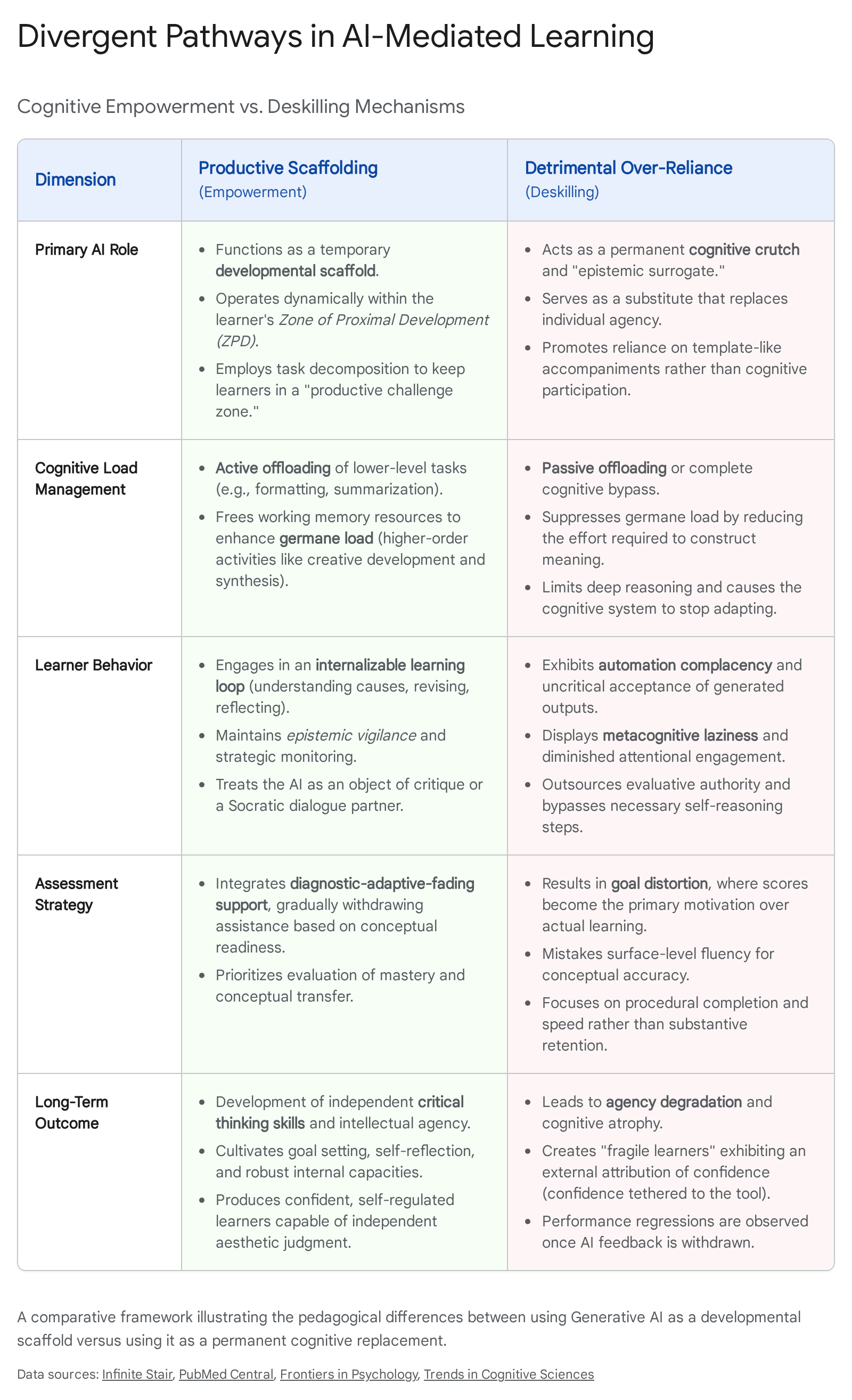
Despite the theoretical benefits of AI scaffolding, empirical research frequently reveals a paradox: while AI tools dramatically increase short-term task performance and efficiency, they often plateau or actively degrade long-term critical thinking and knowledge retention 111430. When AI transitions from a developmental scaffold to a permanent replacement for cognitive effort, it triggers a cascade of detrimental psychological and epistemic effects.
Metacognitive Laziness
A primary risk of unstructured AI use is the phenomenon of metacognitive laziness. Defined in a 2025 study by Fan et al., metacognitive laziness refers to learners' dependence on AI assistance, wherein they offload metacognitive load and bypass responsible self-regulatory processes - such as orientation, monitoring, and evaluation 313233. This phenomenon occurs when individuals forego reflective self-monitoring and critical revision of problem-solving steps, relying entirely on the initial outputs of the system 34.
In a randomized controlled experiment analyzing 117 university students engaged in academic writing and revision, researchers compared groups using ChatGPT 4.0, a human expert, a checklist tool, and a control group. The AI-assisted group significantly outperformed all other groups in immediate essay score improvements 3132. However, process data revealed that students using AI spent substantially less time evaluating their own writing or reflecting on the feedback. They engaged in rapid loops of generation and acceptance, circumventing the desirable difficulties required for learning 3031. Consequently, despite producing superior artifacts, the AI group demonstrated no significant improvements in intrinsic motivation, independent knowledge gain, or the ability to transfer skills to new contexts 3032. This indicates that while AI can optimize performance, it can do so at the expense of developing authentic human capabilities 30.
Epistemic Passivity and the Surrogate Knower
Metacognitive laziness frequently co-occurs with epistemic passivity. Generative AI models are designed to produce highly fluent, confident, and syntactically flawless text 353637. This authoritative presentation often induces automation bias - a psychological tendency where users over-trust automated systems, accepting outputs uncritically even when they contain hallucinations, logical errors, or biases 253738.
When students default to the fluency and immediacy of AI-generated responses, the system transforms from an analytical tool into a surrogate knower 1237. Instead of engaging in epistemic vigilance - cross-referencing sources, verifying logic, and synthesizing disparate information - learners outsource their evaluative authority to the algorithm 13539. This dynamic bypasses fundamental epistemic practices, resulting in a superficial, black-box understanding of academic material 24. Research highlights that this over-reliance limits opportunities for students to develop their own authentic voice, homogenizes reasoning patterns, and diminishes intellectual autonomy 12440. The uncritical acceptance of AI-generated outputs alters belief revision itself, as students update their knowledge bases in response to algorithmic authority without normative epistemic checks 37.
Cognitive Atrophy and Memory Encoding
The cognitive consequences of sustained AI reliance extend to memory encoding and neurological engagement. Just as the Google Effect demonstrated that individuals tend to remember where information is stored rather than the information itself 5, AI reliance alters how knowledge is internalized. In studies analyzing brain activity via electroencephalogram (EEG) scans during AI-assisted writing tasks, participants relying heavily on LLMs exhibited the lowest levels of neural engagement and reduced cognitive modulation 1243.
Furthermore, in subsequent recall tests, students who relied on LLM generation were frequently unable to accurately quote or recall the arguments from their own AI-assisted essays 4041. This suggests that passive interaction with AI facilitates shallow semantic processing. When the system performs the heavy lifting of synthesis and formulation, the learner fails to build the complex neurological schemas necessary for deep comprehension. As the cognitive system adapts to this reduced load, cognitive atrophy or deskilling occurs; the mental muscles required for independent problem-solving degrade through disuse, creating a dependency trap where academic confidence is tethered to the technological support rather than personal capability 11425.
Disparities in Vulnerability
The detrimental effects of AI over-reliance are not distributed equally across student populations. Empirical evidence suggests that pre-existing cognitive abilities and socio-economic factors moderate the degree to which learners are vulnerable to metacognitive laziness.
| Learner Profile | Interaction with Generative AI | Observed Outcomes |
|---|---|---|
| High Metacognitive Ability | Utilizes AI for elaboration, maintains self-monitoring, verifies outputs. | Stable cognitive engagement, subsequent independent creativity maintained 4243. |
| Low Metacognitive Ability | Accepts AI outputs uncritically, bypasses planning and evaluation phases. | Pronounced decrements in independent creativity, high dependency 4344. |
| High Subject-Matter Expertise | Uses AI to resolve specific impasses (e.g., debugging) or clarify complex concepts. | Enhanced productivity, efficient cognitive offloading without loss of comprehension 3844. |
| Novice / Low Prior Knowledge | Relies on AI during initial learning phases, misinterprets AI success as personal skill. | False sense of confidence, reduced conceptual understanding, lower exam performance 113845. |
Students with lower baseline metacognitive abilities experience more pronounced decrements in subsequent independent performance after using LLMs, as they fail to maintain awareness of their cognitive processes during AI-assisted work 43. Similarly, novices in a domain frequently misunderstand initial instructions, progress through steps too quickly, and experience a false sense of confidence 45. In a study of high school mathematics students, it was the weakest students who were most harmed when GenAI tools were deployed without pedagogical guardrails, as they bypassed the desirable difficulties necessary for consolidating foundational knowledge 3845.
Frameworks for Adaptive AI Scaffolding
To mitigate the risks of metacognitive laziness and cognitive atrophy, researchers advocate for a paradigm shift from passive integration to structured, adaptive scaffolding. The fundamental difference between a productive scaffold and a destructive crutch is the presence of fading - the deliberate and calibrated withdrawal of support as the learner gains mastery 1214.
The Evidence-Decision-Feedback Architecture
Traditional intelligent tutoring systems (ITS) often relied on static, rule-based algorithms. Modern generative AI tutors require sophisticated frameworks to balance their open-ended capabilities with pedagogical rigor. The Evidence-Decision-Feedback (EDF) framework represents a cutting-edge approach to structuring LLM interactions to align with the Zone of Proximal Development and ensure scaffold fading 41.
The EDF framework operates as a continuous loop through three interacting modules. First, the Evidence Module monitors student data - such as activity logs, time spent, and chat interactions - to construct a real-time model of the learner's cognitive state and mastery level 41. This effectively diagnoses the student's current ZPD. Second, the Decision Module utilizes this evidence to determine the appropriate pedagogical intent, generating a dialogue policy consistent with Social Cognitive Theory 41. If mastery is low, the AI selects policies aimed at probing understanding or addressing fundamental misconceptions. Finally, the Feedback Module operationalizes the chosen policy into specific, adaptive LLM responses or "talk moves" 41.
Crucially, as the evidence module detects increasing student mastery over time, the system executes a fading strategy. Support intensity decreases, transitioning away from assessment-oriented support and heavy intervention toward pushing the learner to expand their logic or act independently 41. This dynamic adaptivity ensures that students are consistently kept in a state of productive struggle, preventing them from using the AI to bypass necessary cognitive effort.
Calibrated Fading Mechanisms
The implementation of calibrated fading is a persistent challenge in educational technology. Studies evaluating reinforcement learning-based tutors have found that systems frequently fail to implement structured fading, continuing to provide hints even when students are capable of independent problem-solving 46. To achieve true fading, AI systems must be capable of transitioning across different types of scaffolding. For instance, an AI might initially provide conceptual scaffolding to explain core ideas, followed by procedural scaffolding to guide step-by-step execution. As the learner progresses, the system must withdraw these direct supports and rely solely on metacognitive scaffolding, which merely prompts the learner to reflect on their choices and evaluate their own work 6.
Designing for Positive Friction
To counteract the speed and fluency of GenAI, instructional designers are increasingly implementing strategies of "positive friction" or deliberate slowness 51228. If an AI tool supplies a polished answer instantly, it short-circuits the learning process. By intentionally introducing friction, systems force the user to re-engage their metacognitive faculties.
Strategies for positive friction include delaying AI responses to require a first independent attempt from the student, utilizing reflection checkpoints where learners must summarize their rationale before the AI provides further assistance, or programming the AI to generate multiple conflicting solutions that the student must manually evaluate 52247. Furthermore, AI interfaces can be designed to visualize uncertainty. For example, systems might utilize confidence bands or highlight unverified claims, signaling to the learner that the AI's output is provisional and requires human verification 525. In Socratic inquiry-based teaching, limiting the functions of GenAI strictly to proposing counterexamples, challenging assumptions, and identifying weak evidence has been shown to significantly enhance learners' metacognitive reflection 23.
Systemic Implementations and Policy Frameworks
The implementation of AI scaffolding and the management of its cognitive risks are heavily influenced by regional educational policies, technological infrastructure, and geopolitical priorities. A review of global strategies reveals divergent approaches to maximizing AI's pedagogical benefits while mitigating its threats to metacognitive development.
High-Resource Infrastructures and Policy
Nations with robust technological infrastructures and highly centralized educational policies are rapidly systematizing AI scaffolding. Singapore's "Transforming Education through Technology" Masterplan 2030 (EdTech Masterplan 2030) exemplifies a comprehensive, state-led approach 4849. The Ministry of Education (MOE) operates a national digital learning platform, the Student Learning Space (SLS), which deploys centrally developed, pedagogically sound AI tools equipped with strict safety guardrails 4950.
Within this ecosystem, AI is utilized to support personalized learning pathways and develop students' 21st Century Competencies and digital literacy 48. Tools such as the Learning Assistant (LEA) are designed not to provide immediate answers, but to engage students in iterative, role-based questioning, actively scaffolding conceptual understanding while maintaining the student's cognitive involvement 49. Singapore's framework emphasizes human-in-the-loop moderation, ensuring that while AI provides scalable scaffolding, the pedagogical authority remains firmly with the educator 4950. Similarly, Finland demonstrates strong ethical and human-centered policies regarding AI integration, focusing on responsible citizenship alongside technological advancement 51.
Developing Educational Ecosystems
In the Global South and resource-constrained environments, AI presents a highly attractive mechanism to leapfrog systemic challenges such as severe teacher shortages, large class sizes, and content gaps 52. In regions across Sub-Saharan Africa and Latin America, foundational literacy and numeracy remain critically low. Reports indicate that localized, interoperable GenAI tools can facilitate diagnosis, targeted practice, and remediation at a massive scale and lower cost than traditional interventions 52.
For instance, Nigeria has emerged as a leader in AI adoption for learning and entrepreneurship. A 2026 report analyzing public attitudes toward AI indicated that 88% of Nigerian adults utilize AI chatbots, significantly higher than global averages, with 74% specifically using the tools to learn new subjects or understand complex topics 53. The Nigerian government has initiated programs to train thousands of teachers to integrate AI into their pedagogy and plans to launch dedicated AI educational institutions 58. In these contexts, AI serves as an essential instructional scaffold, providing access to tutoring and explanation that would otherwise be entirely unavailable.
However, researchers warn that deploying GenAI in developing regions introduces acute equity risks. Students with lower socio-economic status or lower baseline academic skills are highly vulnerable to the adverse effects of AI over-reliance. Lacking foundational subject knowledge and AI literacy, these students are more likely to exhibit blind trust in AI outputs, experiencing a false sense of confidence that masks underlying deficits in comprehension 45. Without localized pedagogical guardrails, the rapid deployment of GenAI risks exacerbating educational divides, wherein high-achieving students use the technology for sophisticated cognitive scaffolding, while lower-achieving students succumb to metacognitive laziness and automation bias 4445.
Regulatory Approaches to Educational AI
Global regulatory frameworks dictate how AI tools can be deployed in classrooms, directly impacting the types of scaffolding available to students.
| Jurisdiction | Regulatory Approach | Impact on Educational AI Integration |
|---|---|---|
| European Union | Comprehensive, risk-based legislation (EU AI Act). | Categorizes AI used in education as "high-risk," requiring strict compliance, risk assessments, human oversight, and high-quality datasets before deployment 545556. Bans emotion recognition in schools 55. |
| United States | Decentralized, sector-specific rules; focus on innovation. | Lacks a comprehensive federal AI law; relies on voluntary frameworks, state laws, and existing anti-discrimination laws. Emphasizes digital equity and flexible integration 545657. |
| China | Centralized, strict content regulation and state control. | Requires generative outputs to be labeled; rapid enactment of targeted regulations. Promotes AI for innovation while tightly controlling private sector educational tools 51545658. |
| Singapore | "Regulation through collaboration"; proactive guidelines. | Utilizes voluntary Model AI Governance Frameworks and "regulatory sandboxes" to test educational tools safely before widespread market launch 5054. |
These differing approaches highlight the tension between fostering rapid innovation in cognitive scaffolding and ensuring robust protections against algorithmic bias, privacy violations, and detrimental cognitive outcomes.
Metacognitive AI Literacy
Technological safeguards and regulatory frameworks must be paired with educational interventions that develop metacognitive AI literacy. Conventional digital literacy often focuses on functional skills, such as software proficiency or basic prompt engineering. While these skills systematize domains of competence, they privilege individual technical proficiency over deeper engagement 35.
Moving Beyond Functional Competence
Metacognitive AI literacy transcends technical use, defining the capacity of a learner to recognize epistemic uncertainty, monitor and regulate their reliance on probabilistic algorithms, and critically reflect on how human-AI interaction shapes their own judgments and biases 35. This requires viewing technologies not as fixed systems to master, but as evolving processes shaped by human judgment 35. Developing this literacy involves shifting the educational focus from preventing cheating to cultivating evaluative judgment and epistemic responsibility 123539.
Instructional Strategies for Evaluative Judgment
Cultivating metacognitive AI literacy requires educators to explicitly model the limitations of LLMs, teaching students how to interrogate the hidden curriculum embedded within AI systems and recognizing that algorithmic outputs are heavily influenced by their training data 537. When students are taught to treat AI as a provisional thinking partner rather than an infallible oracle, they are better equipped to maintain intellectual agency 12.
Practical implementations include project-based learning approaches where students evaluate AI concepts to solve real-life problems, demonstrating significant improvements in their understanding of ethical boundaries 59. Furthermore, embedding continuous evaluation throughout learning phases - sequencing AI-mediated phases with AI-free phases - ensures that learners do not permanently offload their cognitive responsibilities 12. By integrating explicit reflection activities where students analyze how AI affects their thinking processes, educators can foster an environment where students become conscious of both the benefits and limitations of cognitive scaffolding 60.
Conclusion
The introduction of generative artificial intelligence into the educational ecosystem fundamentally disrupts traditional models of learning and cognition. When deployed thoughtfully - anchored in theories of the Zone of Proximal Development and supported by structured pedagogical designs - AI serves as a powerful cognitive scaffold. It has the capacity to alleviate extraneous cognitive load, facilitate deep metacognitive monitoring, and act as an untiring Socratic dialogue partner that customizes challenges to the individual learner's needs.
Conversely, when interactions are unstructured and driven solely by efficiency, the technology facilitates profound cognitive deskilling. The phenomena of metacognitive laziness and epistemic passivity demonstrate that students are highly susceptible to outsourcing their critical faculties to algorithmic agents. The allure of fluent, instantaneous outputs frequently supersedes the arduous process of self-regulation, resulting in high short-term performance that masks a deterioration in long-term knowledge retention and independent problem-solving capabilities.
Addressing this paradox requires a concerted shift in both the design of AI systems and the methodologies of instruction. Technologically, AI tools must evolve beyond one-size-fits-all answer generators, incorporating adaptive frameworks that prioritize calibrated fading and positive friction. Educationally, institutions must elevate metacognitive AI literacy from a peripheral concern to a core competency, training students to navigate epistemic uncertainty and critically evaluate machine intelligence. Ultimately, the successful integration of AI in education relies on ensuring that the technology is utilized to augment, rather than replace, the foundational human effort required for authentic cognitive growth.