
5 Scenarios for Human Space Settlement by 2050
By 2050, the most likely scenario for human space settlement is a multi-polar, sustained presence at the lunar South Pole - resembling Antarctic research stations - spearheaded by competing global coalitions, while commercial platforms dominate Low Earth Orbit. Despite optimistic billionaire timelines forecasting cities of a million people on Mars, sober engineering constraints regarding radiation, life support, and logistics dictate that Martian presence will be limited to, at most, a small handful of specialized scientific outposts. Humanity will firmly establish a permanent, resource-extracting foothold in the Earth-Moon system rather than leaping directly into interplanetary mass colonization.
How Does the Space Economy Impact Everyday Life on Earth?
The pursuit of human space settlement is frequently misunderstood as an esoteric endeavor detached from terrestrial realities, an expensive distraction from problems on Earth. In truth, the space economy acts as a crucible for technological innovation, actively shaping everyday life through a constant stream of "spin-off" applications. Historically, the grueling requirements of space travel - necessitating failure-proof, lightweight, and highly efficient systems - have yielded commercial products ranging from the memory foam in mattresses to the miniaturized camera sensors in modern smartphones 12.
Algorithms originally developed to clarify images from the Hubble Space Telescope are now routinely deployed in medical facilities to detect micro-calcifications in mammograms, aiding in early breast cancer diagnosis 1. Similarly, the complex water filtration systems developed to sustain astronauts on the International Space Station (ISS) by recycling humidity and urine into potable water have been adapted to provide clean drinking water in disaster zones and developing nations 12. Even the tactile "Kinotex" sensors initially developed for the Canadian Space Agency's robotic arm to detect pressure and avoid collisions in orbit have been repurposed by terrestrial manufacturers into automotive airbag occupant-sensing systems and pressure-sensitive hospital beds 2. The software originally coded to control European Space Agency (ESA) satellites across vast distances was instrumental in the British Broadcasting Corporation's transition to digital television broadcasting 2. More recently, the need for easily deployable power on the lunar surface has driven the creation of "space origami" solar drapes - flexible, thin-film photovoltaic panels that can be rolled out like a carpet, offering immense potential for off-grid energy generation in underdeveloped regions on Earth 1.
As the global space economy transitions from government-led science missions to a sustained commercial ecosystem, its financial footprint is expanding exponentially. Current projections suggest the broader global space economy, already valued at over $400 billion, will surpass $1 trillion within the next two decades, heavily driven by satellite telecommunications, Earth observation, and navigation systems 3. Focusing specifically on lunar surface activities, a comprehensive 2026 market assessment by PwC projects that the emerging lunar economy alone could generate up to $127.3 billion in annual revenue by 2050 12. Capturing this wealth relies heavily on synchronizing development across five foundational infrastructure pillars: mobility, communication, habitation, energy, and water 134. This economic momentum ensures that the push toward 2050 is not merely an exploratory flag-planting exercise, but a strategic race for commercial, technological, and geopolitical dominance.
What Do Earthly Analogues Teach Us About Space Habitats?
To accurately visualize a lunar or Martian settlement in 2050, the most appropriate models are not the sprawling futuristic metropolises of science fiction, but rather the isolated outposts found in Earth's most extreme environments: Antarctic research stations and deep-sea offshore oil rigs. Prototype, simulation, and analogy are crucial to the preparation process for future space missions, and these terrestrial facilities provide the closest approximations to off-world living 5.
Antarctica provides a rigorous analogue for off-world architecture, logistics, and human psychology 5. The continent represents the edge of habitability for terrestrial life, characterized by a cold and dry climate, low water availability, strong katabatic winds, high salt concentrations, desiccation, and high ultraviolet radiation due to atmospheric conditions 6. Stations operated by international coalitions are located in extraordinarily remote areas, subjecting scientists to the harshest living conditions on the planet. The logistical pyramids required to sustain these bases mirror the challenges of space exploration. Delivering materials to the South Pole requires meticulous planning, systematized packing regimes, and precise transportation windows 510. This is highly analogous to the orbital mechanics that dictate spacecraft launch windows - such as the rigid 26-month alignment cycle required for transit to Mars 117.
Furthermore, the psychological toll of living in confined, hostile environments with a small, inescapable group of peers cannot be overstated. Researchers who have spent extended periods in Antarctic isolation, or within simulated Mars habitats like those in Hawaii, note the severe mental strain of living where stepping outside without a protective suit is impossible, and the horizon offers nothing but barren rock and regolith 8. The environment is completely devoid of vegetation, and crew members can never escape their colleagues, necessitating intense psychological screening and resilience training 8.
Offshore oil rigs offer an additional parallel, specifically regarding the industrial nature of future space bases. Lunar and Martian outposts will primarily serve as resource extraction hubs - mining water ice to synthesize rocket propellant (hydrogen and oxygen) - requiring heavy machinery, robust hazard mitigation, and a rotational workforce focused on high-risk, high-yield industrial operations rather than civilian leisure.
Why is "Millions on Mars" by 2050 a Logistical Delusion?
A pervasive misconception, largely fueled by the ambitious timelines of commercial spaceflight billionaires, is the imminent establishment of massive Martian cities. The most prominent example is the stated goal of transporting one million people to Mars by 2050, utilizing a fleet of 1,000 Starship rockets launching three times a day to move 100 megatons of cargo 791510. While this vision drives significant public excitement and corporate funding, it fundamentally ignores severe biological and engineering constraints. When subjected to rigorous analysis by aerospace engineers, astrobiologists, and radiation specialists, the "Million on Mars" timeline collapses under the weight of three insurmountable barriers: radiation, gravity, and the limits of closed-loop life support.
The Radiation Wall: How Does Deep Space Threaten Biology?
Space radiation represents the single greatest long-term threat to human life beyond Low Earth Orbit (LEO). In LEO, the ISS and its crew are largely protected by the Earth's magnetosphere, which deflects the majority of charged particles 1112. Deep space and the surfaces of the Moon and Mars completely lack this global magnetic shield 1119.
The space radiation environment is fundamentally different from terrestrial sources. It comprises Solar Particle Events (SPEs) - intense bursts of medium-energy protons from solar flares that can last hours or days - and continuous Galactic Cosmic Rays (GCRs) 1213. GCRs are extremely dangerous, comprising roughly 85% protons, 14% alpha particles, and 1% high-energy heavy ions (from hydrogen up to iron and nickel) that possess immense penetrating power capable of passing through standard spacecraft shielding 121914. High Linear Energy Transfer (LET) heavy ions are uniquely destructive. Unlike low-LET x-rays that deposit energy uniformly, heavy ions produce dense tracks of ionization, causing severe, correlated damage to organized biological targets like DNA and central nervous system tissues 1516.
To put this in perspective, data indicates a dramatic escalation in radiation exposure as humans travel further from Earth.
Note: A chart comparing radiation exposure across Low Earth Orbit, the Moon, and Mars would be highly effective here to visually underscore the exponential risk increase outside the Earth's magnetosphere.
| Location / Environment | Average Annual Radiation Dose (mSv) | Context and Shielding Factors |
|---|---|---|
| Earth Surface (Average) | 2.4 - 6.2 mSv | Fully protected by Earth's atmosphere and global magnetosphere. Some outlier anomalies exist (e.g., Ramsar, Iran, up to 260 mSv/year due to radium-226) 191524. |
| Low Earth Orbit (ISS) | ~160 - 320 mSv | Protected by the magnetosphere but exposed to trapped radiation belts. Varies by solar cycle (higher during solar minimum) 11. |
| Lunar Surface | ~250 mSv | No atmospheric or global magnetic shielding. Subject to raw GCRs and SPEs. The physical body of the Moon blocks 50% of the ambient deep-space radiation 14. |
| Martian Surface | 230 - 300 mSv | Thin carbon dioxide atmosphere provides marginal shielding; lacks a global magnetosphere. Dose depends heavily on solar minimum vs. maximum 1914. |
| Deep Space Transit | ~438 mSv (calculated) | No planetary mass to block incoming radiation. Estimated at ~1.2 mSv per day of transit 1917. |
The biological consequences of this exposure are profound. NASA limits the lifetime radiation-induced cancer risk for astronauts to 3%, correlating to career limits that would be easily exceeded by a round-trip Mars mission lasting 400 to 600 days in transit plus surface time 17. Chronic GCR exposure dramatically increases the risk of leukemia, solid tumors, cardiovascular degeneration, and cataracts 151718. Furthermore, studies indicate high-LET radiation causes central nervous system damage, potentially leading to cognitive and behavioral impairments, early-onset dementia, and spatial disorientation 131518. For women, a critical concern is radiation exposure in utero; non-human primate studies suggest extreme radiosensitivity of oocytes during gestation. The threshold for developmental abnormalities in a fetus is roughly 100 mSv, and the threshold for early onset of infertility could be in the 50 mSv range 27. Under these conditions, multi-generational reproduction on Mars is highly improbable without burying habitats under several meters of regolith or employing massive, active magnetic shielding - infrastructure that cannot realistically be scaled for a million people by 2050.
Fractional Gravity: What Happens to the Human Body?
In addition to radiation, the human body evolved under 1g of gravitational force. The journey to Mars requires many months in microgravity, followed by a permanent stay in Mars' fractional gravity (0.375g, or roughly 38% of Earth's gravity) 17. Long-term exposure to microgravity induces severe bone demineralization, muscle atrophy, and cardiovascular fluid shifts 1317.
Without the constant pull of Earth's gravity, bodily fluids shift upward toward the head, altering cardiovascular hemodynamics and significantly increasing the workload on the left ventricle of the heart 13. Furthermore, the lack of gravitational vector information confuses the vestibular system, impairing vestibulo-ocular reflexes and leading to dizziness, spatial disorientation, and chronic postural instability 13. While astronauts on the ISS combat these effects with rigorous daily treadmill and resistance exercises, the long-term physiological viability of gestating, birthing, and raising children in 0.375g remains entirely unproven. Will a child born on Mars develop the bone density required to ever visit Earth, or would the gravitational crush of a 1g environment be fatal? Until longitudinal studies are conducted, committing civilian populations to Martian gravity is a medical gamble.
The ECLSS Bottleneck: Can We Truly Create a Closed-Loop Ecosystem?
A permanent space settlement requires a robust Environmental Control and Life Support System (ECLSS). Currently, the most advanced operational system is the ISS ECLSS, which successfully recovers 80% to 90% of water from humidity condensate, waste hygiene water, and crew urine 282919. The European Space Agency's (ESA) Advanced Closed Loop System (ACLS) represents a significant leap forward in atmospheric management. It captures carbon dioxide from cabin air using unique amine beads developed by ESA, uses steam to extract the CO2, and processes it in a Sabatier reactor with hydrogen to create methane (which is vented to space) and water. This water is then electrolyzed to recover breathable oxygen, saving approximately 400 liters of water resupply per year 2032. Next-generation commercial ECLSS architectures aim to implement Methane Pyrolysis Assemblies to push oxygen recovery from CO2 up to 95% 19.
However, current space-qualified technology cannot recycle food or fully recover oxygen from solid waste, meaning all unrecoverable consumables must be imported from Earth 2829. Relying on Earth for sustenance on Mars is a logistical impossibility due to the "Tyranny of the Rocket Equation," which dictates that 12 to 13 tons of propellant are required in Low Earth Orbit for every single ton of mass actually landed on the Martian surface using current technology 21.
Therefore, true Martian settlement requires Bio-Regenerative Life Support Systems (BLSS) that mimic Earth's natural ecological processes. Yet, ecosystems are profoundly unstable when miniaturized. As demonstrated by the Biosphere 2 experiments in the early 1990s, closed or semi-closed ecosystems require massive "buffers" to mitigate sudden, catastrophic instabilities in atmospheric chemistry and microbiology 34. Systems engineers tracking ecological stability mathematically warn that fully closed life support systems capable of autonomously sustaining large populations are still at least 15 to 20 years away from basic viability, let alone mass deployment 34.
The challenge of In-Situ Resource Utilization (ISRU) further complicates matters. To launch a crew back from Mars, an ascent vehicle requires approximately 30 metric tons of liquid oxygen (LOX) propellant and 9 tons of liquid methane 2122. Transporting this mass from Earth is economically ruinous. Precursor cargo missions must land automated ISRU factories years in advance 2136. NASA's Mars Oxygen ISRU Experiment (MOXIE) aboard the Perseverance rover successfully proved this concept by using solid oxide electrolysis to extract oxygen from the CO2-rich Martian atmosphere 212223. However, while MOXIE was a triumphant proof-of-concept, it only produced a total of 122 grams of oxygen over 16 runs - roughly the amount a small dog breathes in ten hours 23. To fuel a human return mission, the MOXIE technology must be scaled up by a factor of 200, powered by a 25-30 kW surface fission plant, and operate flawlessly and autonomously for 16 to 23 Earth months to produce enough propellant before a human crew even departs Earth 2236. Scaling this infrastructure to support a city of one million people by 2050 defies all current industrial and aerospace production capabilities.
Who Are the Global Actors Driving the 2050 Space Race?
To forecast accurate scenarios for 2050, one must analyze the recent strategic shifts of the primary global space actors. Space exploration is no longer a unipolar domain dominated by a single superpower; it is characterized by competing geopolitical blocs and the aggressive integration of private commercial entities.
NASA and the Commercial Sector: Artemis and Starship Realities
NASA's Artemis program aims to return humans to the Moon and establish a sustained presence at the lunar South Pole. However, in early 2026, NASA executed a strategic overhaul of the architecture to prioritize risk reduction, recognizing the immense complexity of the endeavor. The agency canceled the Space Launch System (SLS) Block 1B upgrades and redirected the upcoming Artemis III mission into a 2027 Low Earth Orbit (LEO) docking and systems validation flight. This "Apollo 9-style" rehearsal will test commercial lunar landers from SpaceX and Blue Origin before attempting a crewed surface landing with Artemis IV in 2028 1. This sober pivot highlights the immense difficulty of deep-space logistics and underscores that lunar expansion will be methodical.
Simultaneously, the commercial sector, led by SpaceX, is pushing launch vehicle capabilities. SpaceX hopes to push its Starship megarocket toward Mars-ready milestones by demonstrating in-orbit cryogenic propellant transfer - a mandatory capability for deep-space missions, as a Starship must be refueled in Earth orbit before it can transit to the Moon or Mars 24. While Elon Musk maintains that 1,000 Starships will colonize Mars, the near-term reality focuses on utilizing these heavy-lift vehicles to construct lunar infrastructure and deploy commercial space stations in LEO.
The Sino-Russian Alliance: What is the ILRS?
In direct geopolitical competition with the U.S.-led Artemis Accords is the International Lunar Research Station (ILRS), initiated jointly by the China National Space Administration (CNSA) and Russia's Roscosmos in 2021 2526. The ILRS has grown into a significant coalition, with nations including Azerbaijan, Belarus, Egypt, Pakistan, South Africa, and Venezuela signing on as partners 26.
The ILRS roadmap is highly structured, defining a Reconnaissance Phase (2021-2025), a massive Construction Phase (2026-2035), and a Utilization Phase from 2036 onward 2627. Utilizing the super heavy-lift Chinese Long March 9 and Russian Yenisei rockets, the ILRS aims to build a complex set of multi-purpose research facilities on the lunar surface and in orbit, featuring cislunar transportation nodes and long-term support facilities 2627. The explicit goal is to achieve long-term autonomous operations with the prospect of subsequent human presence, establishing a clear Cold War-style dynamic where two distinct legal and technical blocs are racing to secure strategic resource points at the lunar poles 262743.
The Emerging Superpower: What is ISRO's Roadmap?
Following the historic success of its robotic Chandrayaan-3 landing near the lunar south pole, the Indian Space Research Organisation (ISRO) has dramatically accelerated its deep-space timeline. Prime Minister Narendra Modi has mandated new and ambitious goals, shifting India from a regional player to a global space superpower.
ISRO's roadmap includes the upcoming Chandrayaan-4 sample-return mission in 2028, aiming to bring back 3 kilograms of water-ice-rich regolith from the lunar south pole 28. In the human spaceflight domain, ISRO is advancing its Gaganyaan crew module and has officially targeted the deployment of the Bharatiya Antariksha Station (a moon-orbiting space station) by 2035 282930. To support these massive payloads, ISRO is developing a partially reusable Next Generation Launch Vehicle (NGLV) capable of carrying 150-tonne payloads to LEO 2930. Most critically, India has officially mandated a crewed lunar landing by 2040 and the establishment of an independent crewed lunar base by 2047, complete with crewed lunar terrain vehicles and propellant depots 282930.
ESA's Moon Village: A Collaborative Vision
The European Space Agency (ESA) has championed the concept of a "Moon Village" - not a single physical structure owned by one nation, but an open-architecture community of international and commercial partners sharing infrastructure and resources. ESA ambassadors have projected aggressive population growth for this village: an initial settlement of 6 to 10 pioneers by 2030, scaling to 100 by 2040, and potentially reaching 1,000 inhabitants by 2050 83148. This vision relies heavily on advanced 3D printing technologies, utilizing robots to fuse raw lunar regolith and basalt into thick-walled dome structures to protect against radiation 484950.
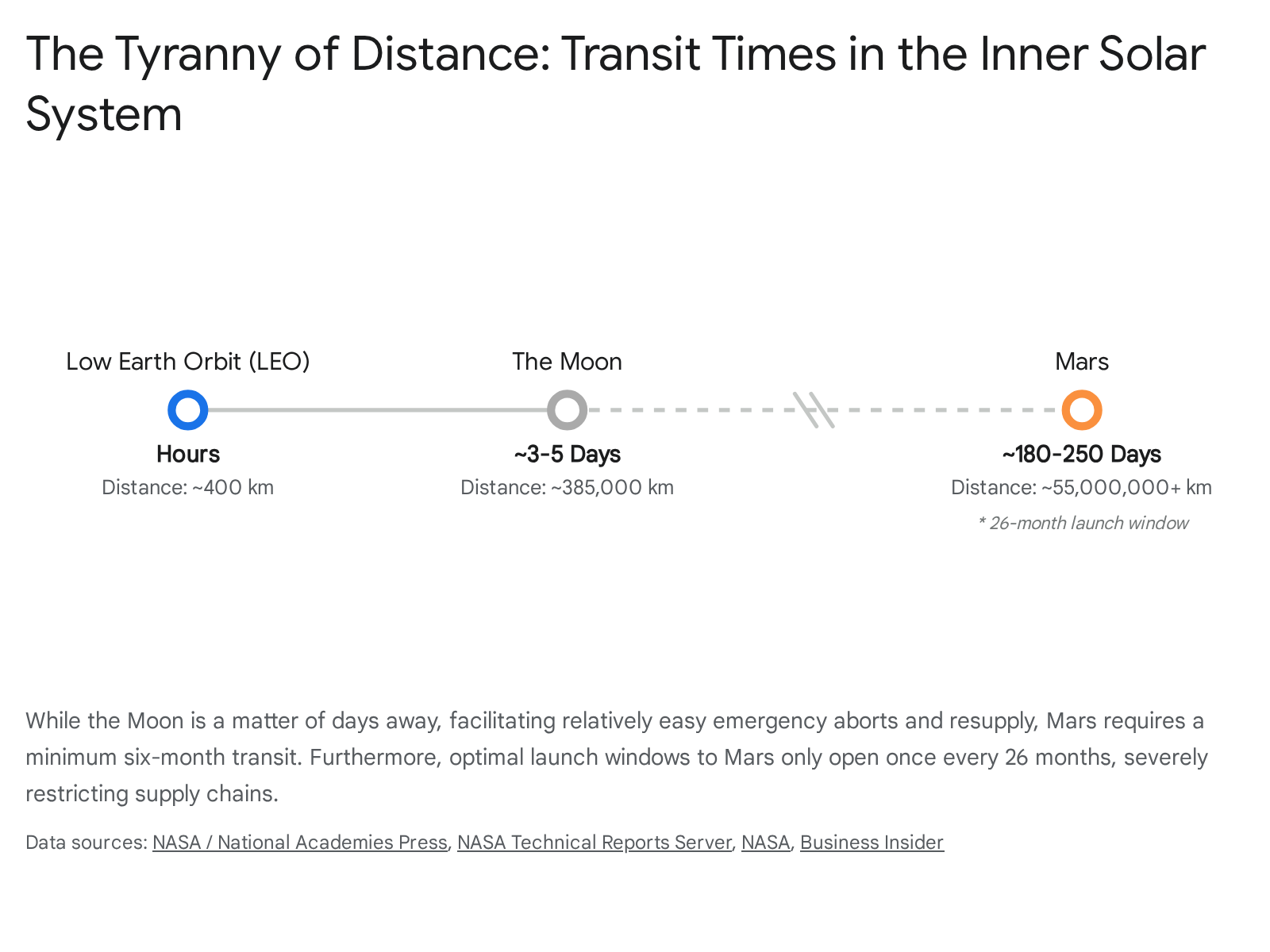
Note: A chart comparing travel times to LEO, the Moon, and Mars by propulsion type would be helpful here to illustrate the logistical constraints dictating where these global actors can practically deploy infrastructure.
5 Scenarios for Human Settlement of Space by 2050
Synthesizing aerospace engineering literature, official government roadmaps, and commercial contracts yields five distinct scenarios for human settlement by the mid-century.
Scenario 1: Commercialized Low Earth Orbit (The Orbital Industrial Park)
What happens to space stations after the ISS is decommissioned?
By 2050, the concept of a singular, government-operated space station in LEO will be entirely obsolete. The International Space Station, expected to be decommissioned by 2030, will have been replaced by a thriving ecosystem of commercial space stations 831. Companies like Vast - which is preparing to launch Haven-1, the world's first commercial space station featuring a microgravity research lab - will operate modular orbital outposts 51.
In this scenario, LEO functions akin to an industrial park and a luxury tourism destination. Permanent populations will remain small (teams of 4 to 12 per station) but highly rotational, utilizing reusable spacecraft to ferry tourists, microgravity manufacturing technicians, and researchers 51. Space-based manufacturing will leverage microgravity to produce high-value goods, such as flawless fiber optics, 3D-printed human tissue, and specialized pharmaceuticals, integrating these products directly into the terrestrial supply chain 52. The life support systems in LEO will remain partially open; the extreme proximity to Earth (a matter of hours) makes frequent resupply of water and oxygen economically viable, bypassing the strict need for deeply complex bio-regenerative systems 1729.
Scenario 2: The Multi-Polar Lunar South Pole (The Antarctic Analogue)
Why is everyone racing to the Moon's South Pole?
This is the most realistic, well-funded, and strategically significant scenario for 2050. Driven by the geopolitical rivalry between the U.S.-led Artemis Accords, the Sino-Russian ILRS, and ISRO's independent ambitions, multiple distinct, permanently occupied bases will dot the rims of craters at the lunar South Pole 25264330. The location is chosen specifically for its permanently shadowed craters, which hold ancient water ice - a critical resource for synthesizing life support consumables and liquid oxygen/liquid hydrogen rocket propellant 432.
However, sustaining these bases hinges entirely on solving the lunar "energy gap." A single lunar night lasts 14 Earth days, during which temperatures plummet to -170°C (-274°F) 12. Solar-only power architectures cannot survive this cycle without a prohibitive mass of batteries 154. Therefore, by 2050, these bases will be powered by standardized nuclear and radioisotope interfaces. NASA and the U.S. Department of Energy are currently developing 100-kWe fission surface power (FSP) reactors, while commercial entities are scaling the use of Americium-241 (sourced from commercial nuclear waste) to power mobile rovers and provide continuous thermal management 154.
These lunar outposts will not be sovereign cities, but rather rugged, government-subsidized industrial complexes. Much like Antarctic research stations, the population will fluctuate between 20 and 50 highly trained engineers, geologists, and technicians working in 6-to-12-month rotations 555. The habitat modules will likely be buried under regolith to shield against Galactic Cosmic Rays, and the economy will revolve around ISRU propellant generation, lunar geology, and strategic territory denial 4355.
Scenario 3: The Expanding "Moon Village" (The Unified Settlement)
Could the Moon host 1,000 residents by mid-century?
This scenario is an optimistic extension of the ESA's Moon Village concept. If launch costs via fully reusable heavy-lift vehicles drop precipitously, and if automated robotic construction proves highly reliable, the lunar population could theoretically scale toward 1,000 individuals by 2050 3148.
Under this outcome, the Moon transitions from a purely scientific and industrial frontier into a nascent society. Habitats are constructed autonomously by robots utilizing 3D printing technology to fuse basalt and lunar regolith into thick-walled dome structures prior to human arrival, offering ample radiation protection 484950. Agriculture shifts from experimental hydroponics to sustainable bio-regenerative life support farming within these domes 828. The economy expands beyond water mining to include the extraction of rare earth elements, helium-3 for advanced fusion energy research, and a burgeoning lunar tourism sector 313256. While international cooperation would be paramount here, current terrestrial political realities make this unified, large-scale settlement less likely than the fragmented, competitive, and militarized outposts of Scenario 2.
Scenario 4: The Martian Scientific Outpost (The Distant Frontier)
Will humans walk on Mars by 2050?
Yes, but it will be a sparse, spartan affair. By 2050, humanity will likely have established a small, precarious scientific foothold on the Red Planet, inhabited by perhaps 4 to 8 astronauts at any given time 119. This scenario is dictated by the immense logistical bottleneck of interplanetary transport and ISRU.
As previously established, transporting the 30 metric tons of LOX required for an ascent vehicle from Earth is economically prohibitive. Therefore, precursor cargo missions must land automated ISRU factories years in advance to synthesize fuel from the Martian atmosphere 2136. Because of the 26-month orbital launch windows, emergency resupply or rapid evacuation is physically impossible 117. Astronauts will endure up to 1,200 mSv of radiation over a multi-year mission and face significant psychological peril from the extreme isolation 111733. The base will be functionally similar to the earliest iterations of the ISS: small, highly dependent on precise supply chains, and focused entirely on geology, the search for past microbial life, and basic survival 11.
Scenario 5: The "Million on Mars" Billionaire Utopia (The Impossible Dream)
Is an independent, self-sustaining Martian city realistic in 30 years?
This is the scenario frequently touted by commercial spaceflight advocates: a self-sustaining metropolis of one million civilians on Mars by 2050 11910. Achieving this requires building 1,000 heavy-lift Starships, launching them en masse during the narrow 30-day planetary alignment windows, and transporting 100,000 people every two years 71510.
From an aerospace, biological, and economic perspective, this scenario scores a near-zero on the realism index. It glosses over the catastrophic health impacts of fetal development and multi-generational living in high-radiation, 0.375g environments 131727. It assumes the magical realization of 100% efficient closed-loop ecological systems capable of feeding a million people without Earth resupply, despite current technology failing to completely recycle solid waste or sustainably buffer atmospheric chemistry at scale 2934. Finally, it lacks a viable economic mechanism; there is no exportable Martian commodity valuable enough to offset the trillions of dollars required to sustain a civilian populace in a toxic, irradiated vacuum 5859. This scenario represents a powerful inspirational narrative that drives engineering recruitment and investment, but it is not a feasible engineering outcome for 2050.
Comparing the 5 Settlement Scenarios
The following table evaluates the five potential 2050 scenarios based on their physical location, projected population sizes, the primary global actors driving the initiative, and an evidence-based realism score derived from current technological and economic trajectories.
| Scenario | Location | Expected Population Size (2050) | Primary Actors / Drivers | Realism Score (1-10) |
|---|---|---|---|---|
| 1. Commercialized LEO | Low Earth Orbit (~400 km) | 50 - 100 (Spread across multiple stations) | Commercial spaceframes (e.g., Vast), NASA, ESA, space tourists | 9/10 (Technology currently exists; commercial contracts are active) |
| 2. Multi-Polar Lunar Outposts | Lunar South Pole | 20 - 50 (Rotational, industrial) | NASA (Artemis), China/Russia (ILRS), ISRO | 8/10 (Strong geopolitical will and funding; ISRU and nuclear development underway) |
| 3. The "Moon Village" | Lunar Surface (Various) | 500 - 1,000 (Permanent) | ESA, global public-private coalitions | 4/10 (Technologically plausible, but politically/financially unlikely by 2050) |
| 4. Martian Scientific Outpost | Mars Surface (Equatorial/Mid-latitudes) | 4 - 8 (Highly specialized researchers) | NASA, SpaceX (as transport provider), ESA | 6/10 (Requires immense ISRU scale-up and radiation mitigation breakthroughs) |
| 5. Billionaire Mars Utopia | Mars Surface | 1,000,000 (Civilian colonization) | SpaceX / Optimistic Private Enterprise | 1/10 (Biologically, logistically, and economically infeasible within 25 years) |
The Bottom Line
The trajectory of human space settlement leading up to 2050 is heavily influenced by rapid advancements in commercial launch capabilities and heavy-lift rocketry, but it remains firmly constrained by the unyielding laws of human biology and physics. The space economy will undoubtedly boom, maturing into a trillion-dollar industry that provides tangible, lucrative benefits to Earth - from advanced medical imaging algorithms and microgravity manufacturing to off-grid solar infrastructure and global broadband 13.
However, humanity will not be an interplanetary, multi-million-person species by mid-century. The sheer lethality of deep-space radiation, the severe physiological degradation caused by fractional gravity, and the immense difficulty of engineering truly closed-loop life support systems prevent rapid, mass civilian migration to Mars 11151734. Instead, the next twenty-five years will be defined by the rigorous industrialization of the Earth-Moon system. Driven by intense geopolitical competition between the US-led Artemis Accords, the Sino-Russian ILRS, and an ascendant ISRO, we will see the establishment of rugged, nuclear-powered resource extraction outposts at the lunar South Pole, operating much like modern Antarctic research stations 15264330. Mars will be reached, but it will stand as a distant, perilous scientific outpost, a testament to human endurance and precise engineering rather than a bustling second home.