
Experimental tests of quantum gravity phenomenology after 2023
Introduction to the Phenomenological Paradigm
The unification of general relativity and quantum mechanics stands as the most profound unresolved challenge in contemporary theoretical physics. For nearly a century, the pursuit of quantum gravity has been heavily dominated by top-down mathematical consistency, leading to the development of sophisticated structural frameworks such as String Theory, Loop Quantum Gravity, Asymptotic Safety, and Causal Dynamical Triangulations 12. However, the historic lack of empirical contact has relegated much of this monumental work to the realm of pure mathematical theory. The central obstacle to empirical validation is the Planck scale - the regime where quantum gravitational effects are expected to become dominant. Characterized by energies on the order of $10^{19}$ GeV, lengths of $10^{-35}$ meters, and times of $10^{-43}$ seconds, these scales exist approximately fifteen orders of magnitude beyond the operational reach of the most powerful terrestrial particle accelerators 3.
Despite this vast and apparent energy gap, the field of fundamental physics has recently undergone a massive paradigm shift toward a data-informed "quantum gravity phenomenology" 23. This paradigm operates on the core principle that one need not directly scatter individual gravitons at Planck energies to find evidence of quantized spacetime 1. Instead, researchers can systematically search for indirect, low-energy remnants, effective field theory signatures, or cumulative trans-Planckian effects that manifest across vast cosmological distances, within macroscopic quantum superpositions, or through mathematically isomorphic analog systems 4.
This research report delivers a fundamentally revised, exhaustive research plan for quantum gravity phenomenology in the post-2023 era. It massively expands the investigation of high-precision table-top experiments to incorporate recent theoretical and technological advancements in optomechanics, massive state superposition, and quantum sensing protocols. It integrates the rapidly maturing field of analog gravity, particularly utilizing ultracold Bose-Einstein condensates to simulate event horizons. Crucially, the analysis delineates the critical epistemological distinction between ruling out specific phenomenological effects - such as Lorentz Invariance Violation - and falsifying the foundational quantum gravity theories themselves. Finally, it comprehensively surveys the global infrastructure supporting this endeavor, mapping international collaborations across the globe and presenting a definitive comparative framework of Astrophysical, Cosmological, Table-top, and Analog observational strategies.
The Epistemological Distinction: Phenomenological Effects versus Fundamental Theories
A foundational priority in any revised research plan for quantum gravity is clarifying the exact relationship between observable phenomenological effects and the underlying fundamental theories. For decades, the search for Lorentz Invariance Violation (LIV) was heralded as the premier test for quantum spacetime geometry 56. The theoretical rationale was that if spacetime is fundamentally discrete - composed of quantized loops, spin foams, or granular networks - it might act as a dispersive, non-continuous medium. In such a scenario, the group velocity of propagating photons would exhibit an energy-dependent vacuum dispersion, breaking standard Lorentz symmetry and causing high-energy gamma rays to travel at slightly different speeds than low-energy photons 67.
However, this assumption has led to a widespread misconception within the broader physics community regarding the falsifiability of major theoretical frameworks. It is absolutely vital to separate the falsification of an isolated phenomenological model from the falsification of quantum gravity as a necessary feature of the universe.
Lorentz Invariance in String Theory and Loop Quantum Gravity
String Theory is fundamentally formulated as a background-dependent perturbative framework that naturally incorporates supersymmetry and higher dimensions to achieve a unified description of gauge interactions and matter 8. While possessing background-independent aspirations in its non-perturbative formulations, the baseline theory preserves local Lorentz symmetry exactly. The $SO(d-1,1)$ symmetry of the target spacetime arises directly and unavoidably from the $SO(d-1,1)$ global symmetry rotating fields on the two-dimensional string worldsheet 10. While spontaneous Lorentz violation can be mathematically engineered in certain specific non-critical or brane-world scenarios (such as Liouville string models or D-particle "foamy" situations) 511, the overarching theory does not require or generically predict LIV.
Conversely, Loop Quantum Gravity (LQG) is a background-independent, non-perturbative canonical quantization of general relativity that emphasizes a discrete spacetime geometry defined by spin networks 68. Early phenomenological arguments incorrectly suggested that this inherent discreteness must inevitably violate Lorentz invariance, acting as an ether-like lattice. Consequently, when space-based observatories consistently found no evidence of LIV at extreme energies, some critics prematurely declared LQG to be fundamentally falsified 610. However, advanced and rigorous formulations of LQG demonstrate that the theory is perfectly compatible with continuous local Lorentz invariance. The discreteness of area and volume operators in LQG does not inherently mandate a preferred reference frame any more than the quantized angular momentum in atomic orbitals violates continuous rotational invariance 10. Both String Theory and LQG, despite their deep ontological and metaphysical incompatibilities regarding the nature of spacetime, are robust against the non-detection of LIV 810.
The Standard-Model Extension (SME) and Effective Field Theories
The modern, mathematically rigorous approach to testing spacetime symmetries relies entirely on the Standard-Model Extension (SME). The SME is an Effective Field Theory (EFT) framework that systematically incorporates all possible Lorentz-violating and CPT-violating operators while strictly preserving coordinate diffeomorphism invariance 5. When astrophysical observations rule out Lorentz violation, they are not testing quantum gravity directly; they are specifically constraining the dimensionless coefficients of these higher-dimensional SME operators.
For instance, recent constraints derived from highly energetic astrophysical events have pushed the lower limit of the linear LIV energy scale well beyond the Planck energy in certain theoretical scenarios, effectively ruling out linear Lorentz violation 79. While this successfully eliminates a specific class of modified dispersion relations, it does not rule out the need to quantize the metric tensor. Instead, it forcefully informs theorists that whatever the ultimate ultraviolet (UV) completion of gravity is, its low-energy effective limit must recover standard Lorentz symmetry to an extraordinary, almost unreasonable degree of precision 1. The epistemological distinction is critical: ruling out a phenomenological effect simply constrains the parameter space of the EFT; it does not invalidate the foundational necessity of merging general relativity with quantum mechanics 13.
Astrophysical Probes of Quantum Spacetime
Astrophysical observatories utilize the observable universe as a high-energy, long-baseline particle accelerator, relying on the immense propagation distances of cosmic messengers to accumulate and magnify minuscule, sub-Planckian quantum spacetime fluctuations until they reach detectable thresholds 3.
Neutrino Decoherence and Fluctuating Metrics
Neutrinos serve as ideal probes for quantum gravity phenomenology. Because they are nearly massless and interact almost exclusively via the weak nuclear force and gravity, they maintain quantum phase coherence over macroscopic, cosmological distances 10. This extreme isolation allows them to act as natural quantum interferometers. If spacetime fundamentally fluctuates - often visualized as a stochastic "quantum foam" of virtual black holes continuously appearing and evaporating from the metric - these fluctuations would trace out non-unitary evolution, perturbing the propagation of neutrinos. This interaction would distort their standard energy- and direction-dependent flavor compositions, leading to an observable loss of quantum coherence 110.
In March 2024, the IceCube Neutrino Observatory, utilizing a cubic-kilometer array embedded in the Antarctic ice, released a landmark study in Nature Physics analyzing a vast sample of atmospheric neutrinos in the 0.5 to 10 TeV energy range 10. The researchers systematically searched for deviations from the standard quantum mechanical rules governing neutrino flavor oscillations, which would signal interactions with fluctuating spacetime metrics. The study found no evidence of neutrino decoherence. However, the non-detection set the world's most stringent constraints on neutrino-quantum gravity interactions, improving upon past limits across a massive range of theoretical scenarios 10. The sensitivity achieved was so profound that principal investigators noted it is highly unlikely any future neutrino experiment will surpass these limits in the near term, directing the field to pivot toward photon, electron, or massive atom interferometry for future decoherence searches 110.
High-Energy Gamma-Ray Bursts and Vacuum Dispersion
Gamma-Ray Bursts (GRBs) remain the primary tool for testing modified dispersion relations and the SME framework. If spacetime discreteness alters the group velocity of light, higher-energy photons emitted simultaneously from a distant GRB will arrive slightly before or after their lower-energy counterparts, depending on whether the LIV effect is subluminal or superluminal 679.
Post-2023 analyses have heavily utilized multi-messenger and multi-wavelength data from a global network of observatories, including the Fermi Gamma-ray Space Telescope, the MAGIC telescopes, and the Large High Altitude Air Shower Observatory (LHAASO), to tighten these constraints mathematically. Observations of the extreme TeV afterglow from GRB 221009A provided unprecedented upper bounds. Using the sophisticated Dispersion Cancellation (DisCan) method, researchers established 95% confidence level lower limits on the quantum gravity energy scale. For linear subluminal scenarios, the limit was pushed to $E_{QG,1} > 5.4 \times 10^{19}$ GeV, surpassing the Planck scale 9. For quadratic scenarios, the limit was established at $E_{QG,2} > 10.0 \times 10^{12}$ GeV 9.
Furthermore, stringent Standard-Model Extension (SME) constraints were derived for birefringence-free LIV operators using 14 GeV-band GRB photons, establishing bounds on the isotropic coefficients for dimensions $d = 6, 8,$ and $10$, with the dimension-6 operator constrained to $|c_{(I)00}^{(6)}| \le 7.75 \times 10^{-20}$ GeV$^{-2}$ 9. Meanwhile, complex parametric fits using Markov Chain Monte Carlo (MCMC) sampling on a dataset of 360 spectral lag measurements across 90 GRBs suggest a maximum a posteriori value for an intrinsic time delay near $8.96 \times 10^{14}$ GeV, though this specific finding remains broadly compatible with exact Lorentz invariance up to a 2.8$\sigma$ confidence interval 7.
Gravitational Waves and Massive Gravity in Pulsar Timing Arrays
Beyond the utilization of photons and neutrinos as messengers, gravitational waves themselves are increasingly being utilized to test low-energy alternatives to general relativity. The European Pulsar Timing Array (EPTA) and the North American Nanohertz Observatory for Gravitational Waves (NANOGrav) have begun utilizing the stochastic gravitational wave background (SGWB) to test complex models of Massive Gravity 1116. In these modified theories, the graviton is theorized to possess a minuscule, non-zero mass, which inherently introduces modified dispersion relations and additional scalar and vector polarization modes for the propagating gravitational waves 16. By meticulously analyzing the angular cross-correlations between timing residuals - analytically computed through the Overlap Reduction Function - researchers are currently executing Bayesian analyses to determine if there is any observational preference for these beyond-GR modifications within the nanohertz gravitational wave spectrum 16.
Cosmological Signatures and Trans-Planckian Imprints
The early universe provides a second major macroscopic arena for quantum gravity phenomenology. During the inflationary epoch, microscopic quantum fluctuations were stretched exponentially to macroscopic, cosmological scales, leaving an indelible imprint on the Cosmic Microwave Background (CMB) 117. The primary phenomenological quest in cosmology is to determine if trans-Planckian physics - effects originating at energy scales smaller than the Planck length - survived this rapid expansion to alter the primordial power spectrum and leave observable artifacts today 18.
CMB Anomalies and the Breakdown of the Cosmological Principle
The standard $\Lambda$CDM model of cosmology, while remarkably successful at predicting the general structure of the universe using only six fundamental parameters, exhibits several persistent statistical anomalies at large angular scales (low multipoles) in the temperature map data gathered by both the Wilkinson Microwave Anisotropy Probe (WMAP) and the Planck satellite 17121314. The most prominent of these anomalies include the low quadrupole, representing an unusually low amplitude of temperature fluctuations at the largest angular scales ($\ell = 2$) indicating a distinct lack of variance compared to standard inflationary predictions 171523. Another significant deviation is the hemispherical power asymmetry, a dipolar power modulation where the variance of temperature fluctuations is significantly different between opposite hemispheres of the sky (colloquially termed the "Axis of Evil"), which sharply violates the Cosmological Principle's foundational assumption of isotropy 171524. Finally, there is the Cold Spot, a massive, anomalous region in the Southern hemisphere with a deeply negative amplitude and high kurtosis at scales of around five degrees 131516.
While standard cosmology often dismisses these features as mere statistical flukes or local foreground contaminants, quantum gravity phenomenology investigates them as highly motivated potential signatures of new, pre-inflationary physics 141617.
Loop Quantum Cosmology and the Big Bounce
Loop Quantum Cosmology (LQC), a rigorous symmetry-reduced application of Loop Quantum Gravity to the homogeneous and isotropic universe, replaces the classical Big Bang singularity with a "Big Bounce." In the LQC framework, as the universe contracts to the Planck density, the repulsive quantum geometry effects native to the quantized spacetime halt the collapse, triggering a cosmic rebound 14.
Recent theoretical advancements have demonstrated that LQC can naturally and elegantly explain the observed CMB anomalies without relying on fine-tuning 14. The extreme curvature of space at the Big Bounce imprints specific primordial fluctuations in the CMB at wavelengths far greater than the size of the presently visible universe. While these super-horizon modes cannot be directly detected, they correlate dynamically with smaller observable wavelengths. This interaction effectively suppresses power at the largest angular scales (directly explaining the anomalous low quadrupole) and induces the observed hemispherical power asymmetries 14.
Furthermore, alternative cosmological formulations such as Direct-Sum Inflation (DSI) introduce the spontaneous breaking of $\mathcal{C}\mathcal{P}\mathcal{T}$ symmetry in an expanding universe. In DSI, a quantum fluctuation arises as a direct sum of two components evolving forward and backward in time at parity-conjugate points in physical space 1524. Rigorous statistical analysis reveals that DSI explains the low quadrupole with a p-value of 3.5%, making it approximately 39 times more capable of explaining the data than standard inflation. When combining statistics from parameters measuring parity and the low-$\ell$ angular power spectrum, DSI is calculated to be between 50 and 650 times more statistically probable than standard $\Lambda$CDM at explaining the anomalies 15.
Future Cosmological Observatories and Polarization Cross-Spectra
Current polarization data from the Planck satellite remains heavily noise-limited at the largest scales, preventing a definitive, statistically unassailable confirmation of these quantum gravitational effects 1216. Consequently, the research plan heavily emphasizes the absolute necessity of next-generation observatories. The LiteBIRD satellite and the ground-based CMB-S4 experiment are currently being designed to measure the CMB E-mode and B-mode polarization anisotropies precisely at the cosmic variance limit 1618.
If the anomalies are genuine trans-Planckian signatures rather than local astrophysical dust or statistical noise, they will manifest vividly in the polarization cross-spectra. The detection of a scale-dependent B-mode polarization signal, alongside precise measurements of the tensor-to-scalar ratio and primordial non-Gaussianities (PNG), would provide a conclusive verification of quantum cosmology 162829. Recent orthogonalization schemes deployed on Planck data using Modal bispectrum estimators have already begun searching for cosmological collider signals, achieving maximum signal-to-noise ratios of 2.35$\sigma$ for massive spin-0 exchanges, setting the stage for future definitive tests 29.
Post-2023 Advancements in Table-Top Quantum Gravity
Perhaps the most revolutionary shift in the quantum gravity landscape over the last decade is the emergence of highly controlled, table-top quantum experiments 192021. While astrophysics and cosmology must rely on the passive observation of uncontrollable environments and historical data, table-top experiments offer the ability to actively, precisely manipulate quantum states to test the linearized regime of quantum gravity 2033.
Massive Superposition and the QGEM Protocol
For decades, gravity has been treated mathematically as a classical background field. The pivotal, foundational question is whether gravity itself can exist in a quantum superposition and actively mediate quantum entanglement between distinct particles 1922. The Quantum Gravity Induced Entanglement of Masses (QGEM) protocol proposes a direct test of this: placing two adjacent, massive, neutral test masses into spatial quantum superpositions 19. If the gravitational field is fundamentally quantum in nature, the gravitational interaction between the two localized masses will entangle their states via the exchange of virtual gravitons. Observing this entanglement through simple correlation measurements between two spins embedded in the test masses would verify that gravity acts as a coherent quantum mediator, effectively proving the quantum nature of the gravitational field without requiring access to Planck-scale scattering energies 192022.
Post-2023 advancements have radically improved the technological feasibility of this protocol. Previous theoretical iterations required the masses to be in perfect free-fall to avoid coupling to the environment, a setup fraught with practical impossibilities regarding signal loss. Recent theoretical frameworks have introduced nanodiamond-based interferometry that utilizes steady massive, mesoscopic objects trapped in highly controlled, small-range electromagnetic fields 35. This steady-state approach allows the massive quantum probes to be continuously re-utilized rather than permanently lost after a single drop, vastly increasing the statistical data acquisition rate and substantially lowering the resource barrier to entry for optical laboratories worldwide 35.
Interferometric Quantum Sensors: GQuEST and QUEST
Simultaneous with superposition experiments, extreme-precision laser interferometry is being rapidly repurposed to search directly for geontropic spacetime fluctuations and dark matter candidates.
The GQuEST (Gravity from the Quantum Entanglement of Space Time) experiment, a major collaborative effort between Fermilab and the California Institute of Technology (Caltech), utilizes an ultra-sensitive tabletop laser interferometer 2324. Building extensively on readout technologies, cryostats, and vacuum vessels developed for the Laser Interferometer Gravitational-Wave Observatory (LIGO) and the legacy Fermilab Holometer, GQuEST pushes past the standard quantum limit by physically counting individual photons 23. Its primary objective is to detect fundamental scalar-metric fluctuations - tiny, random distortions in the structure of spacetime that arise naturally in holographic and emergent gravity models connected to quantum information theory 2526.
Similarly, the QUEST (Quantum Enhanced Space-Time measurement) experiment at Cardiff University's Gravity Exploration Institute has recently achieved a record-breaking level of sensitivity for a table-top device 21. QUEST consists of two bespoke, high-precision, co-located laser interferometers capable of measuring changes in length 100 trillion times smaller than the width of a human hair 2127. In its first science run in late 2025, QUEST set entirely new constraints on the existence of very-high-frequency gravitational waves, which theorists believe could be emitted by miniature primordial black holes or early universe phase transitions 2127. These unified approaches - categorizing fluctuations based on how they behave across space and time - are rapidly turning abstract quantum gravity ideas into highly testable, measurable signals 26.
Technological Bottlenecks: Vacuum Noise and Fundamental Decoherence
The primary theoretical and technological bottleneck for all table-top quantum gravity research is decoherence 2228. To successfully witness gravitational entanglement, the masses must remain strictly isolated from all electromagnetic interactions, thermal radiation, and stray gas particles. Numerical simulations indicate a severe, mass-dependent reduction in interference visibility, dropping from near unity at $10^{-16}$ kg to below 0.2 at $10^{-14}$ kg 28. Maintaining coherence requires extending interaction times beyond one second, which necessitates deep cryogenic cooling (below 196 degrees Celsius) and ultra-high-vacuum environments orders of magnitude purer than currently attained 2028.
Furthermore, researchers must differentiate between standard environmental decoherence and intrinsic fundamental collapse models, such as Continuous Spontaneous Localization (CSL) 28. CSL predicts an inherent, mass-proportional suppression of quantum interference. Distinguishing a failure to entangle caused by classical thermal noise from a failure caused by the fundamental breakdown of quantum mechanics at macroscopic scales remains a formidable challenge 2228. Current efforts to overcome these limitations focus intensely on engineering the quantum vacuum itself. Researchers are utilizing "squeezed" vacuum states and chiral optical cavities to actively reshape and reduce quantum noise, actively shielding the fragile qubits and test masses from ubiquitous vacuum fluctuations 4229.
Analog Gravity: Spacetime Simulators Using Bose-Einstein Condensates
Because direct empirical access to intense gravitational fields - such as the event horizons of astrophysical black holes - is impossible, the research plan heavily integrates Analog Gravity. Analog gravity exploits the exact mathematical isomorphism between the propagation of small density perturbations in certain condensed matter systems and the propagation of scalar quantum fields in highly curved spacetime 4445.
Acoustic Black Holes and the Simulation of Hawking Radiation
In 1981, physicist William Unruh demonstrated theoretically that sound waves (phonons) propagating in a moving fluid experience an effective metric perfectly analogous to the metric of general relativity 30. If a fluid is accelerated such that it flows faster than the local speed of sound, it creates a "sonic horizon" - a strict boundary beyond which acoustic waves cannot travel upstream against the flow. This acoustic horizon perfectly mimics the causal structure of a black hole's event horizon 30.
Ultracold atomic Bose-Einstein Condensates (BECs) have emerged as the premier experimental platform for these simulations. Their proximity to absolute zero allows the quantum nature of sound to emerge without being masked by thermal noise, enabling an accurate theoretical description via Bogoliubov equations 4447. According to Stephen Hawking's monumental 1974 discovery, black holes emit a thermal spectrum of particles due to the conversion of quantum vacuum fluctuations into real, on-shell particles near the horizon 4530. In a BEC, the rapid acceleration of the superfluid across the sonic horizon forces the quantum vacuum to spontaneously emit pairs of entangled phonons - one positive-energy phonon escapes the analog black hole, while its negative-energy partner falls inexorably beyond the sonic horizon 4530.
Post-2023 Methodological Advances in Analog Systems
Recent experiments, heavily analyzed and discussed at specialized analog gravity schools such as the Benasque Science Center in early 2026, have advanced significantly past merely detecting a thermal emission spectrum 31. The modern "smoking gun" for analog Hawking radiation is the direct observation of quantum entanglement between the emitted phonon pairs 45.
Researchers are now utilizing sophisticated Fourier transforms of density correlators and momentum correlators to prove unequivocally that the emission arises spontaneously from the correlated quantum vacuum, validating the microscopic Bogoliubov theory underlying the phenomenon 45. While analog gravity cannot reveal the exact dynamical equations of quantum gravity - as the background is governed entirely by condensed matter physics and hydrodynamics, not the Einstein-Hilbert action - it definitively proves the robustness of the kinematics of quantum field theory in curved spacetime 4532. Specifically, it demonstrates experimentally that the Hawking effect is a universal process that does not rely on, nor is it destroyed by, potential deviations in physics at the trans-Planckian scale 4532.
Global Infrastructure and Collaborative Networks
The realization of this comprehensive, multi-disciplinary research plan is actively supported by a highly integrated global infrastructure. Quantum gravity phenomenology has fundamentally transitioned from isolated theoretical mathematics departments to massive, well-funded international collaborative networks spanning the globe.
In North America, Fermi National Accelerator Laboratory (Fermilab), the California Institute of Technology (Caltech), and the Jet Propulsion Laboratory lead the cutting-edge GQuEST interferometry efforts, backed by substantial funding from the US Department of Energy's QuantiSED program 2324. Additionally, institutions like the Aspen Center for Physics routinely host vital, weeks-long workshops dedicated to "Observables in Quantum Gravity," bridging the deep communication gap between experts in algebraic quantum field theory and tabletop experimentalists 335134.
In Europe, the Max Planck Institute for Gravitational Physics (Albert Einstein Institute) in Germany spearheads quantum-limited interferometric measurements and the development of squeezed-light sources crucial for noise reduction 35. The United Kingdom's Cardiff University successfully operates the QUEST facility and acts as a central hub for the Gravity Exploration Institute 2736. In Italy, the National Institute for Nuclear Physics (INFN) facilitates broad theoretical integration at major conferences, such as PAFT26, uniting classical, quantum, and modified gravity researchers 37.
In the Asia-Pacific region, China has emerged as a rapidly expanding hub for Loop Quantum Gravity. Major institutions, including Zhejiang University of Technology and Yangzhou University, host the annual Loops international conferences and summer schools, uniting hundreds of canonical and covariant LQG researchers 563858. Japan's KEK facility in Tsukuba relentlessly drives initiatives exploring the foundations of quantum theory and the thermodynamic emergence of spacetime 39. Australia, bolstered by nearly AU$900 million in federal funding, focuses heavily on translating quantum infrastructure into functional technology, evident in the large-scale Quantum Australia conferences and the ecosystem development driven by Quantum Australia's network of university partners 6061.
Finally, the Global South contributes vital intellectual diversity to the field. South American institutions, including Argentina's Instituto de Física La Plata and Brazil's ICTP-SAIFR, host crucial symposiums connecting string theory, quantum gravity, and phenomenological models, ensuring a truly global effort to solve the quantum gravity problem 4063.
Comparative Analysis of Phenomenological Approaches
To optimize resource allocation, funding strategies, and experimental design for the next decade, the diverse methodologies of quantum gravity phenomenology must be systematically categorized and compared.
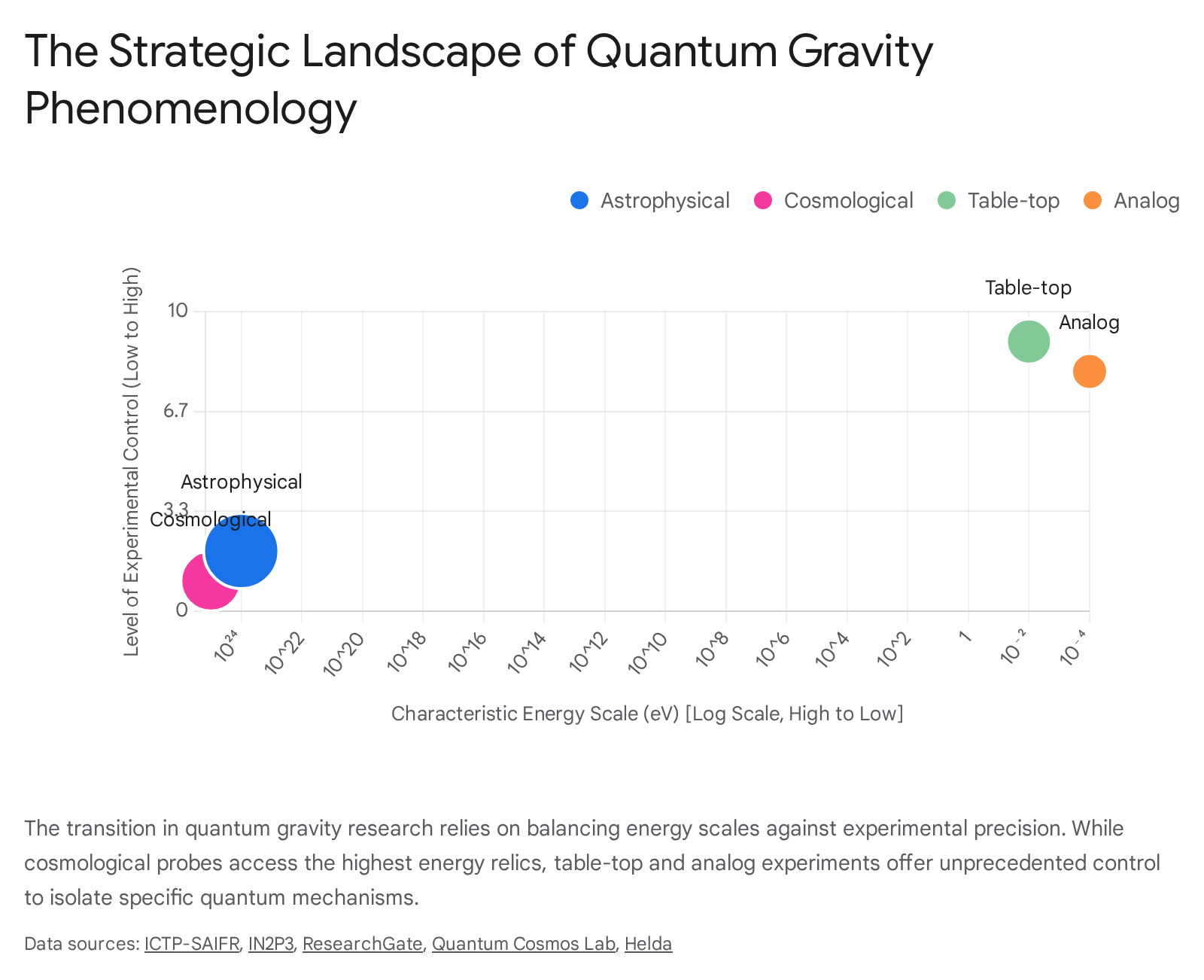
The following table details the four primary approaches - Astrophysical, Cosmological, Table-top, and Analog - delineating their targeted energy scales, primary observables, and the critical theoretical and technological bottlenecks inherent to each strategy.
| Approach Category | Characteristic Energy / Length Scale Probed | Key Observables & Physical Signatures | Primary Technological & Theoretical Bottlenecks |
|---|---|---|---|
| Astrophysical | High Energy ($> 10^{14}$ GeV up to the Planck scale) 7 | Neutrino flavor decoherence; GRB spectral lags; SGWB polarization and graviton mass 91016. | Extremely sparse data points (limited UHE GRBs); uncertainties regarding intrinsic source emission times 7. |
| Cosmological | Ultra-High Energy (Inflationary/Planck regime) 1814 | CMB large-scale anomalies (low quadrupole, parity asymmetry); scale-dependent B-mode polarization 171415. | The cosmic variance limit; severe foreground contamination (galactic dust); geometric parameter degeneracies 2841. |
| Table-top | Low Energy (sub-eV) but high mass objects ($10^{-14}$ kg) 28 | Gravitationally induced entanglement (QGEM); high-frequency gravitational waves; spatial metric fluctuations 192125. | Severe environmental decoherence (thermal radiation, residual gas); mitigating quantum vacuum noise; isolating CSL collapse models 2842. |
| Analog Gravity | Effective kinematic high-energy (Acoustic event horizons) 45 | Spontaneous phonon entanglement; Hawking radiation thermal spectra; density/momentum correlators 4530. | Cannot probe fundamental dynamical gravity (Einstein-Hilbert equations); relies entirely on kinematic mathematical analogies 4432. |
Conclusion
The pursuit of quantum gravity has definitively crossed the threshold from an exercise in abstract mathematics into an era of rigorous, multi-disciplinary phenomenology. This comprehensively revised research plan demonstrates that the field no longer relies on the hope of a single "silver bullet" observation, but rather embraces a robust web of complementary investigations spanning the cosmos and the laboratory.
Astrophysical and cosmological observations continue to push the boundaries of accessible energy scales, utilizing Gamma-Ray Bursts, neutrinos, and the Cosmic Microwave Background to place stringent, unprecedented limits on phenomenological effects such as Lorentz Invariance Violation. Crucially, the theoretical community now universally recognizes that constraining these effective field theories serves to refine and guide, rather than falsify, the fundamental foundational frameworks of String Theory and Loop Quantum Gravity.
Simultaneously, post-2023 advancements have positioned table-top optomechanics, massive superposition, and advanced quantum sensing as the most promising, high-control frontier for active experimentation. By seeking to entangle macroscopic masses through the QGEM protocol and measuring geontropic fluctuations with photon-counting interferometers, experiments like GQuEST and QUEST offer the tantalizing possibility of witnessing the quantum nature of spacetime directly in the laboratory. Bolstered by the kinematic proofs of Hawking radiation provided by analog gravity in Bose-Einstein condensates, and supported by a robust, well-funded global network of observatories and collaborative institutions, quantum gravity phenomenology is poised to answer the most fundamental questions regarding the fabric of reality. The ongoing, paramount necessity for the coming decade is the continued technological push toward ultra-high vacuum environments and active precision noise mitigation, ensuring that the faint whispers of quantum spacetime are not drowned out by the noise of the classical world.