
Statistical physics models of social phase transitions
1. Introduction: The Thermodynamic Lens on Collective Human Behavior
The application of statistical mechanics to collective human behavior - a discipline broadly termed sociophysics - operates on the profound premise that the macroscopic properties of a society can emerge predictably from the microscopic interactions of its constituents. Just as the macroscopic states of matter are governed by the localized interactions of atoms and molecules, societal shifts ranging from the sudden adoption of a technological innovation to the spontaneous polarization of political discourse can be modeled as critical phenomena. These shifts are known as social phase transitions: abrupt, systemic transformations in the collective state of a population triggered by infinitesimal changes in external conditions, interaction topologies, or internal behavioral thresholds 122.
The foundational baseline for this field was comprehensively mapped in Castellano, Fortunato, and Loreto's seminal 2009 review, which demonstrated that spin-glass systems and interacting particle frameworks could accurately replicate opinion consensus, cultural dissemination, and crowd dynamics 35. In the Castellano paradigm, individuals are modeled as interacting nodes (spins) seeking to align their states to minimize local social friction, analogous to minimizing energy in a physical Hamiltonian. However, as the 2009 review crucially noted, human societies are inherently out-of-equilibrium systems. Unlike a true zero-temperature Hamiltonian system, the local minimization of social disagreement often drives an increase in global tension, creating frustrated, metastable states rather than a perfectly ordered equilibrium 3.
Recent research spanning 2023 to 2026 has radically expanded this baseline. The digital epoch has rendered the classical assumption of perfectly mixed populations or simple regular Euclidean lattices obsolete 147. Modern sociophysics must account for the architecture of contemporary socio-technical ecosystems: hypergraphs capturing polyadic group dynamics, temporal networks characterizing bursty online communication, and multiplex networks representing simultaneous interactions across disparate platforms 45. Furthermore, the introduction of algorithmic mediation - where platform algorithms act as non-uniform external fields - has necessitated a re-evaluation of classic models like the Ising, Sznajd, and Deffuant-Weisbuch frameworks 19.
This report delivers an exhaustive analysis of how modern topological realities and psychological parameters - such as human agency, memory kernels, and cross-cultural variations along the individualism-collectivism spectrum - are being integrated into sociophysical models. By prioritizing conceptual mechanisms and empirical boundaries over deep mathematical derivations, the analysis maps the evolving frontier of social phase transitions for interdisciplinary application in journals such as Physical Review E, Nature Human Behaviour, and the Journal of Artificial Societies and Social Simulation.
2. Defining Social Phase Transitions and the Micro-to-Macro Mapping
A phase transition in statistical physics occurs when a system's macroscopic state changes abruptly at a critical value of an external parameter, such as temperature or magnetic field. In the context of society, a social phase transition describes the threshold at which a population moves from a disordered, heterogeneous state of fragmented opinions into a globally ordered state of consensus, or conversely, fractures into rigidly polarized echo chambers 12.
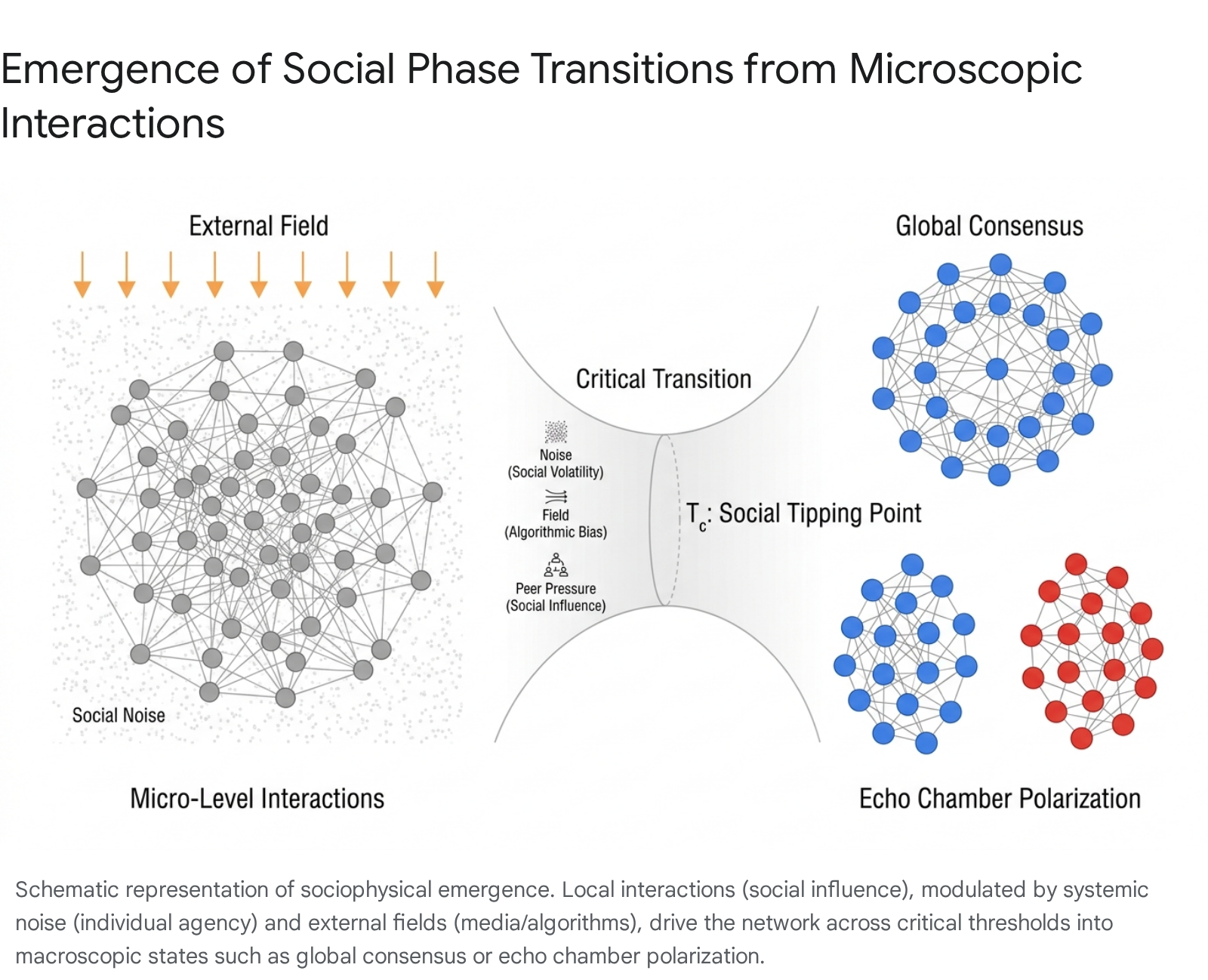
To understand the dynamics of these social phase transitions, it is imperative to establish the conceptual vocabulary linking thermodynamic variables to sociological realities. While the mapping is not perfectly isomorphic, it provides a robust heuristic for understanding tipping points in human networks 36. The table below outlines these structural analogs.
| Statistical Physics Framework | Sociological / Sociotechnical Analog | Conceptual Mechanism in Modeling |
|---|---|---|
| Spin State ($S_i = \pm 1$) | Binary Opinion / Choice | An individual's discrete stance on an issue (e.g., voting intent, technology adoption, belief in a rumor). |
| Continuous State Variable | Nuanced Belief / Attitude | A quantified stance on a spectrum (e.g., from 0 to 1), allowing for compromise and bounded interaction. |
| Thermal Noise / Temperature ($T$) | Social Volatility / Independence | The degree of randomness or idiosyncratic behavior. High "temperature" equates to individuals making choices independent of peer pressure. |
| External Magnetic Field ($H$) | Mass Media / Algorithmic Bias | Top-down pressure applied globally or locally. Propaganda, advertising campaigns, or recommendation algorithms pushing an overarching narrative. |
| Exchange Interaction ($J_{ij}$) | Social Influence / Peer Pressure | The strength of the tie between individuals. Ferromagnetic interactions represent homophily (alignment); antiferromagnetic represent contrarianism. |
| Phase Transition ($T_c$) | Social Tipping Point | The critical threshold where a society shifts abruptly from disorder (fragmentation) to order (consensus/polarization). |
| Magnetization ($M$) | Global Consensus Level | The macroscopic order parameter indicating the overall dominance of one opinion over another in the society. |
| Hysteresis | Opinion Inertia / Retained Memory | The resistance of a society to return to a prior state even after the external field (propaganda) is removed. |
The mapping extends beyond simple interactions to encompass the underlying physical structure of the system. In the standard baseline defined in 2009, many of these transitions were evaluated using models analogous to zero-temperature spin-1 systems, such as the Blume-Emery-Griffiths framework applied to the Schelling segregation model 11. Under zero-temperature conditions without thermal noise, populations easily fall into frozen, metastable configurations where movement is halted not because optimal global satisfaction is achieved, but because local constraints block further evolution 11713. The introduction of a "temperature" parameter - allowing a small fraction of individuals to make choices contrary to their immediate utility - acts analogously to simulated annealing, preventing the network from trapping itself in localized sub-optimal states and driving it toward broader macroscopic segregation or integration depending on the vacancy density 89.
3. The Thermodynamics of Modern Networks and Complex Contagion
The physics of opinion dynamics is inextricably linked to the topology upon which it unfolds. Classical models initially utilized fully connected graphs or simple Euclidean lattices, which reliably yield spontaneous symmetry breaking and scaling laws akin to standard ferromagnetic transitions 3. However, human societies are not crystalline structures. The period from 2023 onward has seen a paradigm shift away from dyadic, static assumptions toward topologies that accurately mirror the complex, multi-layered nature of digital human engagement.
3.1 Simplicial Complexes and Higher-Order Interactions
Recent physics literature has demonstrated that replacing dyadic (pairwise) interactions with polyadic (group) interactions fundamentally alters the nature of social phase transitions 4716. In the real world, human influence often requires the simultaneous reinforcement of a group - a phenomenon known as complex contagion. Unlike the simple contagion modeled by standard Susceptible-Infected-Recovered (SIR) epidemic models, complex contagion requires exposure to multiple independent sources before adoption or belief change occurs 1.
Sociophysics addresses this by mapping models onto simplicial complexes and hypergraphs. When a classical opinion model is elevated to a hypergraph, the critical dynamics change profoundly. Instead of a continuous, second-order phase transition characteristic of pairwise models, group-driven dynamics can induce an explosive, discontinuous phase transition 410. Interestingly, when applied to bounded-confidence frameworks on random hypergraphs, the sharp phase transition often associated with pairwise models is suppressed. Instead, the system undergoes a smooth, size-independent crossover to consensus as the tolerance threshold increases, a phenomenon noticeably absent from regular lattice hypergraphs which conserve their sharp transitions 16. This implies that in modern algorithmically curated forums, the shift toward societal consensus relies heavily on a critical mass of simultaneous reinforcement, rendering the network highly susceptible to sudden cascades once an absolute group threshold is breached.
3.2 Multiplex and Temporal Topologies
Individuals occupy multiple social dimensions simultaneously - such as professional, familial, and political networks. Modern sociophysics captures this multidimensionality via multiplex (or multi-layer) networks 4518.
Inter-layer correlation plays a critical role in stabilizing or destabilizing a society. If layers are highly correlated - meaning individuals interact with the exact same peers across disparate contexts (e.g., maintaining the same social circle on LinkedIn, Facebook, and local community boards) - the system acts as an "echo chamber" and rapidly falls into an absorbing state of polarization 5. Conversely, if layers are distinctly uncorrelated, the competing interactions between layers can stabilize mixed states. This topological diversity allows conflicting opinions to coexist dynamically without the system freezing into total consensus or fracturing into rigid polarization 45.
Furthermore, temporal networks capture the non-Markovian "burstiness" of human communication. Standard physics models previously assumed a constant, Poissonian rate of interaction. Modern activity-driven models reveal that the specific timing of interactions - periods of high localized activity followed by long periods of dormancy - fundamentally alters system relaxation times. Temporal burstiness can either localize the spread of a rumor early in its lifecycle or drastically increase the total time required for the society to reach thermodynamic consensus 419.
4. Upgrading Classical Models for the Digital Era
With the structural substrate of society updated to reflect modern networks, sociophysicists have heavily modified the internal update rules of classical models to account for the realities of the digital information ecosystem. The Ising, Sznajd, and Deffuant models have evolved significantly to incorporate algorithmic bias, media manipulation, and varying degrees of human non-conformity.
4.1 The Ising Paradigm: Volatility, Propaganda, and Algorithmic Bias
The Ising model remains the gravitational center of sociophysics. In its socio-technical adaptation, the updating rule often relies on a majority-vote mechanism where agents adopt the state of their local neighborhood to minimize local social friction (analogous to exchange energy $J_{ij}$) 411. The introduction of a "temperature" parameter acts as social noise: the probability that an agent will behave idiosyncratically and adopt a minority stance, effectively modeling human independence, irrationality, or error 312.
Recent literature has extensively modeled the impact of mass media and propaganda as an external oscillating magnetic field ($H(t)$) 131415. In a highly interconnected social network, if the external field (propaganda) exceeds a critical intensity, it overcomes the local exchange interactions, driving the system into a forced consensus. Interestingly, recent studies reveal the emergence of stochastic resonance in opinion dynamics: an optimal, intermediate level of social noise (temperature) actually maximizes the population's alignment with an oscillating external propaganda field 13. If the society is too "cold" (composed of rigid conformists forming strong local domains), local echo chambers resist the propaganda. If it is too "hot" (highly random individualists), the media signal is lost in the noise. At the critical temperature, the society becomes maximally susceptible to external manipulation, allowing the field to dictate the macroscopic order parameter 1325.
Platforms themselves act as complex external fields. The theoretical fragmentation modeled by bounded confidence is weaponized by algorithmic architecture. Social media recommendation engines act as non-uniform external fields that artificially narrow the interaction radius of the user 116. Algorithms utilizing personalized PageRank actively sample for homophily, replacing the random sampling of interaction partners assumed in classical models with engineered homophily 4. By continually feeding agents concordant views, algorithms artificially lower the agents' tolerance for differing opinions, freezing clusters into highly rigid states impervious to outside fluctuations, directly accelerating the phase transition toward polarization 14.
4.2 The Sznajd Model: Outflow Dynamics and the Independence Transition
Unlike the Ising model where a single node adjusts to its surroundings (inflow dynamics), the Sznajd model relies on outflow dynamics. It posits that a united group of individuals (a $q$-panel) is required to influence their neighbors 414. The core heuristic is "united we stand, divided we fall" - social validation is required to convince outsiders.
Recent advances in the Sznajd framework heavily emphasize the role of nonconformists. Modern populations are rarely composed entirely of conformists; they contain "independents" (who choose their state randomly, disregarding neighbors) and "anti-conformists" or "contrarians" (who actively assess the majority view and adopt the opposite stance) 41718.
Sociophysics research demonstrates a continuous phase transition between a conformity-dominated phase and an independence-dominated phase, dictated by a flexibility parameter ($f$) and an independence probability ($p$) 1417. When the density of independent agents breaches a critical threshold, the ferromagnetic order (consensus) is destroyed, and the system enters a paramagnetic state of coexistence. The exact critical fraction of nonconformists required to shatter consensus depends heavily on whether the disorder is annealed (agents can change their role over time) or quenched (agents are permanently assigned as zealots or inflexibles). Quenched zealots are particularly effective at dragging an entire network away from an absorbing consensus state, anchoring opinions against the flow of the majority 1718.
Furthermore, the integration of Continuous Opinions and Discrete Actions (CODA) into Sznajd dynamics represents a leap in psychological realism. Under CODA, agents hold continuous, Bayesian internal beliefs, but can only observe the discrete, binary actions of their peers 4. This disconnect between internal nuance and external binary signaling leads to extreme internal polarization even when external actions appear unified. It accurately reflects modern political dynamics where individuals feel pressured into binary partisan actions despite harboring nuanced internal views, highlighting the tension between private belief and public performance.
4.3 The Deffuant-Weisbuch Model: Bounded Confidence and Echo Chambers
The Deffuant-Weisbuch (DW) model governs continuous opinion variables on a spectrum (e.g., from 0 to 1). It posits that two interacting agents will only compromise and converge their opinions if their pre-existing difference is smaller than a bounded confidence threshold ($\epsilon$) 192021.
The defining feature of the DW model is its stark bifurcation diagram. If societal tolerance ($\epsilon$) is large, the society easily achieves global consensus. As tolerance drops below critical thresholds, the society abruptly fractures. Analytical mean-field approximations demonstrate that the final number of isolated opinion clusters roughly scales as $1/(2\epsilon)$ 2021. For instance, an $\epsilon$ of 0.3 typically yields two polarized factions, while an $\epsilon$ of 0.15 fragments the society into three or more mutually exclusive echo chambers that can no longer influence one another.
| Bounded Confidence ($\epsilon$) Range | Macroscopic Social State | Systemic Behavior |
|---|---|---|
| High ($\epsilon > 0.5$) | Consensus | Rapid convergence to a single, central opinion average. High societal cohesion. |
| Moderate ($0.2 < \epsilon < 0.5$) | Polarization (Bimodal) | Bifurcation into two distinct, opposed camps (e.g., strong left vs. strong right). |
| Low ($\epsilon \le 0.2$) | Fragmentation (Multimodal) | Shattering into multiple, rigid, isolated echo chambers. No inter-group communication. |
The most significant modern update to the DW model is its application to co-evolutionary and adaptive networks 14. In the Adaptive Bounded Confidence model (ABCm), the network topology is not static; it evolves alongside the opinions 4. When two connected agents discover their opinions exceed the threshold $\epsilon$, they sever the connection (unfriending/rewiring) and form a new link with a randomly chosen or like-minded individual 14.
This topological plasticity creates a powerful feedback loop of homophily. The phase transition here is severe: adaptive rewiring drastically reduces the parameter space where global consensus is possible. Instead of merely ignoring differing opinions, agents actively isolate themselves, driving the rapid, structural formation of permanent polarized enclaves 419. Modern updates have also replaced the sharp boundary of $\epsilon$ with smooth, sigmoidal influence functions, proving that even with a non-zero probability of interacting with extremists, algorithmic homophily inevitably drives the system into inescapable echo chambers 4.
To combat this algorithmically induced polarization, physicists have proposed mechanisms like the "Random Dynamical Nudge" (RDN) 32. The RDN acts as a precisely tuned injection of thermal noise into the network. By randomly exposing users to opinions drawn from outside their homophilic radius, the RDN disrupts the local freezing effect of the algorithm. Computational models demonstrate that if the RDN is maintained above a critical threshold, it effectively destroys the bimodal distribution of opinions, melting the echo chamber and returning the network to a unimodal, neutral consensus. This provides a theoretical framework for depolarizing digital ecosystems without requiring top-down censorship 32.
5. Cross-Cultural Sociophysics: Parameterizing Collectivism and Individualism
A significant frontier in post-2023 sociophysics is the integration of cross-cultural psychological parameters into mathematical models. Human networks do not exhibit identical phase transition thresholds globally; structural and behavioral variations correspond directly to cultural dimensions, most notably the spectrum of individualism versus collectivism 33343522.
Collectivist societies (e.g., China, Japan) prioritize group harmony, interdependence, and structural cohesion, valuing the welfare of the collective over isolated autonomy 333738. In modeling terms, this translates to a high cooperativity parameter ($k$) or high interaction coupling ($J_{ij}$) 3322. Agents in these models possess a lower threshold for assimilation and a higher susceptibility to outflow dynamics (as modeled by the Sznajd framework). Consequently, collectivist networks readily exhibit strong clustering and achieve consensus rapidly when influenced by prevailing social norms or normative pressures 3522. However, because the structural coupling is so tight, if top-down authorities exhibit high decentralization or explicit disagreement (a conflicting external field), the systemic tension cannot be easily absorbed by localized noise. This causes a massive, rigid fracture across the entire network, leading to severe macroscopic polarization 3539.
Conversely, individualist societies (e.g., the United States) prioritize autonomy, self-reliance, and personal rights 333440. In sociophysics, this equates to higher intrinsic "social temperature" (noise) and a lower cooperativity parameter ($k$) 342237. Agents in an individualist model are more likely to execute idiosyncratic choices independent of the local neighborhood, and their interactions are characterized by organic solidarity rather than mechanical conformity 3334.
When sociophysicists apply bounded confidence models to these topologies, they observe that individualist cultures are structurally more vulnerable to polarization driven by competing external fields (e.g., a polarized two-party political system or competing propaganda streams). Empirical simulations reveal that disagreement between authorities is significantly more likely to precipitate an irreversible phase transition into entrenched, polarized camps in individualist cultures compared to collectivist ones 3539. In individualist networks, the high social noise prevents rapid global consensus, leaving the population susceptible to fragmentation as agents gravitate toward local attractors that confirm their individual biases, actively resisting forced alignment.
6. The Role of Human Agency: Memory Kernels and Cognitive Biases
Classical statistical mechanics relies heavily on the Markov property: the assumption that a system's future state depends only on its current state, rendering it memoryless. In standard spin models, an agent recalculates its state at each time step based purely on the immediate configuration of its neighbors 141. However, human opinions exhibit profound inertia and historical path dependence. The psychological phenomenon known as the "continued influence effect" - where individuals retain belief in misinformation even after algorithmic correction or debunking - demands the use of non-Markovian dynamics 1.
Modern sociophysics addresses this by equipping agents with memory kernels 142. In models like the fractional-SIR or the Dodds-Watts model of complex contagion, an agent does not adopt a state based on a single localized interaction. Instead, belief adoption occurs only when the integral of exposures over a specific time window exceeds a cumulative dose threshold, effectively modeling human memory 1. The inclusion of memory fundamentally alters the system's relaxation time. Instead of an exponential decay back to a disordered state once a stimulus is removed, systems with memory kernels exhibit power-law relaxation. This mathematical difference explains why polarization and misinformation can persist in a social network orders of magnitude longer than Markovian models predict 1.
Furthermore, advanced models now imbue agents with heterogeneous cognitive biases, moving beyond simple attraction mechanisms 11939. Incorporating the theory of cognitive dissonance into the differential equations of the Hegselmann-Krause and Deffuant models fundamentally alters the bounded confidence mechanism. In reality, agents do not merely ignore opinions outside their tolerance bound ($\epsilon$); they experience psychological stress and may exhibit repulsive interactions, moving their continuous opinion vector actively away from the offending stimulus 41939. This repulsion dynamic shifts the system from passive fragmentation (where groups simply ignore each other) to active, antagonistic polarization. This maps precisely to the affective polarization observed in modern political ecosystems, where exposure to out-group messaging actually reinforces and radicalizes the in-group stance 43.
7. Empirical Boundaries and Failures in Sociophysics
Despite the elegance of mapping Hamiltonian dynamics to social structures, sociophysics faces acute empirical boundaries. The primary failure of many agent-based models lies in the baseline assumption of homogeneity - treating human beings as identical, interchangeable spins differing only in their current state 344. While statistical mechanics relies on the law of large numbers to smooth out microscopic variations, human collective behavior is highly sensitive to extreme heterogeneities, such as hyper-influential opinion leaders or zealots 44.
Recent attempts to bridge this gap using Large Language Models (LLMs) as generative agents in social simulations (e.g., platforms like AgentSociety) have revealed a new boundary in the field of computational social science. While LLMs can simulate basic human reasoning, they suffer acutely from "mean alignment" - a tendency to output responses converging on a safe, "average persona" determined by their training guardrails. This artificial homogeneity destroys the behavioral variance - the broad spectrum of social noise, cognitive biases, and idiosyncratic zealotry - that is mathematically required to accurately trigger realistic macroscopic emergent phenomena 4445.
Consequently, as highlighted by 2024 - 2025 studies from institutions like Johns Hopkins, current AI architectures fail to grasp nuanced social dynamics and complex contextual interactions 4446. The studies reveal that LLM-driven simulations often act merely as retrodictive engines, matching existing historical patterns but failing entirely to predict future, out-of-sample social tipping points 4447. Humans easily outperform current AI models in interpreting dynamic social interactions because human intuition instinctively parses the shifting contexts that rigid rule-based or mean-aligned systems cannot process 46.
Furthermore, physics models inherently struggle with the semantic payload of information. A physical spin has no inherent meaning, but a political opinion carries profound historical and emotional saliency 123. While models can assign arbitrary statistical weights to "emotional charge" - artificially lowering the transmission threshold for complex contagions based on sentiment analysis - mapping the exact non-linear relationship between semantic outrage and topological transmission remains a profound challenge 1. Therefore, while sociophysics excels at identifying the structural and topological conditions necessary for a phase transition (e.g., calculating the exact network density or critical temperature required for a rumor to cascade), it frequently fails to predict the specific temporal genesis of such events in the real world, as the spark is often semantic rather than structural 4723.
8. Conclusion
Sociophysics has successfully matured from theoretical exercises mapping zero-temperature Ising models onto checkerboard lattices into a rigorous discipline capable of analyzing the complex, out-of-equilibrium realities of the digital age. By translating thermodynamic concepts - temperature as social volatility, magnetic fields as algorithmic bias, and energy landscapes as cognitive dissonance - statistical physics provides a vital, quantitative predictive framework for the social sciences.
Recent research spanning 2023 to 2026 demonstrates that the architecture of modern communication, specifically hypergraphs and adaptive multiplex networks, has fundamentally rewritten the rules of social contagion. Algorithmic homophily and adaptive rewiring have been proven mathematically to lower the threshold for societal fragmentation, driving populations into thermodynamically stable, yet socially destructive, echo chambers. The application of bounded confidence models confirms that as tolerance drops, societies inevitably undergo phase transitions resulting in rigid fragmentation.
Furthermore, the integration of non-Markovian memory kernels and cross-cultural parameters has allowed these advanced models to capture the stubborn persistence of misinformation and the varying susceptibilities of individualist versus collectivist societies to external propaganda. While the precise prediction of specific human events remains constrained by the unpredictable variance of human agency, mean-alignment in AI simulations, and the unquantifiable semantic complexity of language, the statistical physics of society provides the most robust theoretical scaffolding available for understanding how, and when, a society will cross the critical threshold from cohesion into chaos.