
4 Scenarios for Global Water Scarcity by 2040
Global freshwater demand is projected to exceed supply by 40% by the end of this decade, culminating in severe structural water scarcity by 2040 that will threaten macroeconomic stability, food security, and human health 123. Under business-as-usual and high-inequality climate scenarios, rapid demographic expansion and systemic agricultural mismanagement will push billions into extreme water stress, radically reshaping geopolitical dynamics and economic supply chains, particularly across the Global South 44. Averting catastrophic shortfalls requires an immediate transition away from viewing water as an endlessly renewable commodity, necessitating massive investments in urban resilience, technological innovation, and localized demand management.
The Everyday Hook: How 2040 Water Stress Reaches the Grocery Aisle
For the average citizen, the abstract concept of global water scarcity rarely registers as an immediate threat until it materializes as a shock at the local grocery store. However, the global food system is intimately tethered to the hydrological cycle, and the destabilization of one guarantees the fracturing of the other. Agriculture currently accounts for approximately 70% of all freshwater withdrawals globally, making it the sector most extraordinarily vulnerable to shifting precipitation patterns, heatwaves, and aquifer depletion 56. Current irrigation practices remain highly inefficient; globally, about half of the water withdrawn for agriculture never reaches the intended crops, lost instead to wasteful flood irrigation techniques and evaporation 3.
The phenomenon of "climateflation" has already begun to demonstrate how water scarcity ripples through global supply chains and affects everyday life. Extreme weather events and prolonged droughts directly disrupt agricultural output, sending immediate price shocks through global markets. Between 2022 and 2025, the world witnessed preview scenarios of 2040's projected reality: severe droughts in major exporting regions triggered a 300% increase in global cocoa prices and a 100% increase in coffee prices 7. In Brazil, a nation that accounts for over a third of global coffee production, diminished rainfall and severe heatwaves drove up local and international prices, creating a cascading inflationary effect across international logistics and retail supply chains 9. Similarly, in the United States, heatwaves and climate-induced droughts elevated the cost of agricultural feed, contributing to a 60% surge in the retail price of eggs 10.
These localized pricing shocks are not isolated market anomalies; they are structural warnings of systemic vulnerabilities. A stark modeling report from Lloyds of London and the Global Sustainability Institute warned that if the world remains on a "business-as-usual" trajectory, the global food supply system could face catastrophic losses by 2040, leading to unprecedented economic volatility as food production falls permanently short of consumption 11. More than half of the world's food production currently occurs in areas experiencing highly unstable trends in water availability 1. By 2040, an estimated 40% of all irrigated agriculture is expected to face extremely high water stress 3.
When water resources become insufficient, the macroeconomic impacts are profound. Crop yields diminish, livestock productivity falls due to heat and dehydration stress, and agricultural processing costs skyrocket 7. Research indicates that a mere 1°C rise in monthly temperatures can drive food price inflation with effects lasting for at least a full year, a dynamic that is particularly pronounced in hotter, developing regions 7. Water scarcity in major food-exporting regions triggers global price volatility and prompts protectionist trade policies. For instance, in response to erratic monsoon patterns and impending droughts, major exporters like India enacted sweeping rice export bans in 2022 and 2023 to secure domestic supply, which severely impacted food security and inflated prices in importing nations across Sub-Saharan Africa 7. If current trajectories continue without substantial mitigation, climatological and economic models suggest that global crop yields could decrease by 8% to 35% by 2050, permanently altering the affordability and availability of staple foods like maize, wheat, and rice 7. In a highly interconnected global economy, a drought in the Amazon basin or the American Midwest is rapidly translated into food insecurity and inflation in communities thousands of miles away.
FAQ: What is the Current State of Global Water Scarcity?
To comprehensively understand the projections for 2040, it is necessary to establish the baseline of the current global water crisis. Currently, at least 50% of the planet's population - approximately 4 billion people - deal with severe water shortfalls for at least one month of the year, while nearly 500 million people are exposed to water scarcity year-round 358. In early 2026, researchers and the United Nations increasingly adopted the term "water bankruptcy" to describe this state, signaling that human demand and the systemic depletion of natural water systems have vastly exceeded ecological replenishment rates, leading to insolvency in the global hydrological system 910.
However, water scarcity is not a monolithic ecological phenomenon; it manifests differently depending on geography, governance, infrastructure, and wealth. Hydrologists and economists generally divide water scarcity into two distinct categories to better diagnose policy solutions: physical scarcity and economic scarcity.
Physical Scarcity vs. Economic Scarcity
Physical water scarcity occurs when the sheer volumetric demand for water exceeds the naturally available renewable supply in a given region 9. This is fundamentally an ecological boundary issue. It is prevalent in naturally arid and semi-arid regions such as the Middle East and North Africa (MENA), where there are no permanent rivers or lakes and minimal annual rainfall 9. The Falkenmark Water Stress Indicator, a common metric used by hydrologists, categorizes absolute physical scarcity as a region having less than 500 cubic meters of renewable freshwater available per person annually 9. In these severely physically scarce areas, water must be manufactured through highly energy-intensive processes like seawater desalination or imported "virtually" through massive food imports to sustain the domestic population 911.
Economic water scarcity, conversely, materializes when a region possesses adequate, or even abundant, renewable freshwater resources in its natural environment, but communities lack the economic, institutional, and technological infrastructure to access, treat, and distribute it safely 9. This form of scarcity is rampant in Sub-Saharan Africa, parts of Latin America, and South Asia. In these regions, a lack of investment in piping, reservoirs, and sanitation facilities means that populations remain highly vulnerable to water stress despite living adjacent to major river basins or above massive aquifers.
The distinction between these two forms of scarcity is critical for 2040 infrastructure planning. Some regions suffering from acute physical scarcity, such as the southwestern United States (including states like Arizona and Nevada), have historically thrived because immense regional wealth allowed for the construction of elaborate dams, multi-state aqueducts, and deep-well pumping technologies to artificially manage the deficit 9. Meanwhile, areas with abundant natural rainfall may suffer devastating economic water scarcity due to pollution, intermittent utility services, and systemic inequality. In many megacities of the Global South, such as Karachi or Kampala, the municipal piped networks are so dilapidated that residents receive water for only a few hours a week 16. Consequently, marginalized populations are forced to rely on unregulated private water vendors or tanker trucks, paying up to 52 times the municipal rate for water that is frequently contaminated, trapping them in cycles of poverty and disease 16.
FAQ: How Does Groundwater Depletion Work?
While surface water - such as rivers, lakes, and reservoirs - is highly visible and reacts immediately to seasonal rainfall, groundwater acts as the vast, invisible foundation of global water security. Globally, groundwater provides the primary source of drinking water for roughly half the global population and supplies over 50 billion gallons per day to sustain agricultural economies 12.
To understand the crisis facing global aquifers as we approach 2040, hydrologists frequently employ the "bank account" or "trust fund" analogy 1213.
An aquifer, which is any geological formation of soil and porous rock that contains or channels groundwater, is directly analogous to a financial bank account 1213. The volume of water naturally occurring in the aquifer is the principal balance. This account receives "deposits" - known scientifically as recharge - through the slow, steady infiltration of precipitation, surface water, and applied irrigation water seeping downward through the soil 12. Conversely, "withdrawals" or discharge occur naturally through springs and plant transpiration, or artificially via human pumping using drilled wells 12.
Prior to human industrialization and the advent of modern agriculture, most major aquifer systems were in a state of long-term equilibrium: deposits equaled withdrawals, and the principal water balance remained relatively constant over centuries 12. However, modern agricultural expansion and rapid urbanization have fundamentally altered this balance. If a society pumps out more groundwater annually than the natural rate of recharge, it is engaging in overdraft, actively eating into its principal 1319. Unlike a standard financial bank account, aquifers cannot be replenished quickly with a sudden influx of capital. Many deep aquifers contain "fossil water" that accumulated over millennia; once depleted, they are functionally non-renewable on any meaningful human timescale 13.
Data gathered by NASA's GRACE (Gravity Recovery and Climate Experiment) satellite program, which measures microscopic changes in the Earth's gravity caused by the movement of underground water, reveals that the world is heavily overdrawing its accounts. Of the world's 37 largest aquifers, 21 are severely overdrawn, and 13 are declining so rapidly they are classified as being in critical condition 13. The most stressed aquifers are located in highly populated, agriculturally intensive zones, such as northwest India, Pakistan, North Africa, and the Central Valley of California 13. In the United States alone, the High Plains Aquifer (which includes the massive Ogallala Aquifer) is being pumped at an astonishing ten times its natural rate of replenishment, and overall U.S. groundwater reserves dropped by nearly 1 trillion cubic meters between 1900 and 2008 - enough to fill Lake Erie twice over 1320.
The consequences of this sustained overdraft are profound and often geologically irreversible. As the water principal is drained from the underground pore spaces, the physical structure of the soil and rock loses hydrostatic pressure. This loss of pressure causes the geological layers to collapse and compact in on themselves, manifesting at the surface as land subsidence 1219. When land subsidence occurs, the earth physically sinks - in some areas of California's Central Valley, the ground has dropped by approximately one foot per year 19. Crucially, this compaction permanently destroys the earth's capacity to store water in the future. Even if torrential, historic rains return to a region that has suffered severe subsidence, the aquifer can no longer hold the same volume of water because the physical storage space has been crushed out of existence 19.
FAQ: What Does "Day Zero" Mean for Modern Cities?
For decades, severe water scarcity was primarily viewed through the lens of rural agricultural failure or isolated droughts. Today, it is rapidly becoming an acute urban crisis. The term "Day Zero" entered the global lexicon in 2018 when Cape Town, South Africa, faced the imminent, highly publicized threat of its municipal reservoirs running completely dry after years of unprecedented drought 14. Day Zero was the projected date when the city would be forced to shut off residential taps, requiring almost five million residents to queue at military-guarded standpipes for a strict daily survival ration of just 50 liters (about 11 gallons) per person 14.
Cape Town narrowly avoided reaching Day Zero through aggressive, city-wide demand management and extreme civic sacrifice. The city banned the use of potable water for maintaining public parks, swimming pools, and private gardens; accelerated infrastructure repairs to fix municipal leaks; and implemented steep, punitive tariffs to force behavioral change 14. Citizens adapted rapidly by instituting personal water-saving measures, such as capturing greywater from showers to manually flush toilets, and limiting showers to under two minutes 14.
However, hydrologists and urban planners now recognize that Cape Town was not a localized anomaly; it was a precursor to a global trend. The specter of Day Zero now haunts major metropolitan areas worldwide as the buffer capacity of urban reservoirs shrinks. In 2024, unprecedented water shortages hammered Mexico City, bringing parts of the metropolis to a standstill, while Zambia declared a national disaster due to parched conditions 5. That same year, Johannesburg - South Africa's largest city and primary economic hub - saw thousands of residents lining up to collect water from municipal tanker trucks as a brutal heatwave combined with crumbling, underfunded infrastructure completely depleted the city's reservoirs 14.
The Day Zero analogy highlights a terrifying reality for the 2040 horizon: urban water networks are highly rigid, interdependent systems. Once an urban reservoir is depleted, the dense concentration of millions of people makes emergency alternatives, such as trucking in water, logistically and economically impossible to sustain over the long term. As urban populations surge - with an estimated 2.5 billion more people expected to be added to urban areas by 2050, mostly in Asia and Africa - the intersection of extreme climate-induced drought and dilapidated infrastructure will make localized "Day Zeros" a recurrent, destabilizing feature of modern urban life 1516.
Geographic Hotspots: The Global South on the Frontlines
The impacts of structural water scarcity by 2040 will not be distributed equally across the globe. The Global South is disproportionately exposed due to a compounding combination of high vulnerability to climate extremes, rapid population growth, and severe existing infrastructural deficits 315.
South America: The Amazonian Shift
South America, despite holding vast freshwater reserves, is facing a severe hydrological realignment. Between late 2023 and 2024, historically insufficient rainfall severely impacted the continent's rivers, groundwater, and soil moisture 1718. The Amazon and La Plata basins experienced record-low water levels, driven by extreme heatwaves and the lingering effects of the El Niño climate pattern, which shifts rainfall away from the Amazon during its dry season 1718.
In October 2024, rivers in the Amazon basin fell to 122-year lows, resulting in the isolation of indigenous riverine communities, the disruption of major commercial shipping ports, and the critical interruption of hydroelectric power generation across Brazil, Ecuador, Colombia, and Peru 17. The Copernicus Emergency Management Service noted that prolonged warm spells effectively baked the soil, pushing natural vegetation and ecosystems toward tipping points and creating massive wildfire risks 18. By 2040, shifting precipitation patterns are projected to turn historically humid zones into highly volatile regions marked by prolonged dry spells, directly threatening the region's agricultural export capacity and its energy grids, which are overwhelmingly reliant on stable river flows for hydropower 1819.
South Asia: The Triple Crisis
South Asia is currently facing a catastrophic "triple water crisis": too much water in the form of deadly flash floods, too little water due to prolonged droughts and scarcity, and highly contaminated water due to unchecked pollution 27. Approximately 2 billion people in the Asia-Pacific region lack access to adequate, safely managed clean water and sanitation, and roughly 80% of all municipal and industrial wastewater is discharged entirely untreated into the vital freshwater sources that communities rely upon 27.
The situation is deeply exacerbated by the accelerated melting of Himalayan glaciers. While this melt initially causes severe downstream flooding, it will ultimately lead to a devastating reduction in the baseline flows of the major river systems (the Indus, Ganges, and Brahmaputra) that sustain the agricultural economies of India, Pakistan, and Bangladesh 27. Peer-reviewed assessments indicate that under the Paris Agreement scenarios, even if global warming is limited to 1.5°C, the seasonal shifting of water scarcity in South Asia will leave hundreds of millions exposed. During the dry season months of December to February, the population affected by severe water scarcity in South Asia is projected to spike to 42%, deeply impacting highly populated regions like Northwestern India and Eastern Pakistan 28. The Asian Development Bank estimates that averting total infrastructural failure in the region will require massive capital - up to US$4 trillion by 2040 just to meet basic water, sanitation, and hygiene (WASH) needs 27.
Sub-Saharan Africa: Population and Economic Scarcity
In Sub-Saharan Africa, water insecurity is primarily driven by the widening gap between explosive demographic growth and stagnant infrastructural investment. While physical water resources may exist in certain deep aquifers or river basins, severe economic scarcity prevents equitable access. Over the next two decades, massive population booms and rapid urbanization will drive unprecedented increased demand for domestic use and agricultural expansion. Current projections suggest that without an infusion of massive capital - estimated at $30 billion annually for the continent to stem the tide of scarcity - the region will face cascading crises 20. These include deep food insecurity, stunted economic growth, the rampant spread of waterborne diseases in informal settlements, and heightened geopolitical tension over transboundary water basins as nations compete for dwindling flows 320.
A Warning from the Developed World: The Colorado River Basin
Lest the developed world feel immune to these pressures, the Colorado River Basin in the United States offers a stark, real-time preview of the 2040 landscape. Serving roughly 40 million people across seven U.S. states and parts of Mexico, the basin has suffered a two-decade "megadrought" that represents the driest period in the region in over 1,200 years 3031. Giant reservoirs like Lake Mead and Lake Powell have dropped to critically low levels, threatening the cessation of hydroelectric power generation at the Glen Canyon Dam, which provides electricity to millions 30.
In response to this existential threat, the U.S. federal government has been forced to propose historically unprecedented delivery cuts. Recent proposals have called for stripping Arizona, California, and Nevada of up to 40% of their current water allocations - amounting to a reduction of up to 3 million acre-feet per year, enough water to supply 6 to 9 million households 3233. This scenario proves that immense national wealth and advanced 20th-century engineering can only delay, not defeat, the mathematical reality of absolute physical water scarcity.
Projecting the Future: Four Scenarios for Global Freshwater Stress by 2040
To systematically project water scarcity into the 2040 horizon and beyond, climatologists, hydrologists, and economists rely on complex integrated assessment models, specifically utilizing the Shared Socioeconomic Pathways (SSPs). These scenarios combine climate forcings (Representative Concentration Pathways, or RCPs, which map greenhouse gas trajectories) with distinct socio-economic narratives regarding global population growth, economic inequality, technological adoption, and international political cooperation 213522.
The World Resources Institute's Aqueduct 4.0 framework - the leading global water risk assessment tool - utilizes the PCR-GLOBWB 2 hydrological model combined with CMIP6 climate forcings to project water supply, demand, and stress through 2080 based on these SSPs 2324. Below is a comprehensive analysis of four primary scenarios and their dire implications for freshwater stress by 2040.
1. SSP1: Sustainability / "The Green Road" (Optimistic)
- The Narrative: The world shifts gradually but decisively toward a sustainable path. There is high international cooperation on climate treaties, rapid technological development and deployment of low-carbon and water-efficient technologies, and a strong global emphasis on reducing extreme poverty and inequality. Global population growth is low, peaking around 8.5 billion mid-century before beginning to decline 352239.
- Water Impact (2040): Even under this highly optimistic scenario - aligned with the Paris Agreement goal of limiting warming to between 1.3°C and 2.4°C by 2100 - water stress remains a severe global challenge due to the locked-in effects of historical carbon emissions. However, the crisis is managed through highly efficient water governance, drastically reduced agricultural waste, and equitable resource distribution.
- Population Affected: While physical water stress increases globally, fewer people are pushed into extreme poverty, and the rate of climate-induced forced migration is minimized compared to all other scenarios. Even so, the WRI notes that under this optimistic scenario, an additional 1 billion people are expected to live with extremely high water stress by 2050 8.
2. SSP2 & SSP3: Middle of the Road & Regional Rivalry (Business as Usual)
- The Narrative: SSP2 represents a continuation of current historical trends with slow progress toward sustainability, while SSP3 ("Regional Rivalry") envisions a highly fragmented, hostile world. Under SSP3, nationalism and protectionism rise, international environmental cooperation breaks down entirely, and there is high population growth (exceeding 12 billion by 2100) in developing nations combined with stagnant economic growth and low education levels 213522.
- Water Impact (2040): This is widely considered the most dangerous and likely scenario for global food systems and geopolitical stability. Fragmented governance prevents the sharing of crucial water-saving technologies. Resource nationalism leads countries to restrict cross-border food trade during droughts, causing extreme price volatility 35. WRI projects that under a "business-as-usual" trajectory, 33 countries will face extremely high water stress by 2040, regularly using up almost their entire available water supply 819. Fourteen of these highly stressed nations are situated in the Middle East and North Africa (MENA), including Bahrain, Kuwait, Qatar, the United Arab Emirates, and Saudi Arabia, leading to 100% of the MENA population living under extreme water stress 819.
- Population Affected: Machine-learning forecasts based on SSP3 project that by 2050, roughly 6.5 billion people - equivalent to 65.5% of the global population - will face severe water scarcity 4.
3. SSP4: Inequality / "A Road Apart" (High Disparity)
- The Narrative: The defining characteristic of SSP4 is extreme, entrenched socioeconomic disparity both between and within countries. High-income regions experience stable economic growth and rapid technological advancement, while low-income regions face severe stagnation, high population growth, and total political marginalization 2139.
- Water Impact (2040): SSP4 reveals a critical nuance often missed in climate modeling: technology alone cannot solve water scarcity if access is unequal. Under the SSP4 pathway, aggregate global water-use efficiency actually improves due to advanced technology deployed in wealthy nations, but this concurrently deepens spatial and social inequalities 4. Wealthy elites, developed nations, and mega-corporations secure access to water through hyper-expensive infrastructure (e.g., massive desalination plants and deep-aquifer pumping), while the global poor are completely cut off, experiencing absolute physical and economic scarcity simultaneously.
- Population Affected: The burden of water scarcity falls almost entirely on the most vulnerable populations in the Global South. This leads to massive internal displacement, the expansion of disease-ridden informal urban settlements, and brutal local conflicts over dwindling communal water resources 3925.
4. SSP5: Fossil-Fueled Development (Pessimistic Climate)
- The Narrative: Society places its absolute faith in competitive markets, rapid technological progress, and extreme economic growth, but achieves this exclusively by doubling down on fossil fuel extraction. Global population growth is low, and economic inequality is somewhat reduced, but greenhouse gas emissions skyrocket entirely unchecked, with CO2 concentrations potentially exceeding 1,300 ppm 213539.
- Water Impact (2040): This scenario results in the most extreme, catastrophic physical climate impacts. By 2040, dramatic increases in extreme weather events, multi-meter sea-level rise, and large-scale ecosystem collapse are functionally locked in 35. Agricultural productivity in the world's major food production zones plummets irrecoverably due to unprecedented heatwaves and the total failure of historical precipitation patterns, rendering massive tracts of currently arable land completely barren 35.
- Population Affected: Billions are affected by absolute water scarcity as the fundamental hydrological cycle of the planet is permanently altered, overriding any economic gains made through fossil-fueled development 35.
Comparison of 2040 Water Scarcity Scenarios
| Scenario Framework | Socioeconomic Narrative | Climate Mitigation | 2040 Water Stress Outlook | Primary Global Vulnerability |
|---|---|---|---|---|
| SSP1 (Sustainability) | High cooperation, low population growth, low inequality. | High (Paris-aligned, <2.4°C) | Stress exists globally but is managed through advanced tech, conservation, and equitable distribution. | Managing locked-in climate changes; financing adaptation in the Global South. |
| SSP2/SSP3 (Regional Rivalry) | Nationalism, protectionism, high population growth in developing nations. | Low / Stalled | Severe. 33 countries face extreme stress. Global food supply chains fracture under pressure. | Trade wars, export bans, and geopolitical conflict over shared transboundary river basins. |
| SSP4 (Inequality) | Massive wealth gaps, technological hoarding by rich nations. | Moderate | Highly polarized. Wealthy secure water via expensive tech; the poor face absolute economic and physical scarcity. | Marginalized farmers, informal urban settlements, and widespread internal displacement. |
| SSP5 (Fossil-Fueled) | Rapid economic growth fueled by extreme, unchecked emissions. | Very Low (>4.4°C warming) | Catastrophic physical changes. Complete ecosystem collapse fundamentally alters regional water cycles. | Total loss of historical agricultural zones globally due to unprecedented heat and drought. |
The Desalination Dilemma: Technological Salvation or Ecological Hazard?
When confronted with the specter of absolute physical water scarcity, governments and industries inevitably turn their gaze to the ocean. Seawater desalination - the industrial process of removing salt and impurities from seawater to make it potable for human consumption and agriculture - is frequently heralded as the ultimate technological fix. Given that the oceans hold roughly 97% of the planet's water, desalination offers a theoretically unlimited, drought-proof resource 4142.
However, scaling desalination to meet the massive 2040 global supply deficits presents severe economic, logistical, and environmental paradoxes.
First and foremost, desalination is exceptionally energy-intensive. Currently, the vast majority of the world's roughly 21,000 active desalination plants are powered by fossil fuels, contributing massively to global greenhouse gas emissions 2041. In 2014, the sector emitted roughly 76 million tons of CO2, a figure expected to exceed 400 million tons annually by 2050 if historical trends hold 41. Relying on fossil-fueled desalination creates a destructive, self-defeating feedback loop: burning carbon to generate freshwater accelerates the very climate change that caused the freshwater scarcity in the first place. Currently, only about 1% of desalination plants worldwide are powered by low-carbon or renewable energy sources 41.
Second, the sheer economics of desalination strictly limit its geographic utility. Transporting heavy volumes of water inland requires massive, expensive pumping infrastructure. Consequently, desalination is generally only viable for wealthy, coastal populations (such as those in Saudi Arabia, Israel, and the United Arab Emirates) 920. It is entirely out of reach for poor, landlocked nations suffering from deep economic water scarcity. Furthermore, desalinated water is currently far too expensive to be used for high-volume staple agriculture, severely limiting its ability to solve the looming global food security crises 20.
Finally, the desalination process generates highly toxic environmental byproducts. To produce 95 million cubic meters of drinking water, the world's desalination plants produce 142 million cubic meters of hypersaline brine every single day 41. Pumping this hot, chemical-laden brine back into the ocean alters local seawater parameters and severely degrades, or outright destroys, vulnerable coastal marine ecosystems and underwater flora 2041.
For desalination to act as a viable, sustainable global solution in the post-2040 world, the industry acknowledges that massive technological leaps are required. At a major 2022 international conference convened by the Saline Water Conversion Corporation (SWCC) in Saudi Arabia, industry leaders identified three critical milestones that must be achieved by 2030: completely transitioning to renewable energy (solar/wind) to halve carbon emissions; drastically reducing production costs to a target of US$0.32 per cubic meter; and developing breakthroughs in biomimicry and circular economy practices to monetize or safely neutralize brine discharge, aiming to generate 10% of total revenue from non-water streams 2627.
Sponge Cities and the Transition from Grey to Green Infrastructure
As megacities grapple with the dual, alternating threats of extreme flash flooding and crippling droughts, traditional 20th-century urban water management is proving fatally obsolete. The standard historical model relied almost entirely on "grey infrastructure" - inflexible networks of concrete storm drains, underground pipes, and artificial channels designed to instantly funnel rainwater out of the city and dump it into the nearest river or ocean 4528. However, as climate change brings heavier, more highly concentrated downpours, these aging concrete systems are easily overwhelmed, causing catastrophic and deadly urban flooding. Furthermore, by paving over the natural earth with impermeable asphalt and concrete, cities actively prevent rainwater from seeping into the ground to naturally recharge local, depleted aquifers, worsening long-term water scarcity 4528.
In response to these systemic failures, the concept of the "Sponge City" has emerged as a critical, transformative adaptation strategy for 2040. Pioneered at a massive scale by the Chinese government in 2015 following devastating urban floods in Beijing, the Sponge City model utilizes nature-based solutions and "blue-green infrastructure" to mimic natural hydrological processes within the dense urban core 2930.
Instead of pushing water away as quickly as possible, a sponge city is fundamentally designed to absorb, filter, store, and eventually reuse rainwater. This is achieved by systematically replacing impermeable concrete with permeable pavements, constructing expansive green roofs on skyscrapers, restoring degraded urban wetlands, and building bioswales, rain gardens, and sunken parks that act as natural retention basins 452949.
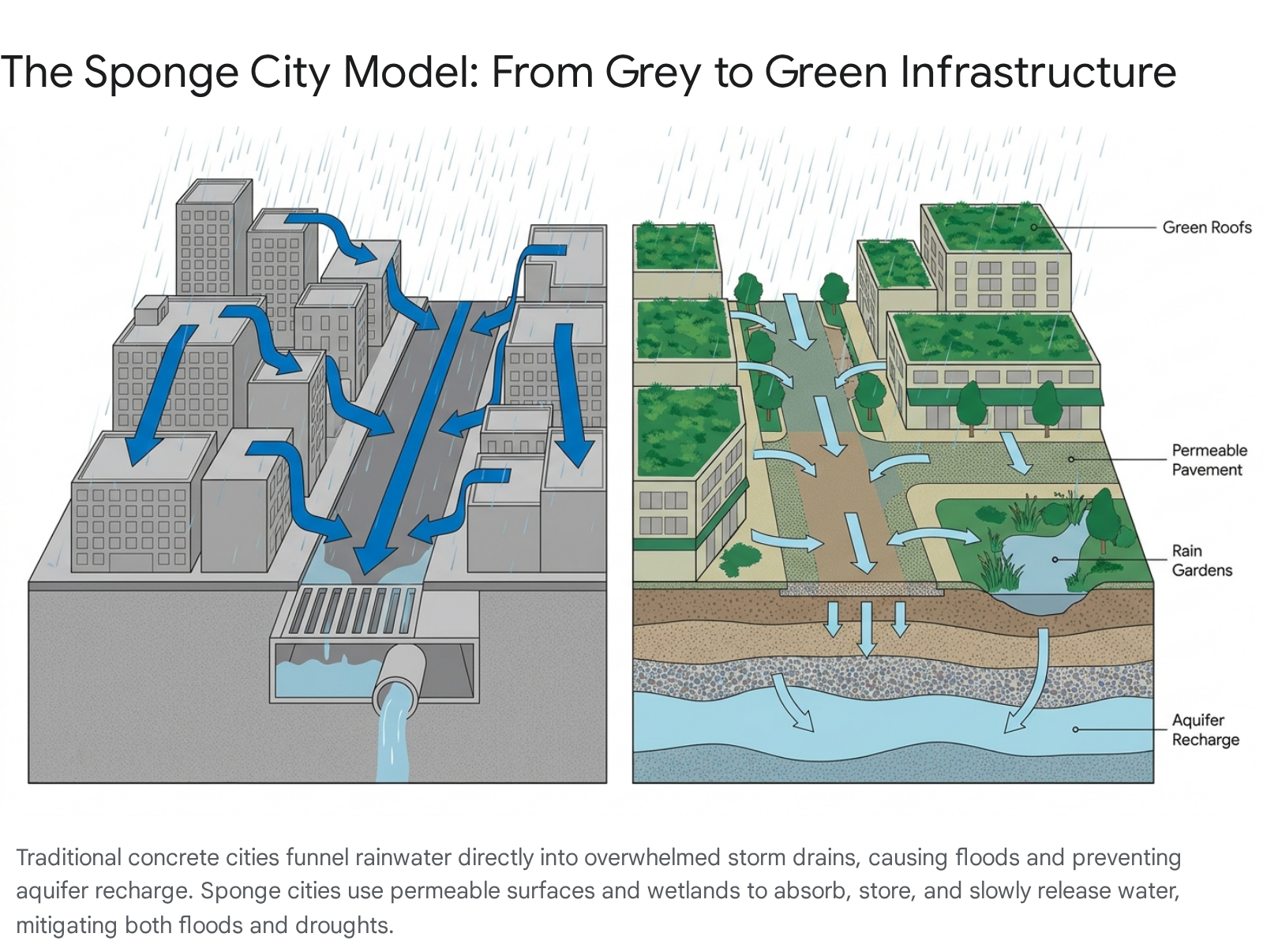
The benefits of this holistic, "One Water" approach to urban design are multi-layered 28. During heavy typhoons or intense cloudbursts, the city's vast green spaces and permeable surfaces act as a massive buffer, soaking up the deluge, reducing the speed of runoff, and preventing deadly flash floods 453031. During prolonged summer droughts, the retained water - having slowly percolated down to recharge the local groundwater table - can be drawn upon for municipal use, acting as a natural reservoir 31. Furthermore, the introduction of massive vegetative infrastructure acts as a powerful carbon sink, significantly mitigates the deadly urban heat island effect, and restores local biodiversity, making the city vastly more livable 3049.
The Sponge City concept and similar "Water Sensitive City" frameworks are rapidly gaining traction globally, particularly in the Global South where infrastructure can be built green from the ground up. In Rio de Janeiro, Brazil, the state government is embarking on the ambitious "Rio Blue Metropolis Project." Recognizing that 600,000 people in the region have already been displaced by climate events, the state is heavily investing in nature-based solutions 32. This includes radically expanding protected forests and restoring native mangrove ecosystems to stave off coastal flooding, while simultaneously securing inland water supplies and even employing localized bio-soaps created in the favelas to naturally break down sewage in drainage systems 32. Similarly, C40 cities like Tshwane, South Africa, and Quito, Ecuador, are integrating green infrastructure with deep community preparedness networks to ensure resilient water access during future climate emergencies 33.
Practical Takeaways: Water-Wise Living and Behavioral Shifts for Citizens
While averting the worst-case SSP3 and SSP5 2040 scenarios requires systemic geopolitical cooperation, the overhaul of global agricultural subsidies, and massive macroeconomic infrastructure financing, municipal adaptation ultimately relies heavily on the daily behavioral shifts and consumption choices of everyday citizens.
1. Dietary Shifts and Recognizing the Water Footprint: The most profound, immediate impact an individual citizen can have on global water stress is through an alteration of their diet. Because agriculture consumes 70% of global freshwater, the food we eat dictates our primary water footprint 56. Animal husbandry is the most notoriously water-intensive sub-sector. Beef production, for example, has a staggering water footprint, requiring up to 15,000 liters of freshwater to produce a single kilogram of meat, largely due to the massive, continuous irrigation required to grow the grains used for animal feed 5. Transitioning toward plant-based diets, limiting meat consumption, or simply substituting highly water-intensive tree nuts (like almonds and walnuts, predominantly grown in water-scarce regions like California) with lower-impact seeds and legumes, significantly reduces a citizen's hidden, "virtual" water footprint 534.
2. Domestic Reductions and Greywater Reuse: While domestic municipal water use is a smaller percentage of global consumption than agriculture, aggressive domestic conservation is absolutely critical for delaying urban "Day Zero" events. Citizens can drastically reduce their direct consumption by installing high-efficiency, low-flow showerheads and toilets, which can cut daily household usage by up to 50% without a loss in performance 54. Furthermore, vigilantly fixing household leaks is essential; a single dripping faucet can waste over 3,000 gallons of treated municipal water per year 54. Beyond basic efficiency, households in water-stressed regions must embrace greywater recycling - capturing slightly dirty water from washing machines, sinks, and showers to safely water outdoor gardens or flush toilets - effectively utilizing the same drop of water twice 1454.
3. Embracing Smart Technology and the "One Water" Ethos: Citizens must advocate for, and actively participate in, "One Water" municipal governance models. This requires a cultural shift: residents must accept and support the use of highly treated, recycled wastewater for drinking (closing the urban water loop) and support local utility investments in smart-metering and AI-driven leak-detection technologies 28. Behavioral economics research has definitively shown the power of data transparency in driving conservation. In a localized study in Belén, Costa Rica, researchers demonstrated that when citizens were provided with clear data comparing their personal water consumption with that of their immediate neighbors, community-wide conservation efforts increased dramatically, proving that social norms and awareness are potent tools in resource management 35.
The Bottom Line
The global water scarcity crisis steadily approaching the 2040 horizon is not merely an isolated environmental or ecological challenge; it is the foundational threat to global macroeconomic stability, international food security, and geopolitical peace. Current trajectories, heavily influenced by extreme socioeconomic inequality (SSP4) and unmitigated climate volatility (SSP5), suggest a future where ecological water bankruptcy fractures developing societies, collapses global agricultural supply chains, and forces the massive demographic displacement of vulnerable populations. However, the worst of these scenarios are not yet geologically or politically locked in. By aggressively transitioning to water-efficient agricultural practices, investing heavily in resilient urban models like Sponge Cities, financing infrastructure in the Global South, and managing freshwater as a shared, finite global good rather than an endless commodity, the international community can still mitigate the most catastrophic impacts of the coming decades. Time, much like the invisible aquifers beneath our feet, is running out - but with immediate, coordinated action, it is not yet entirely exhausted.