
The 1947 Roswell incident and UFO mythology
Geopolitical Context and Military Aviation
The events that transpired in the high desert of New Mexico in the summer of 1947 occurred at a critical juncture in global history. In the immediate aftermath of the Second World War, the geopolitical landscape was rapidly fracturing, giving way to the early stages of the Cold War between the United States and the Soviet Union 12. Concurrently, the world was experiencing a revolution in aerospace engineering, driven by the appropriation of Nazi Germany's rocket-propelled missile programs (such as the V-2) and the rapid advancement of domestic jet propulsion and strategic bomber capabilities 1.
Within the United States, public anxiety regarding foreign technological parity and the threat of nuclear annihilation created a state of hypervigilance 2. This anxiety was catalyzed into a cultural phenomenon on June 24, 1947, when civilian pilot Kenneth Arnold reported observing a formation of nine crescent-shaped aircraft moving at unprecedented speeds near Mount Rainier, Washington 132. Arnold described the objects' movement as resembling "saucers skipping on water," prompting the press to coin the term "flying saucer" 12. Within forty-eight hours, the flying saucer narrative proliferated across national and international newswires, triggering a massive wave of public sightings throughout the summer of 1947 123. It was against this backdrop of Cold War paranoia and intense aerial speculation that the Roswell incident occurred.
Project Mogul Balloon Technology
The physical origin of the Roswell incident was a highly classified United States Army Air Forces initiative known as Project Mogul. Initiated in 1947, the project was designed to address a critical intelligence gap: the inability of the United States to detect long-range atmospheric nuclear tests anticipated to be conducted by the Soviet Union 45.
Acoustic Stratospheric Ducts
Project Mogul was conceived by Dr. Maurice Ewing of Columbia University. Ewing had previously researched the SOFAR (Sound Fixing and Ranging) channel - a deep ocean layer where the speed of sound is at its minimum, allowing low-frequency acoustic waves to travel thousands of miles through refraction 45. Ewing theorized that a similar low-velocity sound channel existed in the upper atmosphere, dictated by specific pressure and temperature gradients in the tropopause 4. If acoustic sensors could be suspended precisely within this atmospheric duct, the U.S. military could theoretically detect the low-frequency acoustic signatures of megaton-scale Soviet nuclear detonations from across the globe 456.
Engineering the Balloon Trains
To exploit this atmospheric sound channel, Project Mogul required constant-level balloon arrays capable of lofting sensitive microphones and radio telemetry equipment into the stratosphere and loitering at precise altitudes for up to sixty hours 457. The technical development of these arrays was spearheaded by the New York University (NYU) atmospheric research group, directed by Dr. Athelstan Spilhaus and engineered by Charles B. Moore 57. Operations were subsequently conducted from Alamogordo Army Air Field in New Mexico, near the White Sands Proving Ground 578.
The resulting Project Mogul arrays were vastly different from standard weather balloons. A single flight consisted of a massive "balloon train" that could extend over 600 feet in length 567. These trains utilized tandem clusters of up to 28 neoprene or rubber sounding balloons, each weighing 350 grams and inflating to over 20 feet in diameter at operational altitudes 45. Suspended along the heavy nylon lines were sonobuoys, acoustic microphones, and specialized ML-307B radar reflectors, which allowed ground crews to track the uncrewed arrays 457.
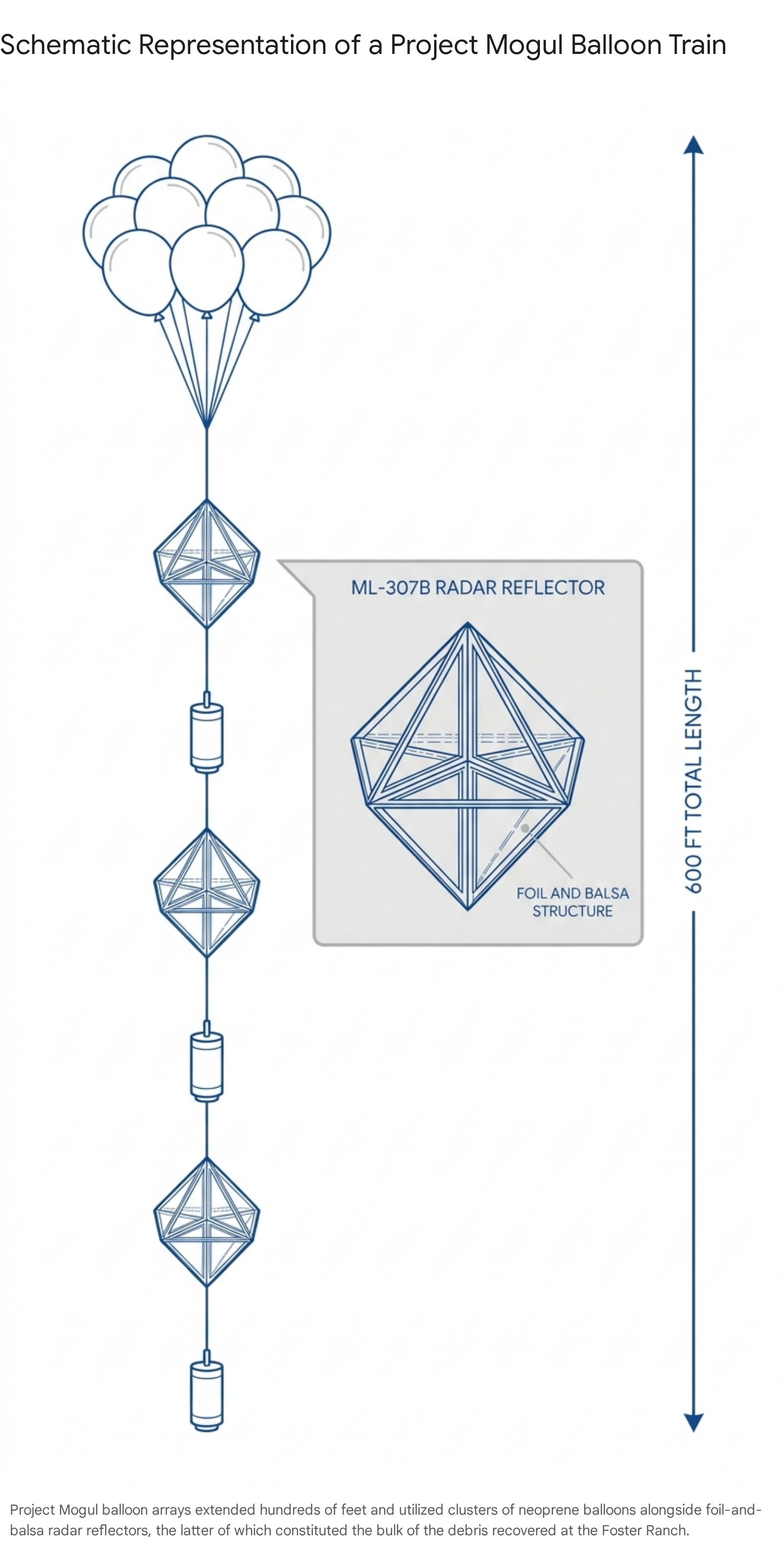
Because the project was assembled during a period of post-war material shortages, the military contracted a toy and novelty company to manufacture components for the radar reflectors 8910. These reflectors were constructed from balsa wood sticks, metallic foil, and tape. The tape used by the toy manufacturer featured pink and purple floral and geometric patterns - details that would later play a critical role in the mythology as witnesses misinterpreted the decorative tape as extraterrestrial "hieroglyphics" 8910.
Discovery of the Foster Ranch Debris
On June 4, 1947, the NYU team at Alamogordo Army Air Field launched Project Mogul Flight #4. The flight represented an early experimental configuration intended to test stratospheric stability 578. Due to inadequate ground reception and the highly classified nature of the program, the balloon train was lost from radar tracking shortly after its ascent 578. Subject to severe high-altitude winds and a subsequent thunderstorm, the massive array eventually descended and shredded itself across the high desert 51314.
In early July 1947, W.W. "Mac" Brazel, the foreman of the Foster Ranch near Corona, New Mexico (located roughly 75 miles northwest of Roswell), rode out on horseback with a young neighbor, Timothy Proctor, to inspect the property 21314. Across a wide swath of the prairie, Brazel discovered an extensive debris field 813. The material he encountered was entirely consistent with a shredded Project Mogul train: patches of smoky gray neoprene rubber, large quantities of tinfoil, heavy string, adhesive tape, and thin balsa wood sticks 27911.
Having no knowledge of classified high-altitude balloon experiments, and aware of the recent "flying saucer" phenomena dominating the news cycle, Brazel collected several pieces of the debris 2813. On July 6, 1947, he drove into Roswell and presented the materials to Chaves County Sheriff George Wilcox 2813. Uncertain of the debris's origin, Wilcox immediately contacted the Roswell Army Air Field (RAAF) 2814. RAAF was the home of the 509th Bomb Group, the elite strategic bomber unit responsible for dropping the atomic bombs on Japan, making it a highly sensitive military installation 812. The base command dispatched Major Jesse Marcel, the group's intelligence officer, and Captain Sheridan Cavitt to accompany Brazel back to the Foster Ranch to gather the remaining material 1811.
Official Press Releases and Retractions
The sequence of events over the next forty-eight hours cemented Roswell into the historical record, primarily due to a severe miscommunication within the military's public relations apparatus. Upon returning from the ranch, Major Marcel presented the debris to his superiors. Swept up in the prevailing national hysteria surrounding flying discs, and unfamiliar with the specialized ML-307B radar reflectors used by the Alamogordo testing facility, RAAF personnel mistakenly concluded that the strange foil and balsa wood assembly was anomalous 289.
The July 8 Announcement
On July 8, 1947, acting under the authority of the base commander, RAAF public information officer Lt. Walter Haut issued a press release stating that the military had "captured" a flying disc 2213. The release was immediately picked up by the Associated Press and generated international headlines, most notably in the Roswell Daily Record, which ran the front-page banner: "RAAF Captures Flying Saucer On Ranch in Roswell Region" 228. The announcement effectively transformed a localized debris recovery into a global media event 813.
The Fort Worth Correction
The sensational narrative was abruptly halted the following day. Command protocols dictated that the recovered debris be flown to the Eighth Air Force headquarters at Fort Worth Army Air Field in Texas 714. Upon inspection by Brigadier General Roger Ramey and his weather officers, the debris was rapidly and correctly identified as the remnants of a standard radar target and a meteorological balloon assembly 7911.
On July 9, 1947, the military held a press conference in Fort Worth, where Major Marcel was photographed posing with the tinfoil and balsa wood debris 91814. The military officially retracted the "flying disc" claim, issuing a new statement that the debris belonged to a weather balloon 229. The Roswell Morning Dispatch subsequently ran the headline, "Army Debunks Roswell Flying Disk as World Simmers with Excitement" 2.
While the "weather balloon" explanation was technically a cover story, its purpose was not to conceal extraterrestrial contact, but to deflect attention away from the top-secret Project Mogul 815. The acoustic monitoring program was highly classified, and admitting that the military was lofting massive stratospheric arrays to spy on Soviet nuclear progress would have severely compromised national security 81521. Following the July 9 retraction and the public display of mundane materials, public interest evaporated. The event was entirely dismissed by the media and the public, entering a thirty-year period of absolute dormancy 23911.
Period of Dormancy and Early UFO Investigations
From 1947 until 1978, the Roswell incident was virtually non-existent in UFO literature, public discourse, and official government investigations 13911. Despite the proliferation of flying saucer sightings and the emergence of early UFO contactee cults throughout the 1950s and 1960s, Roswell was considered a closed case of a misidentified balloon 111.
Official Air Force Investigations
During this dormant period, the United States Air Force established several successive, formal programs to investigate reports of unidentified aerial phenomena, largely to determine if they represented advanced Soviet aviation technology 216.
| Program Name | Active Years | Primary Mandate and Conclusion |
|---|---|---|
| Project Sign 216 | 1948 | Initial evaluation of UFO reports. Considered the "extraterrestrial hypothesis" but concluded objects were likely advanced Soviet aircraft. |
| Project Grudge 216 | 1949 | Successor to Sign. Adopted a more skeptical mandate, concluding that sightings were misidentifications of natural phenomena or conventional aircraft. |
| Project Blue Book 216 | 1952 - 1969 | The longest-running inquiry. Investigated thousands of sightings. Concluded UFOs posed no threat to national security and exhibited no evidence of extraterrestrial origin. |
| Condon Committee 1617 | 1968 | University of Colorado academic review. Concluded further extensive study of UFOs could not be justified on scientific grounds, leading to the termination of Blue Book. |
Notably, neither Project Sign, Project Grudge, nor the exhaustive Project Blue Book included the Roswell incident in their investigative files, as the military had already definitively resolved the debris origin internally 317.
The Aztec Hoax as a Narrative Precursor
While Roswell remained forgotten, other events during this period established the thematic archetypes that would later be grafted onto the Roswell mythology. In 1948, a highly publicized hoax centered on Aztec, New Mexico, introduced the concept of crashed flying saucers containing deceased alien bodies 8.
Orchestrated by con artists seeking to defraud investors with fake alien technology, the Aztec narrative was popularized by Variety columnist Frank Scully 8. The hoax featured claims of small grey humanoid bodies, indestructible metals featuring indecipherable hieroglyphics, and a massive government cover-up to prevent public panic 8. Although the Aztec story was thoroughly discredited by the mid-1950s, it successfully seeded the cultural lexicon with specific narrative tropes - tropes that would lay dormant until they were retroactively applied to the Roswell incident three decades later 8.
Resurrection of the Narrative
The genesis of the modern Roswell myth occurred in 1978, initiated by Stanton T. Friedman, a nuclear physicist and prominent UFO researcher 2381819. Driven by a desire to uncover government secrecy, Friedman tracked down and interviewed retired Major Jesse Marcel, the intelligence officer who had handled the original debris 23819.
Speaking more than thirty years after the event, Marcel's recollections deviated significantly from his original 1947 statements. Marcel asserted that the weather balloon explanation had been a fabricated cover story ordered by General Ramey 2818. More critically, Marcel re-characterized the physical properties of the debris. He claimed that the materials he recovered were "not of this world," describing thin metallic foil that could not be burned, cut, or dented, and rigid I-beams inscribed with strange, unreadable geometric symbols 81819.
The Roswell Incident (1980)
Friedman's interviews laid the foundation for the 1980 book The Roswell Incident, co-authored by Charles Berlitz and William L. Moore 12818. The publication of this book marked the definitive transformation of Roswell from a forgotten balloon crash into a global conspiracy theory 819.
Berlitz and Moore alleged that the United States government had recovered a highly advanced extraterrestrial spacecraft, secretly flown the wreckage to Wright Field (now Wright-Patterson Air Force Base) in Ohio, and subsequently engaged in a ruthless, decades-long cover-up involving witness intimidation and media manipulation 12. Although the authors claimed to have interviewed over 90 witnesses, the vast majority had no firsthand knowledge of the debris; only seven claimed to have seen the materials, and only five claimed to have handled them 8. Despite significant methodological flaws, the book was a commercial success and successfully fused the 1947 historical event with the established folkloric tropes of the Aztec hoax 18.
Narrative Expansion and Advanced Metallurgy Claims
Following the success of The Roswell Incident, the mythology entered a phase of rapid, unregulated expansion. Throughout the late 1980s and 1990s, successive authors - most notably Kevin D. Randle and Donald R. Schmitt (UFO Crash at Roswell, 1991) - published books that introduced entirely new facets to the story, often relying on unverified or contradictory testimonies 11211826.
The Myth of "Memory Metal"
One of the most persistent claims to emerge during this expansion was that the crashed craft was composed of a "memory metal" - a silvery, foil-like material that, when crumpled or stressed, would seamlessly and instantly unfold itself to its original flat shape without a crease 18202829. Witnesses interviewed decades later claimed the metal could not be pierced, cut, or damaged by conventional tools 829.
Historical analysis indicates that these claims were likely a retroactive incorporation of advanced terrestrial materials science into the UFO narrative. In 1959, researchers at the Naval Ordnance Laboratory discovered Nitinol, a highly elastic nickel-titanium alloy that exhibits profound shape-memory effects 2821. However, archival research revealed that the Battelle Memorial Institute had been conducting classified metallurgical research on titanium alloys under contract with Wright-Patterson Air Force Base as early as 1949 2821.
The chronological proximity of the Battelle research to the Roswell incident provided fertile ground for conspiracy theorists to posit a causal link. Theorists argued that modern advanced materials - such as shape-memory alloys, Kevlar, and fiber optics - were directly reverse-engineered from the Roswell debris 202831. There is no empirical evidence to support this assertion; rather, the development of these materials is well-documented within the conventional history of industrial and military engineering 2132.
The Introduction of Alien Autopsies
The most sensational addition to the Roswell mythos was the claim that the military had recovered the bodies of non-human entities 10141822. The original 1947 reports contained zero references to biological casualties 91011. The alien body narrative was primarily introduced in 1989 by W. Glenn Dennis, a former Roswell mortician 10142634.
Dennis claimed that during the week of the crash, the RAAF base contacted him to inquire about hermetically sealed, child-sized caskets and tissue preservation chemicals 1426. Furthermore, he alleged that a military nurse, whom he described as an attractive lieutenant with short black hair, confessed to assisting in the autopsy of small, large-headed, dark-skinned extraterrestrial entities at the base hospital 102634. Dennis claimed the nurse was subsequently transferred to England and disappeared, implying military foul play 101426.
Investigations into Dennis's claims revealed that the nurse closely matched the physical description and service record of 1st Lt. Eileen M. Fanton 2634. However, Fanton was not disappeared by the military; she was transferred to Brooke General Hospital in Texas for emergency medical treatment and medically retired from the Air Force in 1955 26. The withholding of her medical status from Dennis was due to standard patient privacy regulations, not a cover-up 26. More importantly, the Air Force later determined that the vivid descriptions of bodies and strange autopsies were the result of civilian witnesses observing actual, tragic military accidents that occurred years after 1947 21023.
Conflation of Anthropomorphic Dummies and Accidents
To address the escalating claims regarding biological entities, the United States Air Force launched a secondary investigation that culminated in the 1997 report, The Roswell Report: Case Closed 291023. Authored by Capt. James McAndrew, the report analyzed historical military operations in New Mexico to identify the mundane sources of the "alien" narratives 910.
The Air Force concluded that the modern Roswell myth was heavily dependent on the psychological phenomenon of time compression. Witnesses interviewed thirty to forty years after the events had inadvertently merged discrete military incidents from the 1950s into a single, cohesive narrative localized to July 1947 21023.
High-Altitude Parachute Tests
Between 1954 and 1959, the Air Force conducted Project High Dive and Project Excelsior to test high-altitude parachute systems, a critical necessity for pilots ejecting from supersonic aircraft 910. Operating out of Holloman Air Force Base, the military dropped "Sierra Sam" anthropomorphic test dummies from high-altitude balloons at heights reaching 100,000 feet 910.
These dummies, designed to replicate the human form, were frequently dressed in flight suits and encased in protective insulation bags 9. Due to extreme impact forces upon landing in the desert, the dummies often lost limbs, fingers, or sustained severe "head" damage 910. The recovery operations required specialized military convoys, including converted ambulances and large cargo trucks, which would rush into the desert under tight security to retrieve the experimental equipment 910. Civilian observations of these operations - featuring small, mangled, humanoid figures being loaded into military ambulances - became the primary source for the "alien retrieval" narratives 21023.
Military Aviation Tragedies
The Air Force also identified two specific incidents that generated the rumors of secret hospital autopsies and bizarre creatures.
| Element of Roswell Mythology | Actual Historical Event | Date of Event | Mechanism of Conflation |
|---|---|---|---|
| Small, burned, mangled alien corpses autopsied at base hospital. 2634 | KC-97G Aircraft Accident. 10263423 | June 26, 1956 | A refueling tanker crashed 8.8 miles south of Walker AFB (formerly RAAF). Eleven crewmen died in an intense fire. The severely burned, dismembered remains were brought to the base hospital and local mortuary, matching descriptions of "small, black, mangled" entities. |
| Creature with a massive, swollen head walking into hospital. 1026 | Capt. Dan Fulgham Balloon Mishap. 102634 | May 21, 1959 | During a manned balloon test, a gondola struck Capt. Fulgham in the head. He developed a massive hematoma, causing his head to swell disproportionately. He was transported to the base hospital under security. |
| Intimidating, red-headed military colonel enforcing silence. 1026 | Tenure of Col. Lee F. Ferrell. 10 | 1954 - 1960 | Col. Ferrell, a tall, red-headed officer, served as the Walker AFB hospital commander during the time of the KC-97 crash and the Fulgham injury, matching witness descriptions perfectly. |
By cross-referencing military flight logs, medical records, and personnel files, the Air Force decisively demonstrated that the "alien bodies" aspect of the Roswell myth was an amalgamation of later aeronautical research and tragic aviation accidents 2923.
Majestic 12 and Counterintelligence Disinformation
As the Roswell narrative expanded in the 1980s, it gained an intricate layer of institutional conspiracy through the injection of forged government documents, most notably the "Majestic 12" (MJ-12) papers 22425.
In 1984, television producer Jamie Shandera received an anonymous package containing an undeveloped roll of 35mm film 2425. When developed, the film revealed what appeared to be highly classified briefing documents prepared for President-elect Dwight D. Eisenhower 25. The documents outlined the existence of Operation Majestic-12, a secret committee of twelve elite scientists, military leaders, and intelligence officials allegedly established by President Harry S. Truman in September 1947 25. The purported goal of MJ-12 was to manage the recovery of the Roswell spacecraft, oversee the autopsy of the extraterrestrial biological entities, and reverse-engineer the recovered technology 2225.
Forgery and the AFOSI Connection
The release of the MJ-12 documents electrified the UFO community and provided the overarching framework for the "government cover-up" narrative 2425. However, extensive analysis by the Federal Bureau of Investigation (FBI), the Air Force Office of Special Investigations (AFOSI), and independent historians concluded that the documents were elaborate hoaxes 22225. The forgeries contained glaring anachronisms in formatting, incorrect military ranks, and featured a signature of President Truman that had been photocopied and pasted from a legitimate, unrelated 1947 memo 25.
The origin of the MJ-12 hoax is heavily linked to a broader military counterintelligence campaign 2425. During the 1980s, the United States was testing highly classified stealth technology and advanced aerospace platforms at installations like Kirtland Air Force Base in New Mexico and Area 51 in Nevada 312425. Civilian UFO researchers, equipped with radio scanners and telephoto lenses, frequently intercepted anomalies related to these tests.
To protect these black projects, intelligence agents - most prominently Richard Doty of AFOSI - actively engaged with civilian researchers like Paul Bennewitz and William Moore 2425. Doty and others intentionally fed these researchers forged documents and fabricated stories about alien spacecraft and underground bases (such as the Dulce base myth) 2425. By actively encouraging the UFO narrative, the military successfully deflected attention away from authentic national security technologies, ensuring that civilian sightings of experimental aircraft were dismissed by the broader public as the delusions of UFO enthusiasts 242526.
Congressional Inquiries and Air Force Disclosures
The relentless cultural pressure and the persistent accusations of a grand cover-up eventually elevated the Roswell incident to the level of congressional oversight. In early 1994, Representative Steven H. Schiff of New Mexico, responding to constituent demands for transparency, formally requested the General Accounting Office (GAO) to conduct an audit to locate records pertaining to the 1947 incident 9111523.
The 1994 Fact vs. Fiction Report
The GAO mandate forced the Secretary of the Air Force to initiate an exhaustive, systemic declassification review of archives, records centers, and classified project files 112327. The research effort was led by Col. Richard L. Weaver and Capt. James McAndrew 1128.
In July 1994, the Air Force published The Roswell Report: Fact vs. Fiction in the New Mexico Desert 112729. The 1,000-page volume conclusively demonstrated that there was no operational surge, security lockdown, or evidence of an extraterrestrial recovery at Roswell Army Air Field in July 1947 11. Instead, the report officially declassified Project Mogul, providing the original flight logs, technical schematics, and personnel interviews that confirmed the Foster Ranch debris was the shredded remains of the acoustic balloon train 1123.
The publication of this report, followed by the 1997 Case Closed volume detailing the dummy drops and aviation accidents, was intended to definitively resolve the controversy 22327. However, the disclosures were largely rejected by the ufology community, who interpreted the admission of the Project Mogul cover-story as proof that the government was inherently untrustworthy, thereby justifying continued belief in the extraterrestrial hypothesis 215.
Folkloric Archetypes and Sociological Dynamics
The survival and proliferation of the Roswell incident, despite exhaustive debunking, requires an understanding of its sociological utility. Academics, including anthropologist Benson Saler and historian Charles A. Ziegler in their seminal work UFO Crash at Roswell: The Genesis of a Modern Myth, argue that the incident functions perfectly as a modern folklore archetype 24293031.
Cultural Anxiety and the Deep State
The Roswell myth incubated during the Cold War but achieved mass cultural penetration in the post-Watergate, post-Vietnam era of the 1970s and 1980s 281232. During this period, public trust in federal institutions cratered. The narrative evolved from earlier, optimistic depictions of "benevolent space brothers" to darker, paranoid tales of a malevolent shadow government willing to assassinate citizens and bypass democratic oversight to harbor alien technology 243233.
Roswell serves as a powerful folk counter-narrative to official authority 46. The conspiracy theory provides a structural framework for individuals to articulate their anxieties regarding the military-industrial complex, the perceived existence of a "deep state," and the rapid, alienating pace of technological advancement 23246.
Commercialization of the Myth
By the 1990s, the mythology had transcended fringe belief to become a staple of global popular culture, featured prominently in media such as The X-Files and Independence Day 1. The city of Roswell itself embraced the economic potential of the narrative. The establishment of the International UFO Museum and Research Center in 1992 and the annual Roswell UFO Festival transformed the municipality into a premier tourist destination 21318. The sustained commercial viability of the myth ensures its continuous reinforcement in the cultural zeitgeist, entirely detached from the empirical reality of 1947 2218.
Modern Congressional Hearings and the AARO Report
The mechanics of myth-making established by Roswell - specifically the allegations of hidden crash-retrievals and reverse-engineering programs - continue to profoundly dictate modern discourse surrounding Unidentified Anomalous Phenomena (UAP).
The 2023 UAP Whistleblower Hearings
In July 2023, the U.S. House Oversight Committee's national security subcommittee convened a historic hearing on UAPs 163448. The hearing featured testimony from former fighter pilots Ryan Graves and David Fravor, as well as David Grusch, a former intelligence officer with the Air Force and the National Geospatial-Intelligence Agency 16343536.
Testifying under oath, Grusch alleged that the executive branch had operated a "multi-decade UAP crash retrieval and reverse-engineering program" hidden from congressional oversight 163435. Furthermore, Grusch claimed that the government was in possession of spacecraft of "non-human" origin and had recovered "biologics" from the crash sites 3435. These allegations directly mirrored the narrative architecture of the Roswell myth, sparking intense public interest and bipartisan demands for increased government transparency 323448.
The 2024 AARO Historical Record Report
To address these escalating allegations and fulfill mandates set by the National Defense Authorization Act (NDAA), the Department of Defense's All-domain Anomaly Resolution Office (AARO), under the direction of Dr. Sean Kirkpatrick and later Tim Phillips, published Volume 1 of its Historical Record Report in March 2024 1617373853.
The exhaustive 63-page report systematically reviewed all U.S. government investigatory programs since 1945 and evaluated the claims of approximately thirty interviewees who alleged knowledge of hidden reverse-engineering operations 17323853. The report concluded with high confidence that "AARO has found no verifiable evidence that the U.S. government or private industry has ever had access to extraterrestrial technology," nor any evidence that any UAP sighting represented extraterrestrial activity 385339.
The Mechanism of Circular Reporting
AARO's analysis determined that the whistleblower allegations presented to Congress did not represent a genuine cover-up, but rather a sociological phenomenon termed "circular reporting" 17323738.
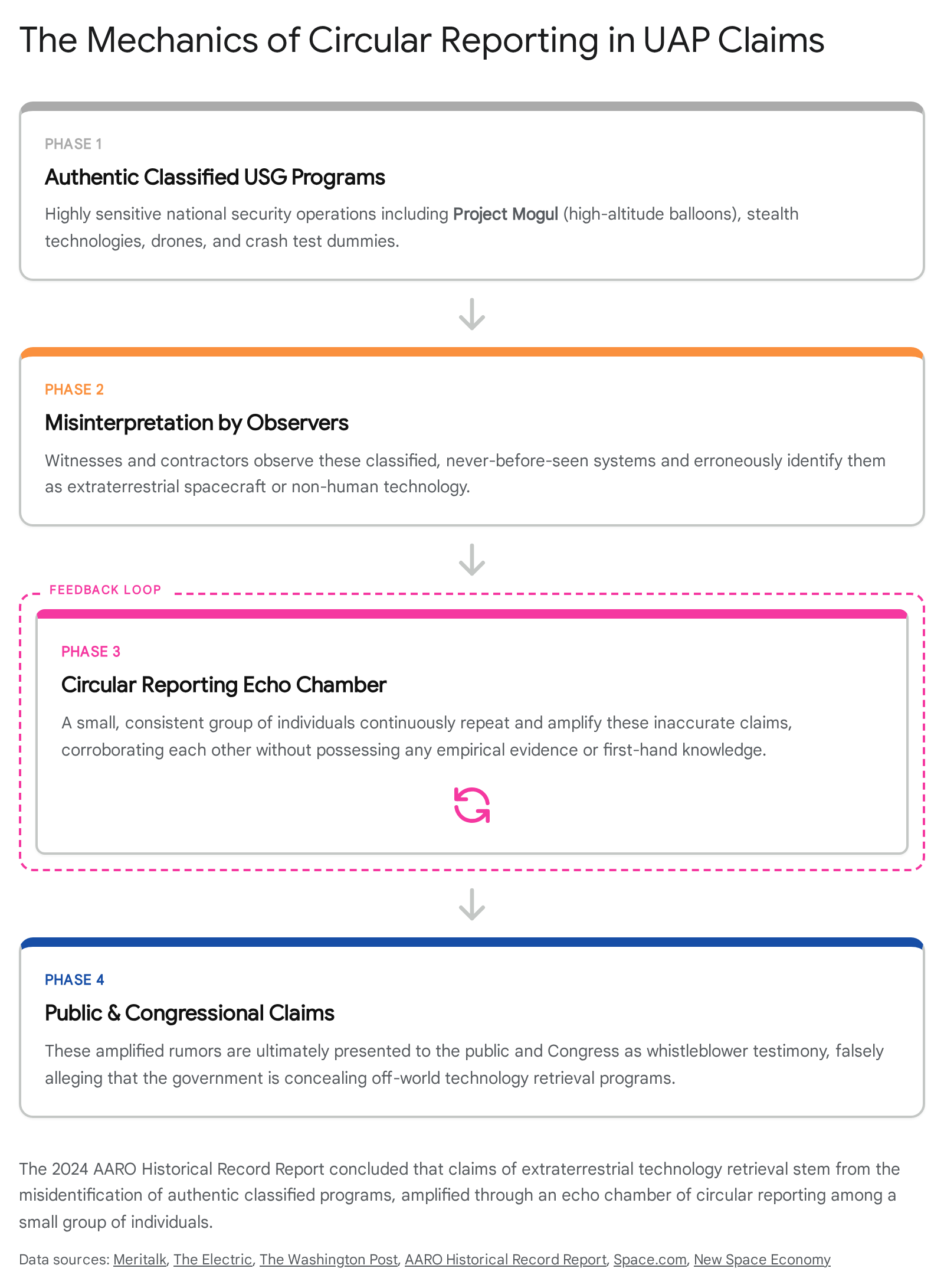
The agency found that claims of hidden programs largely emanated from a small, insular group of individuals who have been involved in UAP advocacy for decades. These individuals repeatedly shared hearsay, rumors, and speculative conclusions with one another, amplifying the claims until they were presented as corroborated facts to lawmakers and the media 1737385340.
Furthermore, AARO documented numerous instances where well-meaning personnel severely misinterpreted authentic, highly classified national security programs as extraterrestrial in nature 323853. For instance, the report identified a program known as "Kona Blue," which whistleblowers alleged was a Department of Homeland Security (DHS) operation to reverse-engineer "nonhuman biologics." AARO's investigation revealed that Kona Blue was merely a program proposed to DHS by outside UAP advocates. It was ultimately rejected by DHS leadership for "lacking merit" and never recovered any material, terrestrial or otherwise 3753.
AARO directly cited the 1947 Roswell incident as the foundational archetype for this dynamic, reaffirming that the Project Mogul balloon was the actual source of the debris 5339. The report noted that throughout the Cold War and into the modern era, sightings of revolutionary aerospace technologies - such as the U-2, SR-71 Blackbird, and advanced stealth drones - were frequently misidentified by observers as otherworldly craft 5339.
When genuine military secrecy intersects with public fascination and an echo chamber of advocacy, mundane technological programs are reliably transformed into enduring myths 5340.
Conclusion
The Roswell incident of 1947 represents a profound intersection of military secrecy, historical accident, and cultural psychology. Exhaustive governmental audits and independent historical research confirm that the physical debris recovered on the Foster Ranch belonged to Project Mogul, a highly classified atmospheric listening array designed to monitor Soviet nuclear activity 451123. The subsequent narratives involving alien bodies, crashed saucers, indestructible memory metals, and vast government conspiracies possess no basis in the empirical record of 1947 2910.
Instead, the modern Roswell myth is a retrospective construction initiated in the late 1970s. Through the sociological mechanisms of time compression and narrative conflation, distinct military tragedies - including the deaths of airmen in the KC-97 crash and high-altitude dummy tests - were woven together by researchers to form a cohesive, compelling folklore 21023. This mythology thrived in a post-Watergate culture deeply suspicious of institutional authority and was actively manipulated by military counterintelligence to obscure legitimate Cold War aerospace projects 22425.
As demonstrated by the recent congressional hearings and the definitive conclusions of the AARO Historical Record Report, the legacy of Roswell extends far beyond the high desert of New Mexico. It established a durable cognitive framework that continues to dictate how the public, media, and government approach the subject of unidentified anomalous phenomena today 173453.