
What Official UFO and UAP Investigations Say Today
Official government programs have fundamentally shifted their approach to unidentified anomalous phenomena (UAP), treating them as serious aerospace safety and national security issues rather than subjects of science fiction. While the vast majority of sightings are resolved as prosaic objects like balloons, drones, and satellites, a small percentage of cases exhibiting anomalous characteristics remain unexplained. To date, no official investigation has confirmed evidence of extraterrestrial technology, but a global push for advanced sensor deployment and declassified data is rapidly transforming our understanding of the skies.
The Evolution of UAP Investigations: From Stigma to Science
For decades, the public conversation surrounding Unidentified Flying Objects (UFOs) was dominated by stigma, conspiracy theories, and pop culture. Pilots who witnessed unusual objects in flight often remained silent, fearing professional ridicule, psychological evaluations, or a grounded career. Today, that paradigm has been entirely rewritten by defense departments, intelligence agencies, and national scientific bodies around the world.
Rebranded globally as Unidentified Anomalous Phenomena (UAP) - a term chosen to encompass objects not just in the air, but also in the sea and space - the subject is now the focus of rigorous, data-driven government investigations 12. This shift has been necessitated by the rapid proliferation of advanced commercial drones, the launch of mega-constellations like SpaceX's Starlink, and the increasing use of high-altitude surveillance balloons by adversarial nations. As global airspace becomes more congested, the inability to identify an object flying near a commercial airliner or a nuclear facility represents an unacceptable blind spot for national security 345.
Consequently, official UAP programs are no longer tasked with chasing extraterrestrial myths. Instead, they are designed to resolve airspace anomalies, improve sensor calibration, and ensure that military and commercial pilots can report hazards without fear of professional retaliation 67.
The United States: AARO and the Drive for Transparency
The United States currently operates the most heavily funded and publicly scrutinized UAP investigation apparatus in the world. Established in July 2022 following mandates in the National Defense Authorization Act (NDAA) for Fiscal Year 2022, the All-domain Anomaly Resolution Office (AARO) serves as the central clearinghouse for UAP reporting across the U.S. government 37. AARO's mandate includes documenting, analyzing, and resolving UAP incidents using a strict scientific framework, while reporting its findings back to Congress and the public 18.
Analyzing the Active Caseload
AARO has systematically compiled historic and modern reports to build a comprehensive picture of UAP activity. According to the Fiscal Year 2024 Consolidated Annual Report on UAP, released in November 2024, the office's active caseload has swelled to 1,652 reports 49. Between May 1, 2023, and June 1, 2024 alone, AARO received 757 new UAP reports 811. This influx was driven heavily by an increase in reporting from U.S. military personnel and commercial pilots, the latter submitting reports through the Federal Aviation Administration (FAA) 49.
The vast majority of these sightings occur in the air domain, typically at altitudes between 10,000 and 30,000 feet, which aligns heavily with standard commercial and military flight corridors 12. AARO has been highly successful in resolving cases where sufficient data exists. During the FY2024 reporting period, 118 cases were fully resolved to commonplace objects, and an additional 174 cases were queued for closure pending final director approval 911.
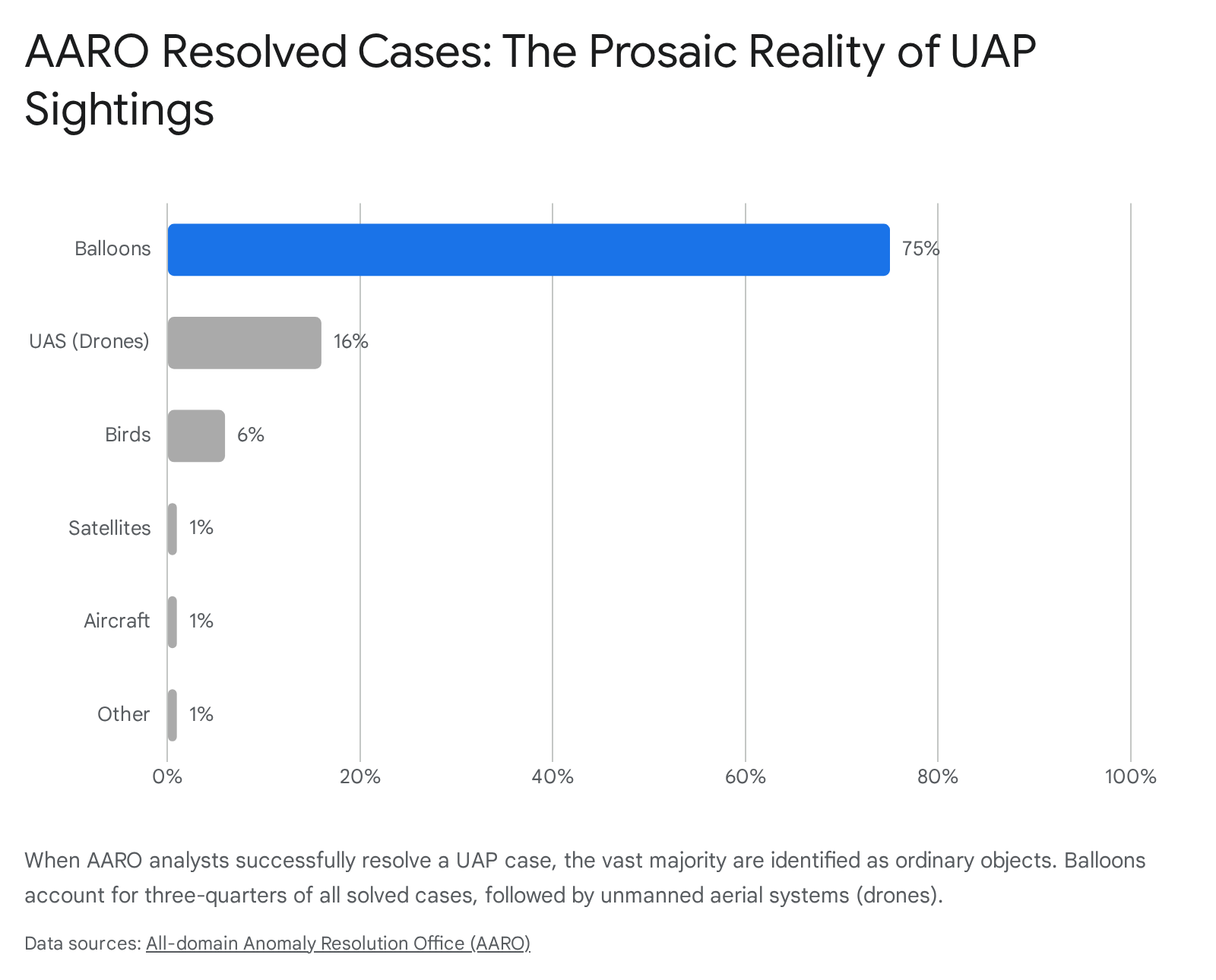
Despite this success, a significant number of cases - 444 reports in the FY2024 cycle - were placed in an "Active Archive." These cases are not deemed inherently mysterious, but they simply lack the actionable sensor data, multiple angles, or witness detail required for rigorous scientific analysis 49. They are held in the archive so analysts can monitor them for broader trend correlations, such as geographic clustering.
The geographic distribution of UAP sightings heavily favors U.S. military installations and training ranges. AARO explicitly notes that this is the result of a "collection bias." Anomalies are not necessarily drawn to military bases; rather, these areas are populated by highly trained observers and dense, sophisticated sensor networks that are actively looking for airborne objects 712.
| AARO FY2024 Caseload Breakdown | Number of Reports | Context |
|---|---|---|
| Total New Reports | 757 | Includes 485 from the current period (May '23 - Jun '24) and 272 delayed reports from 2021-2022 1113. |
| Resolved to Prosaic Objects | 118 | Explained definitively as balloons, drones, birds, and satellites 911. |
| Queued for Closure | 174 | Pending final review, all assessed as prosaic natural or man-made objects 1110. |
| Active Archive | 444 | Insufficient data to analyze; held for pattern-of-life correlation 49. |
| Truly Anomalous Cases | 21 | Displayed unusual flight characteristics; undergoing deep intelligence review 411. |
The 21 Anomalous Cases and Flight Safety Concerns
While AARO has resolved hundreds of cases, the office highlighted 21 specific incidents from the FY2024 reporting period that exhibited "anomalous characteristics and/or behaviors" defying immediate explanation 1116. These cases often involve unique morphologies - such as spherical objects, cylinders, or objects with unusual light patterns - coupled with flight behaviors that current aerodynamic models struggle to explain 912.
These 21 cases have been handed over to AARO's science and technology partners within the Intelligence Community for deeper review. During a media briefing, AARO Director Jon Kosloski acknowledged the perplexing nature of these sightings, stating, "There are cases that neither I nor anyone else understands" 13. However, AARO maintains a firm baseline across all its publications: none of the analyzed cases have yielded any empirical evidence of extraterrestrial technology, nor do they substantiate breakthroughs in foreign adversarial aerospace capabilities 111614.
Of immediate concern to military officials, however, are incursions that threaten aviation safety and site security. The FY2024 report highlighted 18 separate incidents of unmanned aerial systems (UAS) penetrating restricted airspace over U.S. nuclear infrastructure and weapons sites 913. While most of these unauthorized flights lasted fewer than five minutes, two drones loitered for over an hour. Furthermore, military aircrews submitted two reports detailing explicit flight safety concerns, and three reports described military pilots being actively "trailed or shadowed" by UAP 1311.
Overcoming Data Deficits: The GREMLIN Sensor Suite
A persistent hurdle in UAP research is the poor quality of available data. Military infrared cameras and targeting pods are optimized to track the heat signatures of conventional jet engines and missiles, not anomalous, undefined shapes operating at atypical speeds or temperatures. Furthermore, sensor artifacts can easily mislead observers. For example, Forward Looking Infrared (FLIR) cameras often render the rapid flapping of a bird's wings as a "flickering" thermal anomaly, and optical glare can distort a commercial jet into a glowing orb 15.
To bridge this data gap, AARO partnered with the Georgia Tech Research Institute to develop GREMLIN - a highly portable, reconfigurable, hyperspectral sensor suite specifically engineered to detect and characterize UAP 1617.
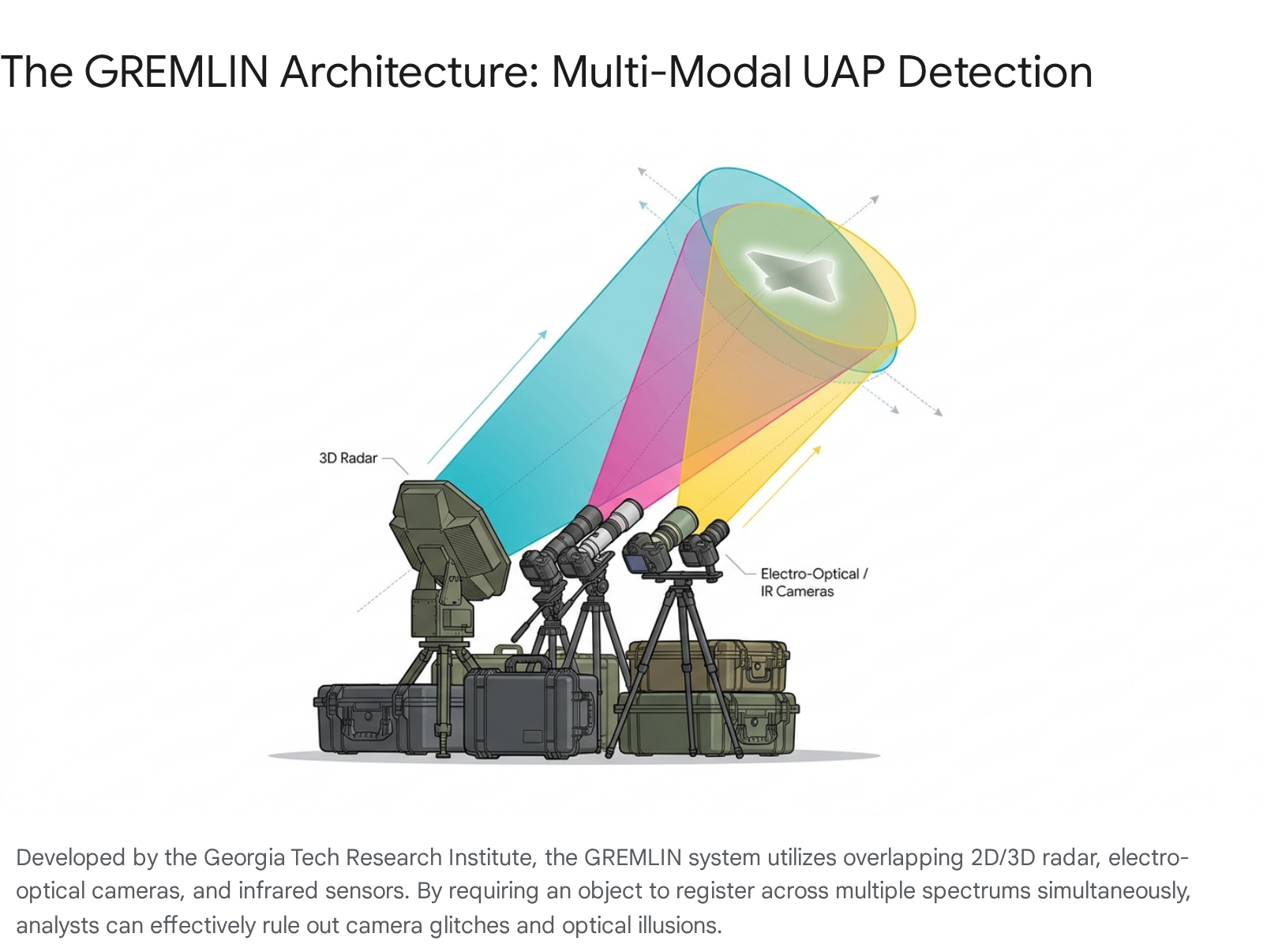
GREMLIN integrates a web of advanced instruments packed into rugged transport cases. The system utilizes 2D radar to measure range and azimuth, alongside 3D radar that adds elevation data for full positional triangulation. This is combined with long-range electro-optical cameras, short-wave infrared, and thermal sensors 1617. By layering these modalities, analysts can cross-reference data in real-time. If an anomaly appears on a thermal camera but fails to register on 3D radar, investigators can more confidently classify it as a sensor artifact rather than a physical object.
Following a successful testing phase in early 2024, AARO deployed the GREMLIN system to an undisclosed national security site for a 90-day "pattern of life" collection campaign 1417. The system proved highly capable of detecting both terrestrial and orbital phenomena, gathering deep telemetry on everything from local bat populations to satellite flares 1819. This baseline data allows the military to confidently filter out normal background activity, leaving only true anomalies for further study.
NASA's Independent Study and Aviation Safety
While the Department of Defense focuses heavily on the national security implications of UAP, NASA has taken a parallel track focusing on civilian science and aviation safety. In 2022, NASA commissioned a UAP Independent Study Team to determine how the agency could leverage its massive open-source data archives and Earth-observing satellites to shed light on the phenomenon 2021.
The team's final report, published in September 2023, echoed AARO's findings: there is no evidence that UAP have an extraterrestrial origin, but the lack of high-quality, reproducible data makes drawing any definitive scientific conclusions nearly impossible 222. NASA concluded that to solve the mystery, the scientific community must move past sensationalism and implement systematic data calibration and multi-sensor measurements 2123.
One of the most critical issues identified by both NASA and private aerospace advocates is the powerful stigma that silences witnesses. Former U.S. Navy F/A-18 pilot Ryan Graves, who founded the advocacy group Americans for Safe Aerospace, testified before Congress that UAP sightings are "routine" among commercial and military pilots 24. However, pilots fear that reporting an anomaly could result in professional repercussions, leading to a massive underreporting of airspace hazards 624.
To combat this, the NASA study recommended leveraging the Aviation Safety Reporting System (ASRS) 725. Administered by NASA and funded by the FAA, the ASRS is a highly trusted, confidential system designed to let pilots report safety violations and near-misses without fear of punishment. By formally integrating UAP reporting into the ASRS, aviation authorities are working to normalize the collection of anomaly data, treating an unidentified object in the sky as a standard safety-of-flight issue rather than a taboo subject 723.
The 2026 PURSUE Disclosures and the "Department of War"
In recent months, the U.S. government's posture on UAP has undergone a radical transformation, driven by high-level executive directives aimed at absolute transparency. This shift was preceded by a major organizational rebrand. In September 2025, President Donald Trump signed Executive Order 14347, authorizing the Department of Defense to adopt its original 1789 moniker, the "Department of War" (DOW), as an official secondary title 2627. The administration argued the name projected a stronger global posture of readiness and authorized its use in public communications and ceremonial contexts 2628.
Under this newly rebranded Department of War, the administration launched the Presidential Unsealing and Reporting System for UAP Encounters (PURSUE) in May 2026 2930. Hosted at a dedicated government portal (war.gov/ufo), the PURSUE initiative was designed to force the rapid declassification and public release of unresolved UAP case files, bypassing decades of bureaucratic classification barriers 29.
The historic rollout occurred in rolling tranches. On May 8, 2026, the DOW published an initial 162 declassified files spanning from the 1940s to the 2020s, pulling from the archives of the FBI, NASA, the Department of Energy, and military intelligence 293132. A second tranche, comprising 222 new documents, videos, and audio recordings, was released on May 22 3033.
The public reaction was unprecedented, with the PURSUE portal registering over 1 billion global hits within its first two weeks 33. Among the released materials were historical anomalies, such as photographs taken on the lunar surface during the 1969 Apollo 12 mission, as well as modern military footage 31. Two videos in particular drew intense international scrutiny: * DOW-UAP-PR47: A nearly two-minute infrared video from 2023 showing three distinct areas of contrast maintaining a fixed orientation near Japan 534. * DOW-UAP-PR46: A nine-second clip from 2024 showing a "football-shaped" UAP with radial projections operating over the East China Sea 534.
Despite the massive volume of the release, officials cautioned the public regarding the interpretation of the data. The presence of a file in the PURSUE database does not confirm an extraterrestrial origin. Rather, it signifies an "unresolved" case where the U.S. government simply lacks the telemetry or sensor data to definitively identify the object, releasing it to the public for open-source analysis 3035.
France's GEIPAN: The Gold Standard for Open Investigation
While the United States dominates modern UAP headlines, France has quietly operated the world's most enduring and transparent UAP investigation unit for nearly half a century. The Groupe d'Études et d'Informations sur les Phénomènes Aérospatiaux Non-identifiés (GEIPAN) operates under the umbrella of CNES, the French national space agency, out of Toulouse 3643.
Founded in 1977 as GEPAN, the unit has evolved through various iterations (including SEPRA) before taking its current form in 2005. It relies on a deeply integrated network of civil and military authorities. Oversight is provided by a steering committee (COPEIPAN) that includes the French Gendarmerie, civil aviation authorities, the Air and Space Force, the national weather service (Météo-France), and academic psychologists 364337.
Decades of Data and the "Three Percent"
Unlike military intelligence units that classify their findings by default due to national security concerns, GEIPAN was built on a foundation of scientific neutrality and public service. When an observation is reported - often routed directly through local police forces - GEIPAN analysts conduct rigorous cognitive interviews, review regional radar logs, and analyze weather data. In about 10 percent of cases, GEIPAN deploys trained volunteer investigators directly to the physical site 3643.
Once investigated, case files are thoroughly anonymized and published to an open online database. GEIPAN evaluates cases using a strict four-tier classification system:
- Category A: Perfectly identified phenomena (e.g., conventional aircraft, planets, weather balloons) 43.
- Category B: Probably identified phenomena (a best-fit explanation exists, though some data is missing) 43.
- Category C: Unidentified due to a lack of actionable data 43.
- Category D: Unidentified after a full, exhaustive investigation 43.
Category D is the most closely scrutinized and is subdivided into D1 (medium consistency, such as a highly credible single witness with no sensor data) and D2 (high consistency, involving multiple independent witnesses and physical or sensor data) 36.
Over its 40-year history, GEIPAN has evaluated approximately 5,300 distinct cases based on nearly 10,000 testimonies. Today, roughly 64% of cases are quickly resolved as Category A or B misidentifications. Another 32% fall into Category C, simply because the witness account was too vague or lacked supporting evidence 3637.
Crucially, only about 3.3% of all cases are classified as Category D 3738. This persistent "three percent" represents the true core of the UAP mystery - incidents where excellent data and highly credible witnesses describe phenomena that simply do not align with known natural or technological origins. GEIPAN's willingness to leave these cases open, without forcing a prosaic explanation or leaping to extraterrestrial conclusions, has made it a global model for scientific rigor 3639.
| GEIPAN Classification System | Percentage of Total Cases | Definition |
|---|---|---|
| Category A | ~25-27% | Perfectly identified phenomena 3637. |
| Category B | ~39-40% | Probably identified phenomena 3637. |
| Category C | ~31-32% | Unidentified due to insufficient data 3637. |
| Category D | ~2-3.3% | Unidentified after full investigation (true anomalies) 3637. |
Canada's Sky Canada Project: Structuring Public Reporting
Following the lead of the United States and France, Canada recently undertook a comprehensive review of its own UAP reporting infrastructure. Spurred by an estimated 600 to 1,000 UAP sightings reported by Canadians annually, the Office of the Chief Science Advisor of Canada (OCSA), led by Dr. Mona Nemer, launched the Sky Canada Project in the fall of 2022 3840.
The goal of the Sky Canada Project was not to hunt for anomalies, investigate specific sightings, or evaluate the existence of off-world intelligence 4849. Instead, it was an administrative and scientific audit designed to figure out exactly what happens to UAP data once a citizen or pilot reports it.
Bridging the Reporting Gap
The findings of the project's preliminary surveys were revealing. While 1 in 4 Canadians claimed to have witnessed a UAP in their lifetime, only 10% actually reported it, and 40% of the public had no idea which government body to contact 384041. The project found that reports were scattered across a disjointed array of federal agencies, non-governmental organizations, and aviation bodies. Because there was no centralized repository, data collection was inconsistent, and no single agency possessed the mandate to conduct scientific follow-ups 3848.
In June 2025, the Sky Canada Project released its final report, outlining 14 key recommendations to overhaul the nation's approach to anomalous phenomena 49. The core recommendations included:
- Identifying a Central Lead: Designating a trusted, publicly facing scientific organization - potentially the Canadian Space Agency (CSA) - to serve as the single national repository for UAP data 404841.
- Establishing a Dedicated Service: Creating a public portal and dedicated hotline for citizens and aviation professionals to submit reports seamlessly, similar to France's GEIPAN model 3840.
- Engaging Civil Aviation: Working closely with Transport Canada and NAV CANADA to encourage air traffic controllers and commercial pilots to report sightings without fear of professional stigma. This would allow analysts to track airspace trends and provide pilots with explanations, reducing cockpit distractions 3841.
- Promoting Transparency: Publishing analyses openly to build public trust and combat the spread of disinformation and conspiracy theories 384049.
By adopting these frameworks, Canada aims to transform UAP from a fringe topic into a cohesive national science initiative.
Japan's Security-Driven Awakening
While Western nations like Canada and France lean toward public science and declassification, Japan's approach to UAP is driven almost entirely by pressing geopolitical realities in the Indo-Pacific. For decades, the Japanese government maintained that it had no official stance or protocols regarding UFOs 51. This changed abruptly in 2020, when then-Defense Minister Taro Kono issued standing orders for the Japanese Self-Defense Forces (SDF) to formally record, photograph, and analyze any unidentified objects entering Japanese airspace 5152.
Drones, Balloons, and a Proposed Defense Office
Japan's interest escalated rapidly following the 2023 incident in which the U.S. military shot down a Chinese high-altitude surveillance balloon over the continental United States. Following the shootdown, the Japanese Defense Ministry announced it strongly suspected that previous "unidentified" flying objects observed over Japan in 2019, 2020, and 2021 - including objects hovering near Self-Defense Forces bases - were actually foreign spy balloons 5.
Recognizing that advanced drones and surveillance tools could easily masquerade as UAP, a bipartisan group of roughly 80 Japanese lawmakers formed the "Parliamentary League for UAP Clarification from a Security Perspective" in 2024 425443. Led by former defense ministers, the group formally proposed in May 2025 that the Ministry of Defense establish a specialized, dedicated UAP division focused on surveillance, data collection, and intelligence sharing 4243.
When the U.S. Department of War released its PURSUE files in May 2026 - which notably included infrared videos of UAPs hovering near Japan and the East China Sea - Tokyo reacted with measured caution 3444. Chief Cabinet Secretary Minoru Kihara confirmed that the government was actively analyzing the U.S. footage but firmly rebuffed the idea of an immediate, wholesale release of Japan's own UAP files. Kihara emphasized that any public disclosure by Japan would be decided on a strict case-by-case basis, carefully weighing the risk of exposing sensitive intelligence-gathering capabilities to foreign adversaries 53445.
The Five Eyes Alliance: Intelligence Sharing in the Shadows
Because UAPs traverse the globe without respect for international borders, intelligence sharing is a critical component of tracking anomalous activities. This is primarily facilitated through the Five Eyes (FVEY) alliance - the post-World War II intelligence-sharing partnership comprising the United States, the United Kingdom, Canada, Australia, and New Zealand 5846.
While public-facing scientific programs thrive on transparency, the Five Eyes approach to UAP remains deeply classified. In May 2023, the Pentagon hosted the "FVEY Inaugural UAP Caucus Working Group," bringing together representatives from all five nations to establish protocols for data sharing, reporting standardization, and analysis calibration 474862.
Despite pledges of transparency from Washington, the allied nations have remained incredibly tight-lipped about the outcomes of this collaboration. Official inquiries from journalists have routinely been deflected. Canada's Department of National Defence confirmed attendance but stated the details of the meeting remained classified 47. Australia's Department of Defence initially claimed it had no UAP reporting protocols at all, though leaked internal emails later confirmed that Australian defense representatives had actively scheduled and attended high-level U.S. UAP task force briefings 4763.
Subsequent Freedom of Information Act (FOIA) and Official Information Act (OIA) requests filed by researchers in the UK, Australia, and New Zealand have revealed that these nations hold considerable aviation safety records and intelligence briefings regarding UAPs. However, the governments consistently cite national security exemptions - specifically the protection of international intelligence-sharing agreements and the potential compromise of foreign operations - to withhold the actual data from the public 394864.
This dynamic highlights a persistent tension in the modern study of UAPs: while there is a massive public appetite for transparency, the instruments used to detect these anomalies are often the most highly classified sensor platforms on earth. Releasing the data often means revealing the exact capabilities and limitations of a nation's early-warning radar and satellite networks.
Bottom line
The era of ignoring unidentified anomalous phenomena has effectively ended. Official government programs in the U.S., France, Canada, and Japan are deploying advanced radar networks, restructuring reporting pipelines, and declassifying historic files to separate genuine aerospace anomalies from drones, balloons, and sensor artifacts. While no official program claims to have discovered evidence of extraterrestrial technology, the persistent presence of highly credible, unresolved cases - coupled with airspace incursions by unknown drones - ensures that UAP research will remain a heavily funded national security and scientific priority for the foreseeable future.