
Why Online Trends Die as Fast as They Rise
Online trends burn out rapidly because algorithmic social platforms are engineered to maximize immediate engagement, aggressively compressing the natural sociological lifecycle of cultural adoption. As users are instantly bombarded with a new aesthetic, meme, or product, it quickly loses its social value as a unique marker of identity, triggering "algorithmic fatigue" and a rapid mass exodus to the next novelty.
The Compression of Cultural Time
Historically, cultural trends defined entire decades or eras. The 1970s had bell-bottoms; the 1990s had grunge. These movements spread through word-of-mouth, print media, and physical retail distribution, creating a natural friction that allowed trends to simmer, peak, and gradually fade. Today, that friction has been entirely removed by the architecture of the modern internet.
Digital ecosystems are now dominated by algorithmic recommendation systems - such as TikTok's "For You" page, Instagram's "Explore" feed, and Douyin's content engine - that abstract human behavior into data points and immediately serve it to millions of like-minded users 1. Because human attention is a finite resource, these platforms prioritize the absolute velocity of engagement. If a piece of content does not spark an immediate reaction, it is buried.
This environment has fundamentally altered the "half-life" of digital content. The half-life of a social media post is defined as the time it takes for a piece of content to receive half of its total lifetime engagement, primarily measured in views, likes, and shares 2. On platforms designed for rapid consumption, this window is startlingly brief.
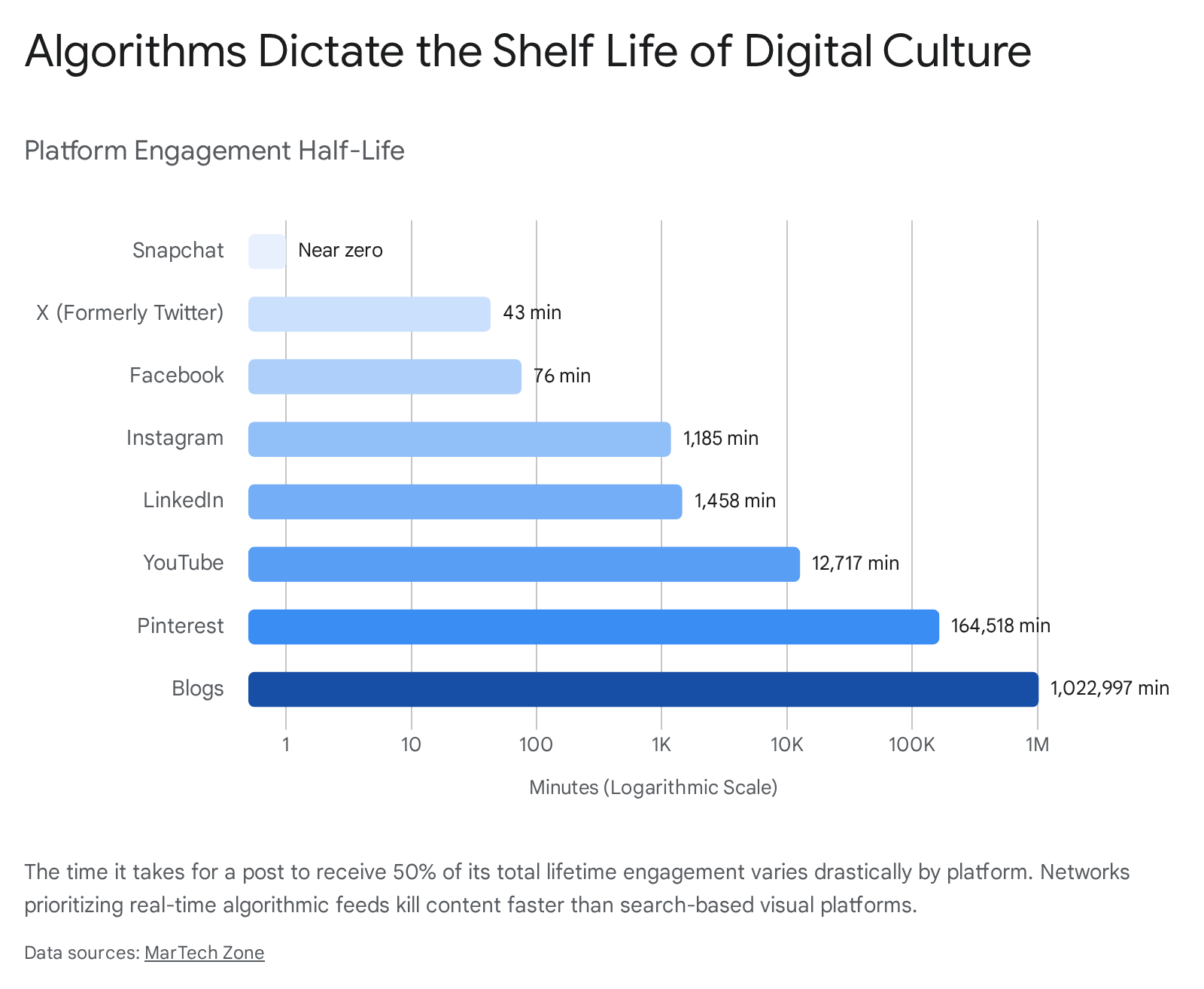
On the fast-paced network X (formerly Twitter), a post's half-life is a mere 43 minutes 2. Even more aggressively, recent behavioral analyses show that on average, a tweet reaches its peak impressions just 72 seconds after being posted. By the 24-hour mark, approximately 95% of all tweets receive no further meaningful visibility, demonstrating an almost instantaneous cultural decay 3. This infrastructure inherently discourages slow-building cultural movements, instead rewarding highly ephemeral "flash-in-the-pan" virality.
The Myth of the Shrinking Attention Span
When discussing the rapid death of online trends, a popular narrative frequently arises: the claim that the human attention span has fallen to eight seconds, supposedly making it shorter than that of a goldfish. This "goldfish myth" is entirely fabricated, originating from a misquoted marketing pamphlet with no basis in peer-reviewed scientific literature 42. However, the actual empirical data regarding human attention in the digital age reveals a dynamic that is arguably more concerning for cultural longevity.
According to decades of research led by Dr. Gloria Mark at the University of California, Irvine, our biological capacity for attention has not vanished, but our ability to sustain focus on a single digital screen has plummeted due to environmental conditioning. In 2004, the average time a user spent engaged with a single screen before switching tasks was roughly 150 seconds (2.5 minutes). By 2012, that metric had dropped to 75 seconds. As of 2024, the average duration sits at a staggering 47 seconds 6789. Further longitudinal studies utilizing eye-tracking data indicate that sustained attention on a single piece of digital content has declined by 36.7% since the year 2000 4.
The Cost of Constant Context Switching
The core issue driving the death of trends is not an attention span deficit, but rather relentless attention switching 810. Algorithmic social media feeds are engineered to offer continuous, frictionless scrolling, delivering highly variable rewards that keep the brain in a state of high alert.
Every time a user switches their attention from a viral dance video, to a geopolitical news snippet, to a targeted advertisement, they incur a "cognitive switch cost" 911. This rapid shifting demands reorientation, which depletes cognitive resources, raises blood pressure, and increases perceived stress levels 79.
Cognitive Satiation and Information Overload
When users are exposed to hundreds of iterations of a single micro-trend in one scrolling session, they quickly reach a state of satiation 3. Cognitive satiation occurs when the brain processes so much information regarding a specific topic, sound, or aesthetic that the stimulus loses its novelty and appeal entirely. In the context of online trends, a massive audience can collectively grow exhausted by a cultural moment in a matter of days, simply because they have been algorithmically force-fed thousands of variations of it.
Even without significant external changes in a product's quality, consumers experience "mainstream fatigue" - an endogenous psychological phenomenon where the depletion of emotional resources leads to an active desire to switch to a new, entirely different trend 3.
The Architecture of Algorithmic Virality
To understand why trends die so quickly, one must examine the specific mechanics of the platforms orchestrating them. Legacy social networks like Facebook originally relied on the "social graph" (distributing content based on who a user explicitly chose to follow). Modern video platforms like TikTok, Instagram Reels, and Lemon8 rely heavily on the "interest graph" (aggressively pushing content to cold, non-follower audiences based on algorithmic predictions of what will capture attention) 13141516.
If a video utilizing a specific audio track or showcasing a new aesthetic exhibits a high Engagement Rate by Views (ERV) - usually needing to hit between 8% and 10% in its first few hours of distribution to signal true breakout potential - the algorithm identifies it as a viral trend 16. It then prioritizes serving that exact template to millions of other users, regardless of whether they follow the creator.
Platform Divergence: A Comparative Analysis
Because different platforms utilize different algorithmic weightings, the velocity and decay rate of a trend vary significantly depending on where it originates.
| Metric / Platform | TikTok | Instagram Reels | YouTube Shorts |
|---|---|---|---|
| Global Monthly Active Users (2025/2026) | ~1.99 Billion 4 | ~3.0 Billion (Total IG) 4 | ~2.0 Billion+ 18 |
| Median Engagement Rate (2024/2025) | ~2.65% - 4.9% 419 | ~0.65% - 1.48% 420 | ~0.30% 20 |
| Trend Lifespan (Time to 95% total views) | ~35 days 5 | ~70-75 days 5 | Highly variable 18 |
| Early View Concentration | 72% of views occur on Day 1 5 | Gradual build, longer tail 5 | Mixed, depends on channel size 20 |
| Algorithmic Focus | Spontaneous, rapid viral trend-jumping 623 | Visual aesthetics, curated lifestyle 623 | Algorithmic extension of long-form video 18 |
TikTok's engagement rate is exceptionally high, and its algorithm fiercely favors rapid replication. As a result, a trend reaches peak cultural saturation faster than on any other platform. Data indicates that 72% of a TikTok video's total lifetime views happen on the very first day it is posted. By day 35, it has typically reached 95% of its total potential views and is functionally dead 5.
Instagram Reels, by contrast, possesses a longer "tail." Videos often accumulate engagement over 70 to 75 days, allowing trends to persist slightly longer as they filter through more curated, polished lifestyle communities before burning out 56.
Sonic Decay: The Lifecycle of Viral Audio
Audio is a critical accelerant in this viral architecture. Fully 88% of TikTok users agree that sound is essential to the platform's experience, and trending audio acts as the connective tissue that turns an isolated video into a replicable trend 24.
However, the lifecycle of a trending sound is notoriously volatile. Creators must navigate the "locked audio trap" - sounds featuring highly specific voiceovers or hyper-contextual jokes that go viral for one original poster but feel deeply out of place when reused 25. More sustainable trends rely on "slow-burn" audios - such as lo-fi instrumental tracks, aesthetic indie remixes, or nostalgic 2010s hits - which grow steadily across multiple niches rather than experiencing a massive, single-day spike followed by immediate abandonment 2425.
Sociological Drivers: Bourdieu in the Digital Age
While algorithms explain the mechanism of rapid trend death, classical sociology explains the human motivation behind it.
In 1979, the influential French sociologist Pierre Bourdieu published Distinction, arguing that individuals use their cultural tastes - what they wear, the art they appreciate, how they decorate their homes - as a form of "cultural capital" 78. This capital is deployed to signal social status, project identity, and establish symbolic boundaries that differentiate one's "in-group" from outsiders 8.
In the digital era, the theories of Bourdieu and his contemporary Jean Baudrillard (who theorized that objects function primarily as signs conferring status) have taken on new meaning 9. Digital environments have shifted the dominance of physical objects toward algorithmic visibility 9. This quest for digital cultural capital has accelerated into a phenomenon sociologists describe as distinction churn 9.
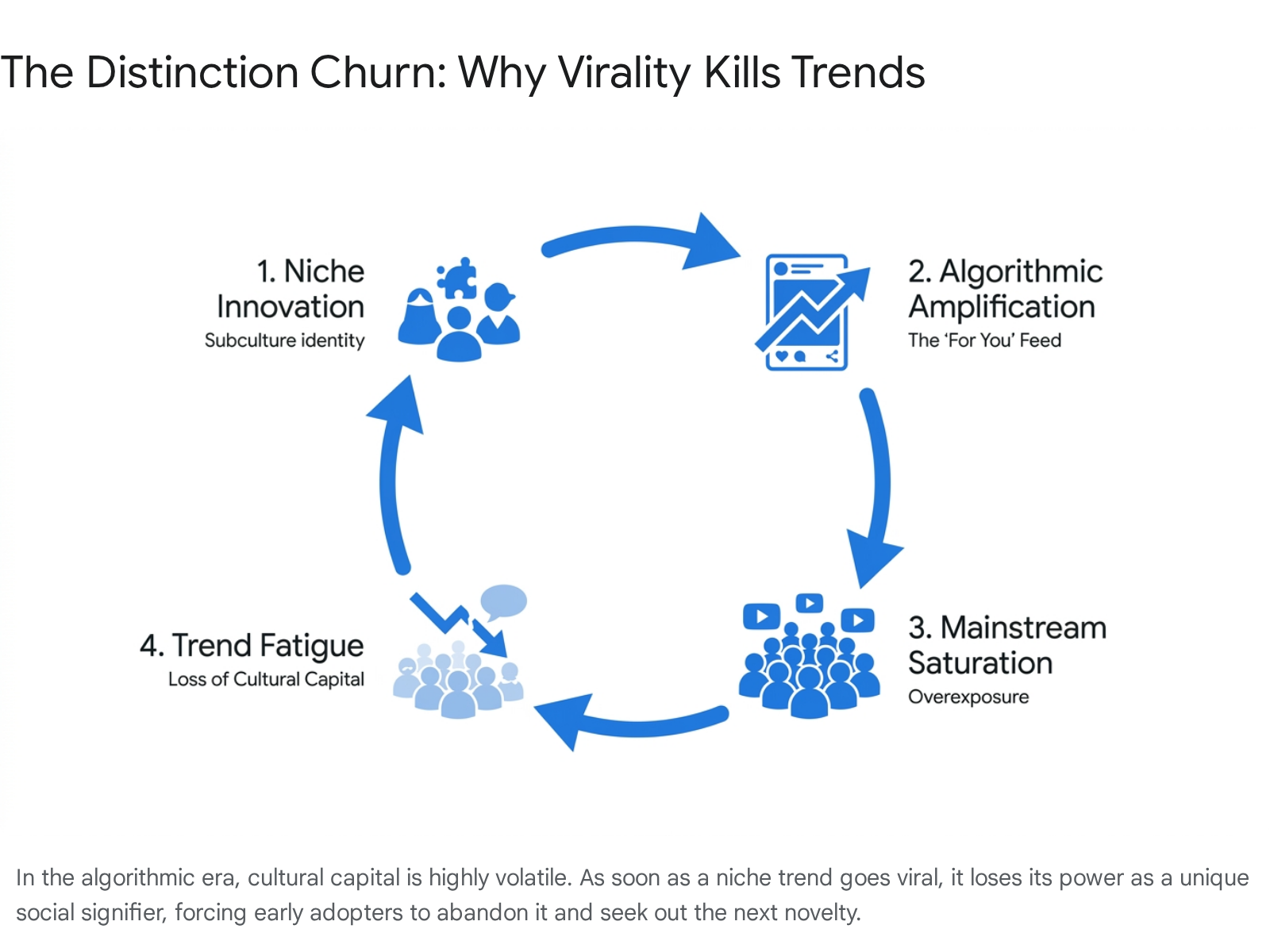
When a niche internet community creates a unique style, it serves as a powerful badge of in-group belonging. However, the moment that style is detected by an algorithm, it is ripped from its original context and broadcasted to millions 18.
The Rise of Hyper-Specific "Cores" and Self-Discretization
This sociological dynamic has birthed the modern phenomenon of hyper-specific micro-trends, which are frequently labeled with the suffix "-core" (e.g., Balletcore, Cybercore, Whimsigoth, Gorpcore, Frutiger Aero) 101131.
Unlike authentic, organic subcultures of the past (such as 1970s punk or 1990s hip-hop), which were rooted in shared physical environments and political ideologies, modern micro-trends are largely digital-first aesthetic packages. Researchers refer to this behavior as "self-discretization" 1. Users willingly fracture and package their identities into easily recognizable, highly tagged aesthetic markers because doing so makes them highly readable to recommendation algorithms 1. By using the right tags and visual cues, users ensure their content is routed to the exact right digital tribe.
However, the paradox of the digital trend is that its success guarantees its demise. When a micro-trend achieves massive visibility, it is adopted by the broader public and commodified by corporate brands 13. At this point, the trend no longer signals unique cultural capital or distinction; instead, it signals mass conformity. The early adopters, stripped of their cultural exclusivity, experience fatigue and rapidly abandon the aesthetic to seek out a new, untapped niche, starting the churn cycle entirely over 332.
Everett Rogers on Fast-Forward: The S-Curve Collapse
Decades before the advent of social media, sociologist Everett Rogers developed the "Diffusion of Innovations" theory (1962). Rogers proposed that new ideas and technologies spread through a social system in an S-shaped curve, moving sequentially from Innovators to Early Adopters, through the Majority, and finally reaching the Laggards 3312.
Rogers theorized that the speed of this adoption depends heavily on several factors, primarily observability (how visible the innovation is to others) and trialability (how easy it is to test without significant risk) 3336.
In the modern digital era, social media has effectively maximized both variables. Everything is instantly observable on a global scale, and participating in a digital trend - whether applying a video filter or lip-syncing to a viral audio clip - requires zero financial cost and only seconds of effort 1636. As a result, the traditional S-curve has been violently compressed. What once took years of slow diffusion across geographic boundaries now happens in a matter of hours, radically accelerating the journey from "innovation" to "obsolescence" and forcing the trend to die out prematurely 33.
Anatomy of a Micro-Trend: The Labubu Phenomenon
To observe how this compressed lifecycle manifests in physical consumer goods, one can examine the 2024 - 2025 explosion of "Labubu," a quirky, gremlin-like collectible plush doll produced by the Chinese toy company Pop Mart 373839.
Created by artist Kasing Lung, the doll saw modest sales for several years following its initial 2015 debut. However, its lifecycle was hyper-accelerated in early 2024 when Blackpink's Lisa and other prominent celebrities began featuring the dolls on their social media as luxury bag accessories 373913. The resulting trend followed a distinct, deeply compressed trajectory:
- Initial Surge & Scarcity: Celebrity endorsements triggered algorithmic amplification on TikTok and Instagram. This resulted in severe supply shortages and massive price markups on secondary markets, with rare dolls initially retailing for $27 fetching upwards of $149 on eBay 3739.
- Growth & Hyper-Monetization: Pop Mart heavily utilized the "blind box" model, forcing consumers to gamble on which toy they would receive to complete a set. Unboxing videos became a secondary viral trend, fueling billions of views. Pop Mart reported a roughly 400% rise in profits by mid-2025, and mentions of "Labubu" spiked to over 635,000 per week across the internet by July 2025 373839.
- Deterioration & Environmental Fallout: By late 2025, market saturation began to set in. As millions of units flooded the market, the social exclusivity (cultural capital) of owning a Labubu evaporated. Pop Mart's share prices experienced sharp declines in late 2025 as analysts warned of waning consumer interest 3941.
This rapid boom-and-bust cycle highlights a severe real-world consequence of algorithmically driven trends: immense environmental waste. When a trend dies in a matter of weeks, it leaves behind massive overproduction. For products like Labubu - made of difficult-to-recycle polyvinyl chloride (PVC) and wrapped in layers of mystery box plastic - the end of the cultural trend results in an immediate, mounting challenge for the recycling sector and global landfills 3741.
The Geographic Nuance of Trend Velocity
While the viral acceleration model holds true in Western markets dominated by TikTok and Instagram, trend lifecycles and platform utilities are not geographically uniform. In various parts of the world, users interact with social platforms under entirely different behavioral paradigms.
China's Platform Ecosystem: Fast vs. Slow
In China, the digital landscape offers a fascinating split between ultra-fast commerce and deliberate, slow consumption. Douyin (ByteDance's Chinese counterpart to TikTok) is the ultimate conversion engine, utilizing short-form video to turn trends into massive e-commerce revenue with over 2 trillion RMB in gross merchandise value reported in 2024 141516.
However, a notable counter-movement has emerged on platforms like Xiaohongshu (often compared to an amalgamation of Instagram and Pinterest) and Kuaishou. Xiaohongshu thrives on deep, text-based reviews, authentic product seeding, and community advice 454647. The platform's algorithm emphasizes search intent rather than passive video scrolling, natively resisting the flash-in-the-pan virality of short-form video and allowing product trends a longer, more stable lifecycle 144748.
| Platform | Core User Base | Primary Content Format | Algorithmic Strategy & Trend Speed |
|---|---|---|---|
| Douyin | Urban, broad demographics 14 | Short-form video, rapid live commerce 1516 | High velocity, algorithmic push, fast trend turnover 1649 |
| Kuaishou | Strong in lower-tier cities 1415 | Short video, authentic community live streams 16 | Slower burn, relies on deep creator-audience trust 1416 |
| Xiaohongshu (RED) | Young urbanites, female-skewing (70% search intent) 4548 | Text-heavy reviews, lifestyle imagery, search queries 4546 | Sustained lifecycle, rewards informative, deliberate curation 144650 |
Similarly, Kuaishou differentiates itself from Douyin by fostering deeper, more authentic creator-audience relationships, particularly outside of China's coastal premium tier-one cities 141516. On these platforms, there has been a recent, platform-supported shift toward "slower," human-centric content, such as documentary-style vlogs of ordinary people, actively pushing back against overstimulating fast-media 50.
Emerging Markets and Utilitarian Social Media
Globally, the perception of social media as merely a trend-generating entertainment machine is largely a Western luxury. In highly active digital markets like Nigeria, Brazil, and India, social media platforms serve as critical, utilitarian infrastructure.
In 2024 - 2025, an estimated 69.9% of the global population uses social networks 51. In countries like Nigeria, nearly 70% of internet users cite learning about brands as a primary reason for using social media, compared to fewer than 30% in Japan 17. Furthermore, an astonishing 58.5% of Nigerians and 44.8% of Brazilians use social media for professional and work purposes, vastly outpacing the United States (24.4%) 51. In these environments, trends often revolve around tangible commerce, news distribution, and professional networking, yielding different engagement half-lives than aesthetic micro-trends.
Algorithm Fatigue and the Pivot to Niche Communities
As trend lifecycles grow shorter and more intense, a predictable psychological backlash has emerged: algorithm fatigue 53.
Users are becoming increasingly exhausted by the friction-free, hyper-targeted nature of the internet. When platforms become too efficient at delivering content, the digital world loses the serendipity of discovery 53. Furthermore, an increase in algorithmic knowledge often leads to "algorithmic cynicism" - where users become acutely aware of how their attention is being manipulated by recommendation engines. This awareness frequently leads to active digital disengagement, lower trust in content reliability, and a desire to log off 181956.
In response to this fatigue, we are witnessing a fragmentation of the social media landscape. Frustrated users are shifting their attention away from massive, generalized video feeds toward niche, specialized platforms 20. Conversation-driven apps like Threads, Reddit, and Discord are seeing sharp year-over-year growth as users seek active community debate, shared values, and text-based connection over passive, algorithm-fed video scrolling 2058.
Simultaneously, marketing data indicates a resurgence in physical, analog experiences. Investment in Digital Out-of-Home (DOOH) advertising and in-person experiential marketing is rising as brands realize that consumers, overwhelmed by digital fatigue, are craving authentic, tangible touchpoints that exist outside the constraints of an algorithm 5356.
Bottom line
Online trends die quickly because the recommendation algorithms that distribute them are optimized entirely for velocity and engagement, effectively compressing years of natural cultural diffusion into a matter of days. Once an algorithm pushes a niche aesthetic or product to the global mainstream, it strips the trend of its unique social value and cultural capital, causing early adopters to experience satiation and immediately abandon it. While digital platforms will undoubtedly continue to chase the massive revenue spikes that these ephemeral micro-trends generate, rising algorithmic cynicism suggests that users are growing exhausted by the churn, increasingly seeking out slower, more intentional digital communities and authentic real-world interactions.