
What the Women's Suffrage Movement Achieved and Left Undone
The women's suffrage movement successfully dismantled legal barriers to female political participation, culminating in historic achievements like the 19th Amendment in the United States and the 1928 Equal Franchise Act in the United Kingdom. However, these initial legislative victories predominantly favored white, property-owning women, leaving women of color, working-class citizens, and Indigenous populations to endure decades of ongoing disenfranchisement. Today, the legacy of this movement continues to echo in fiercely contested legislative battles over voter access, election security, and the enduring realities of intersectional inequality.
The Philosophical and Strategic Origins of the Suffrage Movement
The modern push for women's voting rights emerged in the late eighteenth and early nineteenth centuries, initially intertwined with broader Enlightenment ideals regarding universal human rights. Early philosophical treatises, such as Mary Wollstonecraft's A Vindication of the Rights of Woman (1792) and Olympe de Gouges's Declaration of the Rights of Woman and of the Female Citizen (1791), established the intellectual groundwork for female political equality 1. However, translating these theoretical arguments into concrete political movements took several more decades.
In the United States, organized advocacy formally commenced at the 1848 Seneca Falls Convention in New York, where Elizabeth Cady Stanton and other activists drafted the Declaration of Sentiments, explicitly demanding the right to vote 1. For much of its early history, the American women's suffrage movement was deeply allied with the abolitionist cause. Leaders like Sojourner Truth, Lucretia Mott, and the Grimké sisters viewed the eradication of slavery and the enfranchisement of women as linked human rights battles 2. This alliance fractured notably after the American Civil War when the Fifteenth Amendment was drafted to protect the voting rights of Black men while explicitly ignoring women, leading to strategic and racial divisions that would haunt the movement for the next century 23.
Similarly, in Great Britain and its colonies, early advocacy was defined by petitions, parlor meetings, and gradualist lobbying 45. While these foundational efforts successfully placed the issue of female enfranchisement into public discourse, suffragists rapidly learned that ideological appeals were insufficient to overcome entrenched patriarchal and legislative resistance.
The First Wave of Global Enfranchisement
The achievement of formal suffrage varied widely in its timeline, scope, and inclusivity, proving that the expansion of democratic rights was rarely a linear or universal process. The earliest breakthroughs occurred not in the metropolitan centers of Europe or North America, but in the frontier colonies of the Pacific.
The Pacific Pioneers: New Zealand and Australia
In 1893, New Zealand became the first self-governing nation to grant women the right to vote in parliamentary elections 678. This milestone was particularly notable for its inclusivity; unlike many subsequent suffrage laws elsewhere, the New Zealand legislation enfranchised all women simultaneously, including Indigenous Māori women 9. This sweeping reform was part of a broader drive that allowed the colony to style itself as a "social laboratory," extending political citizenship rapidly across the adult population 10.
Neighboring Australia followed shortly after. The colony of South Australia allowed women to both vote and stand for election in 1895 811. Following the federation of the country, the Australian parliament passed the Commonwealth Franchise Act in 1902, which granted voting rights to all adult British subjects resident in the nation 811. However, unlike New Zealand, Australia's legislation was explicitly exclusionary. The 1902 Act deliberately denied the franchise to "natives of Australia, Asia, Africa and the Pacific Islands" 811. Consequently, Indigenous Australian women - and men - were denied the fundamental right to vote at the federal level for another six decades, finally achieving it in 1962 6711.
The British Struggle: From Gradualism to Militancy
In the United Kingdom, the fight for women's suffrage was characterized by a bitter division over tactics, reflecting widespread frustration with parliamentary stonewalling. In 1897, various peaceful suffrage societies merged to form the National Union of Women's Suffrage Societies (NUWSS), led by Millicent Fawcett, which relied on petitions, lobbying, and pamphlets to persuade male lawmakers 45. Believing these methods to be ineffective, Emmeline Pankhurst founded the Women's Social and Political Union (WSPU) in 1903. The WSPU suffragettes embraced militant tactics under the motto "Deeds, not words," organizing aggressive demonstrations, smashing windows, and engaging in highly publicized hunger strikes when imprisoned 45.
The suffragettes' escalation culminated in events like "Black Friday" in 1910, where 300 women protesting the failure of a suffrage bill were beaten and arrested by police 4. However, the outbreak of World War I in 1914 completely altered the political landscape. The WSPU suspended its militant activities to support the war effort, and millions of British women filled critical labor shortages in munitions factories, agriculture, and transport 51213.
By the war's end, the government faced overwhelming pressure to reform the franchise, primarily because existing residency requirements effectively disenfranchised returning male soldiers 1214. The resulting Representation of the People Act, passed in February 1918, was a compromise. It granted the vote to virtually all men over the age of 21 (and soldiers aged 19), but it restricted women's suffrage to those over the age of 30 who met minimum property qualifications or whose husbands met them 51516. Lawmakers specifically imposed the age restriction because female voters would have vastly outnumbered male voters due to wartime casualties 4.
While the 1918 Act enfranchised roughly 8.4 million British women, it left approximately 22 percent of women over 30 - many of whom were working-class women who had contributed heavily to the wartime economy - without a vote 4513. True electoral equality was not achieved until the passage of the Representation of the People (Equal Franchise) Act in 1928. Sometimes referred to as the Fifth Reform Act, this legislation finally granted the vote to all women over the age of 21 on the same terms as men, adding another 15 million women to the electorate 5171819.
The North American Context: State, Provincial, and Federal Victories
In North America, the path to enfranchisement was equally protracted and required navigating complex federalist systems. In Canada, women's suffrage was achieved piecemeal across the provinces before becoming federal law. The western prairie provinces were the first to move, with Manitoba, Saskatchewan, and Alberta granting female property owners the right to vote in provincial elections in 1916 202122. British Columbia and Ontario followed in 1917 23. At the federal level, the controversial Wartime Elections Act of 1917 granted the vote to women associated with the armed forces, largely as a political maneuver to secure support for conscription 2022. This was quickly followed by the Women's Franchise Act in May 1918, which extended the federal vote to female citizens over the age of 21 2022. However, as with Australia, Canada's legislation harbored deep racial exclusions that barred Asian and Indigenous women for decades 720.
In the United States, activists pursued a dual strategy of state-level campaigns and federal lobbying. Following the Civil War, the western states and territories proved most receptive to women's suffrage, often to attract female settlers and bolster statehood claims 2425. Wyoming led the way, granting women the right to vote in 1890, followed by Colorado, Utah, and Idaho 24. By 1912, nine western states had enacted full women's suffrage 26.
Despite these regional victories, a federal amendment remained elusive. Organizations like the National American Woman Suffrage Association (NAWSA) worked meticulously to win over state legislatures, while the more radical National Woman's Party (NWP), led by Alice Paul, staged dramatic public protests, including the first-ever continuous picket of the White House beginning in 1917 27. Enduring heckling, imprisonment, and physical abuse, these activists steadily increased the political pressure on President Woodrow Wilson and Congress 26. Finally, on June 4, 1919, Congress passed the 19th Amendment, declaring that the right to vote "shall not be denied or abridged by the United States or by any State on account of sex" 2829. Following a grueling ratification battle, the amendment became the law of the land on August 18, 1920, nominally enfranchising 26 million American women 1130.
The Illusion of Universal Suffrage: An Intersectional Analysis
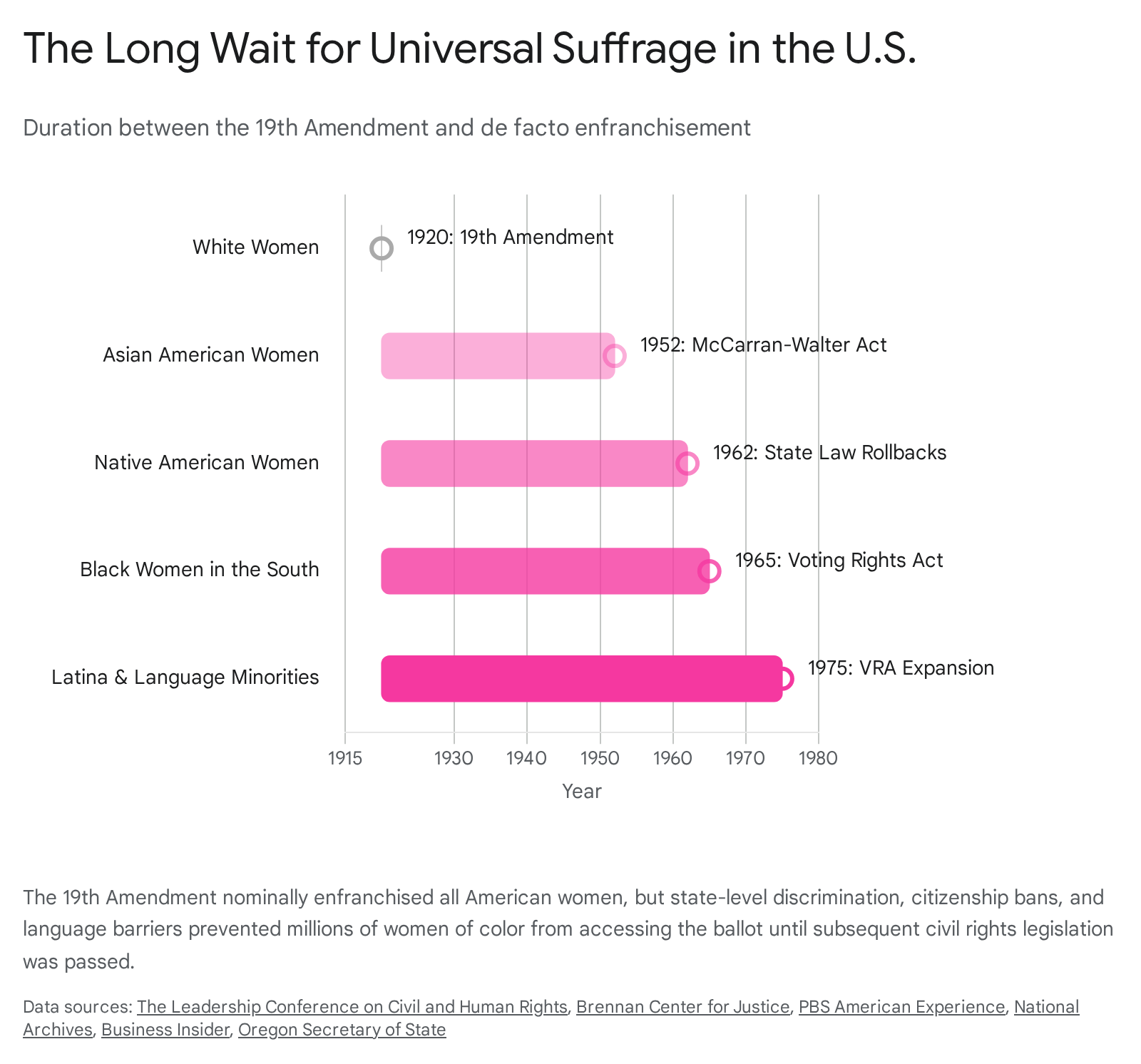
While 1920 is frequently celebrated as the definitive end of the American women's suffrage movement, contemporary historical analysis reveals that this date marks only the enfranchisement of white women. A closer examination requires an intersectional approach - a framework coined by Kimberlé Crenshaw to describe how various forms of inequality, such as race, class, and gender, operate together to exacerbate systemic discrimination 29.
As recent historical reviews, such as those by Ramola Ramtohul (2024), demonstrate, women do not comprise a uniform political bloc 9. During the nineteenth and early twentieth centuries, race, ethnic identity, and class were frequently prioritized over a shared gender identity 9. In many instances, the mainstream suffrage movement actively marginalized women of color to appease conservative legislators, utilizing the promise of white women's votes as a mechanism to reinforce white supremacy 9. Consequently, the achievement of "universal" suffrage was an illusion for millions of minority women who faced decades of continued legal and extralegal disenfranchisement 3132.
Black Women and the Jim Crow South
For African American women, the ratification of the 19th Amendment provided immediate access to the ballot box only in northern and western states 230. In the American South, where the vast majority of the Black population lived, the amendment offered virtually no protection 2.
Following the collapse of Reconstruction, Southern state governments established a draconian system of Jim Crow laws designed specifically to strip political power from African Americans. Lawmakers utilized a variety of legal loopholes to bypass the Fifteenth and Nineteenth Amendments. They implemented impossibly difficult literacy tests, exorbitant poll taxes, and "grandfather clauses" that exempted white citizens from these barriers if their ancestors had voted prior to 1870 23233. Furthermore, states established "white-only" Democratic primary elections, functionally eliminating Black participation in the region's only competitive political contests 224.
When legislative disenfranchisement failed, white supremacist groups utilized systemic terror, economic reprisals, and outright violence to prevent Black women and men from attempting to register 3334. The mainstream suffrage movement often ignored these atrocities, leaving Black activists like Ida B. Wells-Barnett and the founders of the Alpha Suffrage Club to fight simultaneously against sexism within the civil rights movement and racism within the feminist movement 32932. It would take another 45 years of relentless organizing, culminating in the Civil Rights Movement of the 1960s, for Black women to secure federal protection of their voting rights.
Native American and Asian American Disenfranchisement
The 19th Amendment also failed to enfranchise populations explicitly barred from holding United States citizenship. In 1920, the federal government did not recognize Native Americans as citizens, meaning the federal suffrage amendment simply did not apply to them 30. Although early suffragists had observed matrilineal Indigenous societies as models for female political power, they rarely advocated for the enfranchisement of Native women 30. Congress eventually passed the Snyder Act (Indian Citizenship Act) in 1924, granting citizenship to all native-born Indigenous people 23035. However, constitutional authority over elections allowed individual states to maintain discriminatory barriers. Western states utilized contrived justifications, such as claiming that living on a federal reservation negated state residency, to block Native Americans from the polls. Some states, like South Dakota and New Mexico, successfully maintained these discriminatory practices until the late 1950s and early 1960s 23035.
Similarly, federal immigration policies purposefully excluded Asian immigrants from the democratic process. Legislation such as the Chinese Exclusion Act of 1882 and the Immigration Act of 1924 prohibited immigrants of Asian descent from naturalizing as U.S. citizens 243236. Consequently, first-generation Asian American women were legally barred from the polls, despite the active participation of figures like Dr. Mabel Ping-Hua Lee, who led parades advocating for women's suffrage knowing she would not benefit from its passage 3037. This form of racial disenfranchisement remained fully intact until the McCarran-Walter Act of 1952 eliminated racial prerequisites for naturalization, finally allowing Asian American immigrant women to become citizens and voters 243036.
International Echoes of Diplomatic Racism
This phased, exclusionary approach to the franchise was mirrored globally. In Canada, federal and provincial governments operated what researchers classify as a "campaign of diplomatic racism" 38. Despite the passage of the 1918 Women's Franchise Act, individuals of Asian and Indigenous descent were systematically excluded 720. Asian Canadian women did not secure full enfranchisement until 1948, following the cultural shifts initiated by World War II 720. Indigenous communities faced an even longer delay; Inuit men and women gained the vote in 1950, but it was not until 1960 that the Canadian government permitted First Nations people to vote in federal elections without being forced to abandon their treaty status and assimilate into white society 2038.
In South Africa, the history of women's suffrage is inseparable from the history of apartheid. Driven by the Women's Enfranchisement Association of the Union, white South African women won equal voting rights in 1930 911. However, this legislation was fundamentally designed to dilute the limited voting power held by African men in the Cape Province and solidify white minority rule 9. Limited suffrage was gradually offered to Indian and Coloured (mixed-race) populations in the 1980s, but the vast majority of the population - Black South African women - remained entirely disenfranchised until the fall of apartheid led to the nation's first multiracial democratic elections in 1994 6911.
| Region | Milestone for White/Majority Women | Milestone for Indigenous/Minority Women | Mechanism of Exclusion |
|---|---|---|---|
| United States | 1920 (19th Amendment) | 1965 (Black women), 1975 (Language minorities) | Jim Crow laws, literacy tests, poll taxes, citizenship bans 22433 |
| Canada | 1918 (Women's Franchise Act) | 1948 (Asian Canadians), 1960 (First Nations) | Federal legislation explicitly excluding non-white races and treaty members 72038 |
| Australia | 1902 (Commonwealth Franchise Act) | 1962 (Aboriginal Australians) | Explicit statutory exclusion of natives of Australia, Asia, and Africa 811 |
| South Africa | 1930 (White women enfranchised) | 1994 (Black citizens enfranchised) | Apartheid structures designed to maintain white minority supremacy 6911 |
Federal Interventions: The Voting Rights Acts of 1965 and 1975
In the United States, the ultimate fulfillment of the 19th Amendment required robust, sweeping federal intervention to override decades of state-level suppression. Following brutal attacks on peaceful civil rights marchers in Selma, Alabama - an event that shocked the conscience of the nation - President Lyndon B. Johnson and a bipartisan Congress passed the Voting Rights Act (VRA) of 1965 3439.
The VRA was a landmark piece of civil rights legislation that aggressively dismantled the machinery of Jim Crow 34. It explicitly outlawed discriminatory prerequisites like literacy tests and poll taxes 3439. Crucially, it provided for the deployment of federal examiners with the authority to bypass local officials and directly register qualified citizens in jurisdictions with a history of severe discrimination 3440. The act also introduced a "preclearance" requirement, mandating that states with a track record of voter suppression submit any proposed changes to their election laws to the federal government for approval before implementation 3439. The immediate impact was staggering; by the end of 1965, federal examiners and civil rights groups had successfully registered a quarter of a million new Black voters, finally securing the de facto voting rights of Black women in the South 34.
However, the 1965 VRA failed to account for the unique systemic barriers facing non-English speaking citizens, particularly Latina and Asian American women 2. Across the Southwest, Hispanic voters faced election officials who routinely refused to provide registration cards, intimidated Spanish speakers at the polls, and administered deliberately discriminatory English literacy tests 241. Recognizing that individual litigation was insufficient to combat these pervasive abuses, organizations like the Mexican American Legal Defense and Educational Fund (MALDEF) launched a massive advocacy campaign 41.
Their efforts culminated in the 1975 extension of the Voting Rights Act, which officially expanded federal protections to "language minority groups" 4142. The legislation introduced Section 203, which required specific states and local jurisdictions to provide translated voting materials - including voter registration notices, forms, instructions, and ballots - in the language of applicable minority groups 24243. By mandating bilingual election infrastructure, the 1975 extension finally empowered millions of Latina, Asian American, and Indigenous women to navigate the electoral process and participate meaningfully in American democracy 242.
The Modern Electorate: Gender Gaps and Identity Politics
In the century since the initial wave of suffrage legislation, the political behavior of women has dramatically shifted, fundamentally altering the calculus of modern elections. Early skeptics of women's suffrage argued that female enfranchisement would merely double the votes of their husbands 44. For several decades, this appeared partially true, as early women voters exhibited lower turnout rates than men and generally mirrored male partisan preferences 44.
However, as cultural and economic barriers eroded, women became a formidable, independent political force. By 1980, female voter turnout achieved parity with male turnout in the United States 4445. In every presidential election since, women have consistently voted at higher rates than men, currently outvoting them by roughly 4 to 5 percentage points 4445. Because women comprise a majority of the voting-age population, they have fundamentally reshaped the electoral map.
This increased participation has also birthed a significant and widening "gender gap" in partisan preference and issue prioritization. Research indicates that women, on average, place a higher priority on child welfare, public health, education spending, and economic redistribution than men 4446. In highly polarized environments, such as the 2024 U.S. presidential election, demographic divides are stark. Exit polling revealed that 53 percent of female voters supported Democratic candidate Kamala Harris, while 55 percent of male voters favored Republican candidate Donald Trump 4748.
This gender divide intersects heavily with race and education. White women display highly fractured voting patterns, while Black, Latina, and Asian American women reliably serve as the cornerstone of the progressive coalition 4849. Simultaneously, sociologists have observed the rise of distinct, gendered political subcultures. The "manosphere" - a network of online forums focused on masculinity and anti-feminist ideologies - has grown significantly in its ability to mobilize young male voters toward conservative candidates 47. Conversely, the "Mama Bear" movement has organized right-wing Christian mothers around issues of education, school boards, and opposition to progressive curricula, demonstrating how motherhood, gender, and religion intersect to drive contemporary political activism 47. Because women are highly mobilized and hold distinct policy preferences, any legislation that alters the mechanics of voter registration or access inevitably operates as a lever that impacts the "women's vote."
The Ongoing Struggle for Access: The 2025 and 2026 Debates
History demonstrates that the right to vote is never entirely secure; it requires continuous legislative maintenance and vigilant defense against erosion. Today, the foundational questions of the suffrage era - who belongs in the electorate, how difficult the act of voting should be, and who holds the power to verify identity - are being re-litigated in debates over election security and voter fraud 5051.
Following the contentious 2020 and 2024 election cycles, state and federal lawmakers introduced hundreds of bills aimed at altering election administration 5052. While some states expanded access through clearer ID pathways and longer early-voting windows, others aggressively tightened rules, citing fears of illicit voting 50.
At the federal level, this tension coalesced around the Safeguard American Voter Eligibility (SAVE) America Act. Building upon earlier iterations that stalled in the Senate, the revised SAVE America Act passed the U.S. House of Representatives in February 2026 52535455. The legislation represents one of the most substantial proposed overhauls of the National Voter Registration Act of 1993.
The core provision of the SAVE America Act requires all individuals to provide "documentary proof of United States citizenship" (DPOC) - specifically, documents like a U.S. passport, certified birth certificate, or certain Real ID cards - when registering to vote or updating an existing registration with a new name or address 525657. Furthermore, the legislation mandates that this documentation must be presented in person to an election official, effectively eliminating the use of mail-in voter registration forms, online registration portals, and community-led voter registration drives 525355. The bill also requires voters to show specific photo identification to cast an in-person or absentee ballot and mandates that states run their voter rolls through the Department of Homeland Security's Systematic Alien Verification for Entitlements (SAVE) database to identify potential noncitizens 5355.
Proponents of the SAVE America Act argue that it is crucial, commonsense legislation necessary to restore public confidence in democratic institutions and definitively prevent noncitizens from influencing federal elections 5258. However, election experts, civil rights advocates, and political scientists fiercely oppose the measure. They argue that the bill seeks to solve a "phantom problem," as federal law already explicitly prohibits noncitizen voting, and numerous audits have proven that illicit registration by noncitizens is statistically negligible 515658.
Critics warn that the true impact of the SAVE America Act will be the mass disenfranchisement of eligible citizens. An estimated 21 million Americans do not have ready access to a passport or a certified birth certificate, and obtaining these documents often requires navigating complex bureaucracies and paying prohibitive fees 55. By effectively banning online and mail registration, the legislation places an extraordinary logistical burden on low-income individuals, rural residents, college students, and communities of color - groups that already face intersectional barriers to civic participation 525355. Additionally, election administration organizations have raised severe alarms regarding provisions in the bill that establish harsh criminal and civil penalties for local election workers who mistakenly register a voter without sufficient proof, warning that the threat of imprisonment could trigger a mass exodus of nonpartisan poll workers 535455.
As the U.S. Senate debates the SAVE America Act in the spring of 2026, the rhetoric closely mirrors the civil rights and suffrage battles of the past century. Whether utilizing poll taxes, literacy tests, or documentary proof of citizenship, the fundamental tension remains the same: balancing the state's desire for absolute electoral security against the fundamental democratic principle of accessible, universal suffrage.
Bottom line
The women's suffrage movement was a monumental, generation-spanning achievement that shattered millennia of male-exclusive political governance and fundamentally expanded the definition of democratic citizenship worldwide. However, historical evidence unequivocally shows that the movement's early milestones were severely incomplete, prioritizing the enfranchisement of white, property-owning women while abandoning women of color, working-class citizens, and Indigenous populations to endure decades of subsequent legal and physical disenfranchisement. Today, the core themes of the original suffrage struggle remain highly relevant; contemporary legislative battles over voter identification, registration documentation, and election security continue to test the resilience and inclusivity of modern democracy.