
Global Gender Trends in Political Ideology
The question of whether men and women are growing apart politically has become a central focus of contemporary political sociology, electoral analysis, and demographic research. Across numerous advanced democracies and developing nations, public opinion polling and electoral data suggest a diverging ideological trajectory between genders, particularly among younger cohorts. However, the nature, magnitude, and underlying mechanisms of this divergence vary significantly by region, methodology, and the specific metrics used to measure political ideology.
This comprehensive research report synthesizes global polling data, regional election studies, and demographic surveys to evaluate the extent of the gender-based political divide. It examines the critical distinction between symbolic self-identification and operational policy preferences, traces electoral realignments in North America and Western Europe, analyzes the acute ideological polarization in South Korea, and contextualizes these trends against institutional participation metrics in Latin America, Africa, and the Middle East. Furthermore, it explores the theoretical implications of the "gender-equality paradox" and evaluates the methodological limitations of global survey instruments.
The Conceptual Distinction Between Symbolic and Operational Ideology
A fundamental challenge in evaluating the political gender gap lies in the measurement of ideology itself. Political science literature increasingly differentiates between "symbolic ideology" and "operational ideology" to explain seemingly contradictory polling results and the psychological mechanisms driving political polarization 1233.
Definitions and Theoretical Frameworks
Symbolic ideology refers to the ideological labels individuals willingly apply to themselves, such as "conservative," "moderate," or "liberal" 23. It functions primarily as a mechanism of social identity and tribal affiliation. Operational ideology, by contrast, is derived from an individual's actual aggregated preferences on specific policy issues, ranging from taxation and social welfare to reproductive rights, environmental regulations, and defense spending 12.
Recent analyses of the electorate reveal that the public often identifies as symbolically conservative or moderate while simultaneously exhibiting operationally liberal policy preferences 23. Research utilizing the Ideological-Conflict Hypothesis further posits that while standard left-right frameworks characterize elite political discourse, mass public ideology is often constrained by personal values, moral codes, and varying attitudes toward equality that do not map cleanly onto unidimensional scales 2. This distinction is critical when analyzing the youth gender gap, as individuals can hold conservative and liberal positions simultaneously, creating friction with traditional measurement models 23.
The Magnitude of the Ideological Gap
Widely circulated interpretations of global polling data frequently highlight a massive, 30-point ideological gap between young men and young women 15. However, researchers applying the symbolic-operational framework have found that while the gap in symbolic self-identification is indeed expanding, the divergence in average operational ideology remains substantially smaller.
On specific policy issues, the average gap between young men and women in the United States is approximately 5 percentage points 1.
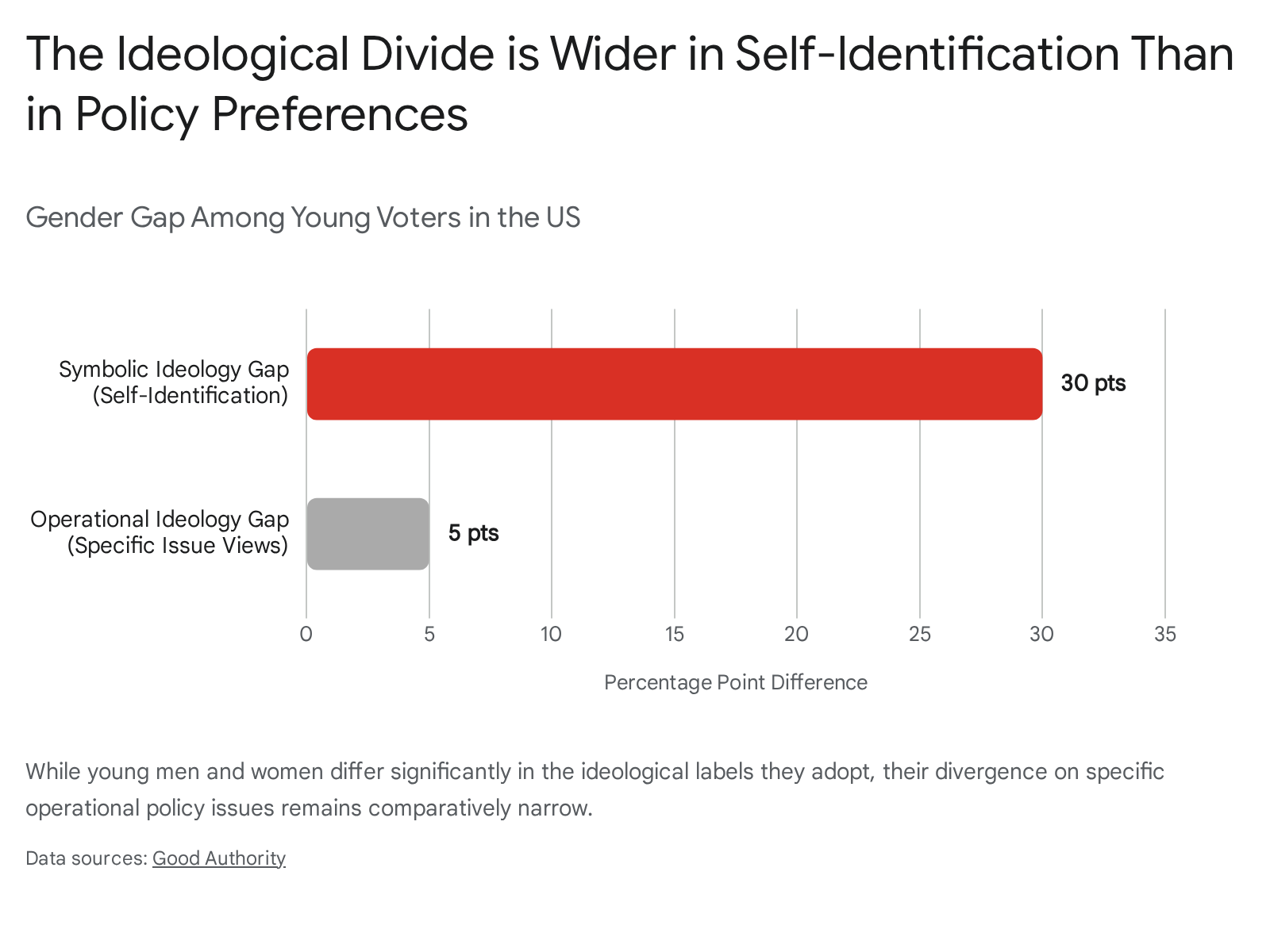
Furthermore, comprehensive data on operational ideology indicates that these gender differences on specific policies are not necessarily larger for the youngest age groups compared to older cohorts 1. This suggests that the narrative of a uniquely polarized generation may be exaggerated by an overreliance on symbolic self-identification, masking a broader consensus on operational governance.
Polling Data and Trends in the United States
In the United States, longitudinal polling data confirms a distinct leftward shift among young women, though the trajectory of young men is a subject of intense methodological debate among polling institutions. The divergence is visible not only in ideological labeling but also in media consumption habits and focal policy priorities.
Longitudinal Shifts in Symbolic Identification
Data aggregated from Gallup telephone surveys over the past three decades demonstrates that Americans generally lean center-right in their self-identification. Historical averages typically hover near 38% conservative, 36% moderate, and 25% liberal 64. However, this aggregate stability masks intense demographic polarization, particularly along the intersecting axes of gender and age.
Between 2001 and 2007, an average of 28% of women aged 18 to 29 identified as liberal, a figure just three percentage points higher than their male counterparts 5. During the period from 2008 to 2016, liberal identification among young women rose to an average of 32%, widening the gap with young men to five points 5. In the most recent period analyzed (2017 - 2024), young women's liberal identification surged to an average of 40%, creating a 15-point gap with young men, whose liberal identification stagnated at an average of 25% 65.
Simultaneously, conservatism among young women has experienced a long-term decline. After reaching an all-time low of 16% in 2020 and 2021, the share of this group identifying as conservative has slightly rebounded to 21% 6. In contrast, young men have historically been most likely to identify as politically moderate (averaging 44% in 2023), with roughly 29% identifying as conservative and 25% as liberal 6. Additional polling from PRRI in 2024 indicates an even starker partisan divide, finding that 47% of Gen Z women identify as liberal compared to just 24% who identify as conservative, making them the most progressive cohort of voters in the nation 6.
Policy Priorities and Cultural Wedge Issues
Beyond ideological labels, specific policy priorities highlight divergent focal points. Data indicates that economic conditions and inflation rank as the top priorities for the largest segment of Gen Z men, whereas Gen Z women prioritize threats to democratic institutions and reproductive rights 610.
This ideological divergence is mirrored in media consumption and cultural alignments. Gen Z women are more likely to consider TikTok their primary news source, while Gen Z men favor YouTube 10. Furthermore, cultural figures elicit highly polarized responses; an NBC News/SurveyMonkey poll found that 41% of Gen Z men view Elon Musk favorably, compared to only 20% of Gen Z women 10. Similarly, attitudes toward the #MeToo movement and gender roles demonstrate a widening chasm. Young women are significantly more likely to identify with the label "feminist" (61% of Gen Z women vs. 43% of Gen Z men), while nearly half of young men aged 18 to 29 report feeling that men face increasing societal discrimination - the highest rate of any male age group surveyed 56.
Methodological Counterpoints and Generational Nuance
While organizations like Gallup portray a rapidly expanding ideological chasm, other major datasets present a stabilizing counter-narrative. The Cooperative Election Study (CES) - a high-quality, large-sample university consortium survey with over 50,000 participants in even-year election cycles - offers a critical re-evaluation of the divergence narrative 7.
CES data spanning 2006 to 2022 confirms that a higher share of young women consistently identify as liberal compared to young men 7. However, the CES indicates that the liberal share of both young men and women declined relative to the conservative share in the early 2010s before trending upward collectively around 2017 7. Crucially, the CES data does not support the conclusion that the ideological gap is actively widening in the contemporary period. When calculating the net ideology gap (the difference between the "percent liberal minus percent conservative" for women versus the same measure for men), the CES shows that the gender gap actually peaked at nearly 10 percentage points in 2010. Since then, it has slightly contracted, stabilizing at approximately 7 percentage points as of 2022 7.
| Polling Source / Metric | Young Women (18-29) Liberal ID | Young Men (18-29) Liberal ID | Trend Assessment |
|---|---|---|---|
| Gallup (2001-2007 avg) | 28% | 25% | Baseline 3-point gap 5 |
| Gallup (2017-2024 avg) | 40% | 25% | Gap expanded to 15 points 65 |
| PRRI (2024) | 47% | 38% | 9-point gap in liberal ID; Gen Z women heavily identify as Democrats (41%) vs GOP (18%) 6 |
| Cooperative Election Study (2022) | Higher than men (exact % varies) | Lower than women | Gap peaked in 2010; currently stable at ~7 percentage points net difference 7 |
This methodological dissonance suggests that while young women have undoubtedly shifted leftward, the narrative that young men are drastically shifting rightward in equal measure may be an artifact of specific survey designs rather than a uniform generational reality.
Electoral Realignment in Western Europe
The gender divide observed in self-identification in the United States translates into tangible electoral realignment in Western European multi-party systems, where the "modern gender gap" - characterized by women voting more left-wing than men - has become a structural feature of recent elections.
Germany and the Emergence of the Modern Gender Gap
Longitudinal analyses utilizing the German Longitudinal Election Study (GLES) and physical ballot data over seven decades reveal that the modern gender gap emerged relatively recently in post-war Germany 128. Historically, the "traditional gender gap" prevailed; women - influenced by higher religiosity, traditional family structures, and lower workforce participation - were more likely to vote for conservative and Christian democratic parties than men 128.
The shift toward the modern gender gap began to show preliminary hints among the youngest voters in 2013 but fully materialized across the electorate in the 2017 federal election 128. By the 2021 election, the ideological divide reached an unprecedented peak, specifically driven by the youngest demographic. Among voters aged 18 to 24, young women's voting behavior was 0.65 points further to the left than that of young men - the largest gender gap ever recorded for any demographic group in German federal election history 8.
This ideological drift manifested starkly in party preference. Young women disproportionately supported left-of-center parties, including the Greens, the Social Democrats (SPD), and Die Linke (The Left), with 35% of young women opting for the far-left Linke party in some demographic subsets 814. Conversely, young men increasingly cast ballots for the liberal Free Democratic Party (FDP) and the right-wing populist Alternative for Germany (AfD), with the AfD capturing up to 27% of the young male vote 814.
Methodological evaluations comparing real ballots to survey estimates suggest that standard surveys may suffer from social desirability bias. Surveys tend to slightly overestimate the actual gender gap for radical parties like the AfD, potentially because young women are more reluctant to admit to right-wing voting in polling environments 128. Nevertheless, the structural divide remains robust and historically unprecedented in actual ballot data.
The United Kingdom and the 2024 General Election
A parallel phenomenon was documented in the United Kingdom's 2024 General Election. Data from the British Election Study (BES) Internet Panel indicates that the gender gap is most pronounced at the opposite ends of the political spectrum rather than in the centrist mainstream 910.
In 2024, 19.7% of women aged 18 to 24 voted for the progressive Green Party, compared to 13.1% of men in the same age bracket 10. Conversely, the populist right-wing party Reform UK captured 12.9% of the young male vote, more than double the 5.9% secured among young women 10.
This electoral divergence is underpinned by differing issue prioritization. According to the BES, 40.7% of women aged 18 to 34 ranked the cost of living as their paramount election issue, compared to 29% of men. In contrast, 12% of young men identified immigration as a top issue, compared to just 4.9% of young women 10. The 2024 UK election results confirm that while the gender gap in two-party support between Labour and the Conservatives has fluctuated - with women even slightly more likely to vote Conservative overall in 2024 - the left-right gap on the political fringes is calcifying among the youth 10.
| UK Demographic (Aged 18-24) | Voted Green Party (Left) | Voted Reform UK (Right) | Top Issue: Cost of Living (18-34) | Top Issue: Immigration (18-34) |
|---|---|---|---|---|
| Young Women | 19.7% | 5.9% | 40.7% | 4.9% |
| Young Men | 13.1% | 12.9% | 29.0% | 12.0% |
Pan-European Trends and Far-Right Support
Broader European Election Studies (EES) data from 2024 encompassing 27 countries confirms that this trend transcends national borders. The electoral success of far-right parties among young voters across the European Union is primarily driven by young men, peaking at over 21% support across the bloc, compared to approximately 14% among young women 911. Age-Period-Cohort models covering eight elections from 1989 to 2024 confirm that this specific gender disparity in far-right voting is greatest among Millennials and Generation Z, indicating a cohort-specific realignment rather than a general lifecycle effect 911.
South Korea and the Accentuated Ideological Divide
Nowhere is the political gender divide more acute, rapid, and socially disruptive than in South Korea. The divergence defies standard electoral theory frameworks and represents a total fracture in the political cohesion of the 20- and 30-something demographic - a dynamic frequently termed the "2030 male" phenomenon 12.
The 2030 Demographic Phenomenon
Recent surveys evaluating ideological orientation on a 0 to 10 scale (where 0 is progressive and 10 is strongly conservative) reveal a massive chasm. South Korean men in their 20s record an average score of 5.42, while women in the same age group average 4.64 1314. This 0.78-point disparity is the largest ideological gap of any age group in the nation; by comparison, men and women in their 40s score nearly identically (4.86 and 4.79, respectively), underscoring that this is entirely a generational phenomenon 1415.
This ideological gap translates directly into polarized electoral behavior. The 2022 South Korean presidential election starkly illustrated this divide. Driven by debates over feminism, military conscription, and structural inequality, 74.1% of men in their 20s and 60.3% of men in their 30s voted for conservative candidates 12. The victorious candidate, Yoon Suk-yeol of the People Power Party (PPP), campaigned heavily on anti-feminist rhetoric, claiming that structural sexism no longer existed and promising to abolish the Ministry of Gender Equality and Family 12. In stark contrast, only 35.6% of women in their 20s supported the conservative ticket, overwhelmingly backing the liberal Democratic Party 12.
Democratic Disillusionment and Foreign Policy Views
The chasm is fueled by profound domestic tensions and differing worldviews. South Korea exhibits some of the highest perceived gender tensions globally, exacerbated by highly competitive educational and labor markets 15. Young men express deep grievances regarding mandatory military service (which they view as an uncompensated career interruption) and intense economic competition, fostering a widespread belief that contemporary gender equality initiatives constitute reverse discrimination 12.
Consequently, young men display growing disillusionment with liberal democratic norms. A recent survey by the East Asia Institute indicated that only 62.6% of men aged 18 to 29 believe democracy is the best political system - the lowest percentage of any demographic group - with nearly a quarter suggesting dictatorial systems could sometimes be preferable 12.
The gender divide also extends to foreign policy and international alignment. Men in their 20s rate the United States significantly more favorably than young women do (62.3 vs 51.7 favorability index). Similarly, favorability toward Japan stands at 50 among young men compared to 39.9 among young women 14. In contrast, young women rate China slightly more favorably (30.1) than young men do (26.7) 14.
| South Korea (Age 18-29) | Ideology Index (10=Conservative) | Voted Conservative (2022) | Favorability: USA | Favorability: Japan |
|---|---|---|---|---|
| Young Women | 4.64 | 35.6% | 51.7 | 39.9 |
| Young Men | 5.42 | 74.1% | 62.3 | 50.0 |
| Data derived from Chosun Ilbo/Seoul National University polling and 2022 exit polls 1214. |
Young women, conversely, react to persistent structural sexism and severe wage gaps (South Korean women make on average roughly 65% of their male counterparts) by embracing progressive feminism and liberal politics 1215. This mutually reinforcing cycle of resentment has contributed to collapsing marriage and birth rates, as political incompatibility severely dampens the prospects for social cohesion 715.
Identitarian Sorting in Latin America
While the modern gender gap in North America and Europe is frequently tied to cultural wedge issues and institutional trust, data from Latin America suggests a distinct mechanism: identitarian sorting without a corresponding divergence in specific policy preferences.
Cohort Divergence in Left-Right Self-Placement
Analyses of AmericasBarometer (LAPOP) data spanning 2006 to 2023 across Argentina, Brazil, Chile, Colombia, Mexico, and Uruguay identify a clear ideological gender gap emerging strictly among younger cohorts 16. Specifically, women born after 1980 lean significantly further to the left, while men of the same cohort lean further to the right - a divergence that is entirely absent in earlier generations 16. Age-Period-Cohort evidence suggests this is a post-2015 period effect concentrated heavily among young men shifting to the right 16.
However, this ideological self-placement gap presents an analytical puzzle. When respondents are queried on specific policy issues, the cohort pattern does not produce a corresponding gender gap. For example, support for reducing economic inequality declines sharply among the youngest cohort, but it declines equally for both men and women 16. Similarly, approval for same-sex marriage and abortion rights has risen across Latin America, but it has risen in tandem for both sexes, maintaining a stable rather than widening female advantage 16.
The data indicates that the modern gender gap has arrived in Latin America as a divergence in left-right self-placement, independent of the culture-war content that typically drives such polarization in the Global North. Researchers tentatively interpret this as an "identitarian divergence" - young men and women are sorting into different ideological tribes and adopting polarized labels for reasons related to identity and social signaling, rather than fundamental disagreements on measurable policy items 16.
Brazil Case Study and Institutional Trust
Data from the Latinobarómetro 2023 survey provides further nuance, highlighting the complex interplay of gender, age, and institutional trust in countries like Brazil. Despite international rankings showing improvements in political representation for Brazilian women, domestic perceptions remain highly divided. While 41% of Brazilian women believe the ideal of gender equality has been fully or partially achieved in politics (a 16% increase since 2018), 70% still perceive they have fewer job and professional opportunities than men 17.
Furthermore, political ideology intersects with deep institutional distrust across the region. Across Latin America, overwhelming majorities express little to no trust in Congress (76.1%) and political parties (84%) 18. However, citizens express higher trust in local governments and collaborative policy designs. In Brazil and neighboring countries, the probability of citizens supporting a policy increases by five to ten percentage points when it is designed collaboratively with civil society or municipal governments rather than exclusively by the national government, indicating a preference for decentralized, inclusive governance regardless of the overarching gender-ideological divide 18.
Institutional Participation and Values in Africa
In the Global South, particularly in Africa, the gender gap manifests less as a left-right ideological split and more as a disparity in institutional participation, democratic ambivalence, and evolving cultural norms surrounding reproductive rights.
Disparities in Civic Engagement
Data from Afrobarometer surveys (encompassing up to 39 African nations and over 53,000 face-to-face interviews) reveals that African youth, and young women specifically, participate significantly less in institutional politics than older demographics 251920. The largest generational disparity exists in voting; youth (aged 18-35) trail their elders by a striking 18 percentage points 19.
Disparities in voting rates by age are most acute in Senegal (-29 percentage points), Cameroon (-28 points), and Zimbabwe (-28 points) 19. Youth are also less likely to attend community meetings, contact traditional leaders, or feel close to a political party 19. Interestingly, youth are slightly more likely to participate in protests than their elders, with Tunisia exhibiting the largest gap in protest rates (+17 points for youth), followed by Sudan (+9 points) 19. However, within this youth demographic, sub-Saharan data consistently indicates that women participate less than men in both institutional voting and non-institutional activism, a gap that cannot be fully explained by socioeconomic characteristics alone 2122.
Democratic Support and Military Intervention
When analyzing political ideology in Africa, discussing preferences on a Western "left-right" spectrum is frequently problematic, as political parties are rarely organized along these traditional ideological lines 2523. Instead, ideological gaps are measured by commitment to democratic norms.
While 64% of African youth prefer democracy over any other kind of government, they express greater dissatisfaction with its current functioning than their elders 20. Concerningly, youth are more likely to accept military takeovers "when elected leaders abuse power for their own ends" (56% of youth versus 47% of those over age 55) 20. Youth are also more likely to view the Presidency as corrupt and rank unemployment as the top priority for urgent government action 20.
Sexual and Reproductive Health and Rights (SRHR)
On specific social issues, clear gendered preferences emerge. Afrobarometer's Round 10 survey (2024-2025) on Sexual and Reproductive Health and Rights highlights strong, though divided, support for autonomy. Across 38 countries, 75% of adults believe women should decide for themselves whether and when to marry 31. However, on the right to decide when to have children, a distinct gender gap exists: 69% of women endorse a woman's right to make childbearing decisions, compared to 55% of men 31. This support is strongly correlated with urbanization and education; support for autonomy in childbearing jumps from 44% among those with no formal schooling to 66% among those with post-secondary education 31.
| African Demographic | Voting Gap (vs. Elders) | Support for Democracy | Accept Military Takeover (if leaders abuse power) | Support Women's Autonomy in Childbearing |
|---|---|---|---|---|
| Youth (18-35) | -18 points | 64% | 56% | 62% (Average) |
| Elders (55+) | Baseline | Similar to Youth | 47% | Lower than Youth |
| Young Women | Lower than Men | - | - | 69% |
| Young Men | Higher than Women | - | - | 55% |
| Data derived from Afrobarometer 2024-2025 flagships and SRHR surveys 192031. |
Value Shifts in the Middle East and North Africa
In the Middle East and North Africa (MENA), the gender gap is heavily intertwined with the ongoing ideological debate between secularism and political Islam, as well as deeply entrenched patriarchal norms.
The Secular-Islamist Divide
Data from the World Values Survey (WVS) Waves 6 and 7 indicates substantial shifts in values. In nations like Tunisia, institutional participation (voting, party membership) shows relative gender parity, but women engage significantly less in non-institutional activism and protests 22. For private activism in Tunisia, the female odds ratio compared to men was 0.676, and for collective activism, it was 0.560, indicating a persistent behavioral gap 22.
Ideologically, the gap between Islamist and secular constituents is less pronounced on general democracy metrics and more concentrated on gender norms and morality 32. Longitudinal data from the Tony Blair Institute utilizing WVS metrics shows complex regional movements regarding secularism. Support for the separation of religion and politics increased dramatically in Egypt (from 56% in 2011 to 81% in 2020), Turkey (76% to 79%), and Iraq (54% to 69%) 24. Conversely, in Tunisia, support for secular politics dropped from 67% to 32% over the same period 24.
Across the region, university-educated women aged 18 to 29 demonstrate the greatest desire for gender equality and openness to liberal values, acting as the primary drivers of ideological modernization 24. Yet, deeply rooted discriminatory social norms remain persistent; recent United Nations indices reflecting WVS data note that nearly half the world's population still believes men make better political leaders than women, a bias that has stagnated globally over the last decade 2526.
The Gender-Equality Paradox in Political Sociology
Efforts to explain the growing ideological and occupational divides between men and women often intersect with a phenomenon identified by sociologists and political scientists as the "gender-equality paradox" 273728.
Theoretical Foundations and Zero-Sum Thinking
Modernization theory historically posited that as nations become wealthier and more egalitarian, gender differences in behavior, ideology, and occupational sorting would naturally converge 27. However, empirical evidence frequently contradicts this. Counterintuitively, some of the most gender-egalitarian and economically developed societies (such as those in Scandinavia and Western Europe) exhibit the highest levels of horizontal gender segregation in academic fields and occupations 2729.
Furthermore, cross-national studies reveal that sex differences in certain psychological traits, negative emotions, and values are often more pronounced in countries with higher living conditions 37. While these findings remain heavily debated regarding measurement and causality, they suggest that increased economic prosperity and the removal of formal institutional barriers may actually allow deeply held, gender-differentiated preferences to manifest more freely - a concept known as revealed preferences 3729.
This paradox is heavily influenced by "zero-sum thinking" - the belief that gains for one demographic group inherently come at the expense of another 30. Research indicates that a zero-sum mindset strongly correlates with alignment to progressive policies (such as affirmative action and wealth redistribution) but also fuels reactionary politics when majority groups feel their historical status is threatened 30.
Implications for Political Sorting
In the political arena, this paradox helps explain why the ideological gender gap is expanding most rapidly in highly developed democracies (like South Korea, Germany, and the UK). As overt institutional barriers fall, young men and women in advanced economies are increasingly sorting into divergent political camps based on zero-sum perceptions. For young women, this often means embracing progressive platforms that advocate for continued structural reform and reproductive rights. For some young men, perceived loss of status, educational lagging, and heightened competition in highly developed economies may be driving a reactionary shift toward right-wing populism and conservative nationalism, viewing gender equity as a zero-sum loss for men 61228.
Limitations of Global Survey Methodologies
While the trend of gender-based political divergence is robust, it is imperative to acknowledge the limitations of the global survey instruments used to measure it.
- The Left-Right Heuristic: Polling that relies on a unidimensional "left-right" or "liberal-conservative" self-placement scale often fails to capture the multidimensionality of political thought 231. In Latin America, Africa, and the Middle East, these labels frequently lack the historical and cultural resonance they hold in the United States and Europe, leading to high rates of ambivalence or identitarian sorting that obscures actual policy alignment 16253132.
- Social Desirability Bias: Survey data can significantly differ from actual ballot behavior. Research utilizing physical ballots in Germany demonstrated that surveys might systematically overestimate the gender gap for radical right parties, potentially due to young women being more susceptible to social desirability bias in polling environments, leading them to underreport conservative voting 128.
- Symbolic Inflation: As demonstrated by the US data, relying solely on ideological self-identification paints a picture of extreme polarization. When researchers measure operational ideology - the aggregate of specific policy preferences - the gender gap is routinely revealed to be a fraction of its symbolic size, highlighting a greater policy consensus than top-line polling suggests 12.
The global analysis indicates that young men and women are indeed growing apart politically, but the nature of this divergence is not uniform. In South Korea and Europe, it is an acute, policy-driven electoral realignment. In the United States, it is heavily amplified by symbolic labeling. In Latin America, it is primarily an identitarian shift, while in the Global South, it is characterized by differences in institutional participation and evolving cultural norms surrounding reproductive autonomy.