
What the Research Says About Psychological Safety in Teams
Psychological safety is the shared belief among team members that their environment is safe for interpersonal risk-taking, such as asking questions, admitting mistakes, or challenging the status quo. Pioneered through rigorous research in clinical and corporate settings, it has emerged as the most critical determinant of team learning, innovation, and performance. Without it, organizations suffer from hidden errors, suppressed innovation, and high turnover, costing the global economy billions in lost productivity.
The Origins and Evolution of the Concept
While the modern corporate world frequently utilizes "psychological safety" as a generalized term for workplace comfort, the scientific definition is highly specific and rooted in decades of rigorous organizational observation. The concept was first introduced in 1965 by Massachusetts Institute of Technology professors Edgar Schein and Warren Bennis 12. In their early work, Schein and Bennis described psychological safety as a complex but essential component of the "unfreezing" process - a necessary state for organizational learning and structural change 2. They argued that psychological safety diminishes the perception of fear, eliminates obstacles to change, and creates a tolerance for failure without the looming threat of guilt or retaliation 2.
Decades later, in 1990, organizational psychologist William Kahn further refined the concept, defining it as the feeling of showing one's self without fearing negative consequences toward career, self-image, or status 23. Kahn posited that psychological safety was a primary driver of employee engagement, allowing individuals to invest their personal selves into their work roles without the need to wear a mask of flawless professionalism 34.
However, it was the research of Harvard Business School professor Amy Edmondson in the late 1990s that elevated psychological safety from an individual psychological state to a group-level construct, formally proving its measurable impact on team performance 26.
The Landmark Studies That Defined the Field
The transition of psychological safety from an obscure academic theory to a foundational pillar of modern management was driven by several landmark studies. These investigations revealed that human behavior in the workplace is deeply constrained by interpersonal fear, often with devastating consequences.
The Hospital Paradox: Edmondson's 1996 Breakthrough
In 1996, Amy Edmondson - then a PhD candidate - set out to study the relationship between teamwork and medical errors in hospital settings 3. Her hypothesis was deeply logical and aligned with prevailing management theories: highly cohesive, effective healthcare teams should make fewer medication errors 23.
To test this, Edmondson utilized a rigorous observational method. A researcher named Andy spent several days observing different hospital units, interviewing nurses and physicians, and assessing their team dynamics and openness. Crucially, the researcher was double-blind, meaning he observed the teams without knowing their respective error rates 410. Simultaneously, Edmondson tracked the detected medical error rates of these specific nursing teams across two hospitals 45.
When the data was analyzed, the results were entirely counterintuitive. The teams with the best leadership, the highest interpersonal cohesion, and the strongest overall performance scores actually reported the highest rates of medication errors 41012.
Upon deeper qualitative analysis, Edmondson uncovered the underlying mechanism driving this paradox. The high-performing teams were not making more mistakes; they were simply more willing and able to talk about them 24. The hospital units in the study represented vastly different work environments. In units with poor team dynamics, nurses reported feeling belittled - "like a two-year-old" - or put "on trial" when things went wrong, leading them to hide their mistakes to avoid punishment and humiliation 4.
Conversely, in the high-performing units, managers acknowledged their own fallibility, openly discussed errors, and treated them as systemic learning opportunities rather than individual character flaws 34. In these units, nurses viewed a certain level of error as inevitable and viewed a non-punitive environment as essential to good patient care 4. This transparency allowed those teams to catch and correct errors systemically before they caused severe patient harm, resulting in a higher rate of reported errors but a safer actual environment.
The 1999 Manufacturing Study
Following the hospital study, Edmondson published a seminal 1999 paper in the Administrative Science Quarterly that formally defined team psychological safety 2. Conducting a multimethod field study of 51 work teams within a manufacturing company, she sought to understand how shared beliefs about interpersonal risk affected actual learning behavior 2613.
The study demonstrated that psychological safety is independent of team efficacy 26. It does not merely mean a team believes it is competent; rather, it indicates a shared belief that the team will not be humiliated or penalized for speaking up, admitting an error, or asking for help 2. Edmondson introduced a seven-item psychological safety scale that became the gold standard for measuring the construct 56. The results proved that when controlling for team psychological safety, team efficacy alone was not sufficient to drive learning behaviors 2. Instead, psychological safety acted as the critical bridge that allowed teams to engage in collaborative problem-solving, seek feedback, and ultimately achieve higher performance 615.
Google's Project Aristotle
Edmondson's academic concept gained explosive mainstream corporate traction nearly two decades later through Google's internal research initiative, known as "Project Aristotle" 1316. Google analyzed over 180 of its internal teams, tracking every conceivable variable - including individual intelligence, educational backgrounds, tenure, personality mix, and even whether teammates ate lunch together - to determine why some teams hummed with productivity while others sputtered 137.
The researchers expected to find that the "who" of the team - the specific combination of top-tier talent - would explain the variance in performance. It did not 13. The breakthrough occurred when the research team applied Edmondson's 1999 framework to their data. The data definitively showed that the single strongest predictor of a Google team's success was psychological safety 167. Teams that felt safe to take interpersonal risks consistently outperformed their peers, regardless of the individual talent or resources available to them 416.
Diagnosing and Building the Fearless Organization
Translating academic findings into actionable corporate strategies requires structured frameworks. Researchers and practitioners have developed several models to help leaders systematically dismantle the interpersonal fear that naturally arises in hierarchical work environments.
Edmondson's Three-Step Framework
In her 2018 book The Fearless Organization, Edmondson outlined three practical, leader-driven steps to cultivate a psychologically safe environment 8910. These steps focus on altering the behavioral dynamics between leadership and subordinates.
The first step requires leaders to frame the work with situational humility 821. In the modern knowledge economy, work is rarely a simple execution problem; it is a complex, uncertain endeavor that requires ongoing learning 821. Leaders must set the stage by explicitly acknowledging the uncertainty of the path ahead and recognizing their own fallibility. By stating that the team might miss something and that failure is an inherent part of the exploratory process, leaders build a shared understanding that input from all levels is necessary 3.
The second step is to invite participation through proactive curiosity 821. Because self-protection is a natural human instinct, the invitation to participate must be crystal clear 89. Leaders must actively solicit input by asking good, probing questions that lower the natural barrier to speaking up. The goal is to lower what is usually a too-high bar for what constitutes appropriate participation 9.
The final, and most critical, step is to respond productively with empathy 821. When employees do take an interpersonal risk - by speaking up, offering a dissenting view, or admitting a mistake - the leader's response dictates the future psychological safety of the entire team 321. Penalizing a well-intentioned error or dismissing an idea gratuitously immediately destroys the safety net 9. Leaders must express appreciation for the input and, more importantly, act on it productively, treating intelligent failures as valuable data points rather than performance flaws 37.
The Four Stages of Psychological Safety
Another prominent framework frequently utilized in corporate training is Timothy R. Clark's "4 Stages of Psychological Safety" 221124. Clark's model proposes that human beings have a sequence of fundamental psychological needs in social environments, and safety must be built progressively across four quadrants 1124.
While Clark acknowledges that team dynamics are rarely perfectly linear and that teams may navigate these stages in various orders, his model provides a useful diagnostic tool for managers trying to identify where their organizational culture is stalling 2224.
| Clark's Stage of Safety | Core Human Need | Behavioral Indicators | Organizational Impact |
|---|---|---|---|
| 1. Inclusion Safety | The basic human need to connect and belong without fear of exclusion. | Members are comfortable being present, feel their identity is accepted, and do not fear marginalization 2211. | Satisfies the foundation of shared identity; reduces loneliness and turnover 1124. |
| 2. Learner Safety | The need to learn and grow without fear of being labeled incompetent. | Members feel safe asking questions, giving/receiving feedback, and experimenting 2211. | Accelerates onboarding, skill acquisition, and process adaptation 2224. |
| 3. Contributor Safety | The need to make a difference and apply skills meaningfully. | Members volunteer ideas, raise concerns, and actively participate in value creation 2211. | Increases productivity, role satisfaction, and energetic engagement 1124. |
| 4. Challenger Safety | The need to make things better by challenging the status quo. | Members can debate in good faith, critique leadership, and suggest radical overhauls without retaliation 1125. | Drives systemic innovation, mitigates critical risks, and prevents groupthink 2425. |
It should be noted that some academic critiques point out that Clark's model lacks the rigorous empirical evidence found in Edmondson's work, particularly regarding the claim that individuals strictly move through these "stages" sequentially as a cumulative progression 2225. However, the framework's intuitive appeal and focus on actionable human needs have made it a staple in modern human resource strategy.
Quantitative Measurement and the Psychological Safety Index
Understanding psychological safety requires precise measurement. Edmondson's original 1999 study utilized a seven-item scale that measured agreement with statements such as "If you make a mistake on this team, it is often held against you" (reverse-scored) and "It is safe to take a risk on this team" 26.
This academic tool has since evolved into enterprise-scale diagnostics, such as the Psychological Safety Index (PSI), developed in collaboration with Edmondson 10. These validated surveys allow human resource professionals to move beyond intuition, gathering real data on team dynamics to benchmark their organizations against global standards 10.
The Tangible Costs of a Psychologically Unsafe Workplace
The urgency of psychological safety is starkly illuminated by the current state of the global workforce. When psychological safety is absent, organizations face severe consequences ranging from macroeconomic productivity losses to profound individual trauma.
The Global Engagement Crisis
According to Gallup's 2024 and 2025 State of the Global Workplace reports, global employee engagement has stagnated at a dismal 21% 1227. The data, drawn from the world's largest continuous study of the employee experience encompassing over 183,000 business units, paints a portrait of a workforce on the brink 1228.
The economic toll of this disengagement is staggering. Gallup estimates that low engagement cost the global economy $438 billion in lost productivity in 2024 alone 1229. Conversely, the report calculates that improving global engagement to just 70% - a level achieved by best-practice organizations - could yield $9.6 trillion in economic impact, representing roughly 9% of global GDP 1227. Regional disparities further highlight the crisis; while some regions fare better, engagement in Europe has flatlined at 13%, and the United Kingdom reports a deeply concerning engagement rate of just 10% 2729.
Managerial Burnout and the Stress Epidemic
The primary driver of this engagement collapse is a crisis in middle management. The Gallup data indicates that manager engagement dropped sharply from 30% to 27%, fueled by the compounding pressures of remote work dynamics, budget constraints, restructuring, and the integration of new technologies 1229.
Because managers account for up to 70% of the variance in team engagement, their burnout has a cascading, detrimental effect on the psychological safety of the entire organization 122730. A disengaged, exhausted manager is highly unlikely to possess the emotional bandwidth required to invite participation or respond empathetically to failure. Consequently, chronic stress has reached an all-time high, with 41% of the global workforce reporting that they experience "a lot of stress" on a daily basis 273132. In environments characterized by low psychological safety, this stress is magnified; employees are nearly 60% more likely to experience intense daily stress when working under ineffective, unsupportive management 3031.
Callousness, Incivility, and Trauma
Beyond economic metrics, a lack of psychological safety generates severe mental health consequences, particularly in high-stress professions. In healthcare and first responder environments, hierarchical and male-dominated cultures have historically normalized a "tough" culture of incivility and silence 13.
A 2026 exploratory study of 557 workers across 20 hospital intensive care units (ICUs) examined the phenomenon of "callousness" - behaving in an impersonal, insensitive, and cynical demeanor toward others 34. The researchers found that self-reported callousness was significantly higher when workers reported lower psychological safety and poor work-life balance 34. This callousness not only harms patient care but serves as a desperate coping mechanism for employees operating in punitive environments 34.
Similarly, studies on first responders show that environments characterized by low psychological safety, high incivility, and perceived institutional betrayal are strongly associated with severe mental health outcomes, including PTSD, clinical depression, and extreme burnout 13. When individuals fear career consequences, ridicule, or judgment for appearing weak, they are deterred from seeking help or processing trauma 13. Conversely, high psychological safety acts as a protective buffer, encouraging help-seeking behaviors, reducing stigma, and vastly improving retention 13.
The Remote Work Premium: Physical vs. Virtual Safety
The post-pandemic shift toward hybrid and remote work models has fundamentally altered how psychological safety is formed, challenging long-held executive assumptions about the necessity of the physical office. A prevailing narrative among corporate leadership is that in-person work is essential for fostering a healthy culture, deep connection, and team trust. However, recent large-scale data heavily contradicts this notion.
A comprehensive 2024 study by the workforce resilience platform meQuilibrium surveyed nearly 4,000 employees and uncovered a stark divide in psychological safety based explicitly on work location 351415. Across virtually every demographic - accounting for age, gender, race, and ethnicity - remote and hybrid workers reported significantly higher degrees of psychological safety than their fully on-site counterparts 351438.
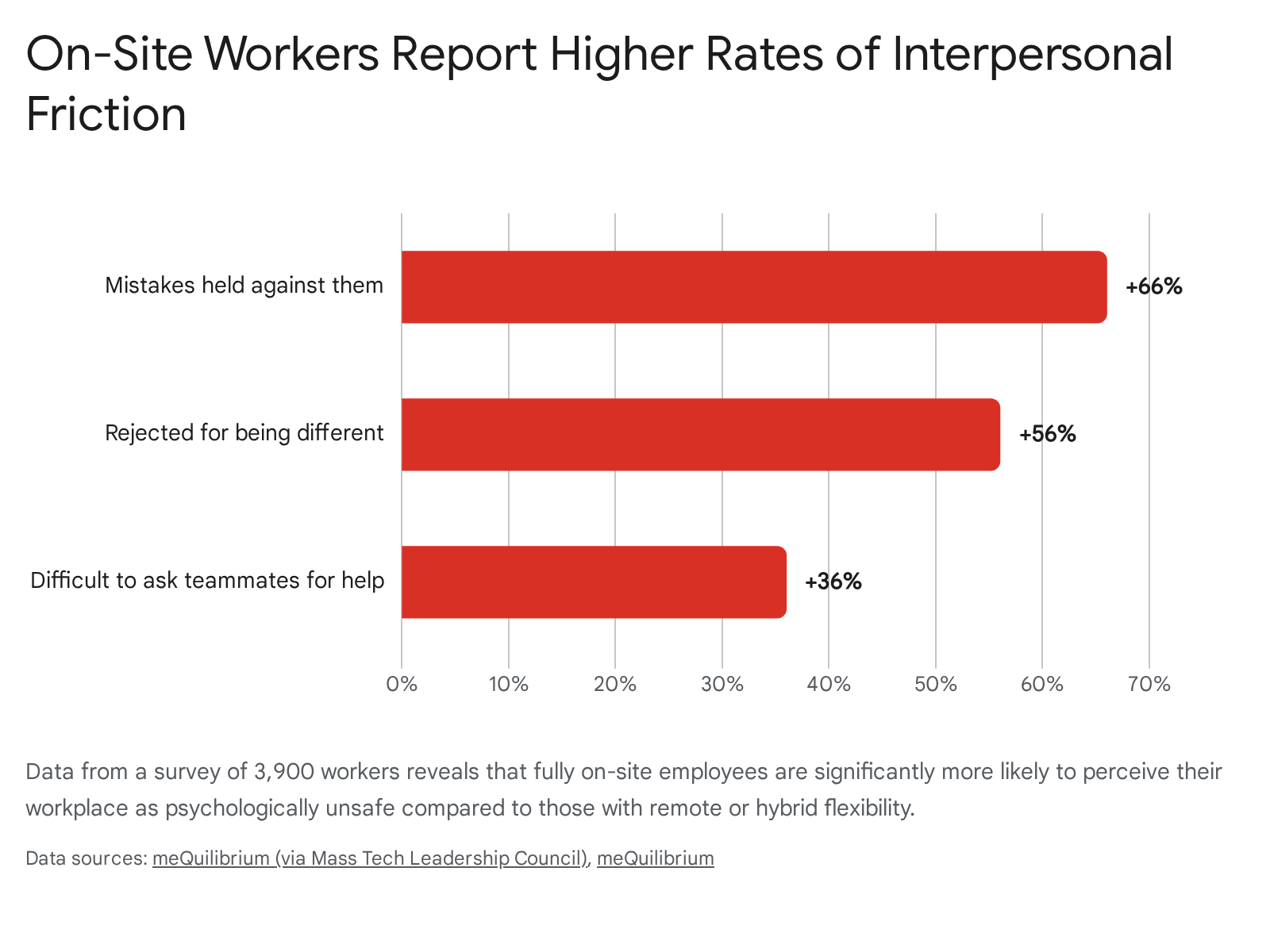
The data revealed that fully on-site employees face significantly higher rates of interpersonal friction. They are 66% more likely to feel that mistakes will be held against them, 56% more likely to report that colleagues are rejected for being different, and 36% more likely to find it difficult to ask teammates for help 351438. Furthermore, one-fourth of on-site workers felt their mistakes were held against them, compared to only 14% of remote/hybrid workers 15.
Behavioral scientists and researchers suggest several mechanisms driving this "remote safety premium." First, the virtual environment serves as a democratizing force. In a remote setting - often described as a space where everyone occupies an equally sized square on a video call - traditional physical hierarchies and intimidating boardroom dynamics are flattened, making it inherently easier for junior employees to speak up and be heard 3515.
Second, remote employees are physically removed from the immediate presence of office politics, exclusionary side conversations, and subtle micro-expressions that can trigger social anxiety 1438. Being out of earshot of common area gossip reduces the ambient perception of interpersonal threat 38. Finally, the physical distance forces managers of remote teams to be highly intentional with their communication. Without the ability to simply walk the floor, remote managers must actively schedule check-ins, which employees interpret as a higher level of managerial support and concern for their well-being 38.
The implications for organizational design are profound. Companies attempting to force a return to the office without aggressively addressing these underlying cultural deficits risk severe attrition. The meQuilibrium study noted that nearly 45% of surveyed employees indicated they would quit if faced with a requirement to work on-site full-time without a remote or hybrid option 35.
Navigating Cross-Cultural Differences in Global Teams
While psychological safety is universally beneficial, the behaviors required to cultivate it are deeply intertwined with cultural norms. What constitutes a "safe" behavior or an acceptable challenge in one country may be viewed as deeply disrespectful or socially disastrous in another.
Hofstede's Cultural Dimensions
The primary framework for understanding these differences is Geert Hofstede's Cultural Dimensions Theory, developed from a massive comparative study of 117,000 IBM employees worldwide between 1967 and 1973 3916. Hofstede's model elucidates how different societies approach hierarchy, individualism, and risk 3917. The dimensions most relevant to psychological safety are:
- Power Distance Index (PDI): The extent to which less powerful members of organizations accept and expect that power is distributed unequally 3917.
- Individualism vs. Collectivism (IDV): The degree to which people prefer to act as individuals rather than as members of cohesive groups 3916.
- Uncertainty Avoidance (UAI): The degree to which people prefer structured, rule-bound situations over unstructured, ambiguous ones 3916.
- Masculinity vs. Femininity (MAS): The emphasis on competitive, risk-taking behaviors versus caring for others and prioritizing relationship quality 3916.
In Low Power Distance cultures (e.g., the United States, Germany, the Netherlands), inequality is viewed as a minimal convenience, and organizational structures strive for egalitarianism 391843. Employees generally feel comfortable speaking out, challenging their supervisors, and engaging in flat, open debate because these actions do not violate cultural norms 43.
Conversely, in High Power Distance cultures (e.g., Japan, China, Arab countries), hierarchical order is accepted without question, and inequality is often seen as the fundamental basis of societal order 391843. In these environments, employees may deeply hesitate to challenge superiors or speak candidly, even when explicitly encouraged to do so, because such behavior feels culturally uncomfortable and subverts established authority 1643.
Cross-Cultural Comparative Studies
Empirical research highlights how these cultural dimensions alter the mechanics of psychological safety. A robust 2026 comparative study examined 84 teams (440 individuals) across the financial sectors of Brazil and Germany 4445. Using partial least squares structural equation modeling, the researchers found that while psychological safety positively affected team cooperation in both nations, the effect was significantly stronger among the German teams 4445. Furthermore, dynamic capabilities - a team's ability to adapt and innovate - predicted actual performance significantly in Germany, but not in Brazil 4445. This suggests that in some cultural contexts, psychological safety seamlessly translates into structured performance, while in others, different mediating factors are required.
The challenges are even more pronounced in medicine. A 2025 study of 340 medical residents in a Lebanese academic hospital - a high power-distance, non-Western environment - explored the barriers to psychological safety in clinical learning 19. The study found that while psychological safety positively correlated with direct feedback-seeking and perceived competence, more passive feedback strategies remained dominant 19. The residents' feedback behaviors were heavily constrained by hierarchical barriers and cultural norms regarding psychological distance 19.
Similarly, research examining cross-cultural corporate teams in Japan revealed that native Japanese employees perceived the direct, challenging communication styles of Western coworkers as disruptive 4320. To foster psychological safety in global teams, leaders cannot simply demand that employees "speak up" using a Western paradigm. Facilitators must find a delicate balance between disrupting harmful silences and respecting local norms, often by creating highly formalized, structured channels for anonymous or indirect feedback that allow employees to offer insights without appearing to subvert authority 43.
Artificial Intelligence and the Adoption Paradox
As the global workplace advances into 2026, the rapid integration of Artificial Intelligence has created unprecedented challenges for team dynamics and change management. While technological capabilities are advancing exponentially, human adoption is lagging severely.
Research indicates that 92% of companies have increased their AI investments, yet a mere 1% classify their deployment of these tools as mature 13. This discrepancy has been dubbed the "AI Adoption Paradox." The bottleneck is not technological; it is deeply human. According to the BCG 10-20-70 rule, only 10% of an AI transformation is about algorithms, while 70% relies entirely on people, processes, and culture 13.
AI Anxiety and the Threat to Competence
AI adoption requires massive amounts of vulnerability, skill acquisition, and interpersonal trust 1348. However, recent data highlights an extreme surge in "AI Anxiety." Surveys show that over 71% of U.S. workers are deeply concerned that AI will eventually make their specific jobs obsolete or put people permanently out of work 48.
When employees fear that a new technology is being introduced to replace them, they are naturally incentivized to resist it. Without psychological safety, employees will hide their inefficiencies, refuse to collaborate with new systems, and quietly revert to legacy processes 48. Furthermore, as AI tools instantly polish half-baked ideas and simulate competence, leaders are increasingly susceptible to "AI-washing" - rewarding the mere usage of AI tokens rather than evaluating whether the actual work output provides real value 7.
Safety as the Gateway, Not the Engine
To navigate this transition, organizations rely heavily on team dynamics. A 2026 study analyzing survey data from 2,257 employees across global consulting firms examined the specific relationship between psychological safety and AI engagement 49.
The logistic and linear regression analyses proved that psychological safety reliably predicts whether an employee will initially adopt an AI tool 49. Employees who feel psychologically safe are willing to risk looking incompetent while struggling to learn new prompt-engineering workflows. Crucially, they also feel secure enough to call out when a highly polished AI output is factually incorrect, hallucinated, or failing upon contact with real customers - engaging in what Edmondson terms "intelligent failures" 7. Without this safety, bad news regarding AI failures gets sanitized and sugar-coated as it climbs the organizational chart 7.
However, the research also notes a vital caveat: psychological safety is the gate to AI adoption, not the engine 1349. While it dictates initial engagement, the study found it does not predict how often or how long employees use AI once they have started 49. Sustained usage depends heavily on the actual technological utility, workflow integration, and relevance of the tool 13. Psychological safety ensures the gate is open, but the technology must still prove its worth.
The Debate: Can a Team Be "Too Safe"?
As the concept of psychological safety has proliferated across industries, it has inevitably faced academic scrutiny. A growing debate asks a provocative question: Does psychological safety have a point of diminishing returns, and can an environment be too safe?
Ethical Blind Spots and Groupthink
One of the most heavily documented risks associated with high psychological safety is its potential to facilitate unethical behavior if the team possesses a flawed moral compass. A pivotal 2011 peer-reviewed study by Pearsall and Ellis examined the relationship between ethical orientation and psychological safety in 126 teams comprised of 378 undergraduate students 505121.
The researchers categorized teams based on their ethical frameworks, contrasting a "formalistic" orientation (strict adherence to rules) with a "utilitarian" orientation (judging actions primarily by their outcomes and benefits) 5021. The findings were stark: when utilitarian teams experienced high levels of psychological safety, their likelihood of engaging in collective unethical behavior - specifically cheating and falsifying data to achieve team goals - significantly increased 5021. Because members felt entirely safe from internal judgment or moral sanction within their tight-knit group, they were highly comfortable proposing illicit solutions, such as reporting incorrect revenue numbers 50. In these specific contexts, the complete lack of interpersonal fear removed a vital, normative check on misconduct.
Furthermore, sociologists warn that an over-emphasis on team harmony can mutate into a "hive mentality" or "groupthink" - a psychological phenomenon originally described by Irving Janis in 1972 2254. Groupthink occurs when the desire for group cohesion completely overrides critical reflection, leading to a false-consensus effect 2254. If psychological safety is misunderstood simply as "being nice" rather than "being candid," dissenting voices may self-censor to avoid disrupting the comfortable environment, resulting in unchallenged, disastrous decisions 2254.
The Controversy Over Routine Performance
In 2023, a highly debated paper titled The Limits of Psychological Safety: Nonlinear Relationships with Performance (Eldor, Hodor, and Cappelli) argued that psychological safety actually has a tipping point where it becomes detrimental 552357.
Drawing on cognitive distraction literature, the authors conducted five independent studies across different organizational levels and settings 235758. They proposed that while psychological safety undeniably benefits creative and innovative tasks, excessively high levels of it can actually harm the execution of routine, standardized tasks 2357. The researchers argued that in highly routine jobs, a climate that constantly encourages questioning processes, challenging the status quo, and trying new things diverts cognitive resources and distracts workers from simply executing necessary tasks efficiently and accurately 2357.
The study found that moderate levels of psychological safety enhanced in-role performance, but very high levels were associated with decreasing performance 2358. The authors suggested that "collective accountability" must act as a buffer to moderate these negative effects, ensuring that employees still face consequences for poor performance 2357. As co-author Peter Cappelli noted, the concept was never meant to suggest there should be no consequences for poor performance or rule-breaking 24.
This paper triggered severe backlash from safety practitioners and organizational psychologists. Critics, such as Tom Geraghty, argued that the study fundamentally misrepresented psychological safety by creating a "straw-man" argument that conflated the concept with comfort, complacency, or a lack of accountability 55. Proponents of Edmondson's original theory maintain that true psychological safety strictly requires high accountability and demanding performance standards 5560. They argue that it does not mean lowering the bar for routine tasks; it simply removes the fear of interpersonal humiliation when reporting an error - which is highly beneficial whether a nurse is executing a routine checklist or an engineer is designing a novel AI system 5560. Furthermore, critics emphasize that fostering psychological safety is not merely an instrumental strategy for productivity, but a moral imperative to protect worker dignity 55.
Bottom line
Psychological safety is the shared belief that a team environment is safe for interpersonal risk-taking, serving as the critical bridge between individual talent and collective performance. It is not synonymous with lowering standards, avoiding conflict, or unconditional comfort; rather, it is the presence of deep interpersonal trust that allows teams to candidly admit errors, challenge the status quo, and innovate without fear of humiliation. While its implementation requires careful calibration to account for complex cross-cultural dynamics and must be paired with high accountability to prevent unethical behavior, the evidence is unequivocal. In a global economy severely strained by worker burnout and the rapid, disruptive integration of artificial intelligence, cultivating a psychologically safe organization is the most effective, evidence-based intervention a leader can deploy.