
Building a non-toxic sales culture for performance and wellbeing
The architectural design of a sales organization fundamentally dictates both its commercial output and the psychological wellbeing of its workforce. Historically, sales cultures have been engineered around aggressive extrinsic incentives, high-pressure quotas, and a strict survival-of-the-fittest operational mentality. However, recent empirical data, longitudinal metadata, and organizational psychology research reveal that environments relying primarily on high-stress, fear-based management models reliably produce destructive consequences. Such environments - broadly categorized as "toxic" cultures - manifest objectively through plunging quota attainment, skyrocketing employee turnover, ethical blindness, and widespread clinical burnout. Transitioning away from these volatile models requires a highly analytical understanding of human motivation, cognitive load limits, psychological safety, and the stark structural realities of modern sales roles.
Structural Indicators of Sales Culture Toxicity
A toxic sales culture is not merely a subjective assessment of employee morale; it is a measurable structural failure that disrupts revenue predictability, increases operational costs, and stalls organizational growth. Identifying systemic toxicity requires examining specific, quantifiable metrics that track both performance distribution and human capital depletion over time.
Quota Attainment Skewness and Bimodal Distributions
The most immediate leading indicator of systemic dysfunction within a sales team is the mathematical distribution of quota attainment. As of late 2024, broad industry data indicates a severe execution gap, with 91% of sales organizations missing their overall quota expectations and the average business-to-business (B2B) sales representative achieving only 43.14% of their target 12. Furthermore, separate benchmarking studies revealed that 69% of all representatives fell short of their quota in early 2024, marking a third consecutive year of widespread shortfalls 3. When quota attainment falls this drastically across a sector, it ceases to be an issue of individual representative motivation and becomes a symptom of systemic operational failure, often driven by unattainable targets detached from total addressable market realities.
In analyzing how these attainments are distributed across a team, organizational analysts look for statistical skewness. Healthy sales cultures typically exhibit a normal, bell-curve distribution of quota attainment - a configuration researchers from the Bridge Group have termed a "Team Summit" 1. In a Team Summit environment, the vast majority of representatives cluster around an 80% to 100% attainment mark, featuring natural, statistically expected tails of underperformers and overachievers 1. In contrast, toxic or misaligned cultures frequently exhibit a bi-modal distribution, or a "Team Camel" configuration 1.
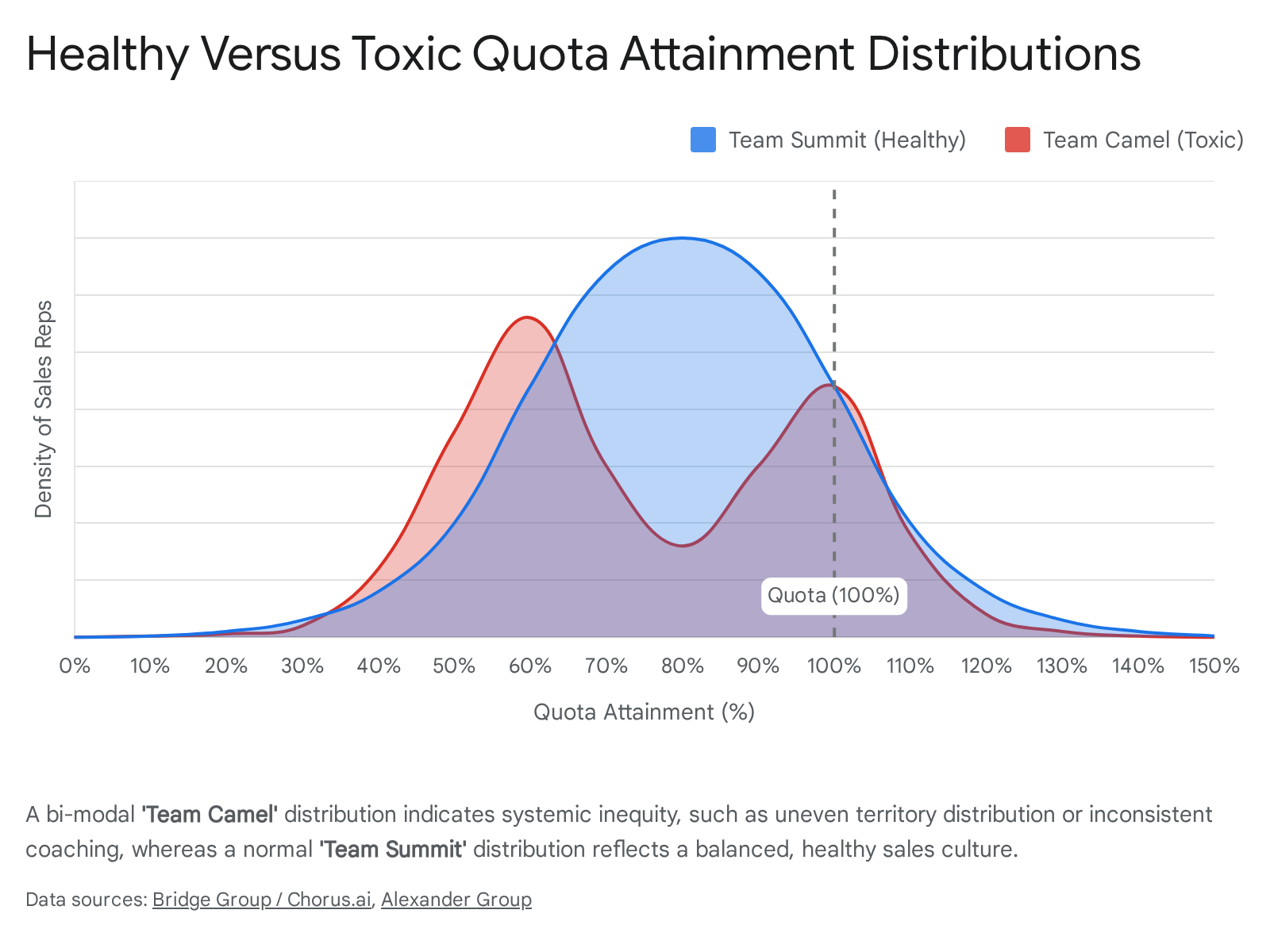
In a bi-modal distribution, the sales team splits into two extreme humps: a massive cluster of representatives failing drastically (e.g., 60% or lower attainment) and a smaller, highly distinct cluster of heavily favored representatives vastly exceeding quota (e.g., 120%+ attainment) 1.
This bi-modal reality severely damages organizational culture. The right-skewed high performers artificially inflate the team's overall average, actively masking the widespread failure of the broader team from executive leadership 5. As a result, the organization faces the dual headwinds of exceptionally high compensation payouts to top-tier earners alongside massive replacement and onboarding costs for the churning bottom tier 12. The Alexander Group documented a case study involving a large SaaS firm that suffered from this exact bi-modal quota attainment distribution; by normalizing the quota distribution and realigning the compensation plan to eliminate extreme performance clusters, the organization reduced compensation costs by approximately $9 million annually while still achieving overall growth 2. When the majority of representatives consistently miss targets due to systemic imbalances, mediocrity normalizes, morale plummets, and a pervasive culture of excuse-making takes root 3.
Voluntary Versus Involuntary Client Churn
While employee performance metrics are critical, a toxic sales culture also bleeds outward, presenting objectively in customer retention metrics - specifically through the distinct lenses of voluntary and involuntary churn.
Voluntary churn occurs when a customer makes a conscious, deliberate decision to cancel a subscription or service 4910. This metric is frequently a direct byproduct of toxic sales practices. When sales representatives are placed under extreme threat to hit arbitrary quotas, they often resort to aggressively closing "bad-fit" clients, over-promising on feature sets, or misleading prospects regarding implementation timelines 512. This aggressive, short-term behavior optimizes immediate commission checks but systematically destroys customer satisfaction, leading to rapid voluntary churn when the client realizes the product does not solve their needs 95.
Conversely, involuntary churn - also termed passive or delinquent churn - happens without the customer's active intent, typically due to expired credit cards, server errors, or insufficient funds 491013. Involuntary churn can silently strip away 20% to 40% of an organization's overall customer base without triggering immediate alarm bells 10. While involuntary churn is not a direct result of sales toxicity, the financial pressure it exerts on the business trickles down to the sales floor. As recurring revenue silently drops, executives often arbitrarily raise new-business quotas to compensate, thereby intensifying the pressure on the sales team and exacerbating the cycle of toxic, high-pressure selling 1314. Resolving involuntary churn through automated payment retries and targeted dunning emails is a critical operational step to relieve artificial pressure on the sales force 4.
Employee Attrition, Absenteeism, and Reputation Degradation
High employee turnover is universally recognized as the most reliable lagging indicator of a toxic work environment. Research from the Society for Human Resource Management (SHRM) reveals that companies with toxic cultures experience turnover rates that are 20% higher than industry averages 15. Overall, employees are up to ten times more likely to quit if an organization exhibits a toxic workplace culture, with discrimination, unrealistic expectations, and a distinct lack of psychological support acting as primary drivers for departure 67. Within the United States, broad sales force turnover hovers around an average of 18% over a 12-month period, and the average sales representative tenure has compressed to roughly 1.5 years 819.
The financial damage associated with this attrition is extensive. Replacing a single quota-carrying representative often costs an organization upwards of $100,000 in fully loaded replacement costs, equivalent to 50% to 200% of the role's base annual salary depending on the technical complexity of the position 20. U.S. firms spend $15 billion annually simply training new salespeople to replace those who have left 12. Beyond the direct, hard-dollar costs of recruiting, onboarding, and severance, organizations suffer compounding soft-dollar losses in the form of damaged client relationships, unworked pipeline, and an overall reduction in pipeline velocity 5129.
Furthermore, toxic environments dramatically increase clinical absenteeism and the utilization of sick days. Employees experiencing high degrees of professional isolation, emotional exhaustion, and unmanageable workloads are significantly more likely to take stress-related absences. The U.S. Surgeon General's 2023 report on isolation noted that stress-related absenteeism costs U.S. employers an estimated $154 billion annually 10. In environments classified as toxic, absenteeism rates can spike to three times the normal average 15. This mass exodus of talent inevitably spills over into the public domain; struggling sales teams consistently tarnish organizational reputations via employer review websites like Glassdoor, fundamentally impairing the company's ability to attract top-tier talent in the future 315.
The Mechanics of Salesperson Motivation
To build a high-performing culture without inducing systemic burnout, organizations must fundamentally understand the psychological mechanisms that drive sustained human effort. The traditional sales management paradigm has operated almost exclusively on extrinsic motivation - utilizing commissions, bonuses, gamified leaderboards, and punitive measures (such as Performance Improvement Plans) to force daily activity 1920. However, comprehensive meta-analyses and deep organizational psychology research reveal that this approach is structurally incomplete and often counterproductive.
Extrinsic Incentives and Performance Quantity
Extrinsic motivation involves performing a task specifically to attain a separable outcome - most commonly financial compensation, public recognition, or the active avoidance of termination 1124. As noted, the prevailing logic in corporate management assumes that external rewards are the primary, if not sole, drivers of professional behavior, justifying the $800 billion spent annually by U.S. companies on sales force compensation 25.
Empirical data confirms that well-designed extrinsic incentive programs are effective at driving specific, highly quantifiable outcomes. General monetary incentives have been shown to increase individual performance quantity by 22% and team performance by 44% 12. However, relying solely on extrinsic rewards carries distinct and severe psychological risks. Behavioral economics research indicates that the relationship between incentives and motivation is highly nuanced. Research by Kamenica (2012) demonstrated that extrinsic rewards can actually backfire by crowding out an employee's intrinsic motivation 12. For instance, offering a rigid bonus for completing a task by a specific deadline increases the number of people who complete it on time, but dramatically decreases the completion rate among those who miss the deadline 12. If the financial bonus is perceived as too small, the overall effect can be a reduction in effort, suggesting that weak incentives are often worse than no incentives at all 12.
When compensation is the sole motivator, the psychological contract is fragile. If the reward becomes mathematically unattainable - such as when a representative realizes halfway through a quarter that hitting an inflated quota is impossible - effort immediately collapses 13. Extrinsically driven representatives often produce their best results only in short, heavily incentivized sales cycles 13. Furthermore, when sales environments apply aggressive extrinsic pressure without proper ethical oversight, it can lead to severe behavioral breaches 1415.
Intrinsic Motivation and Sustained Performance Quality
Intrinsic motivation, conversely, is defined as engaging in an activity because it is inherently interesting, enjoyable, challenging, or fulfilling to the individual 2425. The predominant framework used to study this phenomenon in sales is Self-Determination Theory (SDT). SDT posits that intrinsic, autonomous motivation flourishes only when three basic psychological needs are consistently met: autonomy (having control over one's work and schedule), competence (feeling capable, effective, and appropriately challenged), and relatedness (feeling a sense of belonging and connection to peers and leadership) 201116.
To determine the true impact of these motivational styles, a team of researchers from Baylor University and Michigan State University conducted a massive, comprehensive meta-analysis utilizing 293 effect sizes nested within 127 unique studies. This massive dataset encompassed 77,560 actual salespeople, strictly excluding laboratory students to ensure real-world business validity 251718.
The findings fundamentally challenged conventional sales wisdom. The meta-analysis demonstrated that intrinsic motivation is a significantly stronger predictor of long-term sales performance than extrinsic motivation 171819. The data revealed that while extrinsic motivation positively correlated with performance at r = 0.176, intrinsic motivation exhibited a substantially higher correlation of r = 0.298 18. This held true regardless of whether performance was measured subjectively by self-evaluations or objectively via total revenue generated and units sold 25. The data proves that while external motivators are necessary baseline components of compensation, relying entirely on them leads to suboptimal organizational performance 17.
Demographic and Contextual Motivational Variations
Crucially, the Baylor meta-analysis highlighted that the impact of intrinsic versus extrinsic motivation shifts dynamically depending on the representative's demographic profile, tenure, and specific role.
Intrinsic drive becomes increasingly dominant as salespeople age and gain professional tenure. Older, veteran salespeople showed a significantly stronger connection between intrinsic drive and performance than their younger counterparts 2517. For those entirely new to the field, external incentives played a comparatively larger role in bridging the initial competence gap, though internal drive still remained the primary factor 25.
The selling environment also dictates motivational efficacy. In complex, long-cycle Business-to-Business (B2B) sales environments - which heavily involve nuanced decision-making, strategic problem-solving, and long-term relationship building - intrinsic motivation proved vastly superior to extrinsic rewards in predicting performance 251718. Extrinsic rewards, while still useful, had a more pronounced and effective impact on representatives operating in highly transactional, fast-paced Business-to-Consumer (B2C) environments where emotional endurance is less critical than rapid activity volume 2517.
The study also analyzed gender dynamics, finding that in sales samples featuring a higher percentage of female representatives, the relationship between intrinsic motivation and performance was significantly stronger than the relationship involving extrinsic rewards 25. In male-dominated samples, the impact of the two types of motivation was closer, though intrinsic drive still maintained a slight statistical advantage 25.
| Motivational Construct | Definition & Core Psychological Drivers | Performance Correlation (r) | Optimal Application Context | Systemic Risks of Over-Reliance |
|---|---|---|---|---|
| Extrinsic Motivation | Driven by separable outcomes: commissions, bonuses, quota achievement, fear of termination. | r = 0.176 18 | Early-career representatives, highly transactional (B2C) environments, short-term promotional pushes. | Can crowd out internal drive; effort collapses if the reward becomes mathematically unattainable; encourages unethical shortcuts 1213. |
| Intrinsic Motivation | Driven by inherent satisfaction: autonomy, mastery, intellectual challenge, relatedness. | r = 0.298 18 | Tenured representatives, complex (B2B) sales cycles, roles requiring strategic relationship building. | Difficult to manufacture quickly; requires sustained leadership investment, active coaching, and a non-toxic environment to flourish 2017. |
Role-Specific Stressors and Structural Pressures
Toxicity in sales is rarely a uniform experience; it concentrates differently depending on the specific function a representative serves within the overall revenue engine. The historical bifurcation of the sales process into pipeline generation and deal closure has created distinct, isolated psychological stressors for different roles.
Specialization Dynamics Between Development and Closing Roles
In the modern SaaS (Software as a Service) and technology sales models, the acquisition process is generally split between Sales Development Representatives (SDRs) or Business Development Representatives (BDRs) and Account Executives (AEs) 2035.
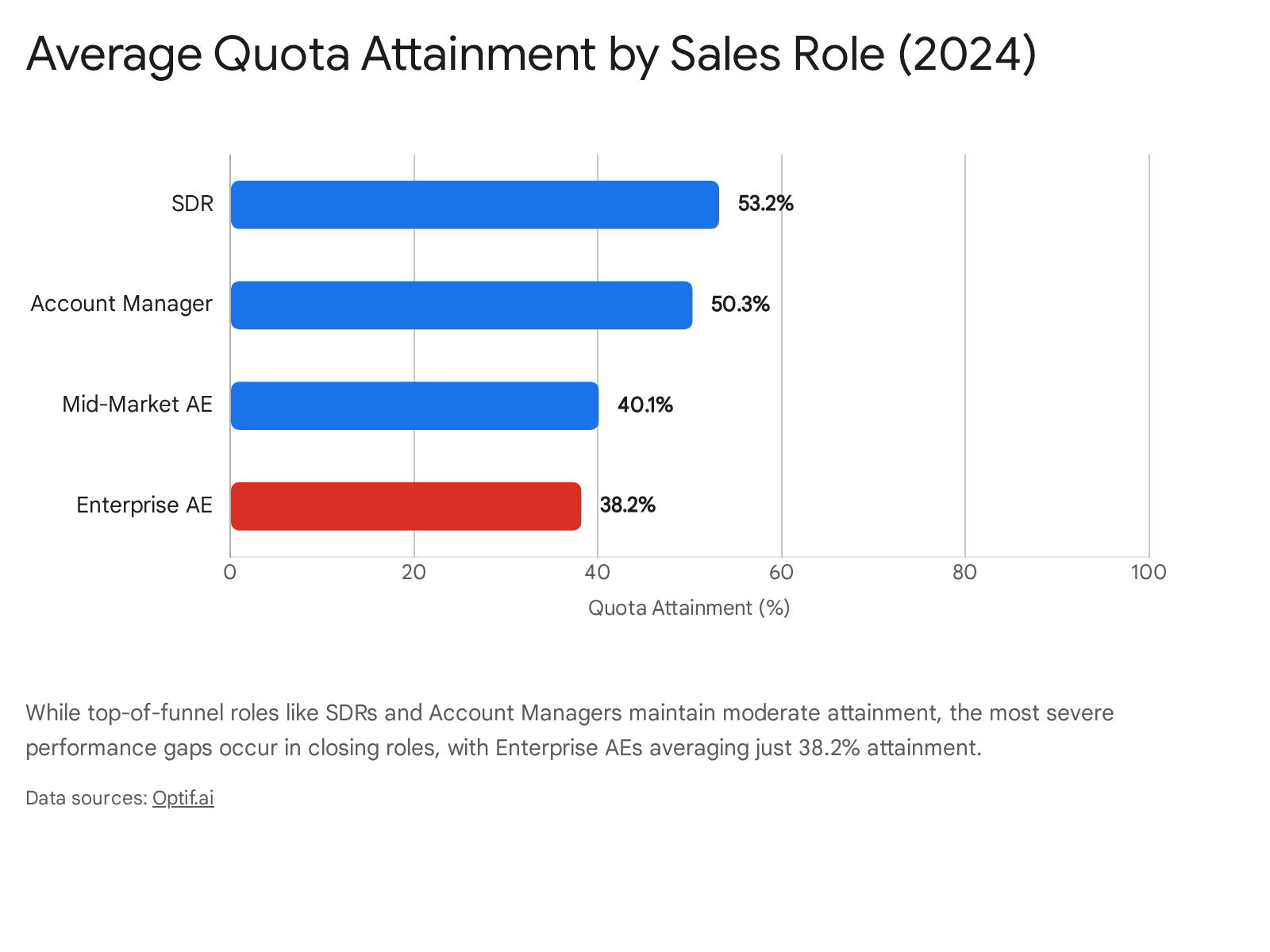
SDRs operate exclusively at the top of the sales funnel. Their primary objective is pipeline generation, which requires maintaining an immensely high volume of daily activity. In outbound-heavy organizations, it is common to see expectations of 60 to 80 cold calls and 50 to 100 targeted emails per day 36. The psychological strain for an SDR is rooted deeply in persistent, high-frequency rejection. Because SDRs are tasked with sourcing approximately 40% of an organization's total pipeline (with marketing generally contributing 25-30% and AEs sourcing the remainder), their quotas are typically tied to meetings booked, Sales Qualified Leads (SQLs), or Sales Accepted Opportunities (SAOs) 136. Despite the high burnout risk associated with constant rejection and the repetitive grind, the objective attainability of SDR quotas is paradoxically higher than for closing roles; recent data shows average SDR quota attainment sitting at 53.2% 2. Financially, SDR On-Target Earnings (OTE) generally range from $70,000 to $95,000, usually split 60/40 between base salary and commission 136.
Account Executives face an entirely different psychological burden: the ultimate pressure of final revenue conversion. The AE takes the qualified pipeline handed over by the SDR and navigates highly complex, multi-stakeholder buying cycles. By 2025, SaaS products have become increasingly sophisticated, with the average enterprise sale now involving 6 to 8 distinct decision-makers, making negotiations highly fragile 35. In the second half of 2024, the average B2B sales cycle lengthened by 8% to 106 days, heavily exacerbating the pressure on AEs as deals stall 9. AE quotas are tied strictly to booked revenue, measured in Annual Contract Value (ACV) or Total Contract Value (TCV) 1. The attainment data for these roles is historically bleak. In recent metrics analyzing Q4 2024, Mid-Market AEs attained only 40.1% of their quotas, while Enterprise AEs attained a mere 38.2% 2.
Financially, the risk/reward ratio is much higher, with AE OTEs ranging from $140,000 to well over $250,000, typically on a 50/50 base-to-variable split 36. The transition from an SDR to an AE - a jump that typically takes 12 to 24 months - is a perilous period where representatives must violently shift from volume-based resilience to deep, consultative buyer psychology, leading to high failure rates if coaching and enablement are poor 2036.
The Great Sales Development Downsizing
As attainment falls, the structural composition of sales teams is undergoing a massive shift. A 2025 survey by Emergence Capital analyzing over 560 venture-backed B2B software companies documented what is being termed "The Great SDR Downsizing." Over the previous 12 months, 36% of organizations actively decreased their SDR/BDR headcount, making it the most heavily reduced sales function across the industry 21.
This reduction is driven by economic pressures where top-of-funnel roles are viewed as easily replaceable or too far removed from direct revenue generation to justify during downturns 21. Concurrently, there has been a shift back toward the "full-cycle" AE model, where a single representative handles both prospecting and closing, aiming for a single point of customer contact and lower overall headcount costs 2035. However, the full-cycle model drastically increases the risk of burnout, as representatives are spread too thin across conflicting skill sets 20. Interestingly, while SDRs face headcount pressure, highly technical "Sales Engineer" roles saw the smallest decrease at just 14%, indicating a broader industry shift toward utilizing fewer, but highly technical, resources to handle complex software sales rather than relying on massive armies of low-touch SDRs 21.
Technological Automation and Workload Mitigation
The high-volume, highly repetitive nature of modern sales has led to significant cognitive overload and administrative bloat. Data from Salesforce reports that sales professionals currently spend only 28% to 30% of their actual workweek actively selling or interacting with prospects 38. The remaining 70% of their time is completely consumed by non-revenue generating tasks: researching prospects, endless data entry into Customer Relationship Management (CRM) systems, and managing internal meetings 238. This severe administrative drag creates a massive disconnect between the effort expended and the outcomes achieved, systematically destroying the competence component of intrinsic motivation 20.
To combat this inefficiency, organizations are rapidly integrating Artificial Intelligence (AI) and automation workflows. AI-driven platforms that automate list building, audience targeting, email sequencing, and meeting summarization have been shown to boost productivity significantly 2022. McKinsey data indicates that AI automation can boost productivity by up to 40% in relevant workflows, while top-performing B2B sales organizations have used these tools to free up roughly 20% of their sellers' capacity 322. MIT Sloan Management Review notes that while generative AI pilots often take 18 to 24 months to show substantial ROI, tools directed at back-office automation and workflow structuring are successfully clearing the bottlenecks that cause widespread administrative burnout 2239.
Cognitive Load and Mental Momentum
In high-stakes sales environments, maintaining continuous psychological focus is absolutely critical to achieving quota. The intersection of administrative bloat, tool proliferation, and constant rejection creates an environment ripe for cognitive exhaustion.
The Concept of Mental Momentum in Sales
Researchers characterize the psychological state that propels a professional toward sustained, frictionless action as "mental momentum" or a "decision-making drive" 2324. This momentum acts as an internal accelerator; once built through consistent, focused habits, the perception of task difficulty decreases, and execution becomes fluid 2324. Clinical psychologist Dr. Anne Mary Montero refers to this continuous building of psychological resilience as "The Domino Effect," emphasizing that mental momentum is built through structured, manageable actions rather than purely through emotional willpower 2543.
For a sales representative, mental momentum is highly fragile. Every time a representative is forced to context-switch - moving from making outbound cold calls, to drafting a bespoke email, to updating a CRM record, to answering an internal Slack message - they suffer a severe cognitive switching penalty 264527. This constant shifting between different types of neurological activities drains mental momentum, requiring immense energy simply to refocus 27.
Collaboration Demand and Toxic Productivity
The modern workplace is further fraught with what Harvard Business Review classifies as "collaboration demand" - the excessive expectation of constant digital communication across multiple internal tools 28. Organizations frequently mandate the use of six to nine different collaboration methods simultaneously, causing massive inefficiencies 28.
This "always-on" culture fuels what researchers call "toxic productivity," where employees feel pressured to perform and remain visible at all hours, equating endless availability with virtue 48. The strain is particularly acute for midlevel sales managers. HBR research shows that an astonishing 85% of midlevel leaders report experiencing burnout on a weekly basis, caught between the conflicting expectations of senior executives demanding higher quotas and the exhausted representatives they manage below 29. When leaders spend their entire day managing collaboration demands rather than engaging in strategic coaching, business momentum stalls completely 22.
Workflow Structuring and Task Batching
To preserve psychological resources and prevent burnout, high-performing sales cultures actively engineer workflows to protect their representatives' mental momentum. The primary antidote to context-switching chaos is "task batching" combined with time blocking 4527.
Rather than alternating between calls and emails throughout the day, representatives are coached to batch all outbound calls into a single, dedicated 90-minute time block, followed by a separate block strictly for administrative updates 27. This allows the representative to achieve a state of flow, maintaining the specific mental posture required for verbal negotiation without the cognitive interruption of text-based tasks 4527. Furthermore, frameworks like the "72-Hour Rule" are implemented to transform mental momentum into physical execution, ensuring that ideas and strategies are acted upon before cognitive decay sets in 50. By prioritizing outcomes over hours worked and enforcing asynchronous communication for non-urgent matters, organizations allow their sales teams the autonomy necessary to thrive without succumbing to toxic productivity 51.
Remote Work Dynamics and Professional Isolation
The post-2020 normalization of distributed workforces has solved many traditional, commute-related stressors but introduced severe new challenges related to isolation, boundary setting, and asynchronous management. As of 2026, remote work remains a permanent fixture, with over 22% of U.S. workers operating fully remotely and many more in hybrid capacities 52.
Structural Versus Emotional Isolation
Remote work yields undeniable baseline productivity benefits; approximately 77% of remote workers self-report being more productive at home, and objective measurements frequently show a 35% to 40% productivity gain over in-office counterparts due to the reduction of spontaneous office distractions 52. However, this productivity frequently comes at the severe cost of professional isolation.
Gallup's state of the global workplace data indicates that 25% of remote employees experience daily loneliness, compared to just 16% of fully onsite employees 10. Other surveys reveal that remote workers report feeling lonely 98% more often than their onsite peers 10. In a comprehensive study published in the Journal of Business and Psychology, researchers from Colorado State University found that remote employees experiencing professional isolation report being significantly less engaged and more cognitively depleted, creating a direct pathway to clinical burnout 53.
It is crucial to distinguish between structural isolation (being physically cut off from the team) and emotional loneliness 30. Remote workers often lack visibility into broader company strategy and miss out on impromptu, informal feedback - a concern cited by 56% of managers 31. This emotional exhaustion is heavily driven by blurred work-life boundaries. A 2025 multivariable logistic regression study demonstrated that fully remote workers exhibit a significantly higher prevalence of overall burnout (41.7%) and emotional exhaustion (63.1%) than hybrid workers 32. The primary independent predictors of this exhaustion were poor work-life boundaries and working in excess of 45 hours per week 32. Without the physical separation of an office, employees find it highly difficult to "switch off," leading to chronic overworking 57.
Mitigating Isolation in Distributed Teams
Managing a remote sales team effectively requires highly intentional communication protocols that counter the inherent risk of isolation. Because active churn and declining metrics are highly visible, managers often miss the silent disengagement of a lonely remote worker until it results in turnover 58.
To mitigate these risks, researchers emphasize the necessity of over-investing in structured one-on-ones 5159. These meetings must be prioritized, with expectations set in advance, and dominated by topics relating to the needs, concerns, and psychological wellbeing of the employee, rather than serving merely as pipeline interrogations 51. Utilizing AI meeting assistants to document these conversations allows managers to focus on active listening and empathetic coaching rather than note-taking 5159. Furthermore, the Colorado State University study identified that providing high schedule flexibility significantly mitigates the negative effects of isolation, empowering employees to manage their workload and personal lives with a sense of autonomous control 53. Remote sales teams also require deliberate, structured moments of synchronicity - such as virtual team-building exercises and transparent performance tracking - to maintain morale and ensure no representative feels abandoned in their territory 515859.
Psychological Safety and Ethical Compliance
To counteract the compounded pressures of quota skewness, role-specific burnout, and remote isolation, organizations must deliberately cultivate psychological safety. The concept, pioneered by Harvard Business School Professor Amy Edmondson, is defined as the shared, organizational belief that a team is safe for interpersonal risk-taking, and that an individual will not be punished, humiliated, or marginalized for speaking up with ideas, questions, or admitting mistakes 6033.
Interpersonal Risk-Taking and Mistake Tolerance
In a highly competitive sales context, psychological safety is the explicit antidote to toxic, fear-based management. Toxic sales cultures routinely silence dissenting voices, punishing employees who highlight unrealistic targets, question flawed processes, or report ethical breaches 1460. When employees fear retaliation or public humiliation for underperformance, they resort to aggressive self-preservation. This manifests as hiding mistakes, failing to ask necessary questions during complex deal negotiations out of fear of appearing incompetent, and occasionally engaging in unethical behavior simply to meet impossible demands 141560.
Conversely, when a sales team possesses high psychological safety, representatives feel comfortable conducting honest, transparent "post-mortems" on lost deals, sharing effective tactics with peers without fear of losing their competitive edge, and pushing back against unrealistic buyer expectations 6034. Organizations that prioritize psychological safety and actively permit sellers to "fail safely" see massive commercial returns; Gartner survey data from over 200 senior sales leaders indicates that such cultures are 2.7 times more likely to see improved customer acquisition and 2.8 times more likely to improve overall commercial performance 35.
Perspective-Taking and Revenue Implications
Psychological safety cannot emerge organically in a high-stress environment; it must be actively managed, trained, and modeled by leadership. According to research from MIT Sloan Management Review, training programs that explicitly combine psychological safety with "perspective-taking" - the cognitive capacity to consider the world from another individual's viewpoint - have a direct, measurable impact on bottom-line revenue 36.
In a documented study involving executives at Skandinaviska Enskilda Banken, emphasizing structured dialogues around these two skills enabled leaders to address real business challenges collaboratively. This approach directly led to the organization achieving revenues 25% above their yearly targets in a highly strategic market segment 36. Empathetic leadership and structured inclusion also serve to neutralize attrition risks. Research from BCG indicates that in workplaces ranking in the top 30% for psychological safety, the attrition risk across all employee demographics - including historically marginalized groups - drops to an exceptionally low 3% 34. By fostering an environment where vulnerability is modeled from the top down, leaders transform high-pressure sales environments from toxic grinding floors into resilient, highly innovative revenue engines 3334.
Systemic Deviance and Ethical Blindness
When psychological safety is absent and extrinsic pressure is overwhelming, organizations risk descending into systemic deviance. The most prominent example in modern financial history is the Wells Fargo cross-selling scandal 1415.
At Wells Fargo, cross-selling metrics were baked into daily sales quotas that were widely recognized internally as mathematically unreasonable and drastically off the mark compared to industry peers 14. This aggressive quota system was enforced by a toxic culture characterized by "petty tyranny" from leadership, where senior executives were insular, defensive, and routinely silenced or mocked employees who aired contrary views or predicted negative outcomes 14. Because employees lacked psychological safety, the lines of accountability blurred. Placed under enormous threat to meet quotas, the workforce engaged in conduct that was deeply unethical and illegal, opening millions of fraudulent accounts 1415.
Organizational psychologists analyzing cases like Wells Fargo, Volkswagen, and BP conclude that organizational toxicity exists not just when corporate norms directly oppose legal norms, but when the culture actively condones, neutralizes, or enables rule-breaking through aggressive pressure and fear 15. Detoxing a sales culture therefore requires far more than changing a few leaders; it requires dismantling the structures that enable "ethical blindness" and prioritizing transparency and realistic expectations over blind quota adherence 1415.
Cross-Regional Variations in Sales Culture
When managing global sales teams, executive leaders must recognize that the baseline expectations for culture, motivation, and performance management vary dramatically by geography. The definitions of toxicity, acceptable pressure, and work-life balance are highly culturally contingent. Attempting to force a uniform management style across international borders frequently results in organizational friction.
Regulatory and Structural Divergences
The United States and European nations (such as the United Kingdom, Germany, and France) exhibit profound structural differences rooted deeply in their respective labor laws. In the US, employment is predominantly "at-will," meaning organizations can terminate employees with minimal to no notice and without formally establishing "cause," provided the firing is not discriminatory 6566. This lack of job security inherently fuels a highly competitive, fast-paced "hustle culture" in American sales teams, characterized by long hours and a survival-of-the-fittest mentality 656768. To compensate for this elevated risk, US sales roles typically offer significantly higher financial rewards. The average base salary and variable compensation for a US sales representative can be anywhere from 25% to 50% higher - and in some cases more than double - that of a UK counterpart 6568.
Conversely, the UK and the broader European Union provide robust statutory protections for employees. European labor laws mandate extensive notice periods for termination (often ranging from 4 to 12 weeks, up to three months depending on seniority), strict protocols for redundancy and unfair dismissal, and robust vacation entitlements (e.g., a legal minimum of 5.6 weeks of paid holiday in the UK) 656667. This highly regulated environment inherently tempers the toxicity of abrupt, fear-based terminations. However, it can also deeply frustrate US-based managers who expect immediate performance turnarounds or rapid workforce adjustments when quotas are missed 19.
Market Impact on Sales Cycles and Buyer Relationships
These internal cultural and regulatory differences inevitably bleed into outward-facing sales strategies and buyer expectations. American B2B sales are predominantly transactional and efficiency-driven, focusing heavily on rapid qualification, demonstrating immediate value, and aggressively moving prospects through the sales funnel 6970. US buyers are generally comfortable with direct, assertive communication and swift, entrepreneurial decision-making 6970.
European markets operate on fundamentally different timelines. Germany, for instance, emphasizes a consensual, structured decision-making process involving thorough analysis and broad stakeholder consensus 70. In these cultures, relational depth is prioritized; trust and a personal connection must be established organically before substantial commercial negotiations can advance 6970. Consequently, European B2B sales cycles typically require 30% to 50% more time to close - often spanning 6 to 12 months for complex technology solutions, compared to a brisk 3 to 6 months in the US 69.
Attempting to apply an aggressive, high-velocity US sales playbook to a European territory frequently backfires. It creates deep friction with local buyers who view aggressive tactics as unprofessional, and it causes severe psychological stress for local European representatives who find themselves caught between the diplomatic norms of their culture and the rigid, high-pressure expectations of foreign management 196869.
| Cultural Dimension | United States | United Kingdom & European Union |
|---|---|---|
| Employment Security | "At-will" employment; fast, unconstrained termination; relatively low job security 6566. | Highly protected by labor laws; mandatory notice periods (4-12 weeks); strict redundancy protocols 656667. |
| Compensation Focus | High base salaries; aggressive commission structures; large bonus potential 656768. | Lower relative salaries; strong focus on statutory benefits, public healthcare, and robust PTO 6567. |
| Communication Style | Direct, informal, assertive, heavily outcome-oriented 656970. | Indirect, formal (initially), highly diplomatic, consensus-driven 656970. |
| Sales Cycle Velocity | Fast (3-6 months); highly transactional; quick entrepreneurial decisions 6970. | Slower (6-12 months); 30-50% longer; highly relational; requires broad consensus 6970. |
By understanding these regional nuances, global organizations can tailor their quota expectations, communication styles, and motivational frameworks to the specific cultural context, thereby preventing the accidental importation of toxic practices across borders.
Conclusion
The vast body of organizational data unequivocally demonstrates that building a non-toxic sales culture is not mutually exclusive with achieving high commercial performance; rather, psychological health is a strict prerequisite for sustainable revenue growth. The prevailing historical model - characterized by aggressive quota assignment detached from market realities, coupled with high-stakes extrinsic rewards and a lack of psychological safety - reliably produces a bi-modal distribution of success. This toxic configuration masks the failure of the majority, drives massive multi-million dollar attrition costs, and fosters systemic burnout and ethical blindness across the workforce.
To engineer a resilient and high-yielding sales environment, modern organizations must fundamentally shift their operational focus. Leadership must recognize that intrinsic motivation - fueled by autonomy, competence, and meaningful coaching - is a statistically superior driver of long-term sales performance compared to simple financial incentivization, particularly in complex B2B environments. Furthermore, organizations must structurally support their teams by alleviating the administrative burdens that destroy mental momentum, utilizing automation to ensure representatives spend their limited cognitive resources on high-value, relationship-building tasks. Finally, establishing unshakeable psychological safety is critical. When representatives feel secure enough to voice concerns, analyze failures without fear of retaliation, and take strategic interpersonal risks, the organization benefits from reduced turnover, higher innovation, and sustainable, ethical revenue generation.