
What the Research Says About Exercise and Mental Health
Exercise is a highly effective, evidence-based treatment for reducing symptoms of depression and anxiety, often matching the clinical benefits of standard psychotherapy and antidepressant medications. A moderate, consistent routine - specifically 150 to 300 minutes a week of walking, yoga, or strength training - provides the most optimal mental health outcomes. However, because depression inherently destroys motivation, clinicians recommend using exercise as a powerful adjunct to traditional therapies rather than a standalone replacement.
The Evidence Map: Mapping the Scale of the Data
For decades, the mental health benefits of exercise were largely viewed through the lens of observational studies, subjective self-reporting, and anecdotal evidence. However, modern psychiatric and sports medicine research has shifted dramatically. By aggregating hundreds of randomized controlled trials (RCTs), researchers have built a comprehensive "evidence map" - a user-friendly synthesis of scientific literature designed to facilitate access to high-quality data for both clinicians and the general public 12.
The scale of the current evidence base is unprecedented. A landmark 2024 network meta-analysis published in the BMJ by Noetel et al. evaluated 218 unique trials involving 14,170 participants with clinical major depression 345. Furthermore, an exhaustive 2026 meta-meta-analysis (utilizing the Preferred Reporting Items for Overviews of Reviews, or PRIOR framework) synthesized 81 meta-analyses comprising 1,079 component studies and 79,551 participants 56.
This 2026 analysis was uniquely designed to isolate the psychological effects of exercise by explicitly excluding populations with pre-existing chronic physiological conditions, thereby removing variables that often confound mental health studies 568. The data revealed a standardized mean difference (SMD) of -0.61 for depression and -0.47 for anxiety, indicating clinically meaningful symptom reductions across virtually all demographic categories, from children to older adults 568.
Supervised vs. Independent Environments
A consistent finding across the highest-quality literature is the profound impact of the environment in which exercise takes place. Interventions conducted in group settings or under the supervision of a professional - such as a clinical exercise physiologist, physical therapist, or certified trainer - consistently yield larger reductions in depressive symptoms than unsupervised, solo exercise 5878.
This phenomenon is likely driven by the psychological benefits of social connection and accountability. Group exercise helps structure support that allows individuals to overcome the severe motivational deficits characteristic of major depressive disorder (MDD) 8119. Physiologically, group settings not only elevate endorphins and facilitate positive affect, but they also reduce inflammatory markers like interleukin-6 (IL-6) and C-reactive protein (CRP), which are known to be elevated in conditions of chronic social isolation 9. Psychologically, the social interaction fosters a sense of belonging, which rebuilds the self-esteem and self-efficacy often eroded by anxiety and depression 9.
Comparative Efficacy: Exercise vs. Traditional Treatments
When positioned directly against standard psychiatric treatments, physical activity performs exceptionally well. However, understanding the exact comparisons is crucial for responsible clinical application.
Head-to-Head Clinical Comparisons
In recent meta-analyses directly comparing exercise to standard pharmacological treatments (like SSRI antidepressants) or cognitive behavioral therapy (CBT), researchers found that exercise is essentially as effective for mild-to-moderate depression 1113141011. A 2023 head-to-head trial found comparable remission rates between a running therapy program (43.3%) and standard antidepressants (44.8%) 11.
When researchers compared physical activity to internet-based CBT over a 12-month period, both treatments significantly outperformed usual care, and the exercise groups showed sustained benefits over time 11. Furthermore, a massive umbrella review of 97 meta-analyses (encompassing over 128,000 participants) found that physical activity interventions can be up to 1.5 times more effective than counseling or leading medications for certain subgroups experiencing psychological distress 1213.
| Treatment Modality | Remission / Success Rate | Key Advantages | Notable Disadvantages |
|---|---|---|---|
| Physical Exercise | ~43.3% remission | Improves cardiovascular health, reduces weight, lowers blood pressure, zero systemic chemical side effects. | High barrier to entry for severely depressed; delayed acute anxiety relief. |
| Antidepressants (SSRIs) | ~44.8% remission | Faster acute relief for severe anxiety/panic; low physical effort required to initiate. | Side effects including fatigue, GI issues, and potential weight gain. |
| Psychotherapy (CBT) | Comparable to exercise | Directly addresses trauma and cognitive distortions; builds lifelong coping frameworks. | Can be expensive, requires significant emotional bandwidth and time. |
The Argument for Adjunct Therapy
Despite these impressive statistics, the vast majority of mental health professionals caution against abandoning medication or therapy in favor of exercise alone 14121415.
For severe, chronic depression with a long history, exercise alone is rarely sufficient to induce complete remission 1214. Furthermore, relying solely on exercise can be actively dangerous for individuals with eating disorders, body dysmorphia, or extreme anxiety, where over-exercising can become a compulsive symptom of the disorder itself 12.
Exercise is currently viewed by the psychiatric community as a frontline adjunct therapy. Medications and psychotherapy provide the neurological and emotional baseline necessary for a patient to gather the energy to begin exercising. In turn, the neurobiological changes generated by exercise make the brain more receptive to the cognitive reframing practiced in talk therapy 141216.
Finding the Optimal Dose: How Much Is Enough?
When prescribing exercise for mental health, the concept of a "dose" is just as critical as it is for pharmaceutical interventions. Research points to a clear dose-response relationship, but it is not entirely linear. More exercise does not indefinitely equate to better mental health.
The U-Shaped Curve of Efficacy
Recent dose-response meta-analyses have revealed a distinct U-shaped relationship between the volume of exercise and the reduction of depressive symptoms 131718. Scientists measure this volume using Metabolic Equivalent of Task (MET) minutes, which calculate the energy expended during physical activity.
- The Minimum Effective Dose: The threshold for clinical benefit is remarkably accessible. The minimum effective dose is estimated to be 320 MET-minutes per week, though some data for menopausal women shows benefits beginning as low as 183 MET-minutes per week 111318. This contradicts the popular misconception that only grueling, exhausting workouts improve mental health.
- The Optimal Dose: The most substantial symptom relief occurs at approximately 750 to 860 MET-minutes per week 111318.
- The Point of Diminishing Returns: Beyond roughly 1,130 MET-minutes per week, the therapeutic effects plateau and begin to diminish. Excessive exercise can increase physical stress, central nervous system fatigue, and systemic inflammation, which can actually exacerbate anxiety and negate positive mood changes 1718.
| Exercise Goal Threshold | MET-Minutes/Week | Real-World Weekly Equivalent |
|---|---|---|
| Minimum Effective Dose | ~320 | 245 minutes of brisk walking (e.g., 35 mins/day) |
| Optimal Response | ~860 | 140 minutes of moderate-intensity aerobic exercise (e.g., jogging) |
| Optimal Mind-Body | ~750 | 215 to 250 minutes of Yoga or Tai Chi |
| Diminishing Returns | >1,130 | >5 hours of vigorous, high-intensity endurance training |
Intensity Variations: Anxiety vs. Depression
The required intensity of the exercise varies depending on the primary symptoms being treated. For major depressive disorder, the benefits tend to be proportional to the intensity prescribed; moderate-to-vigorous exercise (where the participant can talk but not sing) is generally more effective than light activity at breaking through depressive lethargy 31925. High-intensity exercise more effectively enhances neuroplasticity and upregulates neurotrophic factors in depressed populations 20.
Conversely, for state anxiety, generalized anxiety disorders, and panic disorders, lower-to-moderate intensity exercise of shorter durations is most strongly associated with symptom reduction 562521. High-intensity exercise can acutely mimic the physiological symptoms of a panic attack (elevated heart rate, heavy breathing, sweating), which may temporarily trigger or worsen stress-related responses in highly anxious individuals 2128.
Does Walking Actually Count?
A common barrier to exercise is the belief that basic activities like walking are insufficient. The data overwhelmingly refutes this. In the 2024 BMJ network meta-analysis, walking or jogging demonstrated one of the largest effect sizes for reducing depression, outperforming several traditional gym-based routines 45.
Walking becomes moderate-intensity cardiovascular exercise when the pace is brisk enough to elevate the heart rate and deepen breathing 2230. The mental health benefits of walking appear rapidly; research indicates that improved mood and reduced anxiety symptoms can be observed within just two to three weeks of starting a consistent walking routine, well before major cardiovascular or muscular adaptations (which typically take 6 to 8 weeks) occur 22.
Furthermore, a 2023 analysis published in the British Journal of Sports Medicine found that just 11 minutes of daily brisk walking (75 minutes weekly) produced a 23% reduction in early death risk and significantly lowered the risk of depression 2231. Short bouts accumulated throughout the day - such as breaking up sedentary office time with 5-minute brisk walks every 30 minutes - provide measurable metabolic and psychological benefits that count toward the weekly dose 22.
Modalities: Which Types of Exercise Work Best?
While any movement is better than a sedentary lifestyle, certain modalities have emerged as particularly effective for targeted mental health interventions.
Aerobic Exercise
Aerobic activity remains the most consistently reliable "best bet" for broad impact on both depression and anxiety across all populations 5813. Aerobic exercise delivers more oxygen and nutrients to the brain, directly fostering angiogenesis (the growth of new blood vessels) and neurogenesis (the birth of new neurons) in the hippocampus 32. From brisk walking to cycling and swimming, aerobic training shows moderate to large reductions in depressive symptoms when compared to active control conditions like placebo treatments or standard care 1923.
Yoga, Tai Chi, and Mind-Body Practices
Yoga and strength training are repeatedly highlighted not only for their clinical efficacy but for their exceptionally high tolerability 41319. Dropout rates in clinical trials for yoga are notably low, suggesting the practice is highly sustainable for patients struggling with the fatigue of depression 419.
Mind-body exercises like yoga, Tai Chi, and Qigong are particularly effective for anxiety disorders. In network meta-analyses, meditative exercises produced the largest effects for anxiety reduction, outperforming dynamic forms like pure resistance training 2334. This is because breath-focused movements directly engage the parasympathetic nervous system, buffering against stress-induced hyperarousal and regulating the amygdala (the brain's threat detector) 1634. Mind-body exercises also have the lowest effective dose threshold, requiring just over 160 MET-minutes per week to begin showing mental health benefits 18.
Resistance and Strength Training
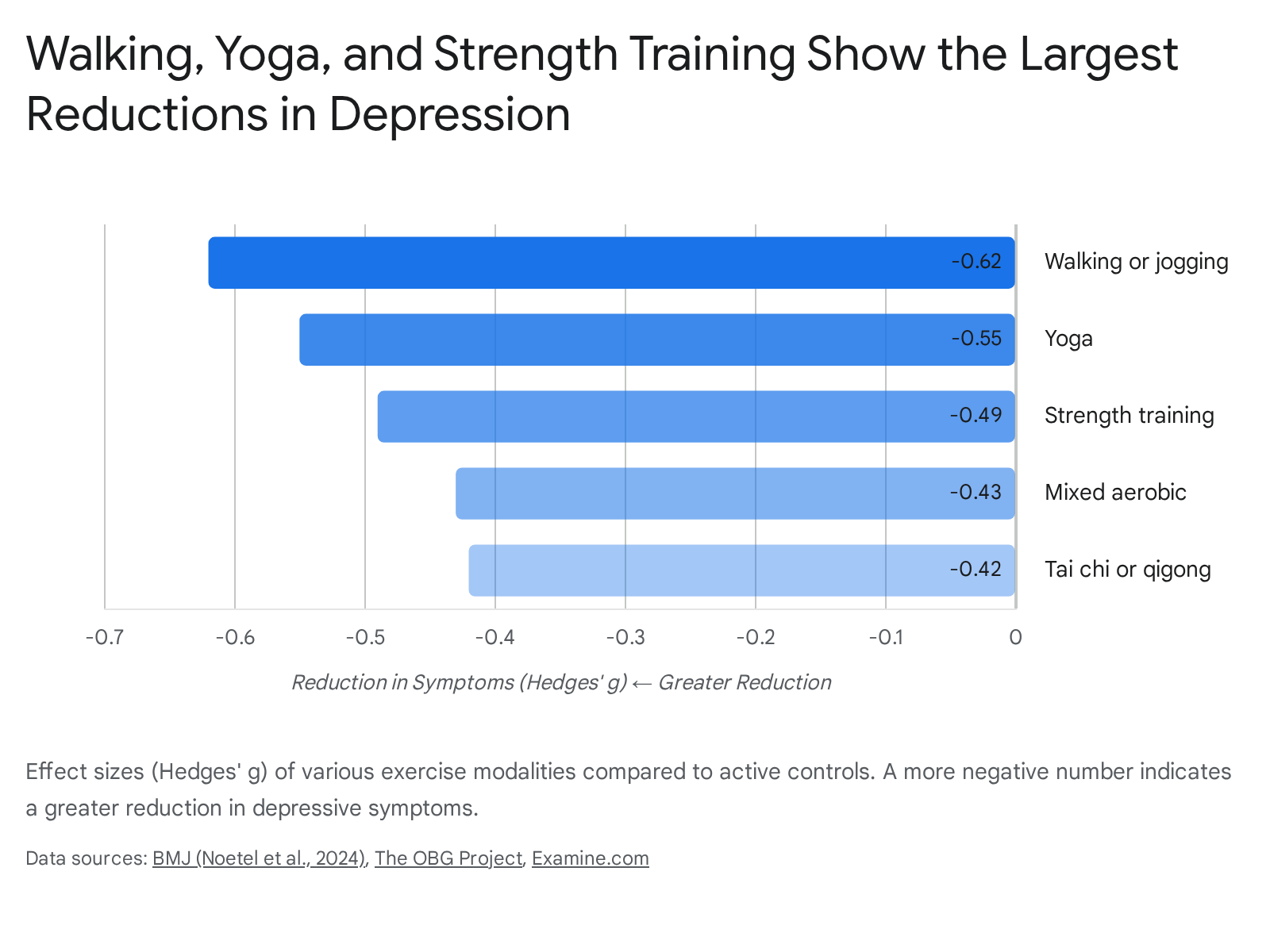
Lifting weights and engaging in bodyweight resistance training have profound psychological impacts. Strength training is associated with significant reductions in depressive symptoms (Hedges' g = -0.49) 3. Beyond the neurochemical changes, resistance training boosts self-efficacy, improves executive function, and alters hormone balance 3224. As individuals visibly track their physical progression in strength, it acts as a behavioral activation strategy that combats the feelings of worthlessness associated with depression.
Dance
While less commonly prescribed, some of the most striking data in recent meta-analyses points to dance as a highly promising modality. Dance showed massive effect sizes (Hedges' g = -0.96) in treating depression, outperforming standard aerobic exercise in several trials 33625. Researchers hypothesize this is due to its unique combination of cardiovascular exertion, real-time social interaction, cognitive demand (learning and recalling choreography), and the mood-enhancing effects of music 33625. Dance has also been shown to enhance short-term memory, learning efficiency, and retrieval fluency in older adults 25. However, researchers caution that the sample sizes for dance studies remain relatively small, meaning confidence in these specific estimates is lower than for walking or yoga 3.
| Exercise Modality | Effect Size (Hedges' g) | Primary Mental Health Benefit | Best Suited For |
|---|---|---|---|
| Dance | -0.96 | Highest mood elevation; cognitive retrieval | Highly social individuals; cognitive decline prevention |
| Walking / Jogging | -0.62 | Broad depression/anxiety reduction | Beginners; low-barrier entry |
| Yoga | -0.55 | Severe anxiety reduction; high tolerability | Older adults; high-stress populations |
| Strength Training | -0.49 | Depression reduction; executive function | Younger adults; those needing self-efficacy boosts |
| Tai Chi / Qigong | -0.42 | Parasympathetic regulation; mild anxiety | Older adults; mobility-restricted individuals |
(Note: Effect sizes denote the standard mean difference against active controls. A more negative number indicates a greater reduction in depressive symptoms 34.)
Tailoring the Prescription: Age and Demographic Nuances
The physiological mechanisms and psychological barriers to exercise vary wildly across a human lifespan. Consequently, the optimal exercise prescription is highly dependent on demographic factors.
Children and Adolescents
Adolescent mental health has emerged as a critical global public health issue. Research demonstrates that physical activity interventions are significantly more effective than control groups in improving overall mental health in typically developing children and adolescents (SMD = 0.37) 26.
The most pronounced effects in youth are seen in stress reduction (SMD = 0.86) and the enhancement of social competence (SMD = 0.56) 26. Interestingly, physical activity interventions appear notably more effective for male adolescents (SMD = 1.11) and secondary school students compared to younger children 26. Team sports, rather than individual sports, are associated with lower levels of anxiety and depression in youth, suggesting that the social scaffolding of team environments provides a crucial buffer against adolescent isolation 27. For adolescents, achieving 30 to 59 minutes of moderate physical activity daily corresponds to a massive 56.4% decrease in the risk of developing mental health issues, with diminishing incremental benefits beyond 60 minutes 28.
Emerging Adults and Postnatal Women
The greatest clinical benefits for depression reduction by population group are seen in emerging adults (aged 18 - 30) and postnatal women 56. For postnatal women, the rapid hormonal shifts and isolation of new motherhood create a high risk for mood disorders; structured exercise provides both endocrine regulation and a necessary routine outside the home 58. For university-aged emerging adults, higher energy expenditure (600 to 6,000 MET-minutes/week) is strongly associated with lower self-reported anxiety, countering the poor work-life balance and high stress of academic environments 29.
Middle-Aged and Older Adults
As individuals age, the goals of exercise shift toward maintaining cognitive health, preventing dementia, and managing the psychological impact of physiological changes.
- Menopause: The menopausal transition is accompanied by a sharp increase in mental health risks, with depression prevalence reaching 20% to 40% 18. Physical exercise, particularly resistance training and mind-body exercises, demonstrates massive therapeutic potential for postmenopausal women by counteracting hormonal mood swings and preserving bone density 1830.
- Older Adults: For adults over 65, resistance exercise (SMD = -0.68) and mind-body exercise (SMD = -0.54) are the most effective forms of exercise for improving depression 1718. Aerobic exercise with music has also been shown to improve global cognition and short-term memory in older adults dealing with Mild Cognitive Impairment (MCI) 25. Furthermore, targeted exercise reduces the fear of falling, bolsters spatial memory, and decreases loneliness in care home settings 43.
- Gender Differences: Nuanced data suggests that strength training is statistically more effective for younger women, while yoga and Qigong are particularly effective for older men 344.
The Biological Mechanisms: What Happens in the Brain?
To understand why physical movement alters a psychological state, we must look at the biological mechanisms triggered by exercise. Physical activity does not just distract the mind; it fundamentally alters the architecture and chemistry of the brain.
Brain-Derived Neurotrophic Factor (BDNF) and Neuroplasticity
The most critical biological mechanism linking exercise to mental health is neuroplasticity - the brain's lifelong ability to reorganize itself by forming new neural connections 163132. In patients with chronic depression, schizophrenia, or PTSD, key brain regions like the prefrontal cortex and the hippocampus (vital for memory and emotional regulation) often show reduced volume, neuronal atrophy, and diminished synaptic connectivity 3334.
Exercise acts as a direct countermeasure by stimulating the release of Brain-Derived Neurotrophic Factor (BDNF) 32313335. * The "Fertilizer" Analogy: Neuroscientists frequently compare BDNF to fertilizer for the brain. Just as fertilizer helps a struggling plant grow new branches and establish deep roots, BDNF supports the survival of existing neurons and encourages the birth of new brain cells (neurogenesis) 16323236. * Rewiring the Pathways: By elevating BDNF levels, exercise creates an optimal physiological environment for the brain to adapt. Following the neuropsychological principle that "neurons that fire together, wire together," a brain bathed in BDNF is more capable of solidifying the new, healthier thought patterns formed during cognitive behavioral therapy 32333637. A specific gene variant (Val66Met) can affect an individual's natural production of BDNF, which explains why some people experience faster or slower rates of mood improvement from exercise 16.
Taming Systemic Inflammation and the Immune System
Major Depressive Disorder is increasingly viewed by the medical community not just as a neurochemical imbalance, but as an inflammatory condition. Up to a third of depressed patients exhibit systemic low-grade chronic inflammation (SLGCI) 3839. This persistent inflammatory state is fueled by modern lifestyle factors: sedentary behavior, poor diet, inadequate sleep, and chronic psychological stress 3840.
High levels of inflammation disrupt the synthesis of serotonin and dopamine. Pro-inflammatory cytokines (like TNF-alpha) can actually hijack the brain's chemistry, pushing the synthesis of tryptophan away from creating serotonin and instead toward the kynurenine pathway, which generates neurotoxic chemicals that induce depressive symptoms and apathy 41. Furthermore, inflammation alters the T cell repertoire and up-regulates the Th17 phenotype, mirroring the lethargy seen in chronic viral infections 3940.
Regular, moderate exercise has a profound, targeted anti-inflammatory effect. During sustained muscular contraction, skeletal muscles secrete anti-inflammatory myokines (such as IL-6) which help downregulate systemic inflammation and lower markers like C-reactive protein (CRP) 93238. By cooling the body's inflammatory response, exercise removes a biological roadblock that prevents traditional antidepressants from working effectively.
Blood Flow and the HPA Axis
Physical activity dramatically increases cardiovascular circulation, delivering a surge of oxygen and nutrients to energy-hungry brain cells 3236. Over months of consistent exercise, this leads to angiogenesis - the creation of entirely new blood vessel networks in the brain 3236. This enhanced infrastructure improves cognitive function, memory, and the brain's ability to clear toxic metabolic waste that accumulates during stress 3236.
Concurrently, exercise helps regulate the Hypothalamic-Pituitary-Adrenal (HPA) axis. Chronic stress leaves the HPA axis hyperactive, flooding the brain with cortisol and impairing neuroplasticity 1632. Consistent exercise normalizes the release of cortisol and increases levels of DHEA (a neuroprotective hormone), effectively buffering the brain against future psychological stressors and reducing the hyperarousal associated with trauma and anxiety 3243.
The "Chicken or Egg" Dilemma: Bidirectional Relationships
A long-standing debate in psychiatric and epidemiological research is the direction of causality: Does a lack of exercise cause depression, or does depression simply stop people from exercising?
Because depression is fundamentally characterized by fatigue, apathy, and anhedonia (the inability to feel pleasure), individuals with mood disorders naturally exercise less 424344. Individuals with anxiety and depression are also more socially isolated, reducing their motivation to engage in group physical activities 4344.
Mendelian Randomization and Cohort Studies
To solve this "chicken and egg" problem, researchers utilize advanced statistical models. A massive 2-sample Mendelian randomization study utilizing data from the UK Biobank and the Psychiatric Genomics Consortium sought to prove causality using genetic instruments 42. By analyzing objective physical activity (measured by wearable accelerometers) rather than flawed self-reporting, the study proved that higher levels of physical activity had a direct causal role in reducing the risk of major depression 42. Interestingly, the genetic data suggested the relationship in this specific model was unidirectional - exercise protected against depression, but a genetic predisposition to depression did not necessarily guarantee physical inactivity 42.
However, longitudinal studies measuring human behavior over time present a different reality. The Whitehall II cohort study, which tracked 9,309 participants over 8 years, confirmed a true bidirectional association 4344. Regular physical activity across the waves reduced the likelihood of developing depressive symptoms. Conversely, participants who exhibited anxiety and depression at the baseline were significantly more likely to abandon their exercise routines and fail to meet physical activity guidelines in the future 44. Similar bidirectional patterns are seen in patients managing chronic pain, where high scores on the DASS-42 (Depression, Anxiety, and Stress Scale) predict the creation of severe mental health barriers to leisure-time exercise 45.
The Clinical Reality of Motivation
In practice, the relationship is deeply bidirectional. While exercise is a potent treatment for depression, the disease itself erects massive neurobiological and psychological barriers to initiating movement 434445.
Expecting a severely depressed patient to simply "go to the gym" ignores the clinical reality of their depleted energy levels 46. This is why modern clinical guidelines emphasize starting with the absolute minimum repeatable dose - such as a 10-minute daily walk (the "Commit 10" approach) - and relying on supervised, appointment-based programs to bypass the patient's lack of internal motivation 81146. Consistency is the antidepressant feature; intensity can be layered in later once the patient's baseline mood improves 46.
Digital Innovations: Apps, VR, and Online Programs
As global sedentary behavior increases, researchers are exploring whether digital interventions can successfully deliver the mental health benefits of exercise at scale.
- Online Exercise Programs: Following the COVID-19 pandemic, telehealth and online fitness surged. A systematic review assessing the efficacy of online exercise (OE) versus face-to-face exercise (FFE) found that OE is a highly effective strategy 24. Online exercise was superior to no exercise in reducing depression (SMD = 1.08) and improving mental well-being (SMD = 0.79), and importantly, it was deemed non-inferior to in-person training for these outcomes 24.
- Fitness Apps and Micro-Incentives: Smartphone applications can drive population-level changes, though the effects are often modest. The Carrot Rewards app study in Canada tracked over 500,000 users and found that combining fitness tracking with financial micro-incentives resulted in small but sustained increases in daily step counts over two years 47. While the average increase was modest (around 250 steps/day), for previously "low active" users, the increases approached 1,000 steps a day, crossing the threshold into clinically significant health improvements 47.
- Virtual Reality (VR): Emerging evidence highlights VR as a tool to enhance exercise adherence in the elderly. In trials combining standard physical training with VR therapy, participants showed significantly greater reductions in the Geriatric Depression Scale and general anxiety compared to those doing standard exercise alone, as the immersive environment distracts from physical discomfort and increases engagement 1.
Limitations in the Science: Why We Must Be Cautious
While the evidence map is overwhelmingly positive, rigorous scientific analysis requires acknowledging the limitations within the current research. The 2026 update to the Cochrane Review - widely considered the gold standard for evidence-based medicine - analyzed 73 trials involving nearly 5,000 adults with depression 11484950.
The review, led by Professor Andrew Clegg, concluded that while exercise clearly reduces depressive symptoms with an efficacy similar to psychological therapy, the overall certainty of the evidence comparing it directly to antidepressants remains low due to methodological flaws in the underlying trials 114850.
Several persistent limitations plague exercise research: 1. The Impossibility of Blinding: In a pharmaceutical trial, neither the patient nor the doctor knows who received the active drug versus the placebo, eliminating bias. In an exercise trial, blinding is impossible; patients obviously know they are exercising and control groups know they are not 314. This introduces a massive "expectancy effect" - patients expect to feel better because society tells them exercise is healthy, which artificially inflates the reported psychological benefits 14. 2. The Social Confounder: Because supervised and group exercises are the most effective, it is incredibly difficult for researchers to isolate the biological benefits of the physical movement from the psychological benefits of leaving the house, interacting with a supportive instructor, and socializing with peers 944. 3. Lack of Long-Term Follow-up: The vast majority of clinical trials track patients for 8 to 12 weeks. Data on whether exercise maintains its antidepressant effects years down the line, or how frequently patients relapse after the supervised trial ends, remains sparse 144850. 4. Publication Bias: Studies that show no mental health benefits from exercise are less likely to be published by medical journals than studies showing positive, exciting results, leading to an overrepresentation of positive data in meta-analyses 6566.
Bottom line
The comprehensive body of scientific research confirms that exercise is a highly effective, biologically grounded intervention for reducing symptoms of depression and anxiety across all demographics. Modalities like walking, yoga, and strength training offer the highest tolerability and best results when performed consistently at a moderate dose of roughly 150 to 300 minutes per week. However, due to inherent limitations in clinical trial designs and the severe motivational barriers caused by mood disorders, exercise should not be viewed as a standalone cure, but rather as a powerful physiological catalyst that works best when integrated with traditional psychotherapy and medical care.