
What Main Character Syndrome Says About Online Identity
Main character syndrome is a popular internet-coined term describing a mindset in which a person views themselves as the central protagonist of their own life story, often treating everyday events as scenes in a movie and the people around them as a supporting cast. While it can serve as a harmless, empowering tool for building self-confidence and practicing mindfulness, taking it to an extreme can foster self-absorption, emotional detachment, and a distinct lack of empathy. Ultimately, it reflects a broader cultural shift in how modern digital audiences construct, curate, and perform their identities for an ever-present online crowd.
The Origins of a Viral Phenomenon
To fully grasp the cultural weight of main character syndrome, one must examine the digital landscape of the early 2020s. The concept first gained massive cultural traction on the video-sharing platform TikTok during the height of the COVID-19 pandemic. In May 2020, a creator named Ashley Ward posted a video that would inadvertently define a generational coping mechanism. Lying on a multi-colored beach towel, filmed from an overhead drone angle that made her the sole focal point, Ward spoke over the atmospheric intro to the song "A Moment Apart" by the electronic duo Odesza 122. Her voiceover delivered a simple but highly resonant manifesto: "You have to start romanticizing your life. You have to start thinking of yourself as the main character, 'cause if you don't, life will continue to pass you by, and all the little things that make it so beautiful will continue to go unnoticed" 125.
During a period defined by global lockdowns, intense isolation, and a profound loss of personal agency, this audio struck a global nerve. It offered a psychological lifeline. If the outside world was restricted, chaotic, and frightening, young people could at least control the narrative of their immediate surroundings. "Romanticizing your life" became a call to action to find cinematic beauty in the mundane - drinking a cup of coffee, taking a solitary walk, or reading a book by a window 638. It was a visual representation of transforming one's outlook on life, encouraging individuals to appreciate simple pleasures and recognize the beauty in their immediate world 16.
From Aesthetic Trend to Cultural Lexicon
What began as a trend of creating highly stylized, aesthetic montage videos quickly evolved into a broader behavioral and psychological concept. By mid-2024, search interest for "main character syndrome" had spiked dramatically on platforms like Google, transitioning from a lighthearted hashtag into a serious topic of cultural, sociological, and psychological commentary 4.
Critics, digital anthropologists, and mental health professionals began to notice that this hyper-focus on the self was altering how people interacted with reality. The phrase evolved into a double-edged sword. On one hand, having "main character energy" was praised as a form of self-empowerment, boundary-setting, and a rejection of societal expectations 5. On the other hand, "main character syndrome" became a pejorative shorthand used to describe individuals who were painfully self-centered, oblivious to social cues, and willing to inconvenience others for the sake of their own personal plotline or content creation 11613. This duality set the stage for intense debates about the nature of identity in the twenty-first century.
The Psychological Underpinnings of the Self
While the terminology of main character syndrome is thoroughly modern, the underlying psychology is deeply rooted in established theories of human development. Psychologists have long studied how humans use storytelling to understand their place in the world, make sense of trauma, and build a cohesive identity.
Narrative Identity and the Constructed Life Story
In the 1980s and 1990s, the prominent psychologist Dan McAdams developed the concept of "narrative identity," which posits that individuals naturally construct an internalized, evolving life story 14. We weave together our past experiences, our present circumstances, and our imagined futures to form a coherent sense of self. In this traditional psychological framework, everyone is already the protagonist of their own narrative arc 1415. Identity is not a fixed set of characteristics, but rather something formed over time through continuous storytelling 14.
Therefore, the foundational idea of seeing oneself as a main character is not new. People have long understood themselves as protagonists navigating the complexities of the human experience. However, modern digital sociology suggests that social media has fundamentally warped this natural, internal process. Identity formation is no longer a purely internal reflection or a private narrative; it is now an outward-facing performance that demands an audience 147.
The Permanent "Imaginary Audience" Effect
Psychologists closely associate main character syndrome with the "imaginary audience" effect - a cognitive bias where an individual believes they are under constant, intense observation and evaluation by their peers 8.
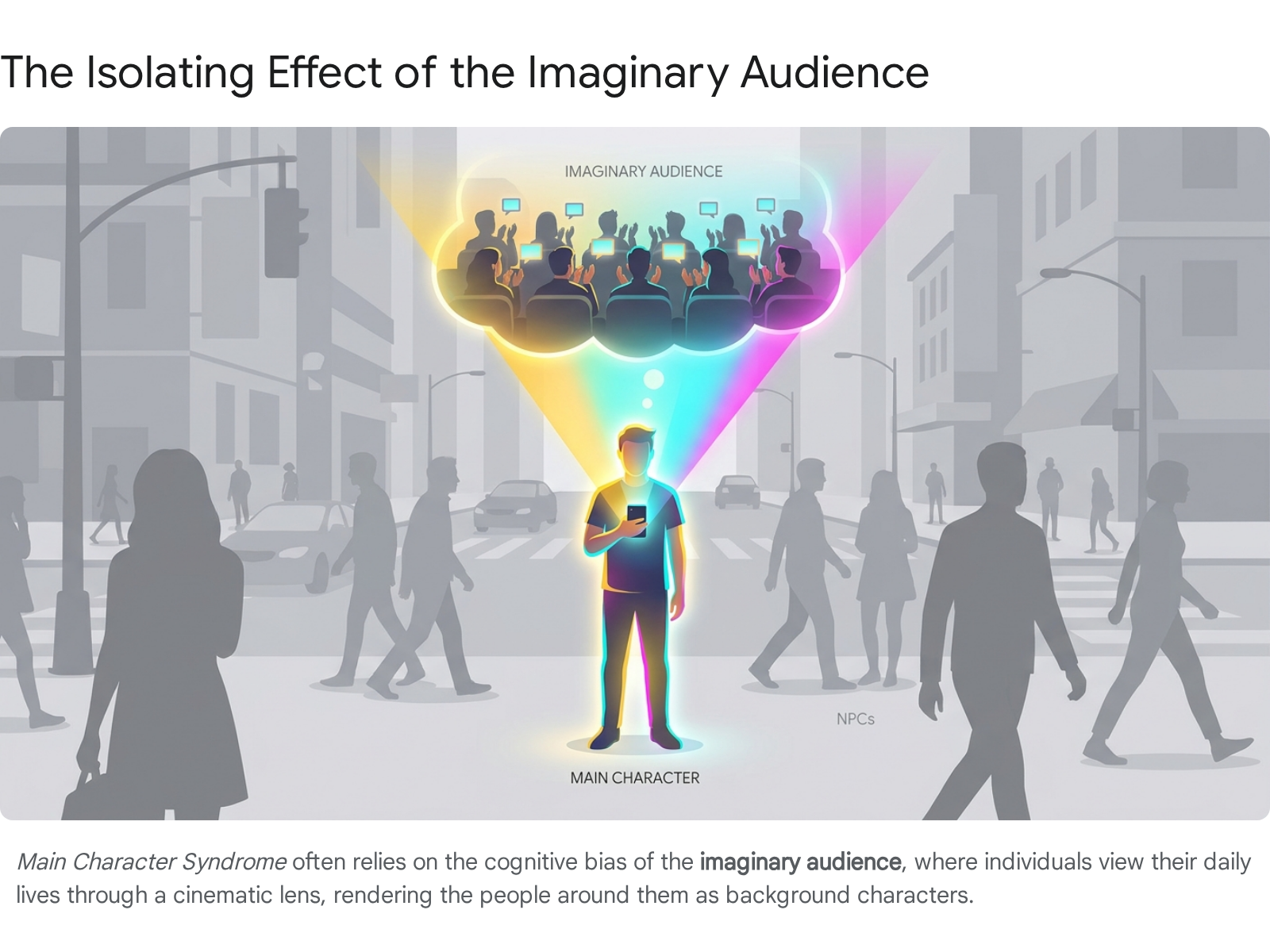
Historically, developmental psychologists considered the imaginary audience to be a temporary phase of early adolescence, a time when teenagers are hyper-aware of social dynamics and identity formation 89.
But for Generation Z and Millennials raised on platforms like Instagram, TikTok, and YouTube, the imaginary audience is no longer a psychological illusion. It is a tangible, quantifiable metric of followers, likes, and views 78. According to digital behavior reports, teenagers and young adults who spend several hours a day on social media exhibit high levels of continuous self-surveillance. They become acutely aware of their camera angles, their facial expressions, and the aesthetic value of their daily routines 8. This constant hyper-visibility creates an unrelenting pressure to be perpetually interesting. Life ceases to be something that is simply experienced organically; it becomes a script to be optimized for public consumption 8.
Self-Determination Theory and Superficial Autonomy
To understand why this mindset is so deeply appealing, psychologists look to Self-Determination Theory, which emphasizes three intrinsic human needs: competence, autonomy, and relatedness 7. Main character syndrome often fulfills these fundamental needs, albeit superficially. Carefully curated images portray a sense of competence; having control over one's digital narrative provides a feeling of autonomy; and audience engagement in the form of likes and comments suggests relatedness and community 7.
However, this externalized form of identity validation becomes incredibly fragile when it is disconnected from deeper, authentic self-awareness. When an individual's sense of self relies entirely on the applause of a digital audience, they are left vulnerable to anxiety, body dissatisfaction, and acute feelings of isolation when that validation inevitably fluctuates 47.
Social Media, Platform Capitalism, and Hyper-Individualism
Main character syndrome does not emerge in a vacuum; it is an inevitable response to the economic structures of modern social media. Digital anthropologists argue that this phenomenon is a direct product of platform capitalism and late-stage individualism 7.
Social media platforms are designed around an attention economy that actively rewards visibility, novelty, and emotional appeal. This architecture commodifies personal stories, pressuring users to stylize not only their physical appearance but their very narratives 7. Consequently, young people are subtly encouraged to view themselves as personal brands rather than as complex, multi-dimensional human beings 7.
The Rise of "Hyperreal Individualism"
As online culture fractures into countless micro-trends and highly specific aesthetics, a new variation of selfhood has emerged, which cultural critics refer to as "hyperreal individualism" 19. In this state, an individual's original cultural references may be entirely illegible or incoherent to the outside world, yet the person remains fiercely committed to defining themselves and building an identity around their disparate, highly curated tastes 19.
This hyperreal individualism often serves as a rejection of postmodernism's inherent nihilism. Some observers argue that postmodernism, which suggests that the world lacks ultimate meaning or objective truth, has left younger generations feeling adrift 1. By embracing the "romanticize your life" trend, young people are actively fighting back against the idea that their existence is meaningless. They are choosing to recognize objective beauty in their daily habits, thereby reclaiming a sense of purpose and rejecting the misery that can accompany endless digital consumption 1.
The NPC Dichotomy: Reducing Others to Background Extras
A direct and somewhat troubling corollary to main character syndrome is the widespread cultural adoption of the "NPC" concept. NPC stands for "Non-Playable Character," a term borrowed from video game design. In gaming, an NPC is a background character programmed by developers to execute limited, repetitive scripts - such as a merchant in a fantasy village or a pedestrian walking down a virtual street 1021. They exist solely to populate the world and provide context or resources for the actual player.
If someone views themselves as the central main character of reality, by logical extension, strangers, service workers, and sometimes even friends and colleagues are reduced to the status of NPCs 1022. In modern online parlance, calling someone an NPC implies they lack a rich inner life, independent thought, critical reasoning skills, or personal agency 10.
Dehumanization and the Empathy Deficit
This dichotomy can lead to a severe breakdown in communal empathy. The term implies a loss of internal subjectivity, categorizing people into those who have "free will" and those who are merely sleepwalking through a harsh economic and political reality 10. When individuals truly internalize the idea that others are merely background extras, they feel justified in ignoring the boundaries of those around them.
This manifests daily in public spaces. It is the mindset that permits someone to film a disruptive TikTok dance in the middle of a busy grocery store aisle, completely disregarding the frustration of shoppers trying to navigate around them 11. To the person with main character syndrome, the annoyed shopper is not a human being with their own complex life and pressing schedule; they are simply a prop or a minor antagonist who has wandered into the frame of their movie 11613. As critics point out, describing others as NPCs diminishes the importance of their unique experiences and perpetuates a cycle of self-centeredness that undermines our collective social well-being 22.
Does Romanticizing Life Actually Work?
The debate among psychologists, cultural critics, and everyday internet users is whether this trend is ultimately a helpful coping mechanism or a harmful delusion. The answer largely depends on execution, self-awareness, and the degree to which it dictates behavior.
The Mental Health Benefits of "Main Character Energy"
When applied with mindfulness and healthy boundaries, "romanticizing your life" has tangible mental health benefits. It encourages individuals to practice deep gratitude and find joy in the present moment, rather than deferring happiness until they reach massive, life-altering milestones 323. Engaging in solo adventures, brewing a cup of tea with intention, or simply dressing up for an otherwise ordinary day can dramatically enhance one's day-to-day experience 823.
For individuals recovering from trauma, experiencing severe burnout, or battling low self-esteem, adopting "main character energy" can be a radical act of self-care and self-preservation. It permits them to prioritize their own happiness, set firm boundaries against toxic influences, and take ownership of their personal growth without feeling guilty 524. It helps individuals combat feelings of being invisible or unimportant, serving as a powerful psychological defense mechanism 25. By actively choosing how to frame their day, individuals reclaim autonomy over their mental well-being and build resilience against adversity.
The Risks of Relentless Self-Surveillance
However, when the desire to be the main character crosses from internal mindfulness into an external, unrelenting performance, it introduces significant psychological risks. The pressure to live a life that is constantly "post-worthy" or cinematic can trigger severe anxiety, paralyzing perfectionism, and deep emotional dissonance 38.
When individuals begin to treat their real-life relationships as narrative plotlines, people cease to be human and become mere conflict arcs, character development tools, or content fodder 8. A 2023 study by researchers at the University of Michigan noted that individuals who constantly frame their personal experiences for social media consumption tend to struggle immensely with regulating their emotions. They begin to interpret their own lives as a performance rather than reality, leading to emotional detachment 8.
This relentless self-focus contributes to what sociologists call hyper-individualism - a state where communal support structures erode. Ironically, by focusing so intensely on curating a perfect individual narrative, the subject often pushes away genuine connection, leaving them feeling more isolated, misunderstood, and lonelier than ever 426.
Main Character Syndrome vs. Clinical Narcissism
Because main character syndrome inherently involves self-centered behavior, a craving for attention, and an inflated sense of self-importance, it is frequently confused with clinical narcissism. It is crucial to clarify that main character syndrome is not a recognized clinical diagnosis in the Diagnostic and Statistical Manual of Mental Disorders (DSM-5); it is strictly an informal cultural observation 1128121331.
While there is a clear, undeniable overlap with the grandiose traits of Narcissistic Personality Disorder (NPD), mental health professionals distinguish the two primarily by examining their stability over time, their severity, and the underlying presence of core human empathy 2514.
| Feature | Main Character Syndrome (Cultural Phenomenon) | Narcissistic Personality Disorder (Clinical Diagnosis) |
|---|---|---|
| Origin & Nature | A learned behavioral pattern often triggered by social media culture, a desire for aesthetic control, or a need for a coping mechanism during stressful transitions 811. | A deeply ingrained, pervasive mental health condition rooted in complex psychological, genetic, and early environmental factors 111314. |
| Self-Awareness | Often playful, ironic, or self-aware. Individuals usually know they are "romanticizing" reality and are participating in a trend 2511. | Genuinely believes in their absolute superiority and entitlement; utterly lacks insight into their own grandiosity or toxic behaviors 1114. |
| Empathy Levels | May act selfishly or oblivious in the moment, but retains the fundamental capacity for genuine empathy and connection with others when prompted 11. | Characterized by a chronic, fundamental inability or unwillingness to recognize, understand, or care about the needs and feelings of others 2514. |
| Stability | Situational or phase-based. May appear heavily during specific life transitions (e.g., entering college, after a breakup) and fade with maturity 1415. | Highly stable across time and present across all contexts of the individual's life (workplace, home, social circles) 14. |
| Response to Criticism | May feel embarrassed, disappointed, or anxious if reality doesn't match their expected "plot," but can adjust their behavior 611. | Often reacts with intense rage, deep defensiveness, or severe psychological injury to any perceived criticism or lack of admiration 25. |
Many psychologists argue that while social media does not necessarily create clinical narcissists out of thin air, digital platforms act as a powerful magnet for them. The architecture of social media actively rewards narcissistic traits - such as low empathy, inflated self-opinion, and a desperate need for admiration - with algorithmic virality and audience attention 16. For the average person, prolonged exposure to these platforms merely induces a heightened state of self-consciousness and a mild, temporary case of main character syndrome, rather than fundamentally altering their personality structure into full-blown NPD 16.
How "Main Character Energy" Impacts Everyday Life
The ripple effects of this syndrome extend far beyond the screens of young social media users. As the cultural vocabulary of the internet bleeds into the physical world, "main character" dynamics are reshaping how we approach romantic relationships, professional environments, and even global geopolitics.
The Strain on Dating and Interpersonal Relationships
In romantic partnerships, main character syndrome can be highly toxic. A partner operating with this mindset views the relationship entirely through the lens of their own emotional journey. They may expect their partner to act as a flawless supporting character, existing solely to validate them, provide grand romantic gestures, or serve as a catalyst for their own personal growth 1417.
When the partner inevitably demonstrates their own complex needs, flaws, or requires compromise, the "main character" may feel deeply disappointed. They might believe the relationship is defective simply because it deviated from their idealized, cinematic script 61117. This leads to an imbalance where one person is constantly performing, while the other is expected to be a passive audience member. Mental health experts warn that this kills honest, open communication, as the main character struggles to truly listen and validate their partner's independent struggles 14.
The "Savior Complex" in Work and Healthcare
In professional settings, the syndrome manifests as a relentless need to hog the spotlight and take all the credit. A notable 2025 article in the British Medical Journal by Dr. Matt Morgan highlighted the severe dangers of main character syndrome specifically within healthcare 181920. While immense confidence is absolutely necessary in high-stakes medicine, doctors who view themselves as the sole "saviors" or the indispensable heroes of a crisis often become arrogant and refuse to collaborate 18.
Modern medicine, like most complex professional fields, relies heavily on interdisciplinary teams. An individual who refuses to share the stage, who cannot accept constructive feedback, and who consumes vast amounts of organizational energy simply to maintain their own ego can actively endanger patient safety and create highly toxic workplace cultures 1839. The belief that one is the only person capable of fixing a problem often masks a deep inability to trust or delegate to competent peers.
Corporate Monopolies and Political Extraction
The concept has even been applied to macro-economics and anti-monopoly law. Legal scholar Tim Wu has argued that modern Big Tech monopolies suffer from a massive, corporate version of main character syndrome 21. Rather than acting as neutral hosts, catalysts, or foundational infrastructure that allow society and independent creators to thrive, these platforms position themselves as the center of the internet. They insist on inserting themselves into every transaction, extracting wealth, attention, and data from their users to ensure they remain the absolute focal point of the digital economy 21.
Similarly, in the political sphere, commentators note that filtering complex, systemic political issues entirely through the lens of one's personal identity is deeply problematic. Making every global event or societal struggle about oneself and one's own emotional reaction cripples effective collective action. It shifts the focus away from pragmatic, structural solutions and drives further societal polarization, as discourse devolves into a battle of competing personal narratives 41.
Cultural Clashes: When the Main Character Travels
Main character syndrome arguably represents the absolute zenith of Western individualistic culture. Consequently, when this digitally exported mindset encounters traditional collectivist cultures, intense friction ensues.
For example, local communities in global digital nomad hotspots like Bali, Indonesia, have reported a palpable "narcissism epidemic" in recent years 42. Locals and long-term residents observe that many transient visitors treat ancient cultural spaces, sacred temples, and local communities merely as aesthetic backdrops for their personal content creation 42. This highly curated, competitive way of carrying oneself completely ignores local customs and disrupts community harmony, replacing authentic engagement with social media-induced hyper-scrutiny 42.
The Nuances of Global Collectivism
Interestingly, modern cultural psychology research warns against treating the concept of "collectivism" as a monolith. A massive study spanning 53 nations and over 17,000 participants recently revealed that different collectivist cultures manage identity and emotion in vastly different ways 222345.
While East Asian cultures traditionally emphasize suppressing individual emotional expression to maintain group harmony and prioritize formal relationships, Latin American collectivist cultures operate differently 2346. Guided by the cultural script of simpatía, Latin American societies actively encourage vibrant, independent, and positive emotional expression as the primary way to foster strong, informal social bonds 4647.
However, neither of these models aligns with the detached, self-serving individualism characteristic of extreme main character syndrome. Whether a culture values quiet harmony or vibrant communal expression, both prioritize the health of the collective over the ego of the individual. When the "main character" mindset is introduced into these environments, it is often viewed not as empowering, but as profoundly disruptive, disrespectful, and fundamentally isolating.
Reclaiming the Narrative: The Power of the Supporting Role
If treating life entirely like a movie is an isolating endeavor, the antidote is not necessarily to abandon the joy of personal storytelling. Rather, it is to expand one's awareness to recognize the absolute validity of other people's narratives.
Psychologists and digital well-being experts suggest practicing "media mindfulness" - the act of recognizing when you are performing for an imaginary audience and intentionally unplugging from that dynamic 724. Counterbalancing the pressure to perform requires engaging in offline rituals that do not yield likes or views, such as private journaling, creative writing for oneself, or participating in community service 7.
Furthermore, as cultural commentators and historians like Dr. Liam Alex Heffron suggest, there is profound meaning and power to be found in actively embracing the "supporting role" in life 49. In a world obsessed with spotlight and status, flipping the script to focus on lifting others up, leading quietly, and contributing to a community without demanding top billing often leads to deeper impact and true contentment 49. Relinquishing the spotlight allows individuals to foster genuine connections, learn from the experiences of their peers, and build resilient communities 4950.
True, healthy self-esteem means knowing you are the author of your own choices, without requiring the rest of the world to sit quietly in the dark as your audience.
Bottom line
Main character syndrome is a fascinating, complex cultural byproduct of the social media age, representing a generation's attempt to find personal agency, beauty, and meaning in a highly surveilled, algorithmic world. While "romanticizing your life" can serve as a highly valuable tool for practicing mindfulness, setting boundaries, and building self-empowerment, an unchecked obsession with one's own narrative carries severe risks. It can breed traits akin to narcissism, foster emotional detachment, and lead to profound social alienation by reducing other human beings to background extras. Moving forward, the true challenge for digital natives will be balancing the innate human desire for personal self-expression with the deep empathy required to recognize that everyone else is living a story equally as vibrant, painful, and complex as their own.