
What Is Entropy and Why Does Disorder Increase
Entropy is a fundamental measure of how energy spreads out and shares itself among the available microscopic configurations of a physical system. The universe inevitably moves toward disorder simply because there are astronomically more ways for energy and matter to be thoroughly mixed than there are ways for them to remain perfectly sorted. Consequently, without a continuous input of energy to actively maintain order, systems will naturally and irreversibly evolve into their most probable, chaotic states.
The Inescapable Asymmetry of Nature
If you drop a glass on a hard floor, it shatters into hundreds of jagged shards. If you film this event and play the video in reverse, the shards will miraculously leap off the floor, assemble themselves perfectly, and form a pristine glass. Any observer watching the reversed video will instantly know it is playing backward 1. We intuitively understand that things break, degrade, and scramble, but they never spontaneously un-break, upgrade, or un-scramble.
This intuition is the visceral human experience of the second law of thermodynamics. While the first law of thermodynamics dictates that energy can neither be created nor destroyed, the second law dictates the specific direction that energy naturally flows. It states that the total entropy of an isolated system can never decrease over time 123. Entropy is the invisible ledger of this irreversible decay. It governs everything from the melting of an ice cube in a warm glass of water to the eventual death of stars 34.
Despite its ubiquity, entropy remains one of the most famously misunderstood concepts in all of physics. It bridges the gap between the microscopic realm of vibrating atoms and the macroscopic realm of heat, time, and biology. To truly understand why the universe behaves the way it does, and how complex life can exist in a cosmos destined for decay, we must first unpack what entropy actually is, how it was discovered, and why the simple metaphor of a "messy room" only tells half the story.
From Steam Engines to the Cosmos: The Birth of Entropy
The concept of entropy was not born from abstract philosophy, but from the grimy, practical realities of the Industrial Revolution. In the early nineteenth century, engineers were obsessed with building more powerful and efficient steam engines to drive modern industry. A young French engineer named Sadi Carnot began studying the theoretical limits of these engines. He realized something profound: no heat engine, no matter how perfectly designed or constructed, could ever be one hundred percent efficient 3.
Carnot discovered that mechanical work could only be extracted when heat flowed from a high-temperature source, such as a coal fire, to a low-temperature sink, such as the surrounding air. In every cycle of the engine, some energy inevitably had to be dumped into the environment as waste heat. It was a fundamental limitation of nature, not a mere engineering flaw 32. Efficiency was constrained by the absolute temperatures of the hot and cold reservoirs, meaning perfect efficiency would require reaching absolute zero, a physical impossibility 3.
Building directly upon Carnot's foundational work, the German physicist Rudolf Clausius coined the term "entropy" in 1865. Etymologically, the word was derived from the Greek words en (meaning "in") and tropē (meaning "turn" or "transformation"). Clausius intended the word to sound similar to the word "energy," while explicitly describing how a system's usable energy transforms or evolves into an unusable state 3. Clausius recognized that whenever energy was dispersed as waste heat due to friction, air resistance, or thermal radiation, a certain property of the universe permanently increased.
In classical thermodynamics, entropy is defined strictly through macroscopic measurements. If a tiny amount of heat flows reversibly into a system at a specific temperature, the system's entropy changes by an amount equal to that heat divided by the absolute temperature. This classical view makes absolutely no assumptions about atoms or molecules, which were still heavily debated theoretical constructs at the time. Yet, it perfectly predicts the inescapable inefficiency of machines and the one-way flow of heat from hot to cold 48.
Macrostates, Microstates, and the Statistical Revolution
While Clausius identified that entropy exists and always increases, his macroscopic equations could not explain the underlying physical mechanism driving this universal tendency. That breakthrough fell to the Austrian physicist Ludwig Boltzmann in the late nineteenth century. Boltzmann dared to look at thermodynamics through the lens of atomic theory, effectively founding the field of statistical mechanics and changing our understanding of reality forever 95.
To understand Boltzmann's genius, it is critical to distinguish between a physical system's "macrostate" and its "microstates."
A macrostate is the big-picture, everyday description of a system. If you hold a sealed balloon full of helium gas, its macrostate is defined by its overall temperature, volume, pressure, and the total number of particles it contains 678. These are collective quantities that describe the object as a whole, ignoring the behavior of the individual constituents.
A microstate, on the other hand, is the unimaginably complex, exact description of that same system at the fundamental atomic level. To specify a single microstate for that balloon, you would need to freeze time and list the exact three-dimensional position, velocity, and spin of every single one of the trillions of helium atoms inside it 958.
Because the atoms are constantly bouncing off the walls of the balloon and colliding with each other, the gas is rapidly cycling through countless different microscopic configurations every fraction of a second. However, a macroscopic observer does not notice these microscopic changes. As long as the overall pressure and temperature remain constant, all those different microstates correspond to the exact same macroscopic reality 7.
The Mathematics of Probability
Boltzmann realized that entropy is simply a measure of how many different microstates can produce a given macrostate 814. He formalized this in a profoundly simple equation that is now engraved on his tombstone in Vienna:
$S = k_B \ln W$
In this equation, $S$ represents the thermodynamic entropy, and $k_B$ is the Boltzmann constant, which is a tiny scaling factor that aligns the statistical mathematics with our macroscopic units of Joules per Kelvin. The term $\ln$ represents the natural logarithm, and $W$ (derived from the German word Wahrscheinlichkeit, or probability) is the total number of accessible microstates 6141516.
The logarithm is mathematically necessary because entropy is an additive property. If you combine two identical systems, their total entropy should double. However, the number of possible microstates is multiplicative; joining two systems multiplies their possible configurations. The logarithm bridges this gap, turning the multiplication of probabilities into the addition of entropy 6817.
Why does entropy always increase? According to Boltzmann, it is a matter of sheer, overwhelming statistical probability. The universe is not guided by a mystical force of decay; it simply wanders into the most probable arrangements.
Consider a highly simplified example: flipping a sequence of coins. If you flip one thousand coins, the macrostate is the total number of heads and tails. The microstate is the specific, exact sequence of the flips. There is only one possible microstate that results in the highly ordered macrostate of "one thousand heads." However, there are an astronomical number of microstates that result in a macrostate of roughly five hundred heads and five hundred tails. If you shake a large box containing one thousand coins, it is incredibly unlikely that they will all spontaneously land on heads. The system will naturally evolve toward the evenly mixed macrostate simply because there are vastly more ways to achieve it 8.
The Two-Bulb Gas Expansion Experiment
To make this concept concrete in the physical world, physicists often refer to a theoretical two-bulb glass apparatus. Imagine two glass bulbs connected by a central pipe with a closed valve. All the gas particles are initially confined to the left bulb, leaving the right bulb completely empty as a vacuum. This is a low-entropy macrostate. Because the particles are constrained to a smaller volume, there are relatively few ways to arrange them; the system has a small number of accessible microstates.
When the valve is opened, the gas molecules spontaneously spread out to fill both chambers evenly. Once the gas has expanded, it does not spontaneously return to the left bulb. It is not that a physical barrier prevents the gas from returning; rather, the evenly distributed macrostate is composed of vastly more possible microscopic arrangements than the concentrated state. While there is a non-zero, infinitesimally small mathematical probability that all the randomly bouncing molecules will happen to fly back into the left bulb simultaneously, the odds are so staggeringly low that it would not occur within the entire lifespan of the universe. The gas expands, and entropy increases, strictly because the universe probabilistically favors macrostates with the highest number of microstates 5718.
Beyond the "Messy Room": The Metaphor of Energy Spreading
For decades, science educators and popular science communicators have relied heavily on the metaphor of "disorder" or a "messy room" to explain entropy to the general public. The analogy is intuitive: if you do not actively expend energy to clean your bedroom, clothes and books naturally scatter, and the room becomes messier. It takes deliberate work to impose order. While this metaphor offers a quick grasp of the second law, modern physics education researchers increasingly argue that the "disorder" metaphor is deeply flawed, anthropocentric, and can actively hinder a student's deeper understanding of thermodynamics 192021.
The primary problem with using the word "disorder" is that it relies on a subjective, visual human judgment of neatness, which frequently contradicts mathematical reality. There are numerous physical systems that visually appear more ordered as their entropy increases. For example, consider the spontaneous formation of certain lipid bilayers or the alignment of liquid crystals. In these systems, molecules can spontaneously align themselves into highly structured, geometric patterns. To the human eye, this looks like a decrease in disorder. However, these visually crystalline states actually possess higher entropy than a chaotic liquid state because the seemingly ordered macroscopic structure allows the individual molecules more internal vibrational and rotational freedom, thereby increasing the total number of accessible microstates 12022.
Similarly, consider the adiabatic expansion of an ideal gas. As gas expands in an insulated container, the physical appearance of the gas remains identical - it just looks like empty space. There is no visual increase in messiness or chaos. Yet, the entropy of the system has massively increased because the molecules now have a significantly larger spatial volume to occupy, generating an exponentially larger number of accessible positional microstates 2223.
The "Spreading" Framework in Physics Education
To replace the flawed and highly subjective "messy room" analogy, physicists and education researchers increasingly advocate for a pedagogical metaphor firmly grounded in thermodynamic reality: energy spreading 2123925.
According to this modern educational framework, entropy is best conceptualized as a measure of how thoroughly the energy of a system is dispersed or shared among its particles, its spatial volume, and its available quantum states 141925.
When a hot iron pan is placed in a cool room, the concentrated thermal energy in the iron pan vigorously vibrates the heavy iron atoms. These rapidly moving atoms collide with the slower-moving oxygen and nitrogen molecules in the surrounding air, transferring kinetic energy outward. The energy spontaneously spreads, diluting itself from a state of high concentration in the pan into the vast, expansive space of the room's atmosphere.
Energy naturally tends to spread out if it is not physically hindered. Entropy is simply the quantifiable, mathematical metric of that spreading process 42526. This framework seamlessly connects the spatial dispersion of molecules, such as perfume gas filling a room, with the dispersion of thermal energy, such as heat radiating from a fire. Both are instances of energy and matter exploring the maximum available phase space.
This statistical, spreading-based approach also resolves profound chemical phenomena that are traditionally difficult to explain, such as colligative properties. When salt is added to water, the freezing point of the water drops. While traditional textbooks sometimes attribute this to vague molecular interactions, the true driver is entropy. The liquid solution possesses a vastly higher number of microstates than pure liquid water. Because the liquid state's entropy is artificially elevated by the dissolved solute, the universe requires a much lower temperature to statistically favor the transition into the highly constrained, low-entropy microstates of solid ice 2728. The "disorder" metaphor struggles to explain freezing point depression, but the statistical spreading of energy explains it elegantly.
Information Theory: The Entropy of the Digital World
In 1948, a mathematician and electrical engineer named Claude Shannon was working at Bell Labs, attempting to solve the fundamental limits of data communication. Shannon wanted to figure out exactly how much data could be reliably compressed and transmitted over noisy telephone lines without losing the original message 4.
Shannon developed a rigorous mathematical formula to quantify the "amount of information" contained in any given message. He discovered a profound truth: information is mathematically equivalent to surprise, or uncertainty. If a weather forecaster tells you a fact you already know with absolute certainty - such as "the sun will rise tomorrow" - you receive zero new information. But if you are given the outcome of a highly unpredictable event - such as the exact winning numbers of a massive lottery - you gain a tremendous amount of information.
When Shannon formulated his equation to measure this average uncertainty, he noticed it looked remarkably familiar to anyone trained in physics.
The Convergence of Thermodynamics and Information
Shannon's formula for the entropy of information, denoted by the letter $H$, was defined as the negative sum of the probability of each symbol multiplied by the base-2 logarithm of that probability 2930.
When the brilliant physicist and mathematician John von Neumann saw Shannon's formula, he reportedly gave him a famous piece of advice regarding what to name this new concept. Von Neumann told him to call it "entropy" for two distinct reasons. First, the mathematical uncertainty function was already used in statistical mechanics under that exact name. Second, and perhaps more importantly, von Neumann joked that no one really knows what entropy is anyway, so using the term would always give Shannon an advantage in a debate 631.
Shannon took the advice, officially coining the term "Shannon Entropy." The links between classical thermodynamic entropy and digital information entropy are profound and inescapable. Both concepts fundamentally quantify uncertainty. In statistical thermodynamics, entropy measures our uncertainty about the exact microscopic state of a physical system, given that we only have access to its macroscopic properties like pressure and temperature 632. In information theory, entropy measures a receiver's uncertainty about the exact message that will be generated by a data source before it arrives 2933.
Despite their deep mathematical symmetry, there are important technical differences between the two fields.
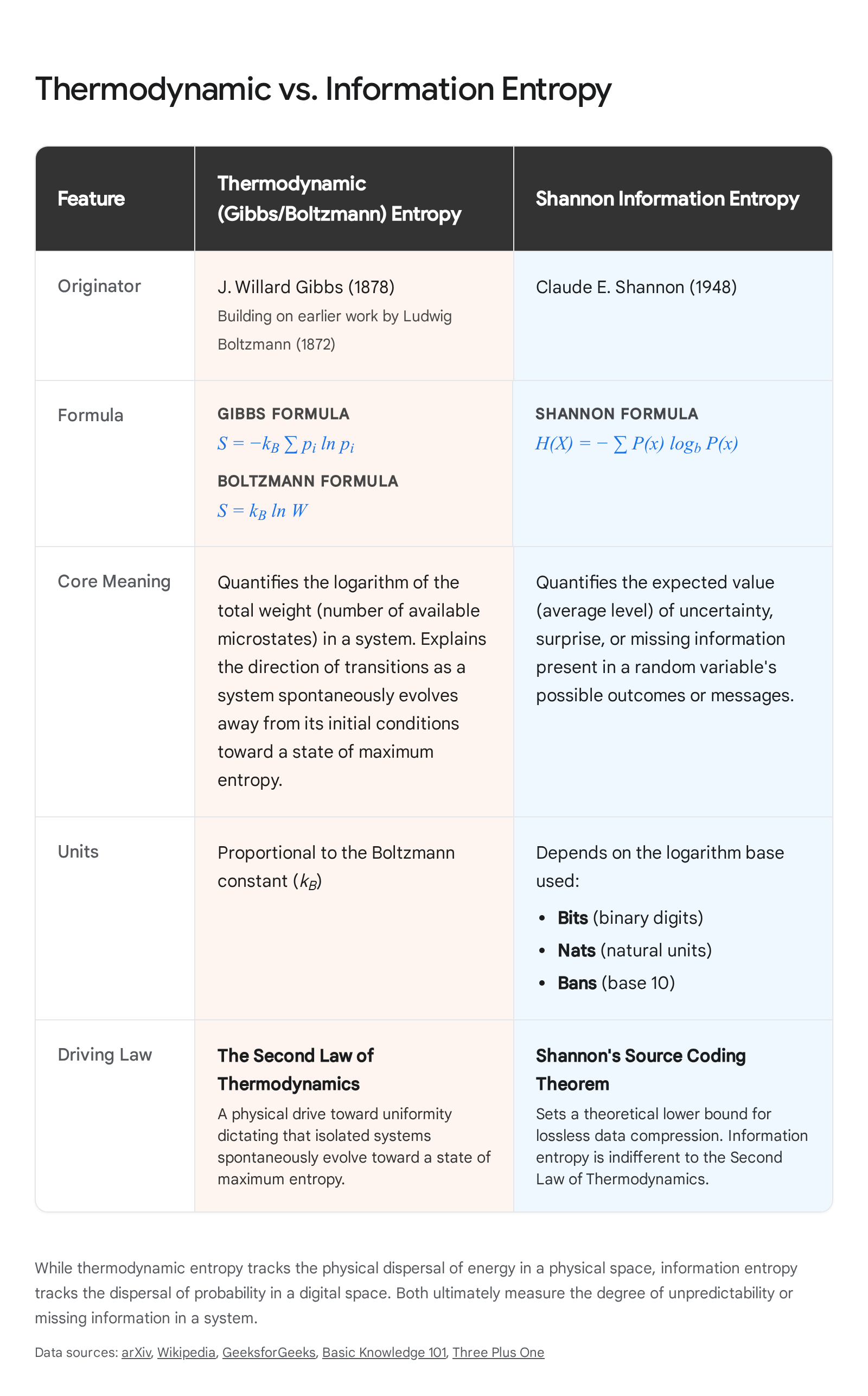
Shannon entropy relies strictly on normalized probability distributions. It requires no physical dimensions, mass, or energy, and is therefore typically measured in dimensionless units called "bits" 633. Thermodynamic entropy, conversely, requires strict physical constraints. It demands specific energy weights, temperature variables, and physical volume, and it is firmly measured in Joules per Kelvin 1733. You cannot physically use a computer's deleted digital data to boil a cup of coffee, but the underlying mathematical frameworks governing the probability of the data and the probability of the heat are virtually identical.
Today, this mathematical bridge is used constantly in advanced computer science. Modern machine learning algorithms utilize cross-entropy calculations to measure the error between a neural network's predictions and the actual training data, constantly striving to minimize the uncertainty of the model 42934.
Comparing the Domains of Entropy
To fully clarify the differing contexts in which entropy is applied, we can break it into three primary academic domains:
| Domain | Key Figure(s) | Core Definition | Primary Application |
|---|---|---|---|
| Classical Thermodynamics | Sadi Carnot, Rudolf Clausius | The ratio of heat transferred to absolute temperature ($S = Q/T$). Measures the irreversibility of physical processes. | Steam engines, refrigeration, phase changes, macroscopic heat transfer. |
| Statistical Mechanics | Ludwig Boltzmann, J. Willard Gibbs | The logarithm of the number of accessible microstates ($S = k_B \ln W$). A measure of microscopic multiplicity. | Predicting the behavior of gases, solids, and chemical reactions based on atomic motion. |
| Information Theory | Claude Shannon | The expected value of information or "surprise" in a probability distribution ($H = - \sum p \log p$). | Data compression limits, telecommunications, cryptography, and machine learning models. |
Table 1: A summary of how the concept of entropy is defined and applied across classical physics, statistical mechanics, and digital information systems. 4861729
The Arrow of Time: Why We Remember the Past but Not the Future
Perhaps the most profound philosophical consequence of the second law of thermodynamics is its inextricable relationship to the flow of time itself. In 1927, the British astrophysicist Arthur Eddington coined the evocative phrase "the Arrow of Time" to describe the stark, one-way direction of universal asymmetry 35.
If you examine the fundamental laws of physics - including Newton's laws of classical motion, Maxwell's equations for electromagnetism, and the Schrödinger equation in quantum mechanics - you will find a disturbing quirk: they are all entirely time-symmetric 11011. The mathematical equations work perfectly well whether time runs forward or backward. If you watch a video of two perfectly elastic billiard balls colliding on a frictionless table, you cannot definitively tell if the video is playing forward or in reverse; the physics of the bounce is identical in both temporal directions 1.
Yet, our macroscopic reality is brutally and obviously asymmetrical. People age, iron rusts, stars burn out, and dead bodies decay. We never see a scrambled egg spontaneously un-scramble itself, even though the fundamental equations of physics would technically allow it if every single atom's trajectory and velocity were perfectly and simultaneously reversed. The only fundamental law of physics that explicitly demands a one-way direction is the second law of thermodynamics: total isolated entropy must increase 11012.
Because there are exponentially more ways for a system to be disordered and dispersed than ordered and concentrated, the universe reliably shifts from low entropy to high entropy. This gradient - from concentrated, highly usable energy to spread-out, unusable heat - is what provides time with its physical direction. The "thermodynamic arrow" points strictly toward higher entropy 311.
The Psychological Arrow of Time
The thermodynamic arrow of time is also intimately connected to the "psychological arrow of time," which describes the fundamental human experience that we can vividly remember the past, but we cannot remember the future 351239.
At first glance, human memory seems to actively defy entropy. A memory requires the biological brain to encode specific, highly ordered synaptic connections, which locally decreases the entropy of the brain tissue 39. However, as physicists like Sean Carroll point out, the act of recording a memory, or even erasing information in a neural circuit, requires the brain to perform metabolic chemical work. This work generates waste heat. The heat dissipated by the brain's metabolism increases the entropy of the surrounding universe by a far greater amount than the local drop in entropy required to form the memory engram 1239.
More importantly, a memory is essentially a physical correlation between a current brain state and an external event that occurred in the external world. Because entropy is always increasing globally across the universe, we can only form reliable correlations, or memories, about states that occurred when the overall entropy of the universe was lower 123940. If universal entropy were constant, or if it miraculously decreased, there would be no preferred direction for information to flow. The very concept of causality - the rule that causes must precede effects - would completely break down 3512. We remember the past because it existed in a state of lower entropy, and we march blindly into the unknown future precisely as the universe's entropy relentlessly expands.
The Schrödinger Paradox: How Can Complex Life Exist?
If the universe is dictated by a ruthless, mathematical drive toward disorder, how do we explain the existence of complex biological life? A human body is a marvel of exquisite, exceptionally low-entropy organization. Trillions of specialized cells, tightly coiled DNA helices, and intricately folded proteins operate in a continuous symphony of molecular order. To a casual observer, the evolution of highly complex biology over billions of years appears to brazenly violate the second law of thermodynamics 414243.
This apparent contradiction is widely known as the Schrödinger paradox. In 1944, the Austrian physicist Erwin Schrödinger, most famous for his pioneering work in quantum mechanics, published a remarkably influential and prescient book called What is Life? 134546. Schrödinger recognized that living organisms maintain their highly ordered internal states by constantly evading the natural decay toward thermodynamic equilibrium. He posited that organisms stay alive by continually feeding on what he termed "negative entropy," or negentropy, from their external environment 134547.
The resolution to this paradox lies in a crucial, often overlooked caveat of the second law of thermodynamics: it dictates that entropy must increase only in an isolated, closed system. An isolated system is one that exchanges neither matter nor energy with the outside world 24313. Living organisms are not closed systems.
Earth Is an Open Thermodynamic System
The Earth as a whole is not a closed system. It is an open system constantly bathed in a massive influx of high-energy, low-entropy radiation from the Sun 2343.
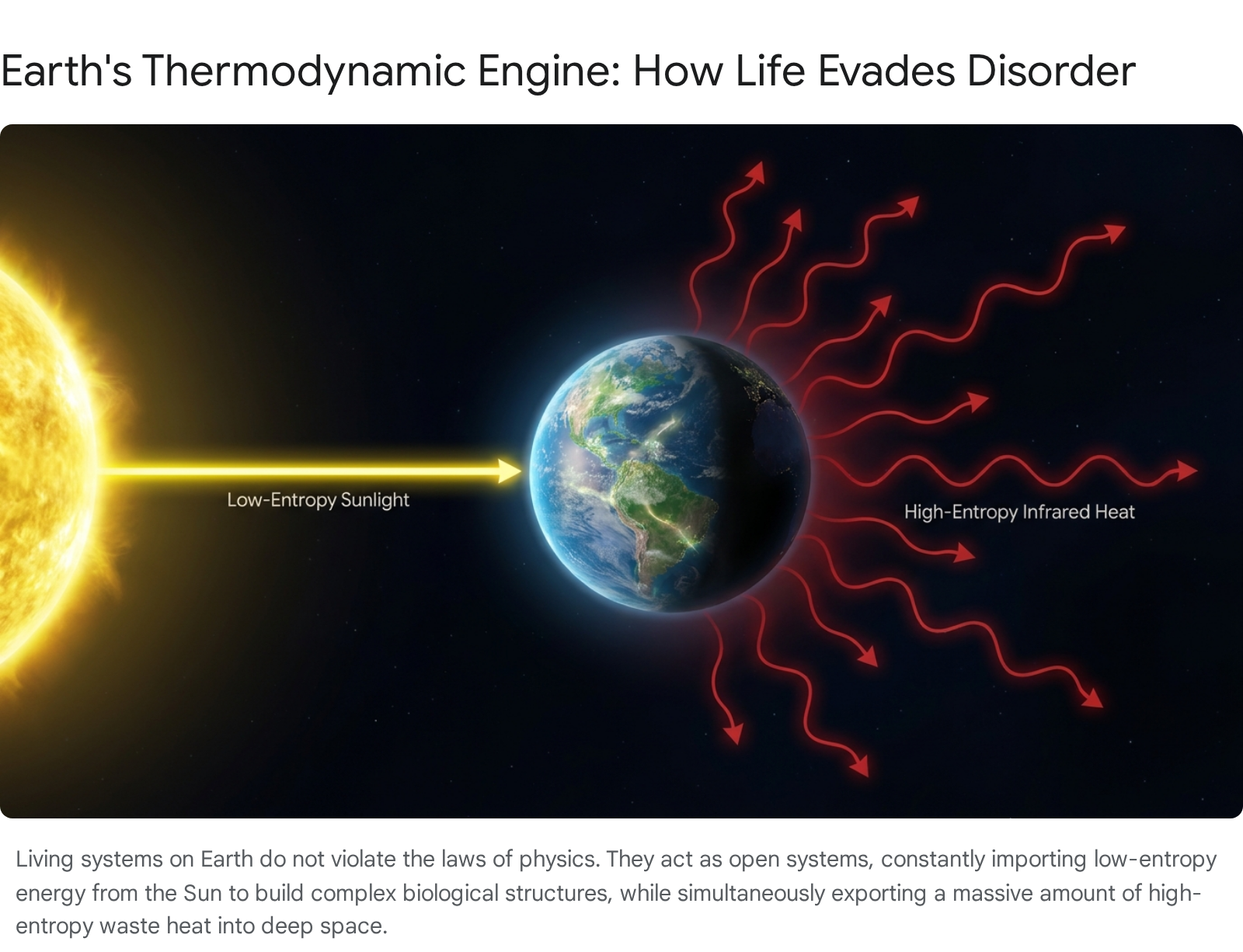
When a plant grows, it performs an extraordinary thermodynamic feat. It absorbs concentrated, highly usable, low-entropy solar photons and uses that energy to drive photosynthesis, stitching dispersed carbon dioxide and water molecules together into ordered, complex sugars. By doing so, the plant actively decreases its own local entropy 4714. However, biological life is an incredibly messy and physically inefficient process. As the plant respires, metabolizes, and eventually decays, it radiates massive amounts of waste heat back into the surrounding environment 314.
That specific waste heat consists of diffuse, long-wavelength infrared photons. The energy contained within these infrared photons is entirely disorganized, moving in random directions, and is virtually impossible to capture and reuse for biological work. If we draw a theoretical thermodynamic boundary around the entire Earth-Sun system, we find that the massive nuclear fusion reactions happening inside the core of the Sun, combined with the immense waste heat radiated by the Earth into deep space, result in a massive net increase in the total entropy of the universe 243.
Life, therefore, does not violate the second law of thermodynamics; it is merely a temporary, open pocket of localized order paid for by the relentless decay of the Sun 411347. Biological organisms are essentially cosmic accountants, borrowing structural order from the Sun and paying it back to the universe with significant interest in the form of high-entropy heat.
Dissipative Adaptation: Is Life a Direct Consequence of Entropy?
While Erwin Schrödinger successfully explained how life can exist without violating the established laws of physics, a far more radical question has emerged in modern biological physics: does the law of entropy actually drive the origin of life itself?
For decades, the origin of life on Earth was largely viewed as a fantastically improbable chemical accident, a random collision of proteins and amino acids in a primordial soup that got incredibly lucky. However, if the universe is always seeking to maximize its entropy production, simply relying on random collisions seems remarkably inefficient. In the 1970s, the Nobel laureate Ilya Prigogine pioneered the concept of "dissipative structures." Prigogine proved mathematically that thermodynamic systems driven far from equilibrium can spontaneously self-organize into complex, orderly patterns, such as the swirling eye of a hurricane or the rhythmic pulsing of certain chemical reactions. These structures emerge simply because those ordered patterns are capable of dissipating heat into the environment far faster than chaotic, unorganized states 4549.
In 2013, MIT physicist Jeremy England expanded significantly on Prigogine's foundational work, proposing a highly provocative theory known as dissipative adaptation 451450.
England's sophisticated mathematical models suggest that when a group of simple, disordered atoms is constantly driven by a powerful external energy source, such as persistent sunlight, and surrounded by a thermal bath, such as a primordial ocean, the atoms will gradually and inevitably restructure themselves. They will naturally reorganize into complex configurations that are fundamentally better at absorbing that input energy and dissipating it as heat 1451.
According to this theoretical framework, the emergence of life is not a miraculous accident; it is an inevitable thermodynamic consequence of matter trying to obey the second law as efficiently as physically possible 4551. A living biological cell is fundamentally an "entropy producing machine" 46. A leafy plant is astronomically better at capturing sunlight, utilizing it for chemical work, and radiating it away as degraded heat than a bare, lifeless rock 1452.
England's work suggests that biological Darwinism, the survival of the fittest, might simply be a special, highly complex case of a more fundamental physical law: the survival of the most entropic 5354. As England famously summarized his view: "You start with a random clump of atoms, and if you shine light on it for long enough, it should not be so surprising that you get a plant" 515556.
While this sweeping theory remains heavily debated in the scientific community - with critics arguing that raw thermodynamics alone cannot fully account for the highly specific, intricately coded information machinery required for DNA replication 5256 - it represents a profound paradigm shift in how we view biology. It suggests that life is not stubbornly fighting against the entropic current of the universe, but rather riding the vanguard of the wave, actively helping the cosmos reach its high-entropy destiny faster 54.
The Ultimate Fate: The Heat Death of the Universe
If the second law of thermodynamics holds true indefinitely, what does it mean for the ultimate, long-term fate of the universe?
Currently, our universe is in an active, intermediate state. The Big Bang provided a cosmos with incredibly low initial entropy, existing as a tightly compressed, uniform, and extraordinarily hot state. Over the last 13.8 billion years, gravity has clumped matter together to form blazing stars and swirling galaxies, creating localized pockets of intense order while vast amounts of energy are radiated out into the expanding void 335.
However, stars possess a strictly finite amount of nuclear fuel. Eventually, trillions of years from now, the very last stars will burn out and go cold, leaving behind a dark universe of black dwarfs and neutron stars. Over unimaginable timescales, even massive black holes will slowly evaporate away via Hawking radiation. All complex matter will decay, and all thermal gradients across the cosmos will flatten out. The universe will eventually reach a state of maximum entropy, known in physics as true thermodynamic equilibrium.
In this final state, all energy will be perfectly and evenly spread out across the infinite expanse of space. There will be no hot spots, no cold spots, and absolutely no usable energy left to perform any thermodynamic work. Without the flow of energy from a hot reservoir to a cold reservoir, no physical processes can occur. Information cannot be processed, thoughts cannot be thought, and biological life cannot exist. This unimaginably bleak, static scenario is known as the "Heat Death" of the universe 34555.
The very law of nature that makes biological life, human memory, and the forward march of time possible is the exact same law that mathematically guarantees their eventual, permanent extinction.
Bottom line
Entropy is a quantifiable measure of how energy spreads out and disperses among the available microscopic configurations of a physical system. Disorder inevitably increases across the universe simply because there are astronomically more ways for a system's energy and matter to be thoroughly mixed than mathematically sorted. While complex local structures like human biology appear to resist this relentless decay, life relies on a continuous input of solar energy to maintain itself, acting as a highly efficient thermodynamic machine that ultimately accelerates the total entropy of the cosmos.