
Introduction to Random Matrix Theory
Historical Origins and Physical Foundations
Nuclear Physics and Wigner Matrices
The mathematical architecture of random matrix theory (RMT) was formulated in the 1950s as a pragmatic solution to an intractable problem in quantum mechanics. Experimental physicists studying the scattering of slow neutrons by heavy atomic nuclei, such as Uranium-238, observed highly complex series of resonance peaks corresponding to the energy levels of the nucleus 123. Constructing a deterministic Hamiltonian to calculate these energy states from first principles was impossible; the nucleus constitutes a strongly interacting many-body quantum system with hundreds of protons and neutrons, resulting in millions of coupled equations and degrees of freedom 14.
Faced with this computational impossibility, Eugene Wigner introduced a radical statistical hypothesis: rather than attempting to determine the exact matrix elements of the microscopic Hamiltonian, the system could be modeled using a large matrix whose entries were populated by independent, identically distributed (i.i.d.) random variables 14. Wigner reasoned that in systems with sufficient complexity, the exact nature of individual microscopic interactions is washed out. The macroscopic statistical properties of the energy spectrum are instead determined entirely by the global symmetries of the system 12.
This paradigm shift meant that the spectrum of a random matrix - provided it respects the underlying physical constraints - will asymptotically reproduce the spectral fluctuation statistics of the heavy nucleus. Wigner's hypothesis established the foundational concept of universality in random matrix theory, suggesting that the macroscopic behavior of large matrices is remarkably insensitive to the precise probability distributions of their individual entries 1.
The Threefold Way and Algebraic Symmetries
In 1962, Freeman Dyson formalized Wigner's heuristic approach by systematically classifying quantum systems according to their fundamental symmetries. Dyson demonstrated that the allowable symmetry classes correspond strictly to the behavior of the quantum Hamiltonian under time-reversal invariance and the presence or absence of spin-orbit interactions 567. Because quantum mechanics relies on Hilbert spaces over division algebras, Dyson proved that only three associative division algebras over the real numbers - the real numbers ($\mathbb{R}$), the complex numbers ($\mathbb{C}$), and the quaternions ($\mathbb{H}$) - can construct valid unitary evolution 8.
This classification, known universally as Dyson's Threefold Way, defined three canonical Gaussian ensembles. The fundamental parameter differentiating these ensembles is the Dyson index, denoted by $\beta$, which counts the number of independent real components in each off-diagonal matrix element and dictates the strength of repulsion between eigenvalues 910.
| Ensemble Name | Abbreviation | Matrix Elements | Time-Reversal Symmetry | Dyson Index ($\beta$) | Physical Application |
|---|---|---|---|---|---|
| Gaussian Orthogonal | GOE | Real | Unbroken (Spinless) | 1 | Systems with strict time-reversal symmetry |
| Gaussian Unitary | GUE | Complex | Broken | 2 | Systems subjected to external magnetic fields |
| Gaussian Symplectic | GSE | Quaternionic | Unbroken (Spinful) | 4 | Systems with strong spin-orbit coupling |
In this framework, any system that breaks time-reversal symmetry (such as an electron in a magnetic field) corresponds to the Gaussian Unitary Ensemble (GUE), where matrices are complex Hermitian 1112. If the system maintains time-reversal symmetry and the time-reversal operator squares to $+1$, it aligns with the Gaussian Orthogonal Ensemble (GOE). If the system includes half-integer spin fermions where the time-reversal operator squares to $-1$, it is described by the Gaussian Symplectic Ensemble (GSE), which forces a phenomenon known as Kramers degeneracy, wherein every exact energy level is twofold degenerate 1112.
Extended Classifications and Non-Hermitian Algebras
While the Threefold Way effectively describes closed, fundamental quantum systems, modern theoretical physics necessitated an expansion of this taxonomy. Decades later, Altland and Zirnbauer identified additional symmetries - specifically particle-hole symmetry and chiral (sublattice) symmetry - expanding Dyson's classification into the Tenfold Way 1112. This framework proved critical for understanding the spectral properties of superconducting Bogoliubov-de Gennes Hamiltonians and topological insulators 12.
More recently, research has focused on open, dissipative quantum systems where energy is not conserved, requiring the relaxation of the Hermiticity constraint. When matrices are non-Hermitian, their eigenvalues are no longer confined to the real line but scatter throughout the complex plane 31314. In non-Hermitian random matrix theory, the mathematical distinctions between complex conjugation and matrix transposition create further bifurcations in symmetry. Recent work by Kawabata, Ueda, and others has generalized the classification to 38 distinct non-Hermitian symmetry classes 613. These frameworks govern phenomena ranging from dissipative quantum chaos to non-Hermitian Anderson localization transitions 614.
The Coulomb Gas Analogy and Thermodynamics
Joint Eigenvalue Distributions
A profound mathematical equivalence exists between the eigenvalues of a random matrix and the statistical mechanics of a thermodynamic gas. For the classical Gaussian ensembles, the joint probability density function of the $N$ real eigenvalues $\lambda_1, \dots, \lambda_N$ is derived by integrating out the eigenvector degrees of freedom. This change of variables introduces a Jacobian determinant, widely known as the Vandermonde determinant 815.
The resulting exact joint probability density is proportional to: $P(\lambda_1, \dots, \lambda_N) \propto \exp\left(-\frac{\beta}{2} \sum_{i=1}^N \lambda_i^2\right) \prod_{1 \le i < j \le N} |\lambda_i - \lambda_j|^\beta$
By expressing the product of eigenvalue differences as an exponential sum of logarithms, the probability density function mirrors the Boltzmann weight $P \propto \exp(-\beta E)$ of a system in canonical equilibrium 151415.
Electrostatic Interactions and Potential Theory
The Hamiltonian energy functional $E$ of this analogous physical system is defined as: $E(\lambda_1, \dots, \lambda_N) = \frac{1}{2} \sum_{i=1}^N \lambda_i^2 - \sum_{i<j} \ln|\lambda_i - \lambda_j|$
In this formulation, recognized as Dyson's Coulomb Gas, the eigenvalues $\lambda_i$ behave as identically charged, fictitious point particles confined to a one-dimensional line 151416. The quadratic term represents a global harmonic confining potential that pushes the charges toward the origin. Conversely, the term $-\ln|\lambda_i - \lambda_j|$ represents a pairwise, two-dimensional Coulombic electrostatic repulsion that strictly prevents any two particles from occupying the identical position 141516.
The Dyson index $\beta$ functions mathematically as the inverse temperature of the gas 915. At high temperatures ($\beta \to 0$), the thermal fluctuations overwhelm the repulsion, and the eigenvalues approximate uncorrelated Poisson points. As $\beta$ increases, the system cools, the electrostatic repulsion dominates, and the eigenvalues crystallize into highly correlated configurations 1515.
| Mathematical Concept (RMT) | Physical Equivalent (Thermodynamics) |
|---|---|
| Eigenvalues ($\lambda_i$) | Position of charged particles |
| Matrix entry distribution | External confining potential $V(x)$ |
| Vandermonde Determinant | Two-dimensional Coulombic repulsion |
| Dyson Index ($\beta$) | Inverse temperature ($1/k_B T$) |
| Asymptotic Limit ($N \to \infty$) | Macroscopic thermodynamic equilibrium |
Phase Transitions in Constrained Log Gases
The electrostatic formulation allows RMT to be analyzed using the rigorous tools of potential theory and statistical mechanics. In the thermodynamic limit ($N \to \infty$), the empirical measure of the discrete eigenvalues converges almost surely to a continuous equilibrium charge density that minimizes the macroscopic free energy functional 15.
When artificial constraints are introduced into this system, the random matrix ensemble undergoes genuine thermodynamic phase transitions. If a "hard wall" constraint limits the available spatial volume of the gas, forcing the eigenvalues away from their natural equilibrium radius, the system experiences a third-order phase transition 15. This transition separates a "pulled" phase, where the boundary constraint is located outside the natural support of the gas and has no effect, from a "pushed" phase, where the boundary actively compresses the gas. In the pushed phase, the density of eigenvalues builds up macroscopically at the constrained edge, resulting in a non-analytic jump in the third derivative of the free energy 15. Such models highlight that phenomena typically associated with condensed matter physics exist intrinsically within the spectral algebraic structure of large matrices 1517.
Global Spectral Statistics and Macroscopic Limits
The Wigner Semicircle Law
The global regime of random matrix theory concerns the limiting density of states - the macroscopic distribution of the entire spectrum as the matrix dimension $N$ approaches infinity. For matrices belonging to the GOE, GUE, or GSE, as well as general symmetric matrices with independent entries of zero mean and variance $\sigma^2$, the empirical spectral distribution converges almost surely to the Wigner Semicircle Law 118.
When the eigenvalues are properly scaled by $1/\sqrt{N}$, the limiting probability density function $\mu_{sc}(x)$ forms a perfect semi-ellipse: $\mu_{sc}(dx) = \frac{1}{2\pi \sigma^2} \sqrt{4\sigma^2 - x^2} \mathbf{1}_{|x| \le 2\sigma} dx$
This convergence demonstrates the remarkable principle of macroscopic universality 1. The particular shape of the probability distribution from which the individual matrix elements are drawn - whether Gaussian, uniform, or discrete Bernoulli variables - becomes entirely irrelevant in the $N \to \infty$ limit 1. The semicircle limit is proven using the method of moments; researchers showed that the expected value of the trace of the $k$-th power of the matrix evaluates topologically to the enumeration of non-crossing partitions, directly generating the Catalan numbers, which uniquely define the moments of the semicircle distribution 12.
The Marchenko-Pastur Law
While Wigner matrices model self-adjoint operators representing Hamiltonians, a second fundamental class of matrices dominates multivariate statistics, data science, and signal processing. When dealing with arrays of noisy data, analysts rely on sample covariance matrices of the form $S = \frac{1}{n} Y Y^T$, where $Y$ is a $p \times n$ matrix whose entries are independent random noise 219.
In the asymptotic limit where the number of features $p$ and the number of observations $n$ both grow toward infinity such that their ratio converges to a constant aspect ratio $\lambda = p/n$, the eigenvalues of $S$ converge to the Marchenko-Pastur distribution 219. The continuous portion of the probability density function is given by: $f(x) = \frac{1}{2\pi \sigma^2 \lambda x} \sqrt{(\lambda_+ - x)(x - \lambda_-)}$
The support of the distribution is strictly bounded between the edges $\lambda_\pm = \sigma^2(1 \pm \sqrt{\lambda})^2$ 19. In scenarios where $p > n$ ($\lambda > 1$), an additional discrete point mass containing $1 - 1/\lambda$ of the probability forms exactly at zero, reflecting the rank deficiency of the matrix 1819.
The Marchenko-Pastur limit provides an essential mathematical filter for separating signal from noise in empirical datasets. In the analysis of financial correlation matrices or wireless communication channels, empirical eigenvalues that fall within the Marchenko-Pastur bounds $[\lambda_-, \lambda_+]$ are mathematically indistinguishable from random noise 19. Only eigenvalues that significantly breach the upper boundary $\lambda_+$ can be classified as containing genuine, statistically significant information 19.
Free Probability Theory
The macroscopic limits of random matrices are deeply intertwined with Free Probability Theory, a branch of operator algebra developed by Dan Voiculescu. Free probability extends classical probability to non-commutative variables (where $AB \neq BA$), utilizing "freeness" as the non-commutative analog of statistical independence 2021.
As the dimension $N$ tends to infinity, independent random matrices become asymptotically free 21. This property implies that the global spectral distribution of the sum or product of two large independent random matrices can be calculated entirely from their individual limiting distributions, without requiring knowledge of their joint eigenvector alignments 2022. Alice Guionnet and her collaborators have extensively utilized these frameworks to construct free transport mappings and to study the non-commutative entropy of large interacting particle systems, firmly establishing the rigorous convergence of multi-matrix models via topological expansions and Dyson-Schwinger equations 2225.
Local Spectral Statistics and Microscopic Limits
Level Repulsion and Bulk Spacings
While global laws dictate the overall shape of the spectrum, the local microscopic regime explores the specific probability distributions of the gaps between adjacent eigenvalues 120. If a matrix has purely uncorrelated random entries on its diagonal (essentially representing an integrable quantum system), the eigenvalues act independently, and the spacings follow a Poisson distribution 2327. In a Poisson distribution, the highest probability density occurs at a spacing of zero, meaning energy levels frequently cross and cluster 23.
However, random matrices in the Wigner-Dyson classes exhibit severe level repulsion due to the Vandermonde determinant ($\prod|\lambda_i - \lambda_j|^\beta$). The probability of finding two eigenvalues infinitely close together drops strictly to zero 2023. In the bulk of the spectrum, the nearest-neighbor gap distribution is highly accurately described by the Wigner surmise. For the GOE ($\beta=1$), the gap probability $P(s)$ scales linearly as $s \exp(-\frac{\pi}{4} s^2)$. For the GUE ($\beta=2$), it scales quadratically as $s^2 \exp(-\frac{4}{\pi} s^2)$ 1523. The exact analytical limits for these bulk correlations rely on determinantal point processes, where multi-point correlations are governed by the universal Sine Kernel 20.
Edge Fluctuations and the Tracy-Widom Law
At the extreme boundaries of the spectrum, the scaling and statistical behavior change completely. The position of the largest eigenvalue (the spectral edge) does not remain fixed at the $2\sigma$ boundary predicted by the semicircle law; it exhibits highly localized, asymmetrical fluctuations. The distribution of this largest eigenvalue, appropriately scaled, converges to the Tracy-Widom distribution 11824.
The Tracy-Widom law for the GUE defines the limit: $F_2(s) = \lim_{N \to \infty} P\left( (\lambda_{max} - 2\sqrt{N}) N^{1/6} \le s \right)$ where the fluctuations scale precisely at the rate $O(N^{-1/6})$ 18. Unlike classical limit theorems that yield Gaussian functions, the Tracy-Widom distribution lacks a closed-form elementary formula and is instead defined by the solution to a non-linear Painlevé II differential equation 124. Recent advancements have established stringent, optimal bounds on this convergence rate, proving that fluctuations for generalized Wigner matrices converge at a rate of $O(N^{-1/3+\omega})$ 25.
| Distribution | Spectral Region | Mathematical Function / Limit | Decay Tail Characteristic |
|---|---|---|---|
| Wigner Semicircle | Global Bulk | $\sqrt{4\sigma^2 - x^2}$ | Hard boundary (finite support) |
| Marchenko-Pastur | Global Bulk (Rectangular) | $\sqrt{(\lambda_+ - x)(x - \lambda_-)} / x$ | Hard boundary (asymmetric support) |
| Sine Kernel / Wigner Surmise | Local Bulk (Spacings) | $s^\beta \exp(-c s^2)$ | Gaussian decay of gap probability |
| Tracy-Widom | Local Edge (Extremes) | Painlevé II solution | Asymmetric non-Gaussian tails |
The significance of the Tracy-Widom law extends far beyond linear algebra.
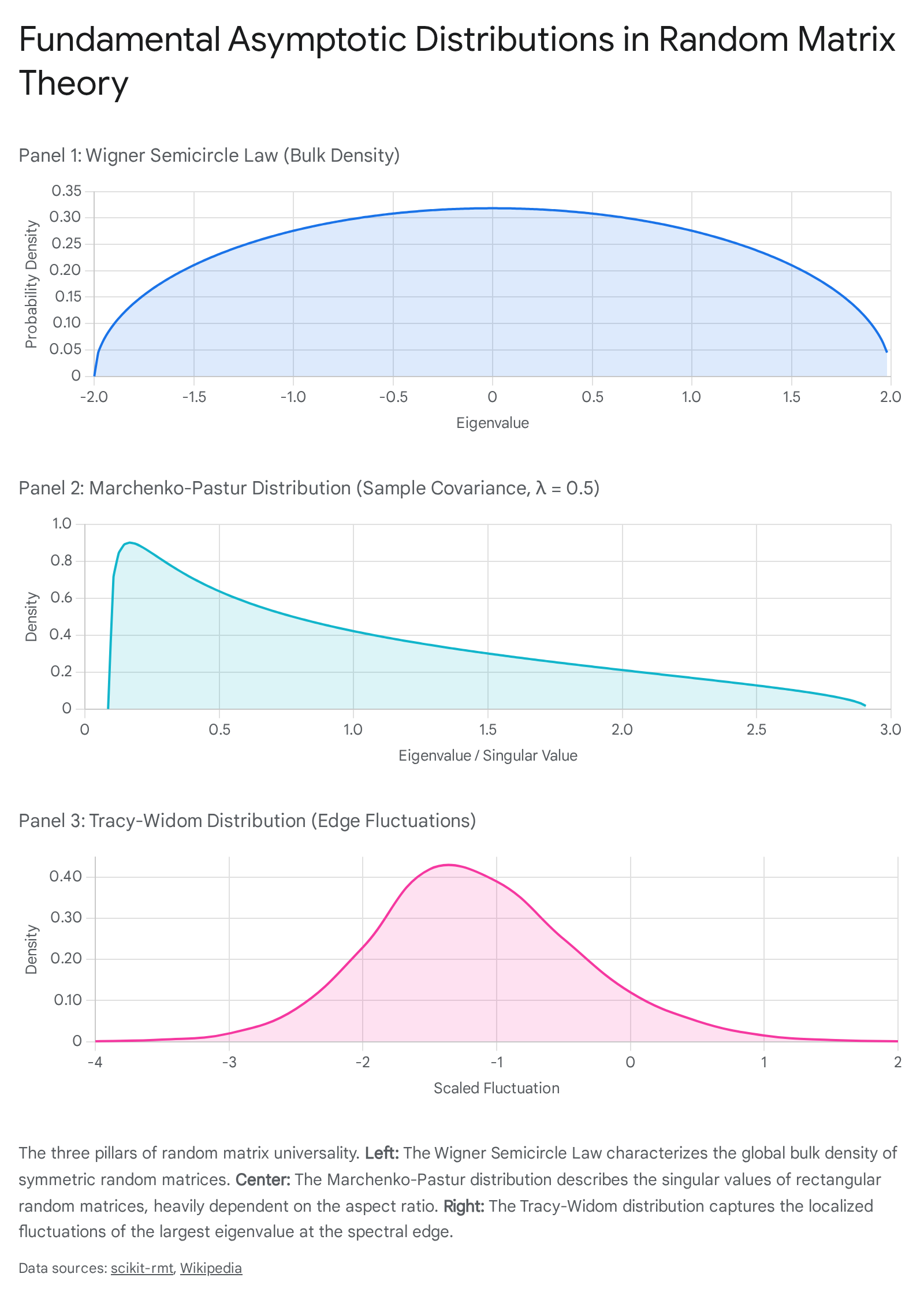
It has been identified as a universal scaling limit in diverse, complex systems. It describes the fluctuations of the longest increasing subsequence of random permutations, the maximum height interfaces of growing surfaces in the Kardar-Parisi-Zhang (KPZ) universality class, and optimal alignment scores in computational biology 2426. This ubiquity elevates Tracy-Widom to a status comparable to the standard normal distribution in probability theory 2631.
Connections to Number Theory
Prime Numbers and the Riemann Zeta Function
One of the most profound and unexpected manifestations of random matrix universality occurs in the realm of pure mathematics: the distribution of prime numbers. The connection stems from the Riemann Zeta function, $\zeta(s)$, whose non-trivial zeros dictate the distribution of primes along the number line 21.
In the 1970s, mathematician Hugh Montgomery was investigating the pair correlation - the statistical spacing between pairs - of the highly elevated non-trivial zeros of the zeta function 21. During a now-legendary tea-time conversation at the Institute for Advanced Study, Montgomery shared his derived Fourier transform of the pair correlation with Freeman Dyson. Dyson immediately recognized the mathematical expression: it was identical to the pair correlation function of the eigenvalues of the Gaussian Unitary Ensemble (GUE) 2123.
This realization birthed the Montgomery-Odlyzko law, which posits that the statistical distribution of the gaps between the zeros of the Riemann Zeta function exactly mimics the level repulsion of complex Hermitian random matrices (GUE). As the zeros climb higher on the critical line, their local spacing statistics perfectly trace the Sine Kernel derived from random matrix theory 21. The implications suggest that the prime numbers, despite being deterministic, exhibit the signature of a deeply concealed quantum chaotic system lacking time-reversal symmetry.
The Keating-Snaith Conjecture
The RMT connection to number theory was further solidified by the Keating-Snaith conjecture. While Montgomery analyzed the zeros, Jon Keating and Nina Snaith applied random matrix theory to understand the value distribution of the zeta function itself. By modeling the Riemann Zeta function at height $T$ along the critical line as the characteristic polynomial of a large $N \times N$ random unitary matrix (where $N \approx \ln(T/2\pi)$), they accurately predicted the asymptotic behavior of the function's higher moments 1321.
The success of the Keating-Snaith formulas verified that random matrix theory can generate deep structural predictions about number-theoretic objects that escape traditional analytical techniques. Currently, RMT supplies the most accurate predictive frameworks for the behavior of L-functions and characteristic polynomials in analytic number theory 13.
Quantum Chaos and Late-Time Dynamics
The Bohigas-Giannoni-Schmit Conjecture
The linkage between classical chaos and quantum mechanics represents another profound application of random matrix theory. A classically integrable system, such as a harmonic oscillator or a particle in a completely symmetrical box, yields a quantum spectrum where energy levels are uncorrelated. Governed by the Berry-Tabor conjecture, the local level spacings of integrable quantum systems follow a Poisson distribution 2327.
However, when the classical equivalent of a quantum system is chaotic - meaning its classical trajectories exhibit extreme sensitivity to initial conditions and ergodic phase-space exploration - the quantum mechanics alter drastically. The Bohigas-Giannoni-Schmit (BGS) conjecture formalizes this: the local spectral statistics of any quantum system with a chaotic classical limit are universally described by random matrix theory 42728.
The implication is staggering: the mere presence of classical chaos guarantees that the quantum eigenvalues will exhibit Wigner-Dyson level repulsion, irrespective of the specific Hamiltonian interactions 429. While a complete, rigorous proof of the BGS conjecture remains evasive, it has been corroborated extensively through the non-linear $\sigma$-model, semiclassical Gutzwiller trace formulas, and experiments in microwave billiards 427.
The Spectral Form Factor and Holographic Gravity
Modern investigations into quantum chaos rely heavily on dynamic probes, predominantly the Spectral Form Factor (SFF). The SFF, defined as the Fourier transform of the two-point eigenvalue correlation function, tracks the survival probability and late-time thermodynamic relaxation of chaotic quantum systems 42327.
For systems governed by random matrix universality, the SFF reliably traces a specific "dip-ramp-plateau" architecture over time 2327. The initial non-universal decay ("dip") is followed by a linear, universal "ramp" strictly driven by the long-range level repulsion of the eigenvalues. Eventually, at exponentially long times (the Heisenberg time), the function stabilizes into a constant "plateau" 2327.
This specific random matrix signature has recently catalyzed breakthroughs in quantum gravity and holography. The Sachdev-Ye-Kitaev (SYK) model, a highly entangled theoretical quantum system featuring random many-body interactions, possesses exact RMT bulk statistics 1228. Furthermore, calculations of the gravitational path integral in holographic string theory models have revealed specific topological configurations - such as "wormholes" or "double-cone" geometries - that perfectly encode the spectral ramp of the SFF 27. Consequently, RMT serves as the central mathematical justification for the modern theoretical assertion that black holes behave as maximally chaotic, thermalized quantum systems 27.
Generalizations and Continuous Ensembles
Tridiagonal Matrix Models and Continuous Beta
Historically, analytical studies of random matrices were heavily restricted to the quantized, integer parameters $\beta=1, 2,$ and $4$, mandated by the algebraic properties of real, complex, and quaternion matrices 72435. Researchers sought to generalize the underlying probability density functions to an arbitrary continuous parameter $\beta > 0$ to study phenomena like the low-temperature crystallization of the Coulomb gas 2435.
This continuity was rigorously achieved through the construction of tridiagonal $\beta$-ensembles by Dumitriu and Edelman. By abandoning the requirement that the matrix ensemble remain fully invariant under unitary or orthogonal group transformations, they constructed sparse, real tridiagonal matrices that replicate the precise eigenvalue statistics of the classical ensembles when $\beta = 1, 2, 4$, but allow smooth interpolation to any positive real value 72435. These models permit the study of Tracy-Widom limit behavior and global semicircle limits across continuous statistical mechanics temperatures 2435. Further expansions removing the Hermitian condition entirely from these tridiagonal frameworks have generated pseudo-Hermitian ensembles, which double the effective non-diagonal variables but asymptotically retain real eigenvalue statistics mapping to a doubled Dyson index 10.
Ginibre Ensembles and Complex Spectra
When the constraint of Hermiticity is completely dropped, the eigenvalues leave the real line and populate the complex plane 31314. The Ginibre ensembles (GinUE, GinOE, GinSE) correspond to random matrices whose elements are drawn independently without the symmetry reflection $A_{ij} = \bar{A}_{ji}$ 613.
For the Ginibre Unitary Ensemble (GinUE), the empirical spectral measure converges to the Circular Law. As the dimension $N \to \infty$, the complex eigenvalues are uniformly distributed within a dense disc in the complex plane 3. Complex random matrices are critical for modeling dissipative systems where quantum states decay, such as open quantum systems or directed neural networks 614. The local statistics in these complex ensembles display distinct repulsion behaviors compared to their real counterparts, often characterized by cubic repulsion at small spacings, further enriching the universality classes 14.
Applications in Machine Learning and Deep Neural Networks
Hessian Spectral Density and Loss Landscapes
The massive analytical apparatus of random matrix theory has recently been deployed to decipher the training dynamics and generalization capabilities of overparameterized artificial intelligence models 303738. In deep neural networks, the geometric curvature of the high-dimensional loss landscape dictates whether stochastic gradient descent discovers generalizable solutions or stagnates in local minima 3031. This curvature is mathematically encoded in the Hessian matrix - the vast matrix of second-order partial derivatives of the loss function with respect to the network's millions of parameters 304032.
By analyzing the Hessian as a generalized random matrix, researchers track the Hessian Eigenvalue Spectral Density (HESD) throughout the training process 3032. RMT proves that the Hessian of heavily trained deep networks organizes into a near-block-diagonal structure characterized by two distinct spectral components: a massive "bulk" of eigenvalues located extremely close to zero, and a much smaller subset of distinct "outlier" eigenvalues 323343.
The near-zero bulk represents vast, flat subspaces in the loss landscape where parameters can be adjusted with almost zero impact on the network's output 4033. The large positive outliers represent the directions of high curvature corresponding to the distinct semantic features or classes the model has successfully learned 3133. Understanding this block-diagonal emergence elucidates why specific optimizers, such as Adam or Q-Newton hybrid solvers, are successful: they implicitly exploit this structural sparsity and spectral conditioning as training progresses 3244.
Model Capacity Bottlenecks in LLMs
For frontier architectures, such as Large Language Models (LLMs), random matrix theory provides critical diagnostics in the proportional scaling regime - where data dimension, sample size, and network parameters scale equivalently 3738. Classical low-dimensional statistical intuitions collapse in this regime, necessitating the use of RMT High-Dimensional Equivalents (HDEs) to calculate nonlinear learning dynamics 3738.
A highly consequential 2025 finding utilized RMT to analyze Multi-head Latent Attention (MLA), a compression mechanism heavily utilized in massive LLMs to reduce key/value cache inference latency 45. The RMT spectral analysis revealed that latent compression can induce severe internal capacity bottlenecks resulting in "rank collapse." In specific layers, the architecture exhibits sharp, propagating spectral spikes where outlier directions aggressively overwhelm the bulk dimensions, disrupting the model's expressivity and concentrating learning into dangerously narrow subspaces 45.
| Model Characteristic | RMT Spectral Indicator | Practical AI Implication |
|---|---|---|
| Flat Minima / Overparameterization | Massive density of near-zero "bulk" eigenvalues | Excellent generalization capability; robust to noise 4043 |
| Feature Extraction | Emergence of distinct positive "outlier" eigenvalues | Identifies the number of distinct semantic classes learned 3233 |
| Capacity Bottlenecks (MLA) | Sharp spectral spikes and rank collapse in specific layers | Compression restricts representational capacity; requires decoupled rotary embeddings 45 |
| Generalization Predictor (LLMs) | Power-law distribution structure within the Hessian spectra | Better correlation to LLM generalization than standard sharpness metrics 43 |
Furthermore, empirical studies report a consistently overlooked power-law structure in the Hessian spectra of well-trained LLMs 43. This RMT power-law signature provides a novel, maximum-entropy theoretical framework that functions as a highly accurate generalization predictor during training, outperforming conventional CNN-based sharpness measures when applied to large language models 43.
Universality Proofs and Mathematical Frontiers
Meta-Theorems and Green's Function Methods
Rigorous demonstrations of random matrix universality present severe mathematical difficulties. For specific invariant ensembles (like the GUE), researchers calculate exact joint distributions using orthogonal polynomial methods or solvable integral equations 3435. However, these exact algebraic methods instantly fail when analyzing generalized Wigner matrices or sparse random graphs that lack underlying rotational symmetries 2648.
To bridge this mathematical gap, probabilists have engineered sophisticated "meta-theorems" for universality - frameworks heavily advanced by researchers such as Deift, Tao, Vu, Erdős, and Yau 264936. Rather than deriving explicit solutions, these approaches use perturbation theory, Lindeberg exchange principles, and continuous Dyson Brownian motion to establish that as long as the first few moments (typically up to the fourth moment) of a generalized matrix entry's distribution match those of a strictly invariant ensemble, their local spectral statistics are asymptotically identical 212631. Utilizing Green's function comparison theorems and multi-level discrete loop equations, these meta-theorems rigorously prove that the microscopic correlations (the Tracy-Widom edges and Sine Kernel gaps) completely decouple from the macroscopic distributions of the individual matrix elements 252636.
Large Deviations and Rare Events
While bulk universality relies on expected behaviors governed by Central Limit Theorems, exploring the extreme boundaries of random matrix systems requires evaluating highly improbable rare events, formalizing the domain of Large Deviations Theory (LDT) 152137.
A Large Deviation Principle seeks to quantify the exponential decay rate of the probabilities of extremely rare macroscopic events, such as the probability that the empirical density of eigenvalues vastly deviates from the deterministic Wigner Semicircle Law, or the probability that the largest eigenvalue is pushed far outside its normal Tracy-Widom bounds 162125. Using the Coulomb gas analogy, the rate function governing the large deviations of the empirical measure corresponds exactly to the energetic cost of displacing the gas from its minimum energy configuration 1516. Formally, the probability of the rare event scales as $\exp(-N^2 \inf I)$, where the $N^2$ scaling arises because the displacement forces the system to overcome the pairwise repulsion between roughly $N^2$ pairs of particles 1516.
Led by mathematicians such as Alice Guionnet, the application of large deviations principles has aggressively expanded into non-commutative entropy, spherical integrals, and discrete beta-ensembles 212537. These frameworks now assess the bounds of universality itself, determining precisely when the meta-theorems collapse. The exact mapping of the Coulomb gas fails universally if the confining potential is defined by specific transcendental functions that escape orthogonal polynomial definitions . Similarly, the extrapolation of the BGS conjecture to models lacking standard physical $k$-locality proves that random matrix universality, while vast, is constrained by topological and interactive criteria that define the outer boundaries of stochastic tractability 2838.