
What Is Dark Matter and Why Is the Universe Mostly Invisible
Dark matter is a hypothetical, invisible substance that does not interact with light but makes up approximately 85 percent of all the physical mass in the universe. Physicists are overwhelmingly convinced of its existence because of the profound gravitational pull it exerts on the visible cosmos, acting as the fundamental cosmic glue that keeps rapidly spinning galaxies from flying apart. Without this unseen scaffolding, the universe as we know it - including our own Milky Way - could never have formed.
The Cosmic Pie: What Is the Universe Made Of?
Everything you have ever seen, touched, or interacted with - every star, planet, tree, and human being - represents only a tiny fraction of what actually exists in the cosmos. When cosmologists look out into the night sky, they are forced to confront the reality that the vast majority of the universe is entirely missing from our visual spectrum.
According to the standard model of cosmology, known as the Lambda-CDM model, the mass-energy content of the universe is divided into three distinct components 12. Ordinary matter, also known as baryonic matter, consists of the protons, neutrons, and electrons that make up atoms. Astonishingly, this ordinary matter accounts for only about 5 percent of the universe 23.
The remaining 95 percent belongs to the "dark sector." Dark matter makes up approximately 27 percent of the total mass-energy budget of the universe, or about 85 percent of all its actual, physical mass 23. The final 68 percent is dark energy, an entirely different phenomenon that acts as a repulsive force driving the accelerated expansion of the universe 24.
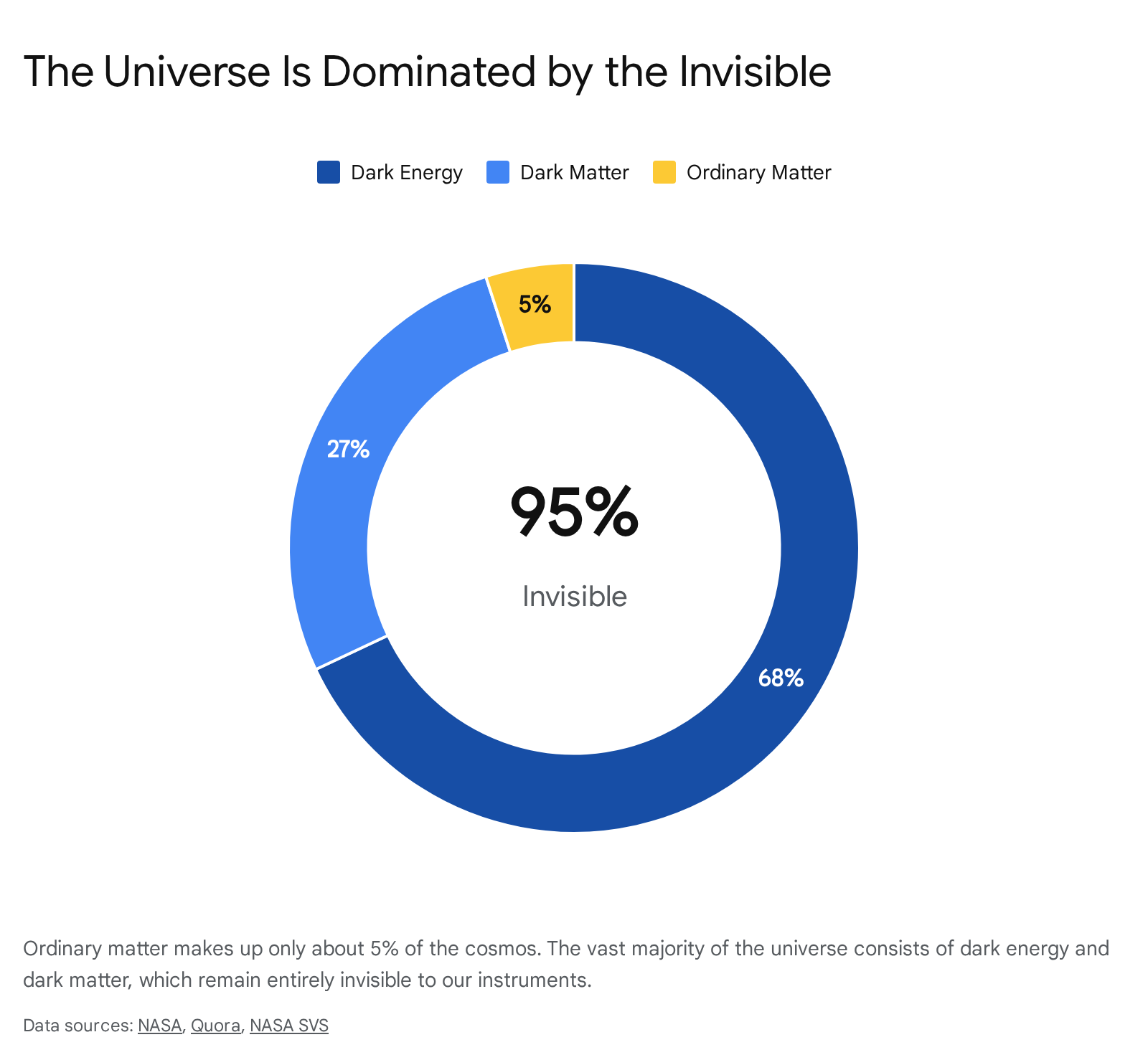
To understand how these three cosmic ingredients differ, it helps to look at their fundamental properties, how they interact with light, how they cluster together, and what role they play in the evolution of the cosmos.
| Feature | Ordinary (Baryonic) Matter | Dark Matter | Dark Energy |
|---|---|---|---|
| Share of Universe | ~5% | ~27% | ~68% |
| Interaction with Light | Absorbs, reflects, and emits light. | Completely invisible; no interaction with electromagnetism. | Invisible; affects light only by stretching space itself. |
| Gravitational Effect | Attractive (pulls matter together). | Attractive (pulls matter together). | Repulsive (pushes space apart). |
| Clustering Behavior | Clumps tightly into stars, planets, and dense clouds. | Forms diffuse, giant "halos" around galaxies and vast cosmic webs. | Perfectly smooth; does not clump or cluster at all. |
| Primary Cosmic Role | Builds complex structures and life. | Acts as the foundational scaffolding for galaxies to form. | Accelerates the expansion of the universe. |
Why Do Physicists Think the Universe Is Invisible?
If we cannot see, touch, or detect dark matter in a laboratory setting, why is the scientific community so universally convinced that it exists? The answer lies in the sheer scale of the cosmos. Over the past century, astronomers have repeatedly found that the gravitational math of the universe simply does not work if we only count the matter that emits light.
Whirling Galaxies and Vera Rubin's Discovery
The first major clue that the universe was hiding something came in the 1930s when Swiss-American astronomer Fritz Zwicky observed the Coma Cluster, a massive grouping of over a thousand galaxies located hundreds of millions of light-years away 23. Zwicky noticed something highly irregular: the galaxies within the cluster were moving much too fast. Based on the visible light coming from the cluster's stars, there was not nearly enough mass to generate the gravity required to keep the cluster from flying apart into the void 3. He coined the term dunkle Materie (dark matter) to describe the unseen mass that must be holding the cluster together.
Zwicky's findings were largely considered an observational anomaly and were ignored for decades. The paradigm shifted in the 1970s, when astronomer Vera Rubin and her colleague W. Kent Ford observed the rotation of individual spiral galaxies, including our neighbor, Andromeda 23.
In our solar system, planets closer to the Sun (like Mercury) orbit much faster than planets further away (like Neptune) because the Sun's gravitational pull weakens with distance. Rubin expected to see the exact same "Keplerian decline" in galaxies. Stars near the dense, bright galactic center should orbit rapidly, while stars on the sparse outer edges should orbit much more slowly 36.
Instead, Rubin discovered that spiral galaxies have what astrophysicists call "flat" rotation curves. The stars on the extreme outer edges of galaxies were moving just as fast as those near the center 34. If the only matter in the galaxy was the visible stars and gas, these outer stars were moving so incredibly fast that they should have been flung out into deep space. The only explanation that fit the established laws of physics was that the visible galaxy was embedded in a vast, invisible halo of mass that extended far beyond the starlight, providing the extra gravitational tether needed to keep the outer stars in orbit 14.
The Cosmic Web and the Early Universe
Dark matter is not just holding modern galaxies together; it is the reason they exist in the first place. The history of the universe's formation relies entirely on dark matter acting as a gravitational anchor.
Shortly after the Big Bang, the universe was a scorching, dense plasma of interacting particles and radiation. During this epoch, ordinary matter could not easily clump together to form structures because the intense pressure of radiation kept blowing it apart - an effect known as Thomson scattering 1.
However, because dark matter does not interact with light or radiation, it was completely immune to this outward pressure 1. Dark matter was able to begin collapsing under its own gravity, forming dense pockets and long, branching filaments. This created a massive "cosmic web" of gravitational scaffolding 12. When the universe eventually cooled enough for atoms to form, ordinary matter was drawn into the gravitational wells already carved out by the dark matter. Without dark matter getting a head start, the universe would not have had enough time over the last 13.8 billion years to form the complex galaxies we see today.
We can see the fingerprints of this process by looking at the Cosmic Microwave Background (CMB), the leftover radiation from the Big Bang. The CMB contains tiny temperature fluctuations that reveal how matter was distributed in the very early universe 45. The pattern of these acoustic fluctuations - specifically the amplitude of the precise "peaks" in the power spectrum - only makes sense mathematically if a vast amount of collisionless dark matter was already present, influencing how ordinary matter clumped together 49.
Gravitational Lensing: Seeing the Invisible
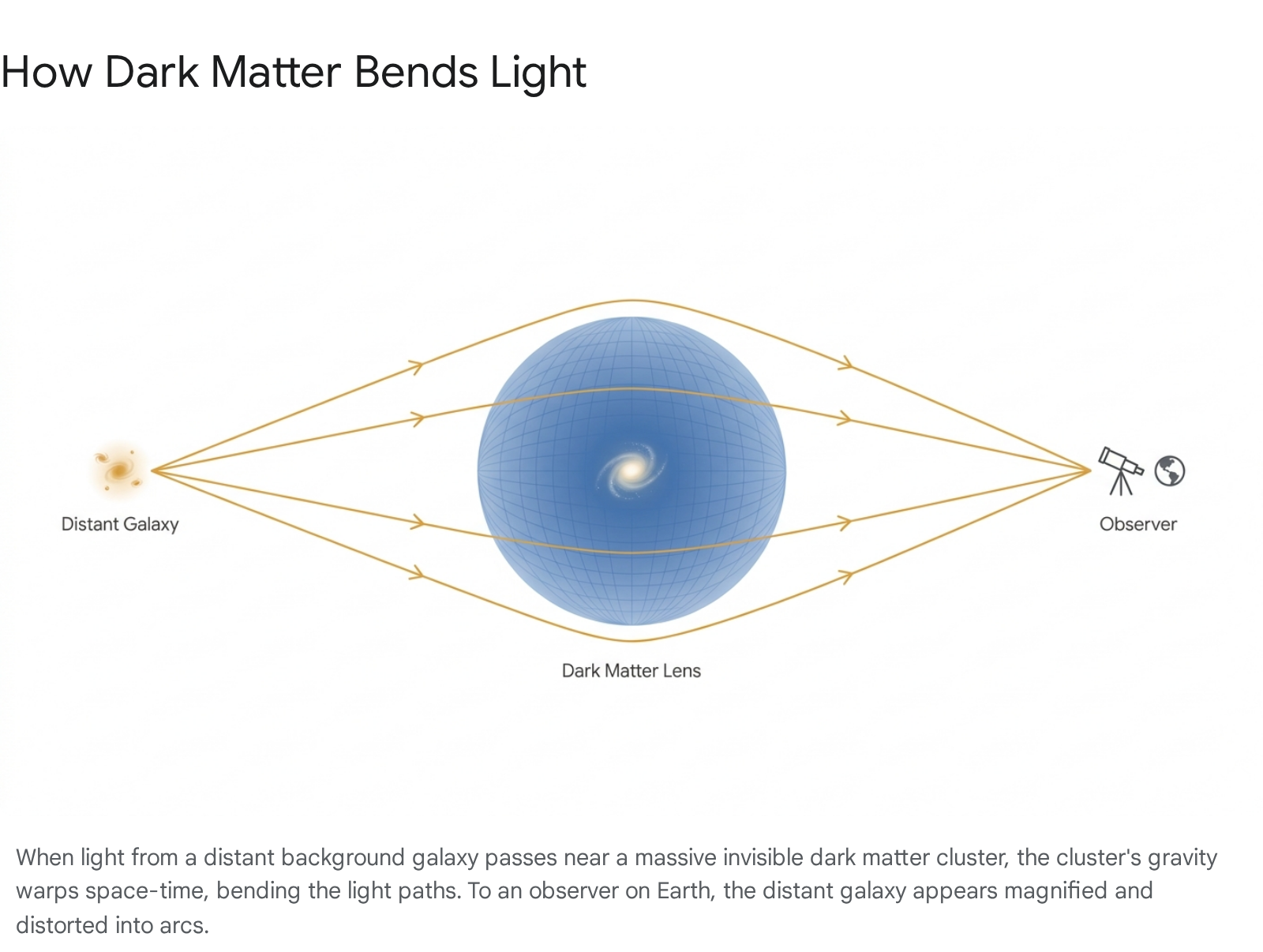
Albert Einstein's theory of general relativity tells us that massive objects warp the physical fabric of space-time around them. When light from a distant galaxy travels toward Earth and passes near a massive object, the warped space acts like a magnifying glass, bending and distorting the light path. This phenomenon is called gravitational lensing 1067.
By looking at distant galaxy clusters, astronomers can see the light of galaxies far behind them being stretched into arcs or perfect circles known as Einstein rings. The exact amount of optical distortion tells astronomers precisely how much mass is in the intervening cluster. When astronomers measure the mass required to bend the light to the degree observed, it is routinely and vastly larger than the mass of the visible stars and gas in the cluster 68.
The most famous and robust example of this is the Bullet Cluster, the aftermath of two colossal galaxy clusters colliding at roughly 5,000 kilometers per second 149. In a collision of this magnitude, the galaxies themselves - which are mostly empty space - pass right through each other. However, the vast clouds of hot gas (ordinary baryonic matter) within the clusters crash into each other, slowing down significantly due to electromagnetic friction and heating up to emit intense X-rays in the center of the collision zone 116.
But when astronomers mapped the actual mass of the Bullet Cluster using weak gravitational lensing, they found something extraordinary. The vast majority of the mass was not located in the center with the crashed hot gas. Instead, the mass had sailed right through the collision unimpeded, flanking the gas on either side 11617.
This is considered by many physicists as the cosmological "smoking gun" for dark matter. It proves that the bulk of the cluster's mass does not interact electromagnetically. If it did, it would have crashed and stuck together exactly like the gas. Instead, it is almost entirely collisionless, passing through itself like a ghost 117.
What Could Dark Matter Be?
If dark matter is real, the obvious question is what it is actually made of. We know what it is not: it is not vast clouds of normal, non-luminous gas (which we would detect via radio waves), and it is not antimatter (which would produce distinct gamma-ray flashes when it touches normal matter) 118. It must be something entirely outside the Standard Model of particle physics.
WIMPs: The Leading Particle Candidate
For decades, the leading theoretical candidate for dark matter has been the WIMP - the Weakly Interacting Massive Particle.
As the acronym suggests, WIMPs are hypothetical subatomic particles that possess mass (and therefore exert gravity) but interact with other matter only through gravity and the weak nuclear force 11819. Because they do not interact via the electromagnetic force, they do not absorb, emit, or reflect light. If WIMPs exist, millions of them are passing through your body every single second without you feeling a thing.
The WIMP hypothesis became incredibly popular in the late 20th century because it neatly solved two problems at once. Supersymmetry, a major proposed extension of the Standard Model of particle physics, naturally predicts the existence of a heavy, stable, electrically neutral particle 45. When physicists calculated how many of these hypothetical particles would have survived the extreme heat of the Big Bang, the resulting mass density matched the exact amount of dark matter we observe in the universe today. This mathematical coincidence is known affectionately in the physics community as the "WIMP miracle."
Axions and the Strong CP Problem
While WIMPs are "cold" (slow-moving) and relatively heavy, other dark matter candidates are incredibly light. Axions are hypothetical, ultra-lightweight particles initially proposed in 1977 to solve a completely different puzzle in quantum chromodynamics called the strong CP problem 18.
The strong CP problem asks why the strong nuclear force seems to preserve a specific type of symmetry (Charge Conjugation and Parity) when the math suggests it shouldn't. To fix the math, physicists theorized the axion. Under certain conditions, incredibly dense fields of low-energy, low-mass axions could act exactly like the cold dark matter holding galaxies together 118.
Primordial Black Holes and MACHOs
Another distinct possibility is that dark matter isn't a new, exotic subatomic particle at all, but rather Primordial Black Holes.
Unlike the massive black holes formed from collapsing dying stars millions of years after the universe began, primordial black holes would have formed in the chaotic fractions of a second immediately following the Big Bang, before atoms even existed 11820. The extreme density of the early universe could have caused localized pockets of matter to collapse directly into black holes.
These primordial black holes could theoretically range in mass from that of a paperclip to thousands of times the mass of our Sun 18. They could pepper the cosmos, exerting gravitational pull without emitting light. These massive, compact halo objects (often referred to as MACHOs) were heavily hunted by astronomers, but extensive surveys have largely ruled out MACHOs from making up the majority of dark matter, though they could still comprise a small fraction of it 1.
JWST and the Hunt for Supermassive Dark Stars
Recent astronomical observations have added fascinating, unexpected wrinkles to the search for dark matter. In late 2025, researchers analyzing data from the James Webb Space Telescope (JWST) published findings identifying several extremely distant objects that appear to be "supermassive dark stars" 21.
In the early universe, a few hundred million years after the Big Bang, the first stars emerged from vast clouds of hydrogen and helium. The JWST data suggests that some of these colossal, puffy clouds might not have been powered by nuclear fusion like our Sun. Instead, they may have been powered by dark matter particles within their cores colliding and annihilating each other, generating immense heat 21.
If confirmed, these supermassive dark stars (such as the candidates named JADES-GS-z13-0 and JADES-GS-z12-0) could explain a major astronomical puzzle: why the earliest galaxies observed by JWST are much brighter and more massive than standard cosmological models predicted 21. It would also offer indirect confirmation that dark matter particles are capable of self-annihilation.
The Hunt Underground: World-Leading Dark Matter Detectors
Because dark matter supposedly envelops our galaxy in a massive halo, the Earth should be flying through a "wind" of dark matter particles as our solar system orbits the center of the Milky Way. For over two decades, physicists have been building increasingly massive, ultra-sensitive detectors deep underground in an attempt to catch a rare glimpse of a WIMP colliding with an atom of ordinary matter.
These detectors are placed deep inside mountains or abandoned mines - such as the Sanford Underground Research Facility in South Dakota or the Gran Sasso National Laboratory in Italy - to shield them from the relentless bombardment of cosmic rays that hit Earth's surface and create false positive signals 222310.
The Empty Nets of LZ, XENONnT, and PandaX
The most advanced dark matter detectors today are dual-phase liquid xenon time projection chambers (TPCs). Three major international collaborations currently lead this global race: the LUX-ZEPLIN (LZ) experiment in the United States, the XENONnT experiment in Italy, and the PandaX-4T experiment in China 192511.
These experiments use massive vats containing tonnes of ultrapure liquid xenon kept at ultracold temperatures. The concept relies on basic collision mechanics: if a dark matter WIMP strikes a heavy xenon nucleus, it will cause the atom to recoil. This tiny nuclear recoil produces a faint flash of light (scintillation) and knocks loose a few electrons, which are then drifted upward by an electric field to create a second flash of light in gaseous xenon 221027. By measuring the precise timing and ratio of these two flashes, scientists can distinguish a true dark matter collision from background radiation.
Despite analyzing the largest datasets ever collected in the history of physics, the results across all three detectors in 2024 and 2025 have been remarkably uniform: zero definitive signs of WIMPs 192829.
In December 2025, the LZ collaboration released a record-breaking analysis based on 417 live days of data, pushing their search into incredibly low mass ranges (between 3 and 9 GeV/c2, or roughly three to nine times the mass of a proton) 1930. They found nothing. Similarly, in early 2025, the XENONnT experiment released data from a massive 3.1 tonne-year exposure, achieving unparalleled background control but finding no significant excess above normal background noise 2529. The PandaX-4T experiment in China reported identical null results after a 1.54 tonne-year exposure, setting strict limits for heavier WIMPs above 100 GeV/c2 28.
While they have not found dark matter, these null results are a vital part of the scientific process. They place the strictest mathematical constraints in history on what dark matter can be (setting limits on the "spin-independent cross-section"), steadily ruling out large portions of the theoretical WIMP parameter space and forcing physicists to rethink their models 192529.
Entering the Neutrino Fog
While the WIMP nets have remained empty, the xenon detectors have become so unfathomably sensitive that they have stumbled into a new era of physics: the "neutrino fog."
In recent analyses, the LZ, XENONnT, and PandaX-4T experiments have all begun detecting boron-8 solar neutrinos - nearly massless, ghostly particles produced in immense quantities by nuclear fusion in the core of our Sun 193031. These neutrinos occasionally interact with the xenon nuclei through a rare process called coherent elastic neutrino-nucleus scattering (CEvNS).
While detecting solar neutrinos in a dark matter vat is a spectacular feat of modern particle physics, it presents a major existential hurdle for the hunt. The signals created by solar neutrinos perfectly mimic the expected signals of low-mass dark matter interactions 30. The detectors have finally become so sensitive that the "background noise" of the Sun itself is threatening to drown out the faint, hypothetical whisper of dark matter 193031.
Observing from Space: The Euclid Mission and JWST
While particle physicists search deep underground, astronomers are attempting to map the dark universe from above. In July 2023, the European Space Agency (ESA), with contributions from NASA, launched the Euclid space telescope. Euclid is a mission explicitly designed to uncover the mysteries of both dark matter and dark energy by charting the cosmos on a scale never before attempted 121314.
Euclid's Massive 2025 Data Release
On March 19, 2025, the Euclid consortium released its first massive batch of survey data to the public, proving the telescope to be an "ultimate discovery machine." In just a short period of observation - covering only 63.1 square degrees of the sky - Euclid mapped out stunning "deep fields" containing a staggering 26 million galaxies, looking back across 10.5 billion years of cosmic history 1516.
Euclid's primary method for mapping dark matter is weak gravitational lensing. By analyzing the incredibly subtle distortions in the shapes of millions of background galaxies, astronomers can deduce where invisible mass must be congregating. Because sifting through 26 million galaxies is impossible for humans alone, the project heavily relies on AI algorithms and citizen scientists (via the Galaxy Zoo platform) to classify the images 1517.
This collaborative effort has already paid massive dividends. The 2025 data release alone identified roughly 500 strong gravitational lenses - more than double the number of strong lenses previously known to humanity 1516. By its scheduled completion in 2030, Euclid aims to map one-third of the entire sky (14,000 square degrees) and identify over 100,000 strong lenses, providing the most detailed 3D map of the invisible universe ever constructed 131618.
Could the Theory Be Wrong? The MOND Alternative
Although dark matter is firmly entrenched in the standard model of cosmology, its stubborn refusal to show up in particle detectors like LZ and XENONnT has kept the door cracked open for alternative theories. The most prominent and hotly debated of these is Modified Newtonian Dynamics (MOND).
What Is Modified Newtonian Dynamics?
Proposed in 1982 by Israeli physicist Mordehai Milgrom, MOND suggests that we do not need invisible matter to explain the rapid rotation of galaxies. Instead, it posits that our fundamental understanding of gravity is simply incomplete. MOND argues that at incredibly low accelerations - such as those experienced by stars drifting at the very sparse edges of galaxies - Newton's law of gravity behaves differently, decaying much more slowly than expected 439.
MOND has been highly successful at predicting the rotation curves of spiral galaxies, often doing so mathematically more naturally than models that have to invent custom dark matter halos for every individual galaxy 9. In mid-2025, researchers studying "wide binary stars" (pairs of stars separated by vast distances of over 2,000 astronomical units, experiencing very weak gravitational acceleration) claimed to observe gravitational behavior that aligned perfectly with MOND's predictions, setting off fierce debates in the astrophysics community 233940.
Where MOND Struggles
Despite these galactic-scale victories, MOND remains a minority view because it severely struggles on larger cosmic scales.
While it works well for individual galaxies, MOND fails by a factor of two or three to explain the mass of larger galaxy clusters. Even within a MOND framework, theorists have to assume some form of unseen mass exists in clusters to make the math work - an ironic "missing baryon" problem 9. Furthermore, MOND has immense difficulty explaining the Bullet Cluster collision, where the mass and the ordinary gas clearly separated, which is a natural consequence of collisionless dark matter but very hard to explain merely by tweaking gravity 91416.
Finally, the precise, ringing sound waves left over in the Cosmic Microwave Background radiation from the Big Bang are the ultimate hurdle. While MOND can predict the first two acoustic peaks of the CMB, it drastically fails to predict the amplitude of the third peak. The Lambda-CDM model, utilizing dark matter, fits the CMB power spectrum beautifully 9. Because of these larger cosmic failures, the vast majority of physicists believe that tweaking the laws of gravity is not enough, and that a physical dark matter particle must exist 41423.
Dark Matter vs. Dark Energy: What Is the Difference?
It is incredibly easy to conflate dark matter and dark energy due to their naming conventions, but in the realm of physics, they act in complete opposition to one another.
If dark matter is the cosmic cement pulling the universe together via gravity, dark energy is the repulsive force tearing it apart. In the late 1990s, astronomers studying distant Type Ia supernovas were shocked to discover that the expansion of the universe is not slowing down under the weight of its own gravity. Instead, the expansion is accelerating at a rapid clip 241. Dark energy is the placeholder name given to whatever is causing this acceleration.
The Cosmological Constant vs. Quintessence
For decades, dark energy was assumed to be a "cosmological constant" (represented by the Greek letter Lambda, $\Lambda$) - an inherent, unchanging energy embedded in the vacuum of space itself, first conceptualized by Albert Einstein 411943. In a universe governed by a cosmological constant, dark energy remains perfectly static over time.
However, the cosmological constant comes with a massive theoretical headache: quantum field theory predicts that the vacuum energy of space should be roughly 122 orders of magnitude larger than what we actually observe. This glaring mathematical discrepancy is known as the cosmological constant problem, and it is one of the greatest unresolved crises in theoretical physics 4344.
The landscape of cosmology was deeply shaken in recent years regarding this exact problem. Data analyzed in 2024 and 2025 by the Dark Energy Spectroscopic Instrument (DESI) strongly hinted that dark energy might not be constant after all. Instead, it appears to be evolving and changing over time, with its equation of state slightly increasing 19434546.
This dynamic, evolving form of dark energy is often referred to by theorists as "quintessence." The DESI results suggest that dark energy could be tied to an ultra-light scalar field or particle - perhaps an ultra-light axion - that slowly rolls down a potential energy slope, rather than just being a static property of empty space 194546. If upcoming data sets from DESI and Euclid confirm these findings with higher statistical significance, it will require a fundamental rewrite of the Lambda-CDM standard model, altering our understanding of how the universe will ultimately end.
Bottom line
Dark matter remains one of the most profound and frustrating mysteries in modern science. The gravitational evidence for its existence is overwhelming, observed in the flat rotation of galaxies, the violent collision of galaxy clusters, and the intricate warping of space-time captured by modern telescopes like Euclid. Yet, despite building the most sensitive underground liquid xenon detectors in human history, the actual particle responsible for this gravitational scaffolding remains entirely invisible and undetected, hiding somewhere within the neutrino fog. Until physicists either catch a dark matter particle in the act or conclusively prove that the laws of gravity need rewriting, the vast majority of our universe will remain hidden in plain sight.