
Yang-Mills existence and mass gap problem
The Millennium Prize Context
The Yang-Mills existence and mass gap problem resides at the deepest and most mathematically demanding intersection of theoretical physics and pure mathematics. Formally articulated in the year 2000 by Arthur Jaffe and Edward Witten as one of the seven Millennium Prize Problems, the challenge carries a reward of one million US dollars offered by the Clay Mathematics Institute for a rigorous mathematical solution 1132. Unlike several of its Millennium counterparts which are purely mathematical in character, the Yang-Mills problem demands the rigorous construction of a complete, internally consistent quantum field theory operating in four-dimensional spacetime, alongside a proof of its most critical non-perturbative property 3.
The precise formulation of the problem requires the solver to prove that for any compact simple gauge group, a non-trivial quantum Yang-Mills theory exists on four-dimensional Euclidean space and exhibits a mass gap strictly greater than zero 16. The "existence" component of this challenge is not merely a request for a working phenomenological model; rather, it demands that the theory satisfies the uncompromising standards of constructive quantum field theory 1. Specifically, the constructed theory must satisfy a recognized axiomatic framework, such as the Wightman axioms or the Osterwalder-Schrader axioms, establishing properties like relativistic covariance, microscopic causality, and the existence of a positive-definite Hilbert space 14.
The "mass gap" component of the problem requires a proof that the energy spectrum of the theory's Hamiltonian is bounded strictly away from zero above the vacuum state 16. In simpler terms, the theory must predict that the lightest particle in its spectrum possesses a strictly positive mass, despite the classical gauge waves traveling at the speed of light 5. The supremum of this lower bound represents the mass of the lightest stable excitation, and the problem demands a mathematical demonstration that this mass is finite and non-zero 6. The general problem of determining the presence of a mass gap, or a spectral gap, in an arbitrary quantum system is known to be undecidable, meaning no generalized computer algorithm can find the answer programmatically, elevating the necessity of a rigorous analytical proof 1.
Physical Foundations and Gauge Symmetry
To comprehend the magnitude of the Millennium Problem, it is necessary to understand the classical and quantum origins of Yang-Mills theory. Formulated in 1954 by Chen Ning Yang and Robert Mills, the theory was designed to extend the principle of local gauge invariance - which successfully governed the Abelian framework of quantum electrodynamics (QED) - to non-Abelian symmetry groups 16.
In classical electrodynamics, the symmetry group is U(1), an Abelian group where the order of operations commutes. The Yang-Mills framework generalizes this by employing non-Abelian Lie groups, such as SU(2) or SU(3), where the group generators do not commute 6. Mathematically, the basic dynamical variable in this framework is a connection on a principal bundle defined over a four-dimensional spacetime manifold 7. The curvature of this connection corresponds to the field strength tensor, and the action is derived from the trace of the square of this curvature 711.
Because the symmetry group is non-Abelian, the gauge fields themselves carry the charge of the interaction. This is a profound departure from QED, where the photon is electrically neutral and does not interact with other photons. In a Yang-Mills theory based on the SU(3) group, the gauge bosons - gluons - carry color charge and continuously interact with one another 68. This non-linear self-interaction introduces severe mathematical complexities. While classical Yang-Mills equations can be treated as a system of non-linear partial differential equations for which specific solutions can be studied, the quantization of these fields introduces ultraviolet divergences and infrared singularities that destabilize traditional analytical methods 17.
Quantum Chromodynamics, Confinement, and the Mass Gap
The physical urgency of the mass gap problem is rooted in the phenomenology of quantum chromodynamics (QCD), the specific Yang-Mills theory based on the SU(3) gauge group that describes the strong nuclear force 68. The classical Lagrangian of Yang-Mills theory possesses conformal symmetry; it contains no intrinsic mass terms or length scales 11. Naively, the quantization of such a classical theory should yield massless particles that propagate over infinite distances, similar to photons.
However, the reality of the strong nuclear interaction violently contradicts this classical prediction. The strong force is effective only over subatomic distances, and the fundamental constituents of the theory - quarks and gluons - are never observed as isolated, free particles in detectors 18. This empirical reality is encapsulated in two linked phenomenological concepts: asymptotic freedom and color confinement.
Asymptotic freedom, discovered in the 1970s, dictates that the effective coupling constant of the strong interaction decreases logarithmically at high energies or short distances 113. In the extreme ultraviolet regime, quarks and gluons behave as weakly interacting particles. This property guarantees that a non-Abelian Yang-Mills theory possesses a trivial ultraviolet fixed point, making it the most viable candidate for a mathematically consistent, non-trivial constructive quantum field theory in four dimensions 1.
Conversely, at low energies or large macroscopic distances, the coupling constant diverges, a regime sometimes referred to as infrared slavery. As color charges are separated, the self-interacting nature of the gluons prevents the gauge field lines from spreading out radially as electric field lines do in QED. Instead, the gluon-gluon interactions squeeze the chromodynamic field into a highly localized, dense tube of energy 1.
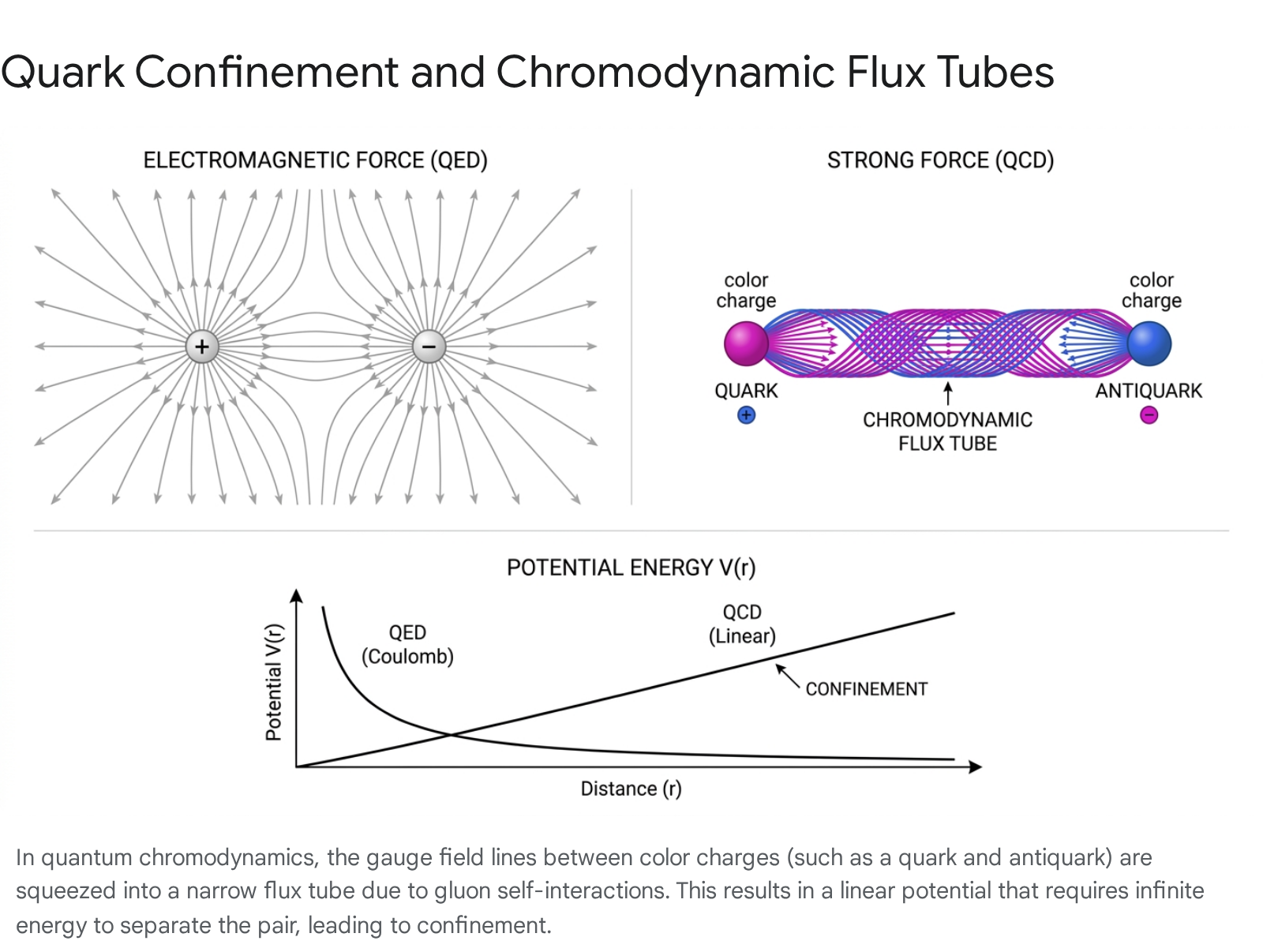
The formation of this flux tube generates a linear confining potential between the color charges. Because the energy stored in the flux tube increases linearly with distance, separating two quarks requires an unbounded amount of energy 19. Before macroscopic separation can occur, the potential energy exceeds the threshold required to spontaneously create a new quark-antiquark pair from the vacuum, immediately snapping the flux tube and creating new, color-neutral bound states (hadrons) 18.
This mechanism of confinement ensures that the observable spectrum of the theory consists solely of massive, color-neutral composite particles 18. Even in a pure Yang-Mills theory absent of matter fields (quarks), the strong interaction of the gluons binds them into massive composite states known as glueballs 16. The mass of the lightest stable glueball corresponds directly to the mass gap of the pure gauge theory. The emergence of this dynamical mass scale out of a classically scale-invariant Lagrangian is the central mystery that the Millennium Problem demands a solution for 613.
Distinction from the Higgs Mechanism
It is critical to distinguish the Yang-Mills mass gap from other mass-generating mechanisms within the Standard Model, most notably the Higgs mechanism. In the electroweak sector, governed by the SU(2) $\times$ U(1) gauge group, the $W$ and $Z$ gauge bosons acquire mass through spontaneous symmetry breaking 1310. This process requires the introduction of an external scalar field - the Higgs field - which acquires a non-zero vacuum expectation value. The interaction of the gauge bosons with this background field shifts their kinetic terms, imbuing them with a rest mass 1310.
The mass gap in a pure Yang-Mills theory operates on entirely different principles. There is no external scalar field to break the symmetry 13. The mass gap must arise purely from the non-perturbative quantum dynamics of the gauge fields themselves 13. The transition from weak coupling in the ultraviolet to strong coupling in the infrared causes the vacuum to restructure itself, trapping the massless gauge degrees of freedom inside massive localized states 113. In the academic literature, proving the Yang-Mills mass gap implies demonstrating this internal dynamical scale generation, not relying on an external classical mechanism like the Higgs field 1310.
Perturbative Versus Non-Perturbative Quantum Field Theory
The failure of contemporary physics to provide a rigorous mathematical proof of the mass gap is deeply intertwined with the limitations of perturbative quantum field theory. Perturbation theory is the standard operational tool for extracting experimental predictions from quantum fields. It assumes that the interaction strength between fields is sufficiently small, allowing the interacting theory to be treated as a free theory with minor corrections 1112. These corrections are calculated via a Taylor series expansion in the coupling constant, famously visualized as Feynman diagrams.
The Breakdown of Asymptotic Series
While perturbative expansions in theories like QED have yielded some of the most precise predictions in the history of science, they are fundamentally mathematically flawed when considered as absolute definitions of a theory. The perturbation series for quantum field theories are generally expected to be divergent asymptotic series, possessing a radius of convergence of zero 1314. This divergence, originally argued by Freeman Dyson, occurs because the number of Feynman diagrams grows factorially with the order of the expansion, eventually overwhelming the decreasing powers of the coupling constant 14.
Furthermore, perturbative methods are entirely blind to non-perturbative phenomena. Non-perturbative effects often scale proportionally to $\exp(-C/g^2)$, where $g$ is the coupling constant 15. Because the Taylor expansion of $\exp(-1/x^2)$ around $x=0$ vanishes at every order, no finite number of perturbative terms can ever detect these effects 12. The mass gap and color confinement in Yang-Mills theory are strictly non-perturbative phenomena; they manifest only in the strong coupling regime where $g$ is large and the perturbative expansion collapses entirely 1812.
Therefore, defining a quantum field theory perturbatively is insufficient for addressing the Millennium Problem 1321. The solver must construct a theory that exists independently of any expansion, possessing a rigorous measure-theoretic foundation capable of handling strong coupling dynamics universally 111.
The following table summarizes the operational and mathematical differences that require the Millennium Problem to be solved via non-perturbative frameworks:
| Attribute | Perturbative Quantum Field Theory | Non-Perturbative Constructive QFT |
|---|---|---|
| Mathematical Nature | Divergent asymptotic series expansion in the coupling constant 1314. | Exact, rigorous functional measures defined over a complete Hilbert space 1114. |
| Coupling Regime | Valid only for infinitesimal or very weak interaction strengths ($g \ll 1$) 112. | Valid across all coupling regimes, handling strong interactions universally 121. |
| Visibility of Phenomena | Blind to effects scaling as $\exp(-1/g^2)$; cannot detect confinement or dynamical mass generation 812. | Captures all emergent phenomena, vacuum restructuring, and dynamic scale generation 1215. |
| Axiomatic Compliance | Generally fails strict axiomatic requirements (e.g., Haag's Theorem prevents the use of the interaction picture) 4. | Designed to satisfy the Wightman or Osterwalder-Schrader axioms completely 411. |
Axiomatic Frameworks for Quantum Field Theory
To bridge the gap between physical intuition and mathematical rigor, researchers established axiomatic frameworks that formalize what a quantum field theory must entail. A valid solution to the Yang-Mills problem must explicitly prove that the constructed theory satisfies one of these rigorous frameworks 1.
The Wightman Axioms
In the 1950s, Arthur Wightman formulated a set of axioms aiming to place relativistic quantum field theory on a foundation as solid as von Neumann's axiomatization of quantum mechanics 4. Published fully in 1964 alongside Lars Gårding, the Wightman axioms operate directly in Minkowski spacetime and govern the behavior of field operators 416.
The fundamental difficulty addressed by Wightman is that a quantum field cannot be evaluated at a single spacetime point; attempting to do so yields infinite variance 417. Instead, fields must be treated as operator-valued distributions smeared over spacetime by rapidly decaying test functions (Schwartz space) 1618.
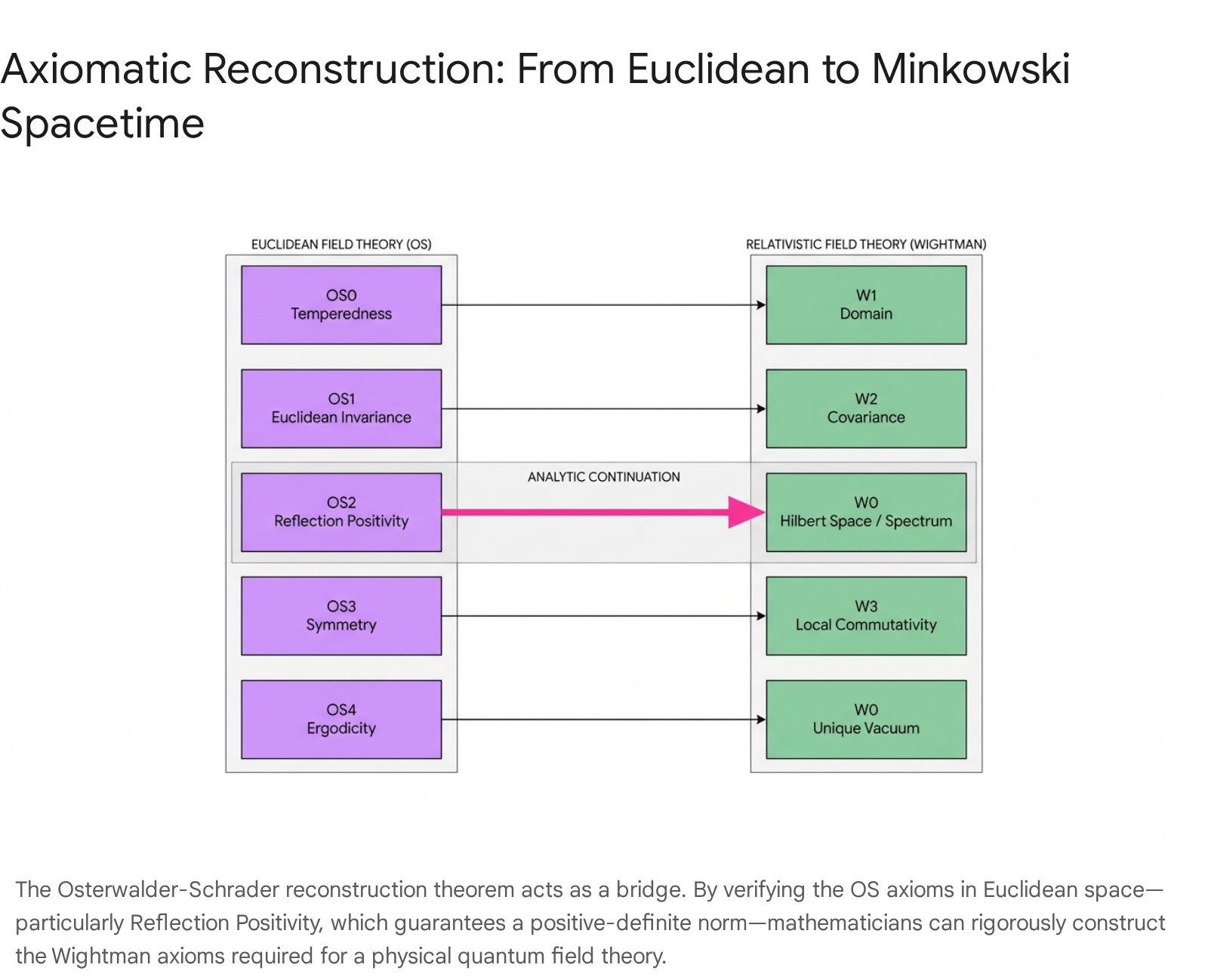
The axioms impose severe structural constraints: 1. W0 (Assumptions of Relativistic Quantum Mechanics): The physical states of the theory must reside in a separable complex Hilbert space. The spacetime symmetries are implemented by a strongly continuous unitary representation of the Poincaré group. Crucially, the joint spectrum of the energy and momentum operators must be confined to the forward light cone. This spectrum condition ensures that the energy of the system is bounded from below, preventing catastrophic instability. Furthermore, there must exist a unique, Poincaré-invariant state known as the vacuum 41920. 2. W1 (Domain and Continuity): The smeared field operators are unbounded, meaning they cannot act on the entire Hilbert space. Therefore, the axioms require the existence of a dense, common domain of state vectors containing the vacuum. The field operators, along with their adjoints, must map this dense domain into itself, allowing for the construction of arbitrary polynomial field algebra 41618. 3. W2 (Transformation Law): The quantum fields must transform covariantly under the unitary representation of the Poincaré group, reflecting the symmetries of special relativity 419. 4. W3 (Local Commutativity or Microscopic Causality): To enforce the principle that no signal can travel faster than light, field operators localized in spacelike-separated regions must either commute (for integer spin bosons) or anticommute (for half-integer spin fermions). This ensures that a measurement in one region cannot instantaneously influence a measurement in a causally disconnected region 41620.
If a set of vacuum expectation values - known as Wightman distributions - satisfies specific corresponding theorems, the Wightman Reconstruction Theorem guarantees that the full Hilbert space and the quantum field operators can be uniquely recovered 1618. However, proving these axioms for a fully interacting, non-trivial four-dimensional theory has proven overwhelmingly difficult. Scalar field theories with quartic interactions ($\phi^4$) have been rigorously proven to be trivial in four spacetime dimensions; the continuum limit strips away the interaction, leaving only a free theory 121927. This triviality result forces researchers to rely on non-Abelian gauge theories, which possess asymptotic freedom, as the only viable candidates for non-trivial constructive QFTs in four dimensions 1.
The Osterwalder-Schrader Framework
Because functional integrals and highly singular distributions in Minkowski spacetime are analytically intractable, mathematical physicists frequently utilize the Euclidean approach. By applying an analytical continuation involving a complex rotation of the time coordinate ($t \to -i\tau$), known as a Wick rotation, Minkowski spacetime is transformed into Euclidean space 1921. This mapping converts the highly oscillatory path integral weights ($\exp(iS)$) into real, exponentially decaying probability measures ($\exp(-S)$), allowing researchers to utilize the robust tools of statistical mechanics and measure theory 1922.
In the 1970s, Konrad Osterwalder and Robert Schrader established the conditions under which a Euclidean field theory can be rotated back into a valid relativistic theory 2123. The Osterwalder-Schrader (OS) axioms are formulated to constrain the Euclidean correlation functions (Schwinger functions):
- OS0 (Temperedness and Linear Growth): The Schwinger functions must define tempered distributions, imposing strict bounds on their singularity structure at coincident points and governing their growth rates to ensure they correspond to valid fields 2331.
- OS1 (Euclidean Invariance): The correlation functions must be strictly invariant under the Euclidean group of rotations and translations 1924.
- OS2 (Reflection Positivity): This is the most technically demanding and physically significant of the Euclidean axioms. It requires that the expectation value of any functional evaluated in the upper half-space, multiplied by its time-reflected conjugate in the lower half-space, must be strictly non-negative 1931. Reflection positivity is the direct Euclidean counterpart to the quantum mechanical requirement of a positive-definite norm; without it, the resulting Minkowski theory would possess negative probabilities (ghost states), violating physical unitarity 19.
- OS3 (Symmetry): The Schwinger functions must be symmetric under the arbitrary permutation of their arguments, mapping directly to the commutativity of bosonic fields in Minkowski space 1924.
- OS4 (Ergodicity/Cluster Decomposition): The temporal translation subgroup must act ergodically on the measure space. This clustering property ensures that physical events separated by vast distances become statistically independent, a requirement that translates to the uniqueness of the vacuum state in the reconstructed relativistic theory 2123.
If an interacting probability measure can be constructed that satisfies all five OS axioms, the Osterwalder-Schrader reconstruction theorem rigorously yields a physical theory satisfying the Wightman axioms 2123.
Thus, the pursuit of the Yang-Mills problem frequently takes place entirely within the Euclidean domain.
Haag-Kastler and Algebraic Extensions
A parallel axiomatic approach is the Haag-Kastler framework, or Algebraic Quantum Field Theory (AQFT). Rather than dealing with singular, unbounded operator distributions at spacetime points, the Haag-Kastler axioms define a theory using nets of local $C^*$-algebras or von Neumann algebras assigned to open bounded regions of spacetime 1820.
This framework cleanly encodes physical principles: isotony ensures that algebras of smaller regions are sub-algebras of larger ones, and locality guarantees that algebras assigned to spacelike-separated regions commute, cleanly avoiding the domain issues inherent in unbounded operators 1820. While constructing a Haag-Kastler net from Wightman fields requires highly technical domain assumptions, demonstrating compliance with these algebraic structures represents an alternative, highly respected pathway for fulfilling the Millennium Problem's existence criteria 1833.
Rigorous Construction Methodologies
Because the Yang-Mills problem requires bypassing perturbation theory, researchers employ distinct non-perturbative methodologies to control the ultraviolet and infrared divergences.
Lattice Gauge Theory and the Continuum Limit
The most successful non-perturbative formulation of quantum chromodynamics is Lattice Gauge Theory, pioneered by Kenneth Wilson in 1974. To tame the ultraviolet divergences caused by arbitrarily short-wavelength fluctuations, continuous spacetime is replaced by a discrete hypercubic lattice with spacing $a$ 19. Gauge fields are no longer continuous connections but are represented by unitary group elements attached to the links connecting adjacent lattice sites. The action is determined by evaluating the trace of closed plaquettes (elementary squares) on this lattice 79.
Lattice gauge theory operates in Euclidean space and naturally provides a non-perturbative, gauge-invariant regulator 9. Through Monte Carlo simulations, physicists have generated overwhelming numerical evidence supporting the existence of a mass gap and color confinement 65. Wilson demonstrated mathematically that in the strong coupling regime of the lattice (where the coupling constant is large), the expectation value of a large closed loop of gauge links - the Wilson loop - decays exponentially according to the minimal area enclosed by the loop 9. This "area law" is the rigorous mathematical signature of a linear confining potential, implying that color charges are bound by a constant-tension flux tube 9. Furthermore, rigorous mathematical links have been established showing that a strong mass gap in a lattice gauge theory, provided unbroken center symmetry exists, directly implies this quark confinement 9.
However, the lattice is only an approximation. To solve the Millennium Problem, one must prove that the theory survives the continuum limit 725. This requires carefully taking the lattice spacing $a \to 0$ while simultaneously scaling the bare coupling constant toward zero in accordance with the renormalization group flow (as dictated by asymptotic freedom) 79. Proving that the mass gap, Area Law, and Osterwalder-Schrader reflection positivity strictly survive this infinite-dimensional limiting procedure in four dimensions remains one of the primary obstacles in mathematical physics 7.
The Gribov-Zwanziger Framework
To evaluate the continuum path integral of a gauge theory, researchers must eliminate the infinite redundancy of gauge-equivalent field configurations. The standard textbook method is the Faddeev-Popov procedure, which introduces a gauge-fixing condition (such as the Landau gauge) and a functional Jacobian determinant involving hypothetical scalar fields known as ghosts 35.
In the perturbative regime, the Faddeev-Popov method is robust. However, as Vladimir Gribov discovered, the procedure breaks down non-perturbatively. For large gauge field amplitudes, multiple distinct field configurations exist that satisfy the exact same gauge-fixing condition - these are known as Gribov copies 35. The existence of these copies causes the Faddeev-Popov operator to develop zero eigenvalues, leading to singular integrals and rendering the standard quantization invalid 35.
To rigorously bypass this, the functional integral must be strictly limited to the first "Gribov region," a subset of the configuration space where the Faddeev-Popov determinant is strictly positive. Implementing this restriction dynamically alters the action, resulting in the Gribov-Zwanziger (GZ) framework 35.
In the deep infrared regime - the domain of the mass gap - the GZ action exhibits instabilities. These are resolved by introducing dimension-two condensates, leading to the Refined Gribov-Zwanziger (RGZ) action 35. The RGZ framework is critical for the mass gap problem because these condensates act as dynamically generated mass scales 35. They fundamentally alter the infrared behavior of the gluon propagator, suppressing low-energy gluon propagation and providing a rigorous analytical mechanism for confinement and the emergence of a mass gap from an initially massless theory 35. A mathematically complete proof integrating the RGZ framework into a full axiomatic existence theorem is an active area of advanced research 1535.
Stochastic Quantization and Langevin Dynamics
A comparatively recent and highly promising approach to defining the Yang-Mills measure abandons the direct construction of the path integral in favor of Stochastic Quantization, originally developed by Parisi and Wu. Instead of integrating over all configurations, this framework introduces a fictitious algorithmic time dimension $t$ 22. The gauge field evolves along this time axis according to a stochastic partial differential equation (SPDE) - specifically, a Langevin heat flow - driven by spacetime white noise 2226.
The dynamic equation is structured such that the deterministic drift pulls the field toward the minima of the Yang-Mills action, while the white noise continuously perturbs it 22. If this process reaches equilibrium, the invariant probability measure of the Markov process corresponds exactly to the Euclidean quantum field theory measure desired by the Osterwalder-Schrader axioms 2227.
Major mathematical breakthroughs have occurred in this domain recently. Researchers including Martin Hairer, Hao Shen, Ilya Chevyrev, and Ajay Chandra have successfully utilized the theory of regularity structures to rigorously renormalize the stochastic Yang-Mills heat flow in two and three spacetime dimensions 222728. These works established a state space of distributional 1-forms capable of supporting highly irregular distributions like the Gaussian Free Field (GFF) 2227. Crucially, they proved that this highly singular dynamic remains gauge covariant in law, allowing the process to be projected onto the quotient space of gauge orbits without losing its Markovian properties 2728.
Despite this immense success in lower dimensions, applying stochastic quantization to the four-dimensional Yang-Mills problem hits a severe barrier. The non-linearities and singularities of the white noise in four dimensions push the SPDE into a critical or subcritical regime where current regularity structures and renormalization group techniques break down 222627. Developing the mathematics to control this four-dimensional stochastic flow is a major focal point for securing the existence component of the Millennium Problem.
Review of Recent Solution Candidates (2025 - 2026)
As of the current period in 2026, the general consensus among the global mathematical physics community is that the Yang-Mills mass gap problem remains unsolved 229. The Clay Mathematics Institute requires that any proposed solution be published in a qualifying peer-reviewed outlet, undergo a minimum two-year waiting period, and achieve general acceptance from the mathematical community 30. No candidate has currently cleared this stringent threshold 22930.
However, the years 2025 and 2026 have seen a high volume of preprints and theoretical proposals claiming to resolve the problem. These candidates split generally into two categories: those attempting to push traditional constructive QFT techniques to their absolute limits, and those proposing radically alternative paradigms.
Conventional Constructive Proposals
Several recent authors claim to have successfully executed the rigorous steps required by the Jaffe-Witten problem description using classical constructive tools:
- David Gutierrez (2025): In an OSF preprint, Gutierrez proposes a seven-step constructive framework utilizing lattice regularization for the SU(N) gauge group 33. The paper claims to achieve the continuum limit and derive a strictly positive mass gap utilizing Balaban's renormalization group, cluster expansions, and infrared bounds inspired by Aizenman-Fröhlich-Spencer. The author claims this construction directly satisfies the Osterwalder-Schrader, Wightman, and Haag-Kastler axioms 33.
- Jonathan Jared Wilson (2026): In a series of preprints, Wilson claims to prove the existence of the mass gap by rigorously constructing the Gribov-Zwanziger measure on a lattice and passing to the continuum 154231. The methodology relies on a polymer expansion utilizing non-circular bootstrap arguments to establish exponential clustering, claiming full verification of the Osterwalder-Schrader axioms within the Coulomb gauge 1542.
Alternative Theoretical Paradigms
Other proposals argue that the traditional methods of perturbation and lattice limits are fundamentally insufficient, requiring entirely new physical or mathematical ontologies to expose the mass gap:
- Quantum Information Theory (MDPI, 2025): A peer-reviewed paper claims a novel approach by reformulating Yang-Mills theory through the lens of quantum circuits and entanglement structures 25. The authors claim to provide a gauge-invariant concrete realization of the theory that satisfies the Wightman axioms. The mass gap is ostensibly proven by analyzing the entanglement spectrum of the vacuum state, linking the physical mass gap directly to the minimum non-zero eigenvalue of the corresponding entanglement Hamiltonian 25.
- Harmonic Coherence Framework (Michael Hanners, 2025): Hanners proposes reframing gauge field dynamics as a fundamental entropy minimization process rather than a perturbative Lagrangian expansion 1. The paper posits "Hanners Theorem," claiming to prove mathematically that quantum gauge fields must naturally evolve toward discrete, stable states characterized by non-zero mass gaps in order to harmonically reduce informational entropy 1.
- The Latnex Model (Michael Bush, 2025): Bush's preprint argues that the mass gap is not a failure of gauge symmetry, but a structural survival mechanism under directional motion 11. The model treats the field as a system of recursive strain; when the second-order motion (acceleration) exceeds a critical compression boundary, the field cannot restore symmetry and collapses into a bounded, persistent object. This structural resistance to redirection is framed as the mechanical origin of mass, redefining the gap as the minimum threshold for this collapse event 11.
The following table provides a comparative summary of these 2025-2026 proposals:
| Principal Author / Outlet | Year | Primary Methodological Paradigm | Core Mechanism Claimed for the Mass Gap | Institutional / Review Status |
|---|---|---|---|---|
| David Gutierrez | 2025 | Constructive QFT / Lattice limits | Infrared bounds via Balaban renormalization and cluster expansion 33. | Preprint (OSF); awaiting peer review 33. |
| Jonathan Jared Wilson | 2026 | Gribov-Zwanziger Quantization | Exponential clustering established via polymer expansions 1542. | Preprint (OSF/Sciety); awaiting peer review 4231. |
| Anonymous (MDPI) | 2025 | Quantum Information Theory | Minimum non-zero eigenvalue of the vacuum entanglement Hamiltonian 25. | Published (MDPI); awaiting long-term community consensus 2530. |
| Michael Hanners | 2025 | Entropy Minimization (Harmonic Coherence) | Fields align into stable, coherent configurations to reduce informational entropy 1. | Unverified preprint 1. |
| Michael Bush | 2025 | The Latnex Model (Structural Mechanics) | Kinetic compression failure leading to persistent localized structural inertia 11. | Unverified preprint 11. |
While these attempts display the vigorous ongoing effort to solve the problem, the mathematical physics community generally approaches such sweeping claims with extreme caution 30. Validating a constructive existence proof requires verifying hundreds of pages of dense analytical estimates governing singularity bounds and renormalization flows. Until an elite consensus emerges, the status of the Millennium Problem remains unsolved.
Institutional Focus and Future Outlook
The sheer difficulty of the Yang-Mills existence and mass gap problem continues to shape the institutional funding and research directions of global mathematical physics. Rather than waiting passively for a singular genius to crack the problem, major institutes are actively organizing long-term programs to build the necessary theoretical architecture 2932.
The Clay Mathematics Institute maintains public awareness and engagement through initiatives like the Millennium Prize Problems Lecture Series, hosted at Harvard University through 2025 and 2026 29. These events, featuring speakers like Sourav Chatterjee explicitly addressing the foundations of QFT and Yang-Mills, underscore the problem's primacy in defining the frontier of mathematics 29.
In Europe, the Institut des Hautes Études Scientifiques (IHES) in France continues to be a central hub for this research 3334. Their recent summer schools have focused heavily on the statistical aspects of non-linear physics (2025) and the intersection of symmetries and anomalies in gauge theories (2024), drawing together mathematicians, high-energy physicists, and condensed matter theorists to cross-pollinate techniques 3536. The integration of diverse fields - such as utilizing statistical mechanics for Euclidean QFT - is viewed as essential for any future breakthrough 36.
Similarly, the Simons Center for Geometry and Physics (SCGP) hosted specific workshops on "Confinement and QCD Strings" in late 2025, alongside extensive programming on random geometry, which heavily intersects with functional integration and measure theory 373839. In Asia, the Research Institute for Mathematical Sciences (RIMS) at Kyoto University programmed a major 2026 research trimester titled "The mathematical roads to QFT," specifically designed to bring together probability theory, stochastic PDEs, operator theory, and microlocal analysis 3240.
The existence of a mass gap in quantum chromodynamics is an undisputed physical reality; the entire structure of the observable universe, from the mass of the proton to the binding of atomic nuclei, relies upon it 58. Yet, the inability of modern mathematics to rigorously prove this from the foundational equations reveals a profound gap in humanity's formal understanding of nature. Whether the ultimate solution arrives via stochastic quantization, algebraic geometry, or an entirely unprecedented paradigm, the resolution of the Yang-Mills Millennium Problem will undeniably precipitate a revolutionary advancement in both pure mathematics and theoretical physics.