
Physics of axions
Theoretical Foundations
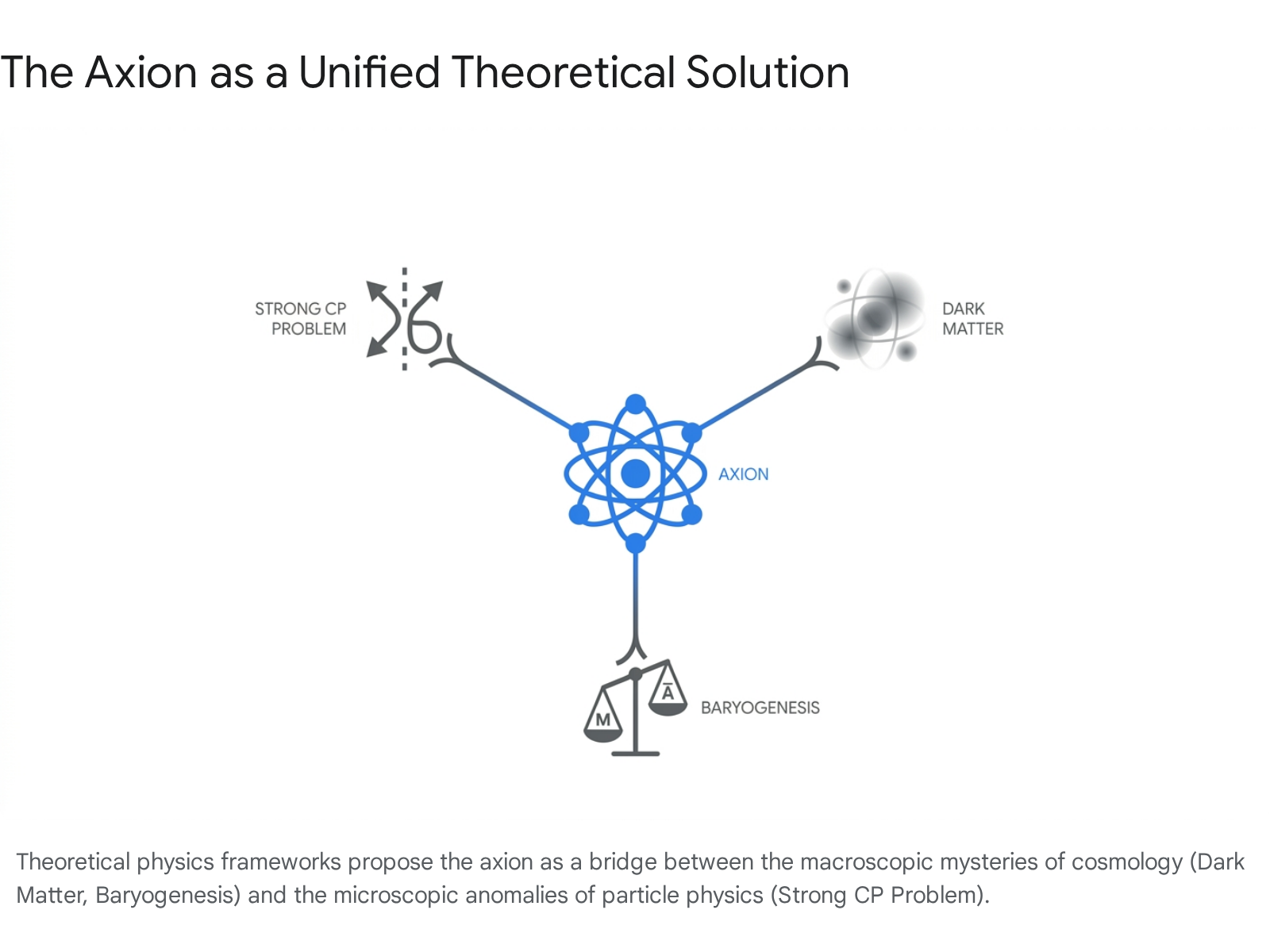
The axion is a hypothetical elementary particle initially postulated to resolve fundamental inconsistencies within the Standard Model of particle physics. Specifically, the particle emerged as a natural consequence of the Peccei-Quinn mechanism proposed in 1977 12. Over subsequent decades, the theoretical framework surrounding the axion has expanded significantly. Contemporary physics models propose that the axion, or variations known as axion-like particles (ALPs), could simultaneously resolve three of the most profound mysteries in cosmology and particle physics: the strong charge-parity (CP) problem, the nature of dark matter, and the matter-antimatter asymmetry of the universe 1234.
The Strong Charge-Parity Problem
The initial theoretical motivation for the axion lies in the strong CP problem within quantum chromodynamics (QCD), the framework describing the strong nuclear force that binds quarks into protons and neutrons 15. The mathematical structure of the QCD Lagrangian includes a term governed by a parameter known as the $\theta$ vacuum angle. This term permits the violation of combined charge conjugation and parity inversion (CP) symmetry. If CP violation were present in the strong interaction, it would manifest as a measurable electric dipole moment (EDM) in the neutron 2.
Despite the quarks within the neutron possessing fractional electrical charges, extensive experimental measurements have demonstrated that the neutron's electric dipole moment is functionally zero, bounded to extraordinarily tight limits 24. The Standard Model provides no inherent mechanism to explain why the $\theta$ parameter must be exactly zero, creating a severe fine-tuning problem. To resolve this, theoretical physicists Roberto Peccei and Helen Quinn proposed an extension to the Standard Model involving a new global $U(1)$ symmetry. As the universe cooled, this symmetry spontaneously broke, replacing the static $\theta$ parameter with a dynamical field that naturally relaxed to zero, thus eliminating strong CP violation 14. The axion is the pseudo-Nambu-Goldstone boson associated with the spontaneous breaking of this Peccei-Quinn symmetry. The mass of the axion and its coupling strength to Standard Model particles are inversely proportional to the symmetry breaking scale, typically denoted as $f_a$ 784.
Dark Matter Candidate Properties
Five years after its initial formulation to address the strong CP problem, physicists recognized that the axion possessed the exact properties required of a dark matter candidate 12. Cosmological observations indicate that non-baryonic dark matter constitutes approximately 85% of the total matter density and 27% of the total energy density of the universe 567. To account for this, a dark matter candidate must be "cold" (non-relativistic during the epoch of structure formation), stable over cosmological timescales, and electrically neutral 8149.
Unlike other dark matter candidates that rely on thermal production mechanisms, axions are theorized to be produced non-thermally in the early universe through a process known as vacuum misalignment 510. Because the postulated axion mass is extraordinarily small - often measured in micro-electronvolts ($\mu$eV) or nano-electronvolts (neV) - axions would exhibit extremely large spatial coherence lengths, forming a macroscopic quantum state. In this regime, dark matter is best modeled not as individual particle collisions, but as a classical field oscillating at a specific Compton frequency defined by the axion mass ($v_a = m_a c^2 / h$) 56. If axions comprise the entirety of the dark matter halo surrounding the Milky Way, their local density is estimated to be approximately 0.45 GeV/cm$^3$, corresponding to an immense local number density of axions oscillating coherently 1118.
Axiogenesis and Matter-Antimatter Asymmetry
The third major mystery addressed by the axion is the cosmological matter-antimatter asymmetry, also known as baryogenesis. According to the Standard Model, the Big Bang should have produced equal quantities of matter and antimatter, which would have subsequently annihilated, leaving a universe filled only with radiation 12. The observed dominance of matter requires a mechanism of CP violation occurring in the early universe, satisfying the Sakharov conditions 8.
In 2020, researchers Keisuke Harigaya and Raymond Co advanced a mechanism termed "axiogenesis," which posits that the dynamics of the QCD axion field in the primordial universe naturally generated the required baryon asymmetry 124. Under this model, as the early ultra-hot universe expanded and cooled, the axion field did not simply oscillate; rather, it underwent a physical rotation around the minimum of its potential. Through interactions governed by the strong and weak nuclear forces, the kinetic energy resulting from the rotation of the QCD axion field produced a fractional excess of ordinary matter baryons over antimatter 12. This excess - estimated at roughly one extra matter particle for every ten billion antimatter particles - survived the subsequent epoch of universal annihilation to form all observable galactic structures, stars, and biological life 24.
Standard Model Axion Seesaw Higgs Portal Inflation
The explanatory power of the axion has been formally integrated into comprehensive physical models such as SMASH (Standard Model Axion Seesaw Higgs portal inflation) 31912. The SMASH framework builds upon the neutrino minimal standard model ($\nu$MSM) introduced by Mikhail Shaposhnikov, demonstrating that minimal extensions to the Standard Model can yield a complete, mathematically consistent picture of cosmology up to the Planck scale without requiring hundreds of unobserved supersymmetric particles 31221.
The model requires the addition of only six new particles to the Standard Model: three heavy right-handed neutrinos, a vector-like color triplet fermion, and a complex singlet scalar field ($\sigma$) 31921. In the SMASH model, the universe operates on only two primary dynamical scales: the Standard Model breaking scale ($v_H$) and the Peccei-Quinn breaking scale ($v_\sigma$), the latter occurring at approximately $10^{11}$ GeV 1922.
The SMASH framework demonstrates theoretical elegance by resolving five distinct physics anomalies simultaneously. Dark matter is explained directly by the axion, which is generated during the Peccei-Quinn phase transition and possesses a predicted mass between 50 and 200 $\mu$eV in this specific formulation 1921. Baryogenesis is achieved via thermal leptogenesis driven by the decay of the massive right-handed neutrinos at temperatures below $10^7$ GeV 122122. Cosmic inflation is driven by a combination of the Standard Model Higgs field and the complex scalar field $\sigma$, which is non-minimally coupled to scalar curvature, yielding a predicted tensor-to-scalar ratio of $r \simeq 0.004$ and a scalar spectral index running of $\alpha \simeq -7 \times 10^{-4}$ 1921. The strong CP problem is solved naturally by the axion dynamics following the QCD phase transition, and neutrino oscillations are explained by the seesaw-generated masses stemming from the three right-handed sterile neutrinos 3122122.
Competing Dark Matter Paradigms
The current search for the axion is taking place against the backdrop of a profound paradigm shift in theoretical and experimental physics. For several decades, the dominant candidate for dark matter was not the axion, but rather a class of particles born out of Supersymmetry theories, alongside other hypothetical constructs like the sterile neutrino 9131415.
Weakly Interacting Massive Particles
Supersymmetry (SUSY) hypothesized that every known particle in the Standard Model possesses a heavier "superpartner" differing by a half-integer of quantum spin. The lightest of these hypothetical superpartners, such as the neutralino, fit the exact profile of a Weakly Interacting Massive Particle (WIMP) 91913. Because WIMPs were theorized to interact strictly via the weak nuclear force and gravity, they were expected to be detectable either through direct collisions with dense atomic nuclei in deep underground laboratories or through high-energy collisions at particle accelerators 891415. This coincidental alignment of theorized properties and cosmological abundance requirements was widely referred to as the "WIMP miracle" 91026.
However, the WIMP paradigm has faced severe challenges due to persistent, highly sensitive null results. Decades of operation at the Large Hadron Collider (LHC) at CERN failed to produce any evidence of supersymmetric partner particles, generating a widely acknowledged crisis within the field 919. Concurrently, direct detection experiments utilizing immense vats of ultrapure liquid xenon have pushed detection sensitivities to unprecedented limits without capturing a single verified WIMP recoil signal 1915.
The LUX-ZEPLIN (LZ) experiment, operating nearly a mile underground at the Sanford Underground Research Facility in South Dakota, utilizes a two-phase xenon time projection chamber containing 10 tonnes of liquid xenon within nested titanium tanks 7161718. In August 2024, the LZ collaboration released results based on an unprecedented 4.2 tonne-years of exposure across 280 live days of operation 171819. The analysis utilized advanced techniques to actively tag and remove background electronic recoils from radioactive isotopes such as $^{214}$Pb, while identifying enhanced electron-ion recombination in double electron capture decays of $^{124}$Xe 17. The final unblinded data yielded no evidence of WIMP interactions, establishing a new world-leading upper limit on the spin-independent WIMP-nucleon cross section at $2.2 \times 10^{-48}$ cm$^2$ for a WIMP mass of 40 GeV/c$^2$ 1719. Similar robust null results have been confirmed by parallel liquid xenon experiments worldwide, including XENONnT and PandaX-4T 1516.
Sterile Neutrinos
Another alternative dark matter candidate, the sterile neutrino, has similarly faced recent exclusionary data that tightly bounds its parameter space. Sterile neutrinos were hypothesized as a fourth flavor of neutrino that interacts entirely through gravity, lacking weak force interactions. They were proposed partly to explain low-energy excess anomalies observed in earlier neutrino experiments, such as LSND and MiniBooNE 5202122.
In late 2025, the MicroBooNE collaboration at Fermilab, utilizing a 170-ton liquid argon time projection chamber, released exhaustive search results targeting the sterile neutrino hypothesis 212223. By analyzing data simultaneously from both the Booster Neutrino Beam (BNB) and the Neutrinos at the Main Injector (NuMI) beam, researchers were able to mitigate systematic degeneracies arising from the cancellation of electron neutrino appearance and muon neutrino disappearance 202224. The results decisively ruled out the 3+1 eV-scale single sterile neutrino model as an explanation for previous anomalies with 95% certainty 202122. Independent confirmation from the KATRIN experiment at the Karlsruhe Institute of Technology, which precisely measures the kinematics of tritium beta decay, also found no distortions in the electron energy spectrum that would indicate the presence of sterile neutrinos emitted in place of standard electron antineutrinos 23.
| Dark Matter Candidate | Theoretical Origin | Target Mass Range | Primary Interaction Mechanism | Current Experimental Status |
|---|---|---|---|---|
| WIMP | Supersymmetry (SUSY) | GeV to TeV scale | Weak Nuclear Force, Gravity | Severely constrained by LZ and XENONnT; no collider evidence at the LHC. |
| Sterile Neutrino | Neutrino oscillation anomalies | eV to keV scale | Gravity | eV-scale models ruled out by MicroBooNE and KATRIN at 95% certainty. |
| Axion / ALPs | Strong CP Problem (Peccei-Quinn) | peV to meV scale | Electromagnetism, Gluons, Spin | Active broadband parameter space scanning; no confirmed detection to date. |
With the WIMP parameter space heavily constrained and sterile neutrinos facing severe experimental pushback, the axion has surged in popularity 10142625. Theoretical physicists note that while WIMPs require the invocation of large new theoretical frameworks like Supersymmetry, the axion is essentially "dark matter for free," as it naturally emerges from the necessary solution to the pre-existing Strong CP problem in quantum chromodynamics 9.
Mechanisms of Axion Interaction
Because axions are electrically neutral and interact with baryonic matter and radiation at extraordinarily weak scales, direct detection requires exploiting highly specific quantum mechanical interaction pathways 5815. The primary difference between the WIMP and axion paradigms lies in this detection philosophy. While WIMP detectors look for rare, violent classical particle collisions in multi-ton atomic targets, axion detectors utilize tuned resonators, ultra-strong magnets, and quantum-limited amplifiers to listen for the faint, continuous conversion of a macroscopic wave field 9102626.
The Primakoff Effect and Photon Conversion
The primary mechanism leveraged in the search for axions is the Primakoff effect, a quantum electrodynamic phenomenon originally described by theoretical physicist Henry Primakoff in 1951 2728. In standard particle physics, the Primakoff effect governs the resonant production of neutral pseudoscalar mesons (such as the $\pi^0$ or $\eta$) when high-energy photons interact with the quasi-real virtual photons of a static Coulomb field surrounding an atomic nucleus 2728. This is represented by the coherent reaction $\gamma + \gamma^* \rightarrow \pi^0$, leveraging the Weizsäcker-Williams approximation to model a virtual photon flux proportional to $Z^2$ (where Z is the atomic number of the target) 727.
For hypothetical axions, the Primakoff effect operates as a mechanism for axion-photon conversion. In the presence of a macroscopic, exceptionally strong magnetic field, an incoming axion can couple to a virtual photon provided by the transverse magnetic field, converting into a real, detectable photon (typically in the microwave or X-ray spectrum) that carries the energy and momentum of the original axion 829. This interaction scales coherently over the volume of the magnetic field, meaning the probability of conversion is strictly proportional to $(B \cdot L)^2$ or more broadly $B^2 V Q$, where $B$ is the magnetic field strength, $L$ is active bore length, $V$ is the magnetic volume, and $Q$ is the quality factor of the experimental resonator apparatus 51129.
The Primakoff effect is also theorized to operate continuously within the core of stars, including the Sun, providing a distinct detection pathway independent of the galactic dark matter halo 2730. In the dense, incredibly hot solar plasma, photons scatter off the strong electric fields of atomic nuclei and collective electrons, producing a vast, continuous flux of relativistic solar axions 2730. Recent dynamic linear response calculations utilizing the Kramers-Kronig sum rules indicate that the Debye-Hückel screening effect within the solar plasma heavily modulates this conversion rate. Contrary to earlier static structure factor models, these dynamic calculations prove that collective plasma electrons actually overtake static ions as the dominant factor mediating the photon-axion conversion 3144. Nonetheless, the overall resultant solar axion flux remains exceptionally high, resulting in an axion luminosity governed primarily by the underlying axion-photon coupling constant $G_{a\gamma\gamma}$ 72730.
Spin Precession and Fermion Coupling
Beyond photon conversion, axions possess theoretical couplings to the strong nuclear force (the defining QCD axion interaction with gluons) and the axial nuclear current (interaction with fermions) 3233. The interaction with the gluon field is theorized to induce a time-varying, oscillating electric dipole moment (EDM) within nucleons, despite the strict lack of a permanent, static EDM 34.
Simultaneously, the coupling to fermion spins is known as the gradient coupling. The axion field can be mathematically treated as an effective, or pseudo-magnetic, field 35. When a macroscopic sample containing nuclear spins is placed in an external bias magnetic field, the nuclear Larmor frequency is determined by the bias field strength and the gyromagnetic ratio of the specific target isotope 35. If the Larmor frequency is precisely tuned to match the Compton frequency of the local dark matter axion field, the gradient interaction will drive the nuclear spins to precess into the transverse plane, generating an oscillating transverse magnetization . This process is functionally identical to nuclear magnetic resonance (NMR), allowing physicists to adapt established precision magnetometry tools, completely bypassing the need for resonant microwave cavities 3435.
Microwave Cavity Haloscopes
For axions with masses in the micro-electronvolt ($\mu$eV) range (corresponding to microwave frequencies of roughly 1 to 10 GHz), the primary detection strategy is the microwave cavity haloscope, a conceptual architecture pioneered by Pierre Sikivie in 1983 3036. Haloscopes specifically seek to detect the ambient background of cold dark matter axions making up the virialized galactic halo 5636.
The standard haloscope consists of a high-quality (high-Q) resonant copper or plated-steel cavity placed inside a powerful superconducting dipole or solenoidal magnet, cooled to temperatures near absolute zero to minimize obscuring thermal photon noise 1136. When the physical dimensions of the cavity are mechanically tuned (often using inserting dielectric or metallic rods) such that its resonant frequency strictly matches the mass of the local axion field, axions undergo inverse-Primakoff conversion into microwave photons. This deposits a tiny but measurable amount of power - often measured in fractions of a yoctowatt ($10^{-24}$ Watts) - into the cavity 5363738.
The Axion Dark Matter Experiment
Hosted at the University of Washington and supported by Fermilab, the Axion Dark Matter eXperiment (ADMX) operates as a flagship Department of Energy "Generation 2" haloscope 363940. ADMX utilizes an 8 Tesla superconducting magnet and a 100-liter cavity cooled to roughly 40 mK using a $^3$He dilution refrigerator 363739. To overcome the thermal noise floor and read the sub-yoctowatt signal, ADMX utilizes an extremely sensitive receiver chain featuring superconducting quantum interference device (SQUID) amplifiers and flux-driven Josephson Parametric Amplifiers (JPA) to achieve noise levels pressing against the Standard Quantum Limit (SQL) 36373839.
During its recent Run 1 operations, ADMX successfully scanned the frequency range of 1.10 to 1.31 GHz (corresponding to an axion mass range of 2.66 to 3.33 $\mu$eV) 373940. The unparalleled sensitivity of this run was sufficient to plunge through the theoretical model bands, completely excluding both the Kim-Shifman-Vainshtein-Zakharov (KSVZ) and Dine-Fischler-Srednicki-Zhitnitsky (DFSZ) theoretical models within that narrow frequency band 373940. Upcoming Run 2 operations target the 1.25 to 2.25 GHz range (5.2 to 9.3 $\mu$eV), with extended frequency searches planning to utilize 18-cavity arrays to push the haloscope limit up to 4 GHz (16.6 $\mu$eV) 39.
Center for Axion and Precision Physics
Operating heavily in South Korea, the Center for Axion and Precision Physics (CAPP) has developed aggressive haloscope designs focusing on slightly higher mass ranges, where standard single-cavity volumes become prohibitively small due to the inverse relationship between resonant frequency and cavity radius 4155.
To maintain substantial detection volume at high frequencies, the CAST-CAPP experiment at CERN utilizes a 4-cavity array (each 23 * 25 * 390 mm) installed inside the 8.8 T CAST dipole magnet 1142. CAPP engineers employed a fast frequency tuning mechanism (10 MHz/min using piezoelectric motors) and a strict phase-matching mechanism to combine the signals coherently across the four independent cavities 1142. Between 2019 and 2021, accounting for 4,124 hours of data acquisition, CAST-CAPP scanned the mass range of 19.74 to 22.47 $\mu$eV, cleanly excluding axion-photon couplings for virialized galactic axions down to $G_{a\gamma\gamma} = 8 \times 10^{-14}$ GeV$^{-1}$ at the 90% confidence level 1142.
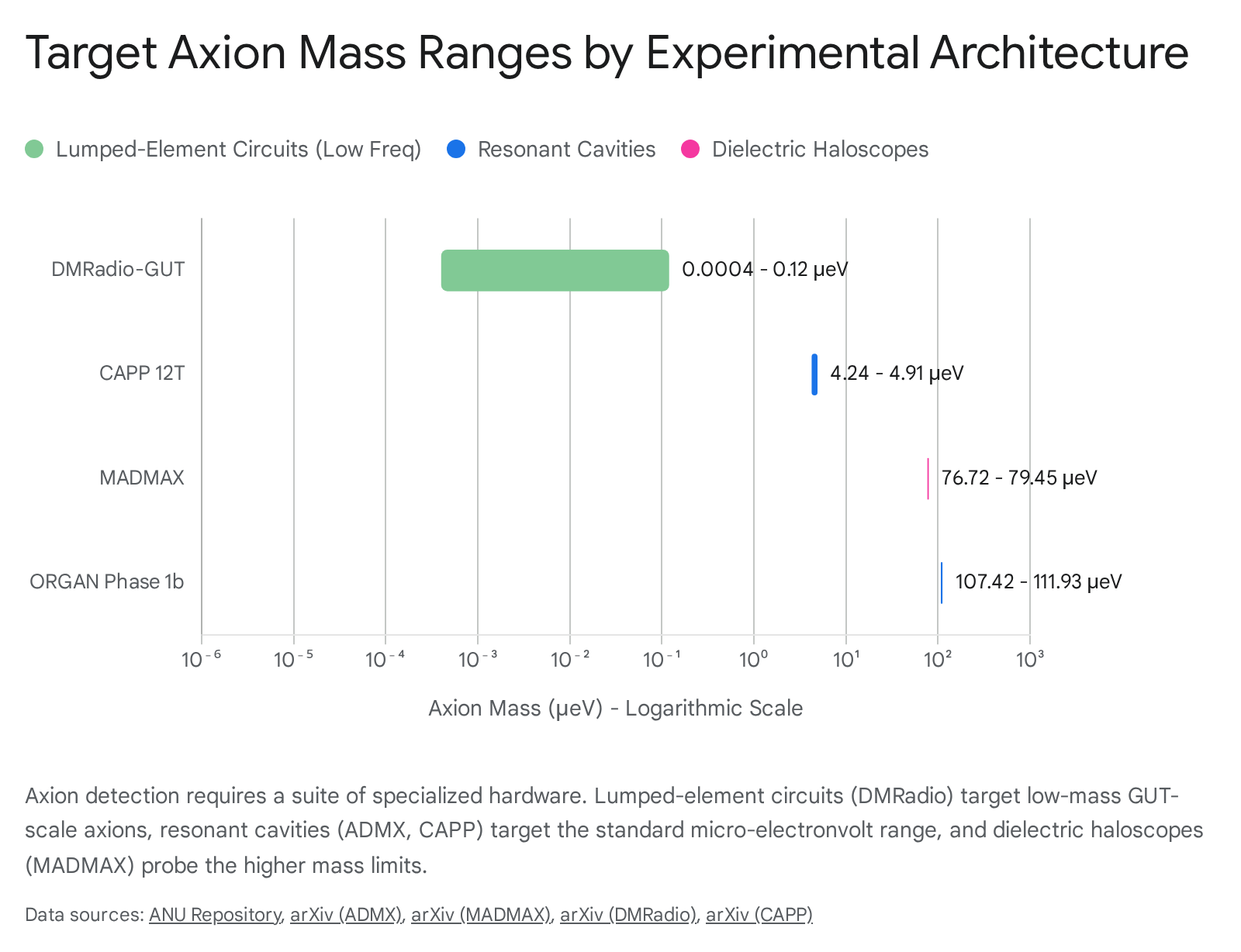
Simultaneously, in 2023 and 2024, CAPP reported the results of an extensive independent search utilizing a custom 12 T magnet composed of Nb$_3$Sn and NbTi superconductors, housing a 37-liter ultralight-weight copper cavity 5743. Operating below 40 mK with a flux-driven JPA, the system achieved a total noise temperature of roughly 200 mK 5743. This experiment systematically excluded the mass range of 4.24 to 4.91 $\mu$eV (1.025 to 1.185 GHz), marking the most stringent exclusion limits on axion-photon coupling within this frequency regime to date, probing deep into DFSZ sensitivity 57.
High-Mass Cavity Searches
For mass ranges substantially higher than those accessible by ADMX, specialized high-mass cavity searches are deployed. The ORGAN experiment, hosted at the University of Western Australia, specifically targets the $\sim 100$ $\mu$eV high-mass regime 544. Operating at a physical temperature of 5.3 K in an 11.5 T magnetic field, ORGAN utilizes a tunable rectangular cavity coupled to a low-noise high electron mobility transistor (HEMT) amplifier 5. ORGAN's Phase 1b recently achieved critical limits, excluding axions with a two-photon coupling $G_{a\gamma\gamma} \geq 4 \times 10^{-12}$ GeV$^{-1}$ across the mass range of 107.42 to 111.93 $\mu$eV (25.97 to 27.07 GHz), representing the most sensitive limits set above 10.4 GHz and functionally excluding the ALP cogenesis dark matter model in that sector 5.
Operating in a complementary high-frequency space, the HAYSTAC (Haloscope At Yale Sensitive To Axion CDM) experiment utilizes a 9 T magnet and a smaller 5 cm radius cavity 3644. To overcome the severe volume constraints at these frequencies, HAYSTAC Phase II implemented a squeezed state receiver, manipulating quantum uncertainty to achieve noise parameters below the standard quantum limit, successfully analyzing the region between 19.46 and 19.52 $\mu$eV 3644.
Alternative Detection Architectures
While microwave cavities excel in the low $\mu$eV range, the physical scaling laws of resonant cavities render them highly inefficient at the extreme ends of the axion mass spectrum. To probe the full parameter space, entirely novel detection architectures are required.
Dielectric Haloscopes
As haloscope searches move to higher axion masses (40 - 400 $\mu$eV, or 10 - 100 GHz), the required microwave cavities become physically smaller, drastically reducing the target volume and signal power . To circumvent this geometric limitation, physicists developed the dielectric haloscope concept 845.
The MADMAX (MAgnetized Disk and Mirror Axion eXperiment) collaboration utilizes a "booster" composed of a stack of large, parallel dielectric disks (typically sapphire) positioned in front of a reflective metallic mirror 846. The entire assembly is immersed in a strong magnetic field. When the macroscopic background axion field interacts with the static magnetic field, the sharp changes in the refractive index at the physical interfaces of the dielectric disks trigger the emission of electromagnetic waves 84. By precisely adjusting the spacing between the disks using micrometer-scale motorized positioning at cryogenic temperatures, researchers can induce constructive interference (resonances) that amplify the microwave signal by many orders of magnitude 84546.
In 2024, an encapsulated prototype booster featuring three 20-cm sapphire disks was successfully tested inside the 1.6 T MORPURGO dipole magnet at CERN 8445. Operating around 18.55 to 19.21 GHz, the prototype yielded 14.5 days of data, setting world-best limits that successfully excluded axions and dark photons in the 76.7 to 79.5 $\mu$eV mass range, fully demonstrating the viability of the dielectric booster concept 8445. The final MADMAX experiment, slated for future construction at DESY in Hamburg, aims to utilize up to 20 movable disks of 1-meter diameter inside a custom 10 T magnet to definitively scan the post-inflationary QCD axion mass range near 100 $\mu$eV 8446.
Lumped-Element Circuits
Conversely, for axion masses below 1 $\mu$eV (sub-MHz frequencies), standard resonant cavities would need to be the size of large buildings to match the corresponding wavelengths 6. To probe this ultra-low-mass regime, experiments exploit a fundamental property of the axion wave: its de Broglie wavelength is vastly larger than the physical detector, meaning spatial gradients of the axion field across the instrument can be safely ignored ($\nabla a \approx 0$) 647. In this limit, the axion acts purely as an oscillating time-dependent current source 6.
The DMRadio collaboration searches for these low-mass axions using lumped-element LC circuits, leveraging high-Q inductors and capacitors. This approach essentially operates as an ultra-sensitive AM radio receiver tuned specifically to the dark matter field, detecting the tiny oscillating magnetic field induced by the axion-photon coupling 6264866.
The program is executing a staged approach: * DMRadio-50L: Currently under construction at Stanford University, this iteration utilizes a 0.6 T average field toroidal magnet and a 50-liter pickup volume to search a vast parameter space from 10 peV to 10 neV (5 kHz to 5 MHz) 266649. * DMRadio-m3: This next-generation detector targets the 30 to 200 MHz frequency range (120 to 830 neV). It will utilize a segmented 4 T to 5 T solenoidal magnet with a coaxial inductive pickup, aiming to achieve DFSZ sensitivity above 120 neV and KSVZ sensitivity down to 40 neV 18486650. * DMRadio-GUT: The ultimate planned iteration of the architecture, targeting the Grand Unified Theory (GUT) scale axion mass range from 0.4 to 120 neV (100 kHz to 30 MHz). Reaching the required DFSZ sensitivity in this ultra-low mass regime will require massive 12 T to 18 T segmented solenoidal magnets spanning 8.5 meters, along with backaction-evading quantum sensors and Radio-Frequency Quantum Upconverters (RQUs) to suppress noise beyond standard quantum limits 1849505152.
Solar Axion Helioscopes
While haloscopes and lumped-element circuits search for the ambient, non-relativistic cold dark matter halo, helioscopes operate entirely independently of cosmological dark matter assumptions 30. Instead, they search for the highly relativistic axions guaranteed to be produced within the dense plasma of the Sun's core via the Primakoff effect 530. These solar axions would easily pass out of the solar mass unimpeded, traveling directly to Earth with a mean kinetic energy peaking around 4.4 keV, placing them squarely in the X-ray spectrum 2930.
The CERN Axion Solar Telescope (CAST) spearheaded this architecture. Operating continuously since 2002, CAST utilized a decommissioned 9.5-meter LHC dipole test magnet (producing a 9.25 T transverse field) mounted on a mechanical slewing platform to continuously track the Sun across the sky 1129. By outfitting the magnet bores with specialized X-ray focusing optics and ultra-low background Micromegas detectors, CAST set the most robust upper bounds on the axion-photon coupling for masses below $\sim 0.02$ eV 293053.
The direct successor to CAST is the International Axion Observatory (IAXO) project, which aims to improve the experimental Figure of Merit (signal-to-noise ratio) by a factor of 10,000 535455. The collaboration is currently taking the intermediate step of constructing BabyIAXO at the DESY facility in Hamburg 53545657. BabyIAXO will feature a 10-meter-long, two-bore superconducting magnet utilizing Nb-Ti racetrack coils - specifically designed by CERN's magnet group - to generate a quasi-homogeneous 2 T field across a massive detection volume 53545859. Designed to track the Sun with sophisticated drive systems and equipped with custom X-ray optics, BabyIAXO is tentatively scheduled to begin solar data acquisition by 2028-2029 5457. It will explore both KSVZ and DFSZ axion models deep into the meV to eV mass range 535455. The final proposed IAXO configuration will utilize a massive 20-meter, 8-bore ATLAS-style toroidal magnet, representing the absolute ultimate theoretical reach of helioscope technology 54.
Nuclear Magnetic Resonance Experiments
For ultra-low mass axions that interact predominantly with fermions and gluons rather than photons, the CASPEr (Cosmic Axion Spin Precession Experiment) leverages highly specialized nuclear magnetic resonance (NMR) techniques 34.
The CASPEr program is divided into two distinct interaction searches: * CASPEr-Electric: This branch targets the axion's defining coupling to the gluon field, which is the specific interaction that solves the strong CP problem. It looks for the minute oscillating nuclear electric dipole moment (EDM) using a polarized solid-state ferroelectric crystal containing $^{207}$Pb 3460. The prototype calibrated via pulsed magnetic resonance in a 4.4 T field has achieved design sensitivity in the nano-electronvolt mass range. Searching specifically between 162 and 166 neV, it placed an upper bound on EDM oscillations at $1.0 \times 10^{-21}$ e$\cdot$cm, demonstrating the feasibility of solid-state NMR for dark matter detection 3460. * CASPEr-Gradient: This branch targets the gradient coupling of the axion to nucleon spin (the axial nuclear current). It utilizes macroscopic samples of hyperpolarized liquids and gases, such as Methanol, Xenon-129, and Helium-3, to drastically boost the degree of polarization and overcome spin-projection noise 343561. The CASPEr-Gradient Low-Field apparatus recently probed the $5.576$ neV mass range (corresponding to a 1.34 MHz Compton frequency), setting a rigorous upper bound on the axion-proton coupling of $g_{aNN} \approx 3 \times 10^{-2}$ GeV$^{-1}$ 3561. Future high-field iterations will utilize 14.1 T magnets to reach Larmor frequencies up to 600 MHz, creating overlap with haloscope limits .
Status of Axion Exclusion Limits
The search for the axion remains an exercise in aggressive constraint. While no definitive, replicable signal has been detected, the parameter space is being systematically closed. Each null result physically removes a segment of theoretical viability for the axion mass, forcing the models into increasingly tight constraints.
| Experiment Name | Detection Architecture | Primary Hardware | Target Mass Range | Recent Exclusion Status |
|---|---|---|---|---|
| ADMX Run 1 | Microwave Haloscope | 8.0 T Solenoid, 100L Cavity | 2.66 - 3.33 $\mu$eV | Excluded DFSZ/KSVZ limits within 1.1 - 1.3 GHz 37. |
| CAPP 12T | Microwave Haloscope | 12.0 T Solenoid, 37L Cavity | 4.24 - 4.91 $\mu$eV | Excluded DFSZ limits within 1.025 - 1.185 GHz 57. |
| ORGAN Phase 1b | High-Mass Haloscope | 11.5 T Solenoid, 5.3 K | 107.4 - 111.9 $\mu$eV | Excluded ALP cogenesis models at ~26 GHz 5. |
| MADMAX Prototype | Dielectric Haloscope | 1.6 T Dipole, Sapphire Disks | 76.7 - 79.5 $\mu$eV | Excluded dark photon limits at ~18.5-19 GHz 8. |
| CASPEr-Electric | NMR Spin Precession | 4.4 T Bias Field, $^{207}$Pb | 162 - 166 neV | Bounded EDM oscillation amplitude to $1.0 \times 10^{-21}$ e$\cdot$cm 60. |
| CASPEr-Gradient | NMR Spin Precession | Bias Field, Hyperpolarized Methanol | 5.576 neV | Bounded gradient coupling $g_{aNN}$ to $3 \times 10^{-2}$ GeV$^{-1}$ at 1.34 MHz 35. |
| CAST | Helioscope (Sun) | 9.25 T LHC Dipole | $\leq 0.02$ eV | Constrained solar axion flux $G_{a\gamma\gamma}$ 2930. |
| DMRadio-50L | Lumped-Element Circuit | 0.6 T Toroidal Magnet | 10 peV - 10 neV | (Under construction) Targeting 5 kHz to 5 MHz limits 2666. |
The next half-decade promises substantial expansion in the sensitivity of the global axion search. Haloscopes like ADMX are upgrading to complex multi-cavity arrays to push the limit up to 16.6 $\mu$eV (4 GHz), addressing the volume loss at higher frequencies 39. Simultaneously, the DMRadio program is scaling its superconducting lumped-element circuits into larger volumes, developing Radio-Frequency Quantum Upconverters (RQUs) to deliberately evade standard quantum limits and achieve sensitivity to Grand Unified Theory (GUT) scale axions at the lowest mass limits 5051.
Furthermore, the construction of BabyIAXO at DESY will mark a fundamental transition for helioscopes - moving from repurposed particle accelerator magnets to custom-built, massive-bore cryogenic optics systems designed explicitly for dark sector interactions 5457. The robust null results from competing dark matter paradigms, specifically the deep exclusions of WIMPs by liquid xenon detectors and sterile neutrinos by liquid argon detectors, have effectively funneled global theoretical and structural resources directly into axion research 9151720. Whether the axion exists as the elegant, unifying solution to the strong CP problem, dark matter, and baryogenesis, or if it represents an incomplete approximation of an even deeper fundamental symmetry, the closing of the axion parameter space remains one of the most critical and dynamic objectives in modern experimental physics.