
What Is the Amplituhedron and Why Physicists Care
The amplituhedron is a multifaceted, higher-dimensional geometric structure that drastically simplifies the calculation of subatomic particle interactions. By allowing physicists to determine the outcomes of particle collisions by calculating the volume of a geometric shape rather than mapping out complex trajectories in space and time, the amplituhedron suggests that space, time, and the conservation of probability are not fundamental ingredients of reality. Instead, these familiar concepts appear to be emergent properties of a deeper, purely mathematical geometry that could ultimately pave the way for a unified theory of quantum gravity.
The Standard Approach to Particle Physics
To truly grasp the significance of the amplituhedron, one must first understand the prevailing mathematical framework it seeks to replace. For nearly a century, physicists have viewed the fundamental base layer of reality through the lens of Quantum Field Theory (QFT), which forms the mathematical backbone of the Standard Model of particle physics 12.
In modern quantum physics, the universe is not filled with tiny, solid, billiard-ball-like particles hurtling through empty space. Instead, reality is constructed from continuous, overlapping, fluid-like entities known as quantum fields 34. The electron field, for example, permeates every inch of the universe. What we observe as a physical "electron" is simply a localized bundle of energy, or a vibrating excitation, within that specific field 34. When these excitations are not actively interacting, they are self-sustaining ripples moving through space 4.
When particle physicists want to test their theoretical models of the universe, they smash these localized energy bundles together in massive particle accelerators, such as the Large Hadron Collider (LHC) at CERN, and measure the wreckage that emerges. Because the quantum world is governed by probability, physicists cannot predict the precise outcome of any single collision. Instead, they calculate a metric known as a "scattering amplitude," which represents the probability amplitude that a specific set of incoming particles will interact and transform into a specific set of outgoing particles 125. For decades, calculating these scattering amplitudes has been the central, bread-and-butter objective of high-energy theoretical physics 53.
The Feynman Diagram Bottleneck
To calculate scattering amplitudes, physicists have historically relied on a tool invented in the late 1940s by Richard Feynman, Julian Schwinger, and Freeman Dyson 5. Feynman diagrams are essentially schematic sketches that trace the possible paths particles can take as they move through space and time 134.
These diagrams depict incoming particles colliding and exchanging "virtual particles" - temporary, off-shell mathematical constructs that mediate the fundamental forces but are never directly observed in nature 245. Each Feynman diagram translates into a complex, multidimensional mathematical integral that must be solved to find the probability of that specific sequence of events occurring 49. Because quantum mechanics dictates that reality is a superposition of all possible events, physicists must calculate and add together the mathematical contribution of every single possible way an interaction could theoretically play out 54.
This method works incredibly well for simple interactions. However, as physicists seek higher precision - which requires factoring in more complex, intermediate interactions known as "loops" - the mathematical burden becomes paralyzing. Calculating amplitudes using standard Feynman diagrams leads to a severe combinatorial explosion 1310.
For example, a seemingly straightforward event involving two subatomic gluons colliding to produce four less energetic gluons requires summing up 220 different Feynman diagrams 5. This collectively contributes thousands of complex mathematical terms and tens of thousands of integrals to the calculation of a single scattering amplitude 59. If researchers want to incorporate more loops for greater precision, the number of diagrams grows exponentially, quickly leading to an impractical or even impossible computational effort 110. By the 1980s, it became apparent to many researchers that the traditional Feynman apparatus, while historically revolutionary, had become a mathematical Rube Goldberg machine 5.
The Foundational Pillars of Modern Physics
The complexity of Feynman diagrams is not arbitrary; it is the direct result of forcing the mathematics to explicitly obey the two foundational pillars of modern physics: locality and unitarity 15.
Locality is the principle that dictates interactions can only occur when particles meet at a specific, adjacent point in space and time 16. There is no instantaneous "action at a distance" for fundamental forces in standard quantum field theory. Unitarity is the quantum mechanical requirement that the probabilities of all possible outcomes of a physical event must conserve perfectly, summing up to exactly one, or 100 percent 125.
Feynman diagrams are meticulously constructed to make both locality and unitarity manifest at every single step of the calculation 55. Physicists string together lines representing trajectories to ensure that particles only interact locally, and they invent off-shell virtual particles with infinite loops to ensure that the probabilities perfectly balance to maintain unitarity 5.
However, many physicists suspect that locality and unitarity are exactly what is holding physics back. When researchers attempt to incorporate gravity into the laws of physics at the quantum scale, the traditional rules result in nonsensical mathematical infinities and deep paradoxes 5. General relativity, which relies on a smooth, continuous fabric of space-time, fundamentally clashes with quantum mechanics. In extreme environments where both theories must apply - such as the singularity inside a black hole or the incredibly dense, hot moments of the Big Bang - the concept of space-time breaks down entirely 41012.
Because space and time cease to make sense in these extreme regimes, many physicists believe they have reached the end of the road when it comes to conceptualizing reality in terms of quantum events playing out in a pre-existing space-time grid 4. They suspect that locality and unitarity are not actually the hard-wired, fundamental bedrock of nature 513. Rather, they are emergent properties - an approximation of a much deeper, abstract, and perhaps timeless underlying structure 2412.
The Birth of the Amplituhedron
A massive breakthrough in the search for this deeper structure arrived in 2013, when theoretical physicist Nima Arkani-Hamed and his student at the time, Jaroslav Trnka, discovered a jewel-like geometric object that could entirely replace Feynman diagrams for certain calculations 124. They called this object the "amplituhedron."
The amplituhedron is an intricate, multifaceted geometric structure that does not exist in our familiar three-dimensional space, nor in four-dimensional space-time. Instead, it exists in a highly abstract, infinite-dimensional mathematical space known as a "positive Grassmannian" 2715. This space is related to the study of algebraic geometry and combinatorics, and it generalizes the idea of a simple triangle or polygon into far higher dimensions 2516.
The defining revelation of the amplituhedron is that the daunting task of calculating scattering amplitudes can be reframed as a problem of pure geometry 1. Instead of laboriously summing thousands of individual Feynman diagrams and solving complex integrals, physicists can determine the outcome of a particle interaction by calculating the volume of the corresponding amplituhedron 14.
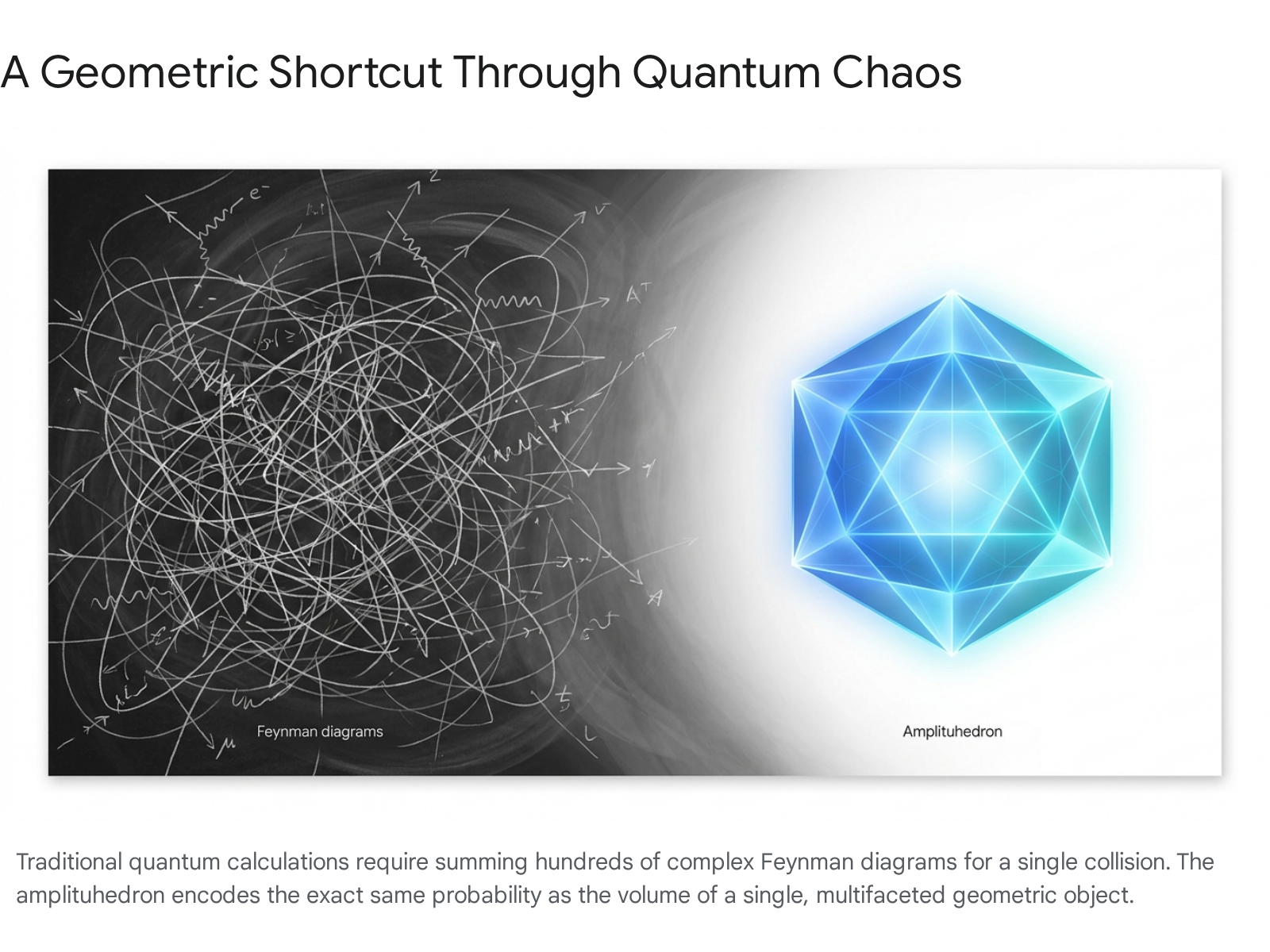
The dimensions and facets of any given amplituhedron are dictated entirely by the list of momentums of the particles that exist before and after the interaction 45. Each specific scattering process, involving a specific number of particles and internal loops, is represented by building a unique amplituhedron according to a set of geometric rules 13. The "volume" of this shape - in the abstract mathematical sense - yields the exact same amplitude that would take hundreds of pages of traditional algebra to compute 4513.
Furthermore, researchers discovered that these individual shapes might be faces on a much larger structure. Arkani-Hamed and Trnka proposed the existence of a "master amplituhedron" possessing an infinite number of facets, much like a two-dimensional circle has an infinite number of straight sides. In theory, the total volume of this master structure represents the total amplitude of all physical processes, with lower-dimensional amplituhedra living on its boundaries 5.
Bypassing Locality and Unitarity
The most philosophically jarring aspect of the amplituhedron is its relationship with the traditional pillars of physics. The geometric rules used to construct the amplituhedron make absolutely no reference to space, time, virtual particles, locality, or unitarity 254. The calculation is completely timeless and spatially disconnected.
Yet, when the volume of the shape is calculated, the resulting mathematical formulas perfectly obey the laws of locality and unitarity 27. The boundaries and singularities of the geometric shape inherently constrain the answers, ensuring probabilities sum to one and particles behave as if they interacted locally in space-time 12.
This provides a vital clue for physicists searching for a theory of quantum gravity. The amplituhedron demonstrates that it is entirely possible to formulate accurate physical laws without assuming space and time as a starting point. Locality and unitarity emerge hand-in-hand as a direct consequence of the positive geometry 27. If space and time are indeed derived concepts rather than the foundational canvas of the universe, geometric structures like the amplituhedron offer a mathematical language capable of describing the cosmos at scales where space and time no longer exist 41217.
| Concept | Traditional QFT (Feynman Diagrams) | The Amplituhedron Framework |
|---|---|---|
| Foundational Arena | Four-dimensional space-time | Momentum twistor space (Positive Grassmannians) |
| Locality | A strict, assumed prerequisite | Emergent; encoded implicitly in the geometry |
| Unitarity | A strict, assumed prerequisite | Emergent; derived from the volume's boundaries |
| Computational Method | Summing hundreds of distinct diagram integrals | Calculating the single volume of an abstract geometric object |
| Handling of Virtual Particles | Required as intermediate steps to balance math | Completely eliminated from the calculations |
The Toy Universe: Supersymmetry and Misconceptions
Despite the profound elegance of the 2013 amplituhedron, it carried a significant caveat that led to widespread misconceptions in the popular press. Many headlines claimed that a new equation had been discovered that completely rewrote the Standard Model. This was inaccurate. The original amplituhedron did not apply to the messy, real-world particles that make up our universe 410.
The mathematical tools required to construct the amplituhedron - specifically twistors and Grassmannians - only worked within the confines of a highly symmetric, hypothetical framework known as planar $\mathcal{N}=4$ supersymmetric Yang-Mills (SYM) theory 210168.
In physics, $\mathcal{N}=4$ SYM is considered a "toy theory" 108. It is an idealized, simplified version of reality that assumes the existence of supersymmetry, a hypothetical property where every known particle has a heavier, exotic partner particle 48. This theory is incredibly useful for theoretical physicists because it is the most symmetric quantum field theory possible in four dimensions that does not involve gravity 89. It boasts superconformal invariance in space-time and dual superconformal invariance in momentum space, making it a pristine proving ground for testing complex mathematical ideas without the chaotic variables of the real world 10.
However, the real universe is not maximally supersymmetric. The exotic partner particles required by $\mathcal{N}=4$ SYM have never been observed in nature, despite decades of searching with the Large Hadron Collider 10. Because the original amplituhedron was intrinsically tied to these fictional particles, some critics argued it was merely a sophisticated mathematical curiosity, completely divorced from physical reality 910.
For nearly a decade, the core challenge for Arkani-Hamed and the theoretical physics community was to strip away the crutch of supersymmetry and find analogous geometric structures that could describe the actual particles of the Standard Model 1410.
| Feature | The Standard Model (Reality) | $\mathcal{N}=4$ Supersymmetric Yang-Mills (Toy Model) |
|---|---|---|
| Supersymmetry | Not observed in nature | Assumed (Maximal supersymmetry) |
| Particle Types | Quarks, leptons, gauge bosons, Higgs | Highly symmetric, idealized particles |
| Mathematical Complexity | Extremely messy, requires renormalization | Pristine, highly symmetric, ultraviolet finite |
| Compatibility with 2013 Amplituhedron | No | Yes (Specifically in the planar limit) |
The 2024 Breakthrough: The Rise of "Surfaceology"
The long-sought bridge between abstract geometry and real-world physics finally materialized between 2023 and 2025. Physicists realized that the rigid, jewel-like polyhedrons of the original theory were just one specific manifestation of a much broader geometric framework. This new, evolved methodology is known as surfaceology 46.
The genesis of surfaceology began in the fall of 2022, when Carolina Figueiredo, a graduate student at Princeton University, uncovered a staggering mathematical conspiracy 4. Figueiredo was analyzing the scattering amplitudes of three entirely different types of subatomic particles: 1. Gluons: The real-world particles that carry the strong nuclear force, governed by Yang-Mills theory. 2. Pions: Real-world composite particles that act as messengers to hold the nuclei of atoms together. 3. Trace phi cubed ($\text{Tr}(\phi^3)$): A drastically simplified, purely theoretical scalar particle used in basic physics modeling.
These three particles play by vastly different quantum rules. There is no logical reason for their underlying mathematics to be connected 4. Yet, Figueiredo discovered that all three theories outlawed the exact same particle collisions. When calculating the amplitudes using traditional Feynman diagrams, she found that all three theories shared identical "hidden zeros" - specific kinematic constraints where the mathematical odds of an interaction taking place drop exactly to zero 4.
This massive coincidence suggested that gluons and pions were far more closely related to simple theoretical particles than anyone had previously realized 4. The rigidity of these shared hidden zeros indicated that the three distinct theories were actually different manifestations of a single, underlying geometric structure 4.
Snaking Curves on Topological Surfaces
Building on Figueiredo's discovery, Arkani-Hamed and his collaborators realized they could map particle interactions without relying on the highly symmetric spaces required by the 2013 amplituhedron. With surfaceology, physicists sidestep Feynman diagrams by using two-dimensional topological surfaces 4.
To compute an amplitude using surfaceology, physicists start by drawing a simple 2D surface. They then draw snaking, intersecting curves across this surface to explore all of its topological junctions 4. These curves, which encode the structure of the surface, completely replace the concept of particles moving along space-time trajectories. Each snaking curve on the surface acts as a bookkeeping mechanism that replaces thousands of individual Feynman diagrams 4.
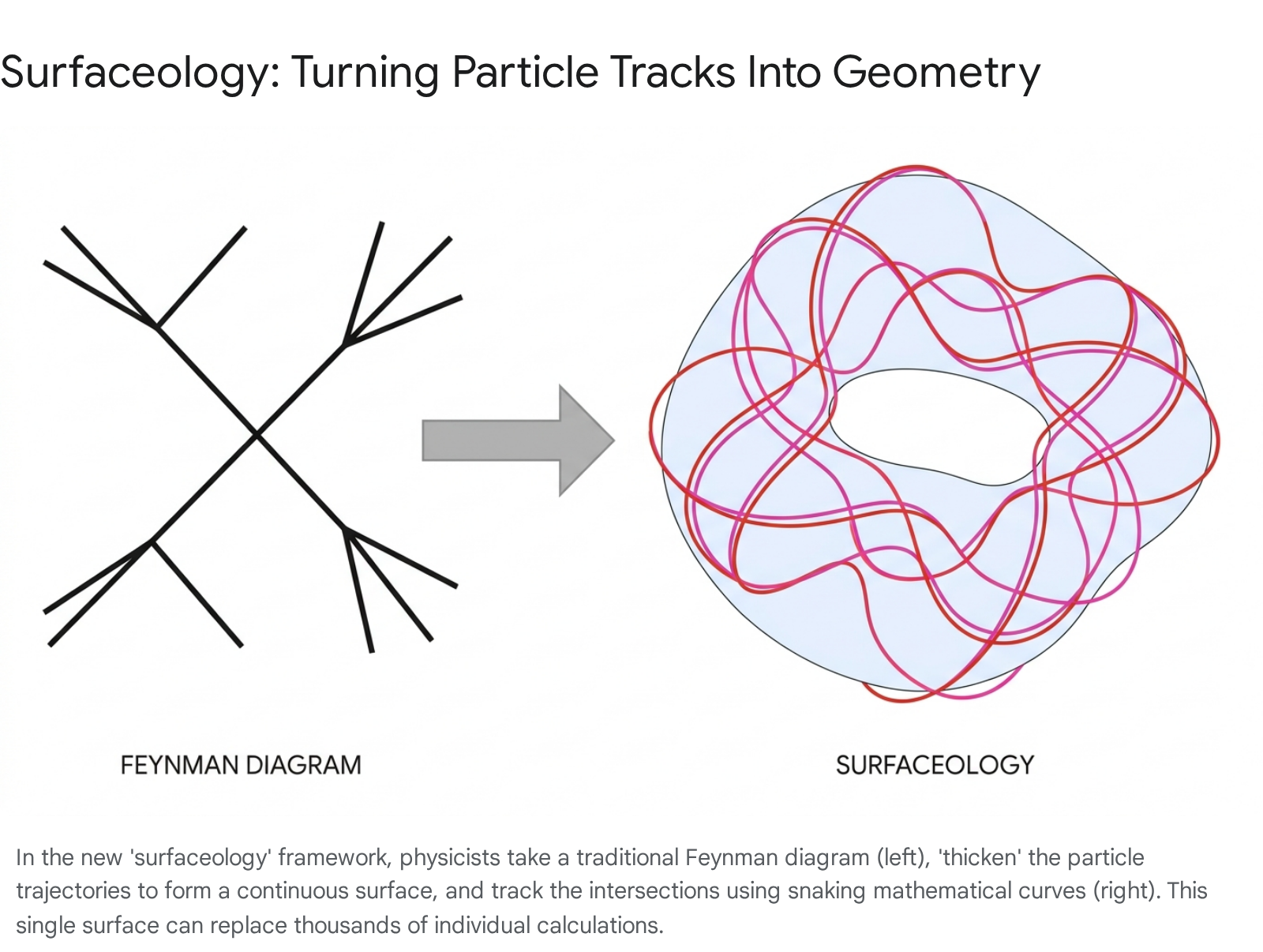
The curves are translated into sequences of mathematical polynomials, and by utilizing the "hidden zeros" identified by Figueiredo, physicists can extract the exact scattering amplitude directly from the geometry of the surface 4. There is an exponential compactification of information; a process that once required tracking countless virtual particles is streamlined into tracing curves on a flat topological object 4.
Crucially, surfaceology succeeds exactly where the original amplituhedron failed. The new mathematical language is completely agnostic to supersymmetry 4. It works perfectly for real-world particles like pions, providing a genuine geometric framework for the Standard Model that operates entirely outside the bounds of traditional space-time 4.
Expanding the Geometric Frontier
The shift toward surfaceology has triggered a flurry of new theoretical developments, expanding the geometric program far beyond massless bosons (particles that carry forces).
In 2024, a research group at Brown University - including Marcus Spradlin, Anastasia Volovich, and Marcos Skowronek - successfully extended the curve integral formalism of surfaceology to accommodate fermionic matter 41011. Fermions, such as electrons and quarks, are the fundamental building blocks of matter and feature a half-integer spin, making their mathematical behavior distinct from force-carrying bosons. By developing "colored Yukawa theory" within the surfaceology framework, the Brown University team presented a compact formula for all-loop, all-multiplicity amplitude integrands involving fermions 101122. This demonstrates that the timeless geometric approach can be generalized to handle the fundamental matter that makes up the tangible universe 412.
Simultaneously, researchers are exploring how to apply these geometric concepts to entire cosmological systems. Recent papers spearheaded by Arkani-Hamed's collaborators have proposed scaling up the geometric construct to formulate the "cosmohedron" 24. This ambitious framework attempts to describe the wave function of the entire early universe, reorganizing cosmological equations to encode the quantum state of the cosmos without relying on local time evolution 24. While the cosmohedron remains more of a mathematical hypothesis for organizing calculations than a finalized theory, it represents a profound attempt to understand the Big Bang through the lens of positive geometry 1624.
The Road to Quantum Gravity
Perhaps the most exciting aspect of surfaceology is what happens when physicists push the mathematics to its limits. When researchers allow the 2D surface to feature topological "holes," the snaking curves that define the particle interactions no longer exit the surface. Instead, they circle around the holes infinitely 4.
From a mathematical perspective, these infinite, closed loops do not describe point-like particles colliding. They describe the tangled interactions of vibrating closed strings 425. This provides an unexpected and direct bridge between surfaceology and string theory, which has long been the leading candidate for a theory of quantum gravity 4.
In physics, closed strings are theorized to constitute gravitons, the hypothetical elementary particles that carry the gravitational force 425. Standard quantum field theory has repeatedly failed to incorporate gravitons because forcing them into Feynman diagrams inevitably leads to mathematical infinities 5. However, the framework of surfaceology naturally gives rise to string-like mathematics without breaking down. As Arkani-Hamed noted, the formalism appears to contain string theory but allows physicists to do significantly more with it 4.
This connection is further reinforced by recent research into the "double copy" phenomenon, spearheaded by physicists like Shruti Paranjape 4. The double copy is a mathematical quirk where the amplitudes of gravity can be calculated by essentially squaring the amplitudes of gluons 1013. Because surfaceology successfully unifies the geometric origins of gluons and scalars via their shared hidden zeros, it provides a cleaner, more rigorous mathematical foundation for utilizing the double copy to derive the behavior of gravitons 413.
While a complete, working picture of quantum gravity remains elusive, surfaceology provides researchers with a robust mathematical language that naturally accommodates both the particles of the Standard Model and the gravitational mechanics of string theory 4.
Bottom line
The amplituhedron and its modern successor, surfaceology, represent a monumental shift in theoretical physics, offering a way to calculate complex subatomic interactions purely through abstract geometry. By discarding Feynman diagrams, virtual particles, and the rigid grid of space and time, physicists can reduce thousands of pages of algebra into elegant geometric equations. While this mathematical program is still evolving to fully incorporate gravity, its ongoing success in describing real-world particles strongly suggests that space, time, and locality are not the fundamental bedrock of the universe, but rather illusions emerging from a deeper mathematical reality.