AdS/CFT Correspondence
Theoretical Foundations of the Holographic Duality
The Anti-de Sitter/Conformal Field Theory (AdS/CFT) correspondence represents a profound paradigm shift in theoretical physics, providing the most mathematically rigorous realization of the holographic principle to date. Formulated initially by Juan Maldacena in 1997, the conjecture postulates an exact equivalence between two distinct physical frameworks: a theory of quantum gravity operating within an asymptotically Anti-de Sitter (AdS) spacetime, and a Conformal Field Theory (CFT) situated on the lower-dimensional asymptotic boundary of that space 1.
The correspondence asserts that all information required to describe the higher-dimensional gravitational bulk is perfectly encoded in the lower-dimensional boundary field theory, mirroring the mechanism of an optical hologram 1. This duality provides a non-perturbative formulation of string theory under specific boundary conditions, circumventing the mathematical intractability of strongly coupled quantum gravity by translating it into the language of conformal field theories 12.
The Geometric and Kinematic Match
The kinematic backbone of the AdS/CFT correspondence relies on the exact matching of global symmetries between the bulk and boundary theories. For a $d$-dimensional conformal field theory, the conformal symmetry group is $SO(d, 2)$. Remarkably, the isometry group of a $(d+1)$-dimensional Anti-de Sitter space is precisely $SO(d, 2)$ 34. This symmetry alignment guarantees that operators in the boundary theory transform identically to fields in the bulk theory under the shared symmetry group.
Furthermore, the extra spatial dimension in the AdS bulk operates as a geometric realization of the renormalization group (RG) energy scale in the boundary CFT. The standard Poincaré metric for AdS space is defined as $ds^2 = \frac{L^2}{z^2}(dz^2 + \eta_{\mu\nu}dx^\mu dx^\nu)$, where $L$ is the AdS radius, $\eta_{\mu\nu}$ is the Minkowski metric, and $z$ is the radial coordinate 5. The boundary of the AdS space is located at $z \to 0$, which corresponds to the extreme ultraviolet (UV) limit of the CFT. Moving deeper into the bulk by increasing $z$ corresponds to flowing toward the infrared (IR) energy scale of the boundary theory 36. Consequently, bulk gravitational dynamics naturally map to the renormalization flow of the dual quantum field theory.
The Weak-Strong Coupling Paradigm
The computational utility of AdS/CFT is massively amplified by its nature as a strong-weak duality. When the fields of the boundary quantum field theory are strongly interacting, the corresponding fields in the bulk gravitational theory are weakly interacting, reducing the complex quantum string theory to classical supergravity 17. Conversely, when the field theory is weakly coupled and amenable to standard perturbative methods, the dual bulk theory enters a highly quantum, strongly coupled string regime.
This feature allows physicists to probe strongly coupled gauge theories by translating intractable quantum problems into classical gravity calculations. The duality operates fundamentally in the planar limit, where the number of color charges $N$ in the $SU(N)$ gauge group approaches infinity 38. Keeping the 't Hooft coupling $\lambda = g_{YM}^2 N$ fixed as $N \to \infty$ suppresses quantum string loop effects by factors of $1/N$, causing the field theory to become dominated by planar Feynman diagrams and the dual string theory to become classical 38.
The Canonical Example: N=4 Super Yang-Mills
The most thoroughly investigated iteration of the correspondence equates Type IIB superstring theory on the product space $AdS_5 \times S^5$ with $\mathcal{N}=4$ supersymmetric Yang-Mills (SYM) theory in four spacetime dimensions 789. This specific duality arises from examining the near-horizon geometry of a stack of $N$ coincident D3-branes in ten-dimensional string theory 8910.
Field Content and Exact Conformal Invariance
$\mathcal{N}=4$ SYM is a relativistic Lagrangian gauge theory characterizing the interactions of fermions via gauge field exchanges. It features the maximal number of supersymmetries allowable for a theory without gravity (spin less than or equal to 1). The field content consists of one vector field (the spin-1 gauge boson), four spinor fields (spin-1/2 fermions), and six scalar fields (spin-0 bosons), totaling 11 distinct fields related by the supersymmetry generators 910.
Crucially, the one-loop beta function of this theory vanishes exactly. The calculation yields $b_0 = (\frac{11}{3} - \frac{8}{3} - 1)C_A = 0$, and supersymmetry strengthens this cancellation to all orders in perturbation theory 9. Consequently, $\mathcal{N}=4$ SYM is an exact conformal field theory with no intrinsic mass scale on $\mathbb{R}^{1,3}$. The $SU(4)$ R-symmetry of the $\mathcal{N}=4$ SYM theory matches the $SO(6)$ isometry of the $S^5$ sphere in the bulk geometry, fully aligning the internal symmetries across the dual spaces 489.
Integrability and Non-Perturbative Validation
While the AdS/CFT correspondence remains a mathematical conjecture without a formal proof applicable to all coupling regimes, $\mathcal{N}=4$ SYM has provided the most stringent validation of the duality through the property of integrability 101112. In the planar limit, the theory becomes completely integrable, possessing an infinite number of non-local conserved charges equivalent to a solvable spin chain model 1114.
This integrability permits researchers to bypass standard perturbation theory and calculate quantities across the full parameter space of the coupling constant. For example, the anomalous conformal dimension of the Konishi operator - the simplest observable not protected by supersymmetry - has been computed up to eight loops using the Thermodynamic Bethe Ansatz (TBA) 11. The results derived from the gauge theory precisely match the estimations derived from the dual string theory at moderate coupling values, confirming the duality's predictions far beyond standard limits 11.
The GKPW Dictionary and Operator Mapping
To utilize the correspondence, theorists established a precise mathematical lexicon to translate physical observables between the two domains. This framework is universally known as the Gubser-Klebanov-Polyakov-Witten (GKPW) dictionary, which asserts that the generating functional of the CFT (the partition function) is mathematically identical to the bulk partition function of the gravitational theory evaluated under specific asymptotic boundary conditions 1415.
Boundary Conditions and Generating Functionals
In quantum field theory, the partition function $Z_{CFT}[J]$ incorporates a source field $J$ that couples to a gauge-invariant local operator $\mathcal{O}$. Taking functional derivatives of this partition function with respect to the source yields the correlation functions of the operator.
The GKPW prescription dictates that the non-normalizable asymptotic value of a bulk field $\Phi$ near the AdS boundary acts precisely as the source field $J$ for the dual operator $\mathcal{O}$ in the CFT 41516. Mathematically, this is expressed as $Z_{bulk}[\Phi|{\partial AdS} = \phi_0] = \langle \exp ( \int d^d x \phi_0 \mathcal{O} ) \rangle{CFT}$, where the left side evaluates the classical supergravity action given the boundary condition $\phi_0$, and the right side represents the quantum field theory path integral 4513. By solving classical wave equations in the AdS bulk and extracting their boundary behavior, physicists can compute $n$-point correlation functions for strongly coupled CFTs 2414.
Core Dictionary Mappings
The field-to-operator map establishes strict correlations between bulk phenomena and boundary data. The following table summarizes the primary entries in the AdS/CFT dictionary.
| Bulk Gravity Concept ($d+1$ dimensions) | Boundary CFT Concept ($d$ dimensions) | Phenomenological Mapping |
|---|---|---|
| Radial Position $z$ | RG Scale $\mu$ | Maps boundary energy scale to bulk spatial depth ($z \sim 1/\mu$) 36. |
| Classical Bulk Field $\Phi$ | Local Operator $\mathcal{O}$ | Operator insertions map to bulk field excitations 34. |
| Bulk Gauge Field $A_M$ | Conserved Current $J^\mu$ | Equates global boundary symmetries to local bulk gauge symmetries 23. |
| Bulk Metric $g_{MN}$ | Stress Tensor $T_{\mu\nu}$ | Connects the boundary energy-momentum to bulk spacetime curvature 23. |
| Bulk Gauge Potential at Boundary $A_t^{(0)}$ | Chemical Potential $\mu$ | Enables the study of finite-density phases and thermodynamics 315. |
| Classical Bulk Saddle | CFT State/Ensemble | Maps pure AdS to the vacuum, and bulk black holes to thermal states 320. |
| Bulk Quantum Loops ($G_N$) | $1/N$ Expansion Effects | Controls quantum gravitational corrections versus planar limits 38. |
| Stringy $\alpha'$ Corrections | $1/\sqrt{\lambda}$ Expansion Effects | Maps string theory phenomena to boundary coupling dynamics 3. |
Quantum Information and Spacetime Geometry
Beyond scattering amplitudes and correlation functions, the AdS/CFT correspondence has fundamentally rewritten the theoretical approach to quantum information. The duality suggests that the architecture of spacetime is an emergent property constructed from quantum entanglement.
The Ryu-Takayanagi Prescription
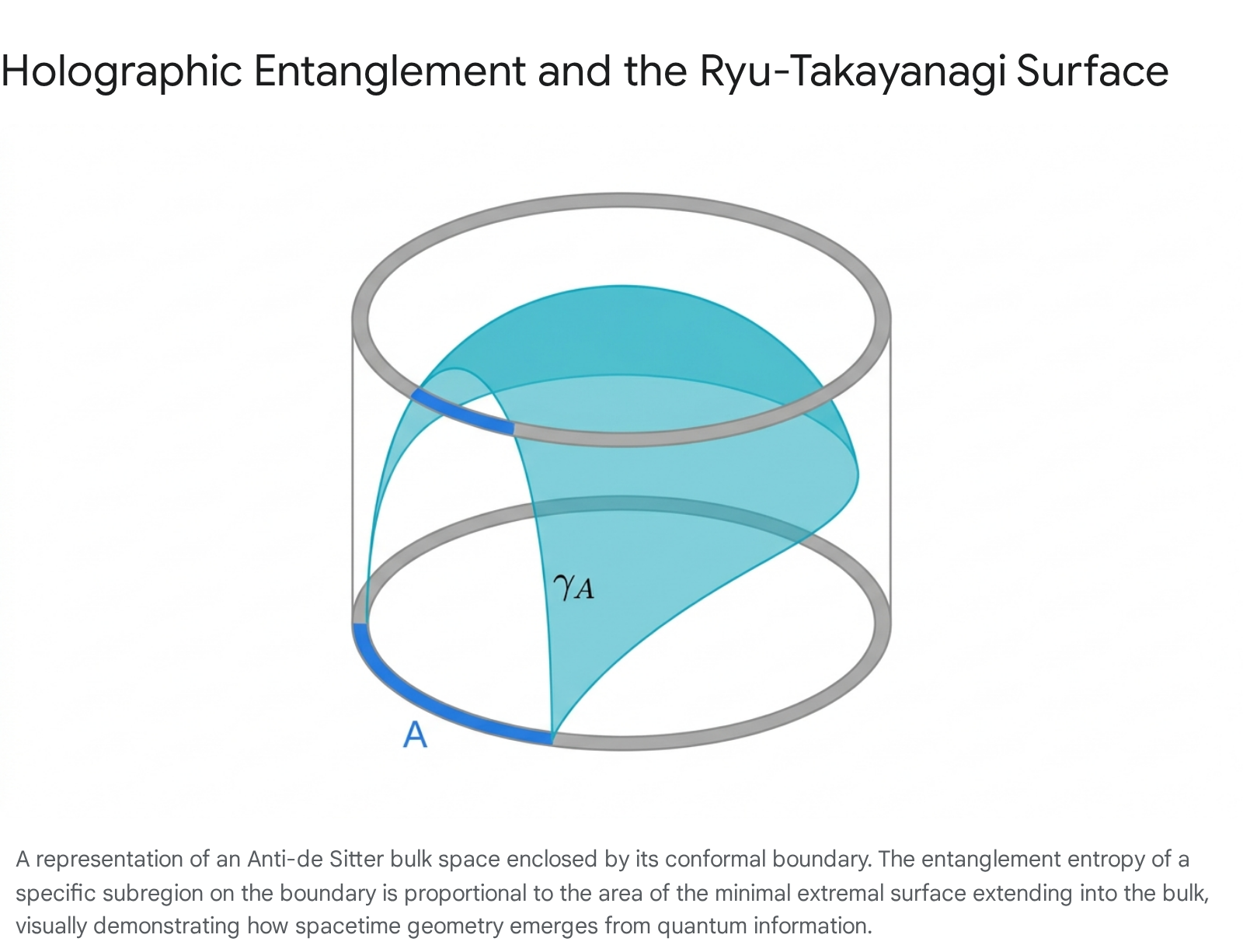
In 2006, Shinsei Ryu and Tadashi Takayanagi proposed a geometric formula to calculate the von Neumann entanglement entropy of a spatial subregion $A$ in the boundary CFT. They demonstrated that the entanglement entropy $S_A$ is directly proportional to the area of the minimal extremal surface $\gamma_A$ in the bulk AdS spacetime that shares the same boundary as the subregion $A$ 32122.
This relationship is formalized as $S_A = \text{Area}(\gamma_A) / 4G_N$, where $G_N$ is the bulk Newton constant. The Ryu-Takayanagi (RT) formula parallels the Bekenstein-Hawking entropy formula for black holes, extending the concept to generalized spatial geometries 32223. For dynamical, time-dependent spacetimes, the formula was extended by Hubeny, Rangamani, and Takayanagi (HRT) to utilize extremal rather than strictly minimal surfaces 321.
Subregion Duality and the Entanglement Wedge
The RT formula implies a deeper principle known as subregion duality. If the entropy of boundary region $A$ is defined by the bulk surface $\gamma_A$, then the specific density matrix of region $A$ must encode all bulk operators located within the spatial region enclosed between $A$ and $\gamma_A$. This enclosed bulk volume is termed the "entanglement wedge" 241617. The Jafferis-Lewkowycz-Maldacena-Suh (JLMS) relation further solidified this, proving that the relative entropy between two states in the boundary subregion exactly equals the relative entropy of the corresponding states in the bulk entanglement wedge 5.
Quantum Error Correction in Holography
As researchers investigated subregion duality, a conceptual paradox emerged regarding bulk locality. A single operator located deep in the central bulk of the AdS space can be reconstructed from the boundary CFT in multiple, redundant ways. If a specific spatial section of the boundary is erased or ignored, the central bulk operator can still be perfectly reconstructed using the remaining boundary regions 2216.
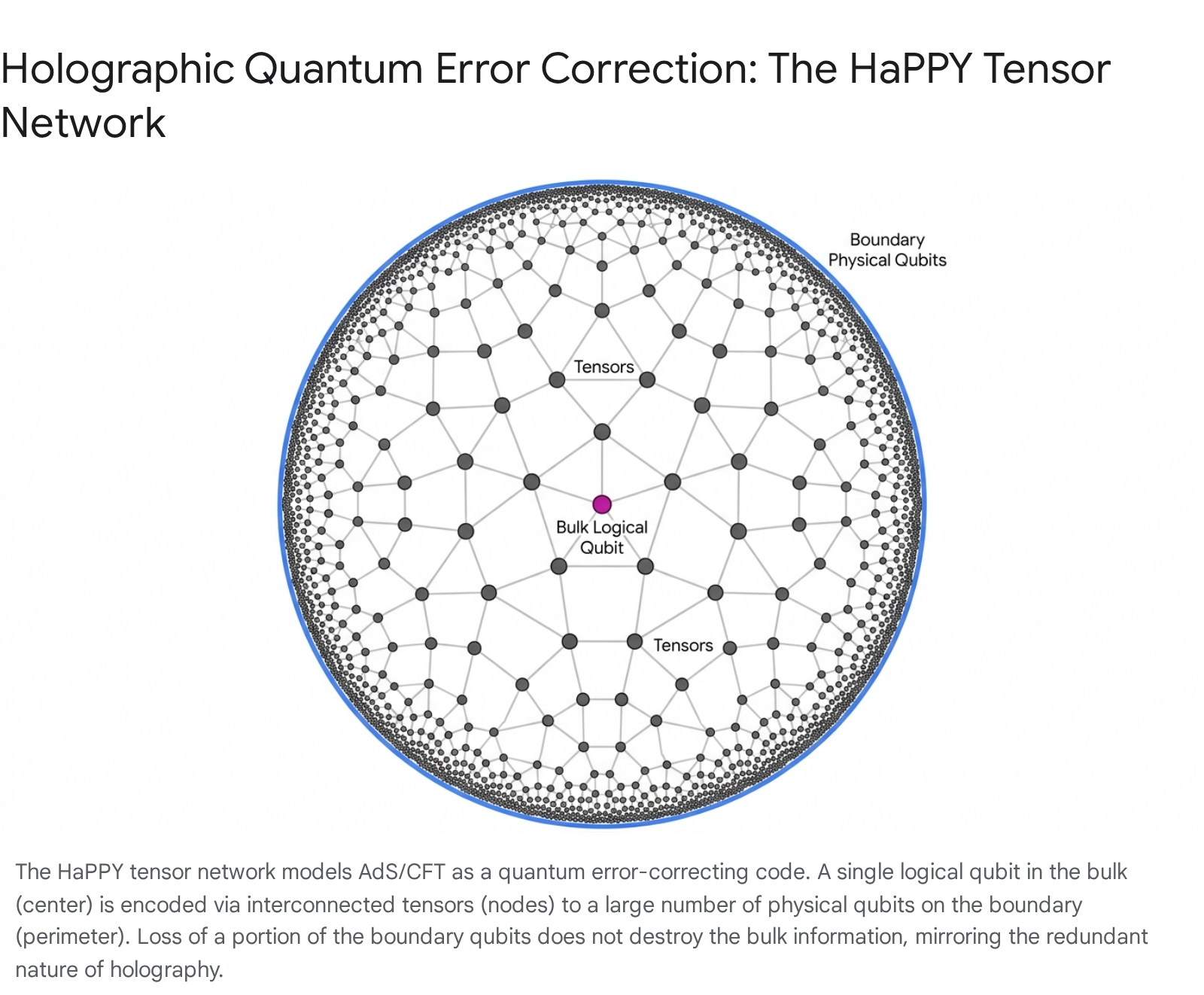
In 2014, physicists Almheiri, Dong, and Harlow demonstrated that this redundancy is not an anomaly, but a structural feature identical to Quantum Error Correction (QEC) protocols 1618. The mapping from the semiclassical bulk effective theory to the exact boundary degrees of freedom inherently possesses the algebraic properties of a quantum error-correcting code, designed to protect fragile quantum information by encoding a single "logical" qubit across multiple highly entangled "physical" qubits 221628.
Tensor Networks and the HaPPY Code
To model this error-correcting nature, theorists developed holographic tensor networks, most notably the HaPPY code (named after Pastawski, Preskill, Harlow, and Yoshida). The HaPPY code uses a hyperbolic tiling of pentagon tensors to discretize the bulk-to-boundary mapping 22.
Each pentagon tensor acts as a $[[5,1,3]]$ stabilizer code - a perfect tensor that takes a central bulk logical qubit and encodes it onto five outward-facing indices. Through successive concatenation, this network creates a discrete realization of the AdS space 2224. The tensor network explicitly demonstrates that a central bulk operator can be reconstructed as long as a sufficient fraction of the boundary physical qubits are preserved, mathematically proving that holography utilizes erasure correction 22.
Hyperinvariant Networks and Evenbly Codes
Recent theoretical advancements in 2024 and 2025 expanded on these models by introducing hyperinvariant holographic codes. A prominent subclass, known as Evenbly codes, demonstrated that holographic tensor networks do not strictly require perfect tensors. Constructed from simpler subsystem Calderbank-Shor-Steane (CSS) codes combined with Hadamard gates on a hyperbolic ${p,q}$ geometry, Evenbly codes allow for dynamic gauge-fixing 29. This enables highly tunable error thresholds, achieving a depolarizing noise threshold of approximately 19.1% and proving highly resilient to pure Pauli and erasure channels 29.
Practical Applications in Quantum Computing Architectures
The abstract mathematics of holographic quantum error correction has directly catalyzed hardware engineering breakthroughs in practical quantum computing. Throughout 2024 and 2025, the quantum technology sector utilized QEC principles derived from theoretical physics to suppress noise exponentially below necessary thresholds 1931.
Fault-Tolerant Logical Qubits
Traditional 2D surface codes, while effective, require substantial overhead - often necessitating hundreds or thousands of physical qubits to sustain a single stable logical qubit 3120. However, recent implementations of Low-Density Parity-Check (LDPC) codes by IBM and neutral atom arrays by QuEra Computing achieved major milestones. QuEra demonstrated a quantum processor sustaining 48 logical qubits with distance-7 protection, capable of real-time fault-tolerant operations 1933. Google Quantum AI also achieved exponential error suppression using 105 superconducting qubits on their Willow processor, functioning entirely below the break-even threshold 19.
Four-Dimensional Geometric Codes
The most direct translation of holographic geometry into hardware occurred in mid-2025, when Microsoft unveiled a family of four-dimensional (4D) geometric codes 21. Drawing explicitly on high-dimensional topological invariants, these codes recreate the topography of quantum processing surfaces on a 4D toroidal lattice 2237.
By projecting the error topologies into four dimensions, the codes extract error information in a single, constant-time cycle (single-shot error correction), entirely bypassing the multi-round measurement bottlenecks of 2D surface codes 20. Deployed on neutral-atom hardware developed by Atom Computing, these 4D geometric codes yielded a 1,000-fold reduction in physical error rates, slashing the physical-to-logical qubit overhead ratio by a factor of five and paving the way toward utility-scale fault tolerance 20.
Condensed Matter Physics and the Strange Metal Phase
While initially intended as a theory of quantum gravity, the AdS/CFT correspondence has provided unprecedented tools for condensed matter physics, a field heavily reliant on understanding strongly correlated many-body systems 232425. Conventional metals and interacting electrons are well-described by Landau's Fermi liquid theory, which treats complex electron interactions as weakly interacting "quasiparticles" 2642. However, certain exotic phases of matter lack stable quasiparticles and cannot be analyzed perturbatively 1542.
Hydrodynamics of the Quark-Gluon Plasma
One of the first major successes of applied holography (often termed AdS/CMT or AdS/QCD) was modeling the quark-gluon plasma generated in heavy-ion collisions at the Relativistic Heavy Ion Collider (RHIC) and the Large Hadron Collider (LHC) 2325. The plasma behaves as an ultra-low viscosity, strongly coupled fluid. By translating the fluid dynamics into the gravitational dynamics of an excited black hole horizon in an AdS bulk, string theorists calculated a universal lower bound for the ratio of shear viscosity to entropy density: $\eta/s \ge 1/4\pi$ 27. Experimental measurements from the RHIC matched this theoretical bound remarkably well, proving that black hole thermodynamics could accurately model real-world nuclear plasmas 2325.
Holographic Models of Strange Metals
A more enduring challenge in condensed matter physics is the "strange metal" phase observed in high-temperature cuprate superconductors, iron pnictides, and heavy-fermion compounds 2426. Unlike ordinary Fermi liquids, where electrical resistivity scales quadratically with temperature ($T^2$), strange metals exhibit a linear-in-temperature ($T$-linear) resistivity and linear-in-field ($H$-linear) magnetoresistance down to absolute zero 2644. Furthermore, charge carriers in strange metals dissipate energy at the "Planckian bound" ($\hbar/\tau = \alpha k_B T$), the absolute maximum rate permitted by the laws of quantum mechanics 4428.
Holographic techniques attempted to describe this phase by placing charged Reissner-Nordström black holes into the AdS bulk, establishing a finite chemical potential for the boundary theory 61527. Analyzing the Dirac equation for bulk fermions in this geometry yielded non-analytic scaling behaviors and non-Fermi liquid spectral functions at the boundary, successfully replicating the absence of stable quasiparticles 15.
| Phenomenological Characteristic | Standard Fermi Liquid Theory | Strange Metal Phase (Holographic / SYK Models) |
|---|---|---|
| Dominant Excitations | Stable Quasiparticles | No well-defined quasiparticles 42 |
| Low-Temperature Resistivity | Quadratic ($T^2$ dependence) | Linear ($T$-linear dependence) 2644 |
| High-Field Magnetoresistance | Quadratic ($H^2$ dependence) | Linear ($H$-linear dependence) 26 |
| Scattering/Dissipation Rate | Highly material-dependent | Universal Planckian limit ($\hbar/\tau = \alpha k_B T$) 2744 |
| Theoretical Architecture | Standard perturbative QFT | Emergent IR CFT / Charged AdS Black Holes 615 |
Universal Mechanisms and the SYK Paradigm
While holographic black holes replicated strange metallic features, defining the exact microscopic mechanisms remained difficult due to the generalized nature of the duality 23. However, the study of the Sachdev-Ye-Kitaev (SYK) model - a solvable 0+1 dimensional quantum mechanical model featuring random all-to-all interactions - provided the missing link 4629. The SYK model shares the same low-energy emergent symmetries as near-extremal black holes ($AdS_2$ geometries), establishing a direct bridge between holographic gravity and condensed matter lattices 3049.
In 2023 and 2024, researchers Aavishkar Patel, Subir Sachdev, and colleagues published a landmark unified theory resolving the strange metal problem 463151. By evaluating a minimal microscopic model informed by SYK concepts, they proved that $T$-linear resistivity and Planckian dissipation arise simultaneously from the dynamic coupling of Fermi surface electrons to nearly critical bosonic order parameters, combined with static spatial disorder 443151. The irregularity in the atomic layout adds randomness to the electron momentum; as temperatures rise, the electrons scatter isotropically at the quantum limits of entanglement, perfectly explaining the linear resistance 4431.
The Black Hole Information Paradox and ER=EPR
The structural insights of AdS/CFT have profoundly impacted the study of black hole thermodynamics, specifically addressing Stephen Hawking's information paradox. Hawking's calculations in the 1970s demonstrated that black holes emit thermal radiation and eventually evaporate. If this radiation is purely thermal, the quantum information of the matter that formed the black hole is permanently destroyed, directly violating the unitary evolution required by quantum mechanics 4232.
Thermofield Double States and Wormhole Geometry
In 2013, Juan Maldacena and Leonard Susskind proposed the ER=EPR conjecture, an operational framework suggesting that quantum entanglement (Einstein-Podolsky-Rosen paradox) and spatial connectivity (Einstein-Rosen bridges) are mathematically and physically identical 235333.
The clearest holographic realization of this is the thermofield double (TFD) state. If one prepares two non-interacting boundary CFTs in a maximally entangled TFD state, the exact gravitational dual of this system is an eternal, two-sided AdS black hole 3435. Despite the two boundary field theories having no direct coupling or communication channel, their dual bulk geometry features a smooth, non-traversable Einstein-Rosen bridge connecting the two black hole interiors 203435.
The Island Formula and the Page Curve
To resolve the information paradox, theoretical physicists tracked the flow of von Neumann entropy during a black hole's evaporation process using holographic entanglement techniques 32. Building upon the Ryu-Takayanagi framework, researchers developed the generalized gravitational entropy formula, frequently referred to as the "island formula" 323658.
The island formula dictates that the entanglement wedge of the escaping Hawking radiation does not remain confined to the exterior spacetime. After the black hole reaches its half-life (the Page time), the radiation becomes so highly entangled with the interior degrees of freedom that its entanglement wedge expands to include isolated regions - "islands" - deep inside the black hole 3235. Because the radiation's entanglement wedge includes the interior geometry, the quantum information of the infalling matter is encoded directly within the radiation. Consequently, information is conserved, and the black hole acts as a complex quantum mirror rather than an information destroyer 4232.
Einstein-Rosen Caterpillars and Interior Complexity
While the island formula mathematically preserves unitarity, the geometric reality of the black hole interior remained intensely debated. Prominent arguments suggested that as a black hole ages and its quantum state becomes maximally randomized, the smooth spacetime at the event horizon might break down into high-energy "firewalls" 3337.
In late 2025, physicists Magán, Sasieta, and Swingle published a breakthrough analysis in Physical Review Letters, countering the firewall hypothesis by demonstrating the existence of "Einstein-Rosen caterpillars" 333861. By constructively sampling ensembles of typical entangled black hole states, they proved that black hole interiors do not terminate in firewalls but rather manifest as vast, tangled networks of semiclassical wormholes populated by massive matter inhomogeneities 3339.
The researchers formalized a strict "complexity = geometry" relationship, demonstrating that the more chaotic and random the quantum entanglement state, the longer and more topographically deformed the internal wormhole throat becomes 6139. This confirms that the ER=EPR conjecture holds true even in the most complex quantum regimes, maintaining coherent, albeit highly convoluted, spacetime interiors 3363.
Experimental Constraints via Hydrogen Hyperfine Structure
Although ER=EPR originated as a theoretical concept dealing with macroscopic black holes and Planck-scale geometry, recent literature proposes testable operational parameters. A 2025 study by Javed et al. identified a novel methodology to test the ER=EPR conjecture using the standard hydrogen atom 64.
The theoretical model assumes that if entangled particles are connected by microscopic quantum wormholes, a fraction of the electric field surrounding an entangled charged particle will leak into the wormhole's throat 64. If the wormhole is non-traversable, this leakage must result in a non-zero total effective charge for the hydrogen atom, concurrently modifying its hyperfine structure 64. High-precision atomic measurements can now be utilized to place severe empirical constraints on the amplitude of wormhole-mediated entanglement, bridging the gap between holographic conjectures and laboratory physics 64.
Cosmological Limitations and Horizonless Alternatives
Despite its unparalleled success in resolving thermodynamic paradoxes and providing insights into strongly coupled field theories, the AdS/CFT correspondence suffers from strict geometric limitations that complicate its application to physical cosmology.
The de Sitter Space Challenge
The foundational limitation of the AdS/CFT correspondence is its strict reliance on a negatively curved background with a negative cosmological constant. Observational data confirms that our universe possesses a positive vacuum energy density and is undergoing accelerated expansion, characterizing it as a de Sitter (dS) space rather than an Anti-de Sitter space 212265.
Translating the holographic dictionary into a dS/CFT correspondence has proven uniquely problematic. In AdS space, the conformal boundary is located at spatial infinity, acting as a static "box" that perfectly contains the unitary field theory 6540. Conversely, in de Sitter space, the conformal boundary exists at temporal infinity - the infinite future or past. A boundary theory localized at the end of time forces the dual field theory into a non-unitary framework 21. Furthermore, holographic entanglement entropy computations fail to translate smoothly. Attempting to anchor a Ryu-Takayanagi surface to two boundary points in dS space results in a timelike geodesic rather than a spacelike surface, yielding a complex-valued entropy measure that breaks standard subregion duality 21.
Gravastars and Nested Anisotropic Solutions
Due to the tensions between quantum unitarity and gravitational singularities, researchers continue to explore horizonless alternatives to classical black holes that bypass the information paradox entirely. In 2001, Mazur and Mottola proposed the gravastar (gravitational vacuum star) - a compact object featuring a dark energy (de Sitter) interior surrounded by a thin shell of stiff matter, removing the singularity and the event horizon 636741.
In 2024, theoretical exploration of these entities expanded significantly with the discovery of "nestar" solutions by Jampolski and Rezzolla 674169. By introducing anisotropic transverse stresses, researchers mathematically demonstrated the viability of nested gravastars - multiple shells of stiff matter alternating with dark energy vacuums, layered sequentially like Russian matryoshka dolls 636769. These multi-layer nestars can theoretically achieve a compactness factor arbitrarily close to that of a Schwarzschild black hole while remaining completely singularity-free and thermodynamically stable 6769. Whether the physical universe resolves the paradox of gravitational collapse through the formation of "Einstein-Rosen caterpillars" inside genuine event horizons or through the phase transitions required to stabilize "nestars" remains a subject of intense investigation.