
Topological quantum field theory
Foundational concepts and physical origins
Topological quantum field theory (TQFT) resides at the convergence of theoretical high-energy physics and pure mathematics. Functioning as a quantum field theory that explicitly computes topological invariants of its underlying spacetime manifolds, it differs fundamentally from standard quantum field theories 12. Conventional physical frameworks - such as the Standard Model of particle physics or classical general relativity - rely heavily on the local geometric structures of spacetime, predominantly the pseudo-Riemannian metric 13. In a topological quantum field theory, however, correlation functions and macroscopic physical observables remain invariant under continuous deformations of the spacetime manifold 14.
The physical motivation for developing TQFT originated in the late 20th century as physicists sought to circumvent the mathematical infinities that conventionally plague Feynman path integral formulations 4. Furthermore, theoretical physics required background-independent mathematical frameworks to lay the groundwork for quantum gravity 4. Because a TQFT evaluated on a flat Minkowski spacetime yields entirely trivial invariants - since Minkowski space can be continuously contracted to a point - these theories are primarily studied on curved spacetimes and compact topological manifolds 1.
The known topological field theories are generally divided into two distinct formal classes based on the specific mathematical mechanisms they utilize to achieve metric independence: Schwarz-type (or Chern-Simons type) and Witten-type (or cohomological type) 135.
Schwarz-type topological quantum field theories
In a Schwarz-type TQFT, the classical action functional of the theory is explicitly independent of the spacetime metric $g_{\mu\nu}$ from the outset 3. Discovered initially by Albert Schwarz, classical examples of these theories include Chern-Simons theory and BF theory 356.
Because the classical action $S$ does not contain the metric tensor, the stress-energy tensor $T_{\mu\nu}$ - which is formally defined in physics as the variational derivative of the action with respect to the metric, $T_{\mu\nu} = \delta S / \delta g_{\mu\nu}$ - evaluates to exactly zero 37. The vanishing of the stress-energy tensor dictates that the Hamiltonian of the system is zero. Consequently, there are no local propagating degrees of freedom, such as local particle excitations, photons, or gravitons 78. The only remaining degrees of freedom in the system are global and topological 3.
In three-dimensional spacetime, Chern-Simons theories provide a profound physical framework for the mathematical study of knots and links 36. Because the theory's observables are explicitly metric-independent operators, their expectation values are completely determined by the global topology of the manifold and the topological embedding of any gauge fields or defects within it 3.
Witten-type topological quantum field theories
Witten-type TQFTs, frequently referred to as cohomological field theories, achieve metric independence through a significantly different algebraic mechanism 13. Introduced by Edward Witten in 1988, these theories often begin with an action functional that explicitly contains the spacetime metric $g_{\mu\nu}$ 1. However, the system is engineered to possess a specific nilpotent symmetry operator $Q$, often functioning as a Becchi-Rouet-Stora-Tyutin (BRST) operator, which satisfies the mathematical property $Q^2 = 0$ 13.
In a Witten-type theory, the stress-energy tensor is mathematically "$Q$-exact," meaning it can be expressed as the anti-commutator $T_{\mu\nu} = {Q, G_{\mu\nu}}$ for some underlying tensor $G_{\mu\nu}$ 139. In the quantum mechanical formulation of the theory, physical states are defined strictly as the cohomology classes of the operator $Q$. These are states that are annihilated by $Q$ but cannot be written as $Q$ acting on another state. Because the stress-energy tensor is $Q$-exact, its expectation value in any physical, physical state inherently evaluates to zero 39. This guarantees that the macroscopic correlation functions of the theory do not depend on the continuous deformations of the metric 9.
Witten-type theories frequently arise from the "topological twisting" of supersymmetric quantum field theories 81011. For instance, a twisted version of four-dimensional $\mathcal{N}=2$ supersymmetric Yang-Mills theory computes the Donaldson polynomial invariants of smooth four-manifolds 38. Similarly, the topological twisting of two-dimensional supersymmetric sigma models yields the A-model and B-model TQFTs, which serve as the foundation for homological mirror symmetry and string theory amplitudes 1012.
Formal comparison of TQFT paradigms
While both paradigms yield metric-independent topological invariants, their underlying mathematical machinery and physical origins differ significantly, as summarized below.
| Feature | Schwarz-type TQFT | Witten-type (Cohomological) TQFT |
|---|---|---|
| Action functional | Explicitly independent of the spacetime metric $g_{\mu\nu}$ 3. | Contains the metric $g_{\mu\nu}$, but is invariant under a nilpotent BRST operator $Q$ 13. |
| Stress-energy tensor ($T_{\mu\nu}$) | Exactly zero ($T_{\mu\nu} = 0$) at the classical and quantum levels 37. | $Q$-exact ($T_{\mu\nu} = {Q, G_{\mu\nu}}$), ensuring its expectation values vanish 139. |
| Origins | Gauge theories with metric-independent forms (e.g., Chern-Simons, BF theory) 35. | Topological twisting of supersymmetric field theories 1011. |
| Observables | Wilson loops, knot operators, linking numbers 313. | Cohomological classes, Donaldson invariants of 4-manifolds 3. |
| Degrees of freedom | Purely topological; no local propagating particles 38. | Encodes intersection theory on moduli spaces; ground states defined by $Q$-cohomology 812. |
There is ongoing theoretical discussion regarding how these two types map onto formal mathematical axioms. In the physical formulation, a TQFT assigns Hilbert spaces with inherent Hermitian structures inherited from the underlying physical field theory 11. In Witten-type TQFTs, insisting on an inherited Hilbert space structure can sometimes yield non-positive-definite inner products, creating tension with standard unitarity requirements, though mathematical frameworks can resolve these discrepancies through specialized bordism operations 11.
Mathematical formalization via category theory
The physical intuition of topological quantum field theories was rigorously axiomatized by mathematician Michael Atiyah in 1988 12414. Heavily inspired by Graeme Segal's related axioms for conformal field theories, the Atiyah-Segal axioms translate the Schrödinger picture of quantum mechanics into the strict language of category theory 111415. This establishes a functorial bridge between the geometry of manifolds and the linear algebra of vector spaces 1415.
The Atiyah-Segal axioms
In the Atiyah-Segal framework, a TQFT in dimension $d$ defined over a commutative ground ring $\Lambda$ (usually a field such as $\mathbb{C}$ or $\mathbb{R}$) is defined fundamentally as a symmetric monoidal functor from a geometric category of cobordisms to an algebraic category of modules or vector spaces 141516.
To build the geometric category, denoted as $\text{Cob}(d+1)$, the following structures are specified: * Objects: Smooth, compact, and oriented manifolds $\Sigma$ of dimension $d$ without boundaries. Physically, these represent spatial slices at a given moment in time 141617. * Morphisms: Oriented, smooth $(d+1)$-dimensional manifolds $M$ that possess boundaries. These represent the spacetimes through which the spatial slices evolve. A cobordism $M$ from an incoming boundary $\Sigma_0$ to an outgoing boundary $\Sigma_1$ must satisfy the condition $\partial M = \Sigma_0^{op} \coprod \Sigma_1$, where $\Sigma_0^{op}$ denotes the manifold with reversed orientation 1416. Composition of morphisms is achieved geometrically by gluing spacetimes together along their common boundaries 1618.
The algebraic category is typically $\text{Vect}_\Lambda$, or more generally, the category of finitely generated projective $\Lambda$-modules 1416: * Objects: Finite-dimensional vector spaces over $\Lambda$, representing the quantum Hilbert spaces of states 1416. * Morphisms: Linear maps (module homomorphisms) between these vector spaces 14.
A topological quantum field theory is thus a functor $Z: \text{Cob}(d+1) \to \text{Vect}_\Lambda$. It assigns a specific vector space $Z(\Sigma)$ to every spatial slice $\Sigma$ (the space of quantum states), and a linear operator $Z(M): Z(\Sigma_0) \to Z(\Sigma_1)$ to every cobordism $M$ 14. This linear operator acts as the quantum propagator or $S$-matrix, tracking the deterministic time evolution of the incoming states to the outgoing states across the topology of the spacetime 14.
Symmetric monoidal structure and topological invariants
A defining and necessary feature of this functor is its symmetric monoidal structure 161920. The geometric category $\text{Cob}(d+1)$ possesses a tensor product defined by the disjoint union of manifolds ($\coprod$), while $\text{Vect}_\Lambda$ possesses the standard tensor product of vector spaces ($\otimes$) 416. To qualify as a symmetric monoidal functor, $Z$ must satisfy the relationship $Z(\Sigma_1 \coprod \Sigma_2) \cong Z(\Sigma_1) \otimes Z(\Sigma_2)$ 1516. Furthermore, the empty manifold $\emptyset$ of dimension $d$ is mapped to the unit object of the target category, meaning $Z(\emptyset) = \Lambda$ 1516. Functors mapping between symmetric monoidal categories can be classified as strict, strong, or lax based on whether the relationships between tensor products are strict equalities, isomorphisms, or general morphisms; TQFTs typically require a strong symmetric monoidal functor 1619.
When $M$ is a closed $(d+1)$-dimensional manifold - meaning it is a cobordism from the empty set to the empty set - the functor yields a linear map from $\Lambda$ to $\Lambda$. A linear map from a 1-dimensional field to itself is entirely determined by the image of $1$, resulting in a single scalar invariant $Z(M) \in \Lambda$ 1516. This scalar represents the partition function of the topological field theory on the closed manifold $M$, providing a global topological invariant 14.
Additionally, the orientation reversal of a spatial manifold $\Sigma^$ (or $\Sigma^{op}$) is mapped to the dual vector space: $Z(\Sigma^) \cong Z(\Sigma)^*$ 1617. For closed manifolds, this provides an intrinsic algebraic duality that requires all state spaces $Z(\Sigma)$ to be finite-dimensional 1417. This marks a critical divergence between TQFTs and conventional quantum field theories, as the latter generally require infinite-dimensional Hilbert spaces to account for continuous local physical states 1517.
Low-dimensional classifications
The mathematical rigidity of the Atiyah-Segal axioms allows researchers to achieve complete algebraic classifications of TQFTs in low dimensions: * One-dimensional TQFTs ($d=0$): In a 1D TQFT, spatial slices are 0-dimensional points, and cobordisms are 1-dimensional line segments or circles 15. A 1D TQFT is entirely determined by the finite-dimensional vector space $V$ assigned to a positively oriented point 17. Thus, 1D TQFTs correspond directly and simply to finite-dimensional vector spaces 1721. * Two-dimensional TQFTs ($d=1$): In 2D TQFTs, the spatial slices are 1-dimensional circles. A 2D TQFT fundamentally evaluates to a commutative Frobenius algebra 1718. The "pair of pants" cobordism - which features two incoming circles merging into a single outgoing circle - corresponds geometrically to the algebraic multiplication mapping of the algebra 18.
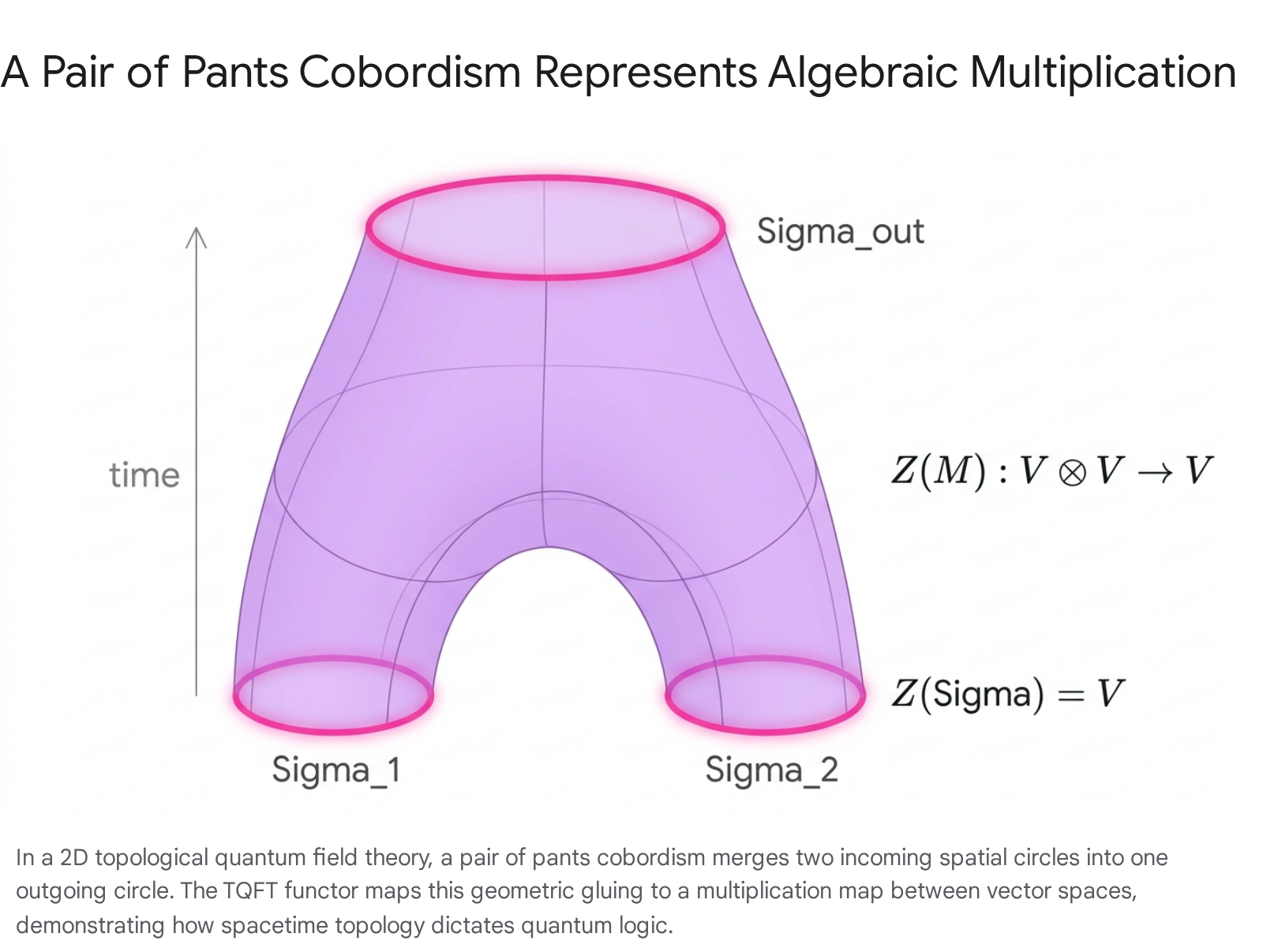
Conversely, the reversed cobordism (one circle splitting into two) corresponds to comultiplication 18. The cap and cup cobordisms provide the unit and trace maps. This establishes a profound equivalence between 2-dimensional topology and the algebraic structure of Frobenius algebras 1718.
Higher category theory and the cobordism hypothesis
While the Atiyah-Segal axioms successfully formalize standard TQFTs, they fail to capture the local "cut-and-paste" operations of spacetimes down to codimensions greater than one 1722. A standard TQFT evaluates on closed $d$-dimensional manifolds and $(d+1)$-dimensional cobordisms, but it does not specify what algebraic objects to assign to manifolds of dimension $d-1$, $d-2$, continuing all the way down to a 0-dimensional point 22.
Extended topological quantum field theories
To address this mathematical deficiency, physicists and mathematicians developed the concept of extended TQFTs 1822. In an extended TQFT, physical quantities and algebraic state spaces can be evaluated on manifolds of all dimensions up to $n$ 222.
This massive formalization requires the advanced machinery of higher category theory, specifically symmetric monoidal $(\infty, n)$-categories 2223. In this multi-tiered framework, the objects are 0-dimensional points, 1-morphisms are 1-dimensional cobordisms connecting the points, 2-morphisms are 2-dimensional cobordisms mediating between the 1-dimensional cobordisms, and so forth, continuing sequentially up to $n$-dimensional manifolds 171822.
Jacob Lurie's classification and dualizable objects
In 1995, mathematical physicists John C. Baez and James Dolan proposed the Cobordism Hypothesis, originally termed the "Extended TQFT Hypothesis" 2223. The hypothesis boldly asserted that a fully extended TQFT is entirely determined by its value on a single point 2223. Specifically, the hypothesis states that the framed bordism $(\infty, n)$-category is equivalent to the free symmetric monoidal $(\infty, n)$-category with duals, generated by a single object 1822.
In 2008, mathematician Jacob Lurie outlined a rigorous proof of the Cobordism Hypothesis 222324. Lurie's work demonstrated that evaluating an extended TQFT on a point yields a "fully dualizable object" in the target category 2224. Conversely, any fully dualizable object entirely defines a framed extended TQFT 1824.
The hypothesis provides an extreme form of locality for topological theories. It dictates that the macroscopic topological invariants of an $n$-dimensional manifold can be entirely computed by triangulating the manifold into 0-dimensional points and carefully tracking the algebraic data as the points are glued back together to form the macro-structure 17. Complete, peer-reviewed details of Lurie's proof remain an ongoing topic of foundational validation, and alternative proofs, such as a 2021 claim by Daniel Grady and Dmitri Pavlov generalizing the hypothesis to bordisms with arbitrary geometric structures, continue to refine this critical intersection of higher category theory and physics 2324.
Braid groups, knot theory, and three-dimensional topology
One of the most consequential triumphs of topological quantum field theory is its profound application to low-dimensional topology, specifically the study of knots and links within three-dimensional manifolds 124. Historically, knot theory was a purely abstract mathematical pursuit. However, a watershed moment occurred in 1989 when Edward Witten demonstrated that the Jones polynomial - a powerful knot invariant discovered by Vaughan Jones - is intrinsically encoded in a 3D Schwarz-type TQFT known as Chern-Simons theory 6132425.
Chern-Simons theory and Wilson loops
Chern-Simons theory is a gauge theory formulated on a 3-dimensional topological manifold $M$. The classical configuration of the theory is defined by a connection one-form $A$ valued in the Lie algebra of a chosen simple Lie group $G$, most frequently the special unitary groups $\text{SU}(2)$ or $\text{U}(N)$ 6. The action functional of the theory is proportional to a coupling constant $k$, referred to as the "level" of the theory. The partition function is well-defined only when this level is an integer, and the behavior of the quantum theory is heavily dependent upon it 613.
To study mathematical knots within this physical framework, physicists introduce non-local observables known as Wilson loops 132426. A knot is physically represented as a closed curve $\gamma$ embedded in the 3D spacetime. The Wilson loop operator $W_\gamma$ computes the trace of the holonomy of the gauge connection along this specific curve 2627. Witten proved that calculating the vacuum expectation value of these Wilson loops in an $\text{SU}(2)$ Chern-Simons theory exactly computes the Jones polynomial of the knot 61324. The polynomial is evaluated at a parameter $q = \exp(2\pi i / (k+2))$, directly linking the topological invariant to the quantum level of the gauge theory 613. Extending this to $\text{U}(N)$ gauge groups allows for the computation of the more generalized HOMFLY-PT polynomial 613. Later advancements further refined this correspondence, mapping Khovanov homology to observables in four-dimensional super Yang-Mills theory 1324.
The Artin braid group in physical spacetime
The connection between TQFT and knots is formalized mathematically through the structure of the braid group, denoted as $B_n$ 2628. The Artin braid group on $n$ strands models the continuous motion of non-coincident points in a two-dimensional plane 2829.
As quasiparticles move through two-dimensional space over time, their trajectories intertwine to form a three-dimensional braid 29303132. In a topological quantum field theory, the specific over-and-under crossings of these worldlines dictate unitary transformations on the quantum state, independent of the particles' exact physical proximity 3234. If one considers a cross-sectional spatial slice of a 3D manifold containing $n$ distinct points, the time-evolution of these points traces out braided worldlines in 3D spacetime 2932.
The generators of the braid group, $\sigma_i$, correspond to the physical exchange (braiding) of the $i$-th and $(i+1)$-th strands 2832. These generators adhere to specific algebraic relations: $\sigma_i \sigma_j = \sigma_j \sigma_i$ for strands that are far apart ($|i-j| \ge 2$), and the fundamental Yang-Baxter relation $\sigma_i \sigma_{i+1} \sigma_i = \sigma_{i+1} \sigma_i \sigma_{i+1}$ 262832. In Chern-Simons theory, the Hilbert space assigned to the 2D spatial surface carrying these punctures acts as a representation of the braid group 2629. As the strands braid, the quantum state of the system transforms via specific matrices (R-matrices) that depend exclusively on the topological class of the exchange path, laying the conceptual groundwork for robust quantum information processing 2634.
Topological phases in condensed matter physics
While topological quantum field theories originated in the realm of high-energy theoretical physics and string theory, they have found their most robust physical and experimental realizations in condensed matter systems 16. Conventional phases of matter - such as magnets or crystals - are classified by Landau's symmetry-breaking paradigm and characterized by local order parameters 33.
However, in the 1990s, physicist Xiao-Gang Wen introduced the concept of "topological order" to describe exotic phases of matter that cannot be differentiated by local symmetry-breaking, but rather by their global topology 33. If a system with topological order is gapped, its low-energy, long-distance behavior cannot contain propagating degrees of freedom, and its effective field theory is exactly described by a TQFT 134.
The fractional quantum Hall effect
The prime experimental arena for exploring topological order is the fractional quantum Hall effect (FQHE) 63335. This phenomenon is observed in two-dimensional electron gases subjected to extremely strong magnetic fields at near-absolute zero temperatures 3134. At specific fractional filling factors of the Landau levels, the electron system condenses into a highly correlated, gapped liquid state 3436.
The elementary excitations of these FQHE states are not standard fundamental particles like bosons or fermions, but rather emergent, fractionalized quasiparticles known as anyons 33353738.
Emergence of anyonic statistics
In three-dimensional space, quantum particle statistics are strictly restricted to bosons (whose wavefunctions are symmetric under exchange) and fermions (whose wavefunctions are antisymmetric, acquiring a $-1$ phase) 38. However, in strictly two spatial dimensions, exchanging two identical particles is topologically equivalent to one particle completing a half-loop around the other. Because the paths cannot be continuously deformed out of the 2D plane without intersecting, the system's many-body wavefunction can acquire an arbitrary complex phase $e^{i\theta}$ upon exchange 313438. Quasiparticles exhibiting these fractional phases are classified as Abelian anyons 31.
At certain specific FQHE filling fractions, such as $\nu = 5/2$, theoretical models predict the existence of a far more complex excitation: non-Abelian anyons 3639. When non-Abelian anyons are exchanged, the system's wavefunction does not merely acquire a simple complex phase. Instead, the entire quantum state undergoes a multi-dimensional unitary matrix transformation within a degenerate ground state manifold 303142.
Because matrix multiplication is inherently non-commutative, the final quantum state of the system depends entirely on the sequential order in which the anyons were braided 31. The specific statistics and fusion rules of these anyons are mathematically captured by modular tensor categories (MTCs), providing a rigorous classification of the topological phases.
| Topological Phase / Filling Factor | Anyon Type | Braiding Statistics | Universality for Quantum Computing |
|---|---|---|---|
| Laughlin States (e.g., $\nu = 1/3$) 39 | Abelian Anyons | Simple complex phase shift $e^{i\theta}$ 31. | Not applicable. |
| Moore-Read State ($\nu = 5/2$) 3639 | Ising Anyons (Majorana zero modes) 3942 | Non-Abelian (Matrix transformation) 3031. | Non-universal. Supports only Clifford gates natively 3742. |
| Read-Rezayi State ($\nu = 12/5$) 39 | Fibonacci Anyons 303940 | Non-Abelian (Matrix transformation) 3031. | Universal. Braiding alone can approximate any quantum gate 30. |
| Fractionalized SC Interfaces 4145 | $\mathbb{Z}_d$ Parafermions ($d>2$) 454243 | Non-Abelian (Matrix transformation) 4243. | Universal. Enables entangling gates beyond Clifford group 45. |
Principles of topological quantum computing
The profound realization that topological phases of matter harbor non-Abelian anyons gave rise to one of the most elegant and ambitious proposals in modern applied physics: topological quantum computing (TQC) 424048. First formalized by Alexei Kitaev in 1997, TQC seeks to encode quantum information within the highly degenerate, non-local ground states of topological phases 3348.
Fault tolerance through global topology
In a conventional quantum computer, quantum bits (qubits) are encoded in local degrees of freedom, such as the spin state of a single electron or the precise energy level of a superconducting circuit 3844. These local states are highly susceptible to environmental noise, thermal fluctuations, and electromagnetic interference, leading to rapid decoherence 3745. Preserving information in standard architectures requires massive overheads for active quantum error correction 374845.
In a topological quantum computer, information is encoded globally 4240. For example, a single logical qubit can be encoded in the joint fusion space of four distinct anyons 304245. Because the quantum information is smeared across the global topology of the multi-particle system, no localized perturbation or environmental noise can alter the state 424045.
The only physical mechanism capable of changing the computational state is physically braiding the anyons around one another in 2D space 303437. Since the computational operations are dictated solely by the topological class of the braid - meaning it does not matter if the paths are slightly perturbed, fast, or slow, so long as the correct over-and-under crossings occur - the computation is intrinsically fault-tolerant at the fundamental hardware level 36384248.
Majorana zero modes and parafermions
The most heavily funded and actively pursued physical candidates for non-Abelian anyons are Majorana zero modes (MZMs) 424451. MZMs are quasiparticles that act as their own antiparticles and exhibit Ising anyon statistics 424451. They are predicted to emerge at the ends of one-dimensional topological superconducting nanowires - frequently constructed by placing an indium arsenide semiconductor in close proximity to an aluminum superconductor 4446.
However, Majorana-based systems face a significant theoretical limitation: braiding Ising anyons allows only a restricted set of quantum operations known as Clifford gates 3742. Clifford gates are computationally insufficient for universal quantum computation 42. To achieve universality in a Majorana system, engineers must introduce non-topological operations, such as magic state distillation or parity measurements, which unfortunately reintroduce the very vulnerabilities to local noise that TQC was designed to avoid 42.
To overcome this universality bottleneck, physicists are investigating higher-order generalizations of Majoranas known as parafermions (or $\mathbb{Z}_d$ parafermions) 4142. Parafermions emerge as exotic bound states in fractional quantum Hall edges that are proximity-coupled to superconductors, acting as "symmetry-enriched" variants of Majoranas 4143. Unlike Majoranas, the braiding of $\mathbb{Z}_d$ parafermions (where the index $d > 2$) yields a much richer set of entangling matrices 45. This offers a direct theoretical path to universal topological quantum computation without relying on noisy classical control mechanisms or distillation protocols 4542.
Experimental milestones and engineering challenges
The transition of topological quantum computing from abstract mathematical theory to laboratory reality has been marked by significant hardware breakthroughs, formidable engineering bottlenecks, and intense scientific debate 474849. The years spanning 2024 to 2026 have been particularly turbulent and productive for the field.
Hardware advancements and readout innovations
A major inflection point occurred in early 2025 when a Microsoft research team, led by scientists at UC Santa Barbara's Station Q, unveiled the "Majorana 1" chip - an eight-qubit topological quantum processor 444657. The researchers achieved this by engineering a new material phase, dubbed a "topoconductor," utilizing indium arsenide semiconductor nanowires interfaced with aluminum 4457. The device demonstrated the ability to create and control Majorana zero modes, utilizing orthogonal Pauli parity measurements to manipulate the state of the qubits 44.
Concurrently, researchers at the Spanish National Research Council (CSIC) in Madrid resolved one of the most stubborn engineering challenges in the field: the readout bottleneck 5059. Because topological qubits are designed to hide information from the local environment to prevent decoherence, they also naturally hide that same information from the measurement devices necessary to read the computational output 5059. Utilizing a global probe technique known as "quantum capacitance," the CSIC team successfully read the hidden parity states of Majorana qubits in real-time without collapsing the topological protection 50. This allowed the team to observe millisecond-scale coherence times, which is orders of magnitude longer than standard superconducting transmon qubits 5059.
Architectural solutions and resource management
To navigate the extreme fragility of early-stage quantum hardware, advanced architectural software is also being deployed. In mid-2025, researchers at Columbia University introduced "HyperQ," a novel virtualization system 51. HyperQ allows multiple users to share a single quantum computer simultaneously by directing workloads to different, isolated sections of a topological or superconducting chip via quantum virtual machines (qVMs) 51.
By dynamically allocating resources and intelligently routing sensitive calculations away from the noisiest regions of the hardware, systems like HyperQ are mitigating fundamental bottlenecks and improving throughput 51. This software-layer approach is helping transition quantum computing from an exclusive scientific tool to a cloud-accessible, practical technology while the underlying topological hardware continues to mature 51.
Replication controversies and standardizing evidence
Despite these high-profile announcements, the field is navigating intense academic scrutiny regarding the validity of experimental claims. Topological condensed matter physics has a history of high-profile retractions, primarily because the electrical signatures of topological phases can be easily mimicked by mundane, non-topological phenomena in complex materials 4852. Following Microsoft's 2025 announcement, several prominent physicists publicly criticized the presented data as unconvincing, citing unresolved disorder and surface roughness in the nanowire materials 52.
This skepticism culminated in early 2026, when a comprehensive replication study was published in Science by a multi-institutional team led by Sergey Frolov at the University of Pittsburgh 485363. The team demonstrated that many earlier "smoking gun" signals of Majorana zero modes - such as highly anticipated zero-bias conductance peaks - could be entirely explained by trivial local defects and fine-tuning in complex sample materials 4853.
The rigorous replication studies emphasized that true topological verification requires expansive data sharing, multi-dimensional parameter sweeps, and the eventual demonstration of actual non-Abelian braiding, rather than solely relying on static conductance measurements 4853. As the field progresses toward full-scale enterprise deployment, the focus has firmly shifted from generating initial signals to establishing rigorous, standardized verification of topological fault tolerance 63.
Topological quantum field theory has evolved from an abstract categorization of spacetime invariants into the foundational blueprint for the next generation of computing architecture. While exact experimental confirmations of macroscopic topological protection remain a subject of active debate, the underlying mathematics - connecting cobordisms, knot polynomials, and fractional statistics - stands as one of the most rigorously unifying frameworks in modern science.