
The Amplituhedron and Particle Scattering Amplitudes
Quantum Field Theory and the Computation of Scattering Amplitudes
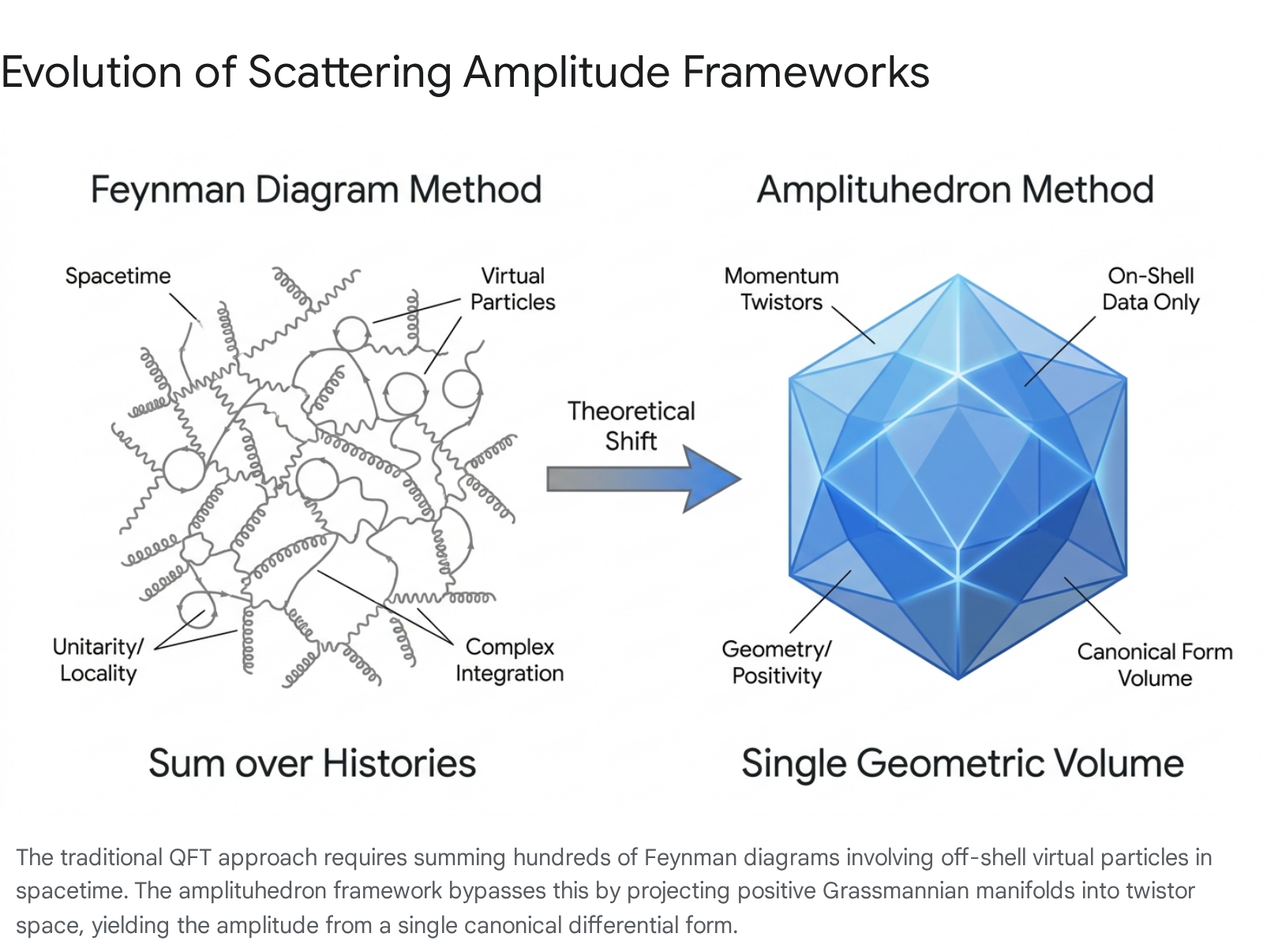
Scattering amplitudes serve as the foundational predictive quantities in quantum field theory, connecting abstract mathematical models to the empirical reality observed in particle accelerators. These amplitudes encode the quantum mechanical probability that a specific configuration of incoming fundamental particles will interact and transform into a designated set of outgoing particles [6, 42, 76]. For more than six decades, the standard paradigm for calculating these probabilities has relied upon perturbation theory, operationalized through the use of Feynman diagrams [6, 48]. This conventional approach is deeply rooted in the Lagrangian formulation of quantum field theory, which enforces two axiomatic physical principles at every stage of the mathematical process: spacetime locality and quantum mechanical unitarity [8, 15, 24].
Spacetime locality is the principle that fundamental particles interact exclusively at specific, localized coordinates in space and time, strictly forbidding instantaneous action at a distance [8, 89]. Quantum unitarity mandates that the sum of the probabilities for all possible outcomes of a physical interaction must precisely equal one, reflecting the conservation of information and probability in a quantum system [9, 24, 89]. When physicists use Feynman diagrams to compute a scattering amplitude, they are graphically representing a perturbative expansion of the transition amplitude or correlation function of the statistical field theory [72, 83]. This process requires summing over all possible spatiotemporal histories that could lead from the initial state to the final state [44, 72].
Consequently, the Feynman diagrammatic method relies heavily on the concept of virtual particles. These intermediate, unobservable states propagate within the internal lines of the diagrams and are required to violate the relativistic energy-momentum dispersion relation ($E^2 - p^2 = m^2$), meaning they exist "off-shell" [44, 46, 69]. While this framework provides a highly intuitive, pictorial representation of particle interactions [72], it introduces massive conceptual and computational inefficiencies when dealing with complex or high-energy processes.
Gauge Redundancy and Combinatorial Explosion
The complexity of the traditional approach stems primarily from gauge redundancy. In the Lagrangian formalism, massless gauge bosons, such as the gluons that mediate the strong nuclear force, are represented as vector fields [45, 73]. This representation inherently introduces unphysical degrees of freedom that must be meticulously canceled out through the application of gauge-fixing conditions and the introduction of theoretical constructs like Faddeev-Popov ghosts [45, 73]. Individual Feynman diagrams are therefore gauge-dependent and physically meaningless in isolation; it is only after summing the entire set of possible diagrams for a given interaction order that a gauge-invariant, physically observable scattering amplitude is recovered [45, 69].
As physicists attempt to calculate scattering amplitudes for processes involving a larger number of external particles (high multiplicity) or a greater number of internal virtual cycles (high loop order), the number of requisite Feynman diagrams undergoes a severe combinatorial explosion [12, 49]. For example, calculating a relatively simple tree-level process involving the scattering of six gluons requires the precise evaluation of 220 distinct Feynman diagrams [69, 70, 81]. This evaluation generates tens of thousands of complex mathematical terms, requiring immense computational power to process the momentum integrals over all unphysical off-shell states [46, 81].
Despite the staggering algebraic complexity of these intermediate steps, the final mathematical expressions for physical scattering amplitudes frequently collapse into astonishingly compact, single-term equations [6, 24, 81]. The most famous illustration of this phenomenon is the Parke-Taylor formula, introduced in the 1980s. The Parke-Taylor formula demonstrated that Maximal Helicity Violating (MHV) tree amplitudes - such as the 220-diagram, six-gluon calculation - reduce to a remarkably simple rational function of the external kinematic variables [70, 71]. This profound discrepancy between the complexity of the computational machinery and the simplicity of the final answer indicated to physicists that the Lagrangian formulation of quantum field theory, with its rigid insistence on manifest locality and unitarity, was obscuring a deeper, mathematically elegant reality [8, 81].
The Shift to On-Shell Methods and Recursion
The recognition that traditional Feynman diagrams were artificially complicating scattering amplitude calculations motivated the development of "on-shell" methodologies. These modern approaches bypass virtual particles and gauge redundancies entirely by formulating calculations strictly in terms of physical, gauge-invariant states that satisfy the relativistic mass-energy equivalence [45, 46, 84].
Spinor-Helicity Variables and Twistor Theory
A crucial mathematical advancement enabling on-shell methods was the adoption of spinor-helicity variables. In four-dimensional Minkowski spacetime, the four-momentum of a massless particle can be efficiently encoded as a bispinor, which separates the kinematic data into left-handed and right-handed spin components [69, 71, 73]. This formalism naturally parameterizes the helicity of particles like photons and gluons, leading to immediate algebraic simplifications when compared to traditional momentum vectors [69].
Building upon the spinor-helicity formalism, physicists integrated concepts from twistor theory. Originally proposed by Roger Penrose in 1967 as a framework to unify general relativity and quantum mechanics, twistor theory shifts the foundational arena of physics away from standard spacetime [19, 22]. The projective twistor space ($\mathbb{CP}^3$) maps points in real Minkowski spacetime to holomorphically embedded complex lines (Riemann spheres) [21, 23]. In 2003, Edward Witten revolutionized the field by demonstrating that perturbative gauge theory could be modeled as a string theory within this twistor space [20, 23]. Witten's twistor string theory revealed that scattering amplitudes naturally localize on algebraic curves, prompting the translation of physical kinematic data into "momentum twistors" [20, 30]. Momentum twistors linearize the conformal symmetries of massless field theories, providing a highly optimized coordinate system for amplitude evaluation [2, 30].
The BCFW Recursion Relations
The integration of on-shell principles and complex analysis culminated in 2005 with the discovery of the Britto-Cachazo-Feng-Witten (BCFW) recursion relations [24, 84, 85]. The BCFW method provides an algorithmic technique to reconstruct tree-level scattering amplitudes without utilizing Feynman diagrams. The core mechanism involves analytically continuing the external momenta of two interacting particles into the complex plane via a complex deformation parameter [70, 86].
By treating the amplitude as a meromorphic function of this complex parameter, BCFW applies Cauchy's residue theorem. The mathematical poles of this function correspond directly to physical factorization channels, where an intermediate virtual particle goes entirely on-shell [82, 88]. The residue at each pole is simply the product of two lower-point, physical on-shell amplitudes [69, 88]. Consequently, the BCFW recursion relation allows physicists to compute highly complex, many-particle amplitudes by recursively multiplying together simpler, previously calculated amplitudes [70, 86].
While the BCFW recursion drastically reduces computational complexity, transforming calculations that previously required hundreds of pages of algebra into a handful of recursive terms, it possesses limitations. The amplitude is still represented as a sum of discrete functions rather than a single unified entity, and the recursion fundamentally relies on the vanishing of boundary contributions at infinite complex momenta, which is not guaranteed for all quantum field theories [31, 85, 86]. Furthermore, the BCFW method was initially restricted to tree-level diagrams, requiring complex adaptations via the Feynman-tree theorem to address higher-order loop corrections [31, 70]. These recursion relations proved that physical amplitudes possess hidden structures determined entirely by lower-point on-shell data, setting the stage for a purely geometric interpretation.
The Mathematics of the Positive Grassmannian
In 2013, theoretical physicists Nima Arkani-Hamed and Jaroslav Trnka introduced a radical reformulation of quantum field theory by demonstrating that scattering amplitudes in planar $\mathcal{N}=4$ Super Yang-Mills theory are mathematically equivalent to the volume of a newly discovered geometric object: the amplituhedron [8, 42]. This discovery translated the highly dynamical, probabilistic problem of particle scattering into a static problem of calculating volumes within algebraic geometry [3, 41]. The foundation of this geometry relies on the positive Grassmannian.
Stratification and Plucker Coordinates
In algebraic geometry, the Grassmannian manifold $Gr(k, n)$ represents the space of all $k$-dimensional linear planes passing through the origin within an $n$-dimensional vector space [12, 26, 97]. A point within the Grassmannian can be defined by a full-rank $k \times n$ matrix, where the $k$ rows span the desired linear subspace [26].
The concept of the totally nonnegative (or positive) Grassmannian, denoted as $Gr_{\ge 0}(k, n)$, restricts this space to the subset of the real Grassmannian where all ordered $k \times k$ sub-determinants - known as Plücker coordinates - are strictly greater than or equal to zero [3, 12, 97]. This positivity constraint profoundly organizes the geometry, imposing a rigid and well-behaved combinatorial structure [41, 97].
The positive Grassmannian naturally decomposes into a distinct stratification of topological "cells." These cells are formally defined by specifying which specific sets of Plücker coordinates equal zero, and which remain strictly positive [58, 97]. This cellular decomposition generalizes the concept of a simplex (such as a triangle or tetrahedron) within projective space to higher-dimensional Grassmannian manifolds [9, 58]. The combinatorial structure of these strata is intimately tied to "positroids" - matroids realizable by non-negative matrices - and can be exhaustively mapped and indexed using decorated permutations and planar bicolored graphs known as plabic graphs [58, 97].
Canonical Differential Forms
The physical relevance of the positive Grassmannian is unlocked through the application of canonical differential forms. A "positive geometry" is a specific class of semi-algebraic space that is uniquely paired with a distinguished meromorphic differential form, denoted as $\Omega$ [60, 94, 98].
This canonical form is rigidly defined by a single, powerful mathematical property: it must possess simple logarithmic singularities (poles) exclusively on the geometric boundaries (facets) of the space [60, 96]. The form is designed such that taking the residue of $\Omega$ along any specific boundary yields the unique canonical form of that lower-dimensional boundary space [60, 62, 98]. In the context of on-shell methods, researchers discovered that the tree-level BCFW recursion relations correspond perfectly to a cellular decomposition - or triangulation - of the positive Grassmannian, with the resulting physical amplitude matching the integration of this unique logarithmic form [58, 59].
Defining the Tree-Level Amplituhedron
The amplituhedron is formally constructed by generalizing the properties of the positive Grassmannian and projecting them into a specialized physical parameter space. The tree-level amplituhedron, designated as $\mathcal{A}{n,k,m}$, is defined as the projection of the totally nonnegative Grassmannian $Gr{\ge 0}(k, n)$ into a lower-dimensional Grassmannian $Gr(k, k+m)$ [3, 12, 94].
The Geometric Projection Matrix
This dimensional reduction is achieved via a linear map defined by a $(k+m) \times n$ projection matrix, $Z$. The map induces a rational map $Z: Gr(k, n) \to Gr(k, k+m)$ [62]. Crucially, to preserve the positive geometry, the matrix $Z$ itself must satisfy strict total positivity constraints, meaning all of its maximal ordered minors must be positive [3, 94].
When mapping this abstract geometry to the specific physics of planar $\mathcal{N}=4$ Super Yang-Mills theory, the parameters take on direct physical meaning [12, 42]: * $n$: Represents the total number of external interacting particles in the scattering event [9, 12]. * $k$: Corresponds to the helicity configuration of the process. In N$^k$MHV (Next-to-Maximal Helicity Violating) amplitudes, $k$ denotes the number of negative-helicity particles beyond the baseline MHV configuration [12, 30]. * $m=4$: This parameter is fundamentally linked to the four dimensions of macroscopic spacetime. The specific physical amplituhedron is therefore $\mathcal{A}_{n,k,4}$, existing as a geometric volume within $Gr(k, k+4)$ [14, 62].
Because of the non-linear nature of the Grassmannian, the amplituhedron $\mathcal{A}_{n,k,4}$ is not a standard, flat-faced Euclidean polytope [12, 26]. Instead, it is a complex, multi-faceted, jewel-like semi-algebraic region whose curved boundaries represent the physical limits of particle interactions [6, 9, 41].
Calculating Volumes and Emergent Physics
In the amplituhedron framework, calculating a scattering amplitude is synonymous with calculating the "volume" of this positive geometry. However, this is not a standard Euclidean volume calculation. Instead, physicists must determine the unique, canonical meromorphic differential form $\Omega$ associated with the region $\mathcal{A}_{n,k,4}$ [4, 62]. By integrating this canonical form over the geometry - effectively finding a specific residue of the rational top-form on $Gr(k, k+4)$ - the exact scattering amplitude is extracted without any reference to off-shell quantum states [42, 59, 62].
This geometric formulation facilitates a profound philosophical inversion regarding the nature of physical laws. In the traditional Lagrangian formulation of quantum field theory, spacetime locality and probability unitarity are rigid axioms inserted by hand to dictate the mathematical structure of the integrals [3, 24, 90]. In the amplituhedron formulation, space, time, and quantum probabilities do not exist in the foundational definitions [24, 27, 42].
Instead, locality and unitarity are emergent properties that derive naturally from the underlying positivity of the geometry [3, 9, 41]. * Emergent Unitarity: Unitarity requires that when internal particles go on-shell, an amplitude must factorize into smaller, independent sub-amplitudes [27, 60, 82]. In the amplituhedron, these physical factorization channels map precisely to the geometric boundaries (facets) of the shape. Taking the residue of the canonical form at a boundary yields the product of the canonical forms of smaller amplituhedra, perfectly recovering unitarity [27, 60]. * Emergent Locality: Locality governs the behavior of amplitudes in extreme kinematic situations, such as when particle momenta become collinear or approach zero energy (soft limits) [4, 9, 42]. The amplituhedron mathematically ensures that the canonical differential form possesses logarithmic singularities only precisely where these local kinematic limits occur [4, 9, 42].
By abstracting these principles into geometric constraints, the amplituhedron suggests that quantum dynamics can be entirely distilled into combinatorial building blocks disconnected from an a priori spacetime manifold [11, 15, 66].
Comparative Analysis of Computational Frameworks
To fully comprehend the computational advantages offered by positive geometries, the amplituhedron must be evaluated against the methodologies that preceded it.
| Analytical Feature | Traditional Feynman Diagrams | BCFW On-Shell Recursion | The Amplituhedron Framework |
|---|---|---|---|
| Foundational Arena | Minkowski Spacetime ($\mathbb{R}^{3,1}$) | Momentum Twistor Space | Positive Grassmannian ($Gr_{\ge 0}$) |
| Fundamental Entities | Virtual (off-shell) particles | Real (on-shell) particles | Combinatorial geometric regions |
| Locality & Unitarity | Manifest (axiomatic starting point) | Manifest via residue factorization | Emergent from geometric positivity |
| Gauge Redundancy | Extremely High (requires gauge fixing) | Eliminated (uses gauge-invariant data) | Eliminated (gauge is inherent to geometry) |
| Computational Structure | Infinite sum over complex histories | Recursive sum of lower-point trees | Extraction of a single canonical form |
| Complexity for 6-Gluon Tree | 220 complex momentum integrals | Approx. 3 recursive algebraic terms | 1 unified geometric volume |
As highlighted in the comparison, the amplituhedron achieves unprecedented computational compactness by synthesizing all discrete diagrammatic or recursive terms into a single, cohesive geometric structure [6, 24].
Higher-Order Loops and Negative Geometries
The groundbreaking 2013 formulation of the amplituhedron was heavily focused on tree-level amplitudes, which model classical particle scattering without accounting for the quantum corrections generated by virtual loops [26]. However, practical high-energy physics at facilities like the Large Hadron Collider requires ultra-precise predictions that incorporate multi-loop corrections [45, 71].
To address these quantum corrections, physicists defined the loop-Amplituhedron, denoted as $\mathcal{A}^{(L)}_{n}$, where $L$ signifies the loop order [1]. At the loop level, the geometric parameter space expands. The unobserved, internal loop momenta are mathematically modeled as abstract, one-dimensional lines within the momentum twistor space [2, 4]. The loop amplituhedron enforces positivity not only on the external kinematic data but also on the $L$ internal loop lines, establishing a rigorous hierarchy of mutual positivity constraints among all elements [26, 82].
The Loops of Loops Expansion
Despite its elegance, computing the canonical form for high-loop amplituhedra via direct triangulation proved exceptionally difficult due to the sheer geometric complexity [2]. In late 2023 and early 2024, theoretical physicists developed a transformative geometric expansion known as the "loops of loops" framework to simplify this process [2, 4].
This novel framework demonstrates that the highly complex all-loop integrand of the positive geometry can be systematically recast as a sum of canonical forms associated with "negative geometries" [2, 4]. Instead of analyzing the full loop geometry simultaneously, the loops of loops expansion dissects the space of loop momenta by categorizing the hierarchy of internal closed cycles [2, 4]. Physicists isolate the complex structure of these internal loops and calculate the amplitude in an approximation where only "tree graphs" in the space of all loops are considered initially [2, 4].
This graph-theoretical organization of negative geometries allows for the determination of differential forms at much higher orders. Using Mellin transformation techniques, researchers in early 2024 successfully integrated these negative geometries to calculate the finite quantities necessary to extract the cusp anomalous dimension up to four loops ($L=4$) for specific ladder-type and box-type configurations [5]. By late 2024, the field had advanced enough to rigorously elucidate the algebraic stratification and face structure of the two-loop four-point Amplituhedron ($\mathcal{A}^{(2)}_4$), definitively proving the existence and uniqueness of its adjoint configurations [1].
Generalizations Beyond Maximally Supersymmetric Yang-Mills
A persistent critique of the early amplituhedron research program was its heavy reliance on planar $\mathcal{N}=4$ Super Yang-Mills theory [7, 24, 25, 89]. While mathematically beautiful, $\mathcal{N}=4$ SYM is a highly idealized, conformally invariant "toy model." It does not perfectly map to the real-world Standard Model because it assumes perfect supersymmetry, incorporates fictitious superpartner particles, and completely lacks confinement (the mechanism that binds quarks into protons and neutrons) [24, 27, 54].
However, over the subsequent decade, physicists demonstrated that the core mathematical machinery of the amplituhedron was remarkably adaptable, leading to the discovery of analogous "positive geometries" governing scattering in distinct quantum theories [3, 62].
- The ABJM Amplituhedron: In the context of three-dimensional $\mathcal{N}=6$ Chern-Simons-matter theory, known as ABJM theory, scattering amplitudes map to a closely related positive geometry. The ABJM amplituhedron is generated by imposing a universal kinematic projection on the four-dimensional $\mathcal{N}=4$ SYM amplituhedron, projecting both external and loop momenta down to three spacetime dimensions [4, 5, 58].
- The Kinematic Associahedron: For field theories involving simpler interactions, such as bi-adjoint scalar particles governed by a cubic ($\phi^3$) Lagrangian, the relevant positive geometry is the associahedron, a classic polytope well-known in algebraic combinatorics and homotopy theory [3, 12, 62]. The tree-level scattering amplitudes of this $\phi^3$ theory are directly identifiable with the canonical differential form of the kinematic associahedron [62].
- The Momentum Amplituhedron: To move beyond the strictly planar limit of quantum theories, physicists redefined the geometric constraints directly within momentum space, rather than relying on momentum twistors. The resulting momentum amplituhedron accommodates the non-planar quantum loop corrections essential for more realistic high-energy calculations [4].
Surfaceology and Real-World Particle Amplitudes
Despite successes in generalizing positive geometries, extending these space-free computational methods to entirely non-supersymmetric theories - most notably Quantum Chromodynamics (QCD), which governs the strong nuclear force in the real world - presented severe mathematical roadblocks [16, 64].
In non-supersymmetric Yang-Mills theory, physicists struggled to establish a canonical "integrand" for loop calculations. Taking a single loop-cut (forcing a loop propagator on-shell) in a non-supersymmetric theory creates severe kinematic pathologies [67]. Degenerate limits produce infinite $1/0$ singularities resulting from unphysical tadpoles and massless external bubbles [67]. In supersymmetric theories, these destructive infinities are gracefully canceled out by "super-sums" over the respective superpartner states, keeping the positive geometry well-defined [67]. Without supersymmetry to stabilize the math, the geometric structure shattered, destroying integrand-level gauge invariance and consistent on-shell factorization [67].
In 2024, a major paradigm shift dubbed "surfaceology" successfully bypassed these fundamental obstructions [17, 53, 54, 64]. Led by Nima Arkani-Hamed, Carolina Figueiredo, and their collaborators, surfaceology represents a primitive geometric approach that applies directly to the non-supersymmetric particles observed in nature [54, 64].
The Conspiracy of Hidden Zeros
The surfaceology breakthrough originated from Figueiredo's observation that three ostensibly unrelated quantum theories - colored scalars, pions, and gluons - share identical structural "zeros" in their scattering amplitudes [54, 68]. Zeros define specific kinematic collision orientations that are mathematically forbidden from occurring. Finding identical zeros across distinct theories strongly suggested a shared underlying mathematical blueprint [54, 68].
Surfaceology resolves this by reformulating Yang-Mills amplitudes as the intersection of topological curves drawn on two-dimensional geometric surfaces [55, 67]. By defining generalized "surface kinematics" that extend beyond standard momentum vectors, surfaceology naturally absorbs the pathological tadpole and bubble singularities, allowing the integrand to cleanly vanish at infinity [67]. Because surfaceology extracts amplitudes purely from the intersection dynamics of these curves, it successfully derives realistic, recursive loop integrands completely agnostic to supersymmetry [54, 64, 67]. This marks the first instance where purely geometric, non-spatiotemporal methods have calculated amplitudes for real-world Standard Model particles [16, 68].
Intersection Theory and Twisted Period Integrals
Concurrently with the expansion of positive geometries, the mathematical study of scattering amplitudes has forged deep connections with intersection theory [32, 33].
Modern analytic frameworks, particularly the Cachazo-He-Yuan (CHY) formulation, represent tree-level scattering amplitudes as complex integrals evaluated over the moduli space of punctured Riemann spheres [32, 35]. In 2017, physicists utilizing Picard-Lefschetz theory mathematically proved that these scattering amplitudes can be rigorously defined as the exact intersection numbers of "twisted cocycles" associated with specific hyperplane arrangements [32, 33, 35].
This realization established that scattering amplitudes are specific manifestations of a broader mathematical class known as twisted period integrals (TPIs), which operate within the domain of twisted de Rham cohomology [34, 36]. Utilizing TPIs and intersection numbers provides a universal mathematical language capable of unifying fundamental particle physics with diverse macro-scale phenomena:
- Analytic Gravitational Waveforms: The scattering of massive, macroscopic compact bodies (such as merging black holes) can be formulated as a quantum scattering amplitude through generalized unitarity [34, 36]. By evaluating these as twisted period integrals with an exponential twist (equivalent to a Fourier transform from momentum space to impact-parameter space), physicists can compute fully analytic, relativistic two-body gravitational waveforms at advanced Post-Minkowskian orders without numerically simulating Einstein's equations on a spacetime grid [34, 36].
- Cosmological Correlators: The correlation functions observed at the spacelike boundary of the universe - which encode the physics of cosmic inflation and the large-scale structural distribution of galaxies - are governed by the same differential equations and intersection topologies as collider particle scattering [34, 36]. Physicists are actively utilizing positive geometries, such as the "cosmological polytope," to compute these deep-time cosmological observables [3, 94].
Implications for Spacetime and Quantum Gravity
The continued development of the amplituhedron and surfaceology fundamentally challenges the most deeply ingrained assumptions of theoretical physics. By proving that the probabilistic dynamics of particle interactions can be perfectly reproduced by calculating the volume of a static, timeless geometric object, these frameworks provide compelling evidence that spacetime and quantum mechanics may not be fundamental ingredients of reality [6, 11, 24, 66].
The most persistent crisis in modern physics is the inability to formulate a coherent theory of quantum gravity. When physicists attempt to integrate the smooth geometric manifold of Einstein's general relativity with the discrete quantum field interactions of the Standard Model, the resulting mathematics yields nonsensical infinities [6, 24, 89]. These paradoxes arise explicitly because current models assume that spacetime locality and quantum unitarity remain strictly valid at arbitrarily small distances, approaching the Planck length [6, 24, 89].
The amplituhedron paradigm suggests that these destructive infinities are artifacts of using an inadequate mathematical language. If locality and unitarity are not fundamental axioms but merely emergent, macroscopic approximations derived from the deeper constraints of a positive geometry, then the traditional barriers to quantum gravity dissolve [6, 17]. While the amplituhedron itself does not yet encode full quantum gravity - a hypothesized "gravituhedron" remains the subject of active mathematical search [24, 25, 28, 89] - twistor string theory models that accommodate maximal supergravity already exist [19, 20]. The ultimate ambition of this theoretical program is to uncover a master geometric structure whose facets and forms naturally yield both an emergent macroscopic spacetime and the microscopic quantum forces, seamlessly unifying the universe into pure geometry [6, 11, 54, 66].