
Nature and discovery of fast radio bursts
Introduction to the Phenomenon
Fast radio bursts are millisecond-duration pulses of coherent radio emission originating from extragalactic distances 123. Since their initial serendipitous discovery in 2007 within the archival data of the Parkes radio telescope - an event historically referred to as the Lorimer burst - these transients have emerged as one of the most dynamic and intensely studied phenomena in modern astrophysics 144. Lasting typically between a fraction of a millisecond and a few milliseconds, fast radio bursts release enormous amounts of energy. A typical burst can emit as much energy in a millisecond as the Sun produces over several days, and in extreme cases, decades 567.
The primary defining characteristic of a fast radio burst is its extreme dispersion measure. As electromagnetic radiation travels through the ionized plasma of the interstellar and intergalactic medium, it undergoes frequency-dependent phase velocity changes. Lower frequencies interact more strongly with free electrons and are delayed relative to higher frequencies 98. This delay creates a characteristic sweeping signature, or "chirp," across the observing bandwidth 910. The dispersion measure is defined as the integrated column density of free electrons along the line of sight from the source to the observer. Because the measured dispersion for these bursts far exceeds the maximum possible contribution from the Milky Way's interstellar medium and galactic halo, the signals must originate from cosmological distances 48.
The Physics of Dispersion and Polarization
The propagation of radio waves through the ionized intergalactic medium leaves indelible imprints on the received signal, transforming fast radio bursts from mere flashes of light into highly sensitive probes of cosmic baryonic matter.
Dispersion Measure and Frequency-Dependent Delay
The velocity at which an electromagnetic wave propagates through a plasma is strictly dependent on its frequency due to dispersive effects governed by the plasma frequency . When a progenitor source emits a broadband pulse of coherent radio emission, the intervening intergalactic medium causes the lower-frequency components of the wave packet to travel more slowly than the higher-frequency components 8.
For an observer on Earth, this results in the high-frequency radio waves arriving at the detector milliseconds to seconds before the lower-frequency waves. The time delay ($\Delta t$) between two observing frequencies is directly proportional to the dispersion measure and inversely proportional to the square of the observation frequencies 8. Specifically, the delay follows the relation $\Delta t \propto \text{DM} \cdot (\nu_{low}^{-2} - \nu_{high}^{-2})$ 814.
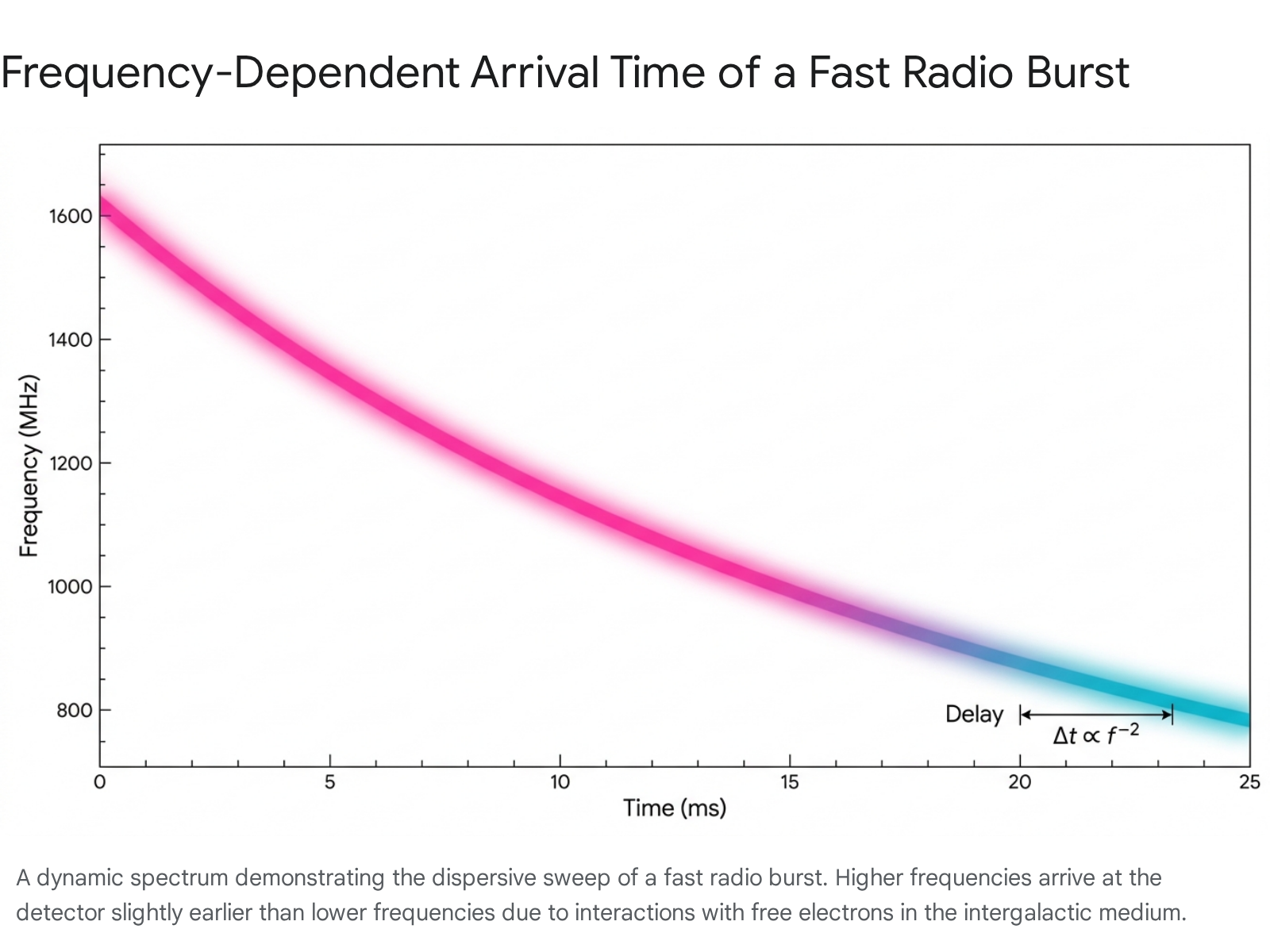
The total dispersion measure is an aggregation of multiple components: the Milky Way's interstellar medium, the Milky Way's halo, the intergalactic medium, any intervening foreground galaxies, and the host galaxy of the burst itself 1116. Calculating the extragalactic contribution requires meticulously subtracting the expected Galactic contributions, which are estimated using models of the Milky Way's electron density distribution 91612.
Faraday Rotation and Multipath Scattering
In addition to dispersion, the polarization of the radio waves provides crucial diagnostic information regarding the magnetic environment of the source. By analyzing the rotation measure (RM) - a metric indicating how much the polarization angle of the linearly polarized radio wave is rotated by magnetic fields along the line of sight via Faraday rotation - astronomers can map the complex magneto-ionic environments surrounding the burst progenitors 1314. High degrees of linear polarization are frequently observed in these bursts, indicating ordered magnetic fields at the source or in the immediate host environment 1420.
Radio waves from these bursts also experience multipath propagation as they traverse turbulent, inhomogeneous plasma screens. This causes the signal to scatter, leading to a frequency-dependent temporal broadening of the pulse profile, often resulting in an exponential decay tail in the pulse morphology 1421. Theoretical models suggest a correlation between the scattering timescale and the dispersion measure contributed by the host galaxy, similar to relations observed in Galactic pulsars, though extreme variances in intergalactic environments make this correlation difficult to isolate purely from observational data 2122.
Observational Infrastructure and Catalog Growth
The transition of fast radio burst research from the discovery of isolated anomalies to large-scale population studies has been driven by rapid advancements in radio interferometry. Telescopes characterized by massive collecting areas, wide fields of view, and high-resolution digital backends have revolutionized the detection rate.
The Canadian Hydrogen Intensity Mapping Experiment (CHIME), a transit radio interferometer operating in the 400 - 800 MHz range, has been the most prolific instrument in this domain 1516. Observing the northern sky daily with a field of view of approximately 200 square degrees, CHIME detects an average of two to three fast radio bursts per day 15. The release of the CHIME/FRB Catalog 2 in 2025 expanded the known population to 4,545 bursts, comprising 3,564 one-off events and 981 repeating bursts originating from 83 distinct sources 15.
Other global facilities have provided highly complementary capabilities. The Australian Square Kilometre Array Pathfinder (ASKAP) and the MeerKAT array in South Africa (through the MeerTRAP project) utilize specialized coherent and incoherent search arrays to achieve high-resolution detections and rapid localizations in the southern hemisphere 241726. Meanwhile, the Five-hundred-meter Aperture Spherical Telescope (FAST) in China provides unmatched raw sensitivity, making it the premier instrument for conducting deep, targeted follow-up monitoring of known repeating sources to detect incredibly faint pulses that other observatories would miss 1828.
The Role of Very Long Baseline Interferometry
While instruments like the primary CHIME array excel at discovery, their baseline resolution is often insufficient to pinpoint the exact galactic origins of the bursts. To address this, the CHIME collaboration developed the Outrigger array - smaller versions of the CHIME cylinder deployed across North America, including sites in British Columbia, California, and the National Radio Quiet Zone in West Virginia 71920.
By utilizing Very Long Baseline Interferometry (VLBI), the Outrigger array synthesizes an aperture effectively spanning the continent. This capability provides localizations on the scale of tens of milliarcseconds. In nearby galaxies, this angular resolution translates to spatial localizations of roughly 10 to 15 parsecs, allowing astronomers to identify not just the host galaxy, but the specific star cluster, spiral arm, or supernova remnant from which the burst originated 71621.
Classification of the Population
Observational data reveals a fundamental dichotomy within the fast radio burst population: those that repeat and those that have only been observed as single, one-off events. Statistical evaluations of large datasets discern morphologically contrasting behavior between the two sub-populations, suggesting different emission mechanisms, distinct local environments, or entirely separate progenitor channels 1517.
Morphological and Temporal Distinctions
Repeating sources generally emit pulses that are broader in temporal duration but narrower in spectral bandwidth 15. A prominent feature of repeating bursts is the phenomenon of downward sub-pulse frequency drifting. In these events, a single burst envelope is composed of multiple sub-bursts, with each subsequent sub-burst peaking at a progressively lower frequency 917. This drifting behavior can be modeled by radius-to-frequency mapping within the magnetosphere of a neutron star, where emission at lower frequencies corresponds to plasma processes occurring at larger altitudes above the stellar surface as the emitting region moves outward 17.
Conversely, one-off bursts tend to be significantly narrower in time - often just fractions of a millisecond - and span a much broader, sometimes continuous, frequency range across the observing band 915. Machine learning techniques, including convolutional neural networks applied to the CHIME/FRB Catalog 2 dynamic spectra, have successfully leveraged these morphological features to classify bursts into the two categories with high performance metrics, reinforcing the hypothesis that these sub-populations are physically distinct 15.
| Feature | Repeating Fast Radio Bursts | Non-Repeating (One-Off) Fast Radio Bursts |
|---|---|---|
| Recurrence | Emit multiple bursts on irregular or clustered cadences 422. | Only a single burst detected despite extensive follow-up 416. |
| Spectral Bandwidth | Typically narrow-banded, covering a fraction of the receiver bandwidth 15. | Broad-banded, often spanning the entire observable frequency range 15. |
| Temporal Duration | Generally wider, lasting several milliseconds 915. | Narrower, often sub-millisecond in duration 915. |
| Pulse Structure | Complex; frequently exhibits downward frequency drift across sub-bursts 91517. | Usually simpler, single-peaked profiles without prominent sub-pulse drifting 915. |
| Associated Radio Sources | Occasionally spatially coincident with compact, steady persistent radio sources (PRSs) 41523. | No confirmed associations with persistent radio sources to date 4153435. |
Host Galaxy Demographics and Environments
The precision localization of fast radio bursts is essential for identifying their host galaxies and characterizing their local environments. Early sub-arcsecond localizations were dominated by repeating bursts found in low-metallicity, highly star-forming dwarf galaxies 242526. This led to early hypotheses that fast radio burst progenitors required environments similar to those producing superluminous supernovae and long gamma-ray bursts, which are tightly correlated with massive stellar progenitors in low-metallicity stellar populations 2627.
As the sample of localized bursts has grown beyond 100 events, a much greater diversity of host galaxies has emerged 1140. Comprehensive studies analyzing the specific star formation rate (sSFR), stellar mass, and gas-phase metallicity indicate that fast radio burst host galaxies span a wide parameter space.
| Metric | Overall Fast Radio Burst Population Trends | Differences Between Repeaters and Non-Repeaters |
|---|---|---|
| Stellar Mass ($M_\odot$) | Ranges from dwarf galaxies ($10^8 M_\odot$) to massive galaxies ($6 \times 10^{10} M_\odot$) 252829. | Non-repeating bursts generally associate with slightly more massive galaxies than repeaters 2530. |
| Star Formation Rate (SFR) | Ranges widely from 0.04 to >10 $M_\odot \text{ yr}^{-1}$ 252829. | Repeating FRB hosts often show higher specific star formation rates, though exceptions exist 2630. |
| Metallicity | Broadly consistent with the mass-metallicity relation of star-forming galaxies; no clear lower bound 44. | Non-repeaters are frequently found in higher metallicity environments, though metal-poor non-repeating hosts have been discovered 25283044. |
| Galaxy Type | Found in spiral, irregular, and early-type/quiescent galaxies 114531. | Roughly half of repeater hosts show evidence of falling in the transitional "green-valley" 2945. |
Observational campaigns have continuously complicated the demographic divide. A 2025 study highlighted the localization of the non-repeating FRB 20230708A to a highly metal-poor dwarf galaxy with a stellar mass of approximately $10^{8.0} M_\odot$ and an extremely low star formation rate of 0.04 $M_\odot \text{ yr}^{-1}$ 2528. This discovery proved that one-off bursts can also originate in the faintest, lowest-metallicity environments, challenging previous assumptions that non-repeaters track strictly with massive, metal-rich galaxies 2528.
Conversely, the discovery of the repeating FRB 20240209A localized to a globular cluster on the outskirts of a quiescent elliptical galaxy at a distance of 1.8 billion light-years severely challenges models that require active, prompt star formation 31. A globular cluster environment implies an ancient stellar population, pointing toward delayed formation pathways, such as the merger of binary white dwarfs or older neutron stars 273147.
Theoretical Progenitor Models
The precise physical mechanisms generating fast radio bursts remain heavily debated. However, a convergence of observational evidence has elevated a few leading astrophysical models, predominantly involving highly magnetized neutron stars and their interactions with binary companions.
Magnetar Emission Models
Magnetars - neutron stars possessing extreme magnetic fields on the order of $10^{14}$ to $10^{15}$ Gauss - are the most widely accepted progenitor candidates 1224832. The discovery of a fast radio burst from a known magnetar within the Milky Way (SGR 1935+2154) in 2020 provided direct empirical support that magnetars are capable of producing millisecond coherent radio emission 283233.
The emission from magnetars may be generated through several mechanisms. In magnetospheric models, intense magnetic stresses induce starquakes, triggering sudden reconfigurations of the magnetic field. This accelerates particles that emit coherent curvature radiation directly within the inner magnetosphere 152248. Alternatively, in synchrotron maser shock models, a magnetar flare ejects a relativistic plasma shell that collides with the surrounding, older pulsar wind nebula or dense circumstellar material. This collision generates a magnetized shock front where coherent synchrotron maser emission produces the observed radio burst 315.
While the magnetar model explains the energy, short timescales, and polarization of many bursts, it faces theoretical challenges with hyperactive repeaters. An isolated magnetar has a finite reservoir of magnetic energy. Some exceptionally active repeating sources exhibit burst rates and total energy outputs that would rapidly exhaust the magnetic budget of a standard isolated magnetar within decades. This rapid depletion suggests alternative mechanisms or sustained energy injection may be required to explain sources that emit tens of thousands of bursts 6.
Binary System Interactions
Recent long-term monitoring campaigns have yielded definitive evidence that some fast radio bursts originate in binary star systems 1834. In early 2026, researchers published an analysis in Science detailing the observation of a rare rotation measure flare from the repeating source FRB 220529A using the FAST telescope 1834.
During late 2023, the rotation measure of the burst increased by more than a factor of 100 before rapidly recovering over two weeks 18. This temporary, dramatic alteration of the magnetic environment strongly supports a scenario where the magnetar is paired with a companion star. A coronal mass ejection or dense, magnetized plasma cloud from the companion crossed the line of sight of the radio burst, injecting a transient plasma screen that altered the burst's polarization 1834.
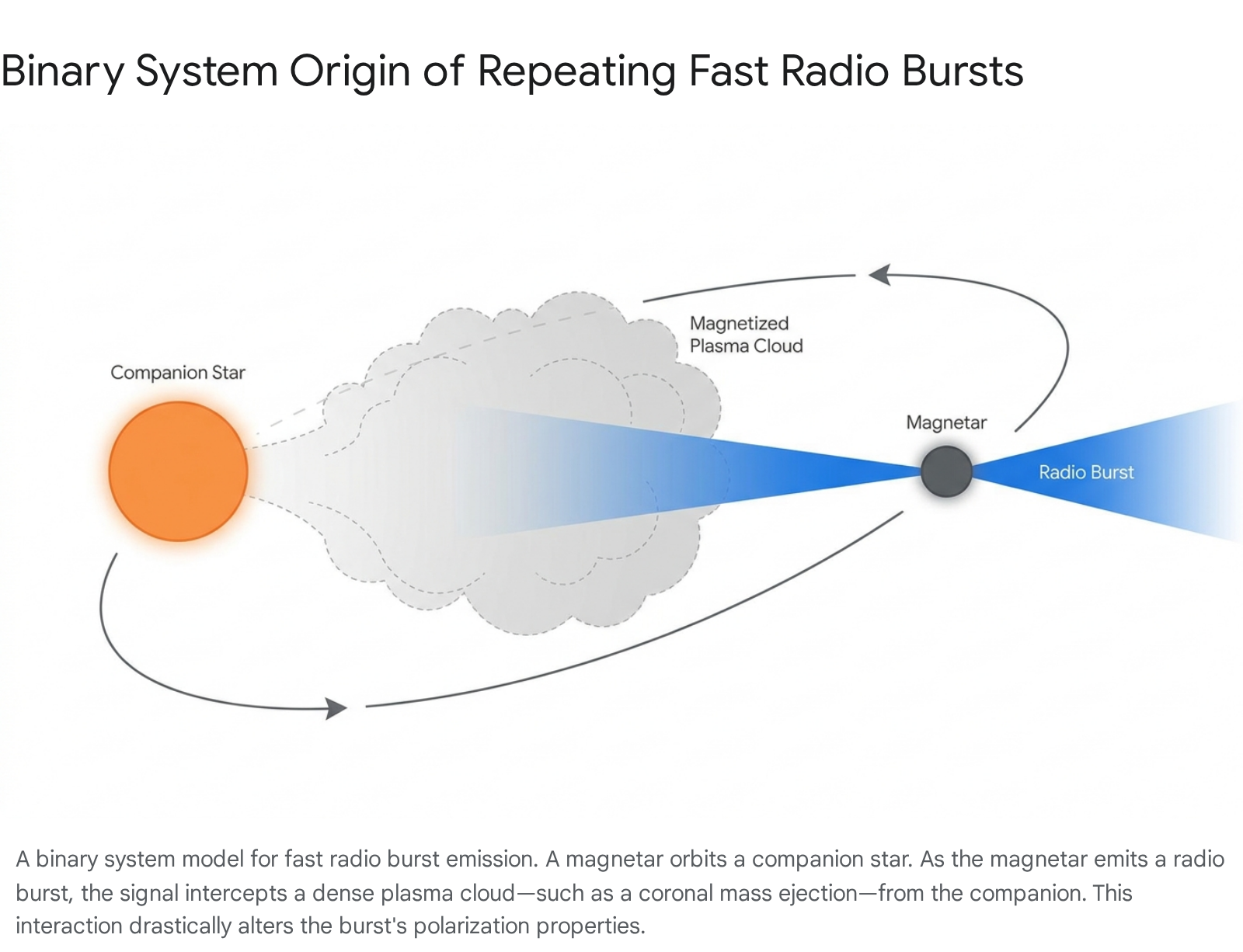
Binary interaction models provide a framework for why certain magnetars maintain aligned rotation and magnetic axes, allowing them to remain hyperactive repeaters. Accretion from the stellar winds of a companion can create a long-lasting engine for repeating bursts, whereas isolated magnetars may eventually misalign and become dormant, emitting only one-off bursts 32. Furthermore, a magnetar moving through the highly dense decretion disk of a companion Be star naturally leads to varying rotation measures, depolarization, and large scattering timescales dependent on the orbital phase 13.
Compact Object Mergers
For non-repeating bursts, catastrophic events such as the mergers of compact objects remain highly viable theories 34733. The merger of binary neutron stars can produce a briefly stable supramassive neutron star or a highly magnetized remnant that collapses into a black hole seconds or minutes later 327. The magnetic field snapping during this collapse could produce a single, highly energetic radio flash without any possibility of repetition.
Similarly, the accretion-induced collapse of a white dwarf into a neutron star provides a mechanism for isolated, one-off bursts in older stellar environments. This specific evolutionary channel is highly consistent with recent localizations of bursts in quiescent elliptical galaxies and globular clusters, environments entirely devoid of the young, massive stars necessary for standard core-collapse magnetar formation 273147.
Rejection of Artificial Origin Hypotheses
Due to the precise, millisecond timing and massive energy outputs of fast radio bursts, artificial origins - specifically extraterrestrial technosignatures - were briefly considered in early literature. Hypotheses included interstellar light sails driven by beamed radio energy acting as planetary-scale propulsion systems 622. However, the scientific consensus strongly rejects artificial origins based on the sheer scale of the energy budgets required and the ubiquitous distribution of these bursts across billions of light-years in every direction of the observable universe 627.
Furthermore, research published by the SETI Institute in 2026 demonstrated that stellar "space weather" - including plasma turbulence and coronal mass ejections - broadens and smears ultra-narrowband radio signals 3536. If advanced civilizations were transmitting artificial, highly coherent narrowband signals, interstellar and circumstellar plasma would distort these signals before they ever left their host star systems. The resulting dispersion would render them virtually indistinguishable from natural broadband phenomena by the time they reach Earth 353637. Consequently, natural extreme astrophysical mechanisms remain the only viable explanations for the fast radio burst population.
Landmark Observational Discoveries
The period spanning 2024 to 2026 has been marked by a series of unprecedented discoveries, driven by next-generation interferometers and deep multi-wavelength follow-up campaigns utilizing both ground-based optical observatories and the James Webb Space Telescope.
The High Redshift Frontier: FRB 20240304B
In August 2025, an international collaboration announced the discovery of FRB 20240304B, a transient that shattered previous distance records. Detected by the MeerKAT radio telescope in South Africa on March 4, 2024, the burst exhibited a profound dispersion measure of approximately 2,330 pc cm$^{-3}$ 243856.
Follow-up spectroscopy utilizing the JWST's Near Infrared Camera (NIRCam) and Near-Infrared Spectrograph (NIRSpec) instruments successfully identified the host - a low-mass, clumpy, star-forming galaxy - and confirmed a spectroscopic redshift of $z = 2.148 \pm 0.001$ 245657. This metric dictates an origin roughly 3 billion years after the Big Bang, during the "cosmic noon" epoch when the universe was undergoing star formation at its peak rate 243857. The light from FRB 20240304B traveled for over 11 billion years to reach Earth, probing ionized baryons across 80% of cosmic history and demonstrating that fast radio bursts can serve as effective probes of galactic formation in the early universe 244058.
Prior to this discovery, the distance record was held by FRB 20220610A, detected by the ASKAP telescope 55939. Localized to a merging galaxy group at a redshift of $z = 1.016$ 258, this burst was anomalously luminous. Its total burst energy was measured at $2 \times 10^{42}$ erg, exceeding the predictions of contemporary FRB emission models by a factor of 3.5 and demonstrating the existence of a highly energetic sub-population of high-redshift bursts 240.
Proximity and Extreme Brightness: FRB 20250316A
At the opposite end of the distance spectrum, the CHIME telescope array detected FRB 20250316A on March 16, 2025. Informally nicknamed RBFLOAT ("Radio Brightest Flash Of All Time"), this burst emitted a fluence of $1.7 \pm 0.1$ kJy ms, producing as much power in a single millisecond as the Sun does over several days and momentarily outshining all other radio sources in its host galaxy 7343541.
The unprecedented apparent brightness of the burst was attributed to its extreme proximity. Utilizing the newly completed CHIME Outrigger array, astronomers pinpointed the burst's origin to a 13-parsec region in an outer spiral arm of the face-on galaxy NGC 4141, located just 130 million light-years from Earth 7162135.
Follow-up observations were mobilized rapidly. The Einstein Probe and the Chandra X-ray Observatory established stringent upper limits on persistent X-ray emission at the FRB position, firmly disfavoring ultra-luminous X-ray sources (ULXs) as the counterpart 2835. Simultaneously, the James Webb Space Telescope located a faint near-infrared source (labeled NIR-1) coincident with the burst location 63. The stellar population in the immediate vicinity features young massive stars, supporting an origin linked to a recent core-collapse supernova yielding a magnetar 63.
Hyperactivity and Persistent Sources: FRB 20240114A
FRB 20240114A, reported by the CHIME collaboration, is one of the most prolific repeating sources ever cataloged 2026. Over a baseline of approximately 200 days, multi-observatory monitoring recorded more than 11,000 individual bursts 6. The source exhibits a burst rate roughly 49 times higher than the median upper limits of non-repeating sources, maintaining a stable dispersion measure of approximately 527.7 pc cm$^{-3}$ 20. Localized to a dwarf galaxy at a redshift of $z = 0.1306$, the host environment and hyperactivity of FRB 20240114A closely mirror those of the famous first repeater, FRB 121102 26.
The study of repeaters took another significant step with FRB 20190417A. In early 2026, observations using the European VLBI Network (EVN) achieved an exceptionally precise localization, confirming that this repeating burst originates from the heart of a persistent, compact radio source constrained to less than 80 light-years in size 23. This association suggests the progenitor is embedded within an extreme magneto-ionic environment, likely a young, highly magnetized plasma nebula 23.
Cosmological Applications
Beyond studying the localized astrophysical origins of the bursts themselves, fast radio bursts have become highly sensitive, independent cosmological tools utilized for mapping the universe's large-scale structure and weighing the cosmos.
The Macquart Relation and Missing Baryons
For decades, cosmological models predicated on the cosmic microwave background and Big Bang nucleosynthesis predicted a specific density of normal, baryonic matter in the universe. However, observational surveys of stars, cold gas in galaxies, and hot gas in galaxy clusters could only account for roughly half of the expected matter 1242. The remainder - colloquially termed the "missing baryons" - was theorized to exist as diffuse, highly ionized plasma spanning the vast voids between galaxies, known as the Warm-Hot Intergalactic Medium (WHIM) 1242.
Fast radio bursts are uniquely suited to locate this matter. Because the dispersion measure is an exact integral of the electron density along the line of sight, every burst provides a direct measurement of the ionized matter it passes through 12. In 2020, J.P. Macquart and colleagues established a direct correlation between the extragalactic dispersion measure of localized fast radio bursts and the redshift of their host galaxies. This "Macquart relation" (parameterized roughly as $\text{DM}_{\text{IGM}} \approx 1000z$ pc cm$^{-3}$) empirically confirmed that the missing baryons are indeed hiding in the intergalactic medium 9114366.
By analyzing large datasets of localized bursts up to 2026, researchers have continually validated the Macquart relation, utilizing it to place tight, independent constraints on cosmological parameters, including the Hubble constant ($H_0$) and the cosmic baryon fraction 967.
Variance, Feedback, and the Fluctuation Parameter
While the average dispersion measure scales linearly with distance, the variance - or scatter - around the Macquart relation provides profound insights into galactic feedback and the hierarchical structure of the cosmic web 436768. The cosmic dispersion variance is formally parameterized by a fluctuation parameter, $F$, defined by the relationship $\sigma_{\text{DM}} = F z^{-0.5}$ 6768.
The fluctuation parameter is highly sensitive to exactly how matter is distributed on macroscopic scales. If intergalactic gas is heavily concentrated within the deep gravitational potential wells of galactic halos, the scatter in dispersion measures across different lines of sight will be exceptionally high. Conversely, if active galactic nuclei (AGN) and intense supernova feedback forcefully eject gas out of halos and into the diffuse intergalactic medium, the distribution becomes smoother, thereby reducing the variance 1168.
Recent studies analyzing larger samples of localized bursts have attempted to tightly constrain the $F$ parameter 4367. Comparisons between observed fast radio burst scatter and cosmological hydrodynamical simulations (such as IllustrisTNG and CROCODILE) show general agreement at higher redshifts ($0.4 < z < 2.0$) 114368. However, at low redshifts ($z < 0.4$), current simulations tend to systematically underpredict the observed scatter. This discrepancy highlights that the true efficiency of kinetic AGN feedback in redistributing gas from galactic halos into the voids is substantially more complex than current theoretical models predict, positioning fast radio bursts as an essential calibrator for future cosmological simulations 114367.
Conclusion
Fast radio bursts represent a critical intersection of extreme stellar astrophysics and precision cosmology. The division of the population into repeating and non-repeating sources suggests a genuine diversity of origins, ranging from hyperactive magnetars embedded in dense, magnetized binary systems to the catastrophic mergers of compact stellar remnants in ancient, quiescent galaxies.
Recent breakthroughs, enabled by vast interferometric arrays and multi-wavelength localizations, have pushed the observational boundary back to the cosmic noon with FRB 20240304B, while simultaneously achieving unprecedented parsec-scale localizations with the nearby FRB 20250316A. As the detection rate continues to accelerate, fast radio bursts have transitioned from mysterious astrophysical anomalies into foundational tools. They now offer an unparalleled mechanism for weighing the universe's missing baryons, tracing the hidden web of intergalactic plasma, and probing the magnetic evolution of the cosmos across billions of years of cosmic history.