
Multi-messenger gravitational wave astronomy since GW170817
The direct detection of gravitational waves from the binary neutron star coalescence GW170817 on August 17, 2017, established a fundamental paradigm shift in observational astrophysics. For the first time, researchers successfully correlated ripples in the fabric of spacetime, captured by the Advanced Laser Interferometer Gravitational-Wave Observatory (LIGO) and the Virgo detector, with an array of electromagnetic signals spanning the gamma-ray, X-ray, optical, infrared, and radio bands 122. This inaugural event proved that binary neutron star (BNS) mergers are the primary progenitors of short gamma-ray bursts (GRBs) and the astrophysical sites of rapid neutron-capture (r-process) nucleosynthesis 13. Furthermore, it introduced gravitational waves as independent cosmological standard sirens, allowing for novel measurements of the Hubble constant 456.
In the subsequent years, the global gravitational-wave detector network has evolved from detecting singular historic events to conducting broad demographic surveys of the compact object universe. The completion of the third observing run (O3) and the highly anticipated fourth observing run (O4) - which spanned from May 2023 through November 2025 - have expanded the transient catalogs to hundreds of confidently detected signals 789. The data from these runs have unveiled unexpected populations of compact objects, including binaries that populate the theoretical lower mass gap, hierarchical systems containing second-generation black holes, and remarkably loud signals that enable unprecedented precision tests of Einstein's general theory of relativity 101112.
This report provides an exhaustive analysis of the multi-messenger astronomy landscape, evaluating the physical constraints derived from foundational detections, the technological enhancements defining the O4 network, the complex populations of black holes and neutron stars recently uncovered, and the operational infrastructure necessary for global electromagnetic and neutrino coordination.
Evolution of the Global Detector Network
Upgrades and Sensitivities in the Fourth Observing Run
The transition from the third (O3) to the fourth observing run (O4) marked a critical juncture for terrestrial kilometer-scale interferometric observatories. O4 began on May 24, 2023, and concluded its primary data acquisition phase on November 18, 2025, operating as the longest and most sensitive observing campaign to date 789. The network architecture comprises Advanced LIGO (with twin facilities in Hanford, Washington, and Livingston, Louisiana), Advanced Virgo in Italy, and KAGRA in Japan 7.
Prior to O4, the LIGO instruments underwent major hardware upgrades, most notably the implementation of frequency-dependent vacuum squeezing via new 300-meter filter cavities, alongside an increase in core laser power 13. These enhancements mitigated quantum noise across a broader frequency band, drastically increasing the detectable volume of the universe. During the first segment of the run (O4a, which concluded on January 16, 2024), the LIGO Hanford and Livingston detectors achieved median binary neutron star (BNS) ranges of 152 Mpc and 160 Mpc, respectively, with peak sensitivities reaching up to 165 Mpc and 177 Mpc 7.
The integration of the international nodes experienced variable timelines due to environmental and commissioning challenges. KAGRA participated briefly in May and June of 2023 but suffered significant setbacks following the Noto Peninsula earthquake in January 2024, which required extensive repairs and re-commissioning efforts aimed at reaching a 10 Mpc BNS sensitivity target 1314. Advanced Virgo delayed its entry into the network to address anomalous mystery noise, eventually joining the second segment of the run (O4b) in April 2024 with a BNS sensitivity range comparable to its O3 performance (90 - 120 Mpc) 71314.
Despite these operational hurdles, the enhanced sensitivity of the active interferometers yielded an unprecedented detection rate. The network registered a compact binary coalescence approximately every two to three days 15. The release of the Gravitational-Wave Transient Catalog 4.0 (GWTC-4.0) in August 2025 incorporated 128 new highly significant candidates from the O4a segment alone. Combined with previous catalogs, the total number of validated events reached 218, with an additional 173 preliminary candidates from the O4b and O4c segments currently undergoing detailed offline analysis 816171819.
Sky Localization and Detection Thresholds
Source localization precision is a fundamental prerequisite for successful multi-messenger follow-up. Detectors are inherently non-directional; triangulating the origin of a gravitational-wave signal requires assessing the phase, amplitude, and arrival time differences across multiple geographically distributed interferometers 120.
During O3, the median 90% credible sky localization area for binary neutron star systems was on the order of several hundred square degrees, corresponding to localization volumes of approximately $10^5$ Mpc$^3$ 21. In O4, the augmented network geometry and improved signal-to-noise ratios (SNRs) reduced the median 90% credible area to roughly 33 square degrees for BNS events and 41 square degrees for binary black hole (BBH) events 7.
| Observing Run | Detectors Active | Median BNS Range (LIGO) | Median BNS Localization Area | Cumulative Validated Detections |
|---|---|---|---|---|
| O1 & O2 (2015-2017) | HL, HLV | ~80 Mpc | > 100 deg$^2$ | 11 |
| O3 (2019-2020) | HLVK | ~110-130 Mpc | ~200-300 deg$^2$ | 90 |
| O4a (2023-2024) | HL (KAGRA brief) | 152-160 Mpc | ~33 deg$^2$ (Simulated Network) | 218 |
| O4b & O4c (2024-2025) | HLV (KAGRA late) | ~160-177 Mpc | Pending Final Analysis | ~350+ (Projected) |
Table 1: Evolution of the global gravitational-wave network capabilities from O1 through O4. 781721.
Analyses of simulated injections and actual public alerts underscore the necessity of a three-detector configuration. For high-SNR events, a two-detector network (such as Hanford-Livingston alone) can occasionally mislocalize the source due to parameter degeneracies. The inclusion of Virgo, even when operating at a lower SNR ($\le 5$), resolves these degeneracies; conversely, excluding a third detector when it possesses a strong antenna response can cause the entire reconstructed sky map to miss the true astrophysical location 2223.
Low-Latency Alert Infrastructure and Cyber-Coordination
Real-Time Detection Pipelines
Multi-messenger astronomy relies on the rapid identification of transient signals to trigger telescopes before the corresponding electromagnetic emissions fade. The LIGO-Virgo-KAGRA (LVK) data analysis infrastructure operates a suite of low-latency pipelines designed to identify signals within seconds of data acquisition 7.
Searches are divided into two primary categories: modeled and unmodeled. Modeled searches utilize matched filtering against millions of theoretical waveform templates to identify compact binary coalescences. Prominent pipelines include GstLAL, PyCBC Live, SPIIR, and the Multi-Band Template Analysis (MBTA), which splits the search into two frequency bands to reduce computational overhead while maintaining phase coherence 72024. Unmodeled searches, such as coherent WaveBurst (cWB) and PySTAMPAS, look for excess power and signal coherence among multiple detectors without assuming a specific waveform, making them sensitive to unknown transient phenomena or highly eccentric mergers 720.
During O4, the median latency for generating preliminary public alerts from full-bandwidth searches was approximately 29.5 seconds 72526. For BNS systems, the network deployed advanced "early warning" search configurations targeting the long inspiral phase. These pipelines successfully issued triggers at a median of -3.1 seconds before the actual merger, providing an extraordinary opportunity for automated telescopes to capture the prompt high-energy emission of a coalescence 72526.
SCiMMA, Hopskotch, and the Electromagnetic Follow-Up Ecosystem
The distribution of these alerts has evolved from simple text-based notices to robust, machine-readable data streams. The Scalable Cyberinfrastructure to support Multi-Messenger Astrophysics (SCiMMA) plays a central role in this ecosystem 2728. SCiMMA hosts Hopskotch, a high-throughput, Kafka-based messaging stream that serves as the official conduit for LVK public alerts during O4 28.
To bridge the gap between complex data infrastructure and astronomers, SCiMMA developed the Hop-Enabled Rapid Message Exchange Service (HERMES), an intuitive web interface and API that integrates seamlessly with existing databases like the Transient Name Server (TNS) and the NASA General Coordinates Network (GCN) 2829. These alerts contain rich data products, including BAYESTAR-generated 3D sky maps (incorporating both celestial coordinates and distance posteriors) and classification probabilities estimating whether the source is a BNS, NSBH, or BBH, as well as the probability that the system contains a remnant mass capable of generating an electromagnetic counterpart 725.
This automated infrastructure dictates the operations of a global network of robotic follow-up facilities.
| Observatory / Network | Primary Methodology | Target Domain |
|---|---|---|
| GOTO | Wide-field robotic optical array | Rapid tiling of GW sky localization areas 30. |
| ZTF | High-cadence wide-field optical survey | Northern sky scans; intra-night transient detection 30. |
| BlackGEM | Southern sky optical array | Chile-based array optimized for GW optical counterparts 30. |
| GRANDMA | Global network of ground facilities | Coordinated time-domain follow-up across longitudes 30. |
| IceCube | Antarctic neutrino observatory | Real-time correlation with TeV-PeV neutrino tracks 3132. |
Table 2: Key observatories and coordination networks facilitating multi-messenger astronomy. 3031.
Through frameworks like the Hop-Enabled Real-time Observatory Information and Coordination (HEROIC) platform and Target and Observation Manager (TOM) toolkits, astronomers can instantly assess which telescopes are active, filter targets based on visibility, and automatically schedule follow-up observations within minutes of a gravitational-wave trigger 2729.
Binary Neutron Star Mergers and Fundamental Physics
Nucleosynthesis and the Rapid Neutron-Capture Process
The multi-messenger observation of GW170817 resolved a decades-old astrophysical mystery regarding the origin of heavy elements in the universe. Elements heavier than iron are predominantly formed via the slow (s-process) and rapid (r-process) neutron-capture mechanisms. While the s-process occurs in asymptotic giant branch stars, the specific astrophysical site of the r-process - which requires extreme neutron densities to overcome beta decay timescales - was heavily debated, with rare core-collapse supernovae and binary neutron star mergers acting as the leading candidates 3.
Following the detection of GW170817, global observatories identified the transient AT 2017gfo in the galaxy NGC 4993 133. The spectroscopic evolution of this kilonova provided definitive evidence of r-process nucleosynthesis. The ejecta displayed a dual-component nature: an early "blue" component indicative of high-velocity, lanthanide-poor material likely ejected from the polar regions during the dynamic merger, followed by a long-lasting "red" component. The red emission is characterized by the high optical opacity of lanthanide-rich elements formed in the neutron-rich equatorial ejecta and viscous disk winds 23. The total mass, velocity, and composition of the ejecta firmly established BNS mergers as major, if not dominant, sources of galactic r-process enrichment, although discrepancies in chemical evolution models relating to merger delay times leave room for supplementary sources like rare supernovae 3.
The Nuclear Equation of State and Tidal Deformability
Neutron stars are the densest objects in the observable universe, housing matter compressed to supernuclear densities exceeding the nuclear saturation threshold of $n_{sat} = 0.16$ baryons/fm$^3$ 34. The internal structure of these bodies is governed by the nuclear equation of state (EOS), a fundamental thermodynamic relationship defining the energy per nucleon as a function of neutron and proton densities under conditions of zero temperature and isospin symmetry 353637.
Because such extreme densities cannot be replicated in terrestrial laboratories, the EOS remains one of the most significant outstanding problems in quantum chromodynamics (QCD) 3436. Gravitational wave astronomy provides a unique observational window into the EOS via the measurement of tidal deformability. During the final orbits of a BNS inspiral, the gravitational gradient of each star induces a quadrupole deformation in its companion. The magnitude of this tidal stretching - parameterized by the tidal deformability constant - directly alters the phase evolution of the emitted gravitational waves 3839.
An EOS that yields a larger neutron star radius (a "stiff" EOS) results in matter that is more easily deformed, accelerating the inspiral phase. Conversely, a "soft" EOS produces more compact stars that resist tidal forces 38. Analysis of the GW170817 signal placed stringent upper limits on tidal deformability, ruling out entirely several families of stiff equations of state 3940. Utilizing EOS-insensitive relations and parameterizations of pressure at supranuclear densities, the LVK collaboration measured the radii of the two neutron stars in GW170817 at $10.8^{+2.0}{-1.7}$ km and $10.7^{+2.1}{-1.5}$ km (90% credible level) 39.
When integrating the requirement that the EOS must support a maximum mass (the Tolman-Oppenheimer-Volkoff, or TOV, mass) of at least $1.97 M_{\odot}$ - based on electromagnetic observations of heavy pulsars - these constraints tighten, yielding a uniform radius estimate of $11.9 \pm 1.4$ km 39. More recent numerical relativity simulations suggest that the "long ringdown" signal of the post-merger remnant can tightly constrain the ratio of energy and angular momentum losses, further refining the EOS at pressures several times the nuclear saturation density 34.
Cosmological Expansion and Standard Sirens
The Hubble Tension
The expansion rate of the universe, quantified by the Hubble constant ($H_0$), defines the cosmic scale and age of the universe. However, modern cosmology faces a severe crisis known as the "Hubble Tension." Measurements derived from the early universe - specifically the cosmic microwave background (CMB) observed by the Planck satellite - yield a value of $67.4 \pm 0.5$ km/s/Mpc assuming a standard $\Lambda$CDM model 4541. Conversely, late-universe measurements constructed from the local distance ladder (utilizing Cepheid variables and Type Ia supernovae) by the SH0ES collaboration produce a significantly higher value of $73.04 \pm 1.04$ km/s/Mpc 541. This $5\sigma$ discrepancy suggests either undiscovered systematic errors in one or both methodologies, or the need for novel physics beyond the standard model, such as early dark energy or evolving dark matter interactions 4243.
Dark Sirens and O4a Constraints
Multi-messenger gravitational-wave astronomy offers a wholly independent methodology to measure $H_0$. Because the amplitude and frequency evolution of a gravitational wave directly encode the absolute luminosity distance to the source - calibrated purely by general relativity without reliance on intermediate astrophysical rungs - they act as "standard sirens" 56. When a gravitational wave is paired with an electromagnetic counterpart (a "bright siren" like GW170817), the host galaxy's redshift can be precisely measured, yielding a direct $H_0$ calculation. The sole bright siren measurement currently yields a value of approximately 70 km/s/Mpc, which straddles the tension but suffers from large statistical uncertainties due to a sample size of one 641.
To circumvent the rarity of bright sirens, researchers employ "dark sirens" - well-localized binary black hole mergers that lack electromagnetic counterparts. By combining the three-dimensional gravitational-wave localization volumes (right ascension, declination, and distance) with comprehensive galaxy catalogs, scientists can utilize statistical frameworks to infer the most probable host galaxy and its corresponding redshift 441.
Recent analyses utilizing data from the first half of the fourth observing run (O4a) have significantly advanced this methodology. Researchers analyzed 17 well-localized dark sirens (including seven new events from O4a) using galaxy catalogs from the DESI Legacy Imaging Survey (LS). By applying deep learning models to compute photometric redshift probability density functions and introducing r-band luminosity weighting (which assumes that more massive, luminous galaxies are more likely to host mergers), the precision of the dark siren method improved substantially 44644.
| Siren Methodology | Events Used | $H_0$ Estimate (km/s/Mpc) | Notes |
|---|---|---|---|
| Bright Siren Only | 1 (GW170817) | $\sim 70.0$ | Direct host identification 6. |
| Dark Sirens (Unweighted) | 17 | $78.8^{+14.6}_{-12.2}$ | Pure statistical cross-correlation 46. |
| Dark Sirens (Luminosity Weighted) | 17 | $78.2^{+12.0}_{-11.0}$ | Assumes merger probability scales with galaxy mass 4146. |
| Combined Bright + Dark Sirens | 18 | $69.9^{+4.1}_{-4.0}$ | ~11% reduction in uncertainty vs. GW170817 alone 4146. |
Table 3: Recent measurements of the Hubble constant utilizing standard sirens from LVK data. 64146.
The combined bright and dark siren analysis yields a final constraint of $69.9^{+4.1}_{-4.0}$ km/s/Mpc 46. While this result remains consistent with both the Planck and SH0ES measurements and does not yet resolve the Hubble tension, the progressive reduction in statistical uncertainty indicates that a catalog of several dozen bright and dark sirens expected by the end of O5 could narrow the error margins to 1-2%, potentially isolating the source of the cosmological discrepancy 541. Furthermore, novel techniques like the "stochastic siren method" propose utilizing the unresolved gravitational-wave background to constrain the expansion rate by measuring the volumetric density of unresolvable background collisions 43.
Black Hole Populations and the Mass Gap
Probing the Lower Mass Gap
Before the advent of gravitational-wave astronomy, electromagnetic observations of X-ray binaries in the Milky Way suggested a distinct "lower mass gap" between the heaviest known neutron stars (roughly 2.0 to 2.5 $M_{\odot}$) and the lightest known black holes (approximately 5.0 $M_{\odot}$) 1145. Theoretical models of stellar collapse struggled to naturally populate this region; standard core-collapse supernovae are highly efficient at ejecting mass, leaving remnants that bypass this 3 - 5 $M_{\odot}$ window entirely 11.
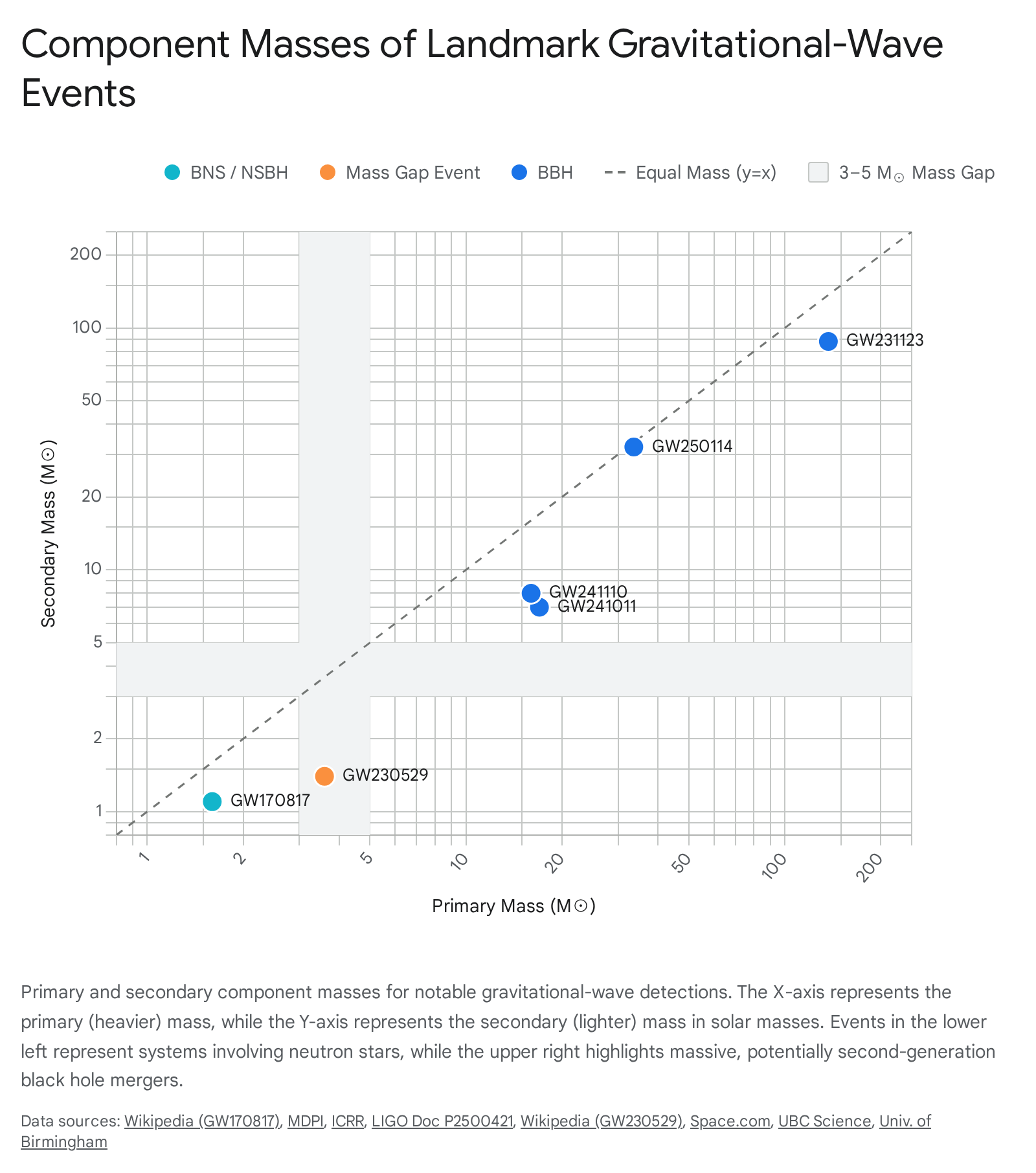
However, the LVK network has increasingly detected signals that violate this boundary. A premier example from the O4 run is GW230529, detected on May 29, 2023, by the LIGO Livingston detector alone 1145. Parameter estimation indicates the event was a highly asymmetric binary merger consisting of a $1.4^{+0.6}{-0.2} M{\odot}$ secondary component (consistent with a neutron star) and a primary component weighing $3.6^{+0.8}{-1.2} M{\odot}$ 1124. The primary mass falls squarely into the contested lower mass gap 4546.
While the lack of an electromagnetic counterpart prevents a definitive classification, the system is overwhelmingly interpreted as a neutron star - black hole (NSBH) merger featuring an exceptionally light black hole 4546. Alternative hypotheses have been rigorously tested. For instance, researchers investigated whether GW230529 could be a standard BNS merger that underwent strong gravitational lensing, thereby magnifying the signal and making the system appear artifactually heavier and closer 24. However, Bayesian model comparisons yield a 1/58 probability of lensing, heavily disfavoring this scenario and confirming that the mass gap is not entirely empty 24. Theorists suggest such low-mass black holes may form through fallback accretion, wherein material initially ejected during a supernova fails to achieve escape velocity and collapses back onto the newly formed neutron star, pushing it past the TOV mass limit 45.
Hierarchical Mergers and Second-Generation Black Holes
At the opposite end of the mass spectrum, LVK observations have challenged the upper mass boundaries imposed by pair-instability supernovae (PISN). Stellar evolution theory posits a forbidden mass range between 50 and 130 $M_{\odot}$. In this regime, the cores of massive stars become so hot that gamma-ray photons spontaneously convert into electron-positron pairs. The resulting sudden drop in radiation pressure triggers a runaway thermonuclear explosion that completely disrupts the star, leaving no compact remnant behind 47.
Despite this theoretical ceiling, the GWTC-4.0 catalog contains events like GW231123, which involved a primary black hole of approximately 137 $M_{\odot}$ merging to form a final remnant exceeding 225 $M_{\odot}$ 181948. Such systems strongly imply the existence of "hierarchical mergers" - systems wherein the constituent black holes are "second-generation" remnants that have already survived a prior coalescence 474849.
Further evidence for hierarchical formation arises from recent detections featuring extreme spin dynamics. 1. GW241011 (detected October 11, 2024): This binary consisted of a 17 $M_{\odot}$ primary and a 7 $M_{\odot}$ secondary. The primary black hole exhibited one of the largest and most precisely measured dimensionless spin magnitudes ever recorded, with a spin axis severely misaligned from the binary's orbital plane 124950. 2. GW241110 (detected November 10, 2024): Featuring 16 $M_{\odot}$ and 8 $M_{\odot}$ components, the primary black hole in this system was observed spinning in a retrograde orientation - rotating in the opposite direction of the binary's mutual orbit 124951.
Standard isolated binary evolution struggles to produce black holes with rapid, highly misaligned, or retrograde spins, as mass transfer processes and tidal synchronization typically force spin alignment 51. Instead, these parameters serve as smoking-gun signatures for dynamical assembly in dense environments, such as globular clusters or active galactic nuclei (AGN) accretion disks. In these crowded environments, previously merged black holes can gravitationally capture new companions, naturally yielding asymmetric mass ratios and randomized spin orientations 495052.
High-Precision Tests of General Relativity
Gravitational waves provide an unparalleled laboratory for testing Albert Einstein's 1915 theory of general relativity in the strong-field, highly dynamical regime. On January 14, 2025, the LIGO observatories detected GW250114, the loudest gravitational-wave signal ever recorded 5354. Generated by the collision of two near-equal mass black holes ($33.6^{+1.2}{-0.8} M{\odot}$ and $32.2^{+0.8}{-1.3} M{\odot}$), the signal achieved an extraordinary network SNR of approximately 80 - three to four times louder than the historic GW150914 detection 105556.
The pristine clarity of GW250114 allowed researchers to conduct high-fidelity "black hole spectroscopy." Following the violent merger, the newly formed remnant is highly perturbed. It settles into a stable state by "ringing" like a struck bell, radiating gravitational waves at specific, damped frequencies known as quasi-normal modes 5354. The frequencies and decay rates of these modes are entirely determined by the remnant's mass and spin angular momentum.
For the first time, data analysis confidently isolated two distinct vibrational modes in the ringdown phase: the dominant quadrupolar fundamental mode ($\ell = |m| = 2$) and its first overtone 5356. Measurements constrained these mode frequencies to within $\pm 30\%$ of the theoretical Kerr spectrum, confirming that the final remnant is a true Kerr black hole, entirely consistent with general relativity 5456. Furthermore, researchers utilized the signal to perform a stringent test of Hawking's area theorem (the second law of black hole mechanics), which dictates that the total surface area of a black hole's event horizon cannot decrease over time. By comparing the inspiral and post-merger parameters, scientists verified that the combined initial horizon area of roughly 240,000 square kilometers increased to a final remnant area of 400,000 square kilometers, proving the theorem to high statistical credibility 485456.
Constraints on Electromagnetic and Neutrino Emission
Physical Mechanisms of Binary Black Hole Mergers
While BNS and NSBH systems offer the potential for multi-messenger astronomy, binary black hole (BBH) mergers remain entirely electromagnetically dark. Despite rigorous search campaigns, no confirmed optical, radio, or high-energy photon counterparts have been linked to a pure BBH coalescence 1.
Theoretical astrophysics robustly explains this absence. For a BBH system to radiate light, it requires the presence of a substantial circumbinary accretion disk. However, the system is governed by a race between viscous torques (which drive gas inward toward the black holes) and gravitational torques (which expel gas outward as the binary transfers angular momentum to the disk) 57. As the binary inspirals and emits gravitational waves, the orbital decay rapidly outpaces the viscous timescale of the gas. The binary reaches a "decoupling radius," leaving the accretion disk behind and plunging into a relative vacuum where the final merger occurs 5758.
Even in theoretical scenarios where the binary moves through a uniform magnetic field anchored to a distant disk, numerical solutions to the Einstein-Maxwell equations reveal that the resulting electromagnetic energy emission is vanishingly small - approximately $10^{-15}$ times weaker than the radiated gravitational energy 62. Furthermore, this theoretical emission would occur at ultra-low frequencies ($\sim 10^{-4}$ Hz), well outside the sensitivity bands of astronomical radio telescopes 62.
Occasionally, asymmetric gravitational-wave emission - caused by precession or unequal component masses - can impart a massive linear momentum "kick" to the final merged black hole, propelling it at recoil velocities up to 5,000 km/s 59. While this high-velocity remnant could theoretically shock surrounding gas and produce an observable afterglow, identifying such a signature remains computationally and observationally prohibitive 59.
Upper Limits on High-Energy Neutrinos
Neutrinos offer a third messenger modality, capable of escaping optically thick environments that trap photons. The IceCube Neutrino Observatory, utilizing a cubic-kilometer array of photomultiplier tubes embedded deep in the Antarctic ice, has conducted extensive searches for neutrino emission coincident with LVK triggers 3132.
Searches during the O3 and O4 runs focused on both high-energy tracks (primarily sensitive to muon neutrinos interacting in the ice) and low-energy cascades (sensitive to all neutrino flavors via the denser DeepCore sub-array) 31326061. Utilizing unbinned maximum likelihood (UML) analyses and Bayesian frameworks with astrophysical priors, IceCube researchers searched for prompt emissions within a 1,000-second window centered on the merger time, as well as extended 14-day windows for systems containing neutron stars 313262.
To date, no significant high-energy neutrino emissions have been correlated with any gravitational-wave event 3162. The absence of TeV to PeV neutrinos places stringent upper limits on the isotropic equivalent energy emitted via hadronic processes in relativistic merger jets 6062. These non-detections indicate that either the efficiency of neutrino production in merger environments is lower than models predict, or that the highly collimated relativistic jets associated with these mergers have not been favorably aligned with Earth's line of sight.
Observational Limits on Kilonovae in the O4 Run
The lack of counterparts in O4 is not limited to black holes. Despite the detection of multiple NSBH candidates - such as GW230529, S230518h, S230627c, and S240422ed - none have yielded a confirmed kilonova or short GRB 6364.
Extensive follow-up campaigns utilizing dozens of instruments (including ATLAS, DECam, ZTF, and TESS) mapped the localization regions of these events but found no transients 63. For candidate S230518h, the multi-messenger non-detections allowed researchers to tightly constrain the dynamical ejecta mass to $m_{dyn} < 0.03 M_{\odot}$ and the viewing angle to $\theta > 25^\circ$, heavily restricting the parameters under which a disk wind or tidal tail could form 63. Population synthesis models projected prior to O4 predicted these difficulties; while wide-field surveys possess the depth to detect nearby kilonovae on the first night, the vast majority of prompt GRB and afterglow emissions are expected to be missed due to off-axis viewing angles unless the event occurs extremely close to Earth ($z \lesssim 0.02$) 656667.
Future Observational Horizons
As the LVK collaboration processes the immense GWTC-4.0 catalog, planning for the next era of gravitational-wave astronomy is already underway. The primary operational bottleneck for multi-messenger follow-up remains the large sky localization areas inherent to a three- or four-detector network. To resolve this, the terrestrial network is physically expanding.
In April 2026, the Indian government, via the Department of Atomic Energy (DAE), broke ground on the LIGO-India facility in the Aundha region of Maharashtra 7268. Constructed by Larsen & Toubro, the facility will feature an 8-kilometer ultra-high vacuum beam tube and infrastructure identical to the US detectors 726869. Scheduled to commence science operations by 2030, the addition of a geographically distant fifth node will vastly improve the global triangulation baseline, shrinking source localization areas by a factor of five to ten, thereby revolutionizing the ability of optical telescopes to rapidly identify kilonovae 6869.
Simultaneously, the existing network is preparing for the fifth observing run (O5), tentatively scheduled for 2028-2031, following a planned interim run (IR1) in late 2026 1570. The O5 upgrades will push the detectors toward their "A+" configuration limits, utilizing advanced squeezed light sources and improved mirror coatings to further suppress quantum and thermal noise 1371. As detector sensitivity scales, the volume of the observable universe scales by the cube of the distance, shifting gravitational-wave astronomy from the regime of individual phenomenological studies to the vast statistical demographic analysis of millions of compact mergers across cosmic time.