
What Happens in Your Brain When You Learn a New Skill
When you learn a new physical skill, your brain undergoes a profound biological transformation, physically and chemically rewiring itself to build new communication networks. Initially, the conscious, planning centers of your brain work in overdrive, making your early movements feel slow, erratic, and clumsy. Over time, through a continuous loop of error correction and reward reinforcement, the task is handed off to deep-brain "autopilot" structures, allowing your neurons to execute the movement with effortless, energy-efficient precision.
The Biological Foundation of Skill Acquisition
Right now, as you attempt to process the information on this screen, your brain is engaging in a biological feat that scientists in the early twentieth century believed was impossible for an adult: it is physically rebuilding its own architecture. For decades, the scientific consensus held that the adult brain was a fixed, static structure. You were born with a set number of neurons, they wired themselves during childhood development, and after that critical period, your neural architecture was essentially set in stone 1.
That consensus was spectacularly wrong. Modern neuroscience has proven that the central nervous system is highly malleable, a phenomenon known as neuroplasticity 123. Your brain contains roughly 86 billion neurons, each capable of forming up to 10,000 connections (synapses) with neighboring cells 1. Every experience you have, every thought you entertain, and every physical movement you practice physically reshapes the structure of your brain by altering how these neurons connect and communicate 14.
When you decide to learn a new motor skill - whether that involves playing a complex piece on the piano, perfecting a tennis serve, or mastering a surgical procedure - you are embarking on a massive, metabolically expensive construction project inside your central nervous system.
The Trailblazer Analogy: Carving Neural Pathways
To understand how neuroplasticity drives motor learning, cognitive neuroscientists frequently rely on a powerful analogy: carving a path through a dense, overgrown forest 156.
Imagine standing at the edge of a thick woods. Your destination is on the other side, but no one has ever walked there before. There is no trail. Your first attempt to cross the forest is incredibly difficult. You have to bushwhack your way through thick brush, step over fallen logs, and constantly pause to figure out which direction to go 6. You will likely make wrong turns and have to double back.
In neurological terms, this is what happens during your first attempt at a new skill. Your brain is firing disorganized electrical signals across weak, unestablished synaptic connections. Because the pathway is unrefined, the movement requires immense conscious effort and feels incredibly clumsy.
However, if you walk that exact same route through the forest every single day, something begins to change. The repeated footsteps trample the underbrush. You snap the obstructing branches out of the way. Over time, a faint dirt trail begins to appear, making the journey slightly easier and faster 56. If you keep walking it for years, that dirt trail might eventually be paved into a multi-lane highway, allowing you to cross the forest at lightning speed with absolutely no conscious thought about navigating the obstacles 56.
Your brain does exactly the same thing, except the trails are carved by electrical activity and chemical reinforcement rather than footsteps 1. In 1949, Canadian psychologist Donald Hebb distilled this mechanism into a foundational concept now known as Hebb's Rule: Neurons that fire together, wire together 13.
Every time you repeat a specific motor pattern, you are strengthening the synaptic connections that make up that specific pathway 13. The brain physically reinforces these heavily trafficked routes. It wraps the most active nerve fibers in fresh layers of myelin - a fatty insulating sheath that dramatically increases the speed and efficiency of electrical impulses traveling down the axon 14. Skip the repetition, and the pathway never stabilizes. Without use, the brain actively prunes connections away, much like the forest reclaiming an abandoned trail - a process scientists call long-term depression (LTD) 13.
The Expansion-Renormalization Model
For a long time, the assumption was that if you practiced a skill extensively, the relevant areas of your brain simply grew larger to accommodate the new ability. Early magnetic resonance imaging (MRI) studies seemed to support this, showing that expert musicians or experienced taxi drivers had thicker gray matter in task-specific brain regions 56.
However, recent advancements in continuous diffusion MRI, which tracks microstructural changes in real-time, have revealed a much more nuanced process known as the "expansion-renormalization" model 51011.
When you first begin acquiring a new skill, your brain calls in massive reinforcements. Neuroimaging shows an initial, transient increase in gray matter volume in task-relevant areas within minutes to hours of practicing a new task 51011. This early "expansion" phase likely reflects the rapid growth of new dendritic spines, the formation of temporary synapses, and an influx of glial cells to support the increased metabolic demand 510. You can think of this phase like a massive casting call for a movie: the brain brings in numerous cellular "candidates" to test out different neural micro-circuitries, hoping to find the optimal pathway for the new movement 5.
However, maintaining this swollen, highly active neural network is incredibly taxing on the body's energy reserves 57. Once the brain identifies the most efficient neural circuitry for the skill, it begins the "renormalization" phase. It aggressively prunes away the excess, unused candidates 5. The overall gray matter volume partially or completely returns to its baseline level, but the internal connectivity is fundamentally altered 511. The end product is a highly optimized, hyper-efficient neural circuit that can execute the skill using a fraction of the energy 57.
The Three Stages of Motor Learning
To categorize this biological journey from initial clumsy attempts to masterful execution, psychologists and neuroscientists frequently reference the classic three-stage model proposed by Paul Fitts and Michael Posner in 1967 814916.
While some modern coaching theorists argue that learning is rarely a perfectly linear progression, the Fitts and Posner framework remains a highly accurate and widely accepted way to describe the distinct behavioral shifts - and the corresponding functional shifts in brain activation - that occur as we acquire a new skill 8916.
1. The Cognitive Stage: High Effort, High Error
When you first attempt a novel movement - whether it is learning a specific martial arts kick, using chopsticks, or driving a manual transmission car - you enter the Cognitive Stage. In this initial phase, your primary goal is simply to understand the fundamental requirements of the task 14916.
Your brain is heavily reliant on explicit, conscious knowledge. You are likely talking yourself through the steps internally: Keep your eye on the ball. Step with the left foot. Follow through with the wrist. Because your mental bandwidth is entirely consumed by figuring out what to do, your movements are stiff, uncoordinated, and highly prone to gross, unpredictable errors 141617. You also lack the internal awareness to know exactly why a movement failed, making you highly dependent on external feedback, such as verbal corrections from a coach or the visual outcome of the action 314.
Neurologically, the cognitive stage is a loud, chaotic, and energy-intensive period. Functional MRI (fMRI) studies mapping the brains of novices reveal massive, widespread activation across the cerebral cortex 1011. Specifically, the prefrontal cortex - the area of the brain responsible for executive function, working memory, and conscious decision-making - is highly engaged 91011. Because the prefrontal cortex is working at maximum capacity, you cannot easily multitask during this stage. If someone asks you a complex question while you are learning to juggle, the cognitive overload will cause you to drop the balls immediately.
2. The Associative Stage: Refining the Rhythm
As you log more practice hours, you naturally transition into the Associative Stage. Having established a basic understanding of the task, you no longer need to consciously recite the overarching goals. Instead, your attention shifts to refining the granular details of the movement 14916.
During this intermediate phase, you are exploring the "solution space." You are figuring out the precise timing, the transitions between sub-movements, and the exact muscular coordination required to make the action smooth 9. Behaviorally, the number of gross errors drops significantly, and your performance becomes far more consistent 141617.
Crucially, this is the stage where you develop an internal "error detection" system. You begin to associate specific physical sensations with specific outcomes. If you hit a bad tennis stroke, you can immediately feel that your racket face was angled incorrectly before the ball even hits the net 1417.
In the brain, we see a distinct shift in the locus of power. The heavy reliance on the prefrontal cortex begins to quiet down 1011. Activation shifts toward the primary motor cortex (which directly commands muscle contractions), the supplementary motor area (SMA, which helps sequence and plan complex movements), and the parietal networks (which process spatial awareness and integrate sensory feedback) 38111213.
3. The Autonomous Stage: The Autopilot Engages
The final destination of skill acquisition is the Autonomous Stage. After countless hours of structured, deliberate practice, the skill becomes an automatized, deeply ingrained routine 1491617.
The movement now requires almost no conscious thought. You can drive a manual car while holding a conversation, or dribble a basketball while scanning the court for open teammates, because the motor execution has been completely offloaded from your conscious working memory 1416. Paradoxically, thinking too much about the mechanics of the movement during this stage can actually ruin your performance - a phenomenon commonly referred to in sports psychology as "choking," which occurs when an expert unnecessarily re-engages their prefrontal cortex to control an already automated skill.
At this expert level, neuroimaging reveals a fascinating phenomenon called neural efficiency 711. When comparing fMRI scans of experts versus novices performing the exact same motor task, experts actually use significantly less overall brain energy 711. The sprawling, generalized brain activation seen in beginners is replaced by highly localized, fine-tuned activation in specific subcortical motor regions 711.
| Stage of Learning | Behavioral Characteristics | Primary Brain Activity | Reliance on Conscious Attention |
|---|---|---|---|
| Cognitive | Erratic, slow, frequent gross errors. Figuring out "what" to do. | Prefrontal cortex (heavy cognitive load, explicit decision-making). | Very High. Easily derailed by external distractions. |
| Associative | Smoother, more consistent. Refining "how" to do it. Self-correcting. | Primary motor cortex, supplementary motor area (SMA), parietal networks. | Moderate. Can handle minor distractions but still requires focus. |
| Autonomous | Effortless, rapid, automatic. Executed as a fluid, subconscious routine. | Basal ganglia, cerebellum, localized sensorimotor cortex. Neural efficiency. | Very Low. Can easily multitask and process secondary information. |
Table: The progression of motor learning based on the classic Fitts and Posner model, integrating modern behavioral and neuroimaging findings 78149161011.
The Brain's Dual Learning Engines
To successfully transition a skill from the clumsy, prefrontal-heavy Cognitive stage to the effortless Autonomous stage, your brain relies heavily on two distinct, complementary, subcortical learning engines: the cerebellum and the basal ganglia 1415161718.
While the primary motor cortex acts as the main "steering wheel" that directly drives your muscles, the cerebellum and the basal ganglia act as advanced navigation and reward systems.
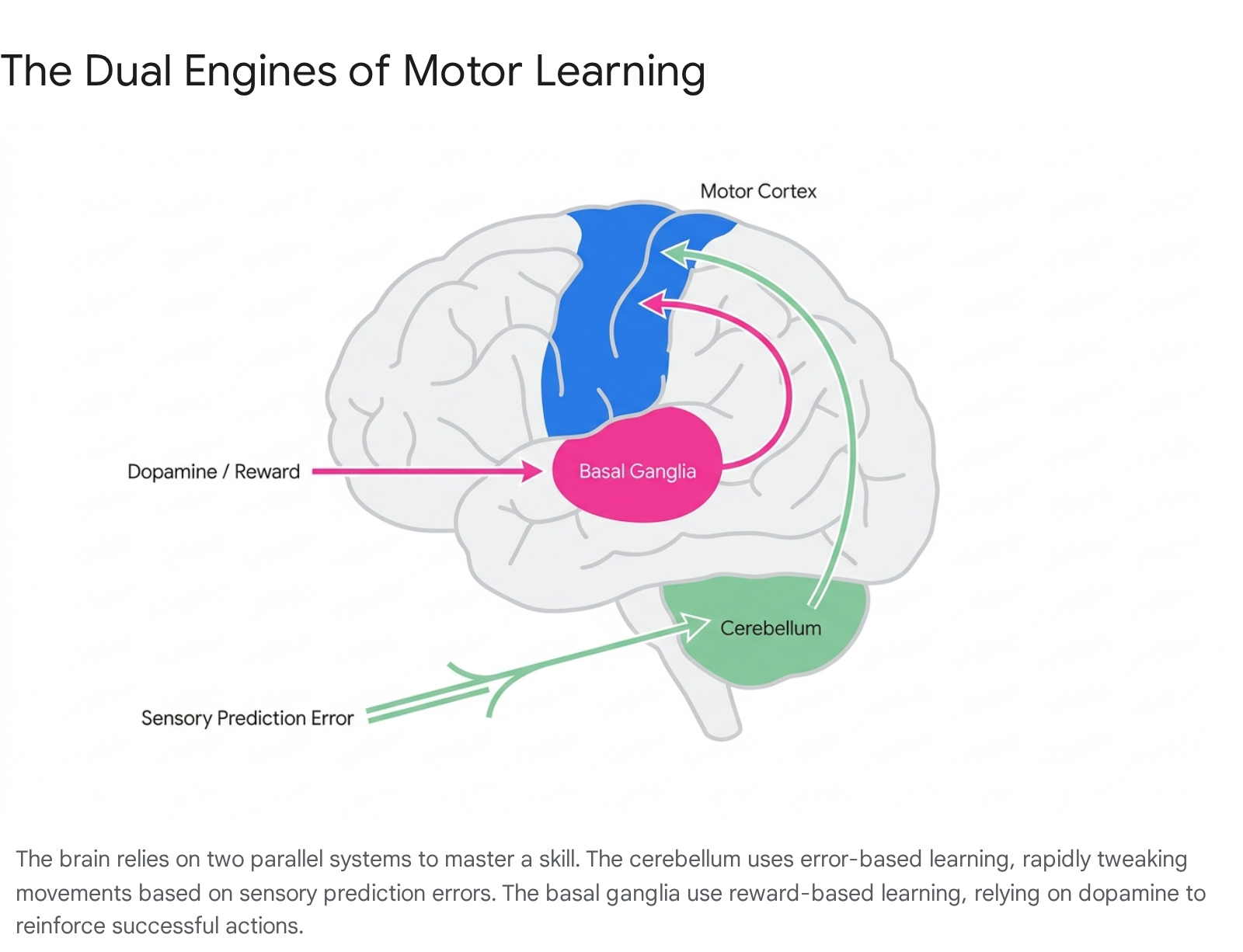
They constantly work behind the scenes to analyze sensory feedback, evaluate success, and optimize your technique before sending refined instructions back up to the cortex 1718.
The Cerebellum: Mastering Error-Based Learning
Nestled at the lower back of the brain, the cerebellum - Latin for "little brain" - is a densely packed structure that contains more than half of all the neurons in your entire nervous system, despite accounting for only about 10% of the brain's total volume 19. It is the undisputed champion of error-based learning 1620293021.
Error-based learning is a fast, highly responsive mechanism driven by "sensory prediction errors" (SPEs) 2029212223. Whenever you initiate a movement - for example, reaching out to grab a cup of coffee - your brain creates an internal "forward model" 9152122. This forward model is a split-second prediction of exactly where your arm will go, how much force it will exert, and what that movement will physically feel like 15162122.
If your hand misses the cup and knocks it over, your visual and proprioceptive (body positioning) systems instantly report the grim reality back to your brain. The cerebellum acts as a comparator. It calculates the exact mathematical mismatch between what the forward model predicted would happen and what actually happened 15162122.
Once it calculates this sensory prediction error, the cerebellum rapidly updates the motor commands for your very next attempt 15162122. This process happens incredibly fast and largely unconsciously, which is why scientists refer to it as implicit adaptation 212425. You do not have to consciously tell your arm to adjust two inches to the left; the cerebellum automatically tweaks the internal model so that your subsequent reaches are more accurate 21.
However, error-based learning has a quirk: it responds most strongly to small, manageable errors. If a sensory prediction error is too large - meaning the outcome was wildly different from the prediction - the brain often attributes the failure to an unpredictable environmental change rather than an internal motor flaw, and the cerebellum's automatic updating process is blunted 252627.
The Basal Ganglia: Learning from Reward
While the cerebellum wants your movements to be kinematically accurate, the basal ganglia want your movements to be successful.
Situated deep within the center of the brain, the basal ganglia network is heavily involved in action selection, habit formation, and crucially, reward-based learning 1415171820. Reward-based learning (often framed as reinforcement learning) does not care about precise vector math or tiny sensory deviations. It relies on binary outcomes: did the action achieve the goal or not? 202930.
When you attempt a movement and it results in a successful outcome - like finally sinking a long putt or playing a complex guitar chord perfectly without buzzing a fret - your brain experiences a surge of the neurotransmitter dopamine, originating from areas like the ventral tegmental area and the substantia nigra 17182030. This dopaminergic release acts as a powerful teaching signal. It tells the basal ganglia, "Whatever precise combination of muscle activations you just used to achieve that outcome, encode it and do it exactly like that again" 182030.
Because reward-based learning relies on exploring different strategies and waiting for a successful outcome, it generally takes longer to alter behavior compared to the rapid, trial-to-trial adjustments of the cerebellum's error-based adaptation 20. However, the changes driven by the basal ganglia are profoundly durable, deeply cementing long-term motor habits and encoding the absolute value of specific actions 14151820.
A Real-World Blend: The Case of Billiards
In highly controlled laboratory settings, researchers have historically tried to isolate these two systems by using robotic arms to introduce artificial force-field perturbations (testing the cerebellum) or by providing delayed point-scoring systems without visual feedback (testing the basal ganglia) 202122.
But in real-world scenarios, your brain blends these two mechanisms seamlessly. Consider the complex motor task of playing pool (billiards).
If you shoot the cue ball and miss the target pocket by two inches, your cerebellum instantly calculates the sensory prediction error based on the visual trajectory of the ball. It subtly adjusts your aim, grip, and stroke angle for your next attempt 202930. But when the ball finally drops into the pocket, your basal ganglia register the success, triggering a dopamine release that reinforces the exact mechanical posture that led to the win 202930.
Recent studies utilizing embodied virtual reality layered over physical pool tables have revealed that humans constantly alternate between these two learning mechanisms 2023. Fascinatingly, research indicates that the presence of an explicit reward can actually modulate how the brain processes errors. When a participant consistently achieves a reward, the brain may actively suppress the cerebellum's automatic error-correction sensitivity. This ensures that minor, meaningless fluctuations in movement do not cause the brain to accidentally "unlearn" a highly successful, rewarded motor strategy 2023.
Neuro-Hacks: Leveraging Science for Effective Practice
Understanding the underlying neuroscience of motor learning allows us to completely rethink how we train. The biological realities of neuroplasticity point to several counter-intuitive strategies for building neural pathways faster and making them more durable.
The Myth and Reality of the 10,000-Hour Rule
It is almost impossible to discuss skill acquisition without encountering the famous "10,000-Hour Rule." Popularized by author Malcolm Gladwell, the rule posits that world-class expertise in any domain requires roughly 10,000 hours of practice 3839. The concept was loosely based on 1993 research by psychologist K. Anders Ericsson examining elite violinists at a Berlin music academy 39.
However, over the past decade, neuroscientists and cognitive psychologists have aggressively pushed back on this idea, viewing it as a massive, and sometimes harmful, oversimplification 383940.
A landmark 2014 meta-analysis encompassing diverse fields found that practice volume accounted for only about 12% of the variance in human performance 38. Factors such as genetic predispositions, baseline intelligence, working memory capacity, the quality of coaching, and the age at which training began play massive, undeniable roles in achieving mastery 38. Furthermore, the original authors of the violin study noted that 10,000 hours was merely an average among the elite cohort; half of the top performers had reached that level with significantly fewer hours, and many lower-performing individuals had practiced just as much 39.
From a neuroplasticity perspective, it is not the sheer volume of hours that rewires the brain, but the quality and intensity of the neural activation 3841. Mindlessly repeating a golf swing for 10,000 hours will not make you a champion; it will simply permanently hardwire your mechanical flaws deeply into your basal ganglia 38.
What truly drives neural adaptation is "deliberate practice" - focused, highly structured effort directed at the edge of your current capabilities, constantly pushing into areas of weakness 384041. In many cases, researchers note that massive, measurable improvements in motor proficiency can be achieved in just 20 to 50 hours of highly focused, deliberate practice 38.
Embracing "Desirable Difficulties" and Spacing
If you want to learn a new skill efficiently, intuition suggests you should practice a single movement over and over in one long session until it feels easy and automatic. Neuroscience suggests the exact opposite.
Making practice deliberately frustrating and varied is one of the most effective ways to force the brain into a state of heightened neuroplasticity. Cognitive psychologists refer to this concept as introducing "desirable difficulties" 4228.
The brain is an ultimate efficiency engine. If you execute the exact same tennis serve fifty times in a row (a concept known as massed or blocked practice), your brain eventually stops paying close attention. The task parameters are temporarily held in short-term working memory, giving you a false illusion of rapid mastery 42.
But if you mix up the drills - practicing a serve, then a backhand, then a volley, returning to the serve later (a concept known as interleaved or random practice) - your brain is denied the luxury of autopilot 4244. It is forced to completely regroup and execute a fresh neural motor plan for every single trial 4244. While performance during the actual practice session plummets and feels chaotic, the long-term retention and transfer of the skill skyrocket, because the neural pathways were forced to activate and reactivate repeatedly 4244.
Similarly, the "spacing effect" dictates that spreading practice sessions out over days or weeks is vastly superior to cramming the same amount of time into a single session 422829. When you introduce a time gap, the neural pathways begin to fade slightly 4229. When you return to the skill a day or a week later, the brain has to work significantly harder to retrieve the motor memory 4229. This struggle to retrieve the memory acts as a powerful signal to the brain that the pathway is important, paradoxically triggering a much stronger, more durable reinforcement of the synaptic bonds 4229.
The Crucial Role of Sleep in Motor Consolidation
Perhaps the most passive, yet arguably the most powerful, motor learning tool available to humans is a good night's sleep.
For many years, scientists debated whether the consolidation of motor skills actually required sleep, or if the sheer passage of time while awake was sufficient to stabilize the memories 3031. Recent, highly comprehensive studies have firmly settled the debate: sleep is an active, essential participant in fine-tuning and cementing motor networks 30313233.
In a massive 2024 study involving 290 participants tasked with a complex visuomotor reaching adaptation, researchers systematically manipulated the timing between the learning session and the onset of sleep 303132. They discovered a critical time-dependency. Motor memories are highly fragile in the first hour immediately after learning; they can be easily overwritten or forgotten 3032. However, participants who practiced the skill and went to sleep shortly after improved their retention of the new movements by roughly 30% compared to groups who remained awake for extended periods after training 303132.
How does unconsciousness improve physical skills? During non-rapid eye movement (NREM) sleep, the brain exhibits fast, localized bursts of electrical activity known as "sleep spindles" 3031. These spindles act as a high-speed replay mechanism. While you are unconscious, your motor cortex, cerebellum, and basal ganglia fire in the exact same patterns they did while you were practicing the skill while awake 303233. This offline neural replay physically strengthens the synaptic connections and integrates the new motor patterns into your broader memory networks, completely independent of physical effort 303233.
Motor Learning Across the Lifespan and Globe
While the fundamental biological mechanisms of neuroplasticity - synaptic strengthening, error-based cerebellar updating, and reward-based dopamine reinforcement - are universal human traits, the way they manifest can shift dramatically based on age, environment, and lifestyle.
The Aging Brain's Compensatory Tactics
It is a well-documented reality that raw motor performance generally declines with age. Older adults often experience a reduction in movement speed, decreased fine motor dexterity, and slower reaction times, partly due to a natural reduction in the volume of encephalic regions like the hippocampus, caudate nucleus, and cerebellum 343536.
However, it is a pervasive myth that older brains cannot learn new tricks. The aging brain absolutely retains the capacity for robust neuroplasticity and the acquisition of complex motor skills 3537. It simply changes how it learns.
When older adults engage in motor learning, fMRI scans reveal a distinct pattern of functional reorganization compared to young adults 3738. To compensate for age-related structural declines in primary motor hubs, the aging brain heavily recruits secondary motor areas, associative areas, and broader cognitive networks to successfully execute the task 3738.
For example, when older adults engage in complex object manipulation (like learning to use a novel tool), they show significantly higher and more prolonged activation in the prefrontal cortex compared to youths 3738. Essentially, older adults invest much more cognitive energy into the strategic planning and preparatory phases of an action, using higher-order executive strategies to make up for decreased raw motor speed and automated efficiency 3738. Through continued practice, older adults successfully trigger waves of structural gray and white matter plasticity, proving that the brain's ability to rewire itself persists well into late life 343537.
The WEIRD Bias and Global Diversity in Neuroscience
As neuroscientists continue to map the intricate networks of motor learning and brain plasticity, the field is confronting a significant historical blind spot: the "WEIRD" bias.
For decades, the vast majority of fMRI and neuroplasticity studies have been conducted on individuals from Western, Educated, Industrialized, Rich, and Democratic societies - most often undergraduate university students residing in North America or Western Europe 394041. This homogenous sampling creates a massive problem when attempting to establish universal baselines for human brain function and motor development 4041.
Recent large-scale, cross-cultural neuroimaging efforts, such as direct comparisons between the US Human Connectome Project and the Chinese Human Connectome Project, have revealed striking differences 404243. While the fundamental biological mechanics of motor learning remain the same, the individualized spatial topography of functional brain networks - how different regions connect and communicate - can differ significantly between different ethnic and racial groups 404243.
These topological variations are not inherently biological destinies; rather, they are heavily shaped by complex gene-environment interactions, distinct cultural experiences, and lifestyle factors such as differing educational systems, socioeconomic statuses, and behavioral norms 404243.
The consequence of ignoring this diversity is severe. When predictive neuroimaging models or rehabilitation protocols are trained solely on WEIRD populations, they often perform significantly worse when applied to underrepresented global groups 40. To build a truly generalizable, equitable science of motor learning, brain plasticity, and neurological rehabilitation, modern researchers are urgently prioritizing global diversification in data collection, ensuring that future breakthroughs apply to the entire human spectrum 39414461.
Bottom line
Learning a new motor skill is not merely an abstract psychological exercise; it is a profound, metabolically demanding physical remodeling of your brain's architecture. As you transition from a clumsy novice to an automatic expert, control shifts from the highly conscious, effortful prefrontal cortex to the hyper-efficient, automated loops of the primary motor cortex, the error-correcting cerebellum, and the reward-seeking basal ganglia. While age and genetic baselines play undeniable roles in peak performance, leveraging science-backed strategies like interleaved practice, spaced repetition, and properly timed post-training sleep can dramatically accelerate your brain's ability to forge and insulate new neural pathways. The ongoing challenge for neuroscientists is to unravel how these intricate neuroplastic processes vary across diverse global populations, paving the way for more personalized and effective neurorehabilitation therapies.