
What Federal Work-Study Is and Whether It Is Worth It
Federal Work-Study is a campus-based federal financial aid program that subsidizes part-time employment for undergraduate and graduate students who demonstrate financial need, uniquely protecting their earnings from reducing future aid eligibility. While historically a cornerstone of college affordability, the program's value is currently in flux; sweeping 2026 legislative changes are shifting payroll costs onto universities and shrinking job availability, forcing students to carefully weigh the program's tax and financial aid benefits against the higher earning potential of private sector jobs.
Understanding the Federal Work-Study Program
The Federal Work-Study (FWS) program operates as a critical component of the federal financial aid system, designed to help students fund their postsecondary education through part-time employment rather than taking on additional debt 123. Administered by the U.S. Department of Education's Office of Federal Student Aid, the program distributes funds directly to over 3,400 participating colleges and universities across the country 44. Institutions then allocate these funds to eligible undergraduate, graduate, and professional students based on demonstrated financial need 14.
A common misconception among students and families is that a Federal Work-Study award is a guaranteed cash grant deposited into a student account to offset tuition. In reality, the award amount listed on a financial aid letter represents a maximum earning potential - a cap on the subsidized wages a student is authorized to earn during the academic year 465. The funds are never disbursed upfront. Instead, students must proactively navigate their campus employment market, apply for eligible positions, secure a job, and work hourly shifts to earn their allocation via a standard paycheck 67.
Once a student's gross earnings reach the cap specified in their financial aid package, the federal subsidy is exhausted 689. At that juncture, the student must either cease working or, if the employing university department has the discretionary budget, transition to an institutionally funded payroll account 89.
The Mechanics of Institutional Funding
The methodology the federal government uses to distribute the roughly $1.2 billion in annual FWS appropriations to universities is highly contested among education policy experts 11013. Congress designed the campus-based allocation formula with two distinct components: a "base guarantee" and a "fair share" calculation 111.
The base guarantee is a legacy provision ensuring that participating institutions receive at least the same baseline funding they were allocated in the 1999 fiscal year 111. Once the base guarantee is satisfied, the remaining appropriated funds are distributed through the fair share formula 11. This secondary calculation relies on the aggregate financial need of the institution's student body, which is a function of the university's total cost of attendance (tuition and fees) and the socioeconomic profile of its enrollees 111.
Policy researchers at the Brookings Institution and the Urban Institute have long criticized this allocation architecture as structurally regressive 110. Because the formula relies heavily on historical participation and overall institutional pricing, federal funds flow disproportionately to older, high-tuition private universities that enroll relatively small populations of low-income students 1210. Consequently, newer institutions and community colleges - which serve the vast majority of the nation's lowest-income students - frequently face severe shortfalls in their fair share calculations 1011.
| Institutional Sector | Share of Federal Work-Study Funds Received | Share of Total National Pell Grant Completions | Policy Implication |
|---|---|---|---|
| Highly Selective Private Nonprofits (58 Institutions) | ~9% | ~1% | These institutions receive a massive surplus of subsidized jobs relative to the size of their low-income populations 10. |
| Public Community Colleges | ~18% | ~39% | Community colleges are severely underfunded by the legacy formula, restricting access to work-study for the students who need it most 10. |
The Financial Protections of Work-Study
To accurately assess whether Federal Work-Study is "worth it," one must look beyond the hourly wage and understand how the program interacts with the broader architecture of federal financial aid. The primary advantage of holding an FWS position over a regular part-time job lies in how the earnings are assessed by the Free Application for Federal Student Aid (FAFSA) 151612.
Navigating the FAFSA Simplification Act
The federal financial aid landscape underwent a massive overhaul with the implementation of the FAFSA Simplification Act for the 2024 - 2025 academic year 131415. This legislation replaced the traditional Expected Family Contribution (EFC) metric with the Student Aid Index (SAI), a new formula capable of dropping to a negative number (-1500) to better identify students with exceptional financial need 141617. The act also mandated the use of the IRS Direct Data Exchange (FA-DDX) to automatically import tax data, eliminated the sibling discount (which previously adjusted aid based on the number of family members in college), and required families to report small businesses and family farms as assets 13141618.
Under this new SAI methodology, income matters immensely. When a student works a standard, off-campus part-time job, those gross earnings must be reported on the FAFSA. If the student's income exceeds the annual income protection allowance, it can artificially inflate their SAI, directly reducing their eligibility for need-based grants in the subsequent academic year 1515.
Federal Work-Study earnings are uniquely exempt from this penalty 6161215. Universities are required to report a student's total FWS earnings directly to the Department of Education 15. During the SAI calculation, the federal formula automatically subtracts these specific earnings from the student's adjusted gross income 61213. This ensures that students are not penalized for working to support their immediate educational expenses, allowing them to earn essential cash without jeopardizing their future financial aid packages 615.
Additionally, the FAFSA Simplification Act removed the notorious "interest checkbox" from the application 15. Previously, students who forgot to check the box indicating their interest in FWS were frequently bypassed for funding. Today, universities automatically assess all applicants for FWS eligibility based purely on their calculated financial need, broadening initial access to the program 15.
FICA Tax Exemptions
Beyond FAFSA protections, work-study students often realize a higher net yield on their hourly wages due to specific tax exemptions. Under the federal student exception, earnings from an FWS job are generally exempt from Social Security and Medicare (FICA) taxes, provided the student is enrolled at least half-time and works directly for the institution they attend 16. While standard federal and state income taxes may still apply depending on the student's total annual income, the avoidance of the 7.65% FICA payroll tax leaves more immediate cash in the student's pocket compared to an identical wage earned at a private retailer 1619.
Work-Study vs. Regular Student Employment
Not every job on a college campus qualifies as Federal Work-Study. Universities employ thousands of students as "regular student workers" using internal departmental operating budgets 3820. While the day-to-day responsibilities of a regular student worker and an FWS student might be identical - such as staffing the circulation desk at the library or working in the campus recreation center - the financial mechanics are vastly different 38.
Regular student employment is not need-based; any enrolled student, regardless of their family's wealth or FAFSA status, can apply 820. Furthermore, because regular campus jobs are not federally subsidized, the earnings count as standard income and do not benefit from the FAFSA income exclusion 315.
| Feature | Federal Work-Study (FWS) | Regular On-Campus Employment | Off-Campus Part-Time Job |
|---|---|---|---|
| Funding Mechanism | Cost-shared (Federal government + Institution) 1 | 100% Institutionally funded 8 | 100% Private employer funded |
| Eligibility | Strict FAFSA-based financial need 320 | Open to all students 20 | Open to the general public |
| Earning Cap | Strictly capped by the student's financial aid award 68 | Limited only by the department's budget | Unlimited, subject to labor laws |
| FAFSA Treatment | Earnings are completely excluded from the SAI calculation 612 | Earnings count toward total income | Earnings count toward total income |
| FICA Taxes | Generally exempt (if enrolled half-time) 16 | Generally exempt (if enrolled half-time) | Fully subject to 7.65% payroll taxes |
The 2026 Upheaval: The One Big Beautiful Bill Act (OBBBA)
While the Federal Work-Study program has historically offered immense value, its operational reality is undergoing a seismic shift. On July 4, 2025, the One Big Beautiful Bill Act (OBBBA) was signed into law, initiating a massive restructuring of federal higher education financing 212822. While the legislation touches everything from immigration fees to electric vehicle tax credits, its higher education provisions take effect on July 1, 2026, and will fundamentally alter campus employment 62123.
The Cost-Share Flip
The most structurally consequential change to the FWS program under the OBBBA is the reversal of the historical funding formula 46.
For decades, the program operated on a generous 75/25 cost-sharing model. For a standard on-campus job, the federal government covered 75% of the student's hourly wage, while the employing university was responsible for only 25% 1. This arrangement made work-study incredibly attractive for university departments, allowing them to hire student labor for a fraction of the actual market cost 69.
Beginning July 1, 2026, the OBBBA mandates that these numbers flip. The federal subsidy drops to 25%, forcing the university to absorb 75% of the student's paycheck out of its own operating budget 4615.
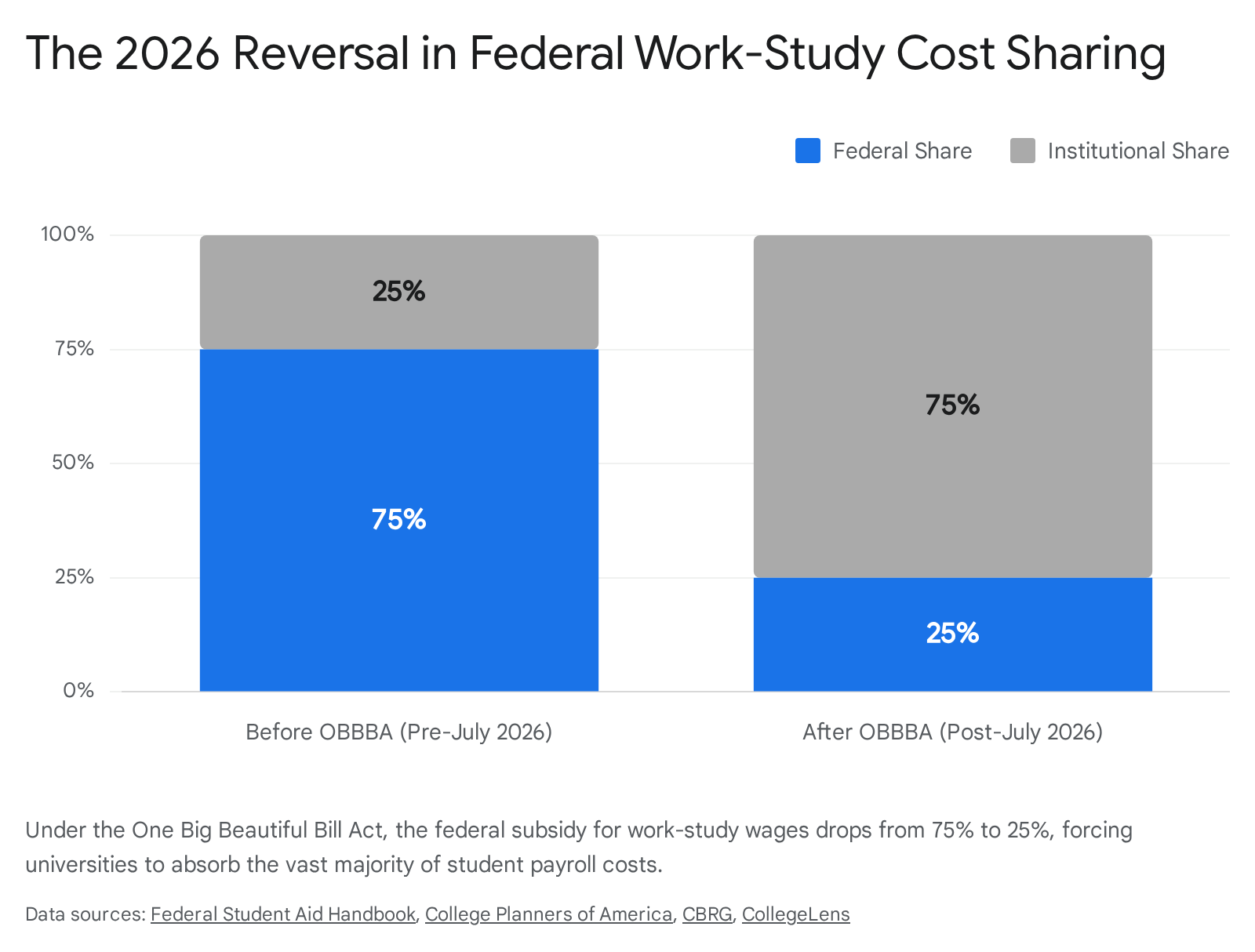
Because every work-study dollar will now cost a college three times more than it did in previous years, higher education analysts predict a severe contraction in job availability 46. Wealthy institutions with massive endowments may absorb the cost, but regional public universities, community colleges, and small private colleges with tight operating margins will likely respond by slashing the total number of work-study jobs offered, capping weekly hours more aggressively, or eliminating the program altogether 4624.
New Restrictions on Job Types
In addition to shifting the financial burden, the Department of Education has issued new guidance under the OBBBA that tightens the parameters of allowable work 615. FWS funds are now explicitly prohibited from being used to finance political activities, partisan advocacy, or civic engagement roles such as voter registration drives or campaign-related work 4615.
Despite these restrictions, standard campus roles - such as library assistants, laboratory researchers, and dining hall staff - remain eligible 6. Furthermore, the federal mandate requiring universities to dedicate at least 7% of their FWS allocation to community service positions remains intact 161925. These community service roles, which prominently include the America Reads program where college students serve as literacy and mathematics tutors for elementary children, represent some of the most rewarding and secure positions in the shrinking FWS landscape 51926.
Looming Federal Budget Cuts in Fiscal Year 2026
Compounding the structural upheaval of the OBBBA is a volatile appropriations environment that threatens to gut campus-based aid entirely.
The fiscal year 2026 federal budget proposals moving through Congress include devastating reductions to programs that support low-income students 242728. Current drafts from the House Appropriations Committee propose cutting the Federal Work-Study program's funding by anywhere from $451 million (a 37% reduction) to roughly $980 million (an 80% reduction), depending on the specific legislative package 4242729.
Simultaneously, the proposed budget targets the complete elimination of the Federal Supplemental Educational Opportunity Grant (FSEOG) 4242829. The FSEOG program has historically provided nearly $910 million in direct grant aid to students with the most exceptional financial need, who frequently rely on a combination of FSEOG grants and FWS employment to cover housing and basic living expenses 41524.
Additional proposed cuts include freezing the maximum Pell Grant award at $7,395 with no adjustment for inflation, eliminating TRIO programs that serve over 800,000 disadvantaged students, and reducing funding for the Child Care Access Means Parents in School (CCAMPIS) program, which subsidizes campus-based childcare for Pell-eligible student parents 24272829. While these budget numbers are subject to final negotiation, the trajectory indicates a stark reduction in federal investment, further ensuring that work-study positions will become fiercely competitive 615.
The Broader Context: Student Loans and the Danger of Debt
The contraction of the Federal Work-Study program is particularly alarming when viewed alongside the broader changes to student borrowing introduced by the OBBBA.
As of July 1, 2026, the OBBBA eliminates the Federal Direct Graduate PLUS Loan program, a critical tool historically utilized by middle- and low-income students to finance graduate education 283031. In its place, the legislation imposes strict annual borrowing limits of $50,000 for professional students (e.g., medicine, law) and $20,500 for other graduate students, alongside an absolute lifetime borrowing cap of $257,500 across all federal student loans (encompassing both undergraduate and graduate borrowing) 28223031. Furthermore, loans will now be prorated based on enrollment intensity, meaning part-time students will see their borrowing limits reduced proportionally 223031.
The OBBBA also consolidates federal student loan repayment options 2831. For new borrowers with loans disbursed after July 1, 2026, legacy income-driven plans like PAYE, REPAYE, and SAVE will be replaced by a streamlined binary choice: the Tiered Standard Repayment Plan or the new Repayment Assistance Plan (RAP) 21283132. RAP requires a $10 minimum monthly payment for borrowers earning less than $10,000, and 1% to 10% of adjusted gross income for higher earners, notably removing caps on monthly payments and negative amortization 28.
The Default Trap
With tighter borrowing caps and less generous repayment options, minimizing debt through earned income is more vital than ever. Federal student loans are unforgiving; missing scheduled payments for 270 days pushes a loan into default 3334.
Default triggers a catastrophic financial cascade: "acceleration" makes the entire unpaid balance immediately due, the borrower loses eligibility for future federal aid, and the debt is transferred to the Default Resolution Group or a Guaranty Agency 3334. The federal government can then initiate involuntary collection methods, including Treasury offsets (seizing tax refunds) and wage garnishment of up to 15% of the borrower's paycheck 333435. Given these severe consequences, Federal Work-Study serves as a vital safeguard, offering students a mechanism to pay for textbooks, food, and rent without relying on high-interest private loans that lack federal forbearance protections 329.
The Economics of Student Labor: Does FWS Pay Enough?
Despite its protections, the mathematical reality of the Federal Work-Study program often disappoints students seeking to close major affordability gaps 5. The "missing middle" demographic - students from middle-income families earning between $50,000 and $125,000 annually - often find that their financial aid packages rely heavily on loans and work-study, leaving a multi-thousand-dollar gap to cover total costs 36.
Federal Work-Study simply does not generate enough volume to close these gaps. According to data from the U.S. Department of Education's Office of Federal Student Aid for the 2024 - 2025 academic year, the median FWS award is just $1,790 per year 5. The median hourly wage across all participating schools was $13.62 5. At that rate, the average student exhausts their entire annual financial aid award after working roughly 132 hours - an average of just 4 to 5 hours per week across a 30-week academic year 5.
The Minimum Wage Discrepancy
Under federal guidelines, universities must pay work-study students at least the prevailing federal minimum wage, which has remained frozen at $7.25 per hour since 2009 6194445. However, the program requires adherence to state or local minimum wage laws if they exceed the federal floor 6.
This creates massive geographical disparities in the program's utility. As of 2026, 30 states and the District of Columbia mandate wages above the federal minimum 37384939.
| Regional Minimum Wage Environment (2026) | Typical Hourly Wage | Impact on the Federal Work-Study Student |
|---|---|---|
| High-Cost Urban Centers (Washington D.C., Seattle, NYC) | $17.00 - $21.00+ | High hourly rates mean students hit their FWS earning caps extremely fast, limiting total hours worked. The high cost of living generally outpaces the small award 373849. |
| Progressive Wage States (California, Washington, New York) | $16.00 - $17.00+ | FWS wages track closer to off-campus entry-level retail, making campus jobs attractive, though total net earnings remain capped 444537. |
| Federal Baseline States (Texas, Georgia, Wyoming, Louisiana) | $7.25 | FWS wages remain depressed at 2009 levels. Students can work more total hours before hitting their cap, but the low hourly rate makes the effort significantly less lucrative than private-sector jobs 444537. |
While federal lawmakers have proposed sweeping changes - such as the "Raise the Wage Act of 2025" and the "Living Wage for All" act, which seek to elevate the federal minimum to $17 or even $25 an hour by 2030 - the current reality forces millions of students in Southern and Midwestern states to accept sub-living wages for campus work 383940.
Earning Caps vs. Market Wages
The strict limitation imposed by the financial aid award cap is the primary reason many students eventually abandon the FWS program in favor of the private sector 51516.
Consider the mathematical comparison: A student working 12 hours a week at an off-campus retail or food service job paying $16 an hour will gross approximately $5,544 over the course of a standard two-semester academic year 5.
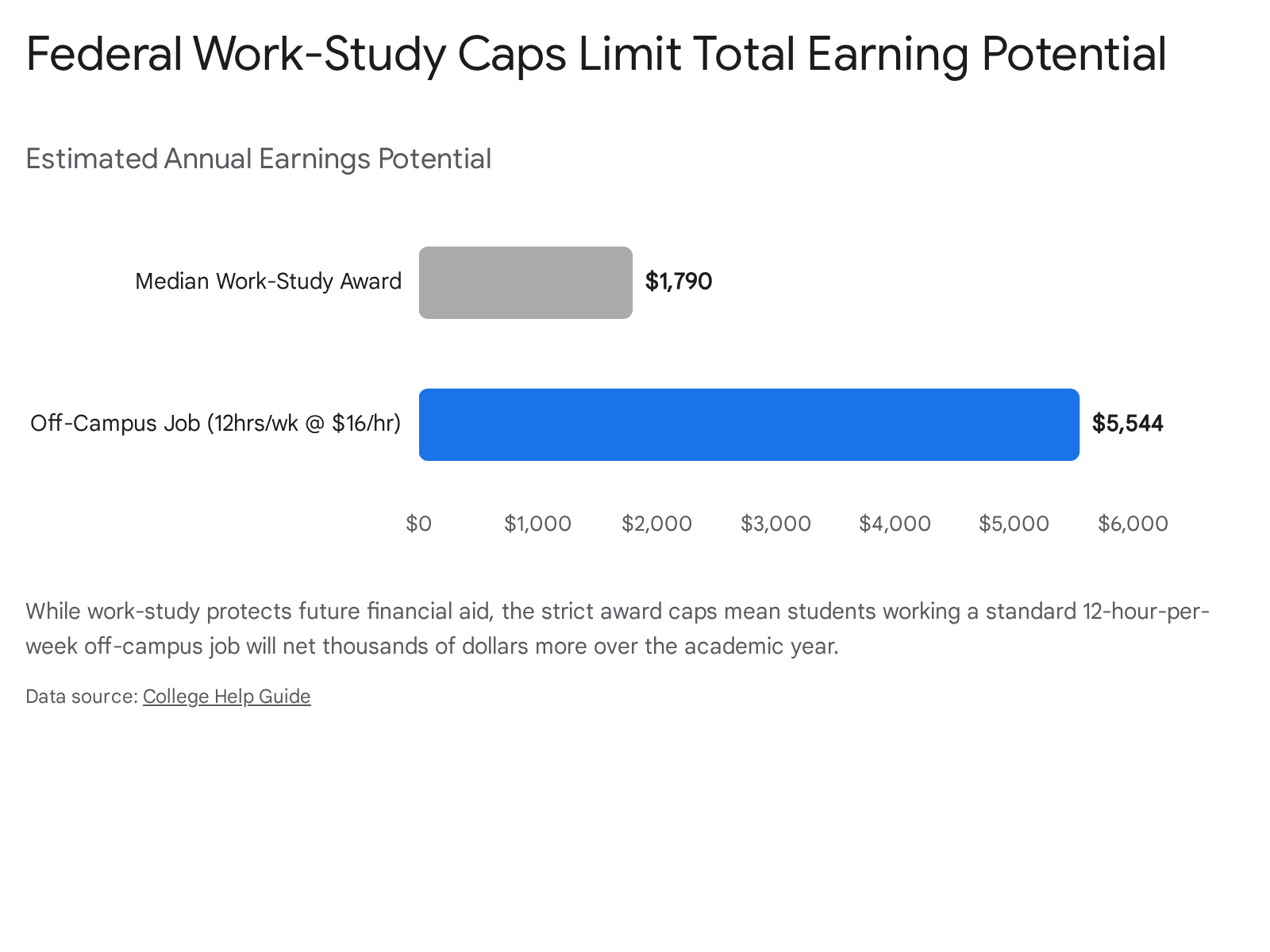
By contrast, an FWS student is artificially constrained; if their financial aid package lists a $2,000 FWS award, the university payroll system will halt their subsidized wages the moment they reach that threshold 56.
For a student who only needs to cover weekend pizza, textbooks, and modest living expenses, the $2,000 FWS award - paired with the convenience of an on-campus commute and an employer who prioritizes exam schedules - is an ideal arrangement 715. However, for a student facing a $6,000 shortfall in basic tuition costs, the FWS program is mathematically insufficient 45. They are forced to take the off-campus job, accepting the reality that the $5,544 in gross earnings will be counted as standard income on their next FAFSA and may incrementally reduce their future grant eligibility 61515.
An Alternative Path: The Rise of Workforce Pell
As traditional campus-based aid mechanisms like FWS contract, the federal government is attempting to open alternative avenues for career readiness. A major inclusion in the OBBBA is the establishment of the "Workforce Pell" grant, set to go live in July 2026 2441.
Historically, Pell Grants could only be applied to traditional degree-seeking programs 41. Workforce Pell fundamentally changes this by allowing students to use federal grant money to pay for short-term, job-focused career training programs, such as IT certificates, healthcare credentials, and skilled trades 2441. To qualify, the program must be at least 150 clock hours over a minimum of 8 weeks, align with high-wage occupations, and report positive student earnings outcomes 41.
However, Workforce Pell comes with strict constraints. Students cannot receive a Workforce Pell Grant and a traditional Pell Grant concurrently, and any funds used for short-term training count toward the student's absolute lifetime limit of 12 semesters of Pell eligibility 41. Furthermore, the OBBBA institutes a new restriction on "Pell over-awarding" - if a student's cost of attendance is already fully covered by non-federal scholarships, they can no longer receive a Pell Grant refund as cash to offset living expenses like transportation or childcare 24.
Maximizing the Value of Federal Work-Study
Despite the looming budget cuts and restrictive earning caps, securing a Federal Work-Study position remains a highly advantageous move for eligible students. To extract the maximum value from the program in a shrinking 2026 market, students must approach the process strategically.
- Verify the Award and Act Early: Financial aid letters for the fall semester are typically dispatched in the spring. Students should immediately check for the "Federal Work-Study" or "FWS" line item 6. Because universities expect intense competition for fewer roles under the new 25/75 cost-sharing rules, students should begin monitoring their university's internal employment portals (such as Handshake or Virtual Job Boards) well before the semester begins, as jobs are awarded strictly on a first-come, first-served basis 791542.
- Prioritize Career Relevance: Research conducted by the Brookings Institution highlights that the most valuable aspect of campus employment is rarely the paycheck; it is the professional development 43. Rather than defaulting to a quiet desk job checking ID cards, students should seek out roles in departments related to their major, such as research assistantships, IT help desks, or university public relations 15162543. The networking opportunities and resume-building potential of these roles far exceed the monetary compensation 31543.
- Seek Out Community Service Designations: Because universities are legally required to spend a portion of their FWS funds on community service, roles in the America Reads program or local nonprofits are highly secure and occasionally offer slightly higher hourly wages to incentivize participation 516192025.
Bottom line
Federal Work-Study remains one of the most student-friendly financial aid programs available, offering unparalleled schedule flexibility, valuable on-campus networking, and the critical advantage of shielding earnings from future FAFSA calculations. However, the program is entering a period of severe contraction; the 2026 implementation of the One Big Beautiful Bill Act shifts the vast majority of payroll costs onto universities, which, combined with looming federal budget cuts, will make positions scarce and highly competitive. While securing a career-relevant work-study job is an excellent way to fund basic living expenses without incurring debt, students facing substantial tuition gaps must recognize the program's strict earning caps and may ultimately need to pursue higher-paying, off-campus employment.