
What the Data Shows About Global Fertility in 2026
The global fertility rate has reached a critical inflection point in 2026, with 71% of the world's population now living in countries where birth rates have fallen below the replacement level. Driven by surging housing costs, unexpected inflation, and shifting social norms, this demographic contraction is forcing a structural transformation across the global economy, healthcare systems, and educational institutions.
The State of Global Population and Fertility
For the first time in modern history, the demographic momentum that defined the twentieth century has decisively fractured. The total fertility rate (TFR) - defined as the average number of children a woman is projected to have over her childbearing years based on current age-specific rates - has been steadily dropping for decades. In the 1960s, the global average stood at roughly 5.0 children per woman, fueling rapid population expansion 123. By 1990, the global TFR had fallen to 3.3 1. As of 2026, the global average hovers between 2.2 and 2.3, resting precariously close to the 2.1 replacement level required to maintain a stable population without net migration 456.
Out of the 237 countries and dependent territories tracked by the United Nations, 136 now fall below this 2.1 replacement threshold 6. The implications of this shift are monumental. While the total number of humans on the planet - currently exceeding 8 billion - will continue to grow for several decades due to demographic momentum and increased life expectancy, the foundation of that growth has hollowed out 7. The global population is transitioning from a period of exponential growth to one of profound regional polarization, where future growth is concentrated in a shrinking handful of nations while major economic powers face unprecedented population aging and decline 8910.
A Widening Regional Divide
The velocity and timing of the fertility transition vary drastically by region, creating a demographically divided world. Today, the world is split between the aging, low-fertility nations of the Global North and East Asia, and the young, high-fertility nations of Sub-Saharan Africa.
The Demographic Winter in the West and East Asia High-income countries are currently facing a demographic winter. Across Europe, North America, and industrialized East Asia, fertility rates have been below replacement levels for decades, but the decline has recently steepened. In the United States, the total fertility rate has dropped to a historic low of 1.53 in 2026, a significant fall from the 2.1 rate recorded in 2006 131112. Europe as a whole trails even further behind, averaging 1.4 children per woman 4. France, which was long considered a European demographic outlier due to its relatively robust family support policies, experienced a major milestone in 2025 when deaths outnumbered births for the first time since World War II, bringing its TFR down to 1.56 13.
The situation in East Asia is even more extreme, featuring the lowest fertility rates ever recorded in peacetime. China's TFR currently sits at just 1.02, a lasting legacy of its strict one-child policy enforced from 1980 to 2015 810. Despite desperate policy reversals, financial subsidies, and housing assistance introduced by the Chinese government, the birth rate has failed to recover, proving that steep demographic declines are exceptionally difficult to reverse 81016. Other Asian territories report even lower figures: South Korea stands at 0.76, Hong Kong at 0.75, and Macao holds the lowest recorded rate globally at 0.70 66. In four specific nations - China, South Korea, Singapore, and Ukraine - fertility has plunged below the critical 1.0 threshold 1.
The Acceleration of Decline in Latin America While the decline in the West was gradual, the speed of fertility decline in several middle-income countries, particularly in Latin America, has been astonishingly rapid. The region transitioned to low fertility precipitously from the second half of the twentieth century onward 13. In 2024, the total fertility rate in Latin America and the Caribbean dropped to 1.8 children per woman 13. Brazil's TFR has plummeted to 1.62, representing a 73% decrease since 1960, while Mexico sits at 1.91 1814.
Chile offers one of the most dramatic examples of this trend. After falling to an average of 1.06 in 2024, Chile's TFR is projected to drop to an astonishingly low 0.92 in 2026 13. A comprehensive study by the National Bureau of Economic Research (NBER) examining Latin America's transition to below-replacement fertility found that the decline is driven primarily by smaller family sizes among young, less-educated mothers, rather than an overall rise in complete childlessness 20. Demographers attribute this rapid regional shift to increased literacy, massive urbanization, the declining influence of traditional religious institutions, and the widespread impact of globalized pop culture that glamorizes independent, single lifestyles 1321.
The Sub-Saharan African Exception In stark contrast to the rest of the globe, Sub-Saharan Africa remains the world's last bastion of high fertility. The African continent features a population-weighted fertility rate of roughly 4.0 children per woman, which is nearly double the global average and almost three times the rate in Europe 4. Chad holds the highest total fertility rate in the world at 5.84, followed closely by Somalia at 5.81, and the Democratic Republic of the Congo at 5.80 66.
This immense concentration of fertility means that the demographic weight of the human race is rapidly shifting southward. Projections indicate that in 2026, approximately 85% of all babies born worldwide will be born in Asia and Africa combined 915. Asia, despite its plunging rates, will still account for roughly 49% of all global births (64.9 million) simply due to its vast population base, while Africa will account for 36% (47.6 million) 915. Conversely, Europe, North America, and Oceania combined will account for barely 8% of the world's newborns 9. Sub-Saharan Africa is fully expected to drive the vast majority of the world's net population growth through the end of the century, with Nigeria alone projected to surpass the United States in total population before 2050 48.
| Global Region | Pop-Weighted TFR (2026 estimates) | Total Population (Millions) | Share of 2026 Global Births |
|---|---|---|---|
| Africa | 4.0 | 1,549.8 | 35.9% |
| Asia | 1.7 | 4,445.8 | 49.0% |
| South America / Caribbean | 1.7 | 438.1 | 7.0% |
| North America | 1.7 | 617.3 | 3.0% |
| Europe | 1.4 | 745.8 | 4.6% |
| Oceania | 2.0 | 46.6 | 0.5% |
(Aggregated demographic data based on United Nations World Population Prospects 2024 Revision and Visual Capitalist geographic models 415.)
The Demographic Modeling Debate: Forecasting the Peak
Because fertility rates are falling faster than historical precedents would suggest, predicting exactly when the global population will peak is a subject of intense scientific debate. For decades, the United Nations Population Division held a virtual monopoly on global demographic forecasting 16. However, newer models developed by independent research institutes utilizing different baseline assumptions now challenge the UN's timeline, predicting a much earlier and lower global population peak 1718.
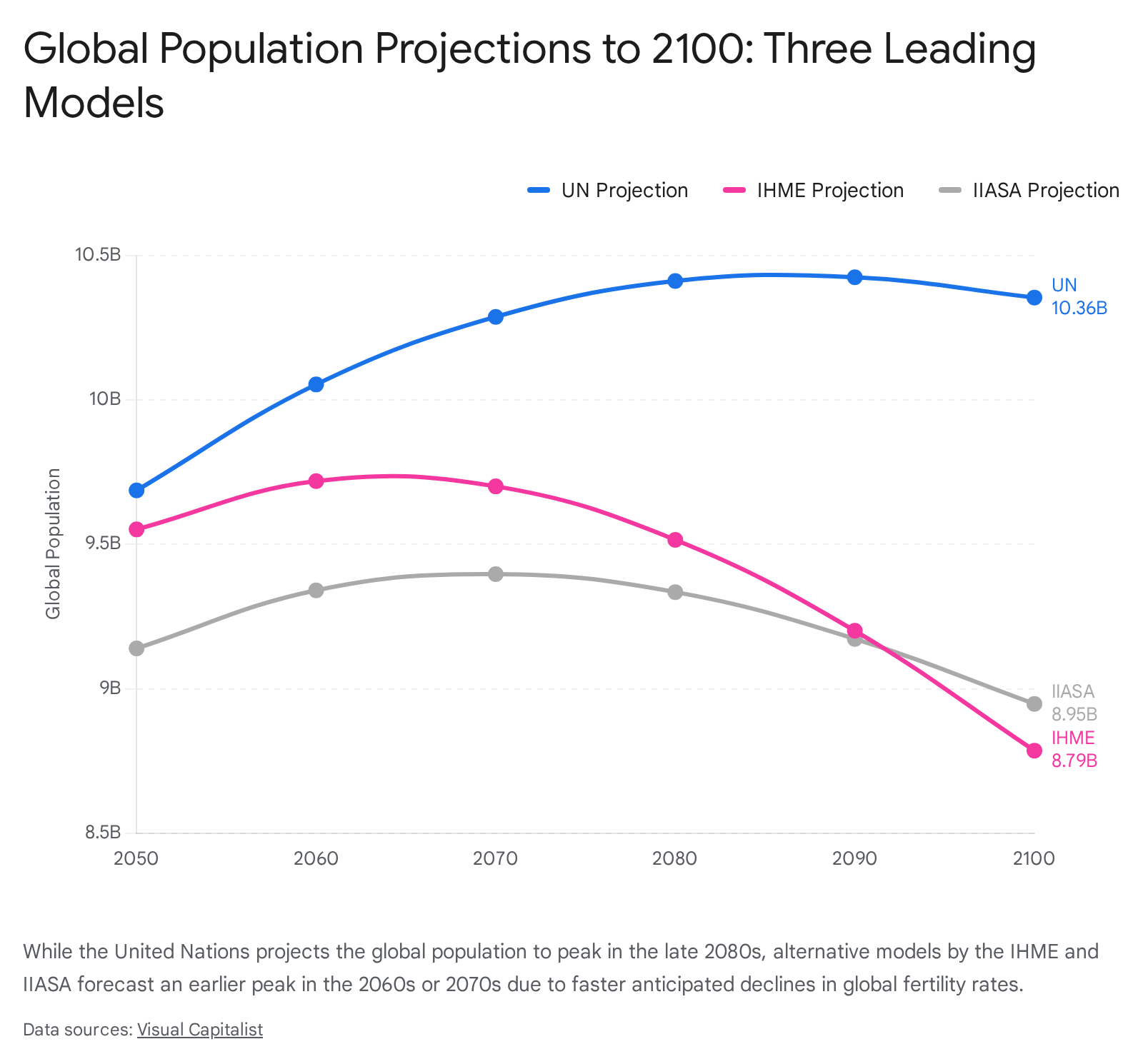
The United Nations utilizes a highly sophisticated statistical model that relies largely on the universal shape of the historical demographic transition. The UN's medium-variant projection assumes that countries currently experiencing very low fertility will eventually see their birth rates organically increase, converging back toward an average of 1.8 children per woman over time 1617. Under this assumption, the UN projects that the world population will hit a peak of roughly 10.3 to 10.4 billion in the mid-2080s before beginning a slow, gradual decline 718.
However, researchers at the Institute for Health Metrics and Evaluation (IHME), supported by the Bill & Melinda Gates Foundation, argue that this assumption is flawed. The IHME models explicitly incorporate female educational attainment and the met need for modern contraception as the primary drivers of demographic behavior 161719. IHME researchers assert that as women become more educated and gain full access to reproductive healthcare, they actively choose to have fewer than 1.5 children on average, and there is little historical evidence to suggest this number will spontaneously rebound 16. Based on these inputs, the IHME projects a much earlier global population peak of 9.7 billion around 2064, followed by a sharp decline to 8.8 billion by 2100 71820.
The International Institute for Applied Systems Analysis (IIASA) in Austria utilizes a similar human-capital-driven model and arrives at a comparable conclusion. IIASA forecasts an even earlier peak of 9.4 billion in 2070, eventually settling at 8.9 billion by the end of the century 1820. A fourth, highly complex model commissioned by the Club of Rome (the Earth4All model) factors in extreme ecological and economic feedback loops, projecting an even lower end-of-century population of just 7.3 billion 17.
The primary battleground for these differing projections is Sub-Saharan Africa. The UN projects that nearly one-third of African countries, including massive populations in Nigeria and Niger, will not reach the 2.1 replacement-level fertility rate before 2100 19. Conversely, IHME and IIASA forecast that rapid educational expansion in Africa will drive the continent's TFR below replacement level as early as the 2050s, radically altering the trajectory of global growth 19.
Structural Drivers of the Fertility Collapse
The global decline in birth rates is not a mysterious anomaly but a highly rational response to modern structural pressures. Historically, falling birth rates were viewed as a natural byproduct of rising wealth, urbanization, and education. Today, however, fertility is declining more rapidly than economic development alone can explain, driven by a toxic blend of soaring living costs, evolving gender roles, biological barriers, and widespread economic anxiety 212223.
The Housing Affordability Crisis
Perhaps the most potent economic deterrent to family formation in the 2020s is the global housing crisis. Expensive housing suppresses fertility by establishing hard budget constraints, forcing young couples to remain in smaller apartments, and driving the migration of families away from economic hubs to more affordable, but less opportunity-rich, areas 24.
A recent study conducted by the University of Toronto tracked the relationship between rent increases and birth rates, finding that rising housing costs alone contributed to 51% of the overall fertility rate decline in the United States from the 2000s to the 2010s 25. When rent rises, the study notes, family formation is delayed, resulting in 7% fewer young families forming during the observed period 25. The National Bureau of Economic Research (NBER) corroborated these findings, demonstrating that a 10% jump in regional home prices leads directly to a 1% drop in births among non-homeowners 12.
Data from the real estate brokerage Redfin highlights that this trend has only worsened. In 2006, the median price of a single-family home in the U.S. was $221,923 (roughly $343,800 adjusted for inflation in 2024), but by 2024, the median sale price had surged past $410,000 12. Because wages have failed to keep pace with these property valuations, millions of young adults are trapped in nontraditional living situations, with a historically high 6% of young Americans moving back in with their parents and another 6% living with roommates purely due to affordability constraints 26. Redfin expects these high housing costs to directly result in fewer babies being born through 2026 and beyond 26.
Unexpected Inflation and Economic Insecurity
Compounding the housing crisis is the persistent sting of inflation. While overall consumer price indexes may fluctuate, unexpected spikes in the cost of daily necessities play a massive role in reproductive decision-making. Economists at the University of Mississippi recently demonstrated that unexpected inflation - defined as price increases that substantially exceed what households anticipate - had a highly significant, negative impact on U.S. fertility rates from 2004 through 2023 2735.
Their models reveal that a five-percentage-point increase in unexpected inflation results in 15 to 25 fewer births per 1,000 reproductive-aged women 35. When inflation rises above expectations, households immediately experience a decline in real purchasing power, generating intense economic uncertainty that discourages childbearing 35. The research specifically noted that women in their early twenties are the most responsive demographic to these inflation shocks, routinely postponing pregnancies when the cost of living spikes unexpectedly 35.
This economic anxiety is reflected in broader consumer sentiment. Despite robust stock market gains and relatively low unemployment in early 2026, the University of Michigan Consumer Sentiment Index has recorded historic lows, indicating deep, structural pessimism among younger generations regarding their financial ability to support a family 28.
The "Motherhood Penalty" and Shifting Social Norms
Economic constraints are deeply intertwined with shifting social and cultural values. Over the past several decades, increased educational attainment among women and their mass integration into the formal labor market have fundamentally altered the timeline of family formation 2229. However, workplace policies and domestic expectations have not evolved at the same pace.
The "motherhood penalty" - the disproportionate burden of uncompensated domestic labor and childcare that falls on women, coupled with severe career interruptions - remains a powerful deterrent to having multiple children, even in regions with strong governmental family support systems like Scandinavia 13. Furthermore, a massive demographic study reveals that the current baby bust is not just the result of couples choosing to have fewer children, but a collapse in family formation itself. In high-income countries, the number of children born to existing mothers has remained relatively stable; the actual decline is driven by a steep drop in the proportion of women who form couples and have any children at all 30.
The proliferation of digital culture and social media is widely viewed as an accelerator of these shifting norms. Researchers note that platforms like Instagram and TikTok have enabled young women globally to bypass traditional, patriarchal authorities, exposing them to alternative lifestyles and raising their expectations for romantic partnerships. This phenomenon, dubbed "cultural leapfrogging," has created a worldwide "relationship recession" where young adults are increasingly comfortable remaining single if ideal partnership and economic conditions are not met 303132.
Crucially, the global fertility decline is not entirely voluntary. A comprehensive 2025 survey by the United Nations Population Fund (UNFPA), spanning 14 countries, uncovered a massive "fertility gap" between desired and actual family sizes. The report found that one in five people globally expect they will not be able to have the number of children they actually desire 32. When surveyed, more than half of the respondents cited economic barriers - including job insecurity, lack of paid family leave, and the exorbitant cost of childcare - as the primary reasons preventing them from achieving their family goals 332.
Biological Barriers and Environmental Toxins
As economic and social pressures force individuals to delay parenthood into their late thirties and forties, they inevitably collide with rigid biological realities. The human reproductive window remains narrow, and the delay in childbearing has exposed millions to age-related infertility.
Recent breakthroughs in reproductive science are illuminating exactly why human eggs deteriorate with age. At the Fertility 2026 conference in Edinburgh, researchers presented compelling evidence linking the age-related decline of a specific protein called shugoshin (Japanese for "guardian spirit") to the rising rates of aneuploidy . Aneuploidy - the presence of an abnormal number of chromosomes in an egg - is a leading cause of miscarriage and in vitro fertilization (IVF) failure . Shugoshin protects the proteins that hold chromosomes in place during the decades-long pause before an egg is fertilized; as this protein degrades over time, chromosomes separate prematurely .
Beyond natural aging, reproductive health is being actively compromised by modern environmental factors. Widespread lifestyle issues, such as global increases in obesity, alongside the ubiquitous presence of reproductive toxicants in the environment - including airborne pollutants, electromagnetic radiation, and nanoplastics - are severely damaging both male and female fecundity 3334. The combination of delayed family planning and rising biological infertility has created an unprecedented reliance on assisted reproductive technologies (ART), which remain prohibitively expensive for the vast majority of the global population 3435.
Sector-Specific Impacts of Demographic Decline
The shift toward a shrinking, aging population is no longer a distant theoretical concern; it is actively rewriting the operational realities of massive global industries in 2026. As societies transition from a "population pyramid" to a top-heavy "population pillar," the ripple effects touch everything from real estate to labor markets.
The Healthcare and Eldercare Crisis
Nowhere is the demographic shift more acute than in the healthcare sector. As fertility falls and life expectancy increases, the ratio of working-age adults to retirees is collapsing. In 2024, the proportion of the U.S. population aged 80 and above stood at 4.2%; by 2029, it is estimated to reach 5.2% . This shift is driving massive growth in Medicare claims, post-acute care, and hospice services .
However, this "silver tsunami" presents a severe structural dilemma. Older populations require significantly higher levels of hands-on, localized labor for chronic illness management and daily care - services that cannot be easily offshored or automated 2131. Simultaneously, the shrinking birth rate means there are fewer young workers entering the healthcare force to provide this care or pay the taxes required to sustain national health systems. Demographers warn of unprecedented dependency ratios; for example, projections suggest that by 2050, Italy could have just 0.88 working-age people for every citizen over 65 31.
The industry is already reacting. The Deloitte 2026 Life Sciences and Health Care Outlook highlights a massive pivot toward outpatient care, remote patient monitoring, and virtual health solutions to offset workforce shortages 363738. Furthermore, the rise of Medicare Advantage and Institutional Special Needs Plans (I-SNPs) in nursing facilities demonstrates a push toward "skilling in place" - treating elderly patients within their care facilities rather than transferring them to overburdened hospitals 49. Conversely, hospitals are likely to see reduced demand for pediatric and maternity wards, forcing consolidations in regions with plummeting birth rates 31.
Empty Desks: The Squeeze on Public Education
While healthcare struggles with surging demand, the education sector is facing a profound contraction. Public school systems, particularly in the United States, are heavily reliant on per-pupil funding formulas. As the number of children shrinks, so do school budgets.
Since 2007, the total number of annual births in the U.S. has dropped by roughly 18%, translating to nearly 718,000 fewer children entering the system each year 50. The National Center for Education Statistics (NCES) projects that public school enrollment will decline by an additional 2.6 million students by 2031 50. This demographic reality is already forcing painful decisions. More than half of the country's 50 largest school districts have recently cited declining enrollment as a primary driver for massive budget deficits 39.
In areas like Broward County, Florida, enrollment has plummeted by 17% over the past decade, while the Denver Public School System in Colorado was forced to shutter or restructure 10 schools in a single academic year 3940. While a smaller student body could theoretically lead to highly beneficial smaller class sizes, the accompanying loss of state and federal funding often results in the opposite: districts are forced to lay off teachers, close community schools, and consolidate classrooms just to keep the lights on 3940.
Labor Markets, AI, and the Macroeconomic Outlook
From a macroeconomic perspective, the debate over falling fertility is deeply divided. Traditional economic theory warns that a shrinking population represents a grave threat to sustained GDP growth. Fewer young people means fewer workers, less dynamic innovation, and a smaller consumer base to purchase homes, cars, and appliances 241. In this pessimistic scenario, nations risk falling into stagnation, burdened by massive pension liabilities and chronic labor shortages that drive up inflation 24142.
However, leading financial institutions argue that technological advancements may neutralize the demographic time bomb. Goldman Sachs Research highlights that increasing longevity is fundamentally altering labor dynamics. Since 2000, life expectancy in developed economies has increased by 5%, but the effective working life of citizens has increased by 12% 4356. Because modern economies rely less on physically demanding manual labor, older adults are remaining productive for significantly longer, actually lowering the dependency ratio in several wealthy nations 56.
Furthermore, the rapid acceleration of artificial intelligence is perfectly timed to offset the shrinking workforce. According to the McKinsey Global Institute's State of Organizations 2026 report, AI is evolving from a basic productivity tool into business-critical infrastructure 57. As agentic AI integrates into corporate workflows, organizations will require fewer human workers for technical execution, prioritizing a smaller, highly skilled human workforce focused on strategy, creative thinking, and conflict mediation 57. JPMorgan's 2026 economic outlook echoes this sentiment, suggesting that AI-driven productivity gains and heavy corporate capital expenditure in tech infrastructure will continue to support robust global GDP growth, even as the raw number of human workers begins to plateau 4461.
Bottom line
The global decline in birth rates is a permanent structural shift, not a temporary economic fluctuation. While the populations of Sub-Saharan Africa will continue to drive global demographic growth through the end of the century, the vast majority of the world is rapidly transitioning into an era of population stagnation and aging, driven by intractable housing costs, economic insecurity, and evolving social norms. How seamlessly the world navigates this transition will depend heavily on the ability of governments and industries to integrate artificial intelligence, rethink urban housing, and adapt healthcare systems to support an overwhelmingly older, post-growth society.