
Global Religious Demographics and Trends in 2026
The global religious landscape in 2026 is defined by a profound demographic and geographic polarization. Extensive data indicates that the world is neither uniformly secularizing nor universally returning to faith. Instead, the historical centers of Christianity and Buddhism in the Global North and East Asia are exhibiting advanced, multi-generational secularization, while the Global South is experiencing an unprecedented expansion of religious adherence driven by high fertility rates and youthful populations. The traditional secularization paradigm - which hypothesized that modernization inevitably results in the decline of religious belief and practice - fails to account for the intense religious vitality currently observed in Sub-Saharan Africa, the Middle East, and parts of Latin America 1234. Consequently, contemporary sociological analysis increasingly relies on rigorous, cross-national quantitative datasets to map these diverging realities, moving beyond uniform historical assumptions to track complex patterns of religious switching, fertility, and state-religion entanglement 56.
As of 2026, approximately 84% to 85% of the global population identifies with a religious tradition 78. This high level of macro-affiliation masks significant internal volatility characterized by massive geographic shifts in religious centers of gravity, highly divergent fertility rates, and the rapid realignment of institutional loyalties.
The Macro-Level Landscape of Religious Affiliation
The composition of global religion in 2026 is dominated by Christianity and Islam, which collectively account for more than half of the human population. However, the growth trajectories of these faiths, alongside Hinduism, Buddhism, and the religiously unaffiliated, are diverging sharply due to regional demographic realities.
Christianity and Demographic Southernization
Christianity remains the world's largest religious tradition, with approximately 2.64 billion to 2.67 billion adherents, representing roughly 31% to 32.3% of the global population 79910. Despite its absolute numerical dominance, global Christianity is growing at an annual rate of roughly 0.95% to 0.98%, which is only marginally higher than the overall global population growth rate of 0.88% 991113.
The defining characteristic of Christianity in the twenty-first century is its demographic "Southernization." The geographic center of gravity has shifted decisively away from Europe and North America toward Sub-Saharan Africa and Latin America 9. Africa now hosts over 754 million Christians, accounting for roughly 30.2% of the global Christian population 9. This region serves as the primary engine of Christian expansion, growing at a robust 2.59% annually 9. If current demographic trends continue, Africa will be home to more than 1.2 billion Christians by 2050, profoundly altering the cultural and theological direction of the faith 9.
Conversely, traditional Christian strongholds are in absolute demographic decline. Europe holds roughly 552 million to 553 million Christians but is declining by 0.41% to 0.54% annually 91113. Northern America, with roughly 271 million to 275 million Christians, is shrinking at a rate of 0.14% to 0.16% per year 911. The most acute collapse is occurring in the Middle East, the historical birthplace of the faith. In 1900, Christians constituted 12.7% of the Middle Eastern population; by 2026, this figure has fallen to 4.2% 91113. This severe contraction is driven by a combination of armed conflict, economic instability, Islamist extremism, and outward migration, leaving many ancient communities facing demographic exhaustion 91113.
Internal dynamics within Christianity vary significantly by tradition. Catholicism remains the largest body, representing 47.8% to 50.1% of all Christians, with a global population estimated between 1.27 billion and 1.4 billion 9910. While Catholicism experiences organic growth in Africa, it faces steep attrition in Latin America and Europe 91012. Protestantism, encompassing between 900 million and 1.1 billion adherents, is experiencing explosive growth in the Global South 9913. The Pentecostal and charismatic movements expand at 1.25% annually, making them the fastest-growing segments of global Christianity 9.
The Demographic Velocity of Islam
Islam is the world's second-largest and fastest-growing major religion. The global Muslim population has surpassed 2 billion adherents and is expanding at an annual rate of 1.57% to 1.68% 791113.
The primary catalyst for this rapid expansion is pure demographics. The Muslim population possesses the youngest median age and the highest fertility rates of any major religious group globally. Islamic growth is heavily concentrated in the Middle East, North Africa, Sub-Saharan Africa, and South Asia. For instance, by 2050, India is projected to surpass Indonesia as the country with the world's largest Muslim population, reaching an estimated 310 million 7. In Europe, the Muslim population continues to grow steadily, driven less by religious conversion than by immigration and higher birth rates compared to the secularizing native populations 214. Current demographic models indicate that the global Muslim population will nearly equal the Christian population by 2050, reaching approximately 2.76 billion to 2.92 billion adherents, and could reach 3.4 billion by 2075 7911.
The Stabilization of the Unaffiliated
The religiously unaffiliated - a broad categorization encompassing atheists, agnostics, and individuals who identify with "nothing in particular" - represent the third-largest demographic group globally. In 2026, this cohort totals approximately 1.19 billion to 1.23 billion people 78.
Geographically, the unaffiliated population is highly concentrated. Roughly 44% of all religiously unaffiliated people reside in China, where state-promoted atheism and deep-rooted cultural syncretism suppress formal religious identification 715. The unaffiliated are experiencing significant growth through religious switching in Western Europe, North America, and Latin America. However, despite this localized growth in the West, the overall global share of the unaffiliated is projected to decline from roughly 16% to 13% by 2050 714. This counterintuitive macro-trend is entirely demographic: the unaffiliated overwhelmingly reside in countries with aging populations and sub-replacement fertility rates, which mathematically limits their global population share over time 214.
The Generational Contraction of Buddhism
Buddhism stands out in 2026 as the only major world religion experiencing an absolute decline in its global adherent base. Estimates place the global Buddhist population between 324 million and 507 million, depending on the inclusion of syncretic folk religions 81617. Between 2010 and 2020, the formally affiliated Buddhist population contracted by over 5% (a decrease of 19 million people), a trend that has accelerated throughout the 2020s 1617.
This decline is acutely localized in East Asia - principally China, Japan, South Korea, and Thailand - which hosts over 90% of the world's Buddhists 4161821. The contraction is driven by two concurrent phenomena: demographic winter and religious disaffiliation. East Asian nations are currently experiencing some of the lowest fertility rates and oldest age distributions globally 271617. Because Buddhism's aggregate growth relies almost entirely on natural population increase rather than proselytization, sub-replacement fertility directly erodes its baseline. Furthermore, there is a pronounced generational shift away from formal Buddhist identity. Recent survey data indicates that 40% of Japanese adults and 42% of South Korean adults raised as Buddhists no longer identify with the religion 161821. Modern work schedules, intense educational pressures, and a growing cultural skepticism toward organized religion have weakened institutional ties 21. While many individuals in East Asia continue to participate in cultural rituals or maintain family altars, they increasingly default to the unaffiliated category in demographic surveys 1821.
| Religious Group | Estimated Population (2026) | Global Share | Primary Demographic Drivers | Core Geographic Concentrations |
|---|---|---|---|---|
| Christianity | 2.38B - 2.67B | ~31% - 32% | High fertility in Africa; severe switching losses in Global North | Americas, Europe, Sub-Saharan Africa |
| Islam | 1.91B - 2.0B+ | ~24% - 25% | Very high fertility; youthful age structure; high retention | MENA, South Asia, Southeast Asia |
| Unaffiliated | 1.19B - 1.23B | ~15% - 16% | High switching gains in West; very low fertility | East Asia, Europe, North America |
| Hinduism | ~1.16B | ~15% | Moderate fertility; near-zero switching rates | South Asia (India, Nepal) |
| Buddhism | 324M - 507M | ~4% - 5% | Sub-replacement fertility; severe switching losses | East Asia, Southeast Asia |
Table 1: Overview of Global Religious Affiliation in 2026. Data synthesizes multiple demographic tracking centers. Exact figures vary based on the classification boundaries of syncretic, independent, and folk religions 78991617.
Drivers of Religious Expansion and Contraction
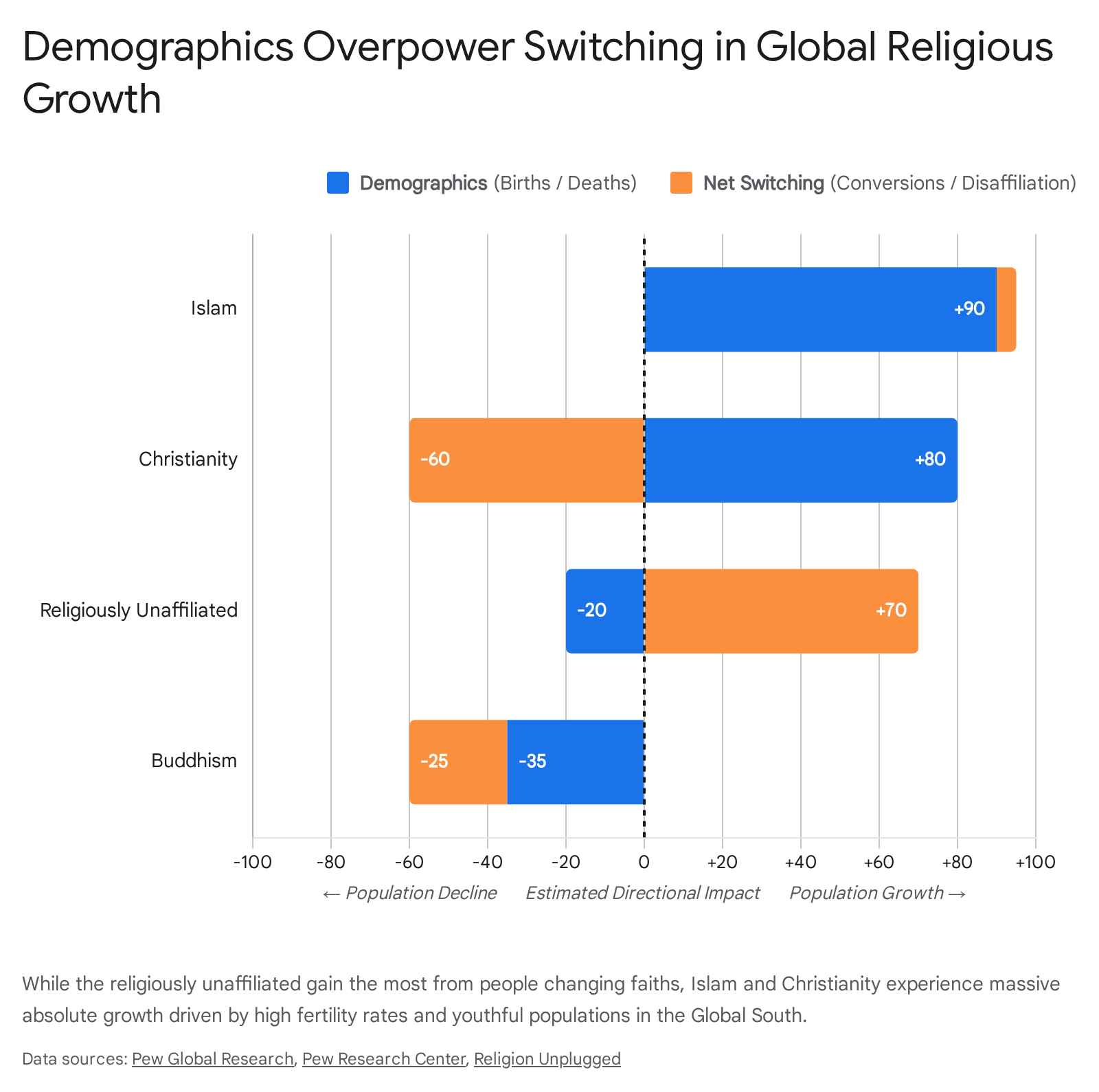
The transformation of the global religious landscape is dictated by two distinct mechanisms: demographic factors (fertility, mortality, and age structure) and religious switching (conversion or disaffiliation). The data for 2026 unequivocally confirms that aggregate global religious expansion is overwhelmingly driven by birth rates, while regional composition is driven by shifting beliefs 21422.
The Primacy of Fertility and Mortality Rates
The demographic axiom that "faith is being outbred" accurately summarizes current global macro-trends 2. Religious groups expand exponentially when their adherents possess a young median age and high fertility rates. Globally, religiously affiliated women tend to have significantly more children than secular women 223.
This dynamic is starkly visible in the geopolitical distribution of births. Projections for 2026 indicate that an overwhelming 85% of all global births will occur in Africa and Asia. Africa alone will account for roughly 36% of global births (over 47 million infants), despite decades of international campaigns to promote secular family planning 19. By contrast, Europe, North America, and Oceania combined will account for merely 8% of global births in 2026 19.
Because religion is primarily transmitted intergenerationally - the vast majority of the global population remains in the religion of their parents - this birth disparity heavily favors Islam and Christianity in the Global South. Sub-Saharan Africa is projected to add over a billion people by 2050, the vast majority of whom will be born into active Muslim and Christian households 2. Conversely, the secularization of Europe and East Asia is compounding their demographic winters. European populations are aging rapidly, and the secular segment of the population exhibits fertility rates well below the replacement level of 2.1 223. Consequently, while the ideology of secularism dominates intellectual and cultural discourse in the Global North, secular populations are mathematically shrinking as a share of the global whole 2.
The Mechanics of Religious Switching
While demographics govern global aggregate numbers, religious switching - the act of leaving one's childhood religion for another faith or for no religion - is the primary driver of regional compositional changes. Between 2010 and 2026, religious switching has primarily benefited the unaffiliated and Protestantism, while heavily penalizing Catholicism and Buddhism 12141720.
The unaffiliated population has experienced the largest net gains from religious switching. Demographic models indicate that for every 100 people aged 18 to 54 who were raised with no religion, 7.5 people join a religion, but 24.2 people raised in a religion switch into the unaffiliated category, resulting in a massive net gain of 16.7 people 14. Buddhism exhibits a similarly negative retention rate; for every 12 adults who join Buddhism as converts, 22 adults raised in the faith leave it 1617.
Crucially, switching behaviors are highly contextual. In the Global North, switching largely moves from institutional Christianity to the unaffiliated. In the Global South, however, switching often occurs within religious boundaries. For example, in Brazil, Kenya, Ghana, Nigeria, and the Philippines, individuals leaving the Catholic Church are statistically much more likely to convert to Protestantism than to become secular 1220.
Regional Trajectories of Secularization
Secularization - sociologically defined as the process by which religious institutions, practices, and beliefs lose their social significance - is advancing rapidly, but its manifestation is highly dependent on regional history and culture 4212223.
The P-I-B Sequence of Western Secularization
Recent cross-national sociological studies covering over 100 countries suggest that secularization in the West is not a sudden rupture but a multi-generational process that follows a predictable "Participation - Importance - Belonging" (P-I-B) sequence, typically unfolding over a span of 200 years 3.
- Participation: The first stage involves individuals abandoning demanding public religious practices, such as weekly attendance at worship services 3.
- Importance: In the subsequent generation, religion loses its personal, private salience. Daily prayer ceases, and religious doctrine is decoupled from personal morality 3.
- Belonging: Finally, successive generations drop the "low-cost" trait of religious affiliation entirely, shifting from nominal adherents to the formally unaffiliated 3.
European societies are furthest along this sequence. In nations like Denmark, secularization is so advanced that the most significant generational differences relate solely to formal belonging 3. In the United States, the landscape is characterized by "stable volatility." While the long-term decline in traditional religious affiliation has slowed, formal institutional participation continues to drop. It is projected that some 15,000 churches and other religious institutions will close their doors in 2026 24. Consequently, the American public is increasingly fractured: 47% describe themselves as religious, while 33% identify as "spiritual but not religious" 24.
The Fragmented Realignment of Latin America
Latin America, historically an impenetrable Catholic stronghold holding over 40% of the world's Catholics, is currently undergoing a radical and fragmented religious realignment 25. While countries like Mexico, Colombia, and Peru maintain Catholic majorities ranging from 46% to 67%, the Catholic share of the population has plummeted across the continent by at least 9 percentage points over the past decade 2026.
This religious decline is bifurcated. In countries like Uruguay and Chile, the departure from Catholicism is swelling the ranks of the secular. Uruguay, possessing a long-standing tradition of state secularism modeled on French laïcité, exhibits "enchanted secularization." In this paradigm, formal institutional affiliation is abandoned - evidenced by a recent 16-point drop in affiliation - but personal spiritual belief remains robust outside sanctuary walls 27. Chile has seen an even steeper 24-point equivalent net loss in Catholicism; 19% of all Chilean adults are former Catholics who now identify as atheists, agnostics, or nothing in particular, a shift largely driven by a generational recoil against perceived institutional authoritarianism 122027. Overall, the unaffiliated share in South America surged from 7% in 2004 to over 18% in 2023 25.
Conversely, in Brazil, the Catholic decline has directly fed the rise of Evangelical and Pentecostal Protestantism. More Brazilians have joined Protestantism (15%) than have left it (6%), resulting in a 9-point net gain, with former Catholics constituting the bulk of this shift 1220.
Crucially, the Latin American secularization model deviates from the European P-I-B standard. While institutional affiliation and church attendance are falling, personal religiosity remains highly resilient. By 2023, the percentage of Latin Americans who rated religion as "very important" in their daily lives actually grew to 64% 25. This suggests that Latin America is experiencing institutional disaffiliation rather than an ideological abandonment of the supernatural.
| Country | Net Catholic Loss via Switching | Primary Beneficiary of Switching | Religious Context |
|---|---|---|---|
| Brazil | High (-23%) | Protestantism (Pentecostal) | Highly competitive religious market |
| Chile | Very High (-24%) | Unaffiliated / Secular | Generational recoil from institutions |
| Uruguay | High | Unaffiliated ("Enchanted Secular") | Historical state secularism (laïcité) |
| Mexico | Moderate (-19%) | Unaffiliated | Gradual institutional erosion |
Table 2: Patterns of Religious Switching in Select Latin American Nations. Net Catholic Loss represents the percentage point difference between adults raised Catholic and those currently identifying as Catholic 1220252627.
Religious Vitality and State Entanglement in the Global South
In stark contrast to the West, institutional religion in the Global South remains deeply embedded in the social, political, and cultural fabric. In Sub-Saharan Africa and the Middle East, religion retains vast cultural authority, defying the linear predictions of classical secularization theory.
Sub-Saharan Africa and the Compliance Gap
In many African nations, individuals who do not subscribe to a religion make up less than 0.1% of the population 33. Whether through Christianity, Islam, or traditional indigenous faiths, the African worldview remains profoundly sacred. Religion is not compartmentalized into a private sphere; rather, it informs approaches to healthcare, governance, and communal identity 3328.
This intense public religiosity presents a paradox for political governance, which scholars term the "compliance gap" 293031. Approximately 27 out of 54 African nations possess constitutions explicitly defining the state as secular 2931. A typological analysis of these constitutions reveals robust separationist clauses on paper; for example, both Ghana and Nigeria score relatively high (8 out of 13) on constitutional secularism indices 293032.
However, in practical reality, governments and citizens routinely breach these secular boundaries. The European concept of distinguishing public secular space from private religious belief is largely incompatible with African socio-cultural paradigms 30. In Ghana, the national anthem opens with an appeal to God, political rhetoric is heavily theologized, and national budgets are frequently presented to parliament with explicit biblical justifications 3032. Colonial-era secular constitutions function more as nation-building myths or legal fictions than as strict operational frameworks for African societies 3031.
State Monopolies and Religious Favoritism
While Africa demonstrates organic religious vitality, other regions exhibit high religiosity enforced by state apparatuses. The Middle East and North Africa (MENA) region operates largely under religious monopolies. The region is 93% to 94% Muslim, making it the least religiously diverse area on the planet 733. In eight of the ten least religiously diverse places globally - including Tunisia, Iraq, Morocco, and Iran - the population is more than 99% Muslim 40.
In these contexts, the state frequently intervenes to create artificial religious monopolies by granting preferential treatment to one faith while applying punitive measures against competitors 34. However, state enforcement can provoke severe counter-reactions. In Iran, decades of strict theocratic rule have generated a significant secular backlash; recent data suggests that up to 73% of Iranians now support the idea of separating Islam from the state, driving widespread protests 35.
The entanglement of religion and state is not restricted to the Middle East. In Buddhist-majority countries like Sri Lanka and Myanmar, historical bargains between the state and the Sangha (the monastic community) have fused religious and national identities 3637. When majoritarian religions feel threatened by globalization or demographic shifts, these implicit bargains can trigger sectarian violence, demonstrating that religious violence is less an inherent theological trait than a product of specific politico-institutional monopolies 3637.
Global Isolation and Persecution
The polarization of global religion has resulted in profound isolation for minority populations. Despite the proliferation of global communication technology, religious communities often exist in parallel realities. According to 2026 data, approximately 27.7% of the world's population - roughly 2.3 billion people - remain completely without access to Christian witness, and less than 20% of non-Christians personally know a Christian 1113. Furthermore, demographic shifts have transformed urban environments; more than 60% of the world's key cities are now considered minority-Christian, compared with just a quarter a century ago 13.
This isolation is frequently accompanied by hostility. Roughly 100,000 Christians die each year due to religious persecution, violent hostility, jihadist insurgencies, or authoritarian repression, totaling approximately 900,000 fatalities over the past decade 913.
Theoretical Frameworks for Interpreting Global Data
The diverging realities of global religion in 2026 have forced sociologists and political scientists to reevaluate the theoretical frameworks used to understand religious change. The academic debate currently centers on three competing paradigms: Secularization Theory, Desecularization Theory, and Religious Market Theory 121223846.
The Limitations of Classical Secularization Theory
Classical Secularization Theory, championed by early sociologists like Max Weber and Émile Durkheim, posited that the modernization of society - characterized by rationalization, industrialization, and scientific advancement - would inevitably lead to the "disenchantment of the world" and the marginalization of religion 42123. In this functionalist view, as the expanding welfare state assumes responsibility for education and healthcare, religious institutions lose their utilitarian social functions. Concurrently, as empirical science provides answers to natural phenomena, theology loses its cognitive monopoly 21233439.
While this theory accurately maps the historical trajectory of Western Europe and parts of East Asia, it fails as a universal heuristic. Critics argue the paradigm is progressive, Western-centric, and strictly linear, failing entirely to account for the massive religious resurgences in the developing world or the historical anomaly of the United States - a highly modern yet intensely religious nation 13434.
Desecularization and Counter-Secularization
In response to the limitations of secularization theory, scholars such as Peter Berger and Vyacheslav Karpov advanced the Desecularization Thesis. This paradigm conceptualizes secularization not as an irreversible evolutionary endpoint, but as a cyclical phenomenon 1. From this perspective, highly secular Western Europe is the global exception, not the rule. Desecularization manifests as a rapprochement between state institutions and religious norms, a resurgence of public faith, and a concerted pushback against forced secularization (as observed in the religious revivals of post-Soviet states like Georgia) 13.
Religious Market Theory and Institutional Supply
Concurrently, Religious Market Theory (or the Supply-Side approach), developed by sociologists Rodney Stark and Roger Finke, applies economic principles to religious behavior. It posits that human populations possess a relatively constant baseline demand for religious goods and existential security 343840. The vitality of religion in a given society is therefore dependent on the supply side 34.
A deregulated, pluralistic religious market forces religious "firms" to compete fiercely for adherents, leading to highly adapted, energetic religious communities. This theory effectively explains the historical religious vitality of the United States and the explosive, competitive growth of Pentecostalism in Latin America today 344641. Conversely, state-sponsored religious monopolies - whether Catholic in historical Latin America, Islamic in the modern Middle East, or secularist in China - breed institutional complacency and lower genuine participation, as the dominant firm relies on coercion rather than persuasion 343746.
Global Religious Diversity and Future Projections
As migration, conversion, and differential birth rates continuously alter the global map, religious diversity is increasing in specific locales while polarizing others.
Segregation Versus Pluralism
The Pew Research Center's Religious Diversity Index (RDI) reveals that the world remains highly segregated by faith. Over 194 countries and territories feature a single religious group constituting 50% or more of the population, and in 43 countries, a single religion commands over 95% of the populace 334042.
However, immigration and secularization have dramatically increased diversity in specific zones. The Asia-Pacific region is the most religiously diverse globally (RDI score of 8.7), featuring massive populations of Hindus, Muslims, Buddhists, Christians, and the unaffiliated without a single majority group 33. Singapore ranks as the most religiously diverse nation on Earth, with a complex tapestry of Buddhists (31%), the unaffiliated (20%), Christians (19%), and Muslims (16%) 334042. Among nations with populations exceeding 120 million, the United States is the most diverse, a direct consequence of its declining Christian majority and rising unaffiliated and minority populations 3342.
| Region | Primary Religious Majority | RDI Score (Out of 10) | Diversity Classification |
|---|---|---|---|
| Asia-Pacific | None (Highly Pluralistic) | 8.7 | Very High |
| North America | Christianity (63%) | 6.0 | High |
| Sub-Saharan Africa | Christianity (62%) | 5.9 | High |
| Europe | Christianity (67%) | 5.6 | High |
| Latin America | Christianity (85%) | 3.1 | Moderate |
| Middle East/N.A. | Islam (94%) | 1.3 | Low |
Table 3: Regional Religious Diversity Index (RDI). Scored from 0 to 10 based on the even distribution of seven major religious categories. Higher scores indicate greater pluralism 733.
Long-Term Projections Toward 2075
If current demographic trends regarding fertility, mortality, and religious switching hold, the global religious landscape will undergo a massive realignment over the next half-century. By 2075, the world population is projected to be 36% Christian and 33% Muslim, pointing to a future where Islam will eventually challenge Christianity as the world's largest religion 43.
This demographic shift will carry profound geopolitical and economic implications. Despite the numerical shift toward the Global South, the economic power of global religion remains vast; projections suggest that by 2075, the personal income of Christians worldwide could total $80 trillion 43. However, the institutional structures that manage this wealth and influence will increasingly reflect the values, cultures, and priorities of African, Latin American, and Asian adherents, permanently decentering the historical dominance of the Global North.
Conclusion
The data for 2026 confirms a world in demographic tension. In the Global North and East Asia, the classical secularization paradigm is largely validated: advanced modernization, economic security, and scientific rationalism have successfully decoupled institutions from religious authority, leading to a multi-generational abandonment of formal faith. In these regions, institutional religion is contracting, replaced by personalized spirituality, enchanted secularization, or outright disaffiliation.
However, from a mathematical and global perspective, the secularization of the West is being fundamentally outpaced by the demographic explosion of the Global South. Because fertility rates among religious populations in Sub-Saharan Africa, the Middle East, and parts of Asia vastly exceed those of secular populations, the global percentage of religiously affiliated individuals is projected to remain stable or increase through the mid-twenty-first century. The future of global religion will be shaped not by the intellectual and secularizing debates of Europe or North America, but by the burgeoning youth populations of Nigeria, Brazil, India, and Pakistan. Consequently, the global religious landscape of the coming decades will be increasingly non-Western, intensely competitive, and deeply influential in the public sphere.