Global fertility decline and its societal impacts
The demographic trajectory of human civilization has reached a historic inflection point. For the past century, global institutions have operated under the assumption of perpetual population growth, building economic models, geopolitical strategies, and welfare systems predicated on a constantly expanding base of young workers. However, current demographic data reveals a rapid and pervasive collapse in birth rates. The global total fertility rate (TFR) has dropped from roughly 4.9 births per woman in the 1950s to approximately 2.25 in 2024, with projections indicating it will fall below the 2.1 replacement level before the middle of the 21st century 123.
The implications of this transition are vast. As societies shift from explosive growth to population stagnation and eventual contraction, they face profound structural challenges. Declining fertility rates precipitate rapid population aging, fundamentally altering dependency ratios, straining fiscal sustainability, and reshaping the international balance of power. Understanding the drivers of this decline - ranging from macroeconomic pressures and biological disruptors to shifting cultural paradigms - is essential for navigating the economic and environmental realities of a depopulating world.
Demographic Trends and Regional Trajectories
The global decline in fertility is not uniform; rather, it is characterized by stark regional disparities that will determine the distribution of human capital over the next century. The transition to low fertility has already swept through advanced economies and is rapidly accelerating in middle-income nations.
Global Birth Rate Data
Recent comprehensive demographic assessments, such as the Global Burden of Disease (GBD) 2021 study published in The Lancet, forecast a radically bifurcated demographic future. By 2050, an estimated 155 of 204 countries and territories (76%) will experience fertility rates below the replacement level of 2.1 45. By 2100, this figure is projected to reach 97%, leaving only a handful of nations with growing populations 5. The United Nations World Population Prospects (2024 Revision) corroborates this trajectory, projecting that global population will peak at approximately 10.3 billion in the mid-2080s before beginning a gradual decline to 10.2 billion by 2100 67.
The most extreme manifestations of this collapse are concentrated in East Asia. South Korea recorded an unprecedented TFR of 0.68 in 2024, representing a 43% decline over a single decade and standing as the lowest global rate 8. Taiwan closely follows with a TFR of 0.695, while China's fertility has fallen to 1.2 following decades of restrictive population policies and rapid urbanization 39.
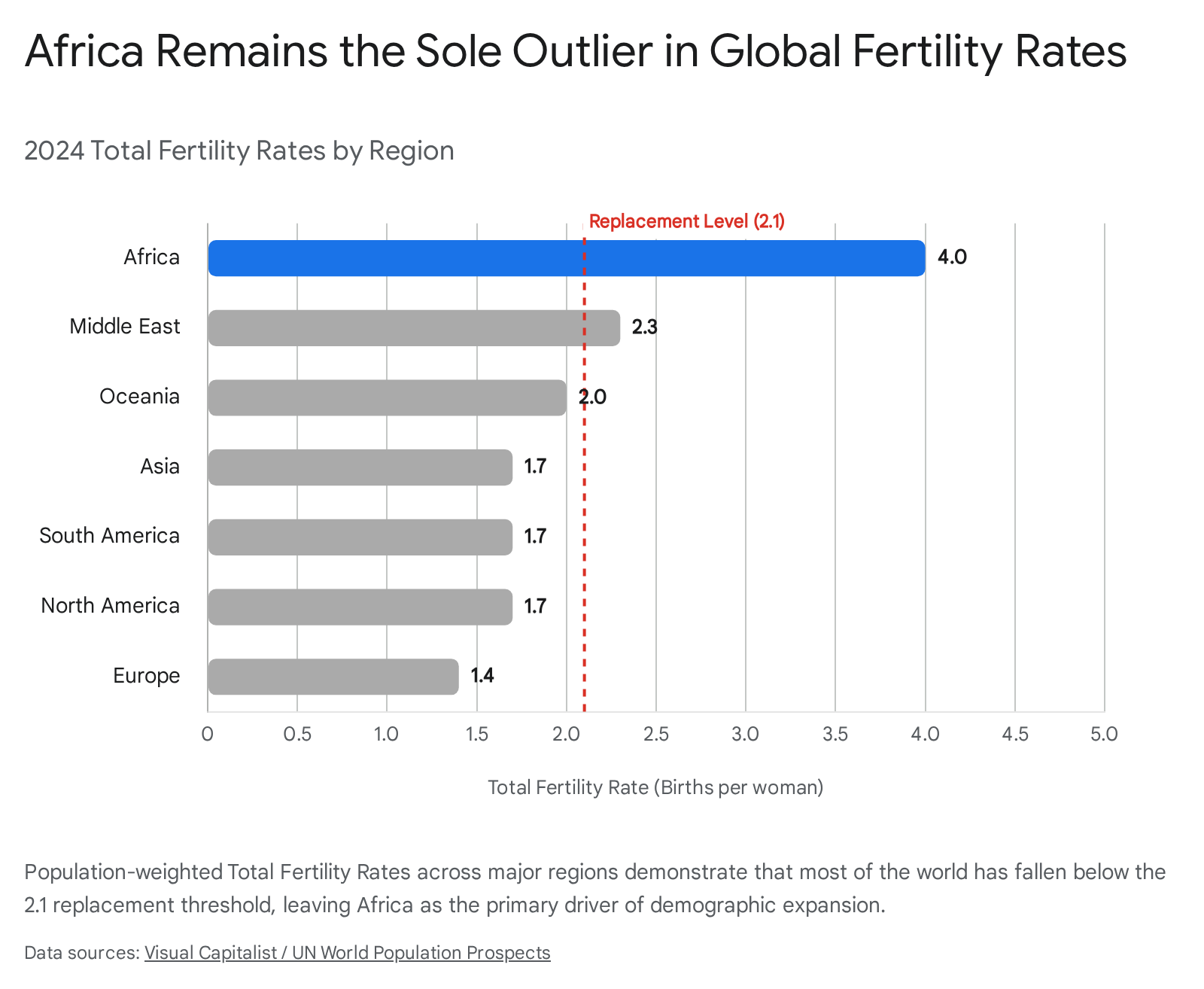
Europe exhibits a similarly entrenched low-fertility environment, with an aggregate TFR of 1.4. Countries such as Spain (1.32) and Italy (1.27) have remained well below replacement for decades, leading to shrinking domestic populations and heavy reliance on immigration 910. The Americas are also participating in this trend, with the United States recording a TFR of 1.62 in 2023, down from 2.08 in 1990 911.
Regional Disparities
Conversely, Sub-Saharan Africa remains the solitary engine of global demographic expansion. The region maintains an estimated TFR of 4.0 births per woman, nearly double the global average 10. Niger reports a TFR of 6.03, though high child mortality rates mean the effective fertility rate (surviving children per woman) is closer to 5.0 12. Nigeria, the most populous nation on the continent, maintains a TFR of 4.57 3.
Due to this stark divide, the proportion of global live births occurring in Sub-Saharan Africa is forecast to surge from 29% in 2021 to over 54% by 2100 45. The data highlights a clear inverse correlation between fertility rates and human development indices. Richer countries inherently feature advanced healthcare systems, extended longevity, and broader educational access, all of which correlate robustly with delayed childbearing and smaller family sizes 312.
To illustrate the breadth of this demographic transition, the following table summarizes the TFR trajectories of key nations spanning different developmental phases:
| Region / Country | Estimated 2023/2024 TFR | Long-Term Demographic Status |
|---|---|---|
| Niger | 6.03 | Rapid Expansion 2 |
| Nigeria | 4.57 | High Growth / Future Population Hub 3 |
| Global Average | 2.25 | Near Stabilization 2 |
| United States | 1.62 | Below Replacement / Reliant on Migration 911 |
| Europe (Aggregate) | 1.40 | Below Replacement / Aging Population 10 |
| China | 1.20 | Accelerated Decline / Workforce Shrinkage 39 |
| South Korea | 0.68 | Extreme Implosion 8 |
Age Structure Shifts
Because demographic momentum involves long lag times, global population totals will continue to rise for decades despite plunging birth rates. However, the underlying age structure is already shifting drastically.
The worldwide working-age population (defined as individuals aged 15 to 64) is expected to peak at just under 6.3 billion by 2070 13. In nations that have already completed their demographic transitions, this compression is acute. By 2100, the working-age population is projected to decline by 52% in Italy, 46% in Japan, and 27% in Germany 13. This shrinkage transforms the traditional population pyramid into an inverted structure, where a small base of young workers must support a vast canopy of retirees. By 2080, persons aged 65 or older will globally outnumber children under 18 for the first time in human history 67.
Economic Pressures on Family Formation
The collapse of global birth rates is heavily influenced by macroeconomic realities that dictate the feasibility of family formation. Chief among these are the escalating costs of housing and the broader delay in young adults achieving financial independence.
Housing Market Dynamics
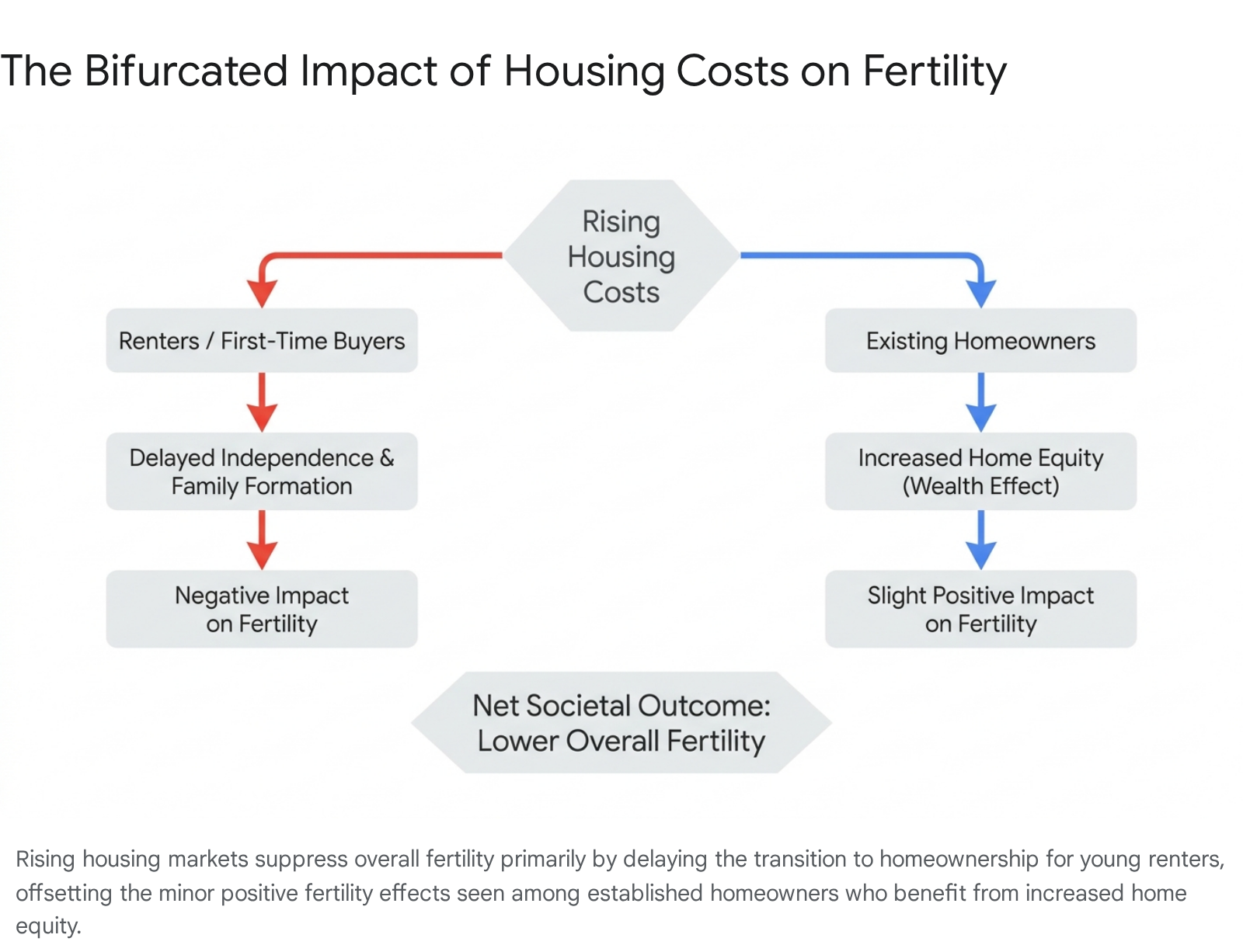
A primary driver of declining fertility in advanced economies is the escalating cost of family formation, exacerbated by housing market affordability. Surging real estate prices exert a negative "price effect" on renters, who are increasingly priced out of the space required to raise children 1415. Research utilizing register data from the Netherlands between 2012 and 2023 demonstrates that increasing house prices are directly associated with lower fertility among younger cohorts, primarily by obstructing the transition from renting to homeownership 14.
Conversely, existing homeowners experience a positive "wealth effect." The increased equity in their homes provides financial stability that can modestly increase their likelihood of having additional children 1415. Despite this offsetting wealth effect, the aggregate societal outcome leans negative, as the barrier to entry for first-time buyers prevents younger cohorts from initiating family formation altogether 1415.
In the United States, models utilizing census data indicate that the housing-fertility link is stronger in denser counties where affordability constraints are most acute. Researchers estimate that had U.S. housing costs remained stable relative to incomes since 1990, roughly 13 million more children would have been born over the subsequent three decades 1617. The model further highlights that subsidizing the construction of family-sized, three-bedroom units would increase births 2.3 times more efficiently than equivalent spending on high-density one-bedroom apartments, underscoring the spatial requirements of child-rearing 16.
Delayed Adulthood Milestones
As housing and living expenses have outpaced wage growth, the traditional milestones of adulthood have been significantly delayed. In the United States, reaching the combined milestones of independence - moving out, securing full-time employment, marrying, and having children - has become increasingly rare. While nearly 45% of 25- to 34-year-olds achieved all four milestones in 1975, less than a quarter do so today 18. Instead, young adults prioritize achieving basic economic security, often delaying family formation indefinitely 1819.
The delay in establishing independent households is a global phenomenon, though it varies significantly by regional economic structures. Eurostat data regarding the average age at which young adults leave the parental home reveals deep cultural and economic divides within Europe 2021.
| European Region | Country Example | Avg. Age Leaving Home (2023/2024) | Housing Cost Overburden Note |
|---|---|---|---|
| Scandinavia | Finland | 21.4 | Lower relative burden 2022 |
| Scandinavia | Sweden | 21.9 | 13.5% (youth overburden) 22 |
| Western Europe | Germany | 23.9 | 14.8% (youth overburden) 2122 |
| Southern Europe | Spain | 30.0 | High structural youth unemployment 2223 |
| Balkans | Croatia | 31.3 | High incidence of multigenerational living 2122 |
In Southern Europe and the Balkans, the combination of high youth unemployment, stagnant wages, and expensive rental markets forces young adults to remain in multigenerational homes well into their 30s 2123. In nations like Greece, 30.3% of youth aged 15-29 are classified as housing cost overburdened (spending more than 40% of disposable income on housing), directly suppressing the formation of new family units 22. In East Asia, similar delays are evident. In South Korea, the average age of new college graduates entering the workforce reached 30.7 years, and the average age of a household head purchasing a first home has risen to 46.4 years, fundamentally truncating the biological window for childbearing 24.
Biological and Environmental Disruptors
Beyond socioeconomic behavioral shifts, an emerging body of peer-reviewed literature points to a systemic biological degradation of human fecundity. This degradation operates independently of personal financial choices, driven by environmental pollutants and climate stressors.
Endocrine Disrupting Chemicals
Over the last 50 years, global human fertility has been systematically impacted by ubiquitous exposure to endocrine-disrupting chemicals (EDCs). EDCs - which include phthalates, bisphenol A (BPA), per- and polyfluoroalkyl substances (PFAS), dioxins, and agricultural pesticides - are pervasive in plastics, personal care products, food packaging, and water supplies 252627. These chemicals interfere with the body's natural hormonal pathways by mimicking or blocking hormones such as estrogen and testosterone 2526.
In males, chronic exposure to EDCs is strongly correlated with degraded semen quality, reduced sperm concentration, altered morphology, and DNA damage. Seminal studies indicate that sperm levels among men in Western countries plummeted by more than 50% over a four-decade period, a decline strongly linked to cumulative chemical exposures 26282930.
In females, EDCs negatively impact the hypothalamic-pituitary-gonadal axis. Observational and clinical studies have linked exposure to non-persistent EDCs (like phthalates and BPA) and persistent organic pollutants (like DDT and PCBs) to altered oocyte maturation, premature ovarian insufficiency (POI), polycystic ovary syndrome (PCOS), and endometriosis. These conditions severely limit both natural conception and the success rates of assisted reproductive technologies like in vitro fertilization (IVF) 252831.
Synergistic Environmental Harms
Recent environmental health research indicates that the toxicological burden of EDCs is being compounded by the broader impacts of climate change. A 2026 review of 177 scientific studies concluded that simultaneous exposure to toxic chemicals and climate stressors (such as heat stress) generates an additive or synergistic effect that increases reproductive harm across global species, including humans, wildlife, and invertebrates 2930.
Because many endocrine disruptors alter environmental sex determination and spermatogenesis similarly across biological kingdoms, researchers hypothesize that this dual threat represents a systemic, physiological barrier to fertility 2930. However, calibrated uncertainty must be maintained: while animal and clinical studies provide strong mechanistic evidence, broad human epidemiological studies face challenges related to confounding variables and exposure misclassification, meaning the exact quantitative impact of EDCs on the global TFR drop remains a subject of ongoing scientific evaluation 2831.
Sociological Shifts in Marriage
The delay in family formation is not purely economic; it is deeply intertwined with shifting sociological paradigms regarding marriage, gender roles, and individual autonomy, particularly in regions that rapidly modernized.
East Asian Marriage Patterns
Sociological shifts in family formation are starkest in East Asia, driving the region's precipitous demographic decline. The traditional East Asian family structure, heavily influenced by Confucian norms, has historically been highly patriarchal, with deeply entrenched gender divisions of labor that place severe social and domestic burdens on women 32.
As societies like South Korea, Japan, and Taiwan underwent hyper-rapid industrialization and modernization, women achieved parity in higher education and labor force participation. However, domestic expectations and corporate workplace cultures failed to evolve symmetrically. The resulting tension between modern economic opportunities and traditional familial obligations has led many young women to delay or entirely forgo marriage - a phenomenon sociologists refer to as a "marriage strike" 3233.
In Japan, South Korea, and Taiwan, out-of-wedlock birth rates are statistically negligible, meaning that a delay in marriage directly equates to a collapse in fertility 3234. The mean age at first marriage in these countries has surged past 30 for men and 28 for women, making them some of the latest marrying societies globally 32.
Changing Gender Roles
Globally, total fertility rates are inversely related to a country's Human Development Index (HDI) and per capita income. As maternal education expands and women gain access to career opportunities outside the home, the opportunity cost of childrearing increases exponentially 1233. When welfare systems and workplace policies fail to accommodate dual-income families - such as lacking affordable childcare or penalizing mothers with wage gaps - women logically choose to limit family size to maintain economic independence and professional viability.
Pro Natalist Policy Efficacy
In response to the specter of demographic collapse, governments have deployed various pro-natalist policies aimed at encouraging larger families. These interventions generally fall into two categories: targeted financial incentives and inclusive, structural welfare systems. The outcomes consistently demonstrate that reversing fertility decline is extraordinarily difficult, highly expensive, and historically limited in efficacy.
Financial Incentive Structures
Several nations have attempted to boost birth rates through direct cash transfers, targeted tax exemptions, and housing subsidies. Hungary serves as a prominent case study in aggressive, financially driven pro-natalism. The Hungarian government spends over 6% of its GDP on family subsidies, offering sweeping income tax exemptions for mothers with multiple children, housing grants, and exemptions for mothers under 30 353637.
While Hungarian policymakers frequently cite an increase in the conventional TFR from 1.25 in 2010 to roughly 1.59 in 2021 as a success, international demographers urge caution. The perceived increase is largely attributed to a "tempo effect" - a temporary stabilization in the timing of births that had been delayed during the 2008 financial crisis 3538. The tempo-adjusted total fertility rate (TFRp*), which controls for the changing age of mothers, has remained remarkably flat 35. Furthermore, the absolute number of live births in Hungary has stagnated at roughly 90,000 to 92,000 annually, remaining far below the 127,000 births required for actual replacement 35. The policy successfully reduced child poverty but failed to fundamentally alter the long-term demographic landscape 3639.
Similarly, Singapore, Japan, and South Korea have injected tens of billions of dollars into baby bonuses and subsidies. South Korea spent approximately $32 billion by 2021 on pro-natal initiatives, yet its fertility rate continued to plummet 9. Singapore, despite possessing the most comprehensive pro-natalist policies in East Asia, has seen its TFR languish at 1.2, far below the government's optimistic target of 1.6 3440. Survey data reveals that singular financial incentives cannot overcome the structural crush of extreme work hours, competitive education systems, and exorbitant living costs 3440.
Comprehensive Welfare Models
In contrast to localized financial bonuses, the most relatively "successful" pro-natalist frameworks rely on long-term, comprehensive social welfare. France and the Nordic countries have historically maintained higher fertility rates than their neighbors by establishing inclusive family policies spanning decades 4142.
France's approach integrates flexible public childcare, generous tax breaks, direct financial transfers, and retirement benefits tied to childrearing. Demographers estimate that France's sustained policies have boosted its long-run fertility by 0.1 to 0.2 children per woman - preventing a population deficit of 5 to 10 million citizens over the last half-century 41. Similarly, Sweden effectively stabilized its cohort fertility in the early 2000s by replacing lost income during parental leave up to 90% and institutionalizing gender-equitable leave policies that encourage active fatherhood and minimize career penalties for women 42.
However, even the robust Nordic and French systems are currently experiencing modern fertility declines. No advanced economy has successfully and permanently returned a sub-1.5 TFR back to the 2.1 replacement rate 143. Pro-natalist policies, at their most effective, act as a buffer to slow demographic collapse rather than a definitive cure 4144.
Macroeconomic Consequences
The transition to an older, smaller population carries profound macroeconomic implications. As the demographic dividend that fueled the late 20th century expires, the global economy faces structural headwinds that threaten fiscal stability and living standards.
Dependency Ratio Expansion
The most immediate economic threat posed by declining fertility is the explosion of the old-age dependency ratio - defined as the number of people aged 65 and over relative to the working-age population (20 - 64 years old). In the OECD area, this ratio more than doubled between 1960 and 2022, and is projected to reach 52 elderly dependents per 100 workers by 2050 4445. In rapidly aging nations like South Korea, the dependency ratio is forecast to surge from 26% in 2022 to a staggering 96% by 2060 46.
This demographic inversion places immense strain on state finances. Governments are forced to allocate an increasing share of GDP to pensions, social care, and healthcare. The prevalence of chronic diseases among the elderly escalates medical costs, limiting a state's capacity to invest in general infrastructure or innovation 47. The European Central Bank projects that aging-related fiscal costs in the euro area will increase from 25.1% of GDP in 2022 to 26.5% by 2070, driven primarily by the sheer volume of retirees offsetting any minor savings from reduced educational expenditures for children 94948.
Labor Market Constraints
Simultaneously, the shrinking tax base restricts economic vitality. The OECD estimates that without decisive policy action - such as increasing the effective retirement age and integrating more women into full-time employment - the working-age population will fall by 13% over the next 40 years 44. This demographic transition is projected to dampen GDP per capita growth across member states by 14% by 2060 44. Economic models corroborate this, suggesting that once a nation's old-age dependency ratio surpasses a critical threshold of roughly 27%, baseline GDP growth inherently flattens or stagnates 49.
Severe labor shortages are already manifesting in early-aging economies. In Japan, the working-age population has dropped below 60%, resulting in extreme tightness in physically demanding sectors. Construction sites, for instance, recently faced 4.6 job openings for every applicant, severely bottlenecking national infrastructure projects 9. As baby boomers exit the workforce and are replaced by significantly smaller youth cohorts, this shift from a "shortage of jobs to a shortage of workers" will redefine global capital and labor dynamics 4650.
Immigration Policies
To offset the shrinking domestic workforce, high-income nations rely heavily on immigration as a demographic buffer. Migrants provide net fiscal benefits to receiving economies, sustaining tax bases and filling critical labor shortages in the care, service, and construction sectors 4549. In 2023, permanent-type migration to OECD countries hit a historic record of 6.5 million 51.
However, immigration is a zero-sum mechanism globally. While it masks population decline in recipient nations like Canada and the United Kingdom, it exacerbates "brain drain" and demographic hollowing in sender nations 1351. Furthermore, relying on massive, sustained migration requires intensive policy interventions to ensure labor market integration. Rapid influxes can strain domestic housing and social infrastructure, frequently sparking xenophobic and right-wing populist political backlash, complicating its viability as a long-term economic panacea 4952.
Geopolitical and Ecological Impacts
As global demographics realign, the 21st century will witness a radical shift in geopolitical power and a heated, multifaceted debate over the ecological consequences of a shrinking human footprint.
Shifting Global Power
Demography is inexorably linked to national power. The size of a nation's working-age population dictates its economic output, military-industrial capacity, and diplomatic leverage 53. As the populations of Europe, Russia, and East Asia contract and age, their aggregate share of global GDP and geopolitical dominance will inevitably wane 1353.
Concurrently, Sub-Saharan Africa will emerge as the demographic epicenter of the world. Driven by continued high fertility and declining infant mortality, the region's population is projected to soar from 1.27 billion today to 2.09 billion by 2050 54. Nigeria alone is adding roughly 4.5 million citizens annually, and by 2053, nations like Tanzania are projected to possess larger populations than Russia 5455.
This demographic explosion presents both a profound opportunity and an acute geopolitical risk. If African nations can adequately invest in education, healthcare, and infrastructure, they stand to reap a massive demographic dividend, potentially emerging as the dominant consumer and labor markets of the late 21st century 656. However, if job creation fails to keep pace with population growth, the region faces the prospect of mass youth unemployment, resource scarcity, and destabilizing waves of climate-driven outmigration toward aging Northern Hemisphere nations 5957.
Climate Change Mitigation
In the context of the climate crisis, the global collapse in birth rates has prompted intense debate over potential environmental benefits. From an emissions standpoint, reducing the global population establishes a mathematically lower baseline for aggregate resource consumption 6158.
Estimates indicate that achieving rapid, voluntary fertility decline globally - primarily by ensuring universal access to family planning and female education - could prevent the emission of 85 gigatonnes of CO2 equivalent by 2050 6159. This reduction is comparable in scale to the cessation of 22,000 coal-fired power plants. Proponents of population reduction note that emissions averted through family planning are highly cost-effective (averaging $4.50 per ton of CO2) compared to technological solutions like solar power deployment or carbon capture 5964. Particularly in high-income, high-emitting nations, fewer people inherently means fewer carbon-intensive consumers 61.
Innovation and Adaptation
However, environmental economists warn that the ecological benefits of depopulation are frequently overstated and oversimplified. Because demographic changes unfold over multiple generations, lower fertility will not alter population sizes swiftly enough to affect critical near-term climate targets, such as the 2050 net-zero goals 65.
Furthermore, aging populations exhibit shifting consumption patterns. Older adults tend to live in smaller household units, which are less energy-efficient per capita, and require highly resource-intensive medical and care infrastructure, potentially offsetting the carbon savings of a smaller population 4766.
Most critically, transitioning to a sustainable green economy requires immense fixed-capital investments, technological innovation, and robust tax bases. Climate mitigation strategies - such as grid overhauls, carbon capture facilities, and climate-resilient infrastructure - are incredibly capital-intensive. A shrinking, aging society faces diminished fiscal capacity and a smaller pool of young innovators required to execute large-scale climate adaptation projects 65. Ultimately, while a declining global population marginally relieves pressure on ecosystems, environmental progress will remain critically dependent on human ingenuity and the active decoupling of economic growth from environmental harm 6566.