
What Are Sterile Neutrinos and Why Are They Debated
Sterile neutrinos are hypothetical subatomic particles proposed to interact with the universe exclusively through gravity, rendering them completely immune to the weak nuclear force that governs ordinary neutrinos. For decades, they served as the leading theoretical solution to several of physics' most stubborn mysteries, including the origin of neutrino mass, the true identity of dark matter, and a series of puzzling experimental anomalies. However, a wave of high-precision data published between 2024 and 2026 has systematically dismantled the evidence for their existence, forcing the scientific community to pivot toward exotic "dark sector" models to explain the universe's lingering secrets.
The Ghostly Nature of Standard Neutrinos
To understand why a sterile neutrino was proposed in the first place, one must first grasp the perplexing nature of the neutrinos we already know to exist.
When theoretical physicist Wolfgang Pauli first postulated the existence of the neutrino in 1930, he did so reluctantly. He called it a "desperate remedy" to save the fundamental law of conservation of energy during radioactive beta decay, a process where atomic nuclei emit electrons 1. It took more than two decades before physicists Clyde Cowan and Frederick Reines finally detected them in 1956 1. Since their discovery, neutrinos have proven to be the most abundant matter particles in the universe. Trillions of them stream through your body every second, originating from the nuclear fusion in the sun, distant supernovae, and the natural radioactivity of the Earth 23.
According to the Standard Model of particle physics, standard (or "active") neutrinos come in three distinct "flavors": the electron neutrino, the muon neutrino, and the tau neutrino 1. Each flavor is associated with its correspondingly named charged lepton (the electron, muon, and tau) 13. Neutrinos are extraordinarily elusive because they carry no electric charge and no strong color charge 4. They interact with other matter almost exclusively through the weak nuclear force - the fundamental force responsible for radioactive decay - and through gravity 24.
Because the weak force operates only across unimaginably short subatomic distances, and because neutrinos possess almost no mass, a neutrino can travel through a light-year of solid lead with only a 50 percent chance of striking a single atom 2. Yet, despite their ghost-like nature, standard neutrinos are deeply integrated into the mathematical architecture of the Standard Model. They carry a specific quantum property known as weak isospin (a value of +1/2 for left-handed neutrinos), which allows them to couple with the W and Z bosons that mediate the weak force 14.
The Left-Handed Universe
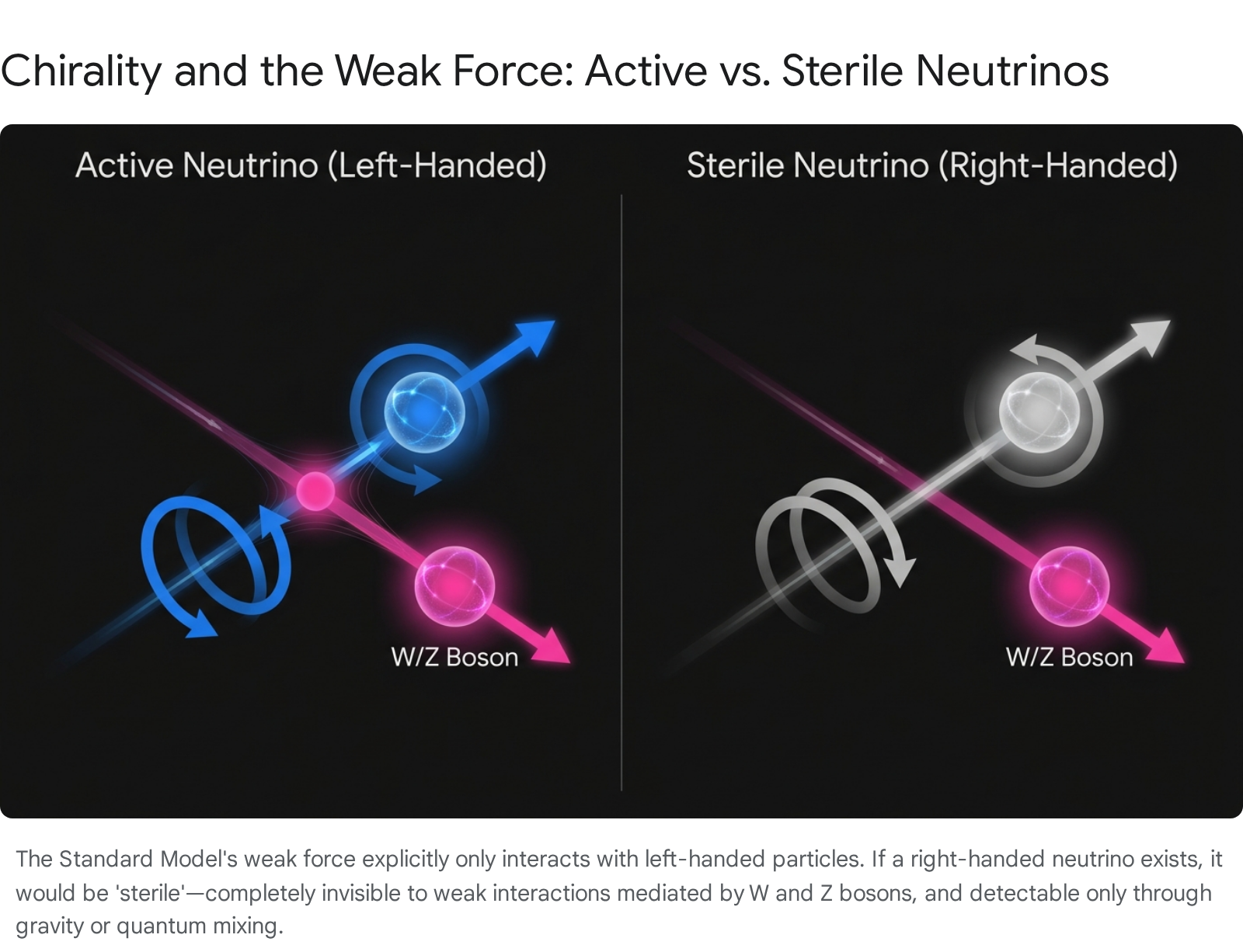
The concept of a "sterile" neutrino is born directly from a strange, fundamental asymmetry in the laws of nature regarding a quantum property called chirality, or "handedness."
In the subatomic realm, particles have an intrinsic form of angular momentum known as spin. You can imagine a particle spinning either clockwise or counterclockwise relative to the direction it is moving. If it spins in the direction of its motion (much like a football thrown with a right-handed spiral), it is considered right-handed. If it spins opposite to its motion, it is left-handed 23.
In 1957, physicist Chien-Shiung Wu conducted a landmark experiment proving that the weak nuclear force violates parity conservation - meaning the universe essentially has a physical preference for one type of handedness 3. The weak force, it turns out, is highly discriminatory: it only interacts with left-handed particles and right-handed antiparticles 23.
For every other fundamental matter particle in the Standard Model - such as electrons, muons, and quarks - both left-handed and right-handed versions have been observed 5. But for decades, particle accelerators and detectors have only ever observed left-handed neutrinos and right-handed antineutrinos 34. As far as the weak force is concerned, right-handed neutrinos simply do not exist.
What Makes a Neutrino "Sterile"?
If a right-handed neutrino did exist, it would be entirely blind to the weak force. Because it already lacks electric charge and color charge, it would feel none of the forces described by the Standard Model. It would interact with the rest of the universe almost solely through gravity 24. For this reason, physicists dubbed this hypothetical right-handed particle the sterile neutrino (and occasionally, the "inert neutrino" or "heavy neutral lepton") 46.
| Property | Standard (Active) Neutrino | Hypothetical Sterile Neutrino |
|---|---|---|
| Chirality (Handedness) | Left-handed | Right-handed |
| Electric Charge | 0 | 0 |
| Color Charge | None | None |
| Weak Isospin | +1/2 | 0 |
| Weak Hypercharge | -1 | 0 |
| Fundamental Forces Felt | Weak Nuclear Force, Gravity | Gravity (and unconfirmed dark forces) |
| Standard Model Status | Confirmed (3 flavors) | Unconfirmed / Hypothetical |
Table 1: A comparison of the quantum properties that distinguish standard active neutrinos from theoretical sterile neutrinos 147.
If sterile neutrinos cannot be seen or easily detected by our instruments, it is reasonable to ask why the physics community spent decades hunting for them. The answer lies in the fact that the Standard Model, while extraordinarily successful, is fundamentally broken when it comes to the behavior of neutrinos. The introduction of a sterile neutrino elegantly solves several of the greatest mysteries in astrophysics and particle mechanics 257.
The Mystery of Neutrino Mass
When the Standard Model was formalized in the 1970s, its mathematical structure required neutrinos to be completely massless 15. In the Standard Model, particles gain mass through interactions with the Higgs field, a process that inherently requires a particle to have both left-handed and right-handed components 4. Because right-handed neutrinos had never been observed, the math dictated that neutrinos could not couple with the Higgs field, meaning they must have a mass of precisely zero 14.
However, a crisis emerged in the late 20th century. Scientists observing neutrinos emitted by nuclear fusion in the sun realized that roughly two-thirds of the expected electron neutrinos were "missing" by the time they reached detectors on Earth 9. In 1998, the Super-Kamiokande observatory in Japan and the Sudbury Neutrino Observatory (SNO) in Canada definitively proved why: neutrinos were shape-shifting. As they travel through space, electron neutrinos can spontaneously transform, or "oscillate," into muon or tau neutrinos 17.
According to the strict laws of quantum mechanics, a particle can only oscillate between different states if it experiences time. According to Einstein's theory of relativity, a particle can only experience time if it travels slower than the speed of light, which requires it to have mass 1. Therefore, neutrinos must have mass.
The discovery of neutrino oscillation resulted in a Nobel Prize, but it broke the Standard Model 79. If neutrinos have mass, how do they acquire it without a right-handed partner?
The Seesaw Mechanism
Theoretical physicists proposed an elegant mathematical solution: the right-handed sterile neutrino does exist, but it operates at an energy scale vastly different from the particles we interact with daily 4. In theoretical frameworks known as Grand Unified Theories (GUTs), physicists introduced the seesaw mechanism 4.
This model pairs the ultra-light left-handed active neutrino with an ultra-heavy right-handed sterile neutrino 4. Just like a physical seesaw on a playground, as the mass of the sterile neutrino gets heavier (pushed up to the extreme GUT energy scales of $\sim 10^{15}$ GeV/$c^2$), the mass of the active neutrino is mathematically forced down to the minuscule fractions of an electron-volt we observe in laboratories today 4.
In this framework, the sterile neutrino is not just an arbitrary curiosity; it is a mathematical necessity to explain why the known neutrinos are millions of times lighter than electrons 4. The seesaw mechanism often requires neutrinos to be "Majorana particles," meaning they are their own antiparticles, distinguished only by their chirality 16.
The Dark Matter Candidate
The seesaw mechanism assumes sterile neutrinos are incredibly heavy. But the mass of a sterile neutrino is a "free parameter" in physics - meaning it is not predicted by a core theory and could theoretically be almost anything 410.
If sterile neutrinos possess a mass in the kiloelectron-volt (keV) range - roughly a thousand times lighter than an electron - they become one of the most compelling candidates for dark matter 2511. Dark matter is the invisible scaffolding of the cosmos; it makes up about 85 percent of all mass in the universe, yet emits no light and rarely interacts with normal matter 1213.
For decades, the leading dark matter candidates were WIMPs (Weakly Interacting Massive Particles), which were theorized to be "cold" (slow-moving) 12. However, as massive underground detectors continually failed to find WIMPs, physicists began to look at "warm" dark matter candidates that travel slightly faster in the early universe 11.
A keV-scale sterile neutrino fits the profile for warm dark matter perfectly. Because they interact only via gravity, they would cluster around galaxies exactly as dark matter is observed to do 11. While active neutrinos are too fast ("hot") and too light to clump together and form galaxies, a slightly heavier sterile neutrino would have the exact right velocity to seed the cosmic structures we see today 1114.
The 3.5 keV X-Ray Signal
The hunt for keV-scale sterile neutrino dark matter reached a fever pitch in 2014. Astrophysicists scanning the cosmos with X-ray observatories like XMM-Newton and Chandra detected a faint, unexplained X-ray emission line at exactly 3.5 kiloelectron-volts (keV) radiating from the Perseus galaxy cluster and the Andromeda galaxy 1315.
Because no standard atomic transition produces an X-ray at precisely 3.5 keV, theorists eagerly hypothesized that the signal was the byproduct of a 7.1 keV sterile neutrino dark matter particle decaying into an active neutrino and a photon over billions of years 1389. The discovery sparked hundreds of academic papers, as it appeared humanity had finally detected the signature of dark matter 1315.
The Short-Baseline Anomalies
While heavy sterile neutrinos (GUT scale) would explain mass, and medium-weight sterile neutrinos (keV scale) would explain dark matter, a third mass scale emerged in the 1990s: the light-weight sterile neutrino.
If sterile neutrinos possess a mass on the order of 1 electron-volt (eV), they would be light enough to actively mix with standard neutrinos 4. This means an active neutrino could temporarily oscillate into a sterile state as it travels, essentially disappearing from our detectors entirely, before popping back into an active state 2.
This exact scenario appeared to play out in a series of highly controversial physics experiments, igniting a three-decade hunt for the eV-scale sterile neutrino 710.
LSND and MiniBooNE: The Appearance Anomalies
In 1995, the Liquid Scintillator Neutrino Detector (LSND) at the Los Alamos National Laboratory observed something impossible. The experiment fired a beam of muon antineutrinos toward a detector 30 meters away 1911. Given the short distance (the "short baseline"), the Standard Model predicted that practically none of the muon antineutrinos would have time to oscillate into electron antineutrinos. Yet, LSND reported a highly significant excess of electron antineutrino events 1911.
To explain this rapid oscillation, physicists realized they would need a mass-squared difference ($\Delta m^2$) of roughly 1 $eV^2$ 19. This was far too large to fit within the known mass limits of the three active neutrinos. The data strongly pointed to a "3+1" model: the three known active neutrinos, plus a fourth, sterile neutrino acting as a catalyst for the rapid oscillation 2112.
Because LSND's results were so revolutionary, Fermi National Accelerator Laboratory (Fermilab) built the MiniBooNE (Mini Booster Neutrino Experiment) specifically to confirm or refute the anomaly 1911. MiniBooNE fired a beam over a longer baseline of 540 meters, at higher energies, maintaining a similar length-to-energy ratio to test the exact oscillation parameters suggested by LSND 19.
Rather than disproving LSND, MiniBooNE compounded the mystery. Over a nearly two-decade run, MiniBooNE consistently reported a massive, unexplained excess of electron-like events at low energies in both neutrino and antineutrino modes 191121. The statistical significance of the combined LSND and MiniBooNE anomalies grew to over 4.8 sigma - dangerously close to the 5-sigma gold standard required to formally announce the discovery of a new particle 21.
Gallium and Reactors: The Disappearance Anomalies
While LSND and MiniBooNE observed neutrinos appearing where they shouldn't, other experiments observed neutrinos disappearing.
In radiochemical experiments designed to calibrate solar neutrino detectors - specifically GALLEX, SAGE, and later the Baksan Experiment on Sterile Transitions (BEST) - scientists placed intense radioactive sources next to vats of liquid gallium 191112. They expected a specific number of electron neutrinos to interact with the gallium and convert it into germanium. However, all these experiments consistently measured a deficit: roughly 20 to 30 percent of the expected electron neutrinos simply vanished 1112. This became famously known as the "Gallium Anomaly."
Similarly, when nuclear physicists recalculated the expected neutrino output from nuclear reactors in 2011, they realized that dozens of historical reactor experiments had also recorded a 6 percent deficit in electron antineutrinos 1921.
This "Reactor Anomaly," combined with the Gallium Anomaly and the LSND/MiniBooNE excesses, created a compelling global picture. The easiest way to mathematically stitch all these anomalies together was the existence of an eV-scale sterile neutrino into which the standard neutrinos were temporarily escaping 2112.
| Experiment Type | The Anomaly Observed | Phenomenon | Proposed Sterile Neutrino Role |
|---|---|---|---|
| LSND (Los Alamos) | Excess of electron antineutrinos at short distances. | Appearance | Muon neutrinos rapidly oscillate into sterile, then into electron neutrinos. |
| MiniBooNE (Fermilab) | Low-energy excess of electron-like events. | Appearance | Acted as a fast-oscillation catalyst bridging muon and electron flavors. |
| GALLEX / SAGE / BEST | 20-30% deficit in Germanium production from Gallium. | Disappearance | Electron neutrinos temporarily oscillate into undetectable sterile states. |
| Nuclear Reactors | 6% deficit in historical electron antineutrino fluxes. | Disappearance | Reactor antineutrinos escape detection by shifting to sterile states. |
Table 2: Summary of the major short-baseline experimental anomalies that drove the 30-year search for the eV-scale sterile neutrino.
The 2026 Death Knell: A Wave of Experimental Blows
For years, the sterile neutrino hypothesis was the most popular and elegant solution to the anomalies 1013. However, science requires rigorous, independent verification. By the mid-2020s, a new generation of high-precision detectors came online, specifically engineered to hunt down the sterile neutrino once and for all.
What they found - or rather, what they didn't find - has fundamentally reshaped particle physics. As published in landmark papers in 2025 and 2026, the global consensus has aggressively shifted away from the sterile neutrino 71014.
MicroBooNE's Decisive Verdict
The most devastating blow to the light sterile neutrino theory came from Fermilab's MicroBooNE (Micro Booster Neutrino Experiment). MicroBooNE was constructed adjacent to MiniBooNE, specifically designed to investigate its predecessor's anomaly using vastly superior technology 71013.
MiniBooNE used a Cherenkov detector, which looks for the faint flashes of light created when particles move faster than the speed of light in a liquid. The critical flaw in Cherenkov detectors is that the fuzzy light ring produced by an electron (from an electron neutrino interaction) looks almost identical to the light ring produced by a photon (which can be a background artifact from neutral pion decay) 21. MiniBooNE could not definitively prove whether its anomalous excess was caused by actual electron neutrinos or by a background of misidentified photons 2113.
MicroBooNE solved this by using a Liquid Argon Time Projection Chamber (LArTPC) the size of a school bus 1114. As neutrinos pass through the dense, ultra-cold liquid argon, they occasionally strike argon atoms, creating a cascade of charged particles that ionize the liquid. This leaves precise, millimeter-resolution 3D tracks, allowing physicists to visually distinguish an electron shower from a photon shower with unprecedented clarity 1113.
In a series of highly anticipated papers culminating in late 2025 and early 2026 releases in Nature and Physical Review Letters, the MicroBooNE collaboration delivered their final analysis 101315. Utilizing data collected from two separate neutrino beams (the Booster Neutrino Beam and the NuMI beam) simultaneously to eliminate systemic uncertainties, MicroBooNE reported zero evidence of a sterile neutrino 1114.
The LArTPC data matched Standard Model predictions perfectly, ruling out the single sterile neutrino explanation for the MiniBooNE anomaly with greater than 95 percent confidence 1316. "This is, in my opinion, the death knell for sterile neutrinos," noted Mark Ross-Lonergan, a physicist and co-author of the studies 7.
The Reactor Limits (Daya Bay, RENO, Double Chooz)
MicroBooNE's findings on the appearance anomalies were simultaneously corroborated by massive reactor neutrino experiments investigating the disappearance anomalies. The Daya Bay experiment in China, alongside RENO in South Korea and Double Chooz in France, spent years measuring the flux of antineutrinos from commercial nuclear reactors across kilometer-scale baselines 27.
In comprehensive final dataset analyses released between 2024 and 2026, the Daya Bay collaboration placed the world's most stringent limits on the mixing of a sub-eV sterile neutrino 29. They excluded the specific parameter region ($\Delta m^2_{41}$) required to explain the short-baseline anomalies 2917.
Furthermore, global statistical fits of all available neutrino disappearance data (including the BEST gallium results) conducted in recent years show a severe mathematical tension. When researchers attempt to force the global data into a "3+1" active-sterile model, the parameter goodness-of-fit drops below 0.042%, resulting in a severe tension of 4 to 5 sigma 12. The sterile neutrino model simply no longer fits the observed reality of the universe.
XRISM and the Vanishing 3.5 keV Dark Matter Signal
While the eV-scale sterile neutrino was being ruled out by Fermilab and Daya Bay, the keV-scale sterile neutrino (the dark matter candidate) faced its own reckoning in the realm of astrophysics 1518.
The excitement surrounding the 3.5 keV X-ray line detected in 2014 began to wane as scientists realized it was not present in areas where dark matter should be thickest, such as the Milky Way's galactic halo 1315. The final, definitive conclusion arrived via the XRISM (X-ray Imaging and Spectroscopy Mission) satellite 819.
Launched by JAXA and NASA, XRISM features a microcalorimeter (the "Resolve" instrument) capable of unprecedented X-ray spectral resolution, far surpassing the older CCD technology of XMM-Newton and Chandra 158. In late 2025, the XRISM collaboration published an exhaustive analysis stacking 3.75 megaseconds of observations across ten galaxy clusters 89.
The results were unequivocal: XRISM detected no unidentified spectral lines in the energy band 89. They placed a massive 3-sigma upper limit on the decay rate of a 7.1 keV dark matter particle, establishing that it decays at a rate of $\Gamma \sim 1.0 \times 10^{-27}$ $s^{-1}$ 89. This upper limit is three to five times lower than the threshold required to validate the original 2014 detection 89.
Astrophysicists now widely agree that the original 3.5 keV line was a "phantom signal" caused by the limitations of older X-ray sensors and overly broad data analysis algorithms picking up standard atomic emissions (like potassium or chlorine ions in hot cluster gas) rather than decaying dark matter 13. With the 3.5 keV line definitively debunked, the primary observational evidence for keV-scale sterile neutrinos evaporated.
If Not Sterile Neutrinos, Then What?
The rejection of the sterile neutrino hypothesis leaves physics in a fascinating, if somewhat uncomfortable, position. The anomalies that sparked the three-decade hunt - MiniBooNE's excess, the Gallium deficit, the Reactor anomaly - still physically exist in the historical data 1011. If sterile neutrinos are not the cause, what is?
The Shift to the "Dark Sector"
With the simple sterile neutrino ruled out, theoretical physicists are charting a course into the "dark sector." The dark sector hypothesis suggests there isn't just one hidden particle, but an entire hidden realm of particles and forces that run parallel to our own, interacting with the Standard Model only through rare, highly suppressed "portals" 3320.
In early 2026, the MicroBooNE collaboration released a highly anticipated study that directly tested dark sector models as a novel explanation for the MiniBooNE anomaly 20. The theory posited that an incoming active muon neutrino strikes an argon atom and transforms into a heavy "dark neutrino" 20. This dark neutrino instantly decays, mediated by a new, undiscovered force-carrying particle (a "dark Z boson"), emitting an electron-positron ($e^+e^-$) pair 20. In the older MiniBooNE Cherenkov detector, this $e^+e^-$ pair would have perfectly mimicked a single electron neutrino signal, creating a false excess 20.
MicroBooNE specifically filtered its LArTPC data to look for these forward-going, coherently produced $e^+e^-$ pairs. Out of millions of particle tracks, they observed 95 candidate events, compared to a background prediction of 69.7 20. While there was a slight excess, the analysis allowed MicroBooNE to set the world's first direct limits on these dark sector models, excluding the vast majority of the parameter space that could viably explain the MiniBooNE anomaly at the 95 percent confidence level 20.
"We have a much more varied menu of options that we're investigating," noted UC Santa Barbara physics professor David Caratelli 14. Scientists are now probing complex models involving neutrino decay, non-standard interactions (where neutrinos temporarily interact with matter via undiscovered higher-order forces), and highly complex multi-sterile models that evade current bounds 113521.
Looking Ahead: JUNO, DUNE, and Beyond
To unravel these deep mysteries and test the validity of dark sector theories, the international physics community is bringing unprecedented infrastructure online.
In August 2025, the Jiangmen Underground Neutrino Observatory (JUNO) in southern China began physics data collection 2223. Featuring a 35.4-meter-wide acrylic sphere filled with 20,000 tons of ultra-transparent liquid scintillator, JUNO is the largest detector of its kind ever built 2223. Positioned exactly 53 kilometers from two massive nuclear power plants, JUNO is optimized to capture the slow oscillation patterns of reactor antineutrinos 39.
Just 59 days into its operation in late 2025, JUNO published a sub-percent precision measurement of solar neutrino oscillation parameters ($\theta_{12}$ and $\Delta m^2_{21}$), achieving a factor of 1.6 better precision than all previous historical experiments combined 124. JUNO is uniquely positioned over the next six years to definitively resolve the tension between solar and reactor anomalies by simultaneously measuring both sources with unprecedented energy resolution, potentially proving or disproving new physics 124.
Looking toward the end of the decade, the Deep Underground Neutrino Experiment (DUNE) is under heavy construction in the United States 2526. DUNE will fire the world's most intense, megawatt-class neutrino beam 1,300 kilometers through the Earth's crust from Fermilab in Illinois to massive liquid argon modules located a mile underground at the Sanford Underground Research Facility in South Dakota 26. DUNE's sheer scale (Phase I and Phase II) and LArTPC precision will allow physicists to definitively test the three-flavor paradigm, measure the mass ordering of neutrinos, and search for Charge Conjugation-Parity (CP) violation - the phenomenon that could explain why the universe is made of matter rather than antimatter 2627.
Bottom line
For over thirty years, the sterile neutrino provided an elegant mathematical lifeboat for physicists seeking to explain the origin of neutrino mass, the nature of dark matter, and a string of puzzling experimental anomalies. However, as detector technology has advanced from broad strokes to high-fidelity precision - most notably with liquid argon time projection chambers and high-resolution X-ray microcalorimeters - the spaces where a sterile neutrino could hide have systematically vanished. Recent data from MicroBooNE, Daya Bay, and the XRISM observatory have delivered a crushing blow to the sterile neutrino hypothesis in both the eV and keV mass ranges. While the anomalies that sparked the hunt remain unresolved, they are now pushing physics past simple extensions of the Standard Model and into the complex, uncharted territories of dark sector physics and non-standard interactions.