Muon anomalous magnetic moment and the Standard Model
Theoretical Foundations of the Magnetic Anomaly
The Standard Model of particle physics stands as the most comprehensively tested theoretical framework in modern physical science. Despite its predictive successes, it is fundamentally incomplete, lacking mechanisms for dark matter, dark energy, neutrino masses, and the observed matter-antimatter asymmetry of the universe. For over two decades, precision measurements of the muon's anomalous magnetic moment have served as one of the most rigorously scrutinized potential pathways to discovering physics beyond the Standard Model.
The muon is a fundamental lepton, possessing a mass of approximately 105.66 MeV/c2, making it roughly 207 times more massive than the electron 12. Like the electron, the muon possesses intrinsic spin and acts as a magnetic dipole. According to the Dirac equation, which elegantly unifies quantum mechanics and special relativity for point-like spin-1/2 particles, the gyromagnetic ratio - the proportionality constant $g$ relating the particle's magnetic moment to its intrinsic spin - should be exactly 2 24.
However, the universe is not purely classical, nor does it adhere strictly to the unperturbed Dirac equation. Quantum field theory demonstrates that the vacuum is not empty; rather, it is a dynamic, fluctuating medium populated by virtual particles that continuously emerge and annihilate. These quantum fluctuations - ranging from simple photon loops to complex exchanges involving W and Z bosons, or quarks and gluons - interact with the muon 53. These interactions slightly enhance the strength of the muon's intrinsic magnet, causing the $g$-factor to deviate slightly from 2. This deviation is formally defined as the anomalous magnetic moment, or the magnetic anomaly, mathematically expressed as $a_\mu = (g-2)/2$ 234.
The Muon as a Probe for New Physics
While the electron's anomalous magnetic moment ($a_e$) has been measured and theoretically calculated to an astounding 13 significant figures, making it the most accurately verified prediction in the history of physics, it is largely insensitive to heavy, undiscovered particles 55. In quantum field theory, the contribution of a heavy virtual particle to a lepton's magnetic anomaly scales proportionally with the square of the lepton's mass relative to the heavy particle's mass 36.
Because the muon is 207 times heavier than the electron, it is approximately 43,000 times more sensitive to interactions with massive, beyond the Standard Model (BSM) particles 35. The tau lepton is heavier still and would be even more sensitive to BSM physics, but its extremely short lifetime (decaying before it can be effectively measured in a macroscopic magnetic field) renders it unsuitable for such precision experiments 510. The muon, with a relatively long lifetime of 2.2 microseconds, occupies a "Goldilocks" position: heavy enough to be sensitive to new high-energy physics, yet stable enough to be manipulated, stored, and precisely measured in particle accelerators 2.
Experimental Methodologies and Storage Ring Dynamics
The experimental determination of $a_\mu$ relies on injecting a beam of highly polarized muons into a uniform magnetic field and observing their behavior. When a muon is placed in a magnetic field, its momentum vector rotates (cyclotron motion), and its internal spin vector precesses. Because $g$ is slightly greater than 2, the spin precesses slightly faster than the momentum rotates. The difference between these two frequencies is the anomalous precession frequency, denoted as $\omega_a$ 78.
If the magnetic field $\vec{B}$ is perfectly uniform and the muon is moving strictly perpendicular to it, the anomalous precession frequency is directly proportional to the anomaly $a_\mu$ and the magnetic field strength. However, practical storage rings require vertical focusing to keep the muon beam constrained, which historically necessitated the use of electrostatic quadrupoles 910.
Principles of Spin Precession and the Magic Momentum
The introduction of an electric field $\vec{E}$ complicates the spin precession dynamics. The full equation governing the anomalous precession frequency is given by:
$\vec{\omega}a = \frac{e}{m} \left[ a\mu \vec{B} - \left( a_\mu - \frac{1}{\gamma^2 - 1} \right) \frac{\vec{\beta} \times \vec{E}}{c} \right]$
In this equation, $e$ is the electric charge, $m$ is the muon mass, $\gamma$ is the Lorentz factor, $\vec{\beta}$ is the velocity relative to the speed of light $c$, and $\vec{E}$ is the electric field 710. The presence of the electric field introduces a systematic dependency that would severely degrade the precision of the measurement.
To circumvent this, researchers utilize a highly specific kinetic regime known as the "magic momentum." By selecting a beam momentum such that the Lorentz factor $\gamma \approx 29.3$ (corresponding to a momentum of 3.094 GeV/c), the term $\left( a_\mu - \frac{1}{\gamma^2 - 1} \right)$ becomes exactly zero 71011. At this magic momentum, the contribution of the electric field to the spin precession vanishes entirely, reducing the complex dynamic to a direct proportional relationship between $\omega_a$ and the magnetic field $\vec{B}$ 10.
The Brookhaven E821 Experiment
The modern era of ultra-precise $a_\mu$ measurements began with the E821 experiment at Brookhaven National Laboratory (BNL), which operated from 1997 to 2001. E821 employed a beam of protons from the Alternating Gradient Synchrotron (AGS) to generate pions, which subsequently decayed into muons in a 80-meter decay channel 1213. The parity-violating nature of the weak decay ensured that the resulting muons were naturally highly polarized, with their spins aligned opposite to their momentum 14.
The muons were injected into a 14.1-meter-diameter (50-foot) continuous superconducting storage ring utilizing a "super-ferric" magnet design, meaning the shape of the magnetic field was determined by carefully machined iron pole pieces rather than the superconducting coils alone 1415. The ring maintained a uniform 1.45-Tesla magnetic field. Muons entered the ring through a superconducting inflector magnet, which canceled the main magnetic field to provide a field-free corridor, and were subsequently nudged onto the correct closed orbit by a set of three fast non-ferric kicker magnets 71216.
As the muons circulated, they decayed into neutrinos and positrons ($e^+$). Due to parity violation, high-energy positrons were preferentially emitted in the direction of the muon's spin at the moment of decay. By positioning 24 calorimeters along the inside of the ring, researchers measured the energy and arrival time of the positrons. Plotting the number of high-energy positrons against time yielded a "wiggle plot" - an exponentially decaying sine wave governed by the muon lifetime and modulated by the anomalous precession frequency $\omega_a$ 71021.
In its final report, released in 2004 and updated in 2006, the BNL E821 collaboration achieved a combined statistical and systematic uncertainty of 0.54 parts per million (ppm), determining the experimental value of $a_\mu$ to be $11659208.0(5.4)(3.3) \times 10^{-10}$ 12. When compared against theoretical predictions of the time, this result exhibited a tension of approximately 2.2 to 2.7 standard deviations, providing the first major quantitative hint of a discrepancy 12. As theoretical calculations were subsequently refined over the next decade, this tension grew to exceed 3.5 standard deviations, prompting the necessity of a next-generation experiment 3.
The Fermilab E989 Experiment and Ultimate Precision
To conclusively confirm or refute the BNL discrepancy, the physics community mobilized to create the E989 experiment at the Fermi National Accelerator Laboratory (Fermilab). In a remarkable engineering feat, the 50-foot superconducting storage ring was transported via land and sea from New York to Illinois in 2013 23. Fermilab's extensive accelerator complex was capable of delivering a muon beam with substantially higher purity and intensity, ultimately collecting over 21 times the data of the BNL experiment 1424.
Fermilab initiated data collection in 2018 and formally concluded the experiment in 2023, conducting a total of six data-taking runs 15. To achieve its ultimate goal of 140 parts per billion (ppb) precision, the collaboration implemented profound upgrades to minimize systematic uncertainties.
Magnetic Field Mapping and Homogeneity
Measuring $a_\mu$ to the ppb level requires an astonishingly precise measurement of the magnetic field experienced by the muons. Fermilab utilized an advanced Nuclear Magnetic Resonance (NMR) system to map the 1.45-Tesla field. A network of 378 fixed NMR probes continuously monitored the field drift outside the vacuum chamber, while an in-vacuum trolley equipped with 17 mobile NMR probes periodically circumnavigated the ring to map the field directly in the beam storage region 71517. Over the course of the experiment, this trolley traveled roughly 100 kilometers, enabling the collaboration to maintain and verify a magnetic field homogeneity of 1 ppm across the storage volume 7.
Beam Dynamics and Positron Tracking
Beam dynamics proved to be a critical source of systematic uncertainty. A primary challenge was Coherent Betatron Oscillations (CBO), resulting from a spatial phase-space mismatch between the incoming beam and the storage ring's acceptance. CBO causes the beam to physically pulse and breathe radially, which modulates the acceptance of the calorimeters and shifts the apparent precession frequency 7. If left uncorrected, CBO effects could introduce uncertainties on the order of 800 ppb. Fermilab implemented radio-frequency (RF) fields superimposed on the electrostatic quadrupoles to actively and resonantly dampen these oscillations, reducing the uncertainty to manageable levels 717.
Additionally, the collaboration installed two tracking stations, each consisting of 8 modules with 128 straw tubes, to physically reconstruct the decay positron trajectories. This allowed researchers to extrapolate backward and continuously monitor the transverse profile of the muon beam 717. The final fit of the wiggle plot was intensely complex; instead of a simple 5-parameter exponential sine wave, the final analysis required over 40 parameters to meticulously account for muon losses, pile-up effects, CBO, pitch corrections (vertical beam motion), and differential decay 71221.
Phased Results and Final Precision
Fermilab released its findings in a phased, blinded manner to prevent confirmation bias 1827. The results demonstrated remarkable internal consistency and escalating precision: * Run 1 (April 2021): The initial analysis confirmed the BNL result with a precision of 0.46 ppm ($a_\mu = 116592040(54) \times 10^{-11}$). This sparked global headlines as the combined experimental average pushed the tension with the Standard Model prediction to 4.2 standard deviations 1517. * Run 2/3 (August 2023): Incorporating the next two years of data, the collaboration halved the uncertainty to 0.20 ppm ($a_\mu = 116592059(22) \times 10^{-11}$). At this stage, the experimental tension with the 2020 theoretical consensus peaked at 5.1 sigma, crossing the traditional 5-sigma threshold required to claim a discovery in particle physics 151819. * Run 4/5/6 (June 2025): The collaboration released the final analysis incorporating the complete six-year dataset. This monumental effort reduced the uncertainty by another factor of 1.8, achieving a final, unprecedented precision of 127 ppb. The final Fermilab value was reported as $a_\mu = 0.001165920705 \pm 0.000000000114 \text{ (stat.)} \pm 0.000000000091 \text{ (syst.)}$ 151920.
The new experimental world average, combining BNL E821 and Fermilab E989 runs 1 through 6, stands at $116592071.5 \pm 14.5 \times 10^{-11}$ 21. This value represents an extraordinary experimental triumph, solidifying the empirical measurement of the muon's magnetic moment as an immutable benchmark for all future physics models.
The J-PARC E34 Alternative Methodology
Despite Fermilab's unparalleled precision, both the BNL and Fermilab experiments relied on the exact same macroscopic framework: injecting energetic muons into a large 14-meter ring relying on electrostatic focusing and the 3.094 GeV/c magic momentum 21022. To ensure that the observed experimental average is not plagued by unrecognized, shared systematic errors inherent to the storage ring paradigm, an entirely orthogonal experimental design is mandatory.
This independent cross-check is currently under construction at the Japan Proton Accelerator Research Complex (J-PARC), designated as experiment E34 923. The J-PARC collaboration aims to measure $a_\mu$ (and the muon electric dipole moment, EDM) utilizing a fundamentally different approach, with commissioning expected to begin in the late 2020s or early 2030s 1123.
Ultra-Cold Muon Generation and Laser Ionization
Rather than utilizing highly energetic muons from in-flight pion decays, J-PARC E34 will generate an ultra-cold, low-emittance muon beam. The process begins at the J-PARC Materials and Life Science Experimental Facility (MLF) H-line, where a 3 GeV proton beam strikes a target to produce a flux of approximately $1 \times 10^8$ positive surface muons per second with an energy of 4 MeV 911.
These surface muons are directed into a silica aerogel target, which has been laser-ablated to increase its surface area, enhancing emission rates by a factor of 10 over flat aerogel 2224. Inside the aerogel, the muons capture electrons to form thermal muonium atoms ($\mu^+e^-$) in a vacuum. These muonium atoms are then subjected to a rigorous two-step resonant laser ionization process. Initially, the collaboration proposed using an intense 122 nm (Lyman-$\alpha$) laser to promote the 1S to 2P transition, followed by a 355 nm laser to strip the electron. Alternatively, a scheme utilizing a 244 nm laser to drive the 1S-2S transition is also under development 91122.
This ionization liberates ultra-slow positive muons with kinetic energies of roughly 25 meV and nearly 50% polarization. Crucially, because these muons begin effectively at rest, the transverse phase-space expansion characteristic of traditional pion-decay beams is avoided, resulting in a low-emittance beam of $O(1 \pi \text{ mm} \cdot \text{mrad})$ 92223.
Linear Acceleration and Compact Storage
To reach the energies required for precision measurement without expanding the beam emittance, the 25 meV muons are injected into a dedicated, multi-stage linear accelerator (linac). This represents the world's first successful RF acceleration of muons. The linac cascade features a Radio-Frequency Quadrupole (RFQ) to accelerate the beam to 90 keV, followed by an Inter-digital H-type Drift Tube Linac (IH-DTL) and an Alvarez-type Disk-and-Washer Coupled Cavity Linac (DAW-CCL) to rapidly push the muons to a final momentum of 300 MeV/c 9223425. The rapid acceleration is critical to mitigate muon decay losses during transit.
Once at 300 MeV/c, the low-emittance beam is injected into the storage region via a novel three-dimensional spiral injection scheme, guided by a pulsed magnetic kicker 112436. Because the beam emittance is so profoundly constrained, there is no need for electrostatic quadrupoles to provide vertical focusing. Instead, the experiment relies entirely on weak magnetic focusing 924.
The absence of an electric field means the term $\frac{\vec{\beta} \times \vec{E}}{c}$ in the spin precession equation is exactly zero, regardless of the beam's momentum. Consequently, J-PARC is entirely freed from the 3.094 GeV/c magic momentum constraint 24. The 300 MeV/c muons are stored in an MRI-type superconducting solenoid with a diameter of just 66 cm - roughly one-twentieth the size of the Fermilab ring 923. The field uniformity is meticulously shimmed to reach 1 ppm locally, and decay positrons are tracked continuously by a full-volume silicon strip detector 922.
By fundamentally altering the injection mechanism, the focusing fields, and the beam momentum, J-PARC E34 is targeting an initial precision of 450 ppb, providing the ultimate independent verification of the macroscopic storage ring methodology 422.
Methodological Divergence: Fermilab vs. J-PARC
| Parameter | BNL E821 / Fermilab E989 | J-PARC E34 (Planned) |
|---|---|---|
| Muon Source | In-flight pion decay channel | Thermal muonium via laser ionization |
| Beam Emittance | High ($O(1000\pi \text{ mm} \cdot \text{mrad})$) | Ultra-low ($O(1\pi \text{ mm} \cdot \text{mrad})$) |
| Storage Ring Size | 14.1 meters (diameter) | 0.66 meters (diameter) |
| Magnetic Field | 1.45 Tesla (Iron-dominated) | 3.0 Tesla (MRI-type superconducting) |
| Vertical Focusing | Electrostatic Quadrupoles | Weak Magnetic Focusing |
| Beam Momentum | 3.094 GeV/c ("Magic Momentum") | 0.300 GeV/c (Linac re-accelerated) |
| Positron Detection | Inward-facing Calorimeters | Full-volume Silicon Tracker |
The Standard Model Theoretical Crisis
While experimentalists achieved phenomenal precision validating the muon's behavior, the true crisis defining the muon $g-2$ landscape emerged within the theoretical physics community. To definitively declare a discovery of BSM physics, the Standard Model prediction must be computed to a precision matching or exceeding the experimental data.
The theoretical value of $a_\mu$ is an aggregate of three primary interaction sectors: Quantum Electrodynamics (QED), Electroweak (EW), and Hadronic interactions 326. The QED and EW contributions can be computed perturbatively with extraordinary accuracy. The QED contribution, originating from the foundational 1-loop Schwinger term up to complex 5-loop diagrams involving virtual photons and leptons, accounts for nearly the entirety of the anomaly and is known to a precision that renders its uncertainty negligible 2427. The Electroweak corrections, encompassing virtual W, Z, and Higgs bosons evaluated at the two-loop order, are similarly well-understood and contribute only marginally to the total theoretical error 27.
The dominant source of theoretical uncertainty - and the catalyst for the subsequent physics crisis - lies entirely within the hadronic sector, specifically the leading-order Hadronic Vacuum Polarization (LO HVP) and Hadronic Light-by-Light (HLbL) scattering 1227.
At the low energy scales relevant to the muon mass, the strong nuclear force (quantum chromodynamics, or QCD) becomes non-perturbative. Quarks and gluons exhibit confinement, meaning they cannot be isolated as free particles, and the standard techniques of perturbative expansion fail 210. Consequently, calculating these hadronic loops from first principles is mathematically formidable, generating the lion's share of the uncertainty in the Standard Model prediction.
The 2020 Consensus and Dispersive Methods
To circumvent the inability to calculate the LO HVP perturbatively, theorists historically relied on a "data-driven" dispersive approach. By exploiting the fundamental physical principles of analyticity and unitarity via dispersion relations, the LO HVP can be mathematically related directly to experimental cross-section measurements of electron-positron annihilation into hadrons ($e^+e^- \to \text{hadrons}$) 22829.
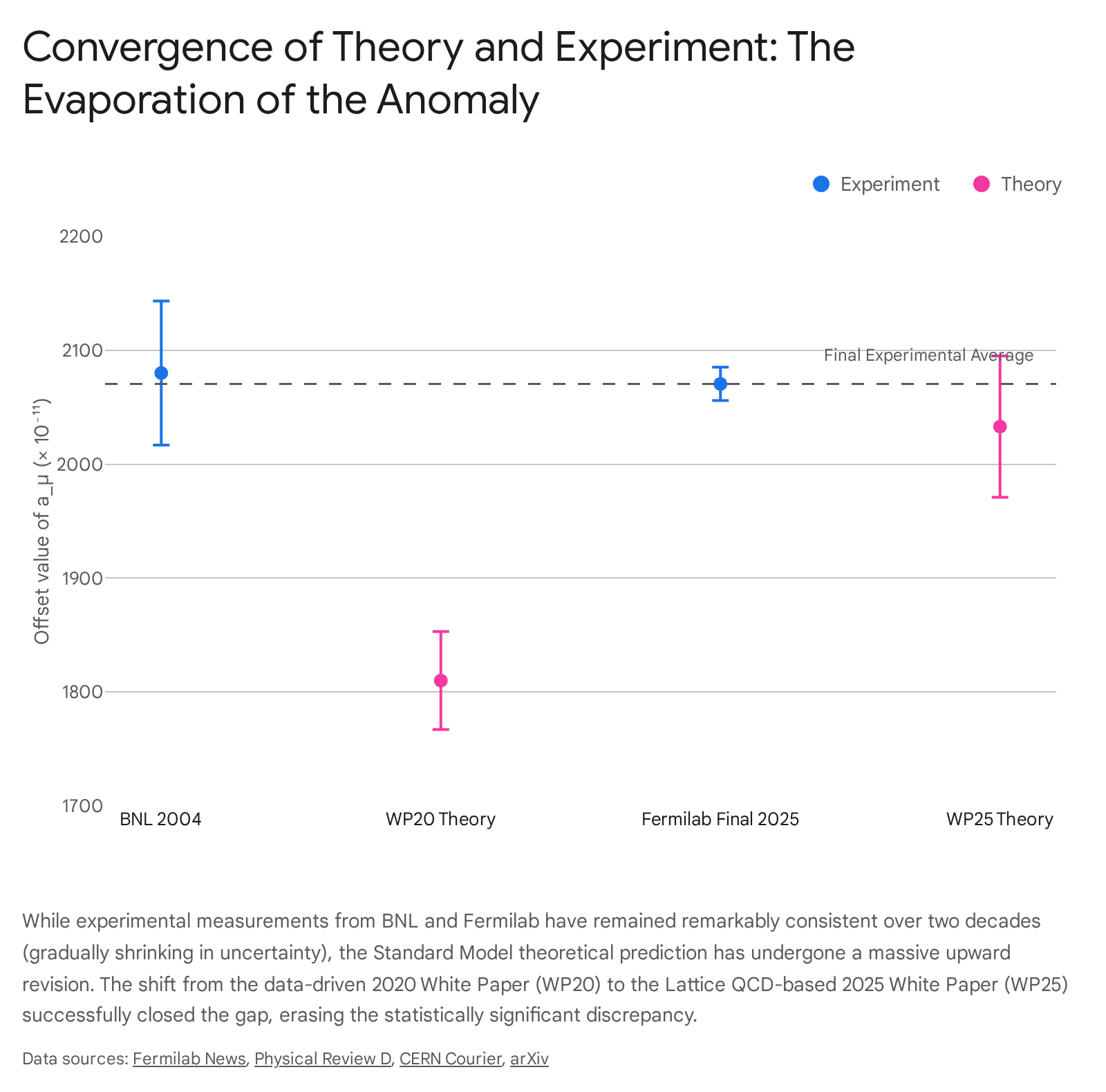
In 2020, the Muon g-2 Theory Initiative - an international consortium of over 130 physicists - published a monumental White Paper (WP20) aimed at establishing a global consensus. WP20 aggregated decades of data-driven dispersive evaluations, drawing heavily from collider experiments like KLOE in Italy, BaBar in the US, and CMD-2 in Russia 230. WP20 reported a Standard Model prediction of $a_\mu = 116591810(43) \times 10^{-11}$, driven primarily by the data-driven HVP evaluations 2831.
It was the comparison against this specific, data-driven WP20 prediction that generated the widely reported 4.2 to 5.1 sigma discrepancies when juxtaposed with Fermilab's early data runs 21532.
The CMD-3 Cross-Section Discrepancy
The stability of the data-driven consensus was fractured in 2023 with the release of new data from the CMD-3 experiment. Operating at the VEPP-2000 $e^+e^-$ collider at the Budker Institute of Nuclear Physics in Novosibirsk, the CMD-3 collaboration published a highly precise, updated measurement of the $e^+e^- \to \pi^+\pi^-$ cross-section. Because the two-pion channel dominates the low-energy hadronic spectrum, it contributes over 70% of the total HVP 3345.
Shockingly, the CMD-3 measurement was significantly larger than all preceding independent measurements, including data from KLOE, BaBar, and even its own predecessor, CMD-2 1233. This divergence created a severe internal contradiction within the dispersive methodology. Because the HVP is determined by integrating over these experimental cross-sections, a higher hadronic cross-section yields a larger theoretical HVP contribution. Consequently, adopting the CMD-3 data would shift the predicted value of $a_\mu$ upward, bringing the Standard Model prediction into much closer agreement with the Fermilab measurements 233.
The data-driven community found itself deadlocked. The tensions among the various dispersive evaluations of the LO HVP had escalated to a level of 5 standard deviations internally, rendering it impossible to combine the conflicting datasets into a mathematically sound, meaningful average 234.
Lattice Quantum Chromodynamics and the BMW Calculation
In parallel with the brewing crisis in the dispersive methodology, a second computational approach to calculating the hadronic contributions was rapidly maturing: Lattice QCD.
Ab Initio Hadronic Vacuum Polarization
Lattice QCD is an ab initio method that attempts to solve the strong force equations from first principles without relying on experimental input data. It achieves this by discretizing continuous spacetime into a four-dimensional hypercubic grid (a lattice). Quarks are placed on the lattice sites, and gluons are represented by the link variables connecting these sites. The extraordinarily complex QCD path integrals are then evaluated numerically using Monte Carlo simulations executed on some of the world's most powerful supercomputers 103536.
Historically, Lattice QCD computations of the LO HVP were hampered by immense statistical noise at long distances and significant systematic uncertainties related to finite lattice spacing and isospin-breaking effects, leaving them unable to match the precision of the dispersive approach 2528.
This paradigm shifted dramatically in 2021 when the Budapest-Marseille-Wuppertal (BMW) collaboration published a comprehensive Lattice QCD calculation of the LO HVP. By leveraging massive computational resources, finer lattices, and pragmatic noise-reduction techniques, BMW achieved an unprecedented 0.8% uncertainty on their measurement 62837.
The BMW result ($a_\mu^{\text{HVP, LO}} = 707.5 \pm 5.5 \times 10^{-10}$) was substantially higher than the dispersive averages endorsed in WP20 637. When substituted into the overarching Standard Model calculation, the BMW value produced a theoretical prediction for $a_\mu$ that was fully compatible with the experimental world average. Relying on the BMW lattice result reduced the vaunted 5-sigma discrepancy between theory and experiment to a statistically insignificant 1.5 sigma 26.
To rigorously test the BMW findings, the Lattice QCD community utilized "time-window" observables, partitioning the HVP calculation into short-distance, intermediate-distance, and long-distance segments. The intermediate window (0.4 to 1.0 fm) is considered a "sweet spot" where signal-to-noise ratios are optimal and different lattice formulations demonstrate impressive agreement 2838. Multiple independent lattice groups published window calculations confirming the BMW results, establishing a stark, unavoidable tension between the purely theoretical Lattice QCD approach and the empirical data-driven dispersive approach 22838.
The 2025 Theory Initiative Update
Confronting the irreconcilable internal contradictions of the dispersive data (driven by the CMD-3 crisis) and the mounting corroboration of the BMW lattice results across the computational community, the Muon g-2 Theory Initiative executed a major pivot.
In May 2025, the Theory Initiative published an updated consensus, the 2025 White Paper (WP25). Acknowledging that the tensions within the $e^+e^-$ cross-section data made dispersive combinations untenable, the steering committee opted to base the new Standard Model LO HVP prediction exclusively on consolidated Lattice QCD calculations 213134.
This methodological shift resulted in a major upward revision of the total Standard Model prediction. The WP25 consensus established the theoretical value at $a_\mu^{\text{SM}} = 116592033(62) \times 10^{-11}$ 3134.
When comparing this new, lattice-driven theoretical baseline against the final 2025 experimental average of $116592071.5(14.5) \times 10^{-11}$ (derived from BNL E821 and Fermilab E989 runs 1-6), the difference is a mere $38(63) \times 10^{-11}$ 2134. Because the uncertainty bounds comfortably overlap, there is currently no statistically significant tension between the Standard Model and experimental measurements. The muon $g-2$ anomaly, as it was understood during the height of the Fermilab Run 1 announcements, has effectively evaporated 3134.
Evolution of Muon Magnetic Anomaly Values
The table below outlines the shifting numerical landscape that defined the rise and fall of the anomaly. Values are expressed in units of $10^{-11}$.
| Source | Year | Value ($a_\mu \times 10^{11}$) | Uncertainty | Status vs. Final Average |
|---|---|---|---|---|
| BNL E821 (Final) | 2004 | 116592080 | $\pm 63$ | Consistent |
| Theory Init. (WP20) | 2020 | 116591810 | $\pm 43$ | $> 5 \sigma$ Tension |
| Fermilab (Run 1) | 2021 | 116592040 | $\pm 54$ | Consistent |
| Fermilab (Run 1-6) | 2025 | 116592071.5 | $\pm 14.5$ | Experimental Benchmark |
| Theory Init. (WP25) | 2025 | 116592033 | $\pm 62$ | Statistically Compatible |
Implications for Physics Beyond the Standard Model
The resolution of the $g-2$ tension forces a profound paradigm shift in high-energy physics phenomenology. Rather than serving as direct, incontrovertible evidence of a specific new particle, the extraordinary 127 ppb experimental precision achieved by Fermilab now acts as a ruthless constraint mechanism on theoretical imagination.
Any proposed extension to the Standard Model must satisfy a strict boundary condition: its hypothetical quantum loop contributions cannot perturb the predicted $a_\mu$ beyond the tight margins where the WP25 theory and Fermilab experiment now intersect 27. Several prominent BSM candidates are severely impacted by this evaporation of the anomaly.
Supersymmetry Constraints
Supersymmetry (SUSY) posits that every Standard Model fermion has a bosonic superpartner, and every boson has a fermionic superpartner 39. In the context of the muon's magnetic moment, virtual loops containing smuons (the scalar superpartner of the muon) and charginos or neutralinos would add distinct, calculable vertices to the Feynman diagrams determining $a_\mu$ 2740.
During the height of the WP20 discrepancy, specific low-mass SUSY configurations were heavily favored as the most elegant explanation for the gap. With the anomaly resolved, the parameter space for low-mass SUSY is drastically restricted. If SUSY exists, the masses of the smuon and chargino must be significantly larger than previously hoped - driving them out of reach of current colliders - or their coupling strengths must be exceptionally weak, ensuring their loop contributions fall within the 63-part-per-100-billion uncertainty margin of the current consensus.
Dark Photons and the Dark Sector
Dark photons ($A'$) are hypothetical vector bosons theorized to mediate forces within a hidden "dark sector" of particles, which serves as a leading candidate for dark matter 841. A dark photon could interact with Standard Model particles via kinetic mixing with the ordinary electromagnetic photon. If a dark photon exists, a muon could emit and reabsorb a virtual dark photon, directly altering $a_\mu$ 442.
The absence of a large anomaly places strict upper limits on the kinetic mixing parameter and the allowable mass of the dark photon. These constraints strongly complement exclusionary data generated by direct-detection and fixed-target experiments, such as NA64 at CERN and BaBar, systematically closing the window on low-mass dark sector explanations 41.
Scalar Leptoquarks
Leptoquarks are hypothetical bosons carrying both baryon and lepton quantum numbers, allowing them to facilitate direct transitions between quarks and leptons. They gained significant theoretical traction as potential simultaneous solutions to various flavor-physics anomalies, such as lepton flavor universality violations observed at the LHCb detector, and the anomalous W-boson mass measurement reported by the CDF collaboration 4041.
Specific models proposed that a combination of a weak-singlet scalar leptoquark ($S_1$) and a weak-triplet scalar leptoquark ($S_3$) mixing through a Higgs portal could simultaneously resolve the W-boson mass anomaly and the muon $g-2$ discrepancy 40. The evaporation of the $g-2$ anomaly removes a vital pillar of phenomenological support for these specific low-mass leptoquark configurations, forcing theoretical models to push these hypothetical particles to higher energy scales testable only at future, higher-energy colliders.
Future Experimental and Theoretical Pathways
While the immediate crisis of a broken Standard Model has been averted, the physics community faces a new, equally daunting challenge: resolving the internal theoretical contradictions. The fact that the data-driven dispersive method (relying on empirical $e^+e^-$ cross-sections) and the ab initio Lattice QCD calculations fundamentally disagree indicates a systemic misunderstanding in how hadronic physics is modeled or measured experimentally 720.
The path forward requires orthogonal checks across both theoretical and experimental domains.
The MUonE Experiment
To bypass the conflicting electron-positron annihilation datasets entirely, the proposed MUonE experiment at CERN seeks to measure the hadronic vacuum polarization in a purely space-like scattering regime. By firing a high-energy muon beam at atomic electrons in a low-Z target (such as Beryllium or Carbon), physicists can extract the HVP contribution directly from the shape of the differential cross-section of elastic $\mu$-$e$ scattering 1929.
Because this approach avoids the complex, timelike resonance regions inherent to $e^+e^-$ annihilation, MUonE offers a purely independent, data-driven methodology to verify the Lattice QCD results and adjudicate the failure of the traditional dispersive method 2729.
Continued Lattice Refinements
The current Standard Model prediction is entirely reliant on Lattice QCD. However, the Lattice QCD error (estimated at 520 ppb for HVP) still dominates the overall uncertainty of the prediction, significantly eclipsing the experimental uncertainty (127 ppb) 729. Independent lattice collaborations must continue to replicate and improve upon the BMW calculations. Future computational efforts will focus on controlling for finite-size volume effects on the lattice and precisely modeling isospin-breaking effects, with the goal of driving the theoretical error down toward the Fermilab experimental baseline 528.
Concluding Outlook
Ultimately, the saga of the muon anomalous magnetic moment serves as a testament to the rigorous, self-correcting nature of particle physics. The pursuit of the anomaly has driven unprecedented innovations in superconducting magnetometry, thermal muonium laser ionization, and supercomputer-driven lattice mathematics. While the muon $g-2$ measurement may not have shattered the Standard Model as widely anticipated in 2021, it has fortified the framework with an empirical benchmark of staggering precision, leaving a vastly narrower, yet more brilliantly illuminated path for the eventual discovery of new physics.