Penrose's Conformal Cyclic Cosmology and evidence
Fundamentals of the Cosmological Paradigm
The prevailing paradigm of modern physical cosmology, the $\Lambda$CDM (Lambda Cold Dark Matter) model, provides a mathematically robust framework that describes the evolution of the universe from a hot, dense primordial state to its current state of accelerating expansion. Supported by decades of precision measurements - including the power spectrum of the Cosmic Microwave Background (CMB), the large-scale distribution of baryonic matter, and the luminosity distance of Type Ia supernovae - $\Lambda$CDM stands as a highly successful descriptive model of observational astrophysics 123. However, the standard model is not without profound theoretical limitations and escalating observational tensions. It posits an initial spacetime singularity, commonly referred to as the Big Bang, where the fundamental equations of General Relativity catastrophically break down and predictive physics ceases to function 356.
Furthermore, the standard model faces a deeply unresolved mystery regarding the thermodynamic arrow of time. The Second Law of Thermodynamics dictates that the overall entropy of a closed system must strictly increase over time, implying that the universe must have originated in a state of extraordinarily low entropy 456. Traditional inflationary models offer little fundamental explanation for why the gravitational entropy of the initial state was fine-tuned to such an exceptional degree 78. In response to the theoretical voids left by standard cosmology, the British mathematician and theoretical physicist Roger Penrose proposed Conformal Cyclic Cosmology (CCC) 91314. First formalized in 2006 and later detailed in his 2010 publication Cycles of Time, CCC represents a radical departure from the singular origin of the universe 915.
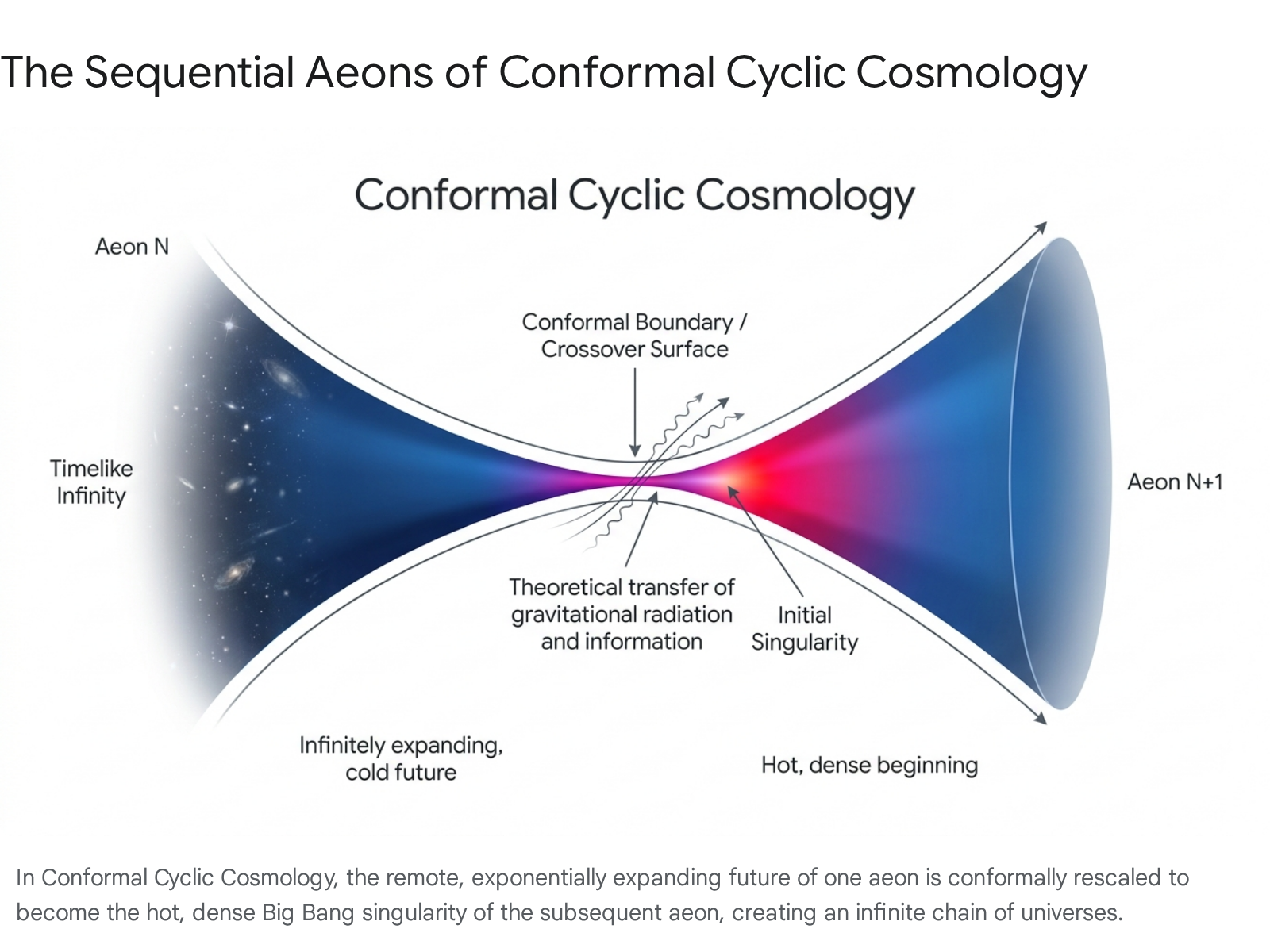
Rather than viewing the Big Bang as an absolute beginning, CCC posits that our universe is merely one in an infinite, sequential chain of cosmic epochs, which Penrose terms "aeons" 915. Through the mathematical machinery of conformal geometry, Penrose demonstrated that the infinitely expanded, infinitely cold remote future of a universe dominated by a positive cosmological constant ($\Lambda$) becomes mathematically and physically indistinguishable from the infinitely hot, infinitely dense Big Bang of a subsequent aeon 5916.
The Weyl Curvature Hypothesis
To understand the theoretical necessity of Conformal Cyclic Cosmology, one must first examine the Weyl Curvature Hypothesis, a concept Penrose introduced in 1979 to address the thermodynamic inconsistencies of the early universe 3717. The hypothesis is rooted in the distinct behavior of thermal entropy versus gravitational entropy.
Gravitational Entropy Versus Thermal Entropy
In a standard thermodynamic system, such as a gas enclosed in a volume, maximum entropy is achieved when the gas is uniformly distributed; clumped or highly ordered gas represents a state of low entropy 47. However, gravity operates inversely because it is an inherently attractive force. A uniform, homogeneous distribution of gravitating matter actually represents a state of remarkably low entropy, as the matter possesses immense potential to undergo spontaneous gravitational collapse 467. Maximum gravitational entropy is achieved when all available matter collapses into supermassive black holes, a state dictated by the Bekenstein-Hawking area-entropy law, which demonstrates that the entropy of a black hole is proportional to its event horizon area 41718.
The early universe, as observed through the extreme uniformity of the CMB, was a highly homogeneous thermal bath 23. Penrose points out that while the thermal entropy of the Big Bang was high, its gravitational entropy must have been practically zero to allow for the subsequent formation of stars, galaxies, and large-scale structures 345. As the universe ages and matter clumps together, the overall gravitational entropy strictly increases, thereby establishing the cosmological arrow of time 365.
Decomposition of the Riemann Curvature Tensor
To mathematically quantify this phenomenon, Penrose turns to the Riemann curvature tensor, which completely describes the curvature of a spacetime manifold in General Relativity 517. The Riemann tensor can be decomposed into two primary components: the Ricci tensor and the Weyl tensor 517.
The Ricci tensor is directly coupled to local matter and energy via Einstein's field equations; its curvature dictates how spatial volumes change in the presence of mass 1710. The Weyl tensor, conversely, measures tidal distortions and gravitational waves propagating through empty space; it governs the shape-changing properties of gravity independent of local matter density 317. Crucially, the Weyl tensor is a conformal invariant, meaning its fundamental properties remain unchanged when the metric is uniformly scaled 1711.
Zeroing the Weyl Tensor at the Initial Singularity
The Weyl Curvature Hypothesis asserts that the initial low-entropy state of the universe is characterized by the strict vanishing (or effective zeroing) of the Weyl curvature tensor at the initial cosmological singularity 354. A spacetime with a vanishing Weyl tensor is conformally flat, meaning it possesses no initial tidal distortions or primordial gravitational clumping 517. Standard inflationary theory attempts to address the universe's initial smoothness by positing a rapid, exponential expansion that ironed out primeval irregularities 37. Penrose rejects this approach, arguing that cosmic inflation requires the highly specific pre-existence of a scalar field (the inflaton) and does not fundamentally resolve the initial entropy fine-tuning required by the Second Law of Thermodynamics 721.
In the framework of CCC, the need for a brief inflationary period in the early universe is entirely eliminated. The "smoothing" of the universe is naturally accomplished by the infinite, exponentially expanding late stage of the preceding aeon, driven by the cosmological constant $\Lambda$ 1621. The low-entropy, Weyl-zero state of the Big Bang is thus a direct mathematical consequence of the conformal geometry inherited from the prior universe 47.
Mathematical Mechanics of Conformal Geometry
The mathematical foundation of CCC relies on conformal mapping, a class of geometric transformations that preserve local angles while allowing for the arbitrary stretching and squashing of temporal and spatial distances 914.
Rescaling the Friedmann-Lemaître-Robertson-Walker Metric
In standard cosmology, the large-scale geometry of the universe is modeled using the Friedmann - Lemaître - Robertson - Walker (FLRW) metric 49. The basic construction of CCC is to connect a countable sequence of open FLRW spacetimes 59. This is achieved by taking the physical metric of the universe, $g_{ab}$, and multiplying it by the square of a conformal scaling factor, $\Omega$, to produce a new conformal metric: $\hat{g}{ab} = \Omega^2 g{ab}$ 921.
In the remote future of a universe dominated by a positive cosmological constant, the universe expands exponentially 59. By choosing a conformal factor $\Omega$ that approaches zero at timelike infinity, the infinite future conformal boundary is mathematically "squashed down" to a regular, conformally finite spacelike hypersurface 5915. Conversely, the infinite density and temperature of the Big Bang singularity, where the physical metric approaches zero, can be "stretched out" into a smooth boundary by applying a reciprocal conformal transformation where $\Omega$ approaches infinity 5621.
Because the stretched-out Big Bang of a nascent universe and the squashed-down infinite future of an aging universe are both mathematically representable as smooth, conformally flat spacelike boundaries, Penrose postulates that they represent the exact same physical hypersurface 515. The past conformal boundary of one copy of an FLRW spacetime is seamlessly attached to the future conformal boundary of another, allowing the conformal metric to smoothly cross from one aeon to the next 59.
Energy Transitions at the Conformal Boundary
For Einstein's field equations to hold on both sides of the crossover surface, the mathematical transition requires a massive shift in physical state 21. The late stage of an aeon is virtually empty, containing almost zero matter density. However, the subsequent aeon must begin with an immense influx of energy density to initiate its Big Bang 21. In CCC, this requires the conformal factor $\Omega$ itself to behave as a physical scalar field on the future side of the boundary 21. This scalar field starts off as effectively massless but rapidly acquires mass, coming to dominate the matter density of the new universe and providing the necessary energy budget for the subsequent cosmic evolution 21.
Particle Physics Constraints and Mass Decay
For Conformal Cyclic Cosmology to function as a physical reality, it is insufficient to simply map geometric boundaries; the matter and radiation within the universe must also fundamentally obey conformal invariance as the aeon transitions 14. A physical system is strictly conformally invariant only if it lacks a fundamental scale of length or time 1417.
Conformal Invariance of Massless Bosons
In the Standard Model of particle physics, massless bosons - such as photons and gluons - naturally obey conformally invariant quantum theory 914. To a photon traveling at the speed of light, neither distance nor time possesses a defined metric meaning; a photon experiences no passage of time, making its frame of reference inherently conformal 14. As a universe expands infinitely and all structures dissolve, a cosmos populated exclusively by photons and gravitons effectively loses its sense of physical scale, becoming mathematically identical to the scale-less singularity of the Big Bang 141612.
The Theoretical Problem of Electron Rest Mass
However, massive fermions, such as electrons and quarks, pose a fatal complication to this elegant geometry. Rest mass establishes a defined temporal scale through the particle's Compton frequency ($E=mc^2 = hf$) and a corresponding spatial scale, explicitly breaking the necessary conformal symmetry 61324. Therefore, a rigid mathematical requirement of early formulations of the CCC hypothesis was that all massive particles must eventually vanish from existence 924. By the time an aeon reaches timelike infinity, the universe must be entirely devoid of rest mass 1416.
For supermassive black holes, this condition is theoretically satisfied through Hawking radiation, which dictates that over timescales approaching $10^{100}$ years, black holes will completely evaporate into massless photons and gravitons 1718. For baryonic matter, Penrose invokes the mechanism of proton decay 914. While proton decay is a mathematically plausible feature of several Grand Unified Theories (GUTs), it has never been experimentally observed, and physical lower bounds place the proton half-life well beyond $10^{34}$ years 914.
The most severe theoretical obstacle is the electron. As the lightest charged particle in the Standard Model, electron decay is strictly forbidden by the fundamental conservation of electric charge 6925. In earlier iterations of CCC, Penrose speculated that electrons might gradually lose their mass or charge over infinite time - a postulate entirely lacking foundation in quantum field theory or the Higgs mechanism 692526. Critics of CCC frequently cite this specific requirement as the theory's most glaring flaw; without a rigorously defined mechanism for the total decay of fermionic mass, the conformal boundary between aeons cannot be mathematically sealed 132425.
The 2020 Nobel Lecture Modification
Acknowledging the severe conflicts with the Standard Model of particle physics, Penrose has recently moderated his theoretical requirements. During his 2020 Nobel Prize Lecture, Penrose introduced an updated interpretation of the mass fade-out necessity 913. He hypothesized that absolute masslessness might not be strictly necessary if the remaining massive particles are infinitesimally rare and highly dominated by kinetic energy 6913.
In a universe experiencing infinite exponential expansion, stray electrons and positrons will eventually become causally isolated behind their respective cosmological horizons, making annihilation impossible 69. However, if the ambient geometry of the universe is overwhelmingly dominated by a highly energetic fluid of massless photons, the rest mass of these isolated fermions becomes physically negligible compared to the total kinetic energy density of the background radiation 613. While this modification softens the rigid mathematical symmetry of the original CCC formulation, it represents a necessary attempt to reconcile the cosmological framework with the observed stability of the electron 13.
Dark Matter and the Erebon Field
As established, the conformal boundary requires a massive influx of energy density on the post-Big Bang side to satisfy Einstein's field equations 21. In the CCC framework, this energy is provided by the sudden manifestation of a dominant new scalar field immediately following the crossover 21. Penrose proposes that the particles comprising this scalar field are the primary constituents of the universe's dark matter 21. He designated these hypothetical particles as "erebons," named for Erebos, the ancient Greek deity of primordial darkness 132427.
Physical Properties and Decay Rates of Erebons
According to CCC, erebons are extraordinarily heavy scalar particles, possessing zero spin and a mass of approximately $10^{-5}$ grams 132728. This mass aligns roughly with the Planck mass, making an individual erebon comparable in weight to a small grain of sand and approximately 22 orders of magnitude heavier than a standard proton 2729. To fulfill their role as dark matter, erebons interact with ordinary baryonic matter exclusively through gravitational coupling, possessing no electromagnetic or strong nuclear charge 212429.
A critical constraint on erebons is that they must not accumulate across successive aeons; if they did, the matter density of the universe would diverge to infinity over subsequent cycles 13. Therefore, erebons must be fundamentally unstable. Penrose postulates that erebons possess a decay lifetime exceeding $10^{10}$ years, roughly corresponding to the current age of our observable universe 13. When a Planck-mass erebon decays, it annihilates entirely, depositing its massive energy directly into a burst of classical gravitational waves 2729. Because the particle operates at the Planck mass, this decay generates an instantaneous, impulsive gravitational wave with an extraordinarily high frequency estimated at $10^{43}$ Hz (the Planck frequency) 1329.
Gravitational Wave Anomalies and LIGO Data
In 2017, Penrose published a highly controversial paper asserting that the decay of erebons might already be visible in terrestrial data collected by the Laser Interferometer Gravitational-Wave Observatory (LIGO) 132829.
The Correlated Noise Hypothesis
A separate group of independent researchers (Cresswell et al.) had previously published an analysis pointing out unexplained, correlated "noise" anomalies in the telemetry surrounding the first major binary black hole merger detections (specifically GW150194, GW151226, and GW170194) 132830. The background noise in both the Hanford and Livingston detectors exhibited the exact same $\sim 6.9$ millisecond time delay as the actual macroscopic gravitational wave signals 1324.
Penrose proposed that this correlated noise was not an instrumental artifact, but rather an authentic astrophysical signal validating the CCC framework 2714. He argued that the distant host galaxies of the merging black holes possess dense dark matter halos composed entirely of erebons 1324. The continuous, ongoing decay of these erebons would generate a background hum of high-frequency gravitational impulses arriving from the exact same directional coordinate as the black hole merger 132430. Consequently, the time delay required for the merger signal to traverse the distance between the two Earth-based detectors would perfectly match the time delay of the erebon decay impulses 1324.
Instrumental Sensitivity Refutations
This specific observational claim was met with profound skepticism by the LIGO scientific collaboration and the broader astrophysics community 24. Critics highlighted several fatal physical and instrumental flaws in the hypothesis. Foremost is the issue of instrumental sensitivity. LIGO is engineered to detect macroscopic gravitational wave frequencies in the highly specific range of tens to thousands of Hertz 242714. The proposed $10^{43}$ Hz frequency of erebon decay is 40 orders of magnitude beyond LIGO's physical detection threshold 242714.
While Penrose argued the signal would register as a near-instantaneous "impulse" that standard algorithms might mistakenly classify as transient noise, the specific physical mechanism by which a kilometers-long laser interferometer could couple to a Planck-frequency wave remains entirely unexplained in his theoretical framework 2714. Furthermore, particle dark matter distributed throughout a distant galaxy would produce a diffuse, isotropic signal locally, not a highly coherent directional beam capable of perfectly mimicking the point-source time delay of the binary merger 24. The LIGO collaboration continually monitors and characterizes instrumental noise, attributing non-Gaussian noise correlations to well-understood properties of the detectors' physical and seismic environments without requiring exotic cosmological interventions 24.
Cosmic Microwave Background Observational Claims
The most heavily scrutinized and debated aspect of Conformal Cyclic Cosmology is its prediction of specific, observable geometric anomalies within the Cosmic Microwave Background (CMB). Because CCC fundamentally rejects the mechanism of cosmic inflation, it relies on the decay of erebons and the transmission of specific gravitational signatures across the aeon boundary to seed the initial temperature fluctuations in our current universe 2124. Over the past decade, Penrose and his primary collaborator, Vahe Gurzadyan, have published multiple analyses claiming to have identified two distinct classes of CMB anomalies that constitute empirical proof of the CCC model 914.
Concentric Rings of Low Temperature Variance
According to the CCC timeline, during the extremely late stages of the previous aeon, supermassive black holes located within the remnants of dense galactic clusters would frequently collide and merge 323334. These unimaginably violent orbital decay events would release massive bursts of gravitational radiation 933. When this propagating gravitational radiation encounters the conformal crossover boundary, it transfers into the newly born aeon, imprinting its geometric signature upon the dark matter (erebon) distribution of the early universe 2124.
Observationally, this energy transfer should manifest in the CMB as concentric families of circular rings exhibiting anomalously low temperature variance compared to the surrounding sky 323334. The rings are predicted to be concentric because multiple supermassive black hole mergers occurring over millions of years within the same localized galactic cluster in the previous aeon would appear from our cosmological perspective to originate from roughly the same central angular coordinate 3233.
In 2010, Gurzadyan and Penrose published a highly publicized analysis of the 7-year data release from the Wilkinson Microwave Anisotropy Probe (WMAP) and the BOOMERanG experiment 93235. They claimed to have discovered a massive excess of these concentric circles with an overwhelming statistical significance of $6\sigma$ 93235. To identify these structures, they developed a bespoke analytical technique termed the "sky-twist procedure" 3233. This methodology involved calculating temperature variances over circular rings of varying radii (ranging from 2.5 degrees up to a maximum cutoff of 15 to 20 degrees, as predicted by CCC constraints) and then mathematically twisting the sky map over itself to search for correlations 323335. They asserted that applying the same twisting algorithm to elliptically distorted shapes generated dramatically fewer hits than perfect circles, arguing this proved the structures were physical realities originating from the spherical geometry of previous-aeon gravitational waves 3233.
Hawking Points from Supermassive Black Hole Evaporation
A subsequent, related claim involves the ultimate thermodynamic fate of the supermassive black holes that did not merge. In the deepest future of the previous aeon, long after all surrounding baryonic matter has decayed or been consumed, these isolated black holes must evaporate entirely via Hawking radiation 1718. Because this evaporative process takes place over googols of years, the emitted radiation is spread across vast, incomprehensible stretches of spacetime 18. However, through the specific mathematical lens of conformal rescaling, the infinite time of the previous aeon is violently compressed at the boundary 1518.
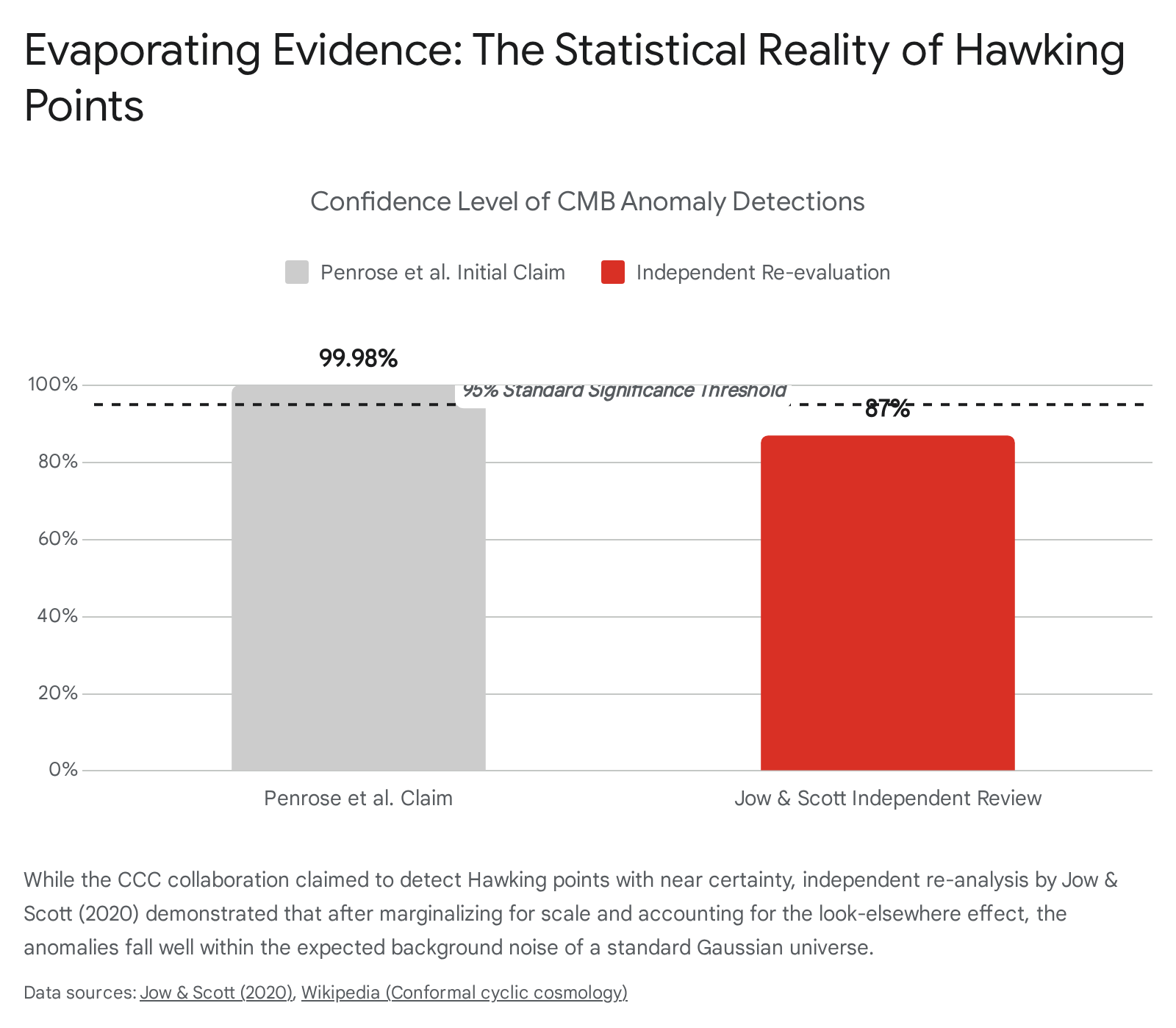
To an observer situated in our current aeon, the entire cumulative mass-energy of an evaporated supermassive black hole is squeezed into a highly energetic, microscopic point on the crossover surface 1518. Penrose termed these high-energy concentrations "Hawking points" 182915. As our current universe expands, these points are stretched out across the sky and should appear in the CMB as anomalously hot spots or distinct points surrounded by unusually large temperature gradients 1516. In 2018, Penrose, along with Daniel An, Krzysztof Meissner, and Paweł Nurowski, published an analysis of high-resolution Planck satellite data, boldly claiming the definitive detection of Hawking points at a $99.98\%$ confidence level 91538.
Statistical Refutations of the Microwave Background Claims
The publication of empirical proofs for CCC sparked intense, immediate pushback from the global cosmological community. The core of the ensuing scientific dispute lies not in whether anomalous circles or hot spots exist within the CMB data - cosmologists agree they do - but in their statistical significance when properly compared to a standard $\Lambda$CDM universe governed by Gaussian random fluctuations 113539.
Simulation Baseline Errors and Gaussian Random Fields
Within days of the initial 2010 concentric rings publication, three independent groups of cosmologists, including a detailed analysis by Moss, Scott, and Zibin (2011), as well as Wehus and Eriksen, rigorously re-evaluated the WMAP data 343940. They confirmed the presence of the low-variance rings but demonstrated mathematically that such structures are an entirely expected, emergent feature of a standard Gaussian random field 343539.
The critical flaw in the CCC team's methodology was determined to be their choice of simulation background. Gurzadyan and Penrose assessed the significance of their findings against an undocumented, non-standard simulation model that did not accurately reflect the known physics of the CMB 935. When Moss, Scott, and Zibin ran the exact same ring-searching algorithm against properly simulated $\Lambda$CDM CMB maps - which naturally contain acoustic peaks and established power spectrum anisotropies - they found that the standard simulations produced the exact same quantity, size, and distribution of concentric rings as the real observational sky data 93439. The CCC researchers had not found evidence of a previous aeon; they had "simply re-discovered that the CMB contains structure" 39.
The table below summarizes the timeline of the primary observational claims surrounding CCC and their subsequent independent refutations by the astrophysical community.
| Claim / Phenomenon | Proponent Publication | Core Assertion | Independent Refutation | Refutation Methodology |
|---|---|---|---|---|
| Concentric Low-Variance Rings | Gurzadyan & Penrose (2010) 35 | $6\sigma$ excess of concentric rings in WMAP data from previous aeon black hole mergers. | Moss, Scott, Zibin (2011) 34 | Demonstrated that identical patterns emerge in properly simulated Gaussian $\Lambda$CDM maps. |
| Hawking Points | An, Meissner, Nurowski, Penrose (2018) 9 | Anomalous CMB temperature gradients detected at 99.98% confidence. | Jow & Scott (2020) 15 | Re-analysis dropped significance to 87% ($<1\sigma$) by marginalizing over ring scales (look-elsewhere effect). |
| Correlated LIGO Noise | Penrose (2017) 28 | Time-delayed noise in LIGO detectors originates from Planck-mass "erebon" dark matter decay. | Cosmological Community Consensus 24 | Instrumental limits ($10^{43}$ Hz signal vs $10^3$ Hz detector); noise characterized as terrestrial/instrumental. |
The Look-Elsewhere Effect in Hawking Point Analysis
A similar, highly specific methodological refutation dismantled the 2018 claims regarding the detection of Hawking points 15. In 2020, cosmologists Jow and Scott conducted a rigorous Bayesian re-evaluation of the Planck satellite data utilized by Penrose's team 1517. They identified a critical statistical error in the CCC analysis known in astrophysics as the "look-elsewhere effect."
The CCC team had searched a vast parameter space - scanning various ring radii, ring thicknesses, and temperature gradients - until they found subsets of data that appeared highly anomalous 15. Jow and Scott proved that when one correctly marginalizes over the sheer size of the rings and the wide array of search parameters, the statistical significance of the Hawking points entirely collapses 15.
The re-analysis demonstrated that Gaussian simulations of the sky contain a more significant Hawking point signal than the actual observational data at least 13% of the time, meaning the true confidence level of the detection is merely 87% (just slightly above $1\sigma$) 15. In particle physics and cosmology, a $1\sigma$ deviation is completely indistinguishable from random background noise, falling drastically short of the $5\sigma$ standard required to claim a scientific discovery 15. Subsequent analyses utilizing machine learning algorithms, such as the ResNet18-based "HawkingNet" (Bodnia et al., 2024), similarly confirmed that the anomalies are artifacts of isolated bright pixels rather than distinct cosmological structures, concluding that there is no statistically relevant evidence for Hawking points in currently available CMB datasets 33435.
Tensions in Early Universe Observations
While the CMB evidence for CCC has been largely dismantled by the cosmological consensus, recent discoveries by the James Webb Space Telescope (JWST) have provided a new observational arena for models challenging the standard $\Lambda$CDM paradigm.
High-Redshift Galaxy Discoveries
Since beginning full scientific operations in 2022, JWST has conducted deep-space surveys that have consistently identified highly luminous, intrinsically red, and structurally mature galaxies at extreme redshifts (ranging from $z = 7.4$ up to confirmed observations at $z = 14.32$) 421819. According to the standard hierarchical model of structure formation, the universe at this early epoch (representing less than 400 to 700 million years after the Big Bang) should only contain loosely associated proto-galaxies and population III stars; it theoretically lacked the required time to gravitationally assemble mature structures exceeding $10^{10}$ solar masses 181920.
This discrepancy has exacerbated existing systemic cracks in the standard model, most notably the "Hubble Tension" - the persistent, statistically significant disagreement between the universe's expansion rate measured locally (via Cepheid variables and Type Ia supernovae) versus the rate extrapolated from the early universe (via Planck CMB data) 424647.
The Covarying Coupling Constants and Tired Light Model
Seizing upon these specific JWST tensions, alternative cosmologists have attempted to resurrect elements of CCC to explain the existence of these impossibly early galaxies 1848. In 2023, astrophysicist Rajendra Gupta proposed a hybrid theoretical model dubbed "Covarying Coupling Constants and Tired Light" (CCC+TL) 184821.
The CCC+TL framework blends the conformal rescaling mechanics of Penrose's theory with the historically discarded "tired light" hypothesis - the idea that photons lose energy over time through inherent mechanisms other than spatial expansion 474821. By relaxing the constraint that fundamental coupling constants are immutable over time, the hybrid mathematical model extends the calculated age of the universe from 13.8 billion years to a staggering 26.7 billion years 1850. This vastly expanded timeline provides the necessary temporal runway (e.g., providing 5.8 billion years of evolution time at $z = 10$) for the observed massive JWST galaxies to form, mature, and organize 18.
Rejection of Hybrid Models via Cosmic Chronometers
Despite gaining significant traction in popular media as an elegant solution to the JWST anomalies, the CCC+TL model fails when subjected to broader, multi-probe cosmological constraints. A rigorous 2026 statistical analysis by Comini et al. tested the CCC+TL model against model-independent Hubble parameter $H(z)$ measurements derived from "cosmic chronometers" (passively evolving galaxies whose stellar aging acts as a clock to measure the universe's expansion history) 48.
The results were mathematically definitive: the specific parameter set optimized to make CCC+TL fit Type-Ia supernova data completely failed to reproduce the cosmic chronometer $H(z)$ data 48. A statistical comparison utilizing the $\Delta\chi^2$ metric strongly favored the standard $\Lambda$CDM model over the CCC+TL framework by a margin of 61.52 48. Furthermore, the hybrid model exhibited severe internal mathematical tensions, with the required speed-of-light variation index definitively rejected by the dataset with a likelihood ratio of approximately $1.7 \times 10^{-14}$ 48. Consequently, the astrophysics community maintains that the JWST anomalies are much more likely indicative of enhanced star formation efficiencies or poorly understood early-universe baryonic astrophysics, rather than evidence supporting a fundamental rewriting of cosmology via CCC 2048.
Quantum Unitarity and Primordial Gravitational Waves
Beyond observational and statistical debates, CCC faces deep, perhaps insurmountable, theoretical hurdles regarding quantum mechanics and the preservation of information across the aeon boundary.
Information Loss at the Conformal Boundary
A foundational, inviolable principle of quantum mechanics is unitarity, which dictates that quantum information must be preserved throughout the entire temporal evolution of a physical system 1622. Standard cosmology already struggles with this concept via the black hole information paradox, but CCC actively relies on the total, permanent destruction of information 1622. For Penrose's conformal rescaling to successfully reset the entropy of the universe, the phase space of the universe must be drastically reduced at the boundary 14. Penrose embraces this reduction, arguing that the ultimate evaporation of supermassive black holes permanently destroys the degrees of freedom associated with the matter they consumed, thus artificially lowering the entropy of the universe to reset it for the pristine beginning of the next aeon 1622.
This wholesale violation of quantum unitarity is deeply unpopular among theoretical physicists 22. Recent theoretical proposals have attempted to formulate a "unitary version" of CCC where quantum information is globally preserved across the crossover surface, but these attempts heavily alter Penrose's original, elegant mathematical construction and introduce severe new complexities 22.
B-Mode Polarization and Tensor-to-Scalar Constraints
Finally, CCC is fundamentally at odds with the ongoing observational search for primordial gravitational waves generated by cosmic inflation. The BICEP and Keck Array experiments, deployed at the Amundsen - Scott South Pole Station, are dedicated to measuring the extremely faint B-mode polarization of the CMB 22324. Standard inflationary theory predicts that quantum fluctuations during the exponential expansion of the early universe generated a specific spectrum of tensor perturbations (primordial gravitational waves), quantifiable by a metric known as the tensor-to-scalar ratio, $r$ 235455.
Because Conformal Cyclic Cosmology explicitly lacks an inflationary period in the current aeon, it does not naturally predict the same primordial tensor spectrum; any gravitational waves present must be remnants traversing the conformal boundary 2124. As of the most recent data releases, the BICEP/Keck collaboration has set highly stringent upper limits on $r$ ($r < 0.036$ at a 95% confidence level), constraining but not eliminating standard slow-roll inflationary models 55. The collaboration aims to reach a sensitivity of $\sigma(r) \lesssim 0.003$ using data through the 2027 observing season 55. If BICEP/Keck, or next-generation space-based observatories like LiteBIRD, definitively detect primordial B-modes consistent with inflationary models, it would serve as definitive, falsifying empirical evidence against the validity of Conformal Cyclic Cosmology 15455.
Conformal Cyclic Cosmology remains an extraordinarily bold and mathematically elegant framework. By identifying the infinite future of one universe with the Big Bang of the next, it attempts to resolve the fine-tuned entropy of the early universe without resorting to the mechanics of cosmic inflation. However, subjected to rigorous empirical scrutiny, its strict requirements for mass decay violate established particle physics, and its primary observational claims in the CMB have been systematically dismantled by independent researchers. Until CCC can provide robust predictions that withstand statistical scrutiny and align with quantum unitarity, it remains a provocative mathematical speculation rather than a viable physical description of the cosmos.