
Transformative learning theory in corporate training
The foundational premise of adult education is that learning is not merely the accumulation of new information, but the continuous interpretation and reinterpretation of experience. In high-impact corporate training environments, traditional learning models that focus strictly on knowledge acquisition, skill building, and behavioral modification are increasingly insufficient. Today's organizations operate in volatile, uncertain, complex, and ambiguous (VUCA) market conditions that require continuous adaptation 12. To meet these extraordinary challenges, corporate learning and development (L&D) professionals and human resources (HR) strategists have increasingly turned to transformative learning theory.
Developed initially in the late 1970s by Jack Mezirow, transformative learning theory provides a comprehensive psychological and pedagogical framework for understanding how adults reconstruct their sense of self, challenge their deep-seated assumptions, and ultimately alter their fundamental worldview to guide future action 345. Rather than teaching employees what to think or how to perform a routine task, transformative learning focuses on how they think, aiming to rewire the cognitive and emotional pathways that govern decision-making, resilience, and adaptability.
This report conducts an exhaustive examination of the epistemological evolution of transformative learning theory, details the core mechanics of Mezirow's concept of perspective transformation, and analyzes its application within contemporary corporate environments. By exploring the inherent tensions between transformational learning objectives and standard corporate compliance metrics, and by evaluating the implementation of these concepts in leadership development, intercultural competence, and technologically mediated environments, this analysis establishes how organizations can systematically facilitate profound cognitive restructuring.
Theoretical Origins and Epistemological Evolution
To understand the application of transformative learning in the modern corporate sphere, one must first examine its academic origins and subsequent theoretical evolution. Transformative learning theory emerged from Jack Mezirow's 1978 empirical study of adult women returning to formal postsecondary education and the workplace after long absences 456. During this research, Mezirow observed a distinct "development of consciousness" 6. His findings led to the conclusion that adults do not seamlessly apply old understanding to entirely new situations; rather, they rely on past experiences as an interpretive lens. When those old paradigms fail to accurately explain or manage new realities, adults are forced into a demanding process of critical reflection 5.
Habermas and the Domains of Learning
Mezirow's framework relies heavily on the critical social theory of German sociologist and philosopher Jürgen Habermas to give his theory of transformative learning its academic rigor 78. Specifically, Mezirow integrated Habermas's classification of learning domains to differentiate transformative education from standard training. Habermas classified learning into three distinct categories:
- Instrumental Learning: This domain involves task-oriented problem-solving and focuses on empirical cause-and-effect relationships 58. Instrumental learning answers the "how" of a task - such as learning a new software program, mastering a manufacturing process, or executing a financial model. The evaluation of instrumental learning is based on objective, measurable performance.
- Communicative Learning: This domain focuses on the process of understanding the meaning behind what is being communicated by others. It involves the assessment of feelings, needs, desires, values, and social interactions 5. In communicative learning, individuals learn to negotiate meaning and express themselves within a social context.
- Emancipatory Learning: The highest order of learning, which prompts individuals to critically reevaluate their deeply held beliefs, the reasoning behind those beliefs, and the societal or organizational forces that shaped them 8.
Mezirow argued that while most traditional education and corporate training remain strictly within the instrumental or communicative domains, true adult development requires emancipatory reflection. This emancipatory process frees learners from unexamined biases, societal conditioning, and habitual responses, allowing them to consciously direct their own cognitive evolution 89.
The First and Second Waves of Transformative Theory
The scholarship surrounding transformative learning has evolved significantly over the past four decades, generally categorizing into distinct "waves" of academic thought.
The "first wave" of transformative learning theory, framed largely by Mezirow's seminal work, represents a psycho-critical, highly cognitive, and rational account of how adults learn 36. For two decades, the theory was explained almost exclusively through cognitive terminology 6. The signature quality of this first wave is critical self-reflection - the rational, often clinical analysis of one's own assumptions and meaning perspectives 3. Mezirow viewed transformative learning as a uniquely adult form of metacognitive reasoning, wherein beliefs are systematically justified through rational discourse and the assessment of good reasons 10.
However, robust scholarly critique eventually highlighted that this purely rationalist approach neglected the holistic nature of the human experience. Critics argued that the theory was overly reliant on Habermas's rationality and lacked an adequate understanding of the broader social, emotional, and neurobiological dimensions of learning 67.
This critique gave rise to a "second wave" of theorizing championed by scholars such as Patricia Cranton, Edward W. Taylor, and John M. Dirkx, who emphasized the affective, cultural, extrarational, and spiritual dimensions of transformation 3. In stark contrast to purely critical self-reflection, the second wave highlights the central role of emotions, unconscious processes, and "imaginative engagement" in facilitating deep change 3. Scholars recognized that perspective transformation is rarely a purely logical deduction; it is often a messy, emotional process that draws equally on the head and the heart 11.
Alternative Conceptions and Expanding Frameworks
As the theory matured, alternative conceptions emerged to address structural and social deficits in Mezirow's original model. Scholars have identified at least seven major alternative conceptions, including psycho-analytic, psycho-developmental, social emancipatory, neurobiological, cultural-spiritual, race-centric, and planetary approaches 6.
One of the most prominent alternatives is the social emancipatory approach, heavily influenced by Paulo Freire. While Mezirow framed transformation as a deeply personal and internal psychological experience, Freire argued that critical reflection must result in the transformation of society, not merely the individual 4. Freire's approach frames education as a tool for social justice, liberating individuals from oppressive structures and inequality 4.
Another vital contribution comes from Robert Kegan's constructive-developmental approach. In 2000, Kegan posed the crucial question: "What form transforms?" 611. He argued that the major outcome of transformative learning is the transition from a "socialized" epistemology - where an individual's identity and decisions are subconsciously written by the expectations of their organization or society - to a "self-authoring" epistemology, where the individual establishes their own internal authority and moral framework 11.
Finally, modern critical theorists have drawn upon Axel Honneth's theory of recognition, arguing that intersubjectivity, mutual recognition, and freedom are necessary preconditions for the critical reflection and rational discourse that Mezirow championed 7. Without a psychologically safe environment where an individual's identity is recognized and respected, the vulnerability required for true transformation cannot occur.
Core Mechanics of Meaning Making
To apply transformative learning within a high-impact corporate environment, instructional designers must first understand how adults construct and structure meaning. Mezirow posited that what individuals perceive, and critically what they fail to perceive, is powerfully influenced by their habitual expectations 9. These expectations form two foundational structural dimensions of meaning:
Meaning Schemes
Meaning schemes are specific, localized sets of related and habitual expectations governing cause-and-effect relationships and everyday event sequences 9. They are the implicit, automatic rules used for interpreting daily occurrences. For example, in a corporate setting, an employee possesses meaning schemes regarding how a standard meeting should be conducted, how to operate a specific software platform, or how to route an expense report. Meaning schemes dictate specific beliefs, attitudes, and emotional reactions to routine stimuli 4. In traditional corporate training, modifying a meaning scheme is relatively common and straightforward; it involves updating a procedure or correcting a factual error 9.
Meaning Perspectives (Frames of Reference)
Meaning perspectives, or frames of reference, are much broader, higher-order schemata. They are composed of comprehensive theories, fundamental propositions, deep-seated cultural beliefs, and psychological prototypes 49. Meaning perspectives serve as the ultimate psychological, sociolinguistic, and epistemic "lens" through which all experience is filtered and interpreted.
Adults procure a coherent body of experience over their lifetimes - associations, values, feelings, and conditioned responses - that defines their world 4. These structures form a boundary around what the individual considers possible or acceptable. Modifying a meaning perspective - such as fundamentally shifting a senior executive's belief about what constitutes effective leadership, or altering an organization's view on diversity - requires a paradigm shift. Transformative learning specifically targets these meaning perspectives. It occurs when uncritically assimilated frames of reference are found to be defective, non-viable, or incomplete in the face of new reality, and are subsequently transformed through deliberate, critical reflection 9.
The Ten Phases of Perspective Transformation
Mezirow identified ten distinct phases that learners typically navigate during a successful perspective transformation 12131314.
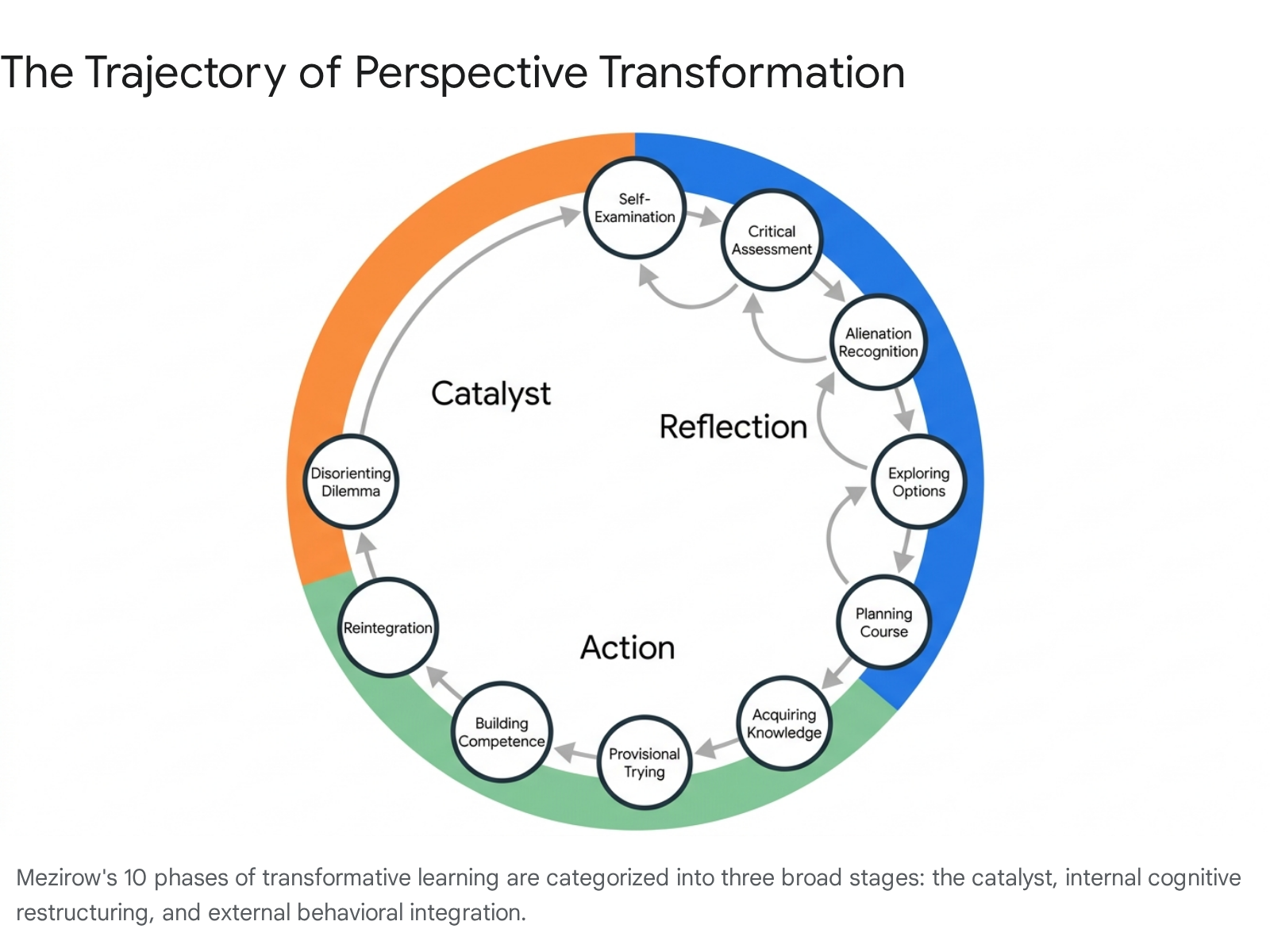
While these phases were originally mapped during academic research, they provide an exact chronological architecture for high-impact corporate training, leadership development, and human resources scenarios.
It is critical to note that these phases do not always unfold in a strict, linear progression. Learners may move between phases, revisit earlier steps, or experience several phases simultaneously depending on their emotional resilience and the organizational context 15.
- A Disorienting Dilemma: The transformation is catalyzed by an event that severely disrupts the learner's current beliefs. This is a moment of cognitive shock - the uncomfortable recognition that prior knowledge, past experience, or existing frames of reference cannot resolve a current conflict or explain a new reality 151718. In a corporate setting, this could be a major market disruption, a failed product launch, or receiving highly critical 360-degree feedback.
- Self-Examination: Triggered by the dilemma, the learner turns inward. This phase is notoriously uncomfortable, as it is often accompanied by feelings of guilt, shame, fear, or profound inadequacy 121516. The individual self-tests their existing beliefs against the undeniable reality of the disorienting dilemma.
- A Critical Assessment of Assumptions: Moving beyond emotional reaction, the individual engages in deep, analytical critical reflection. They question the epistemic, sociocultural, or psychic assumptions that have historically underpinned their worldview 1215. A manager might realize, for instance, that their definition of "productivity" is based on an outdated, industrialized meaning perspective rather than modern knowledge-work realities.
- Recognition of Shared Experiences: The learner discovers that their discontent, and the struggle of the transformation process itself, are not isolated personal failures but shared human experiences. This phase often involves rational discourse and dialogue with peers, mentors, or learning communities, which normalizes the discomfort of change 1520.
- Exploration of Options for New Roles or Actions: As old, non-viable beliefs are dismantled, the learner begins to imagine alternatives. They visualize new ways of thinking, behaving, or relating to colleagues, exploring shifts in their habits of mind 15.
- Planning a Course of Action: The focus shifts from internal reflection to external intention. The learner begins outlining practical steps, strategic goals, or new operational frameworks to navigate their changed reality 15.
- Acquisition of Knowledge and Skills: The learner actively seeks the specific technical competencies, education, and soft skills required to execute their new plan and effectively embody their new role 15.
- Provisional Trying Out of New Roles: The learner tests their new perspectives and skills in the real world. This experimental phase involves stepping outside comfort zones, testing new behaviors in controlled or low-risk scenarios, and gathering immediate feedback 1516.
- Building Competence and Self-Confidence: Through repeated practice, iterative feedback, and small victories, the learner grows comfortable with their new approach. They see the tangible value of their changed perspective, resulting in heightened self-efficacy 15.
- Reintegration: The new meaning perspective is fully assimilated into the learner's everyday life and professional identity. The shift becomes natural and consistent, fundamentally shaping how they interact, make strategic decisions, and understand their place within the organization 815.
Application in High-Impact Corporate Training Programs
The theoretical phases of transformative learning provide a robust blueprint for instructional designers and HR professionals seeking to create high-impact, enduring interventions. Rather than leaving transformation to chance, sophisticated organizations intentionally structure environments that safely trigger and support these phases.
Corporate training environments historically favor experiential learning cycles (such as David Kolb's model), which encourage learners to engage in active experiences and reflect on them to improve future task performance 15. While experiential learning is excellent for skill development and adaptability, transformative learning diverges by utilizing reflection not just to improve a task, but to fundamentally shift the learner's identity, mindset, and long-term worldview 15.
The following table demonstrates how traditional, transactional training paradigms differ fundamentally from transformative instructional designs across the lifecycle of employee development.
| Training Paradigm | Transactional / Informational Training | Transformational Learning Design |
|---|---|---|
| Primary Objective | Skill acquisition, compliance, and behavioral modification within existing paradigms 1617. | Expansion of consciousness, reconstruction of meaning perspectives, and deep paradigm shifts 1417. |
| Trigger Mechanism | Identification of a tactical skill gap, onboarding, or a change in regulatory/operational requirements. | Intentional introduction of a "disorienting dilemma" that exposes the inadequacy of current assumptions 82218. |
| Learner's Role | Passive or moderately active receiver of established knowledge and standardized best practices. | Active co-creator of meaning who critically assesses their own underlying beliefs and cognitive biases 815. |
| Facilitator's Role | Subject matter expert who transfers knowledge, dictates rules, and evaluates specific behavioral outputs. | Provocateur and empathetic guide who creates necessary psychological safety for vulnerability and critical discourse 1519. |
| Role of Experience | Used primarily for practice, repetition, and role-playing standard operational scenarios. | Central to the learning process; past life and professional experiences are critically deconstructed to understand current biases 51417. |
| Success Metric | Passing a standardized test, demonstrating a technical skill, or meeting a compliance benchmark 1520. | Altered worldview, enhanced cognitive complexity, self-authoring epistemology, and resilient adaptability to ambiguity 1121. |
Work-Integrated Learning and HR Scenarios
In practice, applying transformative theory requires moving beyond classroom settings into situated learning environments. Work-Integrated Learning (WIL) programs and strategic internship models serve as prime examples of applied transformative design. By structuring exposure to real-world HR scenarios - such as managing employee grievances, navigating complex organizational politics, or facing ethical dilemmas - organizations provide the continuous low-level disorienting dilemmas necessary for growth 2722.
Through structured reflection logs, monthly supervision, and dialogue with advisory boards, these programs formalize the "Self-Examination" and "Critical Assessment" phases 27. Students or junior employees are pushed to reconcile the theoretical knowledge acquired in academic settings with the nuanced, often contradictory realities of workplace culture. This bridging of theory and practice cultivates professionals who are not merely technically competent, but who possess the mental flexibility and agency to navigate dynamic organizational environments 27.
Structural Tensions: Compliance, Resistance, and Immunity to Change
While transformative learning holds immense potential for developing agile, resilient workforces, its implementation in the corporate sector is fraught with systemic tension. A significant operational gap exists between the theoretical construct of transformative learning and its practical, repeatable application in outcomes-driven, quarterly-focused business environments 6.
The Psychology of Organizational Resistance
Transformative learning requires the learner to undergo significant psychological discomfort. By definition, a disorienting dilemma threatens an individual's established identity, sense of competence, and professional standing 23. In organizational psychology and change management, this resistance is deeply rooted in how the human brain perceives uncertainty, risk, and social dynamics 24. Several interlocking mechanisms explain resistance to transformative initiatives:
- Immunity to Change: As identified by Kegan and Lahey, humans possess a built-in "immunity to change." This psychological mechanism actively fights any cognitive, affective, or behavioral force that attempts to disrupt the status quo 11. Employees often possess hidden, competing commitments that serve to protect their current identity or prevent anxiety, making transformative efforts incredibly difficult without sustained, personalized coaching 11.
- Psychological Reactance: When employees perceive that an organizational change or a transformative training program is being forced upon them - thereby restricting their autonomy or freedom of choice - they experience psychological reactance 24. This results in defensive pushback against perceived control. If transformative learning is mandated in a heavy-handed manner rather than facilitated organically, it predictably backfires, solidifying old habits rather than dismantling them 24.
- Loss Aversion and Status Quo Bias: Stakeholders often resist changing their perspectives because of latent power struggles, fear of losing organizational status, or the fear that new paradigms will render their existing, hard-won expertise obsolete 24.
- Perceived Unfairness and Social Conformity: Transformative change may disrupt important social relationships or loyalties within a team. If the prevailing organizational norms, language, or culture implicitly reinforce old patterns, employees will conform to the status quo rather than risk social alienation by adopting new perspectives 24.
The Tension with Corporate Compliance and ROI
A primary structural tension arises between the goals of transformative learning and the rigid requirements of corporate compliance and Return on Investment (ROI). Corporate training is heavily influenced by the need to mitigate legal risk and ensure strict compliance with frameworks such as U.S. Equal Employment Opportunity Commission (EEOC) guidelines, occupational safety regulations, and anti-corruption laws 313225.
Compliance training is inherently transactional, instrumental, and prescriptive; it dictates specific rules, standardizes acceptable behavior, and requires binary adherence 32. Transformative learning, conversely, asks learners to critically question rules, reflect on ambiguity, explore diverse perspectives, and navigate what scholars term "contained chaos" 26. Critics argue that transformative theory is difficult to apply in these highly structured, outcomes-driven environments because true perspective transformation is unpredictable, difficult to quantify on a balance sheet, and occurs on a timeline dictated by the individual learner's psychological readiness, not the financial quarter 115.
However, proponents argue that while strict compliance guarantees minimum viable behavior, it does not prevent the types of corporate malfeasance rooted in toxic organizational culture. A resolute corporate ethics strategy relies on transformative learning to indoctrinate genuine ethical leadership, shifting employees from acting merely out of fear of punitive measures to acting from a self-authored, rigorously tested moral framework 32.
To bridge this gap, modern instructional designers do not attempt full-scale perspective transformations in every training session. Instead, they inject transformative micro-elements - such as short critical reflection exercises, scenario-based ethical debates, and peer dialogue - into standard compliance courses. These small shifts encourage learners to think more deeply and critically without compromising necessary regulatory mandates 15.
Transformative Learning in Leadership Development
Leadership development programs are transitioning rapidly away from teaching static management techniques toward fostering deep cognitive complexity and emotional intelligence. The 2024 Global Leadership Development Study conducted by Harvard Business Publishing underscores this shift, surveying over 1,100 L&D professionals 2728. The study's primary finding is the urgent need to advance the practice of leadership to meet the demands of continuous organizational transformation. The critical objectives for today's leaders include widening skill sets, managing complex polarities, potentializing people, and most importantly, challenging existing paradigms 2728.
Developing leaders capable of challenging paradigms requires transformative learning experiences. In high-stakes global environments, leaders often encounter "crucible" experiences - severe professional tests, cross-cultural conflicts, or systemic crises that serve as monumental disorienting dilemmas 3229.
Research into global leadership indicates that executives who undergo international assignments lasting more than a year frequently pass through Mezirow's ten phases of transformative learning 29. These crucible moments force leaders to dismantle their ethnocentric assumptions and rebuild a cosmopolitan orientation and global mindset. The disorientation of operating in an unfamiliar cultural context strips away their habitual meaning schemes, forcing them to engage in critical self-reflection and dialogue to survive and thrive, ultimately enabling them to manage multicultural complexities 2129.
Furthermore, the development of authentic ethical leadership relies heavily on transformative phases. Executives who consider themselves ethical leaders report that their core values were forged through specific critical incidents - ethical disorienting dilemmas - that required them to make painful decisions 32. By critically reflecting on the consequences of these decisions, they developed resilient, value-based frameworks that guide their future actions, illustrating that ethical leadership is developed through transformative practice rather than rote compliance memorization 32.
Diversity, Equity, Inclusion (DEI), and Intercultural Competence
Perhaps no corporate sector relies as heavily on the mechanisms of transformative learning as Diversity, Equity, and Inclusion (DEI) and intercultural training. DEI initiatives target the absolute deepest layers of an individual's meaning perspectives - their unconscious biases, social conditioning, cultural prejudices, and awareness of systemic privilege 1626.
Traditional, informational approaches to DEI that focus merely on listing acceptable terminologies or transferring demographic data often trigger severe psychological reactance, failing entirely to alter behavior 26. High-impact DEI programs must instead foster a psychologically safe environment for critical, and often painful, self-reflection. By presenting carefully constructed disorienting dilemmas - such as exposing leaders to anonymized, specific feedback about how their communication style inadvertently marginalizes specific team members - facilitators can guide learners through feelings of guilt or defensiveness (Phase 2) toward a genuine critical assessment of their assumptions (Phase 3) 121516.
Navigating Confucian Heritage Cultures vs. Western Paradigms
Intercultural competence training demands a similar paradigm shift. Global corporations must navigate vast differences in communication styles, hierarchy, and values, most notably the dichotomy between Western individualism and Eastern collectivism 3138.
In Confucian Heritage Cultures (CHC) such as China, Japan, and South Korea, education, socialization, and workplace communication emphasize relational ethics, social harmony, indirect communication, and collective identity 3930. Knowledge and behavior are viewed as serving the moral and social order, rather than the autonomous individual 3930. In these collectivist cultures, direct feedback is often viewed as disruptive to harmony, and leadership emphasizes team achievement over individual performance 38.
Conversely, Western training programs often assert direct communication, individual achievement, and high-visibility leadership as objective, universal "best practices." When Western corporate norms are imposed on CHC environments, it can serve as a negative disorienting dilemma, alienating non-Western employees and causing profound friction 38. Effective cross-cultural training leverages transformative learning to help employees recognize that their cultural norms are socially constructed perspectives, rather than absolute universal truths 3132. By intentionally exposing Western leaders to CHC norms (such as the concept of "saving face" or prioritizing group cohesion), training programs force a critical reassessment of ethnocentric biases, ultimately developing the Cultural Intelligence (CQ) required to adapt fluidly to diverse global teams 38.
Technological Disruption: Artificial Intelligence and Immersive VR
Rapid technological disruption acts as both a massive external disorienting dilemma for the global workforce and an innovative medium through which transformative learning can be delivered.
The abrupt, mandatory shift to emergency remote teaching and working during the COVID-19 pandemic manifested as a global disorienting dilemma. It shattered existing meaning schemes regarding productivity, physical presence, and communication, forcing professionals to critically reflect on their work identities and continuously adopt new practices 22194333.
Currently, the rapid integration of Generative Artificial Intelligence (GenAI) is triggering a similar systemic disruption. AI is fundamentally altering the nature of cognitive work, raising profound ethical tensions regarding academic and corporate integrity, authorship, transparency, algorithmic bias, and potential job displacement 3435. There is widespread concern that over-reliance on AI will lead to the "deskilling" of the workforce - the erosion of human competencies such as critical thinking, nuanced problem-solving, and ethical judgment 35.
The shift from viewing AI as a threat to viewing it as a human-centric "amplifier" requires a profound perspective transformation 3536. Corporate training regarding AI must therefore transcend technical instruction on prompt-engineering. Drawing on transformative theory, effective AI professional development introduces case-based ethical dilemmas to trigger critical reflection on human agency and the societal implications of technology 3437. By engaging in rational discourse about these complex dilemmas, employees move from a state of technological anxiety to one of confident, ethical adoption, developing practical wisdom (phronesis) for navigating ill-defined technological futures 3437.
Immersive Technologies: VR as a Catalyst for Transformation
Virtual Reality (VR) and Augmented Reality (AR) are revolutionizing the delivery of transformative learning by allowing instructional designers to artificially engineer visceral, high-impact disorienting dilemmas in completely safe, replicable environments 3839.
True perspective transformation requires an emotional or cognitive shock. While traditional training relies on role-play exercises or written case studies - which participants often struggle to take seriously or fully engage with - VR provides profound spatial immersion, presence, and physical embodiment 3840.
In healthcare and corporate environments, VR simulations are increasingly deployed to facilitate intergroup interactions. These simulations allow users to embody the avatars of marginalized individuals and experience workplace discrimination, microaggressions, or harassment from a visceral, first-person perspective 38. These immersive bystander and embodiment experiences reliably trigger Mezirow's first phase (the disorienting dilemma) by creating an undeniable affective shock that text-based training cannot replicate.
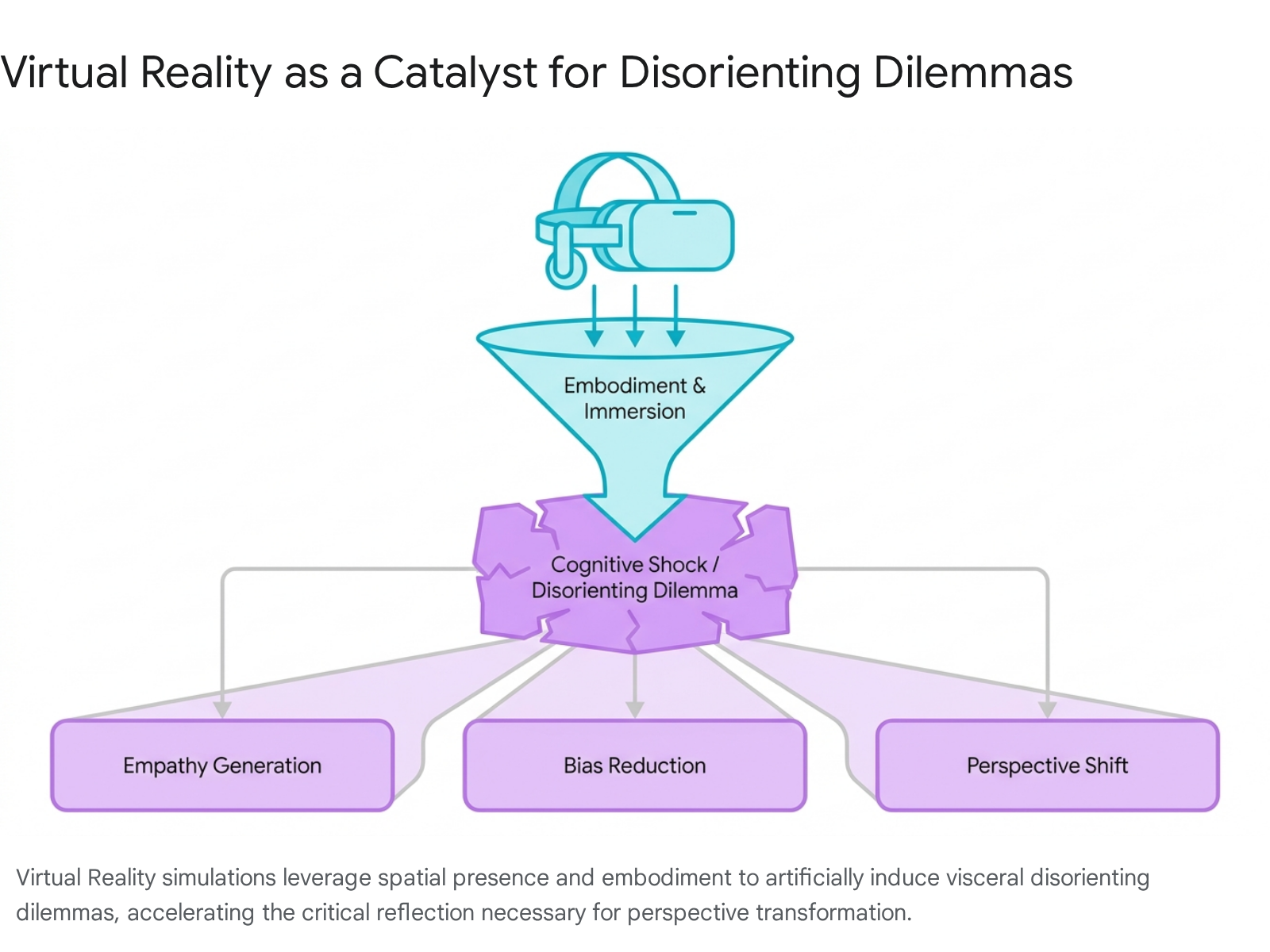
Empirical research demonstrates that such VR interventions significantly enhance empathy, measurably reduce implicit racial bias, and prompt individuals to critically assess their communicative behaviors and leadership styles 38.
Furthermore, VR is utilized to enhance spatial cognition and complex decision-making by forcing users to rapidly shift visual perspectives. Training systems in sports and high-stress corporate environments use head-mounted displays to train individuals to switch seamlessly from a restricted first-person view to a comprehensive bird's-eye view 40. This serves as both a literal and metaphorical exercise in perspective-taking, systematically breaking down cognitive rigidity and expanding the user's capacity to process complex, multi-variable environments 40.
Evaluating and Measuring Transformational Outcomes
Because transformative learning fundamentally alters internal meaning perspectives and cognitive frameworks, its outcomes are notoriously difficult to quantify using standard corporate metrics like multiple-choice assessments, attendance logs, or short-term ROI calculations 631. Evaluation strategies for transformative initiatives must therefore be sophisticated, longitudinal, and multifaceted.
Organizations must shift from measuring rote knowledge retention to evaluating behavioral application, cognitive complexity, and cultural impact. Effective evaluation in this domain relies on a blend of qualitative insights and strategic quantitative data 31:
- Qualitative Assessment and Thematic Analysis: Evaluators analyze learner reflection logs, focus group discourse, and self-reported changes in perspective. They look for specific linguistic markers indicating a shift from dogmatic certainty to intellectual curiosity, or an explicit acknowledgment of past biases and assumptions 2731.
- Longitudinal 360-Degree Feedback: Behavioral changes are observed by peers and subordinates over extended periods. For example, following a transformative inclusive leadership intervention, organizations assess whether subordinates report a sustained increase in psychological safety, a decrease in meeting interruptions, and improved cross-functional collaboration 15.
- Organizational KPIs: While isolating direct financial ROI to a single transformative learning event is methodologically challenging, organizations can track long-term lagging indicators. These include employee retention rates, the demographic diversity of the leadership succession pipeline, and global employee engagement scores over multi-year horizons following transformational cohort programs 241. Though exact financial figures are rare, specific interventions, such as process refinements resulting from perspective shifts in healthcare administration, have occasionally yielded quantifiable ROI through eliminated waste and enhanced efficiencies 41.
Conclusion
Transformative learning theory, originating from Jack Mezirow's early explorations of adult meaning-making, provides the most robust psychological architecture available for organizations seeking to develop highly adaptable, ethically grounded, and culturally intelligent workforces. As the demands of the global corporate landscape shift irreversibly from the execution of routine, automatable tasks to the navigation of profound complexity and continuous disruption, traditional transactional training models must give way to transformational design.
Achieving this requires a fundamental reimagining of the corporate Learning and Development function. Organizations must move beyond mere regulatory compliance, deliberately designing environments that introduce safe disorienting dilemmas, foster psychological safety for critical discourse, and support learners through the inevitable discomfort of dismantling their deep-seated assumptions. By integrating the ten phases of perspective transformation into global leadership curricula, DEI initiatives, and technology-mediated immersive simulations, organizations can move past superficial behavioral modification. Ultimately, facilitating true perspective transformation allows corporations to unlock profound human potential, cultivating leaders who do not just react defensively to change, but who possess the self-authoring cognitive complexity to shape the future.