
Retrieval practice and testing effects in corporate training
The Current Paradigm of Corporate Training
The foundational objective of corporate training and learning and development (L&D) programs is the durable acquisition and transfer of knowledge to improve workforce performance. However, a significant gap exists between the delivery of instructional content and the actual retention of that information. In many organizations, corporate training is fundamentally structured around compliance and completion metrics rather than cognitive retention 12. Employees are frequently subjected to intensive, massed training sessions - often utilizing slide decks, lengthy videos, or dense manuals - and are subsequently evaluated through immediate, low-stakes recognition quizzes. Once the assessment is passed, the training is considered complete 12.
This dominant paradigm relies heavily on passive learning strategies, primarily reviewing, re-reading, and re-watching material. While passive exposure allows organizations to track completion rates and ensure regulatory compliance in the short term, it fails to align with the biological and psychological realities of adult cognition 4. Data indicates a structural disconnect in the industry: a 2024 report by the Association for Talent Development (ATD), which surveyed 340 talent development professionals, revealed that while 87% of professionals recognize spaced practice as effective, only 52% consistently integrate it into their learning design 3. Similarly, while 89% acknowledge the effectiveness of elaborative strategies, only 58% utilize them regularly 3.
This disconnect results in training programs that produce a high initial success rate on immediate assessments but suffer from catastrophic knowledge decay in the subsequent weeks and months 1. The failure of these programs often becomes visible only when employees are required to apply the knowledge on the job, leading to compliance breaches, operational inefficiencies, and the need for redundant remedial training 16. To counter this, cognitive science offers a robust body of evidence supporting retrieval practice - the act of actively recalling information from memory - as a superior alternative to passive review.
Cognitive Mechanics of Memory Decay
To understand why passive review fails to produce durable learning, it is necessary to examine the foundational mechanics of memory decay, which were first quantified in the late 19th century and remain a cornerstone of modern cognitive psychology.
In 1885, German psychologist Hermann Ebbinghaus published Über das Gedächtnis, detailing the first experimental study of memory and introducing the "forgetting curve" 45. By utilizing lists of nonsense syllables (consonant-vowel-consonant combinations with no prior meaning) to eliminate the variables of familiarity and prior knowledge, Ebbinghaus measured the exact rate at which newly acquired information decays when no effort is made to actively retain it 46.
The data from these experiments demonstrated that memory loss is not linear; rather, it is an exponential decay that occurs most rapidly immediately following initial exposure. Modern replications of this study confirm that the human brain naturally filters out unreviewed information to prevent cognitive overload 67.
| Time Elapsed Since Initial Learning | Average Percentage of Information Forgotten | Average Percentage of Information Retained |
|---|---|---|
| 20 Minutes | 42% | 58% |
| 1 Hour | 56% | 44% |
| 9 Hours | 64% | 36% |
| 24 Hours | 67% - 70% | 30% - 33% |
| 6 Days | 75% | 25% |
| 31 Days | 79% | 21% |
Data representing the baseline decay of knowledge without the intervention of retrieval practice or spaced repetition 56.
These findings highlight the inherent flaw in traditional corporate training architectures. If an employee attends a day-long seminar or completes a mandatory e-learning module but does not actively engage with the material afterward, approximately 70% of the organizational investment in that training event evaporates within 24 hours 5118.
The Fluency Illusion and Passive Review
The persistence of the review-and-re-read approach in corporate settings is largely driven by a psychological phenomenon known as the "fluency illusion" or the "illusion of competence" 139. When learners repeatedly read a text, review a slide deck, or highlight a manual, the information becomes highly familiar. The brain processes this familiar information with increasing ease, which cognitive scientists refer to as perceptual fluency 1315.
Learners conflate this feeling of familiarity with actual mastery. Because the text looks recognizable on the page, the individual assumes the information is securely encoded and will be easily retrievable during an application scenario 1310. However, recognizing information that is physically present in the environment relies on entirely different neurological mechanisms than summoning information from long-term memory without external cues 910.
This illusion creates a false sense of confidence 19. When training programs rely on passive review, employees often evaluate their own knowledge inaccurately, believing they are fully prepared for the job floor. It is only when confronted with a novel problem requiring the unprompted recall of that knowledge that the illusion shatters, revealing a fundamental lack of retention 1. Passive activities simply move information through short-term working memory without requiring the cognitive effort needed to create lasting structural changes in the brain 910.
Theoretical Foundations of Retrieval Practice
Retrieval practice, frequently referred to in cognitive psychology as the "testing effect," directly counters the fluency illusion. It is the active process of forcing the brain to search for, reconstruct, and reorganize knowledge from memory without referring to the original source material 1510.
Extensive research, including meta-analyses encompassing hundreds of studies across laboratory and applied classroom settings, demonstrates that retrieval practice produces significantly stronger and more durable learning than passive review 19. A comprehensive meta-analysis of the testing effect reported a reliable medium effect size (g = 0.50) for testing over restudying, as well as a medium effect size (d = 0.40) when examining the transfer of test-enhanced learning to new contexts 11.
The superiority of retrieval practice extends beyond mere comparison with re-reading. Research comparing retrieval practice to other active study techniques, such as concept mapping, further solidifies its efficacy. In one study, students who utilized retrieval practice outperformed those who created node-and-link concept diagrams by 25% on a long-term recall test 18. Concept mapping often primes learners to process information relationally by looking back at the text, which inadvertently mimics the low-utility strategy of re-reading, whereas retrieval forces independent neurological reconstruction 18.
In direct quantitative comparisons, learners utilizing active recall strategies score approximately 20% higher on assessments while simultaneously reducing their total study time by roughly 30% 19. Conversely, passive review methods typically yield long-term retention rates near 20% while consuming up to 50% more time 19.
Desirable Difficulties
The effectiveness of retrieval practice is theoretically grounded in Robert and Elizabeth Bjork's concept of "desirable difficulties" 121314. Introduced in the 1990s, this framework posits that learning conditions which make performance improve rapidly during instruction - such as massed practice, predictable sequencing, and passive reading - often fail to support long-term retention and transfer of skills 13.
Conversely, introducing intentional friction or difficulty into the learning process enhances long-term encoding. A difficulty is considered "desirable" if it triggers the necessary encoding and retrieval processes that support comprehension, provided the learner has the requisite foundational knowledge to succeed 1415. Retrieval practice acts as a primary desirable difficulty because it is inherently more effortful and less comfortable than re-reading 1. The mental struggle to pull information into conscious thought is precisely the mechanism that modifies and strengthens the memory trace, making the information more resilient to interference and slowing the rate of subsequent forgetting 1024.
| Feature | Passive Review (Re-reading/Highlighting) | Active Retrieval Practice |
|---|---|---|
| Cognitive Mechanism | Relies on recognition and short-term working memory. | Forces reconstruction and deeper neural encoding. |
| Learner Perception | High initial confidence due to the "fluency illusion." | Lower initial confidence; effortful and mentally taxing. |
| Memory Modification | Weak memory trace; highly susceptible to rapid decay. | Strengthens memory trace; flattens the forgetting curve. |
| Time Efficiency | Requires up to 50% more study time for poor yields 19. | Highly efficient; shorter, targeted sessions yield higher retention. |
| Knowledge Assessment | Hides knowledge gaps until a real-world failure occurs. | Immediately exposes knowledge gaps, allowing for targeted restudy. |
| Long-Term Retention | Generally yields ~20% retention over time 19. | Can yield up to 80% retention with repeated spacing 1924. |
The Initial Performance Dip
A significant barrier to implementing desirable difficulties in corporate settings is the phenomenon of the "initial performance dip" 1626. Because retrieval practice, spacing, and interleaving demand higher cognitive load and ruthlessly expose knowledge gaps, learners' immediate performance during the training phase often drops compared to those using passive methods 16.
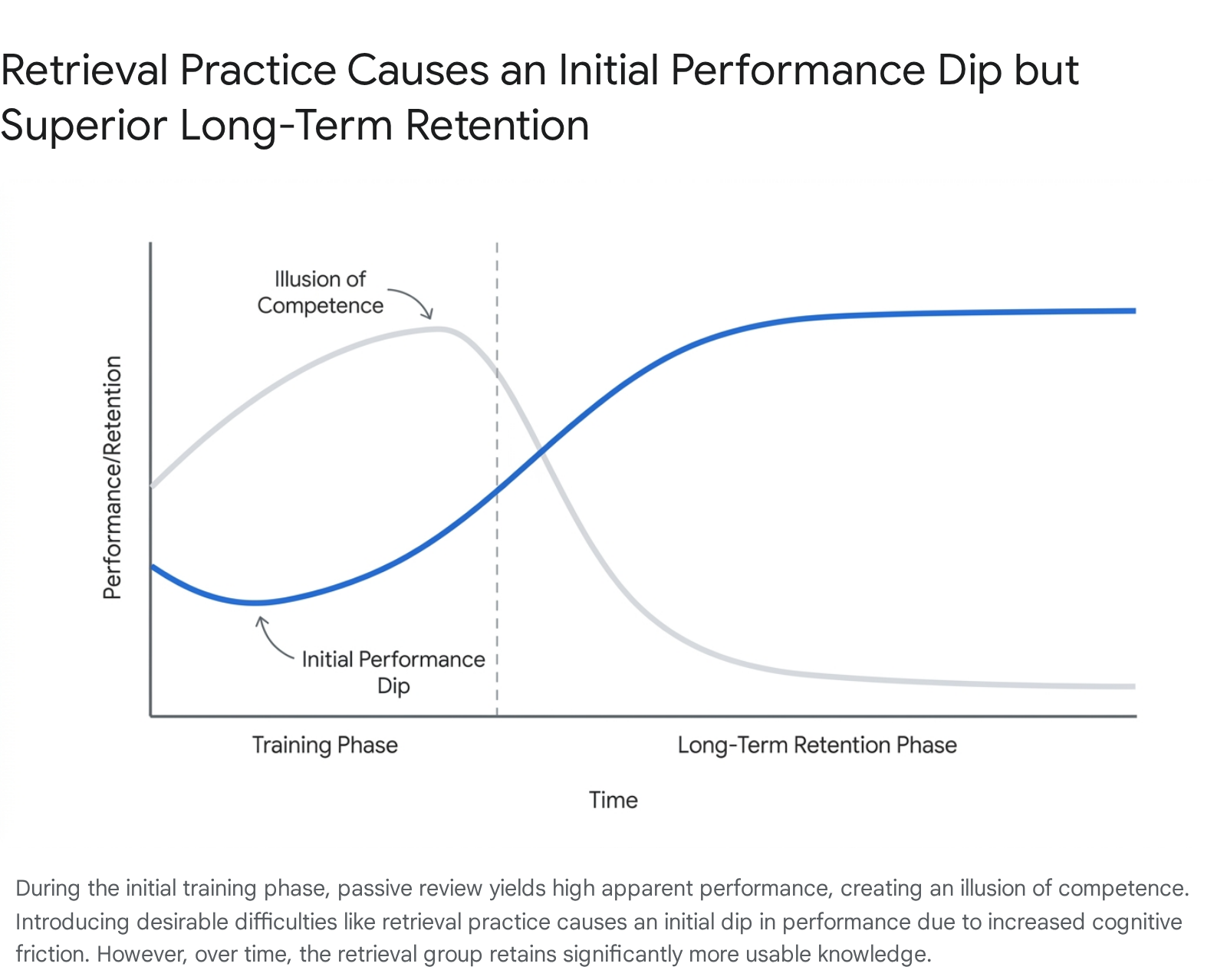
This dip can generate intense resistance from both employees and management. Employees may feel frustrated, interpreting the difficulty as a personal failure or poor instructional design, leading to complaints that the training is "too hard" or requests to just "re-read the slides" 116. Management, viewing traditional dashboard metrics, may mistakenly interpret lower initial quiz scores during the training phase as a failure of the L&D program 126.
Overcoming this organizational friction requires reframing the struggle not as a failure, but as a necessary cognitive workout. Stakeholders must be educated that productive struggle is the exact mechanism of true learning, and that short-term friction prevents long-term knowledge loss 116.
Operationalizing Spaced and Interleaved Practice
Retrieval practice does not exist in a vacuum; it is exponentially more effective when combined with specific scheduling architectures, namely spaced repetition and interleaving.
Spaced Repetition Architecture
Spaced repetition involves separating retrieval attempts by increasingly longer intervals of time 2728. Rather than massing practice into a single block, learning is distributed. A common and highly effective starting point for spaced retrieval is the 1-3-7-14 model, wherein a learner reviews new information one day after initial exposure, then three days later, then seven days, and finally fourteen days later 7.
By spacing out the retrieval, the information is allowed to partially decay in the learner's memory 1515. When the learner attempts to retrieve the information just as it is on the verge of being forgotten, the retrieval requires maximum effort. This biological reality ensures that each successful retrieval sends a strong signal to the brain to prioritize that specific neural pathway, progressively resetting the Ebbinghaus forgetting curve to a higher baseline and a shallower trajectory of decay 515.
The Role of Interleaving
Another critical desirable difficulty is interleaving, which contrasts with the standard corporate practice of block training (e.g., teaching one concept or process completely before moving to the next) 1217. Interleaving involves mixing different, but related, topics or skills during practice sessions 28.
This forces the learner's brain to constantly compare and contrast concepts, working harder to identify the underlying rules and select the appropriate strategy for each specific problem 28. While interleaving exacerbates the initial performance dip by preventing the brain from operating on autopilot, it leads to more robust, flexible knowledge 1628. This flexibility is essential for the transfer of training to real-world workplace scenarios, where operational problems do not arrive neatly categorized with helpful labels indicating which training module to apply 11214.
Implementation Limits and Boundary Conditions
While the testing effect is a robust psychological phenomenon, it is not universally applicable without strategic calibration. Cognitive science research points to several "boundary conditions" where the effectiveness of retrieval practice requires careful instructional design.
Narrow Versus Broad Transfer
Research by cognitive scientists indicates that retrieval practice often has a "narrow" rather than a "broad" effect. Retrieval reliably strengthens the specific memory trace of the precise information recalled, but it does not reliably guarantee the consolidation of related, un-retrieved concepts residing within that same memory network 18.
For corporate instructional designers, this implies that practice questions must be highly targeted and meticulously aligned with business objectives. If an organization requires employees to remember specific compliance protocols or safety procedures, they must test those exact protocols 18. Providing tangentially related questions will not generate the necessary transfer of knowledge, emphasizing the need for precision in assessment design 1918.
Foundational Knowledge Requirements
Desirable difficulties are only desirable if the learner possesses the foundational schema to engage with them. If a learner lacks basic background knowledge, a retrieval attempt becomes an "undesirable difficulty," leading to cognitive overload, frustration, and a complete cessation of learning 1415.
Cognitive researchers stress that retrieval practice must be preceded by effective direct instruction or scaffolding 1215. In a corporate setting, worked examples should be utilized for novices facing novel material to reduce extraneous cognitive load and build initial mental schemas. Once the schema is established, retrieval practice should immediately be introduced to cement those schemas into long-term memory 114.
Furthermore, research suggests that on highly difficult items, learners with lower fluid intelligence or lower mastery orientation may struggle more with retrieval practice and might occasionally benefit more from direct review 1118. Consequently, instructional designers should monitor success rates closely. A target success rate of 60% to 75% on retrieval activities is often recommended to ensure the difficulty remains productive 1. Immediate, corrective feedback following a retrieval attempt is also vital to prevent the consolidation of incorrect information and to guide subsequent restudy 1931.
Instructional Design Costs and Return on Investment
The transition from passive content delivery to retrieval-based learning introduces distinct economic and operational challenges for L&D departments, primarily concerning instructional design costs, authoring time, and technological infrastructure.
The Cost of Authoring Quality Assessment
Designing effective retrieval practice is fundamentally more resource-intensive than creating passive review materials. While a subject matter expert (SME) can rapidly generate a slide deck or write a procedural manual, authoring high-quality, targeted multiple-choice or short-answer questions requires dedicated instructional design expertise 3233. Crafting plausible distractors (incorrect options) that expose specific misconceptions and simulate real-world decision-making is a time-consuming process that scales poorly under traditional development models 32.
In complex fields such as medical education and technical training, systematic reviews indicate that technology-enhanced simulation and active retrieval methods often carry higher upfront costs than traditional didactics. A comprehensive review of simulation-based medical education found that while these methods yield moderate to large positive effects on skill and knowledge acquisition (with process measures of behavior showing an effect size of 0.77), they are generally more expensive to develop and deploy 3435.
Long-Term Return on Investment (ROI)
Despite the higher initial authoring and implementation costs, the long-term ROI of retrieval practice is driven by the reduction in knowledge decay, lower error rates on the job, and the elimination of redundant "refresher" training 12. When knowledge fades quickly due to passive review, operational performance suffers, software adoption stalls, and the initial training investment is effectively lost 8.
Case studies demonstrate the tangible business impact of mitigating this decay. In a detailed analysis of a contact center system migration, the integration of targeted retrieval practice, microlearning, and performance support tools resulted in significant operational improvements. Despite an initial performance dip as agents adapted to the new cognitive demands, the organization ultimately achieved a 23% reduction in average handle time (AHT) and a 17% improvement in first-call resolution (FCR) 6. The project realized annualized cost savings of approximately $2.4 million and achieved a payback period of just 16 months, outperforming the industry average of 22 to 24 months 6.
Technological Automation and Artificial Intelligence
The most significant operational barriers to implementing retrieval practice and spaced repetition have historically been the logistical complexity of scheduling individualized review intervals and the labor-intensive nature of authoring sufficient question banks. Recent advancements in Artificial Intelligence (AI) and enterprise Spaced Repetition Systems (SRS) have largely mitigated these bottlenecks.
Algorithmic Spaced Repetition Platforms
Enterprise platforms (such as SC Training, RapL, and Memrise) now utilize algorithms to automatically track individual learner performance and calculate the optimal time to re-introduce a concept 3619. These systems trigger a micro-assessment precisely when the algorithmic model dictates the memory is about to fade, shifting the burden of scheduling from the instructor to the software 3619. For instance, a platform can seamlessly convert a completed training module into a series of daily, low-stakes quizzes delivered via mobile devices, ensuring continuous retrieval without disrupting workflow 19.
Generative AI and Content Authoring
Generative AI and Retrieval-Augmented Generation (RAG) are actively transforming the content authoring process. AI tools can ingest corporate manuals, lecture transcripts, and slide decks, instantly generating banks of practice questions, flashcards, and scenario-based micro-assessments 383940.
This automation reduces the authoring time for a quiz bank from several hours to minutes 40. Furthermore, AI agents can unify fragmented organizational knowledge, allowing employees to query internal databases and receive source-linked answers, effectively cutting search time by up to 50% and accelerating new-hire onboarding by 40% 20.
However, instructional designers emphasize a critical "human-in-the-loop" necessity. AI-generated drafts are rarely final; they require expert review to refine wording, validate answer keys, remove weak distractors, and adjust difficulty levels 3942. The value of AI in this context is the acceleration of the first draft, allowing instructional designers to focus their time on pedagogical refinement rather than blank-page generation 3942.
Global Adaptations and Cultural Dimensions
As multinational corporations deploy retrieval-based training programs across a global workforce, instructional designers must account for deep-seated cultural differences in learning preferences, power dynamics, and communication styles. A globally standardized training strategy that ignores these factors risks alienating learners and diminishing the efficacy of the program 2122.
Individualism Versus Collectivism in Learning
Cultural backgrounds significantly impact how employees process information and relate to educational environments 23. Western HR models and educational paradigms often operate on assumptions of individualism, where employees are encouraged to speak up, challenge instructors, and engage in self-directed, competitive learning 4624.
Conversely, in many Asian, Middle Eastern, and Latin American cultures - which often lean toward collectivism - group harmony, mentorship, and peer collaboration are prioritized 4624. In these contexts, forcing highly individualized, competitive retrieval practice without a collaborative framework may induce anxiety and resistance. Group discussions and team-based retrieval exercises (such as peer teach-backs) can be far more effective in collectivist cultures, aligning the cognitive benefits of recall with cultural expectations of collaboration 2446.
Power Distance and the Perception of Testing
Power distance - the extent to which less powerful members of organizations expect and accept that power is distributed unequally - also radically alters the reception of retrieval practice. In Western cultures with flatter hierarchies, a quiz is often viewed merely as a tool for personal assessment and growth 24. In high power-distance cultures, hierarchy is deeply respected, titles signal responsibility, and public failure carries significant social risk 24.
When learners from high power-distance cultures are presented with frequent, difficult retrieval practice that exposes knowledge gaps (the aforementioned "initial performance dip"), they may feel exposed or perceive the assessment as a punitive evaluation from management 2425. Quiet or reserved behavior during training might be misinterpreted by Western trainers as a lack of understanding or engagement, when it is actually a cultural norm of deference to the instructor 25.
To implement retrieval practice successfully in these environments, L&D leaders must heavily emphasize "low-stakes" environments, normalizing errors as a standard, expected part of the learning process. It is critical to ensure that retrieval data is strictly divorced from formal performance evaluations, and feedback must be provided privately and constructively to avoid any loss of social face 3124.
| Cultural Dimension | Western (Low Power Distance / Individualistic) | Eastern/Hierarchical (High Power Distance / Collectivist) | Instructional Adaptation for Retrieval Practice |
|---|---|---|---|
| Learner Dynamics | Self-directed, competitive, comfortable challenging authority 4624. | Group-oriented, deferential to authority, prioritizes harmony 4624. | Blend individual self-testing with collaborative, peer-based teach-backs to respect group harmony. |
| View of Failure | Seen as a stepping stone; "fail fast" mentality is generally accepted. | High social risk; public failure can result in loss of face or perceived disrespect 24. | Keep retrieval strictly low-stakes. Provide private, immediate, and constructive feedback rather than public leaderboards. |
| Instructor Relationship | Facilitator or guide; open to questioning and debate. | Respected authority figure; direct questioning may be seen as disrespectful 25. | Instructors must proactively reframe retrieval exercises as a learning tool, not a formal evaluation of the employee's worth. |
| Training Structure | Prefers flexible, flat, and individualized learning paths. | Prefers structured, clear expectations with defined roles and parameters 24. | Provide clear scaffolding and rationale for why the "desirable difficulty" is being introduced before testing begins. |
Strategic Implications for Organizational Learning
The reliance on review-and-re-read strategies in corporate training represents a structural inefficiency. While passive methods generate the illusion of competence and satisfy immediate compliance metrics, they succumb rapidly to the Ebbinghaus forgetting curve, rendering much of the training investment void within weeks.
The integration of retrieval practice, underpinned by the concept of desirable difficulties, forces a paradigm shift from content exposure to cognitive mastery. By demanding the active reconstruction of knowledge, retrieval practice strengthens neural pathways, increases resilience to interference, and substantially flattens the rate of knowledge decay.
Transitioning to this model requires organizations to navigate several practical hurdles. Stakeholders must be educated to accept the initial performance dip, understanding that increased effort and lower scores during the training phase yield superior long-term results and operational ROI. Instructional designers must account for the boundary conditions of retrieval, ensuring that foundational knowledge is established before testing begins and that questions are precisely targeted to the desired business outcomes.
Furthermore, the global deployment of these strategies demands high cultural intelligence. While the cognitive mechanics of memory and retrieval are universal, the pedagogical delivery - navigating power distance, feedback mechanisms, and individual versus collective learning preferences - must be carefully localized. Ultimately, the combination of cognitive science with modern, AI-driven spaced repetition systems provides the enterprise with a highly scalable mechanism to transform transient training events into durable, operational competencies.