
Microlearning and adult attention in the workplace
Introduction to the Modern Corporate Learning Ecosystem
The corporate learning and development (L&D) landscape is undergoing a profound structural shift driven by technological acceleration, shrinking half-lives of technical skills, and evolving workforce demographics. Traditional training models, rooted in an industrial-era paradigm of separated work and learning, are increasingly failing to meet the demands of dynamic business environments. In 2023 and 2024, research indicated that L&D teams faced mounting pressures to align their strategies with agile business objectives while managing constrained resources and increased workloads. According to the Chartered Institute of Personnel and Development (CIPD), 53% of L&D professionals reported increased team workloads, despite concurrent pressures to address widening skills gaps across the workforce 12.
Simultaneously, the financial and temporal realities of workplace training have reached a critical inflection point. The Association for Talent Development (ATD) 2024 State of the Industry report revealed that while average organizational spending on workplace learning increased to $1,283 per employee, the average number of formal learning hours per employee declined steeply from 17.4 hours in 2022 to 13.7 hours in 2023 24. This inverse relationship highlights a systemic challenge: employers are investing more capital into training, but employees have less time to consume it. Research indicates that the average knowledge worker has approximately 1% of their workweek - roughly 24 minutes - to dedicate to formal professional development 364.
The conventional "destination learning" model, which requires employees to exit their daily workflow, log into a Learning Management System (LMS), and consume long-form content, is structurally incompatible with this scarcity of time 35. Consequently, traditional e-learning courses suffer from severe engagement deficits, with completion rates frequently hovering between 15% and 30% 678. This systemic inefficiency contributes to an estimated $360 billion wasted annually on corporate training that is never completed or applied 6.
In response to these inefficiencies, microlearning has emerged as a primary pedagogical strategy. Microlearning delivers training in focused, bite-sized modules - typically ranging from two to ten minutes - each designed to address a single learning objective 6129. Its adoption has surged; a 2025 ATD report found that two-thirds of surveyed organizations now utilize microlearning, representing a 28% increase over previous tracking periods 1011. By aligning instructional delivery with the cognitive limits of adult attention and embedding learning directly into the flow of daily tasks, microlearning offers a data-backed methodology to enhance retention, lower development costs, and drive continuous performance improvement.
Cognitive Architecture and Adult Attention
To understand the efficacy of short-form content, it is necessary to examine the neurological and psychological mechanisms governing adult attention, memory consolidation, and cognitive processing. The success of microlearning is deeply rooted in established frameworks of cognitive psychology, specifically concerning how the human brain processes, sustains focus on, and stores new information.
The Neurobiology of Sustained Attention
Sustained attention, or vigilance, is the neurological capacity to maintain focus on a stimulus over an extended period. Cognitive psychology research consistently demonstrates that human attention is not constant; it fluctuates from moment to moment and degrades predictably over time 12. This phenomenon, known as the "vigilance decrement," was first systematically studied by Norman Mackworth in 1948 using a clock test, which required observers to watch a clock hand making regular movements and detect occasional double-jumps. Performance declined significantly over a two-hour period, with the sharpest decline occurring within the first 15 to 30 minutes 13.
Modern neuroimaging and behavioral studies corroborate these historical findings. Maintaining attention relies on a right-lateralized frontoparietal network. The right prefrontal cortex is responsible for maintaining task sets, the anterior cingulate cortex handles conflict monitoring, and the locus coeruleus regulates arousal via the noradrenergic system 13. The Default Mode Network (DMN), a network active during mind-wandering and self-referential thought, must be deactivated for sustained external focus 13. However, the brain struggles to suppress the DMN indefinitely. A comprehensive meta-analysis published in the Psychological Bulletin, encompassing over 10,000 participants across 68 studies, confirmed that mind-wandering increases significantly as task duration extends, with participants losing focus at least half the time toward the end of prolonged tasks, regardless of how inherently engaging the task might be 14.
Furthermore, sustained attention performance follows an inverted-U relationship with arousal, consistent with the Yerkes-Dodson law. Optimal performance requires moderate arousal levels. Excessively long, passive tasks - such as a 60-minute e-learning lecture - induce hypoarousal, exacerbating the vigilance decrement 13. Microlearning inherently bypasses this neurological limitation by capping instructional duration at two to ten minutes 12. This duration fits perfectly within the peak window of sustained attention, allowing adult learners to process information fully before the neurological mechanisms of mind-wandering and cognitive fatigue intervene.
Cognitive Load Theory
Cognitive Load Theory (CLT), originally developed by John Sweller in the late 1980s, posits that the human working memory has a strictly limited capacity for processing new information at any given time 1516. When individuals are subjected to rapid, voluminous, or highly complex information without adequate processing time, their cognitive resources are depleted, resulting in cognitive overload and a failure to transfer information to long-term memory 1718.
CLT categorizes cognitive load into three distinct types. Intrinsic cognitive load represents the inherent difficulty of the subject matter, which remains relatively fixed depending on the learner's prior knowledge 1519. Extraneous cognitive load is the mental effort generated by the manner in which information is presented, such as poor instructional design, confusing user interfaces, or distracting multimedia elements 1519. Germane cognitive load is the productive mental effort dedicated to processing information, constructing schemas, and automating cognitive pathways (the actual learning process) 1519.
Microlearning operates effectively by structurally optimizing these cognitive loads 1620. By isolating a single learning objective per module, microlearning restricts the intrinsic load to a manageable level. Furthermore, well-designed microlearning eliminates unnecessary multimedia and tangential information, thereby minimizing extraneous load 25. This optimization frees the learner's working memory to maximize germane load, focusing entirely on schema construction and the immediate internalization of the specific concept 151920. Empirical surveys of microlearning participants in higher education and corporate sectors have demonstrated that these modules effectively reduce intrinsic and extraneous load while enhancing germane load, leading to superior immediate retention compared to traditional lectures 1620.
Memory Consolidation and Instructional Design
While sustained attention dictates how long a learner can focus, memory consolidation dictates how much of that focus translates into permanent capability. The design of microlearning aligns precisely with the psychological mechanisms required to move information from short-term to long-term memory.
The Forgetting Curve and Spaced Repetition
A critical cognitive principle supporting microlearning is the spacing effect. In 1885, German psychologist Hermann Ebbinghaus discovered the "forgetting curve," demonstrating that humans forget approximately 50% of newly acquired information within an hour, and up to 90% within a week if the information is not actively reviewed 21.
Traditional corporate training relies heavily on "massed practice" (often referred to colloquially as cramming), where vast amounts of information are delivered in a single, intensive session 2122. Over 140 years of cognitive science research proves that massed practice is highly inefficient for long-term retention 21. Conversely, "distributed practice" or spaced repetition - reviewing information at strategically increasing intervals - forces the brain to strengthen memory retrieval pathways, effectively flattening the forgetting curve 2123.
A 2021 meta-analysis of 242 studies involving over 169,000 participants confirmed that distributed practice is one of the highest-utility learning strategies available 21. Empirical data shows that spaced repetition improves long-term retention by 200% to 300% compared to massed practice 212329. In clinical studies of medical students learning anatomy, those utilizing spaced repetition schedules retained 87% of terms after six months, whereas the massed practice group retained only 24% after the same period, despite studying for the same total amount of time 23.
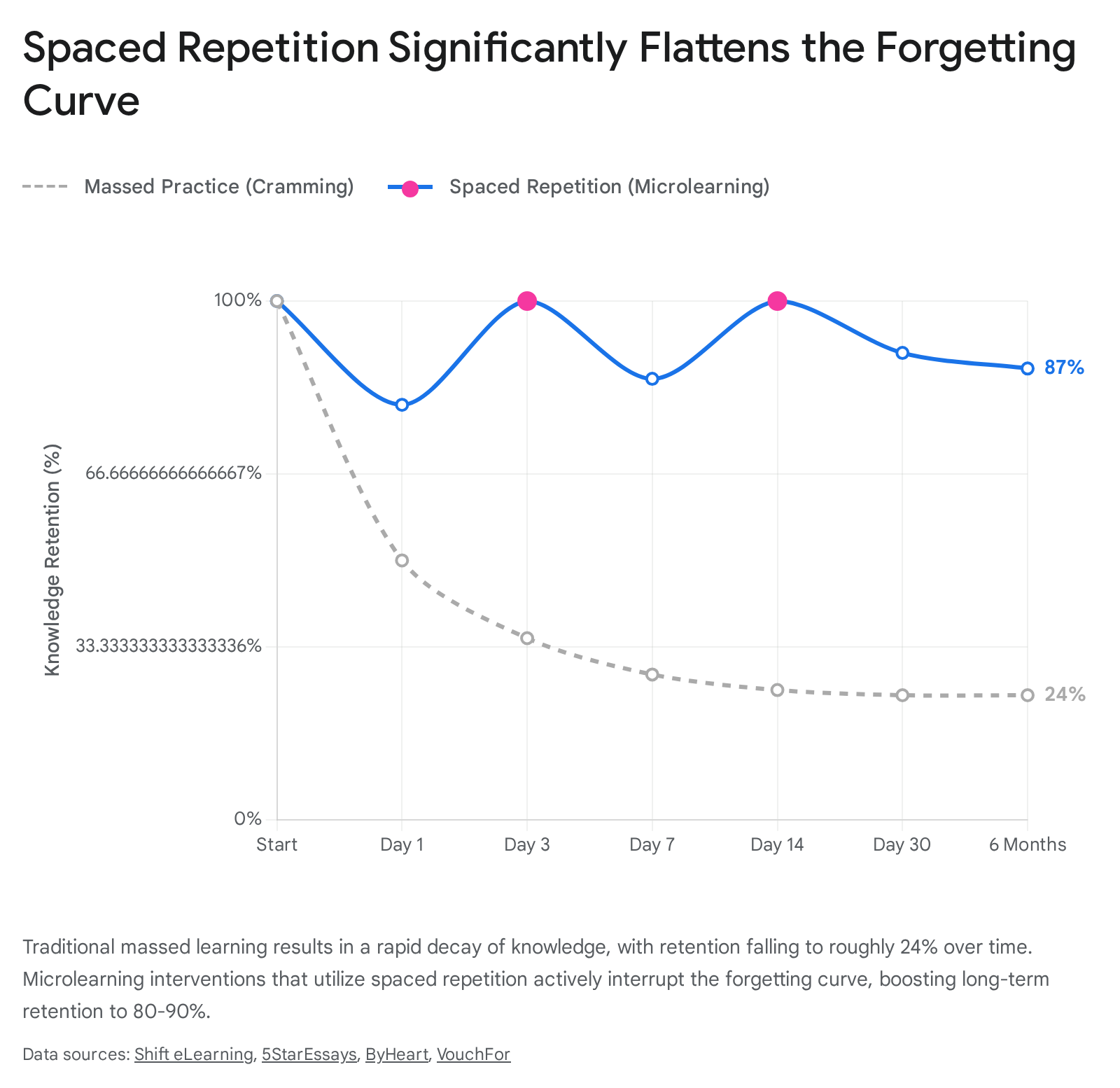
Because microlearning breaks content into small, modular units, it serves as the ideal delivery vehicle for spaced repetition, allowing organizations to push brief reinforcement exercises in the days and weeks following initial skill acquisition without disrupting daily workflows 3830.
Active Retrieval and Metacognitive Regulation
Beyond timing, the nature of the interaction during study sessions is paramount. Spaced practice is heavily augmented by the "testing effect," or active retrieval practice 21. Research by Roediger and Karpicke indicates that actively testing oneself on material produces better long-term retention than additional passive study time 21. Microlearning frequently incorporates active retrieval through brief quizzes, interactive scenarios, and gamified assessments immediately following the delivery of content.
This active engagement not only solidifies memory pathways but also enhances metacognitive regulation - the learner's awareness of their own understanding. In a quasi-experimental study of university students, those exposed to a 12-week microlearning intervention demonstrated a dramatic, statistically significant increase in metacognitive awareness and immediate retention compared to a control group utilizing traditional lecture-based classes (with a large effect size of Cohen's d = 0.98) 2425. By forcing the brain to recall information frequently, microlearning transforms passive consumers of information into active participants in skill acquisition.
Integration into Workplace Realities
The cognitive benefits of microlearning are fully realized when the modality is seamlessly integrated into the operational environment. This structural integration is conceptualized as "Learning in the Flow of Work" (LIFOW), a paradigm that bridges the gap between knowledge acquisition and its immediate application.
Learning in the Flow of Work (LIFOW)
Traditional instructional approaches that isolate learning into formal events create artificial barriers, resulting in low transfer rates and limited behavioral change 26. The longer the temporal gap between learning a concept and applying it, the more information is degraded by the forgetting curve. As documented in adult education research, providing comprehensive training long before the knowledge is required is highly inefficient; knowledge that has no immediate practical use rarely sticks 27.
LIFOW resolves this inefficiency by delivering microlearning assets precisely at the point of need. This approach proves exceptionally effective for procedural and task-level knowledge - such as adopting a new software tool, executing a defined compliance process, or navigating a specific customer service scenario 2728. By embedding learning within the workflow, organizations reduce the cognitive friction required to find answers. Employees are less likely to stall on tasks, less likely to interrupt colleagues unnecessarily, and more likely to resolve problems independently 27. Organizations that implement robust flow-of-work learning cultures are reported to adapt to market changes five times faster, demonstrate 92% higher innovation rates, and achieve a 58% faster rate of skill acquisition 26.
Collaboration Tools and Mobile Delivery
The proliferation of digital enterprise communication platforms has provided the necessary technological infrastructure to execute LIFOW at scale. In the contemporary workplace, knowledge workers are frequently overwhelmed, dividing their attention between email, project management software, and instant messaging platforms like Slack and Microsoft Teams 3. Rather than forcing employees to navigate away from these tools to access a separate, often clunky LMS portal, modern microlearning strategies deliver content directly into these familiar channels 29.
For frontline and deskless workers - populations that often lack dedicated corporate email accounts or desktop computers - mobile-first microlearning is particularly transformative 2937. By leveraging platforms like WhatsApp or proprietary mobile applications, organizations remove the friction of separate logins and allow employees to access training asynchronously 29. Delivering two-minute videos or interactive flashcards directly into a mobile chat interface transforms learning from a mandatory administrative chore into a highly accessible, just-in-time support mechanism 62729.
The Crucial Role of Managerial Support
While technology enables the delivery of microlearning, organizational psychology dictates that human leadership drives its adoption and cultural integration. Research on learning transfer consistently demonstrates that direct manager behavior is the strongest predictor of whether new knowledge alters actual workplace behavior 27.
The efficacy of microlearning is amplified when managers actively cultivate a culture of continuous learning 3031. When direct supervisors refer team members to contextual micro-resources, create psychological safety for employees to search for information rather than simply asking for it, and treat the pursuit of guidance as a sign of initiative rather than a competency gap, the adoption of microlearning rises significantly and sustains over time 2627. Furthermore, incorporating learning objectives into continuous performance management processes validates the time employees spend engaging with micro-content, aligning individual development directly with organizational goals 31.
Economic Impact and Performance Metrics
The strategic shift toward microlearning is heavily supported by quantitative improvements in organizational metrics. When compared head-to-head with traditional macro-learning methodologies, microlearning demonstrates superior outcomes across engagement, long-term retention, and financial efficiency.
Development Speed and Cost-Effectiveness
From a production standpoint, the economics of microlearning are highly favorable to L&D departments grappling with tight budgets and the need for rapid content deployment 13032. The development of traditional, highly interactive e-learning can be prohibitively expensive and time-consuming. According to widely cited industry benchmarks by the Chapman Alliance and researchers Karl Kapp and Robyn Defelice, the creation of a single hour of "Level 1" (basic page-turner) e-learning content requires approximately 79 to 144 hours of instructional design labor, resulting in development costs ranging from $9,360 to over $10,000 per finished hour 33. Highly engaged, interactive courses can cost upward of $35,600 per finished hour 33.
Because of its concise format and narrower scope, microlearning is significantly cheaper and faster to produce. Research indicates that microlearning modules are developed up to 300% faster than traditional e-learning 4323435. Development costs are generally reduced by 50% 683435. This agility is crucial for modern compliance updates, product launches, or enterprise software rollouts (such as SAP or Oracle implementations), where information must be distributed immediately and updated frequently without incurring massive redesign costs 8363738.
Completion Rates and Knowledge Transfer
The most glaring failure of traditional e-learning is its inability to maintain engagement through completion. Long-form courses typically see completion rates hovering between 15% and 30% 367837. Consequently, a massive portion of corporate training budgets is wasted on content that is abandoned midway, yielding zero return on investment.
In stark contrast, microlearning courses consistently achieve completion rates between 70% and 90%, averaging around 80% to 83% 36783237. Because the modules are brief, mobile-friendly, and require low cognitive commitment, employees can easily consume them between meetings, during commutes, or precisely when a knowledge gap is identified 3539. Furthermore, knowledge retention is drastically improved. The combination of focused objectives, reduced cognitive overload, and the facilitation of spaced repetition allows microlearning to improve knowledge transfer and retention by 25% to 60% (and up to 80% in some specific use cases) compared to traditional methods 4683234.
Comparative Analysis of Learning Modalities
The following table synthesizes the empirical differences between traditional e-learning and microlearning formats based on industry consensus data 4678323335:
| Metric | Traditional Macro-Learning | Microlearning |
|---|---|---|
| Average Session Length | 30 - 60+ minutes | 2 - 10 minutes |
| Average Completion Rate | 15% - 30% | 70% - 90% |
| Knowledge Retention Rate | ~25% (Subject to rapid decay) | ~80% (Via spaced repetition) |
| Development Speed | Weeks to Months (79 - 144 hours/unit) | Days (Up to 300% faster) |
| Average Development Cost | $9,000 - $35,000 per course hour | ~50% lower than traditional |
| Primary Device Alignment | Desktop-first | Mobile-first / Omnichannel |
| Underlying Cognitive Approach | Massed Practice (Cramming) | Spaced Repetition / Retrieval |
Artificial Intelligence in Personalized Microlearning
The efficacy of microlearning is currently being augmented by rapid advancements in Artificial Intelligence (AI). While microlearning provides the optimal format for human attention, AI provides the optimal context, shifting the paradigm from static, monolithic training catalogs to hyper-personalized, dynamic learning pathways. As of 2024, approximately 40% of surveyed L&D organizations were already utilizing AI in learning, with another 36% actively planning implementation 4.
Adaptive Learning Pathways
Historically, corporate training has relied on a uniform approach, pushing identical compliance modules or skills training to a diverse workforce regardless of baseline competency 404142. This model inherently violates Cognitive Load Theory; it forces subject-matter experts to suffer redundant instruction (wasting time and reducing engagement) and forces novices to suffer cognitive overload by progressing too quickly 19.
AI-driven adaptive learning systems resolve this inefficiency by analyzing an individual's performance data, job role, historical learning behaviors, and real-time assessment results to dynamically adjust the difficulty and pacing of microlearning content 40414243. Sophisticated algorithms, utilizing machine learning and deep learning models, can accurately predict student engagement and identify precise skill gaps 4445. If a learner demonstrates mastery of a topic through a quick diagnostic micro-assessment, the AI skips redundant content. Conversely, if a learner struggles, the AI autonomously serves remedial micro-lessons and adjusts the frequency of spaced repetition 40. Research analyzing the Open University Learning Analytics Dataset (OULAD) demonstrated that AI algorithms can predict and react to specific student needs with a fidelity of 98.96% accuracy, 99% precision, and a 99% F1-Score 4446. This level of hyper-personalization significantly boosts engagement and accelerates skill acquisition compared to static curricula 42.
Agentic AI and Real-Time Performance Support
Beyond adaptive curricula, AI is driving the next evolution of learning in the flow of work through Context-Aware Performance Support 3. Agentic AI and intelligent chatbots integrated directly into enterprise platforms can monitor workflow contexts and proactively surface relevant microlearning assets exactly when they are needed 34447.
For example, if a customer service representative is drafting a response regarding a newly released software feature, a background AI agent can instantly sidebar a two-minute microlearning video or a flashcard detailing the exact specifications of that feature 3. This application effectively dissolves the barrier between working and learning, creating an environment of continuous upskilling.
Organizations are also leveraging this technology to train their workforces on AI utilization itself. A 2024 internal study conducted by Slack demonstrated the power of this approach. Slack deployed a three-week curriculum consisting of 10-minute daily generative AI microlearning challenges directly within a moderated Slack channel 4857. Participants engaged in hands-on projects and shared outcomes with peers. The results were highly favorable: participants reported an 87% increase in viewing AI tools as beneficial to their productivity, and the proportion of employees comfortable using AI nearly doubled from 43% to 72% 4857.
Limitations and Hybrid Learning Strategies
Despite its overwhelming statistical advantages in retention, completion, and cost-efficiency, microlearning is not a panacea for all educational requirements. L&D leaders and instructional designers must recognize that modality is not a strategy; the delivery method must follow the specific cognitive requirements of the capability being developed 2849. Utilizing microlearning as a default response for all performance gaps risks resulting in shallow, fragmented learning 1728.
The Cognitive Constraints of Short-Form Content
The primary limitation of microlearning lies in its unsuitability for facilitating deep, complex synthesis 172050. While small, digestible chunks are excellent for procedural tasks, software onboarding, compliance updates, and recalling factual knowledge at the moment of need 62728, they are inherently insufficient for teaching highly intricate concepts that demand deep cognitive engagement, critical analysis, and interwoven, lateral thinking 1750.
Subjects such as advanced engineering, high-level leadership capability, strategic thinking, or complex medical diagnostics require the learner to see the broader picture and understand how disparate, complex variables interact systematically 1292750. Delivering this type of complex subject matter strictly through disconnected micro-bursts risks severe oversimplification. It deprives the learner of the extended reflection, debate, and cognitive dissonance required to create profound paradigm shifts in understanding 1217. Without adequate time to build comprehensive schemas, learners subjected exclusively to microlearning may fail to transfer their knowledge to complex, real-world situations, resulting in a superficial understanding of a topic 121750. Furthermore, microlearning often isolates the learner, reducing the peer-to-peer social learning and collaboration that are crucial for developing soft skills and emotional intelligence 2050.
The Macro-Micro Synergy
To overcome these cognitive limitations, sophisticated instructional designers rely on a blended strategy that synergizes macro-learning (deep dives) with microlearning. A 2020 meta-analysis by the Association for Talent Development noted that relying exclusively on microlearning for complex skills resulted in a 23% lower application rate compared to a blended approach 12. Conversely, relying entirely on extended macro-learning results in high dropout rates and the rapid decay of memory due to the forgetting curve 12.
The optimal learning architecture utilizes macro-learning - such as intensive workshops, comprehensive seminars, detailed scenario simulations, or immersive long-form courses - to establish foundational knowledge, deep contextual understanding, and behavioral paradigm shifts 1249. Once the core capability is established, microlearning is subsequently deployed to reinforce known processes, reduce execution friction, combat the forgetting curve via spaced repetition, and provide just-in-time performance support 1292849.
Regional Frameworks and Policy Adoption
The integration of microlearning and modular education is not limited to internal corporate spheres; it is increasingly being formalized at institutional, governmental, and international policy levels. Variations in regional approaches highlight how different economies are adapting to continuous skills disruption and the need for lifelong learning.
The European Union Micro-Credentials Ecosystem
In Europe, the shift toward modular learning has reached the highest levels of structural policy. Driven by the urgent need for workforce upskilling in the face of green and digital transitions, as well as post-pandemic economic recovery, the Council of the European Union adopted a formal Recommendation on a European approach to micro-credentials for lifelong learning and employability on June 16, 2022 5152535455.
This institutional framework seeks to legitimize and standardize short-form learning across borders, academic institutions, and corporate sectors. A major historical barrier to microlearning has been the lack of a shared definition, perceived quality, and formalized recognition in the labor market 5155. The EU Council's framework establishes standard elements to describe micro-credentials - including the identity of the learner, clearly defined learning outcomes, notional workload (measured in ECTS wherever possible), and rigorous quality assurance standards 52535657.
Crucially, the EU aims to map these micro-credentials to the European Qualifications Framework (EQF). This ensures that short, focused bursts of learning provided by diverse entities - employers, tech companies, trade associations, or universities - can be trusted, made portable via platforms like Europass, and accumulated by the learner throughout their career 51525556. This policy integration signals a monumental shift: microlearning is evolving from a localized corporate training tactic into a recognized, verifiable, and exchangeable currency for the entire European labor market.
Mobile-First Dynamics in the Asia-Pacific
Conversely, in the Asia-Pacific (APAC) region, the adoption of microlearning is largely driven by organic technological habits, rapid economic expansion, and corporate strategies rather than top-down institutional frameworks. APAC markets are experiencing aggressive growth in corporate training - with the South East Asia market projected to grow at an 11.2% CAGR and India at a similarly rapid pace into the 2030s - fueled by a massive need for technological upskilling 585960.
The defining characteristic of the APAC corporate learning ecosystem is its heavily entrenched "mobile-first" culture 377061. In rapidly developing markets such as Indonesia, Vietnam, and the Philippines, smartphone penetration is exceptionally high (exceeding 78%), and for many frontline or deskless workers, a mobile device is their sole conduit for corporate communication 293762. Consequently, Asian corporations frequently bypass traditional desktop-based LMS infrastructures, opting to deliver microlearning directly through mobile platforms, proprietary apps, and messaging tools 29375970.
This mobile-first strategy actively dissolves traditional hierarchical communication barriers, which are historically deep-seated in many Asian corporate cultures 37. It allows organizations to deploy agile, just-in-time micro-training that accommodates the logistical realities of high-volume, geographically dispersed workforces 3770. Furthermore, major regional players are utilizing microlearning for broad societal impact; for instance, Chinese corporations have launched numerous digital skills micro-programs across the APAC region aligned with the Digital Silk Road, while Japanese corporations lead in executing global CSR digital skilling initiatives 63.
Conclusion
The transition from long-form, destination-based training to microlearning represents a fundamental alignment of instructional design with human neurobiology and the logistical realities of the modern workplace. By breaking information down into focused, 2-to-10-minute intervals, microlearning respects the strict limitations of working memory capacity identified by Cognitive Load Theory, and elegantly navigates the 15-to-30-minute threshold of the vigilance decrement. Furthermore, its inherent modularity makes it the ideal vehicle for spaced repetition and active retrieval, which are proven cognitive mechanisms for halting the Ebbinghaus forgetting curve and ensuring long-term knowledge retention.
Economically, microlearning offers undeniable advantages, boasting completion rates of over 80% and drastically reducing both development time and costs compared to traditional e-learning courses. When embedded directly into the daily workflow through communication tools, it fosters a culture of continuous, contextual development that minimizes disruption and maximizes immediate, practical application. This efficacy is being further compounded by the integration of artificial intelligence, which transforms static content into highly personalized, adaptive learning pathways that respond to individual skill gaps with extraordinary accuracy.
However, instructional designers and organizational leaders must exercise caution against viewing microlearning as a universal solution. It remains unsuitable for instilling complex paradigm shifts, synthesizing deep conceptual frameworks, or fostering the nuanced behavioral changes required for advanced leadership and problem-solving. To build an optimal, resilient workforce, organizations must deploy a synergistic architecture: utilizing deep, immersive macro-learning to establish foundational capability, and deploying agile, AI-driven microlearning in the flow of work to reinforce, sustain, and support that capability over time.