
Neuroscience of learning transfer and instructional design strategies
The capacity of a biological organism to encode knowledge in one context and effectively retrieve and apply it in a distinct, novel environment is the foundational objective of all structured education and professional training. However, the phenomenon of learning transfer - specifically the transition of acquired information from an isolated instructional setting into sustained, real-world behavioral application - remains a persistent vulnerability in human cognitive development. Substantial empirical literature indicates that traditional instructional methodologies, such as massed lecture formats and blocked practice, routinely fail to produce durable behavioral modifications beyond the immediate training session. Resolving this discrepancy requires a rigorous examination of the underlying neurobiology of learning, memory consolidation, and neuroplasticity, integrated with the application of empirically validated instructional design strategies.
Neurobiological Foundations of Learning and Memory
At the physiological level, learning is driven by neuroplasticity: the brain's continuous capacity to reorganize its neural networks in response to environmental stimuli, behavioral experiences, and cognitive demands 123. Rather than a transient developmental phase restricted to early childhood, neuroplasticity is an ongoing, lifelong state that allows the nervous system to adapt to intrinsic and extrinsic challenges across the lifespan. The mechanisms of plasticity operate across a complex hierarchy, from molecular gene expression to the large-scale reorganization of cortical networks 24.
Cellular Mechanisms of Functional Plasticity
Functional plasticity refers to the ongoing modification of synaptic efficacy, neurotransmitter regulation, and the temporal dynamics of neural activity, typically occurring without immediate, gross anatomical changes 456. Over the past seven decades, the dominant theoretical model for functional plasticity has been Hebbian plasticity, frequently summarized by the axiom that neurons firing synchronously will wire together 167. When a presynaptic neuron repeatedly and persistently stimulates a postsynaptic neuron within milliseconds of one another, the synaptic connection is chemically and electrically strengthened - a process known as long-term potentiation (LTP) 12. Conversely, the persistent weakening of unused or uncoordinated synaptic connections results in long-term depression (LTD), which actively prunes inefficient pathways 12.
While Hebbian plasticity explains learning on a millisecond timescale, modern neuroscientific observations have identified additional mechanisms, such as behavioral timescale synaptic plasticity (BTSP) 7. Observed prominently in the hippocampus - the brain's primary memory consolidation hub - BTSP operates over a broader timescale of several seconds. This extended temporal window allows entire sequences of events, representing the continuous behavioral process of learning from a single experience, to be captured and consolidated by a network of neurons simultaneously 7. BTSP relies on complex electrical events within the dendrites of neurons, permitting a single neuron to execute complex computations akin to an artificial neural network and facilitating rapid learning from isolated exposures 7.
Functional Versus Structural Plasticity
Whereas functional plasticity adjusts the signal strength of existing connections, structural plasticity involves the physical addition or subtraction of neural architecture 56.
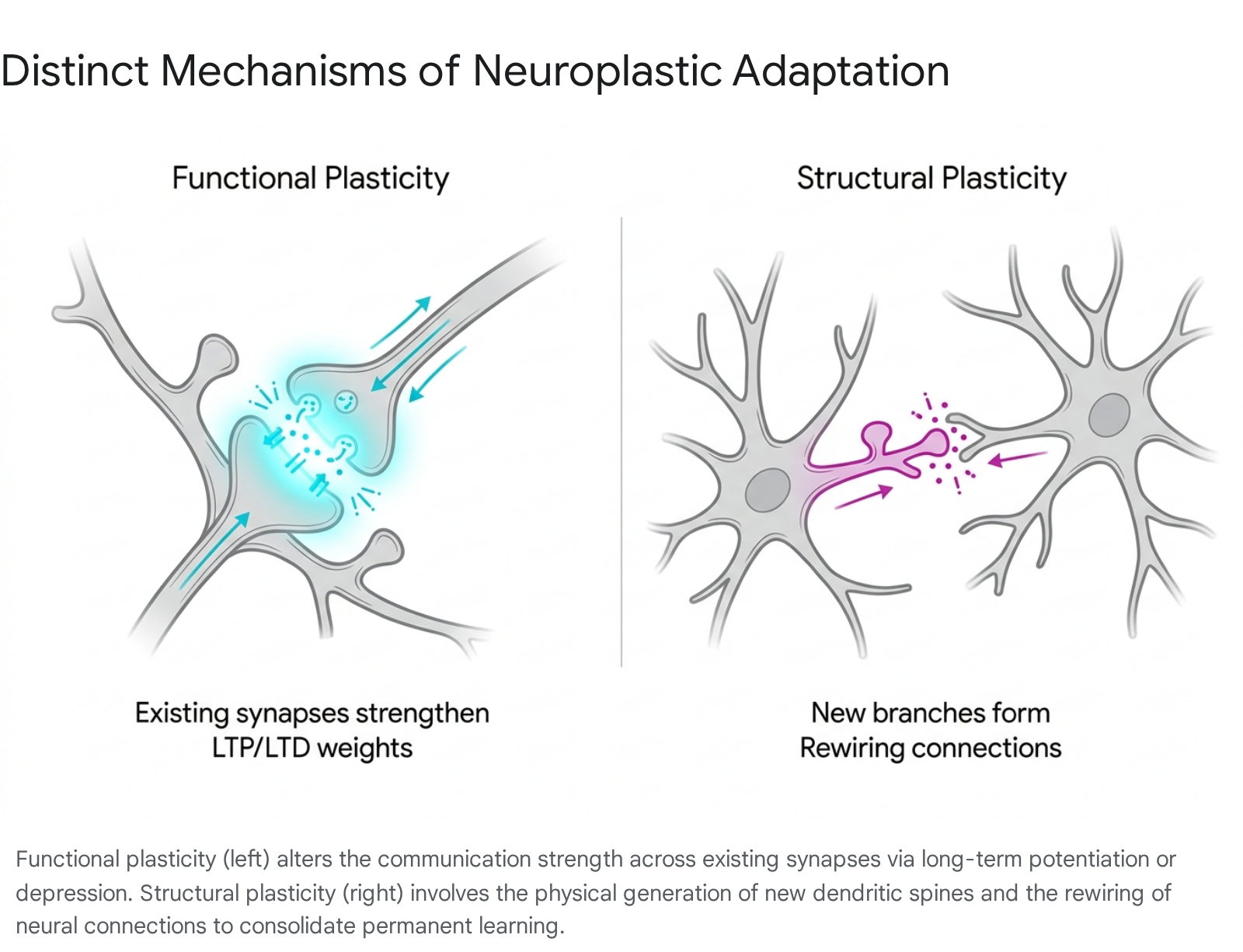
This encompasses axonal growth, dendritic sprouting, the generation of entirely new synapses (synaptogenesis), and the embedding of new neurons into existing networks (neurogenesis) 168. Structural plasticity provides a level of network flexibility impossible through functional plasticity alone; it permits synaptic rewiring, which requires the breaking of connections between one pair of neurons to establish a physical connection with an entirely different neuron 5.
The transition from functional to structural plasticity is heavily mediated by specific biochemical environments, most notably the presence of Brain-Derived Neurotrophic Factor (BDNF). BDNF serves as a biological catalyst for the growth of new neurons and the protection of existing architecture 6. Evidence demonstrates that structural changes consolidate the temporary gains made by functional plasticity. New synapses frequently form in close physical proximity to existing synapses that have recently been enhanced by LTP, effectively hardwiring the learned behavior into the cortex 5.
Early Life Sensory Experience and Cortical Development
The capacity for neuroplastic adaptation is profoundly influenced by early life sensory experiences, which interact with genetically encoded biological programs to shape the maturation of cortical circuitry. Foundational studies establish that sensory input is an absolute requirement for the appropriate wiring of primary sensory areas and higher-order associative regions, particularly the prefrontal cortex (PFC) 910. The PFC is critical for sensory integration, goal-directed behavior, and flexible cognitive control across species 910. Because the PFC is a late-developing structure, its underlying neural circuitry is highly susceptible to alterations driven by early life sensory and emotional inputs.
Experimental models utilizing rodents demonstrate the causal impact of sensory environments. Sensory restriction, such as whisker trimming or dark rearing from birth, leads to abnormal increases in interneuron subtypes and significant impairments in prefrontal cortical myelination and oligodendrocyte complexity 9. Conversely, environmental enrichment - immersion in environments featuring complex textures, novel objects, and social interaction - drives profound neural maturation 9. Mice raised in enriched environments between postnatal days 21 and 70 exhibit heavily altered sensory-cognitive network connectivity and heightened multisensory integration 9.
Human studies corroborate these findings, demonstrating that exposure to enriching activities during early development alters cortical thickness and increases functional connectivity within subcortical areas 9. Furthermore, behavioral states modulate this developmental plasticity. In developing subjects, neural activity in the secondary motor cortex (M2) and medial prefrontal cortex (mPFC) increases significantly during active sleep (REM sleep) compared to wakefulness 1112. This movement-related activity, driven by sensory feedback, indicates that sleep states and sensory responsivity extend deeply into the prefrontal cortex, scaffolding the activity-dependent development of higher-order cortical areas essential for subsequent learning transfer 1112.
| Plasticity Classification | Primary Mechanism of Action | Temporal Scale | Behavioral Implication |
|---|---|---|---|
| Functional Plasticity | Modulation of synaptic activity (LTP/LTD); changes in neurotransmitter release and receptor sensitivity. | Milliseconds to hours. | Short-term memory encoding; initial skill acquisition and sensitization 145. |
| Structural Plasticity | Synaptogenesis, neurogenesis, dendritic sprouting, and axonal rewiring. | Days to months. | Long-term memory consolidation; permanent behavioral adaptation and recovery from neural injury 158. |
| Developmental Plasticity | Activity-dependent shaping of cortical networks via early sensory input and enriched environments. | Early lifespan (critical periods). | Formation of baseline prefrontal circuitry and cognitive control capacity 91011. |
The Mechanics and Limitations of Learning Transfer
The ultimate metric of effective instructional design is learning transfer. Despite its theoretical importance, empirical investigations reveal that human cognition is remarkably resistant to generalized transfer 1314. Cognitive science delineates this phenomenon into two distinct categories: near transfer and far transfer. Understanding the neurobiological parameters of these categories is critical for designing realistic instructional interventions.
Definitional Boundaries of Near and Far Transfer
Near transfer occurs when knowledge or skills acquired in a specific training context are applied to structurally and superficially similar environments 131516. This involves tasks that share overlapping cognitive processes, stimulus modalities, or environmental cues with the original training scenario 1317. Conversely, far transfer demands the application of learned skills to contexts that differ fundamentally in structure, appearance, and domain from the training environment 131518. Far transfer relies theoretically on the enhancement of broad, domain-general cognitive abilities, such as fluid intelligence or executive function 1319.
Decades of behavioral research and neuroimaging data demonstrate that while near transfer is reliably achievable under specific conditions, far transfer is exceptionally rare, particularly following isolated cognitive training 131519. Comprehensive second-order meta-analyses of cognitive training programs yield a definitive consensus: the overall effect size of far transfer is statistically null 151820. The absence of far transfer generalizes across different populations, age groups, and task structures, driven by the brain's tendency to build highly specialized, non-generalizable neural networks for repetitive tasks 1820.
Cognitive Training and the Far Transfer Deficit
The limitations of transfer are highly visible in the empirical evaluation of computerized working memory training (WMT) programs. Commercial WMT applications often claim to enhance general intelligence or broad academic performance. However, rigorous meta-analytic data shows these claims are largely unsubstantiated. Training working memory reliably improves performance on the specific trained tasks and highly similar untrained working memory tasks (generating a near transfer effect size of approximately 0.29), but confers an effect size of 0.01 regarding far transfer 161920.
Neurophysiological investigations using event-related potentials (ERPs) clarify this phenomenon. In studies observing Chinese preschool children undergoing four weeks of WMT, the training group demonstrated behavioral improvements in working memory capacity and significant changes in ERP markers associated with response inhibition tasks 1619. Specifically, trained individuals exhibited a significant decrease in N2 amplitude, an increase in P3 amplitude, and a decrease in theta band energy during go/no-go tasks, confirming successful near transfer to related inhibitory control 16. However, there was no empirical evidence of far transfer to fluid intelligence 19.
Neurobiological evidence explains these limitations through the mechanics of automaticity. As an individual repeats a skill, the brain constructs dedicated, highly efficient functional modules 20. As a skill becomes automatic, its neural representation becomes increasingly rigid and specific. This modularity diminishes the learner's conscious access to the underlying mechanics of the skill, ironically reducing the ability to adapt and transfer the skill to divergent contexts 20. Transfer narrows substantially as automaticity increases.
Electrophysiological Markers of Near Transfer
In instances where near transfer is successful, magnetoencephalography (MEG) and functional magnetic resonance imaging (fMRI) reveal specific neural correlates. Individuals who learn novel tasks rapidly and demonstrate successful near transfer exhibit an increased similarity of neural representations between trained and novel problems 1721. This shared neural representation is accompanied by the dynamic reorganization and strengthened connectivity within the dorsal attention network, primarily spanning the frontal and parietal lobes 21.
Furthermore, successful transfer involves the strengthening of alpha-band synchronization across cortical regions 21. Faster learners exhibit parallel processes of learning-rate-dependent local integration and large-scale segregation of functional brain circuits, allowing them to better discriminate between trained and novel problems while applying the correct, adapted heuristics 17. The absence of these neurophysiological markers in far transfer tasks confirms that domain-general cognitive enhancement via domain-specific training is neurobiologically implausible 1721.
Contextual Inference and State-Dependent Learning
A primary barrier to generalized transfer is that basic sensory analysis, memory formation, and behavioral expression are inherently context-dependent 222324. The brain does not store information as isolated, abstract variables; it seamlessly binds acquired knowledge to the environmental, temporal, and emotional cues present during encoding 2223.
Under naturalistic conditions, the precise operational context is often uncertain, requiring the brain to engage in contextual inference - a complex Bayesian computation wherein the prefrontal cortex, hippocampus, and motor cortices continuously predict which environmental rules apply to the current situation 2324. If an instructional environment lacks the specific contextual cues of the eventual real-world application environment, the brain may fail to retrieve the appropriate behavioral response 2223.
This reality challenges the classical "identical elements" theory proposed by Thorndike, which suggested transfer is solely dependent on the quantity of shared features between a source and target domain 14. Ecological theories of transfer argue that Thorndike's model fails because it assumes similarities are transported as static representations (e.g., rigid models or chunks) across the learning-transfer divide 14. In reality, human activity relies heavily on implicit elements and complex affordances. Instructional design that completely decontextualizes learning severely limits the probability of successful transfer to noisy, operational environments 142223.
| Transfer Variable | Near Transfer Profile | Far Transfer Profile |
|---|---|---|
| Definition | Application of skills to structurally and contextually similar situations. | Application of skills to domains differing fundamentally in structure and appearance. |
| Neurobiological Marker | Shared neural representations; strengthened connectivity in the dorsal attention network 1721. | Theoretical reliance on generalized enhancement of prefrontal executive function; lacks empirical markers. |
| Empirical Reliability | High. Consistently observed in domain-specific training and WMT interventions 151618. | Low to Null. Statistically indistinguishable from zero in general cognitive training 151819. |
| Effect of Automaticity | Enhances efficiency and reaction time within the specific trained domain 20. | Narrows transferability; deep modularity severely restricts flexible application 20. |
Neuromyths in Educational and Professional Paradigms
A significant systemic impediment to effective instructional design is the proliferation of "neuromyths" - misconceptions generated by the misunderstanding, oversimplification, or misapplication of authentic scientific findings 252627. Implementing design strategies based on these myths wastes organizational resources, misdirects instructional focus, and frequently yields suboptimal behavioral outcomes.
The Persistence of Learning Styles and Hemispheric Dominance
The most pervasive neuromyth in contemporary education and corporate training is the concept of distinct "learning styles" - the belief that individuals learn best when instruction is explicitly tailored to their specific sensory preference, typically categorized as visual, auditory, or kinesthetic 272829. Despite near-universal belief among educators and trainers (with international surveys indicating up to 89% endorsement), rigorous psychological and neuroscientific research demonstrates absolutely no empirical evidence that aligning instruction with preferred learning styles improves information retention, comprehension, or transfer 252829.
Furthermore, categorizing learners by these arbitrary sensory buckets inflicts demonstrable harm. Recent empirical investigations, including a comprehensive 2023 study published in Nature, reveal that children, parents, and educators harbor biased expectations of intelligence based on learning style labels 28. Participants consistently and incorrectly judged individuals described as "visual learners" to be inherently more intelligent and academically capable than those described as "hands-on" or kinesthetic learners 28. These stereotypes foster susceptibility to cognitive biases at highly formative ages. The human brain is deeply interconnected, and effective learning relies on dual-coding and multiple representations across interconnected networks rather than isolated sensory channels 25.
Other common neuromyths include the assertion that learners are strictly "left-brained" (logical and analytical) or "right-brained" (creative and intuitive) 262729. This concept is a gross distortion of the split-brain studies conducted by Roger Sperry and Michael Gazzaniga in the 1960s on epileptic patients with severed corpus callosa 26. In neurotypical individuals, complex cognitive tasks demand massive inter-hemispheric communication. Designing training to cater to a "right-brained" employee is neurobiologically incoherent 2627.
Addressing these fallacies requires recognizing that most neuromyths are, in fact, "psycho-myths" 29. They are behavioral claims masquerading as neurobiological facts. Because they do not rest on actual neuroscience, debunking them by teaching complex neuroanatomy is frequently ineffective. Eliminating these practices requires directly replacing them with evidence-based cognitive psychology principles 29.
Epistemological Contradictions in Traditional Frameworks
Even highly established instructional models are vulnerable to pseudo-neuroscientific interpretations. David Kolb's Experiential Learning Theory (KELT), published in 1984, remains a foundational text in instructional design, positing a four-stage learning cycle 3032. However, modern analyses critique Kolb's model for epistemological contradictions, particularly the conceptual interchange of learning cycle stages with learning style modes 30.
More concerningly, recent adaptations of KELT have attempted to map Kolb's four stages directly onto specific cortical lobes, generating misleading diagrams that suggest concrete experience occurs solely in the sensory cortex, while abstract conceptualization occurs exclusively in the frontal integrative cortex 30. This oversimplification implies that only certain regions of the brain are active based on the type of learning activity, an a priori assumption that completely ignores the distributed nature of neural processing, the necessity of salience networks, and the role of cognitive load theory 30. Such frameworks must be updated to align with modern Dynamic Skill Theory and cognitive neuroscience to avoid perpetuating neuromyths 30.
Evidence-Based Instructional Design for Behavioral Change
With far transfer largely inaccessible via generalized cognitive exercises, and traditional passive instruction yielding minimal retention, achieving reliable behavior change requires instructional methodologies that directly replicate the target context or structurally optimize the neural encoding process. Experiential learning, spaced retrieval practice, and interleaved practice currently demonstrate the highest empirical efficacy.
Experiential Learning and Reinforcement Circuitry
Experiential learning shifts instruction from passive information reception to active, context-bound problem-solving. This pedagogy requires learners to bridge the gap between theoretical knowledge and practical application through direct engagement with real-world or simulated phenomena 313233.
The behavioral and physiological validity of learning through experience is remarkably robust. Experiential learning actively recruits the reinforcement learning circuits of the mammalian brain. When a learner engages in active trial and error, dopamine pathways connecting the ventral tegmental area to the prefrontal cortex and basolateral amygdala are heavily activated 3435. Specifically, parvalbumin interneurons within the basolateral amygdala contribute to calculating the value of rewards and processing emotional responses 34. This dopaminergic circuitry calculates reward prediction errors - the difference between expected and actual outcomes - physically altering synaptic weights to shape future motivated behavior, emotional regulation, and decision-making capabilities 3436.
Notably, developmental neurobiology indicates that the reliance on experiential feedback versus explicit instruction shifts across the lifespan. Behavioral studies demonstrate that children and adolescents integrate experiential feedback in a relatively unbiased manner, quickly shifting their choices away from inaccurate explicit instructions 36. In contrast, adults often exhibit a confirmation bias, allowing explicit instruction to skew their experiential learning 36. This protracted neurocognitive maturation highlights the necessity of providing adults with highly authentic experiential environments to override pre-existing biases 36.
Because experiential learning directly mimics the contextual complexity of the application environment, it bypasses the transfer problem by encoding the contextual cues alongside the skill itself. Meta-analyses of experiential learning in academic and corporate settings demonstrate substantial outcomes, including retention rates approaching 75% to 90% (compared to 5-10% for passive lectures) and massive pooled effect sizes (d = 0.43 to 1.05) in quantitative achievement metrics 39373839.
Applications in Professional and Corporate Environments
The principles of neurobiology and experiential design apply identically to corporate and professional settings. Organizations continuously expend vast resources on leadership development, change management, and soft-skill acquisition, often relying on theoretical workshops that generate high satisfaction scores but zero behavioral transfer to the workplace 3139.
Modern organizational development relies heavily on the 70-20-10 framework, which posits that 70% of professional capability develops through on-the-job experience and active problem-solving 43. By formally engineering this experiential learning through scenario-based crisis simulations, business modeling, role-play with structured feedback, stretch assignments, and job shadowing, organizations can successfully bridge the gap between theoretical strategy and practical commercial judgment 43404146.
Experiential training forces leaders into safe, simulated environments where they must navigate ambiguity, manage cross-functional teams, and experience the immediate systemic consequences of their decisions 314742. By directly engaging the emotional and cognitive circuits required for ethical decision-making, experiential learning builds psychological empowerment, self-efficacy, and adaptability 33464742. Meta-analyses of leadership development programs indicate that embedding critical reflection and experiential elements leads to statistically significant enhancements in transformational leadership capabilities, team cohesion, and overall organizational innovation 464743.
The Role of Spaced Retrieval Practice in Memory Consolidation
The brain's default physiological state involves the active decay and pruning of unused synaptic connections, a phenomenon behaviorally modeled as the Ebbinghaus forgetting curve 44. Spaced retrieval practice is the intentional combating of this synaptic decay through the scheduled, repeated recall of information over progressively expanding intervals of time 45464748.
Retrieval practice (frequently termed the "testing effect") is fundamentally different from restudying or re-reading text. Every time a memory is actively retrieved from long-term storage without external support, the neural pathway representing that memory is physically altered, modified, and strengthened 444649. Comprehensive meta-analyses comprising hundreds of studies and over 160,000 unique participants confirm that distributed practice and practice testing are among the most potent instructional interventions available 4650. Across diverse STEM domains, mathematics, and medical education, the weighted mean effect of spaced versus massed practice demonstrates a robust overall effect size ranging from g = 0.28 to g = 0.43 455152.
Behaviorally, replacing massed cramming sessions with spaced retrieval yields significantly higher final test scores and directly reduces test anxiety, contradicting traditional educational assumptions 4653. In primary school settings, retrieval combined with accuracy feedback produces superior text comprehension and long-term retention compared to passive reading 49.
Clinical and Developmental Efficacy of Retrieval Paradigms
The efficacy of spaced retrieval is not limited to neurotypical educational cohorts; it demonstrates profound utility in clinical and developmental populations. In geriatric care, mobile applications utilizing spaced retrieval algorithms coupled with machine learning have demonstrated significant feasibility and efficacy in maintaining critical semantic memory and name-face associations for individuals with early-stage Alzheimer's disease and Mild Cognitive Impairment (MCI) 48.
In pediatric populations, spaced retrieval significantly aids word learning in preschool-aged children with Developmental Language Disorder (DLD) 5455. Clinical studies evaluating the specific scheduling of retrieval - comparing an expanding schedule (progressively longer gaps) against an equally spaced schedule - reveal that shorter initial spacing results in greater immediate retrieval success 54. However, as the learning period progresses, the accuracy levels between the two schedules converge, suggesting that while short spacing provides early gains, rigorous distributed practice guarantees long-term retention irrespective of minor schedule variations 54.
Interleaved Practice and Discriminative Contrast
A vital corollary to spaced retrieval is interleaved practice. Instead of massing practice on a single topic (e.g., solving twenty identical ratio problems or studying one specific architectural style consecutively), interleaving involves mixing different, but conceptually related, topics within a single continuous study session 47565758.
The Discriminative-Contrast Hypothesis and Attention Attenuation
The neurocognitive efficacy of interleaving relies primarily on the discriminative-contrast hypothesis 585960. When highly similar concepts are blocked together, learners apply formulas or behaviors automatically, without processing the underlying structural reasons for why that specific solution is necessary. Interleaving forces the brain to continuously compare and contrast features across categories 5859. This teaches the learner not only how to execute a specific skill, but how to accurately identify which skill is required by the environmental context 5961.
Additionally, interleaved practice leverages the attention attenuation hypothesis 60. Sustained focus on blocked, homogenous material leads to rapid cognitive depletion and mental fatigue. Interleaving forces a continuous mental shift between subject matter and perceptual modalities, restoring attention, lowering skin conductance levels (a marker of stress and fatigue), and sustaining engagement over longer study periods 60.
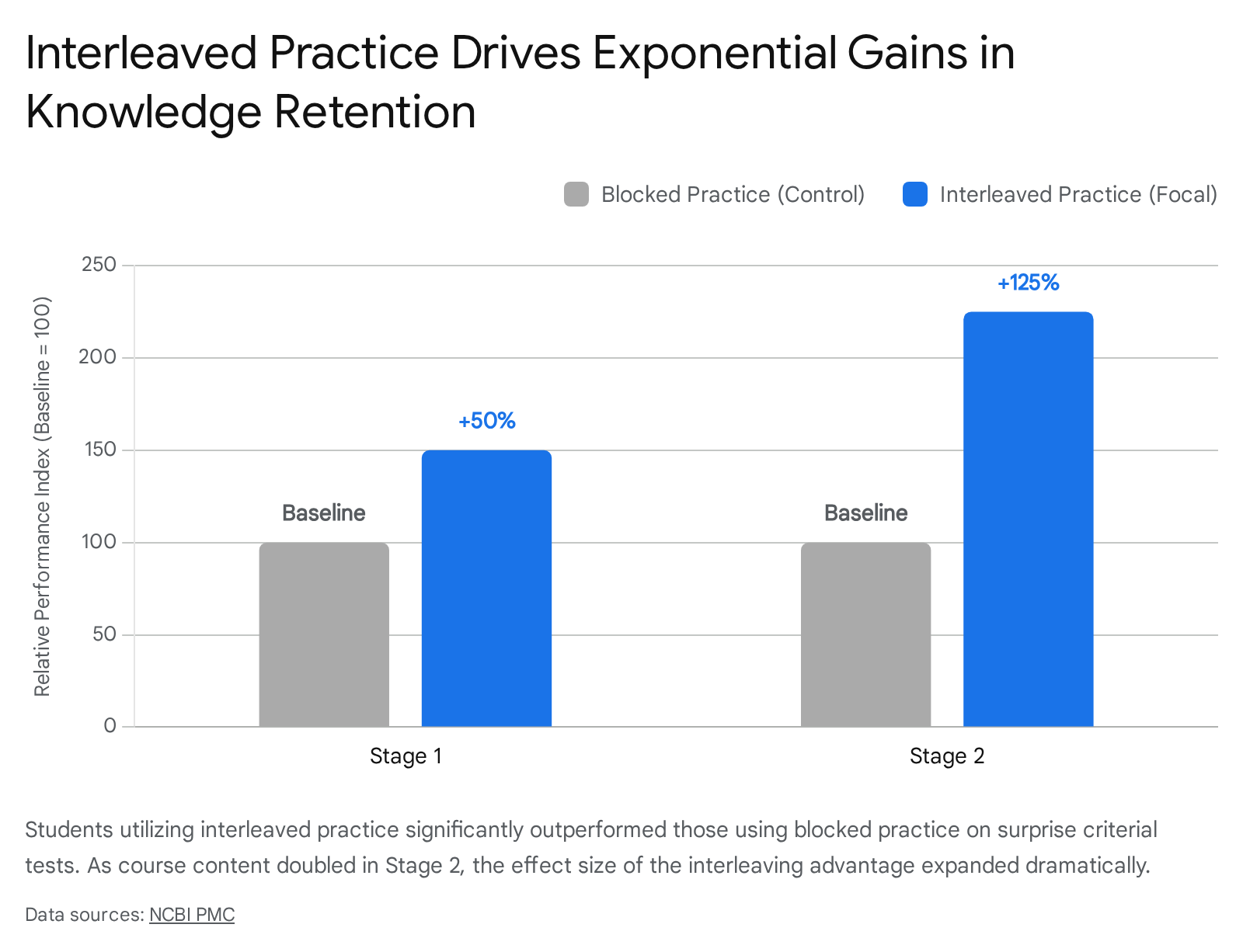
While interleaving often slows initial skill acquisition and feels inherently more difficult to the learner (functioning as a "desirable difficulty"), it produces massive, measurable gains in delayed transfer tasks. In rigorous field experiments utilizing natural category learning (e.g., classifying rock types), interleaving promoted higher categorization accuracy in both children and young adults compared to blocked schedules 58. In advanced mathematics and university-level physics courses, interleaving improved median test scores over blocked practice by 50% in early course stages and up to 125% in later stages 5356.
Managing Cognitive Load Through Collaborative Interleaving
However, interleaving is strictly bounded by human cognitive load limits. Recent empirical field experiments involving high school physics students learning highly abstract concepts (e.g., the motion of charged particles in magnetic fields) highlight that if the material is overwhelmingly complex, interleaving performed individually can lead to working memory overload and result in worse long-term outcomes than blocked practice 62.
The structural solution to this cognitive overload lies in collaborative learning. When learners tackled interleaved complex problems in pairs, the shared cognitive load mitigated the overload 62. Neuroimaging studies utilizing functional near-infrared spectroscopy (fNIRS) hyperscanning reveal that collaborative cooperation bolsters inter-brain synchrony (IBS) and intra-brain functional connectivity in regions linked to the mirror neuron system, spatial perception, and cognitive control 63. Interestingly, dyadic friend groups exhibited stronger IBS in the mirror neuron system than stranger dyads, proving that collaborative interleaving acts not merely as a social add-on, but as a direct neurocognitive support mechanism that creates the cognitive space required for demanding learning strategies to pay off 6263.
Global Perspectives and Transfer in Non-WEIRD Populations
While the neurobiological constraints of learning transfer and functional plasticity are universally applicable to human cognition, the systemic implementation of instructional design strategies must account for the macroscopic variables present in non-WEIRD (Western, Educated, Industrialized, Rich, Democratic) populations.
Scaling Cognitive Interventions Across Demographic Contexts
Educational equity and the translation of cognitive science into actionable policy present distinct challenges in rapidly developing demographics, such as the BRICS nations (Brazil, Russia, India, China, and South Africa) 64. These nations present diverse institutional arrangements, socio-economic profiles, and infrastructural scarcities that heavily impact the delivery of experiential and spaced retrieval methodologies 64.
For example, achieving learning transfer at scale in these regions requires aligning educational programs with socio-economic development objectives, such as Brazil's conditional cash transfer programs (Bolsa Família) which link financial support directly to school attendance, or China's massive digital infrastructure initiatives aimed at connecting rural and urban educational hubs 64. These systemic interventions address the baseline environmental stability necessary for optimal prefrontal cortical development and neuroplasticity 964.
Furthermore, as global student mobility shifts from the traditional "big four" destinations toward an emerging "big fourteen," institutions in regions like Brazil are striving to act as educational bridges between the Global North and South, increasing the demand for scalable, evidence-based instructional frameworks that transcend cultural and linguistic barriers 65. The integration of artificial intelligence, green transition technologies, and sovereign digital frameworks heavily discussed among BRICS think tanks will increasingly dictate how cognitive training and complex skills are delivered and measured globally 66.
Ultimately, whether managing the cognitive load of a physics student in Europe or designing digital STEM curricula in the Global South, recognizing the physiological boundaries of learning transfer ensures that instructional design moves beyond aesthetic engagement and towards measurable, durable behavioral change.
| Neurobiological Principle | Instructional Design Strategy | Expected Behavioral Outcome |
|---|---|---|
| Synaptic Decay & Consolidation 64446 | Spaced Retrieval: Replace massed training days with brief, frequent testing across months. | Halts the forgetting curve; builds robust, automated recall of critical procedures. |
| Discriminative Contrast 585960 | Interleaving: Mix different problem types or scenarios in a single module rather than blocking them. | Improves ability to identify underlying structural rules; prevents robotic application of incorrect solutions. |
| Contextual Inference 222324 | Experiential Authenticity: Ensure training simulators match the physical, temporal, and emotional cues of the real job. | Enhances near transfer; ensures environmental cues successfully trigger the learned neural pathways. |
| Dopaminergic Error-Correction 343536 | Active Experimentation: Allow collaborative trial-and-error in safe environments followed by structured debriefing. | Drives long-term structural plasticity; builds deep resilience, adaptability, and judgment. |
In conclusion, learning transfer cannot be treated as a spontaneous byproduct of exposure to information. Because the brain relies intensely on context, actively prunes unused connections, and strictly limits far transfer to preserve automated efficiency, instructional design must be deliberate and empirically grounded. By abandoning pervasive neuromyths and anchoring training in authentic experiential problem-solving, spacing retrieval to fight synaptic decay, and interleaving content to sharpen contextual discrimination, organizations and educators can construct durable, functional neural architecture that translates reliably to real-world performance.