
Quantum Computing and Market Disruption Theory
Introduction: The Quantum Landscape of 2026
The commercialization of quantum computing stands at a critical inflection point in 2026, a year formally recognized by the United Nations as the International Year of Quantum Science and Technology 1. Transitioning from a domain historically confined to theoretical physics and academic laboratories, the sector has evolved into a strategic imperative driving billions of dollars in global public and private investments 234. By leveraging the fundamental principles of quantum mechanics - namely superposition, where qubits exist in multiple states simultaneously, and entanglement, where the state of one qubit instantly influences another regardless of distance - quantum systems promise to process multidimensional datasets at speeds unattainable by classical supercomputers 15. This paradigm shift has profound implications for optimization, cryptography, drug discovery, and materials science 678.
However, the industry is simultaneously navigating a period of intense scrutiny and market recalibration. The narrative surrounding quantum computing is heavily saturated with hype, often mischaracterizing the technology as a ubiquitous replacement for classical systems and misapplying strategic business frameworks like "disruptive innovation" 91011. Beneath the persistent optimism lies a formidable wall of physical challenges, primarily the phenomenon of decoherence, the high overhead of quantum error correction, and the staggering capital intensity required to push hardware beyond experimental phases 12131112.
This comprehensive analysis investigates the multifaceted quantum computing landscape. It broadens the theoretical lens to explicitly classify quantum computing within the framework of Clayton Christensen's innovation theories, dispels the myth of universal classical replacement by outlining the co-processor paradigm, and examines market entry footholds such as cloud-based access models 131415. Furthermore, it addresses skeptical perspectives regarding the technology's thermodynamic and financial viability, contrasts the divergent quantum strategies of the United States, China, and the European Union, and calibrates the technology's maturity against recent peer-reviewed breakthroughs in foundational scientific journals 12161718.
Theoretical Framework: Sustaining Versus Disruptive Innovation
In mainstream business discourse, the term "disruption" is frequently and incorrectly utilized as a ubiquitous synonym for any major technological breakthrough 91019. To accurately assess the market trajectory and strategic implications of quantum computing, it is imperative to apply the rigorous criteria established by Clayton Christensen in the foundational literature of the Harvard Business Review and the Christensen Institute 9202122.
Defining the Innovator's Dilemma
According to Christensen's established theory, innovations fall into two fundamentally distinct categories, each requiring entirely different management strategies and yielding different market outcomes. The first category is sustaining innovations. These improvements target existing products or services along the dimensions of performance that mainstream, high-end customers already value 13202123. Sustaining innovations are typically developed by established industry incumbents seeking to provide superior performance, allowing them to compete against rivals and maintain market leadership by solving increasingly difficult problems for their most profitable client segments 13202123.
The second category comprises disruptive innovations. Contrary to popular usage, disruptive innovations are fundamentally not breakthrough technologies that make good products better for existing customers. Instead, disruptive innovations transform complex, expensive products into simpler, more affordable, and highly accessible alternatives 922. The theory posits that disruption originates in two primary forms. Low-end disruption targets overserved customers at the bottom of the market with a "good enough" product at a significantly lower price point, utilizing a business model with lower gross margins 202425. New-market disruption, conversely, creates an entirely new value network by turning non-consumers into consumers because the original product was previously too expensive, centralized, or complicated to use 202324. Historically, established companies ignore these disruptive entrants because the initial profit margins are too low to justify investment, allowing the disruptors to eventually move upmarket and displace the incumbents 132529.
The Misclassification of Quantum Computing
Applying these rigorous criteria, quantum computing is emphatically not a disruptive innovation; rather, it is a quintessential, extreme manifestation of a sustaining innovation 1326.
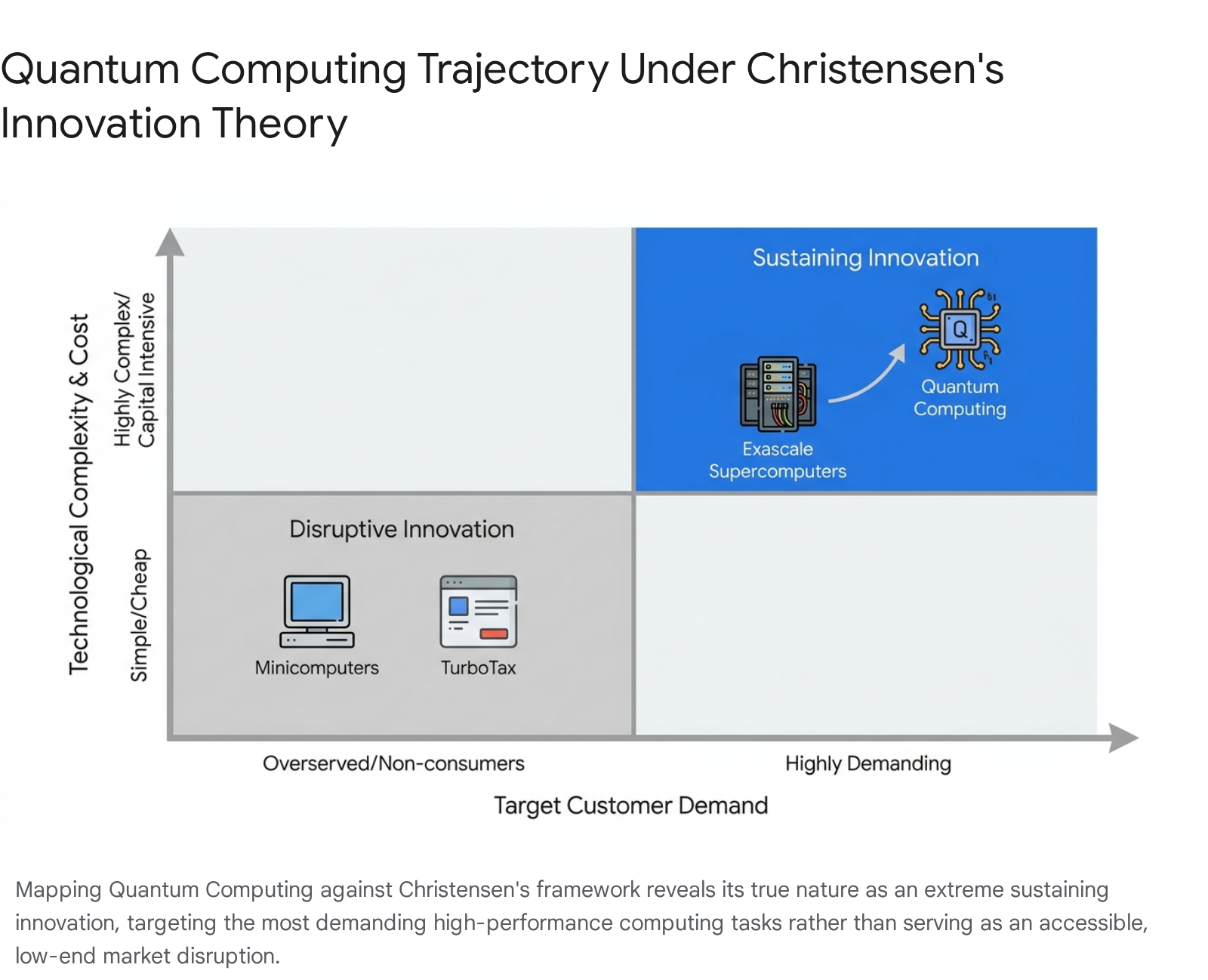
Quantum computing does not make computation cheaper, simpler, or more accessible to a broad base of non-consumers, nor does it target the low end of the technology market with a "good enough" proposition 222426. Instead, it is an extraordinarily expensive, highly complex, and highly capital-intensive technology aimed squarely at the most demanding, highest-paying customers in the global market 4262728. These customers include the operators of high-performance computing centers, national defense and intelligence agencies, and elite enterprise research and development divisions in pharmaceuticals and finance 4262728.
Incumbent computing giants such as IBM, Google, Microsoft, and Amazon are leading the quantum charge, which aligns perfectly with Christensen's observation that sustaining innovations are almost always developed, funded, and commercialized by established industry leaders 212629. These hyperscalers are investing billions to secure the high-margin market of the future. Quantum computing represents a continuation of the high-performance computing trajectory, specifically designed to push the boundaries of what is computationally tractable for entities that are increasingly constrained by the physical limits of classical supercomputers and the waning returns of Moore's Law 52728.
Mapping Quantum Computing Against Disruption Criteria
To solidify this classification, the following table explicitly contrasts the characteristics of a true Christensen Disruptive Innovation with the commercial and technical reality of Quantum Computing.
| Christensen's Disruption Criteria | True Disruptive Innovation Profile | Quantum Computing Reality (Sustaining Innovation) |
|---|---|---|
| Initial Performance Level | Inferior to established products; deemed merely "good enough" for the low-end market 132229. | Engineered to exponentially outperform classical supercomputers on specific, highly complex mathematical tasks 2630. |
| Target Audience & Market Segment | Low-end consumers or non-consumers, creating entirely new, accessible markets 132324. | High-end, highly demanding enterprise, government, and high-performance computing users 262728. |
| Cost Profile & Accessibility | Highly affordable, simple to use, and democratizes access to previously exclusive capabilities 922. | Immensely expensive, requires extreme cryogenic infrastructure, and demands highly specialized doctoral-level talent 3132. |
| Incumbent Strategic Reaction | Incumbents flee upmarket to avoid low-margin competition, ignoring the disruptor until it is too late 132125. | Incumbents (e.g., IBM, Google, Microsoft) proactively drive the innovation, heavily investing to secure future high-margin monopolies 142629. |
| Underlying Business Model | Lower gross profit margins compensated by high-volume market penetration 2021. | Highly capital-intensive operations, massive barriers to entry, and premium enterprise pricing models 1126. |
The Co-Processor Paradigm: Dispelling the Universal Replacement Myth
A pervasive misconception fueling the quantum hype cycle is the notion that quantum computers will eventually render classical computers obsolete. This "Q-Day" narrative suggests an impending technological turnover where conventional laptops, enterprise servers, and global data centers are wholly replaced by quantum equivalents 1331. Peer-reviewed evidence and advanced architectural designs definitively refute this narrative. Quantum computers are highly specialized scientific instruments; they are fundamentally ill-suited for everyday, sequential computational tasks such as web hosting, database management, video rendering, or basic data storage 133033.
The Algorithmic Limitations of Quantum Utility
The power of quantum computing is strictly confined to a specific subset of mathematical and physical problems that can successfully leverage quantum parallelism and interference. Classical algorithms are inherently deterministic, processing binary bits serially in a linear fashion. Quantum algorithms, conversely, utilize multi-dimensional state spaces, known mathematically as Hilbert spaces, allowing them to explore vast combinatorial possibilities simultaneously before converging on a high-probability outcome 12830.
Therefore, the utility of quantum systems is mathematically restricted to highly specialized domains. These include prime factorization via Shor's algorithm, which threatens modern encryption; unstructured database search via Grover's algorithm; and the simulation of highly correlated quantum mechanical systems via the Variational Quantum Eigensolver 8283435. For any task outside these specific algorithmic architectures, a quantum computer offers no speedup and may, in fact, perform significantly slower than a standard classical processor.
Hybrid QPU-CPU Architectures in High-Performance Computing
Rather than acting as standalone replacements, quantum systems are being integrated as co-processors within existing classical high-performance computing infrastructures 2730. In this hybrid paradigm, a classical central processing unit partitions a massive computational problem, offloads only the classically intractable, highly correlated subroutines to the quantum processing unit, and then retrieves the quantum output to continue the classical computation 52730.
This hybrid approach was empirically validated in a landmark November 2024 publication in the journal Nature by researchers at IBM. The team successfully realized error-mitigated dynamic circuits by connecting two separate 127-qubit "Eagle" quantum processing units via a real-time classical communication link, effectively operating a distributed 142-qubit system 153637. The real-time classical link allowed a quantum gate on one processing unit to be conditionally triggered by a measurement outcome on the other processing unit within a fraction of the qubits' coherence time 153637. This milestone underscores a critical reality: classical networking, classical control flow, and classical error mitigation are not merely supplementary to quantum computing, but are structurally mandatory for the operation, synchronization, and scaling of advanced quantum systems 152737. The future of computation is inherently hybrid.
Footholds for Market Entry: The NISQ Era and Cloud Access Models
Given the immense capital expenditure required to procure, house, and cool quantum hardware - often necessitating specialized dilution refrigerators to maintain temperatures near absolute zero - direct hardware sales to individual enterprises represent a highly limited commercial market 113242. To achieve early market entry, recoup massive research and development costs, and secure revenue streams prior to the realization of fully fault-tolerant systems, the quantum industry has pivoted toward distinct operational footholds.
Navigating the NISQ and ISQ Transitional Phases
The current technological epoch has been largely defined by Noisy Intermediate-Scale Quantum devices. These systems feature tens to hundreds of physical qubits but lack the logical qubit encoding necessary for robust quantum error correction 134338. Consequently, they are highly susceptible to environmental noise, thermal fluctuations, and decoherence, which severely limits the depth of the computational circuits they can execute before errors overwhelm the output 131243. While Noisy Intermediate-Scale Quantum devices have successfully demonstrated heuristic quantum-classical algorithms, such as quantum machine learning for parameter optimization, their immediate commercial utility in delivering an absolute advantage over classical supercomputers remains a subject of intense academic and industrial debate 4338.
However, the industry is rapidly transitioning toward the Intermediate-Scale Quantum era, frequently termed the "early fault-tolerant" computing phase 38. In the Intermediate-Scale Quantum regime, early forms of error correction allow for significantly deeper quantum circuits, albeit with a highly limited number of logical qubits 38. This transitional phase provides the first real opportunity for organizations to test proprietary algorithms on hardware capable of executing operations that would otherwise cripple classical brute-force simulations 438.
Democratization Through Quantum-as-a-Service
To facilitate access to these early-stage devices, the primary market entry mechanism is Quantum-as-a-Service 47143145. By abstracting the complex cryogenic infrastructure and physical maintenance layers, technology hyperscalers such as Amazon Web Services through Amazon Braket, Microsoft via Azure Quantum, and the IBM Quantum Cloud offer cloud-based application programming interfaces 471445. These platforms allow researchers and corporate developers to execute quantum circuits on actual hardware on a pay-per-use or subscription basis.
This asset-light distribution model effectively democratizes access for pharmaceutical companies, financial institutions, and logistics firms. It enables them to conduct pilot projects, build internal quantum talent, and test hybrid quantum-artificial intelligence algorithms without internalizing the prohibitive infrastructure costs required to build a physical quantum laboratory 41439. By 2026, Quantum-as-a-Service has established itself as the commercial backbone of the quantum ecosystem, effectively bridging the perilous gap between foundational hardware research and broad enterprise adoption 439.
The Skeptic's Lens: A Highly Capital-Intensive Niche Tool
Despite the rapid proliferation of Quantum-as-a-Service platforms and aggressive corporate roadmaps, a formidable contingent of industry analysts and physicists argue that quantum computing may permanently remain a highly capital-intensive, niche scientific tool 1112113140. This deep skepticism is not merely contrarianism; it is rooted in severe thermodynamic realities and the unforgiving economics of deep technology venture capital.
Thermodynamic Debt and the Error Correction Wall
The core physical critique centers on the phenomenon of decoherence and the non-linear scaling of error correction overhead. As articulated by prominent skeptics in leading technical forums, isolating a fragile quantum state from environmental interference while simultaneously manipulating it to perform calculations requires energy and control mechanisms that scale disproportionately with system size 12. Analysts argue that each new hardware milestone inadvertently reveals another layer of "thermodynamic debt," wherein the energy required to isolate, measure, and correct errors scales significantly faster than the actual computational gain, potentially colliding with fundamental physical limits of energy and entropy 1240.
For example, to execute a commercially viable, system-breaking algorithm like Shor's to factor RSA-2048 encryption keys, experts estimate that millions of error-corrected physical qubits are theoretically required 1333. Constructing a single machine of this immense scale involves routing millions of delicate microwave control cables and scaling cryogenic cooling systems far beyond the capabilities of current global engineering 323340. Skeptics note that while small arrays of qubits have been successfully demonstrated in controlled environments, the underlying theory of massive, system-wide quantum entanglement necessary for exponential speedup has yet to be empirically verified at a commercially useful scale 40. Without this verification, the ultimate promise of quantum supremacy remains theoretical.
Financial Realities: Valuation Versus Tangible Utility
From a financial market perspective, quantum computing is uniquely vulnerable to the fluctuations of the technology hype cycle. Mid-cap and pure-play startup quantum companies carry premium market valuations that rely almost entirely on market confidence, speculative enthusiasm, and multi-year future roadmaps, rather than current, sustainable commercial revenue 1141. In stark contrast to Artificial Intelligence - which rapidly transitioned from a niche developer tool to a general-purpose technology woven into everyday consumer and enterprise workflows via large language models - quantum computing lacks broad, immediate, and easily demonstrable applicability 113142.
The capital intensity of developing quantum hardware is staggering 11. For context, corporate capital expenditures for artificial intelligence infrastructure reached hundreds of billions in the mid-2020s, with a single company like Amazon spending over $44 billion in a single quarter of 2026 alone, illustrating the massive scale of investment required to compete in next-generation compute environments 42. Pure-play quantum startups, functioning primarily in a pre-commercial research phase, face a highly asymmetric risk-to-reward profile 11. If hardware scaling timelines slip, or if classical algorithmic efficiency - such as tensor networks cleverly mimicking quantum circuits - continues to improve and artificially erode the margin of "quantum advantage," venture funding may evaporate rapidly 11314143. This scenario would leave quantum computing isolated as a specialized scientific instrument for national laboratories, rather than the broad enterprise tool envisioned by venture capitalists.
The Global Race: Comparing US, China, and EU Strategies
The development of quantum technology is not occurring in a geopolitical vacuum. It is increasingly viewed by world leaders as a mission-essential national asset, capable of conferring distinct, irreversible military, intelligence, and economic superiority in the 21st century 4445. Consequently, the United States, China, and the European Union are executing radically different models of "quantum statecraft," which are deeply reflective of their broader macroeconomic structures and political philosophies 1646.
The United States: Private-Sector Dominance and the Moonshot Approach
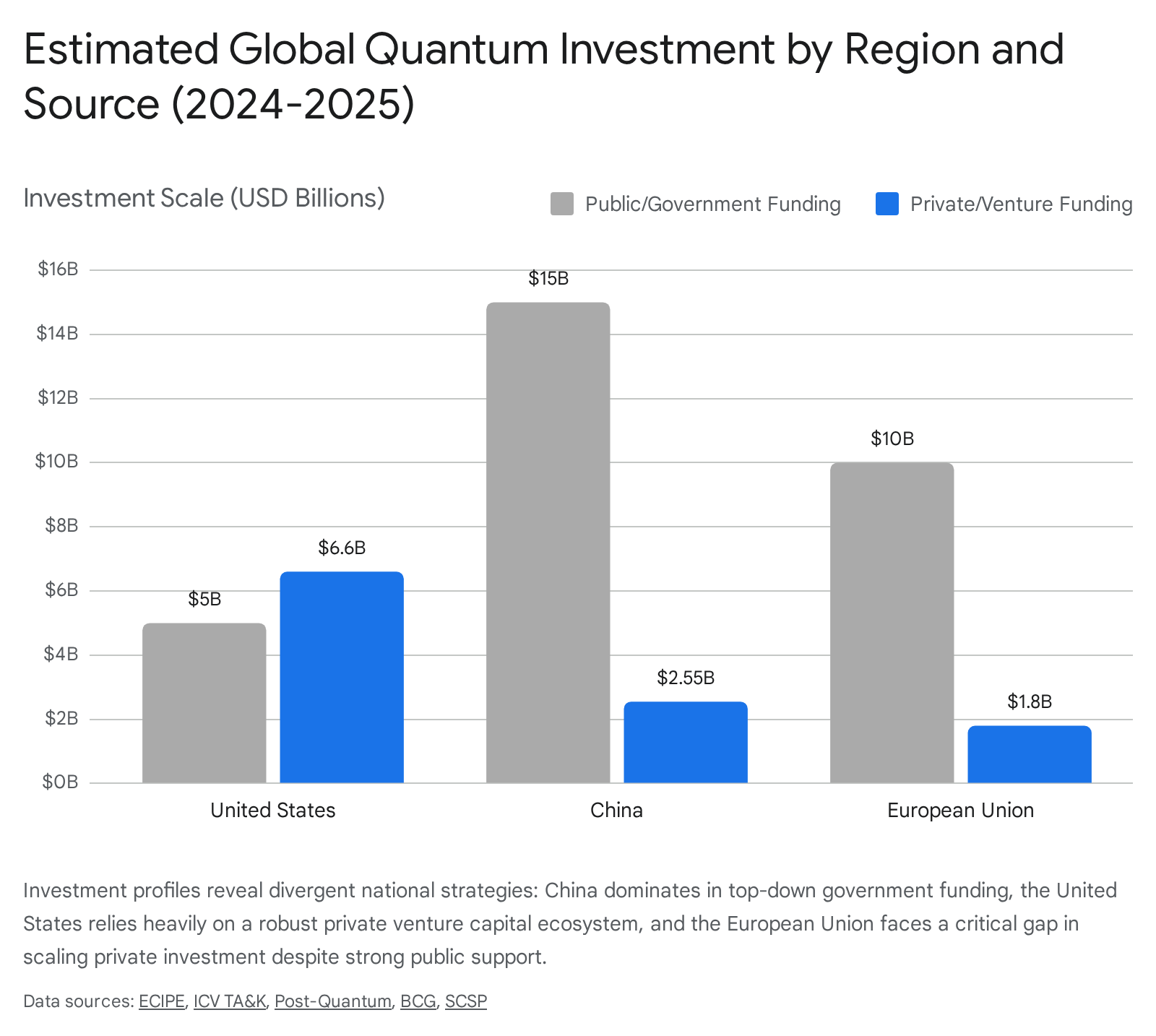
The strategy of the United States is characterized by a "moonshot" approach focused on achieving absolute quantum computing supremacy, driven overwhelmingly by the agility of private-sector venture capital and massive corporate research and development budgets 2294748. The United States commands approximately 44% of global private quantum funding and boasts an ecosystem of roughly 300 quantum startups, creating a highly vibrant, albeit fragmented and fiercely competitive, innovation landscape 248. Technology giants like IBM, Google, and Microsoft act as foundational ecosystem anchors, leading the world in high-impact algorithmic research, logical qubit development, and international patent accumulation 2294748.
However, the United States lags significantly behind its geopolitical peers in direct public funding. While the landmark 2018 National Quantum Initiative Act catalyzed early federal coordination across agencies, the legislation has operated without formal reauthorization since 2023, creating bureaucratic friction 2956. With total cumulative government funding estimated between $3.7 billion and $5 billion, the United States relies heavily on free-market mechanisms and targeted defense and intelligence agency investments, such as those from the Defense Advanced Research Projects Agency, to sustain its precarious global leadership 2485649.
China: State-Directed Commercialization and the 15th Five-Year Plan
In stark contrast, China operates a vertically integrated, heavily state-mobilized strategy designed to achieve absolute technological self-reliance. China leads the world in public quantum investment, with conservative estimates ranging from $11.18 billion to over $15 billion, funneling vast resources into national technology clusters and state-owned enterprises 229474849. Historically, China's development has heavily prioritized quantum communications and sensing over pure computing. This focus resulted in the construction of the 10,000-kilometer Beijing-Shanghai quantum key distribution trunk line and the launch of the Micius satellite, built to ensure perfectly secure, tamper-proof government and military communication networks 244454750.
The geopolitical landscape shifted dramatically in early 2026 with the approval of China's 15th Five-Year Plan covering the period from 2026 to 2030 56505152. This master plan elevates quantum technology to the very apex of designated "future industries" and explicitly shifts the national focus from academic research to mass commercialization 56505152. To achieve this, the National Venture Guidance Fund allocated a staggering $17.5 billion across three regional quantum-focused venture funds. These funds are designed specifically to stimulate domestic manufacturing, facilitate scalable product deployments, and mandate government procurement pipelines to guarantee early revenue for domestic quantum firms 565051. This highly coordinated, long-term funding system insulates Chinese quantum programs from the short-term return-on-investment pressures and hype cycles that frequently plague Western venture capital markets 56.
The European Union: The Regulatory Mosaic and the Funding Gap
Europe pursues a distinctly hybrid model, focusing heavily on regulatory coordination, cross-border public consortiums, and the development of continent-wide secure infrastructure 162946. Through funding vehicles like the €1 billion Quantum Technologies Flagship program and mobilized national funds led predominantly by Germany and France, the European Union has amassed over $10 billion in public investment, ranking second globally behind China 22946. The European Union excels in fundamental academic output, basic scientific research, and talent generation 29.
However, Europe suffers from a severe "funding bottleneck" within its private sector. This dynamic is often referred to as the "European Paradox" - an abundance of high-quality academic research that fails to translate into commercialized patents or globally dominant technology companies 2. Despite fostering 26% of the world's quantum startups, the European Union captures a mere 12% of worldwide private venture capital investment 246. Lacking indigenous digital hyperscalers to act as corporate consolidators or massive early adopters, European startups struggle significantly to scale commercially 29. To rectify this imbalance, the proposed EU Quantum Act of 2026 and related strategic frameworks aim to position public bodies as anchor customers to essentially "crowd-in" private venture capital, attempting to forcefully translate deep scientific excellence into genuine industrial autonomy 1646.
| Region | Primary Strategy Focus | Public Funding Estimate | Private Funding Share | Key Strengths & Vulnerabilities |
|---|---|---|---|---|
| United States | Free-market innovation, corporate-led R&D, computing supremacy 474853. | ~$3.7B - $5B 256. | ~44% (Global Leader) 2. | Highest private innovation and logical qubit breakthroughs, but lagging public funding coordination 248. |
| China | State-directed self-reliance, massive commercialization, quantum communications 45475053. | ~$11.1B - $15B+ 485649. | ~17% 2. | Unmatched public funding and infrastructure deployment (e.g., 15th Five-Year Plan), but heavily reliant on state directives 25650. |
| European Union | Regulatory coordination, basic academic research, pan-European secure infrastructure 162946. | ~$10B 2. | ~12% (Significant Lag) 2. | Excellent academic talent generation and strong public consortiums, hampered by a severe lack of late-stage venture capital to scale startups 2946. |
Evaluating Quantum Maturity: Evidence from Peer-Reviewed Science
To accurately cut through commercial marketing posturing and calibrate actual technological maturity, industry analysts must rely exclusively on empirical progress documented in top-tier, peer-reviewed scientific journals such as Nature and IEEE. In 2026, the primary metric of quantum maturity is no longer the sheer volume of noisy physical qubits a company can fabricate, but rather the efficiency of Quantum Error Correction protocols and the proven fidelity of stable "logical qubits" 485455.
Breakthroughs in Error Correction and Logical Qubits
Throughout 2024 and 2025, several landmark peer-reviewed papers demonstrated that the theoretical foundation of error correction is indeed viable, though immense engineering hurdles remain.
In March 2024, researchers at IBM published a breakthrough in the journal Nature, introducing a highly efficient quantum low-density parity-check code, formally termed the "gross code" or Bivariate Bicycle code 17. Traditional surface codes previously required massive physical overhead - often cited as requiring nearly 3,000 physical qubits to protect just 12 logical qubits from errors 17. IBM's architectural innovation reduced this overhead by a full order of magnitude. The gross code architecture requires only 288 physical qubits to achieve the exact same level of logical protection, connected across just two routing layers, making fault-tolerant quantum memory drastically more feasible on near-term hardware 1764.
Concurrently, research utilizing neutral atom arrays has rapidly accelerated. A Harvard-led team, funded by DARPA, demonstrated the execution of error-corrected logical qubit operations using Rydberg qubits 5565. Because Rydberg atoms are completely homogeneous by nature and can be dynamically reconfigured in a vacuum using optical tweezers, this architecture successfully avoids the static routing errors and manufacturing defects inherent to solid-state superconducting systems 5565.
Furthermore, in February 2025, Google published experimental evidence in Nature detailing "below-threshold" surface code memories operating on their 105-qubit superconducting Willow processor 184856. This was a monumental physics milestone. It empirically proved that increasing the code distance - meaning adding more physical qubits to the error correction protocol - actually decreased the logical error rate exponentially 56. This confirmed that highly scalable fault tolerance is physically attainable, provided that the baseline physical hardware fidelity is sufficiently high 4856. Additionally, researchers at ETH Zurich presented the first digital quantum system capable of repeatedly detecting and correcting fundamental errors simultaneously using a 17-qubit surface code operating at a temperature of 0.01 Kelvin 12.
While these Nature publications rigorously validate the theoretical path toward commercial utility, they simultaneously highlight the grueling engineering reality. Systems must still scale from current arrays of hundreds of physical qubits up to millions, all while maintaining absolutely pristine cryogenic environments and flawless microwave or laser control systems to deliver on ultimate commercial promises 4176556.
Commercial Adoption Timelines and Industry Applications
The trajectory for actual commercial adoption is highly fragmented across different industries, depending entirely on the specific algorithmic complexity required by the domain. Assuming continued exponential improvements in hardware scaling and error correction efficiency, market intelligence models predict three distinct, staggered phases of enterprise adoption across specific sectors 6467.
| Target Industry & Application | Expected Adoption Phase | Algorithmic Mechanism & Use Case | Commercial Impact & Rationale |
|---|---|---|---|
| Cryptography (Security) | Immediate/Short-Term (2025 - 2030) | Shor's Algorithm threat dictates migration to Post-Quantum Cryptography (PQC) 136757. | Mandatory enterprise overhaul. While a Cryptographically Relevant Quantum Computer (CRQC) is a decade away, the "harvest now, decrypt later" threat forces immediate software updates 6757. |
| Materials Science | Mid-Term (2028 - 2032) | Lattice models and optimization algorithms for interacting electrons 4334364. | Projected to reach "quantum advantage" first due to lower qubit overhead required for solid-state simulations compared to complex biology. Used for battery design and catalysts 464. |
| Drug Discovery (Pharma) | Long-Term (2030 - 2035+) | Variational Quantum Eigensolver (VQE) and Quantum Machine Learning (QML) 8343569. | High complexity of biological molecules requires massive error correction. Will eventually compress hit-to-lead times and improve protein folding predictions via hybrid AI-Quantum pipelines 8396469. |
Cryptography: The Imminent Threat and Post-Quantum Migration
The most urgent, near-term commercial impact of quantum computing is destructive rather than generative. Utilizing Shor's algorithm, a sufficiently scaled and error-corrected quantum computer possesses the theoretical capability to factor the exceptionally large prime numbers that underlie RSA-2048 encryption, thereby entirely undermining the foundational bedrock of global digital security 133357. While the deployment of a cryptographically relevant quantum computer capable of executing this feat is widely estimated to be at least a decade away, occurring somewhere between 2035 and 2040, the threat is an immediate concern today 6757. The intelligence community's well-documented fears regarding "harvest now, decrypt later" attacks - where hostile state actors intercept and store encrypted data today with the intention of unlocking it when quantum hardware matures - have forced immediate, widespread action 6757. Consequently, the period from 2025 to 2030 is characterized by a massive, legally mandated enterprise migration toward Post-Quantum Cryptography standards finalized by organizations like the National Institute of Standards and Technology 31336757. This defensive posture is catalyzing a multi-billion dollar cybersecurity market well before the actual offensive quantum hardware reaches full maturity.
Drug Discovery and Pharmaceuticals
The global pharmaceutical industry currently suffers from exceptionally high clinical failure rates and exorbitant research and development costs. This inefficiency occurs primarily because classical computers must rely on rough approximations and simplified heuristics to model the highly complex electron correlations and binding affinities of biological molecules 6970. Quantum algorithms, specifically the Variational Quantum Eigensolver and Quantum Phase Estimation, possess the unique ability to simulate the fundamental quantum mechanical nature of complex molecules natively, rather than approximating them 834356970.
Between 2030 and 2035, highly optimized hybrid quantum-classical pipelines - accessed predominantly via Quantum-as-a-Service cloud platforms - are projected to begin successfully generating novel lead compounds and predicting protein folding dynamics with accuracies that definitively surpass classical high-performance computing capabilities 839646971. This shift promises to significantly compress early-stage hit-to-lead times and reduce the reliance on expensive in vitro laboratory testing 3470.
Materials Science and Engineering
Similar to drug discovery, designing novel physical materials - such as highly efficient solid-state battery electrolytes, room-temperature superconductors, or advanced industrial chemical catalysts - requires solving incredibly complex lattice models 33433864. Because materials science problems typically involve strongly interacting electrons in solid-state structures, they require a slightly lower logical qubit overhead compared to the massive, highly flexible biological molecules analyzed in pharmacology 4. Consequently, the materials science sector is uniquely positioned to achieve definitive, commercial "quantum advantage" first 4. Early commercial optimization use cases in this sector are projected to emerge by 2030, with widespread, transformative use in climate technology, energy grids, and aerospace engineering accelerating rapidly by 2035 464.
Conclusion
Quantum computing is fundamentally not a disruptive technology poised to democratize computation for the masses; rather, it is an apex sustaining innovation that will empower the world's most advanced research and computing infrastructures to break through the physical, thermodynamic, and mathematical limits of classical architectures. While the popularized vision of universally accessible, standalone quantum mainframes replacing conventional data centers remains a profound misconception, the targeted integration of quantum processors as highly specialized co-processing nodes within massive hybrid supercomputing networks is an imminent, scientifically validated reality.
Despite the profound physical obstacles facing the industry - chiefly decoherence and the non-linear scaling of thermodynamic debt required for error correction - recent peer-reviewed literature in Nature and IEEE confirms that the theoretical path to fault tolerance via advanced code architectures is fundamentally sound. The precise timing of broad commercial utility, however, will be dictated equally by advancements in physics and the pressures of global geopolitics and market economics. While the United States continues to rely heavily on the innovative agility of private venture capital, China is executing a heavily capitalized, state-directed commercialization master plan orchestrated through its 15th Five-Year Plan, applying immense pressure on the Western ecosystem to adapt. Over the coming decade, organizations that prudently utilize cloud-based Quantum-as-a-Service platforms to iteratively prepare their algorithmic infrastructure, while simultaneously hardening their immediate cybersecurity postures against post-quantum cryptographic threats, will be best positioned to harness this generational leap in computational power.