
Psychology of tipping in digital and in-person transactions
Theoretical Foundations of Service Gratuity
Service gratuity represents a behavioral anomaly within classical economic theory. Under the rigid assumptions of the homo economicus model, rational agents seek to minimize costs and maximize utility. Offering a voluntary payment after a service has already been rendered - especially to a service provider the consumer may never encounter again - appears economically irrational 123. Despite this, the practice is deeply entrenched in the global economy. In the United States food industry alone, tipping generates tens of billions of dollars annually, accounting for an estimated $46.6 billion economic value as of 2011 and acting as the primary income source for millions of workers 44.
To reconcile this economic paradox, researchers rely on behavioral and sociopsychological mechanisms rather than pure economic exchange models. The motivations underlying gratuity are complex, encompassing social conformity, guilt avoidance, status signaling, and genuine reciprocity 2567. The Tipping Motives Framework (TMF) identifies five primary intrinsic and extrinsic drivers: helping servers, rewarding service, forward buying future service, acquiring social esteem, and fulfilling a sense of obligation 678.
Mathematical models analyzing tipping in the presence of a social norm indicate that consumer populations are generally divided into two categories: "appreciators" who find genuine value in the service and tip to reward it, and "conformists" who tip standard amounts primarily to avoid negative feelings or social friction 13. Because conformists align their behavior with the prevailing average, appreciators tend to pull the overall tipping rate upward over time, providing a theoretical explanation for why baseline tipping percentages in the United States have steadily increased from 10% to 20% over the past several decades 13.
In-Person Tipping Dynamics
Before the ubiquity of digital payment terminals, traditional in-person tipping relied on interpersonal rapport, implied social norms, and physical mediums such as cash or handwritten credit card slips. The psychology of this analog transaction is governed primarily by internal motivations and physical social surveillance.
Historical Context and Wage Structures
The psychological contract of traditional tipping in North America is rooted in historical labor structures. Originating in post-Civil War America, the practice initially mimicked European aristocratic customs before morphing into a widespread wage subsidy 910. This structure is codified in the United States through the tipped minimum wage, federally set at $2.13 per hour, creating an environment where gratuity is not a mere bonus but a vital component of worker survival 111415.
Because waitstaff rely on these tips to reach standard minimum wage levels, the consumer implicitly assumes the role of the employer. Failing to tip violates a powerful social norm, resulting in psychological disutility for the consumer, manifesting as embarrassment, guilt, or the fear of being perceived as unfair 237. Interestingly, while consumers overwhelmingly state they tip to reward good service, empirical research demonstrates that the customer's rating of service quality explains only about 4% of the variance in the tip amounts left by different dining parties 3512. Social expectation and bill size are far stronger determinants of the final gratuity 12.
Omission and Passive Social Norms
A critical psychological distinction in traditional, non-table-service tipping (such as a tip jar at a coffee shop) is the dynamic of omission. A physical tip jar does not actively demand money; it passively accepts it. If a customer chooses not to leave a tip, they simply refrain from acting. In behavioral terminology, this is a "sin of omission" 12.
Furthermore, traditional tip jars provide clear, passive social information. A customer standing in line can look into the jar to gauge the descriptive norm, observing whether preceding patrons have tipped and what denominations are typical 12. The transaction involves low cognitive load and zero interface friction. Because the default state of the transaction involves no additional physical action, the psychological pressure to tip remains relatively low compared to active digital interventions.
Digital Point-of-Sale Systems
The introduction of digital point-of-sale (POS) terminals, operated by technology providers like Square, Toast, and Clover, systematically re-engineered the tipping transaction. By replacing the analog tip jar with a customer-facing tablet, merchants deployed behavioral economics - specifically "choice architecture" and "nudge theory" - to manipulate gratuity frequencies and amounts 171320.
The Anchoring Effect and Default Options
The most powerful psychological tool in digital POS systems is the anchoring effect, a cognitive bias where individuals rely heavily on the first piece of information offered (the "anchor") when making decisions 4142215. Digital tipping interfaces present predetermined tip percentages before allowing the customer to finalize payment.
Adjusting these default anchors significantly alters consumer behavior. A landmark study analyzing over 13 million New York City taxi rides revealed that exposing consumers to higher default tip suggestions directly increased the average tip amount 41617. When a credit card vendor changed its default suggestions from 15%, 20%, and 25% to 20%, 25%, and 30%, average tips rose by approximately 10% 1618. This dynamic is replicated in restaurant environments; establishing an 18% or 20% minimum anchor resets the consumer's expectation of a normative tip, utilizing price framing to manipulate perceived fairness 1928. Consumers instinctively avoid selecting the lowest option to evade negative self-perception or social judgment, pulling the average tip upward 192920.
Cognitive Load and Heuristic Reliance
The effectiveness of high default anchors is heavily dependent on the cognitive costs associated with the transaction. Calculating a custom tip or navigating away from the default screen requires mental effort. Research indicates that default suggestions exert the strongest influence when consumers face high cognitive load, such as being fatigued, intoxicated, or unfamiliar with the local tipping norms 1521.
In these scenarios, the effort required to reason out a fair tip takes a backseat to the ease of simply tapping the path of least resistance. Digital payment makes tipping feel convenient, akin to a seamless "tap-to-tip" motion where the friction of manual calculation is removed 29. However, this convenience is paired with a deliberate structural friction regarding opt-outs.
Active Commission and Social Surveillance
Digital POS systems transform the passive omission of the tip jar into an active commission 12. The transaction physically cannot proceed until the customer makes a gratuity decision 13. To decline leaving a tip, the customer must actively locate and press a "No Tip" or "Skip" button, which is occasionally minimized in the user interface 1320.
This interface design maximizes social pressure. This dynamic is amplified by the physical environment: the tablet is frequently swiveled around by a cashier who remains standing immediately opposite the customer, establishing direct line-of-sight surveillance 920. The customer operates under the assumption that the employee, and potentially the patrons in line behind them, are observing the screen 151217. Because individuals judge active commissions more harshly than omissions, the psychological cost of actively pressing "No Tip" while under observation is extremely high, frequently resulting in what researchers term "guilt tipping" 91220.
| Transaction Modality | Decision Trigger | Default Action | Social Surveillance Level | Cognitive Load |
|---|---|---|---|---|
| Analog Tip Jar | Voluntary, passive | No tip (omission) | Low (ambient observation) | High (manual calculation) |
| Traditional Receipt | Required signature | No tip (omission) | Low (server absent during signing) | High (manual calculation) |
| Digital POS Screen | Mandatory gate | Suggested anchor | High (direct line-of-sight) | Low (one-tap selection) |
Consumer Backlash and Reactance
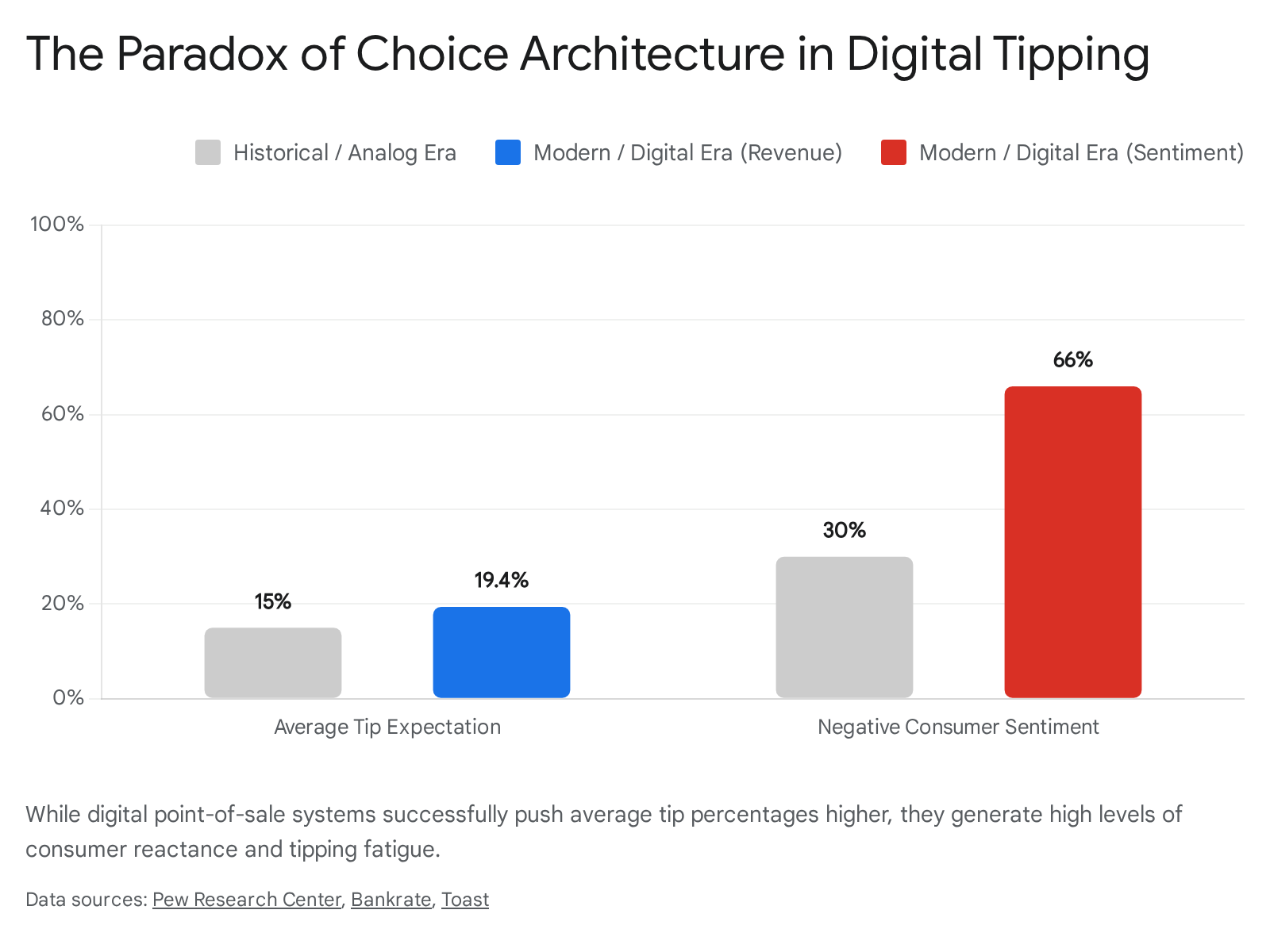
While choice architecture successfully maximizes short-term tipping revenue, it relies on psychological friction that degrades consumer sentiment. The expansion of tipping prompts into historically non-tipped, counter-service, and retail environments has triggered severe cultural pushback 91022.
Tipflation and Tip Creep
Consumer frustration is currently driven by two distinct but interrelated phenomena documented in recent economic literature: 1. Tipflation: The escalation of suggested tip percentages. Historically centered around 15%, digital screens now frequently present 18%, 20%, or 25% as the baseline options, functionally hiding the traditional 15% rate behind "Custom Amount" menus 91023. 2. Tip Creep: The proliferation of tip prompts into non-traditional contexts. POS systems now solicit tips at bakeries, self-service kiosks, movie theaters, and retail stores where human service is minimal 11192224.
Survey data highlights a stark erosion of consumer patience. A 2023 Pew Research Center study found that 72% of American adults report tipping is expected in more places today than five years ago 2835. A subsequent 2024 Bankrate survey revealed that 66% of Americans hold a negative view of modern tipping culture, with 30% stating the practice has spiraled "out of control" and 41% arguing that businesses should pay employees better rather than relying on gratuity 101535.
Reactance Theory and High Defaults
The psychological backlash against aggressive choice architecture is explained by Reactance Theory, which posits that when individuals perceive their freedom of choice is being restricted or manipulated, they assert autonomy by rebelling against the pressure 1516. When tip defaults are set excessively high, consumers feel coerced 1515.
Research on taxi tipping identified the limits of anchoring: while higher defaults raise the average tip among those who choose to tip, they also significantly increase the proportion of consumers who bypass the defaults entirely to leave a $0 tip 1625. This indicates a threshold where perceived manipulation overrides the desire to conform. Furthermore, aggressive pre-service tip requests in emerging contexts have been empirically shown to induce negative emotional reactions, lower the perceived deservingness of the employee, and reduce overall satisfaction with the establishment 22262728.
Platform-Mediated Transactions and Open-Market Bidding
The rise of platform-to-consumer delivery services, such as DoorDash, UberEats, and Deliveroo, introduces a third paradigm into the psychology of gratuity. In these decentralized environments, tipping is fundamentally decoupled from its historical definition as a post-service reward for quality 29413043. Platform interfaces have structurally transformed the gratuity into a pre-service bid in an open labor market 444531.
The Tip as a Service Bid
Traditional tips are determined after the completion of a meal or a taxi ride. In contrast, major food delivery platforms prompt the user to input a gratuity at the point of checkout, prior to food preparation or driver assignment 92941. Because gig workers on these platforms act as independent contractors and are shown the estimated payout of a delivery before choosing to accept or decline the contract, the upfront "tip" acts as an explicit incentive mechanism to attract labor 4132.
If a user selects a $0 or low tip, drivers frequently reject the order, causing the delivery to be delayed, arrive cold, or sit unfulfilled entirely 294133. Therefore, the psychological motivation for the consumer shifts entirely from retrospective gratitude to prospective risk mitigation 2945. Consumers learn that the platform's label of "tip" is a semantic misnomer; it functions as an unregulated priority fee or a blind auction bid for basic service 294145.
Information Asymmetry and Transactive Friction
Platform-mediated tipping relies on profound information asymmetry. Customers are rarely fully aware of how the platform distributes extensive service and delivery fees versus tips 3541. High baseline charges set by the platforms create an illusion that the driver is adequately compensated by the corporation, providing cognitive justification for consumers to lower or omit their tips entirely 41.
When consumers recognize that their "tip" is heavily subsidizing the platform's low algorithmic base pay rather than acting as a bonus, resentment builds. This environment strips the transaction of social rapport 1244. The digital interface eliminates the physical presence of the worker at the moment of the financial decision, insulating the consumer from the immediate social judgment that drives in-person POS tipping 45. Concurrently, it creates a hostile dependency loop: workers require the pre-tip to achieve a living wage due to low base pay, while consumers resent negotiating a gratuity for a service they have not yet received 4131.
| Platform Mechanism | Psychological Impact on Consumer | Impact on Gig Worker |
|---|---|---|
| Pre-Service Tip Prompt | Shifts mindset from reward to bidding/risk mitigation | Uses tips as the primary metric for accepting/declining work |
| High Service Fees | Creates illusion of worker compensation, reducing tip intent | Relies entirely on customer tips due to low algorithmic base pay |
| Private Digital Checkout | Removes social surveillance, making zero-tipping easier | Increases reliance on platform punitive measures to enforce tips |
Global and Cultural Divergence
The psychological reception of digital tipping technology is not uniform. Because tipping is intrinsically tied to regional labor norms and cultural concepts of dignity, the friction caused by POS systems and delivery applications varies dramatically across the globe 34.
Northern Europe and Resistance to Nudges
In Europe, tipping has traditionally been a modest, post-service gesture, such as rounding up the bill or leaving 5 - 10%. Robust labor laws and service-inclusive pricing ensure living wages for hospitality workers, neutralizing the wage-subsidy dynamic present in the United States 2034. However, the influx of US-designed digital POS systems is actively disrupting these stable norms.
In Germany, the introduction of the digital "tip button" (Trinkgeld button) on card readers - frequently anchored at 10%, 15%, and 20% - is pushing tips to artificially high levels through the decoy effect 20. The psychological reaction across Northern Europe is highly skeptical. A comprehensive survey of consumers across Norway, Sweden, Denmark, Finland, and Iceland found that 75% believe digital tipping has had a negative impact on Nordic culture, with 79% stating that default suggestions above 10% are highly inappropriate at quick-service locations 3536. Consumers in these regions view the digital tip screen not as a convenience, but as an intrusive commercial import that violates the cultural spirit of voluntary gratitude 2036.
East Asia and Cultural Incompatibility
In East Asia, the cultural framing of service creates an even stronger barrier to Western tipping mechanics. In Japan and South Korea, providing excellent service is viewed as a fundamental professional duty, and the cost of labor is strictly baked into the listed price of goods 34525337. Attempting to leave a financial tip is frequently interpreted as insulting, as it implies the employer fails to value or compensate the worker adequately 345556.
When Western POS systems and platforms attempt to force tipping into these markets, the psychological reactance is fierce. In South Korea, local experiments with physical tip boxes and digital POS tipping prompts in 2023 and 2024 sparked intense viral backlash 533738. The public viewed the prompts as "un-Korean" and a deceptive mechanism for owners to shift operational costs onto consumers. Consequently, Korean law strongly enforces "final price display" mandates, making hidden service charges illegal and suppressing the spread of POS tipping 3738. Similarly, commercial ventures attempting to introduce American tipping practices into Japan, such as the "Tip Project" in 2021, have failed due to profound cultural incompatibility 3940.
Digital Micro-Transactions in China
Paradoxically, while East Asia rejects POS gratuity for physical services, it is highly receptive to digital gratuity for online content creation. In China, platforms like WeChat Pay and Alipay have popularized massive digital tipping economies 4142. However, this tipping operates under an entirely different psychological framework: it traces its roots to online gaming, live streaming, and patronage for independent writers, rather than the food service industry 4143. In these digital ecosystems, tipping is a frictionless, micro-transactional expression of fan support and social appreciation, completely devoid of the guilt, social surveillance, and wage-subsidy obligations associated with Western POS systems 5244.
Summary Observations
The transition from analog to digital transaction mediums has profoundly fractured the psychological contract of service gratuity.
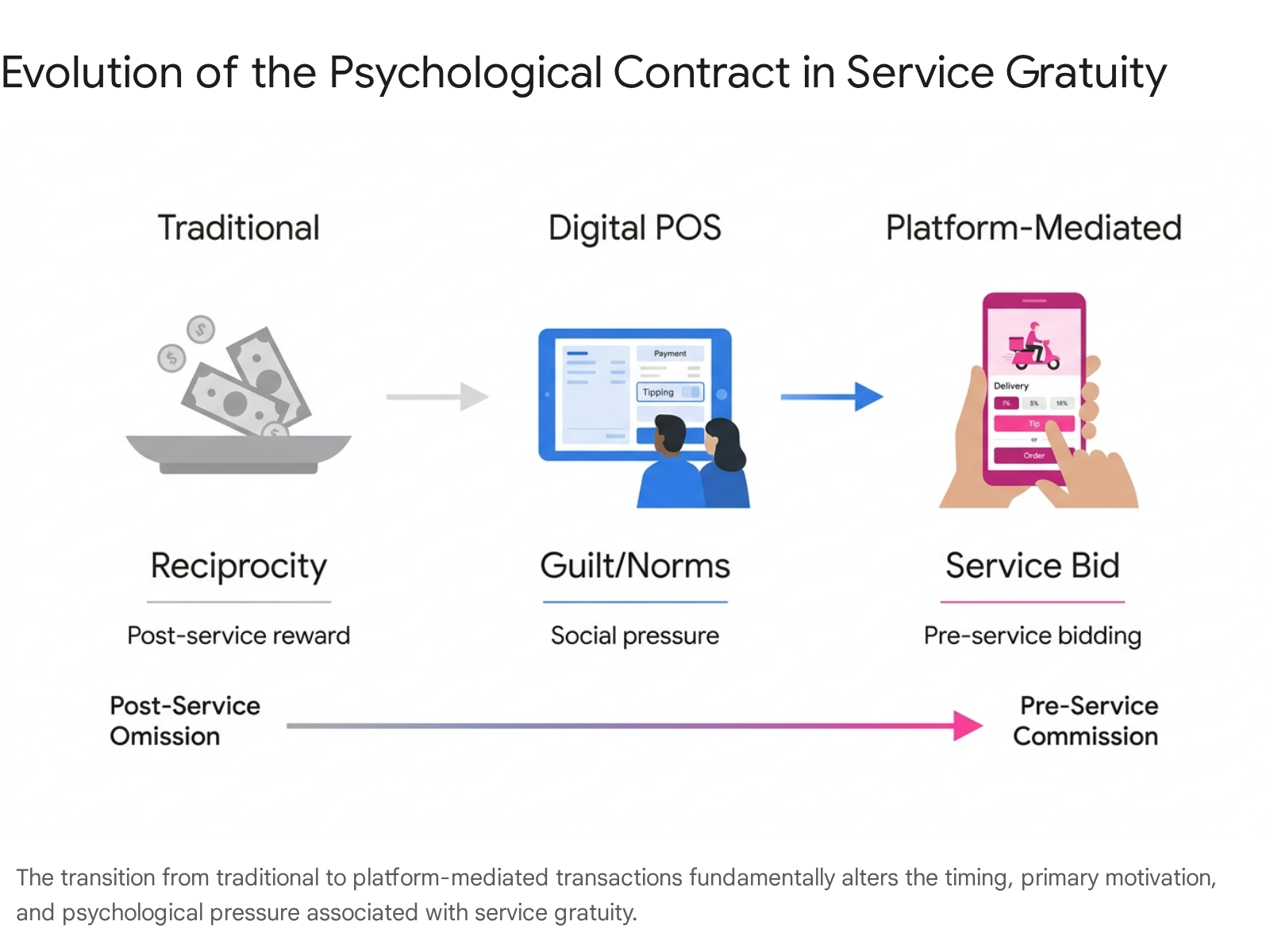
In traditional settings, the omission-based nature of the tip jar allowed consumers to navigate social expectations with minimal cognitive friction, driven largely by conformity and mild reciprocity.
The widespread deployment of digital point-of-sale systems fundamentally altered this dynamic. By utilizing choice architecture, establishing high default anchors, and forcing an active commission under direct social surveillance, merchants have effectively weaponized consumer guilt. While this successfully increases short-term tip percentages, it generates deep psychological reactance, manifesting as "tipflation" fatigue and consumer resentment.
Simultaneously, platform-mediated gig applications have stripped the tip of its retrospective reward function entirely, transforming it into a pre-service open-market bid. This isolates the consumer from the worker socially, while pitting them against one another economically in an environment of high information asymmetry. Ultimately, the digitalization of tipping demonstrates the boundaries of behavioral nudging: while interfaces can be engineered to extract higher revenues through social pressure, the resulting psychological exhaustion threatens the long-term viability of the practice.