
Psychology of price endings and brand signaling
The strategic manipulation of the rightmost digits in retail pricing is a foundational element of behavioral economics and market positioning. For decades, the ubiquitous .99 price ending has been utilized to signal economic value and promotional discounting, while the .00 price ending has served as an indicator of premium quality and brand prestige. However, the psychological mechanisms underpinning these consumer reactions extend far beyond simple pricing heuristics. They encompass complex cognitive processes involving numerical magnitude perception, processing fluency, semantic signaling, and cultural numerology. As global markets evolve, the efficacy of these pricing tactics is increasingly subject to rigorous boundary conditions, including consumer thinking styles, product categories, regional cultural contexts, and macroeconomic environments characterized by heightened inflation and consumer skepticism.
Cognitive Mechanisms Underlying Numerical Perception
The dichotomy between odd-ending prices (charm pricing) and round-ending prices is rooted in two competing cognitive frameworks: the left-digit effect and the perceptual fluency effect. Consumers process price endings through these dual, often competing, cognitive mechanisms. Odd endings trigger left-to-right magnitude anchoring, driving value perceptions and underestimations of cost. Conversely, round endings facilitate cognitive ease and low cognitive load, generating a positive affect that drives quality appraisals. These mechanisms operate simultaneously within consumer decision-making processes, dictating whether a price is evaluated primarily on its economic magnitude or its aesthetic and semantic connotations.
The Left-Digit Effect in Magnitude Encoding
The left-digit effect (LDE) refers to the psychological phenomenon in which consumers disproportionately anchor their perception of a number's magnitude on its leftmost digit. Because humans process Western numerals sequentially from left to right, the initial digit establishes an immediate, overarching magnitude anchor before the subsequent right-hand digits are fully encoded into working memory 12. Consequently, a price of $2.99 is frequently encoded not as a value marginally below three dollars, but rather as a value situated firmly within the two-dollar psychological range.
Empirical research extensively documents the conditional nature of this bias. In a seminal series of experiments examining the LDE, researchers established that the perceived magnitude difference between $2.99 and $3.00 is significantly greater than the mathematical one-cent difference solely because the leftmost dollar digit changes 345. When comparing prices where the leftmost digit remains constant, such as $3.59 and $3.60, the psychological magnitude drop is entirely absent 3.
The effectiveness of the LDE is heavily moderated by the numerical and psychological distance between the prices being compared. The cognitive bias is most pronounced when comparing competing prices that are numerically close. For instance, evaluating a target brand priced at $3.99 against a standard competitor priced at $5.00 triggers the LDE, whereas evaluating the same $3.99 target against a competitor priced at $6.00 significantly diminishes the effect 3. Response latency studies further corroborate this mechanism; changing the leftmost digit to a lower number (e.g., $4.99 versus $5.00) systematically reduces the time required for a consumer to categorize the price as "low" compared to a $5.50 benchmark 3. Conversely, transitioning from $5.99 to $6.00 increases the cognitive response time necessary to evaluate the magnitude 3.
Despite the pervasive reliance on the LDE in retail environments, the effect is not absolute. Meta-analyses of just-below pricing, aggregating hundreds of effect sizes, indicate that while 9-endings reliably increase purchase decisions and yield an advantageous price image, the overall effect sizes are small, highly heterogeneous, and heavily dependent on specific participant and product characteristics 67. Furthermore, contemporary large-scale, pre-registered online experiments have occasionally failed to reproduce strong left-digit effects across randomized purchasing scenarios 28. Researchers posit that modern consumers, subjected to decades of ubiquitous charm pricing, may deploy compensatory decision heuristics - such as conscious mental rounding - to intentionally mitigate their susceptibility to the bias 28.
Processing Fluency and Aesthetic Appraisal
In direct tension with the left-digit effect is the concept of processing fluency, which examines the cognitive ease with which numerical stimuli are processed and encoded by the human brain. Round numbers, such as $100.00 or $20.00, are highly prevalent in everyday human communication and mathematically simpler to manipulate in working memory. As a result, they possess significantly higher cognitive processing fluency than precise or odd numbers 689.
The perceptual fluency effect posits that this ease of processing translates directly into an affective evaluation. Because round prices require less cognitive exertion to encode, they generate a subtle aesthetic pleasure or a positive affective state in the perceiver 2. Consumers routinely misattribute this positive affect to the product itself, leading to higher appraisals of the product's overall quality, completeness, and prestige 810. This mechanism explains why consumers rely on odd-even pricing heuristics where round numbers are subconsciously associated with honesty and premium quality, whereas precise or odd numbers suggest calculative discounting, rigid cost-plus margin targeting, or a lack of brand confidence 610.
The perceptual fluency effect operates robustly at higher price levels, where the absolute value of the purchase makes the cognitive strain of fractional mathematics more salient. While the LDE may dominate low-involvement, low-cost purchases, processing fluency becomes the dominant psychological driver as absolute prices increase, explaining the shift in optimal pricing strategies across different market segments 68.
The Moderating Role of Cognitive Thinking Styles
The susceptibility to psychological pricing is further moderated by the inherent thinking styles of the target consumer demographic. A comprehensive study utilizing 932 consumers across four experiments isolated the impact of analytic versus holistic thinking styles on price perception 11.
Analytic thinkers process information by viewing parts of a complex system as separate and independent entities. In a retail pricing context, they evaluate the digits of a price sequentially and independently, with their focal attention disproportionately weighted toward the leftmost digit. Consequently, analytic thinkers are highly susceptible to the underestimation effects of nine-ending pricing 11.
Holistic thinkers, by contrast, view environmental elements as interconnected and inseparable parts of a unified whole. They are more likely to encode the entire price tag as a single, cohesive numerical entity, making them generally immune to the underestimation effect of a .99 ending when evaluated under normal conditions. However, the study identified cognitive load as a strict boundary condition for this immunity. When holistic thinkers are subjected to time pressure, distraction, or mental fatigue, their cognitive resources are depleted. Under these resource-constrained conditions, holistic thinkers fall back on the low-effort analytic heuristic, responding to nine-ending prices with the same left-digit susceptibility as analytic thinkers 11.
| Cognitive Mechanism | Primary Pricing Trigger | Underlying Psychological Process | Resulting Consumer Perception |
|---|---|---|---|
| Left-Digit Effect (LDE) | .99 / .95 / .97 endings | Left-to-right sequential encoding; over-weighting the initial digit. | Magnitude underestimation; perception of a discount or strong economic value. |
| Perceptual Fluency Effect (PFE) | .00 / Round endings | Low cognitive load; mathematical simplicity in encoding. | Aesthetic pleasure; misattribution of positive affect to product quality and honesty. |
| Analytic Thinking Style | N/A (Trait-based) | Independent evaluation of isolated digits. | High susceptibility to charm pricing under all standard conditions. |
| Holistic Thinking Style | N/A (Trait-based) | Interconnected evaluation of the entire numerical string. | Resistance to charm pricing, unless subjected to high cognitive load or time pressure. |
Brand Positioning and Semantic Signaling
The intentional selection of a specific price ending serves as a direct signaling mechanism that communicates brand positioning to the broader market. Because consumers rarely possess perfect, symmetric information regarding a product's true manufacturing cost or objective quality, they rely heavily on extrinsic cues to infer these invisible attributes. The formulation of the price itself acts as a primary extrinsic cue.
Charm Pricing and the Value Signal
Prices ending in 9 or 99 - colloquially termed "charm pricing" - are the global retail standard for signaling value, affordability, and promotional discounts 121313. The historical origins of this tactic are debated; some researchers trace its proliferation to an 1880 Macy's advertisement in the New York Times featuring black silk priced at $0.99, $1.49, and $1.99, while others attribute it to an early anti-theft measure designed to force retail clerks to open the cash register to make change, thereby recording the sale 714. Regardless of its origin, the contemporary application of charm pricing is heavily validated by empirical sales data.
Across multiple market studies, charm prices have been shown to increase sales conversions by averages ranging from 8% to 24% compared to proximal rounded prices 1121516.
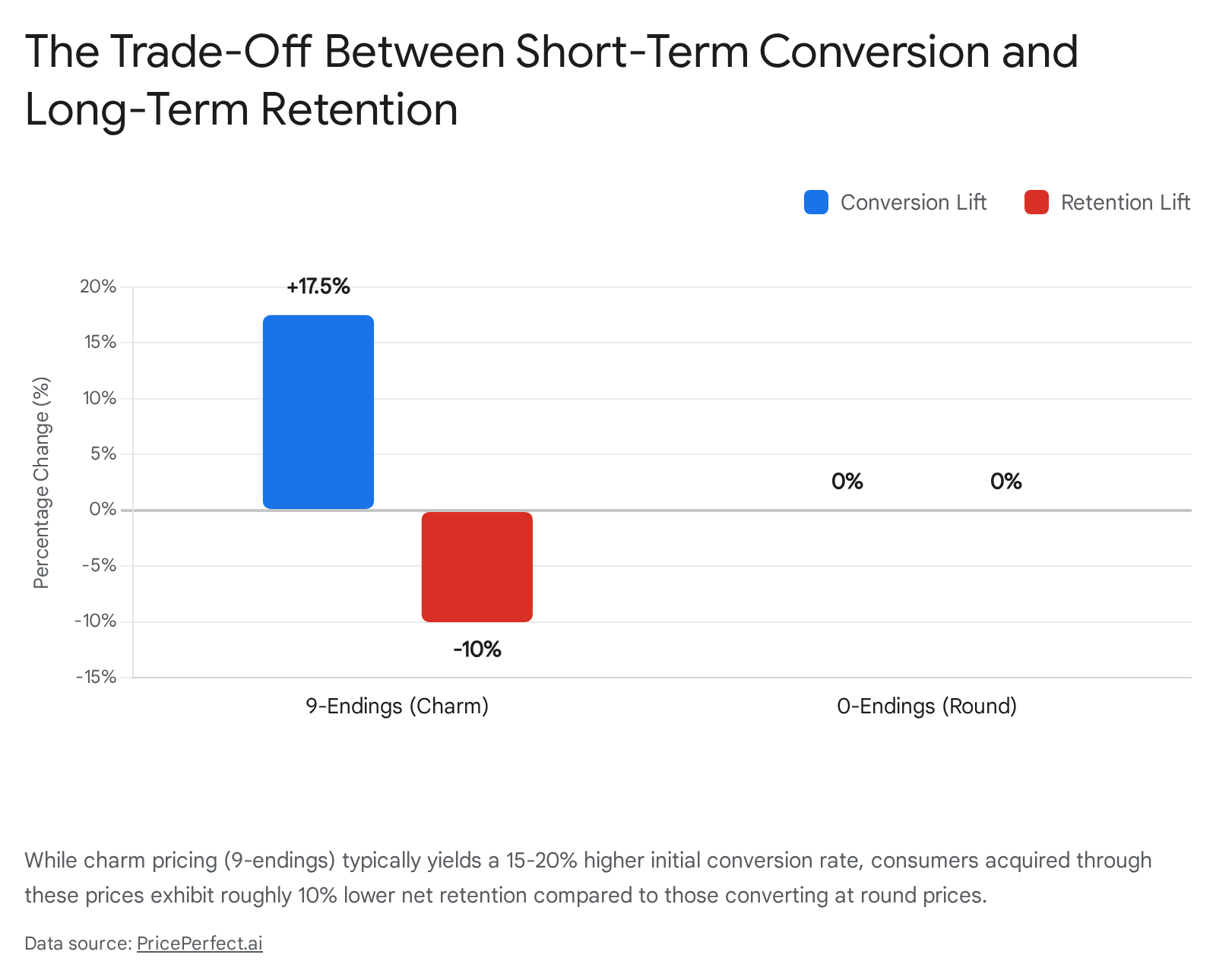
In highly controlled experimental settings involving direct mail catalogs, researchers observed that an item priced at $39 consistently outsold identical items priced at $34 and $44 1215. This illustrates a profound behavioral anomaly: the psychological signal of the 9-ending can sometimes override the rational, mathematical advantage of an objectively lower absolute price 121516.
The efficacy of the .99 signal is deeply dependent on the product's baseline cost and the frequency of the digit change. The magnitude of the psychological effect scales logarithmically; the transition from $10 to $9 creates a much stronger behavioral impact than the transition from $100 to $99, and vastly more than the transition from $1,000 to $999 12.
While the tactic successfully drives short-term sales velocity and is virtually mandatory for fast-moving consumer goods (FMCG) and discount retail, it inherently signals a lack of prestige. Prospect theory suggests that consumers associate the 9-ending with aggressive cost optimization, deep discounting, and mass-market positioning, which inadvertently communicates lower product quality to the buyer 1617.
Prestige Pricing and the Quality Signal
When a brand strategy emphasizes exclusivity, expert craftsmanship, and premium quality over economic value, round numbers are deployed to reinforce that positioning 121316. Termed "prestige pricing," the deliberate use of zero-endings (e.g., $100, $500, $1,000) intentionally bypasses the bargain-hunting circuitry of the consumer's brain, catering instead to the desire for status and aesthetic completion.
Round numbers convey an implicit "don't sweat the small stuff" mentality 15. This pricing architecture suggests that the product's intrinsic value is so self-evident and superior that it does not require aggressive, penny-pinching psychological manipulation to secure a sale 1516. High-end boutiques, luxury vehicle manufacturers, and fine dining establishments deliberately avoid charm pricing to prevent cognitive dissonance 1316. If a brand competing on premium features and superior support suddenly utilizes a $199.99 price tag, the dissonance between the high-status product and the low-status pricing mechanism erodes brand equity and signals desperation to the target demographic 121316.
Boundary Conditions in Business-to-Business Markets
The aggressive application of charm pricing can severely backfire when deployed outside of standard consumer retail environments, particularly within business-to-business (B2B) transactions and high-stakes professional services 1318.
In B2B enterprise sales, procurement buyers evaluate the entire ecosystem of a transaction, prioritizing total cost of ownership, risk mitigation, and long-term vendor stability. While lower-tier, standardized Software-as-a-Service (SaaS) subscriptions targeting small businesses may successfully utilize $99-per-month pricing tiers, high-touch enterprise software and consulting services actively avoid it 12. At the enterprise level, a platform is typically priced at standard round numbers (e.g., $150 per user per month rather than $149) because organizational buyers expect complex, customized negotiations 12. In these contexts, charm pricing suggests inflexibility, unsophistication, or a rigid commoditization of the service that precludes volume discounting or tailored service level agreements 12.
Similarly, for legal, financial, or high-end consulting services, establishing a pricing structure ending in .99 actively undermines the firm's professional authority 1316. Because professional services rely fundamentally on credibility, buyers of these services are highly analytical. Utilizing left-digit manipulation on a Chief Financial Officer or a corporate procurement team is often perceived as a deceptive tactic. This erodes the foundational trust necessary for long-term contract negotiation, framing the service provider as a transactional vendor rather than a strategic partner 1213.
Cultural Numerology and Global Pricing Adaptations
Pricing strategies that perform optimally in Western markets frequently fail in international contexts due to varying cultural paradigms regarding numbers. While early behavioral economics historically treated price-ending effects as universal cognitive traits, modern global market analysis reveals that consumer susceptibility is deeply intertwined with linguistic phonetics, historical bargaining legacies, and profound cultural symbolism 1019.
Western Ubiquity of the Nine-Ending
In low-context Western cultures, including North America and Northern Europe, consumers extract information directly from the explicit message of the price tag rather than embedding it in complex cultural symbolism 1020. The number 9 overwhelmingly dominates these markets, appearing in a vast majority of retail transactions - estimated at over 60% to 70% in certain retail categories 1021. Western consumers accept the 9-ending as a standard, transparent market signal for value; the emotional comfort in these regions is derived from the feeling of securing a rational bargain and validating one's identity as a "smart shopper" 101415. Furthermore, in North American markets, the number 7 is also frequently utilized to signal a precise, calculated cost, serving as an effective middle ground between the heavy discount perception of a 9 and the premium, untouchable feel of a round number 2324.
Auspicious Digits and Phonetic Pricing in Asian Markets
In high-context Asian markets, particularly within Chinese and Cantonese-speaking demographics, phonetic alignment and cultural numerology completely override traditional Western left-digit bias principles 102122. The number 8 (pronounced bā in Mandarin) is phonetically highly similar to the word for "wealth," "prosper," or "multiply" (fā) 102627.
This linguistic alignment transforms the 8-ending price from a mere mathematical figure into a powerful cultural signal of luck, prosperity, and goodwill 1026. Consumers willingly pay substantial premiums for properties, licenses, telephone numbers, and retail products associated with the number 8, making it an optimal price ending for both everyday FMCG goods and extreme luxury items 192223. Marketers actively leverage complex combinations to maximize positive affect, such as 168 (pronounced yī lù fā, meaning "prosperity all the way"), 520 (wǒ ài nǐ, sounding akin to "I love you"), and 999 (jiǔ jiǔ jiǔ, symbolizing eternity and longevity) 22. In real estate, pre-owned condominiums in regions like Chengdu and Hong Kong sell at demonstrably higher prices and move more quickly if located on floors ending in 8 1923.
Conversely, the number 4 (pronounced sì) is strictly avoided across pricing, real estate, and product models because its pronunciation closely resembles the word for "death" (sǐ) 2122. Utilizing a 4-ending in pricing or packaging in these markets introduces severe negative affect, generating immediate brand avoidance and product rejection 2122.
| Cultural Number | Primary Phonetic / Symbolic Meaning | Market Application & Consumer Response |
|---|---|---|
| 8 (bā) | Sounds like "fā" (Wealth, Prosper) | Highly auspicious. Used across all pricing tiers to signal luck. Generates massive price premiums in real estate and luxury. |
| 4 (sì) | Sounds like "sǐ" (Death) | Highly inauspicious. Strictly avoided in retail pricing, floor numbers, and phone numbers to prevent brand avoidance. |
| 6 (liù) | Smoothness, ease ("liù liù dà shùn") | Auspicious. Utilized to signal frictionless transactions and smooth business operations. |
| 9 (jiǔ) | Longevity, eternity, imperial power | Auspicious in Asia (longevity); in the West, it is the primary signal for value and discounting. |
| 2 (èr / liǎng) | Harmony, pairs, balance | Auspicious. Used to signal relationship harmony and completeness. |
Regional Skepticism and Context-Dependent Heuristics
Pricing norms also shift significantly based on historical economic contexts and localized preferences. In Japanese markets, research shows that consumers exhibit significantly higher conversion rates - upwards of 15% to 20% - with round pricing structures (e.g., ¥1,000) rather than charm prices (e.g., ¥999) 21. This directly contradicts Western pricing psychology research and reflects a distinct cultural preference for simplicity, social harmony, and mental calculation ease over the aggressive pursuit of minor discounts 21.
In Eastern Europe, research indicates that consumers frequently reject 9-ending prices, viewing them with intense skepticism. These demographics often associate charm pricing with manipulative sales tactics and deceptive marketing - a legacy inherited from the confrontational bargaining cultures of the post-Soviet era 10. In the Middle East, while the numbers 9 and 99 can sometimes be associated with harmony and completeness (and are often utilized in jewelry and design motifs), modern e-commerce data from the United Arab Emirates and Saudi Arabia reveals that recent aggressive price inflation has made consumers highly price-sensitive. In these regions, consumers increasingly prioritize absolute price drops and broad omni-channel value over the subtle psychological nudges of specific ending digits 2424.
Macroeconomic Volatility and Algorithmic Pricing
The broader macroeconomic environment heavily dictates the effectiveness and consumer reception of psychological pricing. During periods of sustained volatility, such as the 2022 - 2024 global inflation surge, consumer price sensitivity and awareness undergo significant shifts, permanently altering baseline responses to historical pricing tactics 2526.
Inflationary Pressures and Promotional Habituation
During intense inflationary cycles, consumers become hyper-aware of costs, accelerating market share shifts toward value-segment retailers. The continuous upward adjustment of prices erodes standard reference prices within the consumer's memory. In this environment, the "always on sale" charm pricing tactic begins to lose its efficacy due to consumer habituation. Research tracking e-commerce behavior during recent inflationary periods indicates severe diminishing returns to promotional frequency, with retailers experiencing negligible revenue gains beyond three promotions per quarter 2532. Habitual discounting erodes the reference price, leading consumers to view the "discounted" .99 price as the actual baseline cost rather than a temporary bargain 32.
When businesses must implement unavoidable price increases, the architecture of the increase heavily influences perceived fairness. Research in the restaurant sector during high-inflation periods indicates that consumers perceive a direct, transparent increase in menu prices (even when utilizing round numbers) as significantly fairer and more trustworthy than the implementation of deceptive percentage surcharges or convoluted fractional pricing added at the point of sale 26.
Shrinkflation Aversion and the Left-Digit Effect in Quantities
As production and material costs rise, brands frequently deploy "shrinkflation" - the practice of reducing the size, volume, or weight of a product while maintaining the existing retail price 33. While consumers generally exhibit profound "shrinkflation aversion" - judging hidden size reductions as far more unfair and deceptive than equivalent, transparent price increases - manufacturers still rely heavily on cognitive limitations to mask these physical changes 33.
Recent marketing literature has successfully extended the left-digit effect from the domain of pricing to the domain of physical product quantities. Shrinkflation is significantly less noticeable to consumers when the volume reduction does not alter the leftmost digit. For example, a manufacturer downsizing a package from 450 grams to 445 grams experiences minimal consumer backlash 3334. However, a mathematically identical 5-gram reduction that crosses a numerical threshold - such as downsizing from 400 grams down to 395 grams - triggers immediate cognitive recognition. Because consumers process the magnitude of the weight primarily via the left digit, thresholds that force a change in the leading digit expose the downsizing immediately. This triggers acute cognitive dissonance, highly negative brand impressions, and a severe loss of long-term consumer trust 333435. Furthermore, consumers also anchor on standardized fractional quantities (e.g., 750 ml as exactly 3/4 of a liter); deviations from these standardized cognitive anchors are penalized heavily by the market 27.
Algorithmic Precision and Consumer Trust
The exponential growth of digital commerce has led to the proliferation of dynamic and algorithmic pricing, allowing retailers to adjust prices in real-time based on supply, demand, and individual user data. However, when algorithms generate highly precise, non-standard price endings (e.g., $14.37 or $82.11), they break established cultural pricing norms 1028.
While precision can sometimes signal rigorous cost-calculation, in a consumer retail setting, it often triggers skepticism. If consumers detect that prices are fluctuating rapidly or are personalized based on their browser history, the lack of traditional round or charm endings signals algorithmic exploitation and digital price gouging rather than a standard retail discount 1032. When consumers discover they are subject to AI-driven price discrimination, they experience a profound loss of agency, triggering retaliatory behaviors and immediate market disengagement 10. Consequently, businesses utilizing dynamic pricing must balance mathematical optimization with perceived fairness. This often requires programming pricing algorithms to intentionally "snap" to culturally accepted price endings (e.g., rounding an algorithmic $14.37 to $14.50 or $14.99) to maintain consumer trust and conceal the volatility of the underlying dynamic pricing engine 1028.
Extrapolation to High-Stakes and Non-Retail Domains
The heuristics that govern the evaluation of retail prices - specifically the left-digit bias and round-number anchoring - manifest prominently in non-retail contexts involving high-stakes quantitative judgments. The prevailing assumption that trained experts are immune to basic numerical framing is routinely challenged by empirical data across medicine, legal negotiations, and macroeconomic forecasting.
Medical Diagnostics and Legal Negotiations
In medical decision-making, the left-digit bias significantly alters clinical interventions and testing protocols. Empirical studies utilizing large-scale health databases indicate that testing and diagnosis rates for certain conditions spike discontinuously immediately after a patient crosses a left-digit age threshold, such as turning exactly 40 years old 9. Conversely, disparities in life-saving treatments - such as aggressive cancer interventions or surgical procedures for the elderly - have been noted to drop off sharply the moment patients cross the age of 80 9. Medical professionals mentally reclassify patients based on these round-number chronological thresholds, despite the complete absence of formal biological or clinical guidelines recommending abrupt, binary changes in care at those specific numerical boundaries 9.
In the legal and financial domains, similar magnitude drops occur. An exhaustive analysis of tens of millions of used-car transactions reveals massive, discontinuous drops in wholesale prices the exact moment an odometer reading crosses a 10,000-mile threshold (e.g., transitioning from 79,999 to 80,000 miles) 293040. This price drop far exceeds the actual mechanical depreciation value of a single mile, entirely driven by the buyer's left-digit inattention 40. Furthermore, in formal dispute resolution and legal settlement negotiations, the use of precise anchors (e.g., a demand of $1,015,000) leads to smaller, more favorable counter-adjustments from the opposing party than round anchors (e.g., $1,000,000). The precise number implies rigorous, unyielding calculation and deep domain knowledge, whereas the round number is interpreted as an arbitrary, negotiable estimation 30.
Household Inflation Expectations
One of the most profound and globally relevant impacts of the left-digit bias occurs in macroeconomic forecasting and the formation of household inflation expectations. Recent macroeconomic research modeling European Central Bank (ECB) data demonstrates that households process inflation figures subject to severe left-digit bias 2941.
When the official, published inflation rate crosses a salient round-number threshold - particularly multiples of five, such as an increase from 4.9% to 5.0%, or from 9.9% to 10.0% - household inflation expectations jump discontinuously, often by a full percentage point 2941. Because consumers anchor deeply on these leading digits, a statistically minor threshold crossing can trigger disproportionate macroeconomic responses, including demands for higher wages and preemptive major purchases, which paradoxically fuels actual current inflation 2931. Central banks and economic media are increasingly advised to manage the communication of rates carefully, recognizing that reporting a 9.9% versus a 10.0% inflation rate elicits vastly different psychological reactions and subsequent economic behaviors across the populace, despite their statistical proximity 2931.