
The psychology of magical thinking and ritual
Magical thinking - the attribution of causal relationships between actions and events that cannot be justified by reason, observation, or the established laws of physics - is a universal and enduring human phenomenon. Far from being a mere relic of pre-industrial societies or a transient developmental stage of early childhood, symbolic and superstitious behaviors persist tenaciously across all cultures, geographical boundaries, and demographic strata. The scientific investigation of magical thinking requires a comprehensive, multidisciplinary approach, bridging evolutionary biology, cognitive psychology, neurobiology, and cultural anthropology. From the localized animistic rituals of Amazonian foragers to the algorithmic superstitions and manifestation trends of modern social media users, the human impulse to infer hidden connections, transfer spiritual essences, and interpret random variables as purposeful reveals the fundamental architecture of the human mind.
This report provides a systemic examination of the underlying mechanisms that govern magical thinking. It synthesizes current research concerning the evolutionary drivers that originally selected for prosocial rituals, the deeply ingrained cognitive heuristics that dictate sympathetic magic, the specific neurobiological networks that mediate symbolic processing, and the clinical boundaries that distinguish normative cultural superstitions from pathological psychiatric conditions such as Obsessive-Compulsive Disorder. Furthermore, it explores how these ancient cognitive reflexes adapt to contemporary digital environments, manifesting as "algorithmic folklore" in the age of artificial intelligence.
Evolutionary and Adaptationist Origins
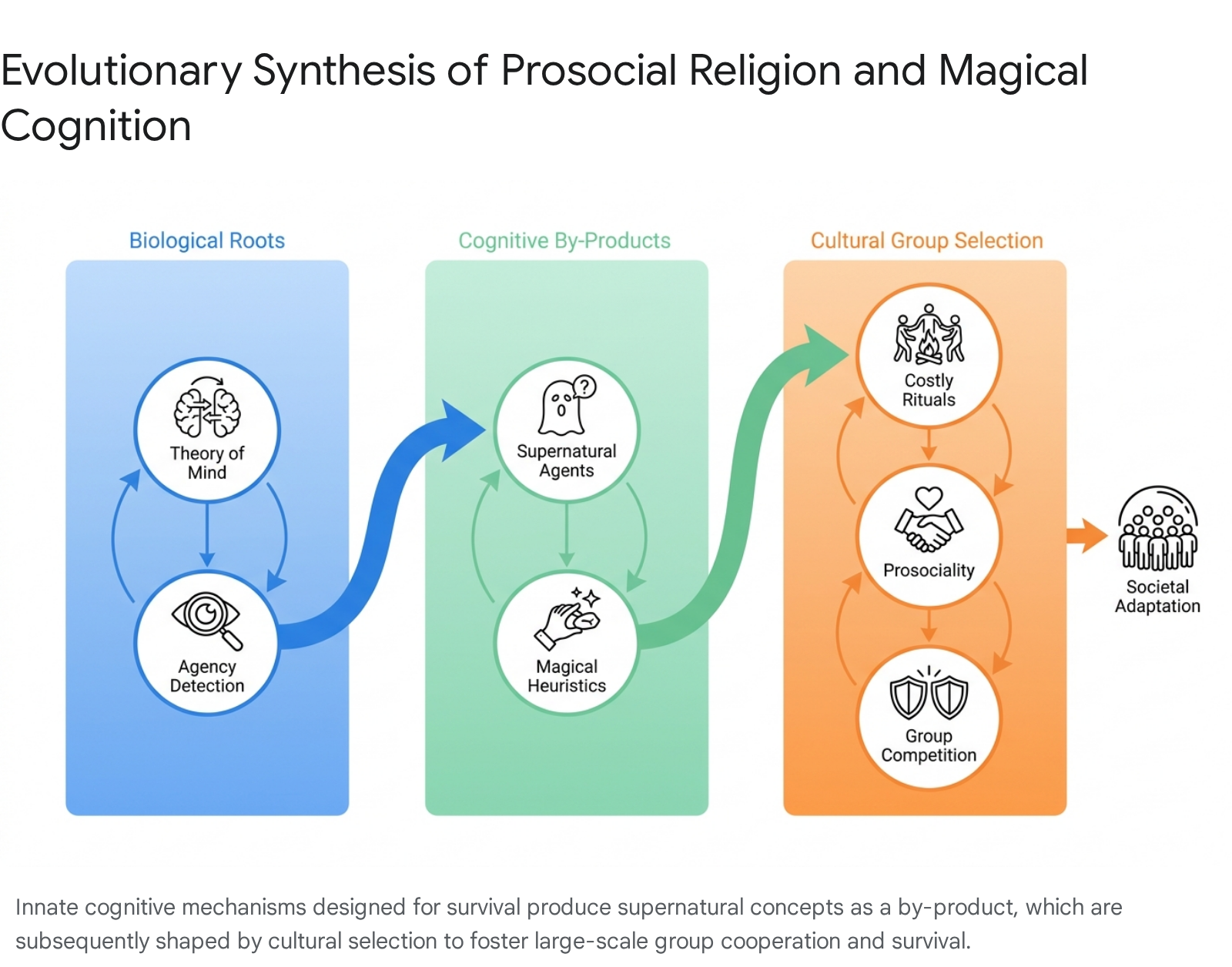
The enduring persistence of religion, superstition, and ritual across millennia presents a distinct evolutionary puzzle to behavioral scientists: why do human beings consistently invest extraordinary amounts of time, energy, and resources into practices that yield no direct, observable material benefit? Theoretical frameworks addressing this question have historically been divided into two primary camps: the cognitive by-product hypothesis and the adaptationist model. Recent anthropological consensus and cultural evolutionary theory suggest that these two perspectives are not mutually exclusive, but rather function as sequential phases in a long-term cultural evolutionary process 123.
The Cognitive By-Product Hypothesis
The cognitive by-product hypothesis posits that magical and religious beliefs originally arose as nonadaptive, incidental outcomes of innate cognitive functions designed for mundane, everyday survival tasks 34. Throughout evolutionary history, the human brain developed highly robust neural mechanisms for navigating complex social environments and avoiding predators. Two of the most significant mechanisms in this regard are "theory of mind" and the "hyperactive agency detection device" (HADD) 235. Theory of mind enables human beings to attribute beliefs, desires, and intentions to others, which is a critical skill for managing social cooperation, predicting behavior, and recognizing deception within a group. Concurrently, HADD functions as an evolutionary survival mechanism that biases humans toward detecting intentional agents even in highly ambiguous situations. From an evolutionary standpoint, the cost of a false positive (e.g., interpreting the rustling of leaves as a hidden predator when it is merely the wind) is negligible, whereas the cost of a false negative (failing to recognize an actual predator) is fatal.
When these highly attuned cognitive reflexes are applied outside their original adaptive contexts, they compel individuals to perceive intentionality and agency in natural, inanimate phenomena. This cognitive misapplication results in the attribution of weather events, the onset of disease, and fluctuations in personal fortunes to supernatural agents, spirits, or unseen cosmic forces 35. Magical beliefs thus emerge because the human brain naturally relies on simple, rapid heuristics and employs them in situations where the standard rules of physical causality are either unknown or inapplicable 6. Even when rational deliberation (System 2 thinking) recognizes a specific magical belief as physically impossible, the rapid, intuitive conclusions drawn by these heuristics (System 1 thinking) often persist. This dual-process architecture allows rational and magical thoughts to cohabit deep inside the human mind simultaneously, constantly negotiating our perception of reality 6.
Cultural Group Selection and Prosociality
While the basic underlying structures of magical thinking may have originated as cognitive by-products, evolutionary anthropologists strongly argue that specific ritualized behaviors and superstitious complexes were subsequently selected for their prosocial benefits 12. In the context of early human history, survival depended heavily upon maintaining large-scale cooperation and mitigating "free-rider" problems within expanding social groups. As tribal societies grew, ensuring trust among strangers became increasingly difficult.
A "package" of culturally evolved religious beliefs and practices - characterized by moralizing supernatural agents, credible displays of faith, and psychologically active rituals - proved highly effective at promoting high fertility rates and enforcing in-group solidarity 23. The performance of costly, emotionally arousing rituals serves as a hard-to-fake, credible signal of commitment to the group 57. Because participating in these rituals requires significant investments of time and resources, or enduring physical discomfort, it reliably separates committed group members from potential exploiters who wish to reap the benefits of the community without contributing. Over millennia, groups that successfully adopted these prosocial religious frameworks outcompeted those that did not. This competitive advantage drove the proliferation of ritualized belief systems through a mechanism known as cultural group selection and gene-culture coevolution, effectively transforming a cognitive glitch into a foundational pillar of human civilization 378.
The Cultural Morphospace of Ritual Form
Cross-cultural data drawn from the Human Relations Area Files, which cover hundreds of religious rituals globally, supports the theory that rituals cluster into specific "modes" based on the structural needs of the host society 9. Ethnographic and archaeological analyses reveal a cultural morphospace that strongly favors two distinct, naturally occurring ritual dynamics: 1. The Imagistic Mode: These are low-frequency, highly dysphorically arousing rituals. They are emotionally intense, often painful rites of passage that forge intense, cohesive bonds in smaller, intimate communities. The shared trauma or high emotional valence ensures long-term episodic memory retention among participants. 2. The Doctrinal Mode: These are high-frequency, low-arousal rituals. Characterized by routine, repetitive practices (e.g., weekly religious services, daily prayers, standardized liturgy), this mode is associated with larger, centralized social structures and the advent of widespread agriculture 9. It relies on semantic memory and allows for the standardization of belief across vast, anonymous populations.
Both ritual modes cue group cohesion, facilitate social trust, and engage with collective neurobiological responses to alleviate societal anxiety, effectively operating as critical mechanisms to maintain the delicate fabric of human social networks in differing environmental ecologies 9.
The Cognitive Architecture of Superstition
If evolutionary theory explains why magical thinking exists as an adaptive tool, cognitive psychology explains how it operates mechanically in real-time. Modern psychological research reveals that magical thinking is not arbitrary or chaotic; rather, it operates according to specific, highly predictable internal rules. Foundational anthropological work by James Frazer and Marcel Mauss, which was later empirically expanded by psychologists Paul Rozin and Carol Nemeroff, categorized these rules as the "Laws of Sympathetic Magic" 1011.
These laws function as powerful cognitive heuristics - mental rules of thumb that operate rapidly and unconsciously to help individuals make sense of the world, avoid danger, and predict outcomes. While these heuristics generally promote adaptive behaviors (e.g., avoiding disease vectors or toxic substances), they frequently overgeneralize, resulting in irrational aversions and magical superstitions even among highly educated, modern adults 12.
The Law of Contagion
The law of contagion holds the foundational premise that "once in contact, always in contact" 1012. It suggests that when two objects make physical contact, an invisible, permanent transfer of properties or "essence" occurs between them 1113. This essence can be interpreted as either physical (e.g., contamination) or moral (e.g., evil), and crucially, it is believed to remain active long after the physical connection has been severed. Contagion operates holographically, meaning that the part strictly equals the whole. Consequently, route and dose sensitivity are completely negligible; a microscopic fragment of a source is subconsciously believed to contain the full power of its original essence 1113.
Empirical studies conducted in Western, highly educated populations repeatedly demonstrate the active, enduring role of contagious magic in modern adult cognition. For instance, in laboratory settings, participants express strong, visceral aversion to consuming a preferred beverage if it has briefly been in contact with a sterilized, completely dead cockroach 10. The heuristic of contagion powerfully dictates that the negative "essence" of the cockroach has permanently corrupted the liquid, entirely overriding the subject's rational knowledge of the object's sterility. Similarly, moral contagion is observed when individuals adamantly refuse to wear freshly laundered clothing previously worn by a disliked figure (e.g., a murderer or dictator), fearing the transfer of negative moral essence to their own person 1012.
Psychological research also indicates that there is a profound "negativity bias" inherent in the law of contagion. Negative entities serve as far more potent sources of contagious essence than positive entities. As researchers note, a drop of sewage ruins a barrel of wine, but a drop of wine does nothing to elevate a barrel of sewage; negative events and essences are cognitively processed as more potent than corresponding positive events 12.
The Law of Similarity
The law of similarity posits the principle that "the image equals the object" and that causes inherently resemble their effects 101112. Action taken on a representation of an object is subconsciously believed to produce an effect on the object itself, an idea most famously represented by traditional "voodoo" practices or effigy burnings 12.
In modern psychological contexts, the law of similarity dictates that appearance equates to reality. Experimental subjects demonstrate significant hesitation and disgust when asked to consume high-quality, delicious fudge that has been molded into the shape of dog feces, or when offered soup served in a brand-new, thoroughly sterilized bedpan 1013. Furthermore, individuals show measurable declines in motor accuracy and performance when asked to throw darts at a picture of a loved one's face compared to throwing darts at a neutral target or an enemy 10. The similarity heuristic bridges the cognitive gap between the symbol and the entity, imbuing the mere symbol with the psychological weight, emotional valence, and perceived vulnerability of the real object.
| Cognitive Dimension | Law of Contagion | Law of Similarity |
|---|---|---|
| Core Principle | "Once in contact, always in contact" 1012 | "The image equals the object" / "Like causes like" 1012 |
| Mechanism of Action | Transfer of physical or spiritual "essence" through brief physical touch 1013 | The symbol or representation operates as a psychological proxy for the actual object 1013 |
| Equivalence Paradigm | Part = Whole (Holographic effect) 1113 | Appearance = Reality 11 |
| Direction of Causality | Frequently allows for "backward causation" (acting on a piece of hair affects the original owner) 1113 | Frequently allows for "forward causation" (burning an effigy harms the subject) 1112 |
| Developmental Trajectory | Increases with age as cultural taboos and concepts of invisible contamination are learned 11 | Decreases with age as children learn the physical limits of causality and biology 11 |
Neurobiological Substrates of Causal and Symbolic Processing
The biological machinery underlying magical thinking, symbolic behavior, and causal inference is highly complex. The human brain continuously constructs and updates predictive models of the world, identifying patterns, assessing probabilities, and assigning causality to random events. When examining how these biological systems function during magical ideation or creative insight, neuroimaging provides valuable maps of activation, though it simultaneously presents significant methodological challenges regarding the distinction between correlation and direct neural causality.
Functional Mapping and Network Activity
Functional magnetic resonance imaging (fMRI) has been a crucial tool in mapping the neuroanatomy of belief, creativity, and insight. Research indicates that moments of sudden clarity or "Aha!" epiphanies - which conceptually mirror the sudden, non-linear connections made during magical thinking - trigger intense bursts of activity in the hippocampus and the ventral occipito-temporal cortex 14. This neural response effectively reshapes how the brain represents information, essentially searing the novel connection or symbolic association into long-term memory 14.
Furthermore, generating novel explanations for phenomena - whether in the context of rigorous scientific hypothesis generation or magical sense-making - requires the continuous, active coordination of three major brain networks: the default mode network (DMN, particularly the posterior cingulate cortex), the salience network (centered in the right anterior insula), and semantic control regions (specifically the left inferior frontal gyrus) 15. This interconnected architecture suggests that magical thinking utilizes the exact same basic neurological hardware as general creative thinking: it requires drawing on episodic memories, simulating alternative mental scenarios, and evaluating plausible explanations, albeit governed by different evidentiary thresholds and cultural inputs 15.
The prefrontal cortex (PFC) plays a particularly specific and vital role in regulating these threshold models. Lesion-mapping studies of patients who suffered penetrating traumatic brain injuries (pTBI) demonstrate that damage to the PFC is associated with significantly increased scores in magical ideation, a relationship that is heavily mediated by heightened religious experiences 16. This neurobiological evidence suggests that intact frontal lobe processes normally act to suppress magical beliefs through executive control and rational filtering; when PFC regulation is diminished by trauma or disease, individuals become significantly more open to unchecked symbolic and magical interpretations of their environment 16. Metacognition - the capacity to monitor, evaluate, and regulate one's own cognitive processes - relies heavily on these prefrontal-parietal circuits and their connections to the anterior cingulate cortex (ACC) 1718. The functional integrity of these specific regions largely dictates whether an individual overrides an intuitive magical heuristic or accepts it as objective reality.
Limitations of Observational Neuroimaging
While neuroimaging successfully highlights active networks, a persistent controversy within cognitive neuroscience is the distinction between correlation and causation 1920. Functional neuroimaging reveals which brain areas are metabolically active during a behavior, but it cannot definitively prove that the neural activity caused the behavior 2021. For example, the fact that a specific brain region activates when a subject reports an intrusive magical thought does not confirm that the region generated the thought; it may merely reflect secondary processing, emotional distress, or physiological compensation 1920.
Traditional methods of extracting causal inferences from fMRI data, such as Granger causality and dynamic causal modeling, often struggle with large-scale networks, latent common causes, and contemporaneous effects 222324. To address this "causality gap," researchers have developed advanced algorithmic approaches, such as Causal discovery for Large-scale Low-resolution Time-series with Feedback (CaLLTiF), which better untangle top-down causal flow from default mode networks to sensorimotor areas 2223. Furthermore, high-resolution studies have isolated specific functional roles within these networks, showing that Blood-Oxygen-Level-Dependent (BOLD) activity in the left angular gyrus correlates specifically with memory precision, while the hippocampus manages general retrieval success, highlighting the modularity of symbolic recall 2526. Nevertheless, the overarching consensus among neuroscientists is that establishing true brain-to-behavior causality requires direct physical intervention, such as noninvasive brain stimulation (e.g., transcranial magnetic stimulation) or the rigorous study of focal brain lesions, rather than relying solely on observational imaging 192021.
Cross-Cultural and Ethnographic Perspectives
To fully comprehend the sheer universality and pragmatic utility of magical thinking, it is necessary to examine it outside the sterile confines of the laboratory. Ethnographic data from indigenous and subsistence-oriented societies offer critical windows into how supernatural causality functions as a highly effective, culturally integrated framework for interacting with the environment, managing resources, and maintaining social homeostasis.
Animism and Environmental Causality
Among foraging and horticultural populations, such as the Tsimane of the Bolivian Amazon, the Baka of the Congo Basin, and the Punan of Borneo, specialized environmental knowledge is intimately tied to individual survival and hunting yields 272829. However, this empirical knowledge is consistently filtered through, and preserved by, animistic and magical paradigms.
For the Tsimane, significant ecological changes - such as severe defaunation and widespread wildlife scarcity - are not primarily understood as by-products of global habitat loss, overhunting by outsiders, or climate change 30. Instead, they are interpreted heavily through the lens of supernatural causality. The Tsimane attribute declining animal populations to direct punishments inflicted by animal deities in response to disrespectful human conduct or explicit violations of cultural norms regarding the treatment of animal remains 30. This magical worldview serves a highly functional, explicit regulatory purpose: by defining overhunting or improper resource use as a dangerous spiritual transgression, the society enforces sustainable practices through the fear of supernatural reprisal. Furthermore, the Tsimane view the loss of traditional shamans - the primary mediators capable of communicating with these spirits - as a compounding factor in their environmental crisis, as it leaves the community unable to negotiate with the supernatural forces that control their food supply 30.
Spirit Rituals and Community Cohesion
Supernatural practices also serve indispensable sociopsychological roles in managing interpersonal conflict. Among the Baka pygmies, communities engage in complex, multi-day "spirit rituals" where initiated men don elaborate clothing that entirely conceals their identities to convincingly stage the presence of forest spirits (known as me), most notably a prominent and beloved spirit named Jengi 31. These highly entertaining, musically driven performances are not merely theatrical diversions; they function as crucial, institutionally embedded mechanisms to ease communal tensions, foster reciprocity among families, and strengthen group unity against the backdrop of a harsh environment 31. The evolutionary ecology of these rituals reveals a highly dynamic cultural system: various spirits essentially "compete" for survival in the community's cultural memory, with the most engaging, musically stimulating, and prosocial rituals persisting over generations while less effective spirits are forgotten 31.
Similarly, in modern Senegal, deep-rooted animist traditions persist robustly alongside Islam and rapid metropolitan urbanization, particularly in the realm of mental health. The Ndëpp ritual is a complex, communal healing ceremony directed by initiated female priestesses (Ndëppkat) meant to appease ancestral spirits or rabb that are believed to cause sudden psychiatric disturbances 32. Rather than viewing mental illness strictly through an individualized Western biomedical lens, local populations frequently attribute sudden psychological distress, depression, or erratic behavior to supernatural forces. These forces include broken pacts with ancestral spirits, malicious curses born of jealousy (maraboutage), or the direct interference of Islamic-derived spirits (djinne) 32. By externalizing the underlying cause of the illness to an autonomous spirit, and subsequently engaging the entire community in a highly rhythmic, trance-inducing healing rite to satisfy that spirit, the society effectively alleviates the patient's individual stigma and re-integrates them safely into the social fabric 32.
Clinical Pathology Versus Normative Ritual
Because magical thinking and ritualized behavior are so deeply ingrained in the human operating system, distinguishing between normal, culturally sanctioned practices and pathological psychiatric disorders requires careful clinical calibration. This boundary is most prominent, and most frequently contested, in the diagnosis and treatment of Obsessive-Compulsive Disorder (OCD).
Obsessive-Compulsive Disorder and Ego-Dystonia
OCD is a severe, debilitating mental health condition affecting approximately 1-2% of the global population. It is characterized by highly distressing, intrusive obsessions and repetitive, time-consuming compulsions aimed at neutralizing the anxiety generated by those obsessions 333434. The casual, colloquial use of the term "OCD" to describe general tidiness frequently strips the disorder of its clinical severity. Under the comprehensive DSM-5 and ICD-11 psychiatric guidelines, a formal diagnosis dictates that symptoms must be intensely distressing, consume significant daily time (e.g., more than an hour a day), and severely interfere with normal occupational or social functioning 3435. Notably, reflecting an evolving understanding of its distinct neurobiology, the DSM-5 officially removed OCD from the broad "Anxiety Disorders" category, placing it in a distinct "Obsessive-Compulsive and Related Disorders" chapter 3435.
A primary diagnostic differentiator utilized by clinicians to separate clinical OCD from normal cultural superstition relies heavily on the psychological concepts of ego-dystonia and ego-syntonia 373637. * Ego-dystonic behaviors are those that stand in direct, painful conflict with an individual's true values, beliefs, and core sense of self 373638. The vast majority of clinical OCD presentations are ego-dystonic. For example, a deeply religious person may suffer from intrusive blasphemous thoughts, or a non-violent individual may experience terrifying urges to harm a loved one. The individual generally recognizes the thoughts as irrational or horrific but feels powerless to stop the subsequent neutralizing compulsions 3736. * Ego-syntonic behaviors, by contrast, align comfortably with an individual's worldview, values, and identity. While some specific, rare manifestations of OCD (such as severe perfectionism) can be ego-syntonic, almost all normative cultural rituals and religious superstitions firmly occupy this category 3637. When an individual performs a religious purification rite or avoids walking under a ladder, they do not experience the action as an alien, intrusive demand; they experience it as a valid, morally appropriate, or culturally sensible action 37.
Treatment efficacy hinges on this distinction. Patients with ego-dystonic OCD are generally receptive to standard Exposure and Response Prevention (ERP) therapy because they actively wish to be rid of the intrusive thoughts. Conversely, ego-syntonic symptoms require significant psychoeducation before behavioral interventions can be effective, as the patient fundamentally believes their compulsions are necessary or correct 37.
Cultural Variations in Symptom Expression
While the underlying neurobiological pathophysiology of OCD appears to be remarkably universal across different populations, local culture heavily dictates the specific thematic content of the disorder. Extensive cross-cultural comparisons indicate that the specific fears an OCD patient obsesses over are directly influenced by the values and taboos of their surrounding environment 394041.
Because psychiatric compulsions can easily mimic accepted religious rituals or superstitious habits, standardized clinical tools can sometimes fail to distinguish pathology from piety in diverse populations 3340. A clinician lacking adequate cultural competence might mistake a patient's debilitating, contamination-themed OCD as a devout, culturally appropriate commitment to spiritual purity, or conversely, pathologize a standard religious practice as an obsessive compulsion 3340.
| Cultural/Regional Context | Dominant OCD Symptom / Compulsion Theme | Theoretical / Environmental Driver |
|---|---|---|
| Middle Eastern / Islamic | Religious and ritual compulsions (Scrupulosity) 333940 | High societal emphasis on strict religious rites, rules of prayer, and blasphemy avoidance 3339. |
| Indian Subcontinent | Contamination fears and aggressive cleaning 33343940 | Deeply ingrained societal and religious traditions surrounding physical pollution and spiritual purification 3439. |
| South American (e.g., Brazil) | Aggressive or violent compulsions 3940 | Correlations with local environmental stressors, socio-economic violence, and higher comorbidity with PTSD 3940. |
| East Asian (e.g., China, Japan) | Symmetry, exactness, and social ordering 3440 | Cultural emphasis on harmony, order, and precise aesthetic/social arrangements (e.g., Jikoshu-kyofu) 3442. |
| Western / North American | Checking, counting, and taboo sexual thoughts 3340 | Highly individualistic societies dealing with moral taboos regarding sexuality and personal responsibility/control 33. |
Note: While the core diagnostic features of OCD (symmetry, forbidden thoughts, hoarding, cleaning) manifest globally, cultural variations significantly influence the dominance, social interpretation, and clinical management of these expressions 334041.
Modern Iterations in Digital Spaces
As human societies transition rapidly into highly digitized, algorithmically mediated ecosystems, magical thinking does not disappear; it merely adapts and migrates to new interfaces. The exact same cognitive structures that once sought causality in the flight patterns of birds or the rustling of leaves now seek deep meaning in the opaque, mathematical outputs of algorithms and social media feeds.
Algorithmic Folklore and Rational Superstition
The rapid, pervasive integration of machine learning, content recommendation engines, and artificial intelligence into everyday life has created what sociologists and digital scholars term the "post-artificial situation" 43. Because the inner workings of commercial algorithms (such as the TikTok "For You" page or the billions of neural weights within Large Language Models) are complex, proprietary black boxes, human users fundamentally lack the technical literacy to truly understand causality within the system 4346.
To bridge this massive knowledge gap and regain a sense of agency, users spontaneously generate algorithmic folklore - a rich repertoire of folk theories, urban legends, and speculative tactics used to make sense of automated systems 434644. Users routinely anthropomorphize the algorithm, attempt to "trick" it using specific hidden hashtags or syntax, or firmly believe that it is secretly listening to their verbal conversations 434645. This dynamic represents a profound convergence: the logic of folklore is inherently algorithmic (relying on step-by-step, conditional rituals to achieve specific outcomes), while the opacity of digital algorithms actively stimulates folkloric myth-making 46.
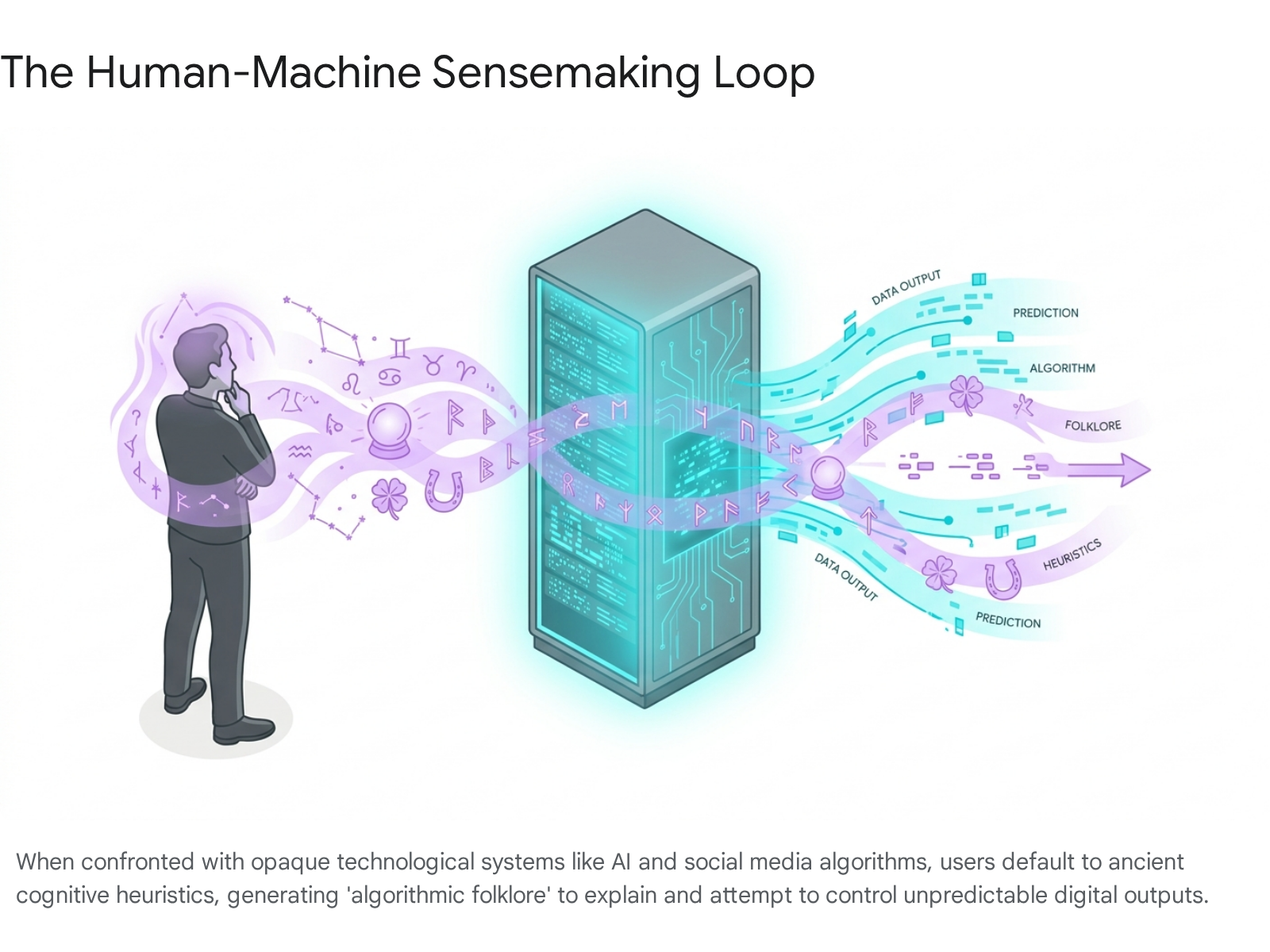
Recent studies analyzing human-AI interaction have identified a widespread phenomenon known as "rational superstition" 5047. Controlled experiments demonstrate that an individual's belief in the validity, reliability, and personalization of fictitious AI-generated predictions is positively correlated with their belief in astrology and the paranormal 5047. This reveals that even when interacting with high-technology interfaces, humans rely heavily on ancient mental heuristics and intuition rather than critical evaluation, proving that sophisticated technology often amplifies, rather than eliminates, magical ideation 5047.
The Psychology of Social Media Manifestation
Another prominent intersection of magical thinking and digital culture is the recent explosion of "manifestation" trends on platforms like TikTok and Instagram. Since the COVID-19 pandemic - a period characterized by acute societal loss of control, isolation, and rising anxiety - global search volumes for manifestation techniques skyrocketed by over 600%, transitioning from a niche aesthetic trend to a primary coping mechanism and pseudo-therapy for Generation Z 4853.
In the modern digital lexicon, manifestation relies heavily on the "Law of Attraction" - a pseudoscientific philosophy claiming that focused positive thoughts and symbolic actions can cosmically summon wealth, love, and physical alterations directly into one's material reality 53. TikTok's platform architecture, specifically designed to provide instant gratification and trigger continuous dopamine release, serves as a perfect vehicle for this phenomenon. It enables users to rapidly consume, perform, and share 15-second manifestation rituals involving crystals, repetitive journaling, and positive affirmations 495051. Marketing analytics demonstrate that targeting users based on these psychographic profiles (e.g., a desire for control or status) is vastly more effective than targeting based on standard demographics, further fueling the algorithmic spread of magical content 50.
While these practices provide an illusory sense of control and temporary stress relief, clinical psychologists warn of their severe cognitive hazards. Yale psychologist Laurie Santos notes that scientific evidence indicates manifestation can actively backfire; spending excessive time visualizing success without planning for realistic obstacles statistically decreases the likelihood of achieving long-term goals 52. Furthermore, the ideology implies that reality is exclusively a matter of personal choice, leading to toxic positivity. This carries the dangerous implication that individuals who suffer misfortune, poverty, or illness somehow brought it upon themselves through negative thinking 5353. The psychological fallout is measurable: studies indicate that just 20 minutes of engagement with certain social media loops can lead to a 12% rise in depression scores and a 15% rise in anxiety, highlighting the detrimental effects of relying on digital manifestation as a replacement for evidence-based coping mechanisms 54.
Cognitive Style, Intelligence, and Lifespan Development
The relationship between magical thinking, human intellect, and aging has long been subject to cultural misconceptions. The common assumption that highly intelligent or highly analytical individuals are entirely immune to superstitious beliefs, or that formal logic acts as an immediate "kill switch" for magical ideation, is not supported by recent empirical psychological data.
Analytical Processing and Probability Forecasting
Psychological studies specifically investigating the activation of analytical thinking reveal that leaning on formal logic does not automatically diminish an individual's deeply held religious or magical beliefs 55. Even when experimental subjects undergo targeted debiasing training to recognize logical fallacies and cognitive errors, their underlying faith and symbolic worldviews remain largely untouched. This suggests that analytical processing and magical sense-making operate on parallel, highly compartmentalized tracks in the brain; an individual can excel at mathematical logic while simultaneously maintaining belief in sympathetic magic 55.
However, general intelligence (IQ) does correlate strongly with specific aspects of predicting future reality. Research on large adult populations indicates that individuals with higher IQs make significantly more accurate probability forecasts regarding complex life events (such as estimating life expectancy) 56. Those in the lowest cognitive percentiles produce forecasting errors more than twice as severe as those in the top percentiles 56. This suggests that while raw intelligence does not eradicate the innate human instinct for magical thinking, it enhances an individual's capacity to assess statistical probability over supernatural interventions in practical, high-stakes real-world decision-making 56.
Lifespan Development and Genetic Predispositions
Developmental psychology historically posited that magical thinking naturally fades as children mature and learn the strict laws of physics. However, contemporary studies show that these beliefs simply submerge into the subconscious, rather than disappearing entirely. An analysis of lifespan trajectories reveals that while explicit, consciously acknowledged superstitious beliefs decrease across adulthood, they never fully vanish 57. This finding directly contradicts the popular cultural trope of the highly superstitious elder (often referred to as the "old wives' tale"); empirical data actually indicates that older adults exhibit significantly less overt agreement with magical contagion and similarity heuristics than younger adults, likely due to decades of accumulated life experience reinforcing the physical realities of the world 57.
Conversely, genetic predispositions play a fascinating, newly discovered role in the maintenance of magical thinking across the lifespan. Individuals carrying high polygenic risk scores (PRS) for schizophrenia - who do not actually develop full non-affective psychotic disorders - often exhibit a distinct developmental trajectory 58. Instead of their magical thinking steadily decreasing with age, the normal age-related decline ceases entirely in middle age, leaving them with significantly higher baseline levels of magical ideation than their peers 58. This suggests that elevated magical thinking can serve as a mild, sub-clinical phenotypic expression of the genetic risk for psychosis, highlighting the profound entanglement of genetics, psychopathology, and standard cognitive function.
Conclusion
The comprehensive science of magical thinking reveals that the human reliance on ritual, superstition, and symbolic behavior is not an intellectual failure, a lack of education, or a cognitive error. Rather, it is a foundational, highly functional feature of the species' evolutionary and neurological design. What began hundreds of thousands of years ago as an accidental by-product of vital survival mechanics - our innate capacity to rapidly detect agency and attribute minds to avoid predation - was masterfully co-opted by cultural evolution. It forged the deep prosocial bonds, trust networks, and communal cohesion necessary for large-scale human civilizations to survive and thrive. The cognitive heuristics of contagion and similarity, originally designed to protect early humans from invisible pathogens and environmental peril, continue to govern modern aversions, affections, and moral judgments today.
In the contemporary era, these same ancient neural pathways dictate how humans interface with the digital frontier. They spawn complex algorithmic folklore and viral manifestation trends as modern individuals desperately seek agency and predictability in an increasingly chaotic, opaque, and technologically mediated world. Whether it manifests as an indigenous Amazonian hunter appeasing a powerful forest deity, an individual suffering from the intrusive, ego-dystonic torments of clinical OCD, or a modern social media user attempting to hack a recommendation algorithm with a digital ritual, the underlying psychological reality remains exactly the same: the human brain is an unparalleled, relentless meaning-making machine, fundamentally wired by evolution to see connections where none may exist.