
What Is Magical Thinking and When Is It a Problem
Magical thinking is the psychological belief that one's internal thoughts, words, or everyday actions can directly influence unrelated external events without any plausible physical mechanism connecting them. While it begins as a standard developmental phase in childhood and serves as a harmless evolutionary coping mechanism to reduce anxiety in adults, it can become highly problematic. When magical beliefs become rigid, intrusive, or replace practical reality, the phenomenon shifts from a protective cognitive quirk into the defining feature of severe clinical conditions like obsessive-compulsive disorder and schizotypal personality disorder.
The Cognitive Architecture of Magical Thinking
At its most fundamental level, magical thinking represents a fallacy of causation. It occurs when the human brain observes a correlation - or simply experiences a strong desire for a specific outcome - and assumes a direct physical link where none scientifically exists 1. A person wearing a specific "lucky" jersey to ensure their favorite sports team wins, an individual knocking on wood to prevent a jinx after making a hopeful statement, or a child believing it stopped raining solely because they wished for the sun to come out are all engaging in variations of magical thinking 234.
The precise definition of magical thinking varies slightly depending on the field of study. In developmental psychology, it describes the belief that one's thoughts alone can bring about effects in the world. In psychiatry, it defines false, sometimes delusional beliefs about the capability of thoughts, actions, or words to cause or prevent undesirable events 1. Despite these subtle variations, the core theme remains the same: a conflation of internal mental states with external physical realities.
Developmental Roots in Childhood
Early pioneers in psychology viewed magical thinking primarily as a developmental stepping stone. Developmental psychologist Jean Piaget famously identified magical thinking as a hallmark of the "preoperational stage" of child cognitive development, which typically occurs between the ages of two and seven 125. During this developmental window, children are rapidly mastering language, abstract thought, and symbolic play, but they have not yet fully grasped the objective laws of physical causality 25.
Because a child's thinking is highly egocentric and dominated by perceptions of immediate physical features, they often impute their own internal activity as the causal source for external physical events 15. For example, a grieving child might believe that their angry thoughts toward a family member directly caused that person's illness or death, leading to profound but misplaced guilt 1. Sigmund Freud also believed that magical thinking was produced by cognitive developmental factors, describing practitioners of magic as projecting their internal mental states onto the external world around them 1.
Historically, mainstream psychology assumed that humans simply outgrew this phase. It was believed that as the brain matured and integrated rational, scientific reasoning, magical beliefs were discarded 67. However, modern cognitive science and anthropological research have thoroughly debunked this linear view. Magical thinking does not disappear in adulthood; instead, it becomes more sophisticated and cohabits deep inside the human mind alongside logical, scientific thought processes 678.
Evolutionary Origins and Error Management Theory
The persistence of magical thinking across every known human culture suggests that it is not merely a cognitive error, but rather a profound evolutionary adaptation. The human brain is constantly bombarded with vast amounts of sensory data, forcing it to rely on heuristics - mental shortcuts - to process information, detect patterns, and assign significance quickly 5.
Evolutionary psychologists frequently frame magical thinking through the lens of Error Management Theory (EMT). Asserted by researchers David M. Buss and Martie G. Haselton, EMT proposes that decision-making processes and cognitive biases evolved specifically to minimize costs in adaptive domains 8. In ancestral environments, the brain evolved to detect agency and patterns as a matter of survival. If an early human heard a sudden rustling in the tall grass, assuming the wind caused it (a false negative) could result in being attacked by an unseen predator. Conversely, assuming a spirit, agent, or predator caused it (a false positive) merely cost a few calories of running away 810.
Through the rigorous sieve of natural selection, the human brain became overtuned to suspect agency and infer connections 109. Modern humans are the descendants of those who survived by being paranoid about unseen forces. Today, this innate tendency manifests as patternicity - the tendency to find meaningful patterns in meaningless noise - and agenticity, the tendency to infuse those patterns with meaning, intention, and agency 10.
Furthermore, magical thinking ties into evolutionary strategies like "tit-for-tat" cooperation. The illusion of control, a specific type of self-deceptive mechanism, induces individuals to overestimate their influence over events, thereby increasing their confidence 8. Increased confidence can make an individual appear more attractive or desirable, reduce the fear of rejection, and facilitate the building of mutually beneficial social environments 8.
The Psychological Functions of Magical Beliefs
If magical thinking is hardwired into human cognition, it is essential to understand the specific psychological functions it serves in contemporary life. Foremost among these functions is anxiety reduction and the establishment of perceived control.
Anxiety Reduction and the Illusion of Control
Magical thinking thrives in the presence of uncertainty and psychological distress. When individuals face situations that are fundamentally beyond their rational control - such as sudden illness, economic instability, natural disasters, or the chaos of war - superstitious behaviors and magical beliefs provide a critical "illusion of control" 6811.
The anthropologist Bronisław Malinowski argued extensively that magical beliefs and superstitious behaviors help people fill the void of the unknown and reduce the immense tension created by uncertainty 6. Control is an essential human coping strategy; a prolonged lack of control can lead directly to mental health issues such as severe anxiety and clinical depression 6. Engaging in a ritual - whether it is carrying a lucky penny, reciting a specific mantra, or avoiding stepping on cracks in the pavement - tricks the brain into feeling that it has successfully navigated a threat 2411.
This illusion serves a highly adaptive function. By believing that a specific action or thought can influence an outcome, the neurological stress response is lowered. Research indicates that this reduction in acute stress can improve immune functions and reduce susceptibility to diseases, consequently increasing the chances of survival in harsh environments 8. As one psychological researcher noted, if humans pondered all the statistically probable ways they might die in a motor vehicle accident every time they got into a car, they would become paralyzed with anxiety; magical thinking provides the necessary cognitive buffer to function 11.
Pandemic-Era Coping and Stress Cascades
The psychological utility of magical thinking was heavily documented during the global outbreak of the SARS-CoV-2 (COVID-19) pandemic. The pandemic acted as a mass traumatic event, universally and indiscriminately increasing stressors such as profound uncertainty, health anxieties, and financial instability 12. During this period, empirical evidence showed a global surge in varied coping mechanisms, including a measurable rise in the popularity of prayer, mindfulness, and ritualistic behaviors as populations sought to manage psychological distress 413.
However, pandemic research also highlighted that not all coping mechanisms yielded positive results. Studies drawing on longitudinal data from the Understanding American Study (UAS) demonstrated that coping methods generally split into adaptive approaches (such as social connection, behavioral activation, and relaxation techniques) and maladaptive approaches (such as substance use, behavioral disengagement, and severe catastrophizing) 1314. While adaptive coping tended to protect mental health at both the within-person and between-person levels, the pandemic introduced unique complexities. For instance, while social connection usually reduces loneliness, the pandemic forced many interactions online, where social media emerged as a double-edged sword. It offered vital connection but also exposed users to misinformation, harmful social comparisons, and heightened "psychosocial stress contagion" 13.
In this turbulent context, magical thinking provided a stopgap for many individuals. By engaging in rigid rituals or clinging to specific superstitions regarding contamination and safety, people attempted to artificially construct the predictability that the virus had stripped away 1015.
Magical Thinking Across Cultures
Magical thinking cannot be accurately evaluated without understanding its cultural context. Historically, Western prominent early theorists, including those from the English anthropological and French sociological schools, suggested that magical thinking characterized traditional, non-Western cultures. They often contrasted this with the supposedly more developmentally advanced rational-scientific thought found in industrialized Western societies 516.
Modern cross-cultural psychology forcefully rejects this ethnocentric view. Magical thinking is a universal human trait, but the specific ways it manifests, the frequency of its use, and the societal reactions to it vary drastically depending on whether a culture is predominantly individualistic or collectivistic 81718.
Individualism Versus Collectivism
Collectivism - a cultural orientation predominant in East Asia, the Middle East, and parts of Africa - refers to assessing the self in relation to others (an interdependent self-construal) and placing group harmony and cohesion above personal concerns. In contrast, individualism - predominant in Western Europe and North America - refers to assessing the self as entirely separate from others (an independent self-construal) and placing individual rights and self-enhancement above the group 181920.
These distinct cultural values fundamentally modulate the neural representations underlying social cognition, specifically within the medial prefrontal cortex (MPFC) during the processing of general and contextual self-judgments 19. Consequently, they also shape how magical thinking is utilized.
A comprehensive 2022 cross-cultural study utilizing historical frameworks developed by Martha Muchow and Heinz Werner re-analyzed data on magical practices from four distinct countries: Germany, India, Turkey, and South Korea 17. The findings revealed profound differences in the application and motivation behind magical thinking:
| Cultural Dimension | Specific Findings on Magical Practice | Psychological Motivation | Reaction to Unsuccessful Magic |
|---|---|---|---|
| India (Highly Collectivist) | Disproportionately associated with the continued practice of magic into adulthood; frequently practiced daily. Often utilized active rituals like consuming specific foods or drinks. | Strongly influenced by family traditions. Performed out of a deep sense of social responsibility for others. | Highest rate of negative emotions (e.g., guilt, sadness) when magical rituals failed to produce the desired outcome. |
| South Korea (Collectivist) | Disproportionately associated with utilizing magical practices for making "important decisions." | Also associated with performing rituals out of a sense of responsibility for others and group cohesion. | Disproportionately associated with experiencing unspecified frustration when magic failed. |
| Turkey (Mixed/Collectivist) | Disproportionately associated with active applications of oracles, such as testing physical fitness or adjusting walking pace to predict outcomes. | Influenced by unrelated persons (friends). Partially motivated by internal states like boredom. | Generally indifferent to failure, though some physical complaints (headaches) were noted. |
| Germany (Individualist) | Practiced magic less frequently ("sometimes" or "rarely"). Disproportionately associated with passive applications, such as counting objects or using games. | Influenced by unrelated peers rather than family. Highly motivated by individual boredom. | Indifference was the most common reaction to a failed magical practice. |
Data synthesized from cross-national comparisons of magical thinking and practices 17.
This data highlights that in collectivist cultures, magical thinking is often intertwined with social duty and family cohesion. In individualistic cultures, it is more likely to be an isolated, individualistic pursuit, sometimes engaged in purely for entertainment or personal anxiety reduction 17. Furthermore, what Western psychologists might hastily label as "magical thinking" or a cognitive error may actually represent a normative spiritual belief or a "cultural idiom of distress" within a non-Western context 82122.
The Modern Epidemic: "Magical Overthinking"
Despite the assumptions of early sociologists that scientific advancement would eradicate magical practices, contemporary observation proves the exact opposite. Well-stocked esoteric bookshops, the explosion of astrological apps, and the mainstreaming of crystal healing indicate that a highly technological society is perfectly capable of sustaining deep magical beliefs 23.
Author and linguist Amanda Montell describes the current cultural moment as the "Age of Magical Overthinking." She argues that the modern information age - characterized by a gluttonous stream of constant data, mass loneliness, and intense capitalistic pressure to "know everything" - has actively overloaded the brain's innate coping mechanisms 24252627.
Faced with a sudden glut of information, cognitive biases cause the modern mind to overthink the wrong things and underthink complex deliberations 30. Instead of making the world more sensible, the internet has triggered a regression into irrationality, manifesting through several distinct cognitive biases that operate beneath the level of conscious awareness 1124.
Core Biases of Modern Irrationality
The architecture of modern magical overthinking relies on several deeply ingrained heuristics:
- Proportionality Bias: The human mind struggles to accept that massive, tragic events can be the result of random, meaningless chance. Proportionality bias is the cognitive leap that a big event must have an equally big, intentional cause 2530. This bias is the psychological bedrock of conspiracy theories. When a public figure dies tragically, or a global pandemic erupts, the brain finds more emotional comfort in elaborate magical conspiracies (e.g., secret cabals, faked moon landings) than in acknowledging the terrifying randomness of the universe 2425.
- The Halo Effect: This describes the unconscious tendency to admire one single quality in a person - such as a pop star's musical talent or an influencer's physical attractiveness - and magically jump to the conclusion that they must be perfect overall, possessing deep moral, political, and intellectual authority 252732. When these figures inevitably display human flaws, the disproportionate public outrage is a direct result of the shattered magical projection 28.
- The Sunk Cost Fallacy: This is the deeply ingrained, irrational conviction that spending resources you cannot get back (such as time, money, or emotional energy) justifies spending even more to avoid admitting defeat 30. Montell notes this bias keeps individuals trapped in abusive relationships, cults, or failing multi-level marketing schemes, magically believing that endurance alone will eventually yield a reward 27.
- Zero-Sum Bias and Overconfidence: Zero-sum bias is the false intuition that another party's gain directly guarantees your loss, heavily exacerbated by the curated realities of social media 30. Conversely, overconfidence bias leads individuals to drastically overvalue their actual skills and express excessive certainty in their evaluations, a trait frequently observed in high-profile corporate frauds 322829.
- The Illusory Truth Effect: The psychological proclivity to believe that something is factually true simply because it has been repeated multiple times. This bias overrides analytical thinking and is the primary vehicle for the rapid spread of political disinformation and internet lore 253229.
The Psychology of Manifestation
One of the most prominent, commercially successful, and widely debated forms of magical thinking in the 21st century is the practice of "manifestation." Popularized globally by Rhonda Byrne's 2006 book The Secret and resurging forcefully on platforms like TikTok under hashtags like #LuckyGirlSyndrome, manifestation is the belief that an individual can cosmically attract success, wealth, and health into their life purely through focused positive thoughts, visualization, and positive affirmations 30363731.
While modern influencers often dress manifestation in the language of quantum physics or secular wellness, its roots lie in the 19th-century American "Mind Cure" movement and the New Thought philosophy. Figures like Phineas Parkhurst Quimby and later Norman Vincent Peale (author of The Power of Positive Thinking) posited that all disease and poverty were simply false beliefs manifesting in physical reality, and that "right thinking" held omnipotent healing power 3637. This was further commercialized by Napoleon Hill in Think and Grow Rich, directly linking spiritual thought to material wealth 36.
The Manifestation Scale and Behavioral Outcomes
From a psychological perspective, manifestation is a belief system based on thought-action fusion, delusions of causality, blind optimism, and a dramatic overvaluation of personal agency 36. To understand the impact of this phenomenon, psychological researchers Dixon, Hornsey, and Hartley developed a reliable psychometric tool in 2023 known as the "Manifestation Scale" 3632.
Testing over 1,000 participants, the researchers found that over one-third of the population strongly endorsed manifestation beliefs, which the scale divided into two dimensions: "personal power" (the ability to manifest success through positive emotion) and "cosmic collaboration" (partnering with supernatural forces) 324033.
The psychological profile of a high-scoring "manifester" reveals a fascinating duality: * The Positives (Optimism and Self-Efficacy): High scorers on the Manifestation Scale perceived themselves as significantly more successful, had stronger aspirations, and displayed higher self-efficacy 3240. Research in sports psychology confirms that visualization - mentally rehearsing an outcome - can enhance performance by activating neural pathways and the brain's reticular activating system, helping individuals spot real-world opportunities 344344. * The Negatives (Risk and Ruin): Crucially, the Dixon study revealed that believing in manifestation made absolutely no impact on an individual's objective level of success 36. Instead, because manifestation belief correlates with severe overconfidence, high scorers were significantly more likely to be drawn to risky cryptocurrency investments, have experienced bankruptcy, and hold an unrealistic belief that they could achieve massive success quickly 323345.
Furthermore, manifestation beliefs heavily predispose individuals to the allure of Multi-Level Marketing (MLM) schemes. Because MLMs promote "mind over matter" doctrines and blame failure on a distributor's lack of positive belief rather than a flawed business model, individuals prone to magical thinking evaluate these inherently risky opportunities as highly credible and lucrative 3335.
When Manifestation Becomes a Mental Health Risk
While cultivating hope and a positive mindset is generally beneficial, the absolute nature of manifestation creates severe psychological hazards. The core premise - that thoughts dictate reality - inevitably leads to toxic positivity and victim-blaming. If a person believes they can manifest wealth, the logical corollary is that individuals who suffer poverty, illness, or trauma somehow "brought it upon themselves" through negative thinking or a lack of spiritual intention 303643.
Clinical psychologists warn that excessive focus on manifesting can actively damage emotional health. It frequently triggers what therapists term "Low Vibe Anxiety" - a chronic, obsessive worry that experiencing a single natural negative emotion (sadness, doubt, anger) will magically ruin a person's future or repel success 47. This leads to the dangerous suppression of authentic emotions. Other signs that manifesting has become a psychological liability include mood instability tied entirely to productivity, an intolerance of uncertainty, an obsessive search for "signs" from the universe, and checking out of the present moment to constantly anticipate the future 3147.
Distinguishing Normal Quirks from Clinical Pathology
Given that magical thinking is an evolutionary default, drives massive cultural trends like manifestation, and is present in everyday superstitions, a critical question arises for psychiatry: When does magical thinking cross the line from a normative quirk into a diagnosable mental illness?
The clinical threshold is determined not by the presence of the magical thought itself, but by two factors: the individual's level of insight into the irrationality of the thought, and whether the thought is experienced as ego-syntonic or ego-dystonic.
The Ego-Syntonic vs. Ego-Dystonic Divide
In psychoanalytic and modern clinical terms, the "ego" refers to a person's conscious sense of self, their core identity, and their established values 48. How a magical thought interacts with this ego determines its clinical severity.
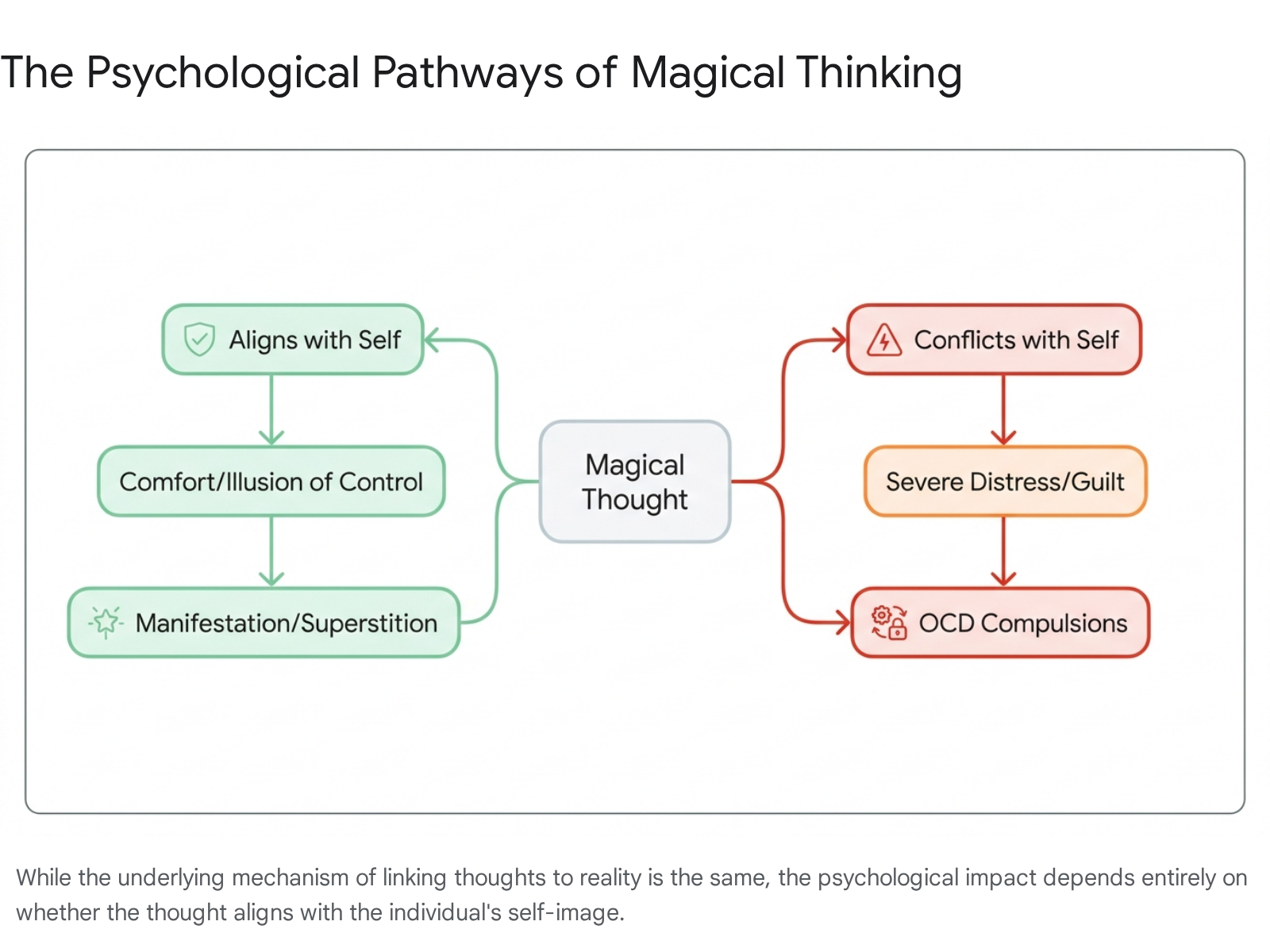
- Ego-Syntonic: Thoughts, feelings, and behaviors that align perfectly with an individual's self-perception and values. They feel natural, correct, and harmonious 495036. A person practicing "Lucky Girl Syndrome" affirmations experiences their magical thinking as ego-syntonic; it feels empowering and correct. Similarly, individuals with certain personality disorders, such as Narcissistic Personality Disorder or Obsessive-Compulsive Personality Disorder (OCPD), view their rigid behaviors as assets rather than problems. Because ego-syntonic traits feel "right," the individual rarely experiences subjective distress regarding the behavior itself and is highly unlikely to seek therapeutic change 495037.
- Ego-Dystonic: Thoughts, impulses, and behaviors that violently conflict with a person's core identity, morals, or desires. They feel intrusive, alien, unwanted, and profoundly distressing 484937. An individual experiencing an ego-dystonic magical thought knows that the thought is bizarre and contrary to who they are, which generates immense psychological pain, shame, and a desperate drive to neutralize the thought 37.
Magical Thinking in Obsessive-Compulsive Disorder (OCD)
When magical thinking becomes severely ego-dystonic, it often crystallizes into Obsessive-Compulsive Disorder (OCD). OCD is a debilitating anxiety-related condition affecting roughly 2 to 3 percent of the population worldwide 38. It is characterized by a vicious cycle of obsessions (unwanted, intrusive thoughts that trigger intense fear) and compulsions (repetitive behaviors performed to neutralize the fear) 394041.
Magical thinking is the central cognitive construct fueling the OCD cycle 16. The individual experiences an intrusive thought about a horrific event (e.g., a loved one dying in a car crash). Because of magical thinking, the brain misinterprets the mere presence of this thought as an indicator that the event will actually happen in the material world. To prevent this catastrophe, the individual feels forced to perform a compulsion, such as turning a doorknob a specific number of times or rigidly arranging objects 394041.
Thought-Action Fusion (TAF)
The specific psychological mechanism driving magical thinking in OCD is known as Thought-Action Fusion (TAF) 1642. TAF conflates internal cognitive events with external physical reality, and it presents in two primary forms:
- TAF-Likelihood: The irrational belief that simply having a thought about an unacceptable or dangerous event increases the mathematical probability that the event will occur 42.
- TAF-Moral: The belief that having a distressing, taboo, or violent thought is morally equivalent to actually committing the act 42. This leads to profound, excessive guilt and is heavily associated with the "scrupulosity" (religious or moral) subtype of OCD 42.
High levels of TAF lead to faulty probabilistic reasoning, where individuals make decisions based on feelings of anxiety and magical certainty rather than objective contextual information 42.
Mental Rituals: The Invisible Compulsions
While physical compulsions like excessive hand-washing or checking door locks are highly visible, magical thinking frequently drives mental compulsions. These are silent, internal rituals that are just as exhausting and time-consuming as physical acts, but are often missed by clinicians because they masquerade as normal "problem solving" 4344.
Common mental compulsions driven by magical thinking include: * Mental Reviewing: Replaying past memories or conversations frame-by-frame like a video reel to "prove" to oneself that a feared event did not occur or that one's intentions were pure 404344. * Self-Reassurance and Neutralizing: Silently repeating specific phrases, lucky numbers, or prayers to "undo" the damage of a sudden negative intrusive thought 4344. * Mental Checking: Scanning the body internally for signs of illness or scanning the mind to ensure an inappropriate urge is not present 4344.
In all these cases, the mental ritual acts as negative reinforcement. It provides a brief drop in anxiety, but it prevents the brain from learning that the magical threat was never real to begin with. Over time, the need for absolute certainty grows stronger, trapping the individual 4344. The gold-standard treatment, Exposure and Response Prevention (ERP), involves facing the ego-dystonic thought without engaging in the magical neutralizing ritual, teaching the brain to tolerate uncertainty 373844.
Schizotypal Personality Disorder and Psychosis
While magical thinking is a core component of OCD, its presentation shifts dramatically in Schizophrenia Spectrum Disorders and Schizotypal Personality Disorder (STPD). This distinction highlights the boundary between an anxiety disorder and a cluster-A personality disorder 456146.
In OCD, magical thinking is usually isolated to specific obsessive themes. The individual retains "good or fair insight" - they logically recognize that their rituals are excessive and irrational, but the drive to perform them is overwhelming 464748. They battle against the thoughts.
In Schizotypal Personality Disorder, magical thinking is pervasive, chronic, and crucially, ego-syntonic 6146. The individual does not fight the magical thoughts because the thoughts are integrated into their baseline perception of reality. Individuals with STPD exhibit odd ways of thinking, perceiving, and communicating, prominently featuring "ideas of reference." This is the steadfast belief that ordinary, random occurrences hold a special, hidden meaning directed specifically at them 4950.
For instance, an individual with STPD might genuinely believe they possess telepathic powers, that they can control the actions of strangers with their mind, or that a news broadcast is secretly communicating with them through coded signals 394750. In these cases, clinical insight is absent; the magical thinking borders on, or crosses into, actual delusional conviction 47.
The Diagnostic Overlap: Schizotypal OCD
Complicating the clinical landscape is the phenomenon of comorbidity. Research indicates a 5% to 50% co-occurrence rate of STPD in patients with OCD 49. This hybrid condition, sometimes termed "Schizotypal OCD," presents a uniquely challenging clinical picture.
Patients with both OCD and schizotypal traits tend to have an earlier onset of illness, poorer insight, higher rates of counting and symmetry compulsions, and a higher prevalence of psychotic-like experiences, including perceptual distortions and paranoia 6149. Unlike standard OCD, the intrusive thoughts in Schizotypal OCD often contain bizarre or quasi-delusional content - such as fearing that one's thoughts will cause a global natural disaster. While these beliefs border on psychosis, the individual usually retains a shred of internal conflict or doubt, differentiating the condition from full-blown schizophrenia 61. Standard ERP therapy is often less effective for these patients, requiring highly specialized, tailored interventions 49.
Comparing the Spectrum of Magical Thinking
The following table synthesizes clinical guidelines to illustrate how magical thinking scales from non-pathological superstitions to severe psychiatric disorders 493942475051:
| Diagnostic Category | Level of Insight | Ego Alignment | Scope of Magical Belief | Real-World Clinical Example |
|---|---|---|---|---|
| Everyday Superstition & Manifestation | High (Usually aware it is irrational but enjoys the practice) | Ego-Syntonic | Isolated to specific goals (wealth, sports, health). | Visualizing a promotion daily; wearing a "lucky" charm; knocking on wood. |
| Obsessive-Compulsive Disorder (OCD) | Good/Fair (Aware the fear is irrational but feels compelled to act) | Ego-Dystonic | Isolated to specific obsessive themes (contamination, harm, scrupulosity). | Mentally repeating a "safe" word 8 times to prevent a spouse from dying in a crash. |
| Schizotypal Personality Disorder (STPD) | Poor/Absent (Believes the magic is an objective fact) | Ego-Syntonic | Pervasive across all aspects of life; odd behavior and speech. | Believing that stepping on a specific crack in the sidewalk physically caused an earthquake overseas. |
| Schizophrenia | Absent (Delusional conviction) | Ego-Syntonic | Pervasive, accompanied by hallucinations and severe social deficits. | Hearing voices confirming that the individual's thoughts are controlling the government. |
Note: Distinguishing between normal variation and disorder relies heavily on the presence of significant distress or impairment in social, occupational, or daily functioning 51.
Clinical Assessment and Cultural Sensitivity
Because magical thinking straddles the line between normal human cognition, spiritual belief, and severe psychopathology, modern clinical assessment requires extreme nuance. Psychometric tools like the Magical Ideation Scale (MIS) and the Dissociative Experiences Survey (DES) are frequently used to measure the rate of unrealistic invalid causations and false beliefs in patients 526953.
However, raw scores on these scales must be interpreted carefully. High levels of magical ideation or absorption do not automatically indicate psychopathology; they may simply reflect an individual's deep immersion in fantasy, high creativity, or adherence to non-Western cultural norms 42526953.
To prevent the over-pathologization of normative beliefs, the Diagnostic and Statistical Manual of Mental Disorders, Fifth Edition, Text Revision (DSM-5-TR) made concerted efforts to incorporate greater cultural sensitivity 212254. Rather than viewing culture as a static list of "culture-bound syndromes," the DSM-5 introduced the Cultural Formulation Interview (CFI). This clinical tool assists psychiatrists in assessing how a patient's race, religion, and geographical origin influence their presentation of symptoms 2122.
For example, a patient presenting with an intense fear of the "evil eye" or a belief that their illness was caused by a curse might trigger a clinician's suspicion of magical thinking or psychosis. However, the CFI guidelines mandate that clinicians consider whether this represents a culturally specific "idiom of distress" - a shared way a community experiences and talks about personal concerns - rather than an individualized psychiatric delusion 2251. Understanding this distinction is vital, as misdiagnosing a cultural belief as a psychotic obsession can lead to inappropriate treatment with heavy antipsychotics, while missing true ego-dystonic OCD denies a patient necessary behavioral therapy 2247.
Bottom line
Magical thinking is a universal psychological phenomenon rooted deep within the brain's evolutionary architecture, designed to detect patterns and establish a necessary illusion of control in an unpredictable world. While practices ranging from harmless superstitions to modern manifestation trends can provide emotional comfort and lower acute anxiety, they carry distinct risks of victim-blaming, financial recklessness, and toxic positivity if taken to absolutes. Clinically, magical thinking crosses the threshold into pathology when it causes severe functional impairment - such as the distressing, ego-dystonic mental rituals found in Obsessive-Compulsive Disorder - or when a total loss of insight and pervasive, ego-syntonic delusions signal the presence of a schizotypal or psychotic disorder.