
Evolutionary and Cognitive Origins of Religion
The universality of religious belief and ritual across human societies presents a persistent puzzle for evolutionary biology and the cognitive sciences. Because religious practices frequently demand profound expenditures of time, resources, and biological fitness - ranging from celibacy and fasting to costly monumental architecture and hazardous rituals - evolutionary frameworks dictate that such behaviors should be selected against unless they offer compensatory survival or reproductive advantages. Over the past several decades, the academic effort to resolve this puzzle has fractured into distinct, highly specialized theoretical domains. Researchers seek to establish whether religion is an incidental by-product of cognitive architecture evolved for other purposes, a direct biological adaptation facilitating individual or group survival, or a complex outcome of gene-culture coevolution.
This report provides an exhaustive synthesis of the evolutionary origins of religion, integrating data from cognitive psychology, cultural phylogenetics, historical databases, and evolutionary biology to outline the mechanisms driving human religious behavior.
Cognitive Architecture and By-Product Frameworks
The predominant framework within the cognitive science of religion posits that religion is not an evolutionary adaptation in itself. Instead, it is an incidental by-product of domain-specific cognitive modules that evolved to solve standard ecological and social problems during the Pleistocene 123. According to this standard model, the human mind is equipped with specialized inference engines that process environmental stimuli. When these engines are triggered by ambiguous stimuli, they reliably generate supernatural concepts.
Agency Detection and Theory of Mind
At the foundation of the by-product theory is the concept of the Hyperactive Agency Detection Device 45. In ancestral environments, the cost of a false positive - assuming the rustling of grass is a predator when it is merely the wind - was negligible compared to the fatal cost of a false negative. Consequently, natural selection favored a cognitive architecture heavily biased toward attributing intentional agency to ambiguous physical stimuli 34. This propensity to detect invisible agents translates into a baseline neurological receptivity to belief in spirits, ghosts, or deities operating behind natural phenomena.
Coupled with hyperactive agency detection is the human cognitive capacity known as Theory of Mind, which is the ability to attribute mental states, intentions, and desires to others. Because human survival relies fundamentally on complex social navigation, the human brain constantly models the minds of peers. Cognitive theorists argue that once the brain is capable of modeling the minds of absent or deceased individuals, it requires a minimal cognitive leap to model the minds of invisible supernatural agents 25. The architecture that allows a human to anticipate the behavior of a living chieftain is identical to the architecture used to anticipate the demands of an ancestral spirit.
Promiscuous Teleology and Minimally Counterintuitive Concepts
Developmental psychology provides significant supporting evidence for cognitive by-products. Research into promiscuous teleology demonstrates that children possess an innate bias to attribute purpose and design to natural objects, viewing even inanimate phenomena as having been created for a specific reason 45. This innate cognitive bias primes the human mind to accept creationist or teleological narratives long before formal religious socialization occurs. Studies involving subjects with Alzheimer's disease and adults without formal biological education also show a persistent default preference for teleological explanations, suggesting that this cognitive bias remains the baseline architectural setting of the human brain throughout life 5.
Furthermore, anthropological research indicates that the most successful and culturally enduring religious ideas are minimally counterintuitive 46. Minimally counterintuitive concepts conform to the vast majority of human ontological expectations but violate a small, specific subset of physical rules 45. For instance, a supernatural agent might possess standard human emotions, memories, and motivations, but simultaneously possess the ability to pass through physical barriers or live perpetually. If a concept violates too many rules, it becomes cognitively burdensome and difficult to remember; if it violates none, it is entirely mundane and easily forgotten. Concepts that optimize this ratio hit a cognitive threshold that makes them highly memorable, emotionally salient, and effortlessly transmissible across generations 467.
Critiques of Cognitive Reductionism
While the by-product theory explains the initial generation and transmission of supernatural concepts, it faces severe criticism for its biological reductionism 89. Critics argue that the by-product model relies heavily on a highly modular view of the mind, a paradigm that is increasingly contested by holistic and predictive processing models of cognition 5810. Dual process theories that integrate embodied predictive processing suggest that human rationality is bounded by proximal stimuli, making rigid modularity an insufficient explanation for complex cultural phenomena like religion 1011.
Furthermore, while agency detection and minimally counterintuitive concepts explain why people might effortlessly imagine ghosts or spirits, they fail to explain why humans engage in highly organized, structurally demanding, and materially costly religious rituals 121315. Identifying a cognitive by-product accounts for the presence of supernatural ideation, but it does not explain the evolutionary stabilization of religion as a massive, organizing force of human civilization.
Adaptationist Theories and Evolutionary Utility
To address the limitations of the by-product model, adaptationist theorists argue that while the raw cognitive materials of religion may have originated as by-products, religion itself was rapidly subjected to natural selection because it conferred distinct survival advantages 15161415.
Individual Adaptation and Costly Signaling
At the level of the individual, religious engagement can yield direct physiological and psychological benefits. A growing body of medical and epidemiological research demonstrates positive correlations between religious service attendance, positive religious coping mechanisms, and delayed cognitive impairment 161718. Studies focusing on marginalized populations, such as older Black adults, indicate that engagement in religious activities predicts slower cognitive decline and serves as a buffer against behavioral expressions associated with mild cognitive impairment and dementia 16171920. These direct health benefits provide a proximate mechanism for individual selection.
Moreover, individual adaptationist theories frequently employ costly signaling theory 1214. Costly signaling theory frames bizarre, painful, or resource-depleting religious rituals as honest indicators of group commitment. In any cooperative species, the free-rider problem is a persistent threat: individuals who extract the benefits of community cooperation without contributing to it will mathematically outcompete altruistic individuals. By requiring initiates to undergo painful rites, adhere to strict dietary taboos, or sacrifice valuable resources, religious groups establish a barrier to entry that is too expensive for free-riders to fake 1221. Therefore, individuals who endure these costly signals gain access to high-trust networks of mutual aid, increasing their individual survival odds during famines or crises 1421. Historical analyses of 19th-century utopian communes demonstrate that communes demanding costlier requirements from their members survived significantly longer than less demanding secular equivalents 1214.
Group Selection and Social Cohesion
Evolutionary biologists such as David Sloan Wilson posit that religion is fundamentally an adaptation at the group level 162526. While classical inclusive fitness theory argues that selection operates primarily at the level of the gene or the individual, multilevel selection theory argues that in highly social species, selective pressures operate on the group as a cohesive unit 1625.
If an individual sacrifices their life for the group, their individual biological fitness drops to zero, which should eliminate genes for absolute altruism. However, a group populated by individuals willing to sacrifice themselves for the collective will decisively outcompete, conquer, or outlast a group of selfish individuals 1622. Under this framework, religion serves as the ultimate socio-biological mechanism for cohesion. It enforces pro-social moral codes, suppresses in-group cheating through the threat of supernatural punishment, and provides the psychological motivation required for individuals to prioritize the group's survival over their own 161826.
Despite its explanatory power regarding altruism, genetic group selection remains highly contested in evolutionary biology. Critics, such as Taylor Davis, argue that the amount of genetic variation between human groups is insufficient to support genetic group selection 25. Because human populations experience high rates of migration and interbreeding, genetic differences between groups are constantly diluted, making cultural evolution a far more mathematically viable mechanism for group-level selection than genetic evolution 25.
| Theoretical Framework | Primary Evolutionary Mechanism | View of Religious Beliefs and Rituals | Key Limitations and Academic Critiques |
|---|---|---|---|
| Cognitive By-Product | Misapplication of evolved mental modules (Hyperactive Agency Detection, Theory of Mind). | Accidental side-effects of cognitive architecture designed for predator detection and social navigation. | Fails to explain costly, organized, fitness-reducing rituals and extreme social cooperation. |
| Individual Adaptation | Natural selection acting directly on individual survival and reproductive success. | Health buffers; costly signals that prove commitment to gain access to mutual-aid networks. | Struggles to explain genuine, anonymous altruism and the scaling of group-level institutional religion. |
| Group Selection | Selection acting on competing populations; cooperative groups outcompete selfish groups. | Evolutionary mechanisms designed to suppress free-riders and foster ultimate in-group altruism. | Highly debated in biology; genetic variation between human groups is often too low to support genetic group selection. |
| Dual-Inheritance | Co-evolution of genetic biology and socially transmitted cultural information. | Packages of cultural traits that alter selective environments and co-opt preexisting cognitive biases. | Requires complex mathematical modeling; difficult to isolate exact causal arrows in prehistoric deep time. |
Dual-Inheritance Theory and Niche Construction
To reconcile the divide between cognitive by-products and genetic adaptations, modern anthropologists increasingly rely on Dual-Inheritance Theory, also known as gene-culture coevolution 723. This theory posits that human behavior is the product of two distinct but interacting lines of inherited information: the genetic line transmitted via reproduction, and the cultural line transmitted via social learning 23242526.
The Mechanics of Cultural Transmission
In Dual-Inheritance Theory, culture evolves through a Darwinian selection process that operates independently of, but interacting with, genetic evolution 2327. Because acquiring information through individual trial-and-error is highly costly and dangerous, human cognitive architecture is heavily biased toward social learning. Consequently, humans possess context biases, such as prestige bias (copying the behavior of successful individuals) and conformist bias (copying the behavior of the majority) 232829.
Religion operates as a highly successful package of cultural information. While the content of religion may be supported by cognitive by-products that make the ideas easy to conceptualize, the transmission of religion relies heavily on context biases 730. To ensure that subsequent generations adopt counterintuitive beliefs, societies utilize Credibility Enhancing Displays 4630. When cultural models engage in actions that would be severely detrimental unless they genuinely believed the doctrine - such as martyrdom, extreme fasting, or significant charitable giving - these displays trigger deep social-learning heuristics in observers. This process ensures the robust transmission of the belief system to the next generation, anchoring religious continuity independent of genetic changes 46.
Niche Construction and Evolutionary Feedback
A central pillar of gene-culture coevolution is niche construction, which is the process by which organisms modify their environment, thereby fundamentally altering the natural selection pressures acting upon their own genes 12253631.
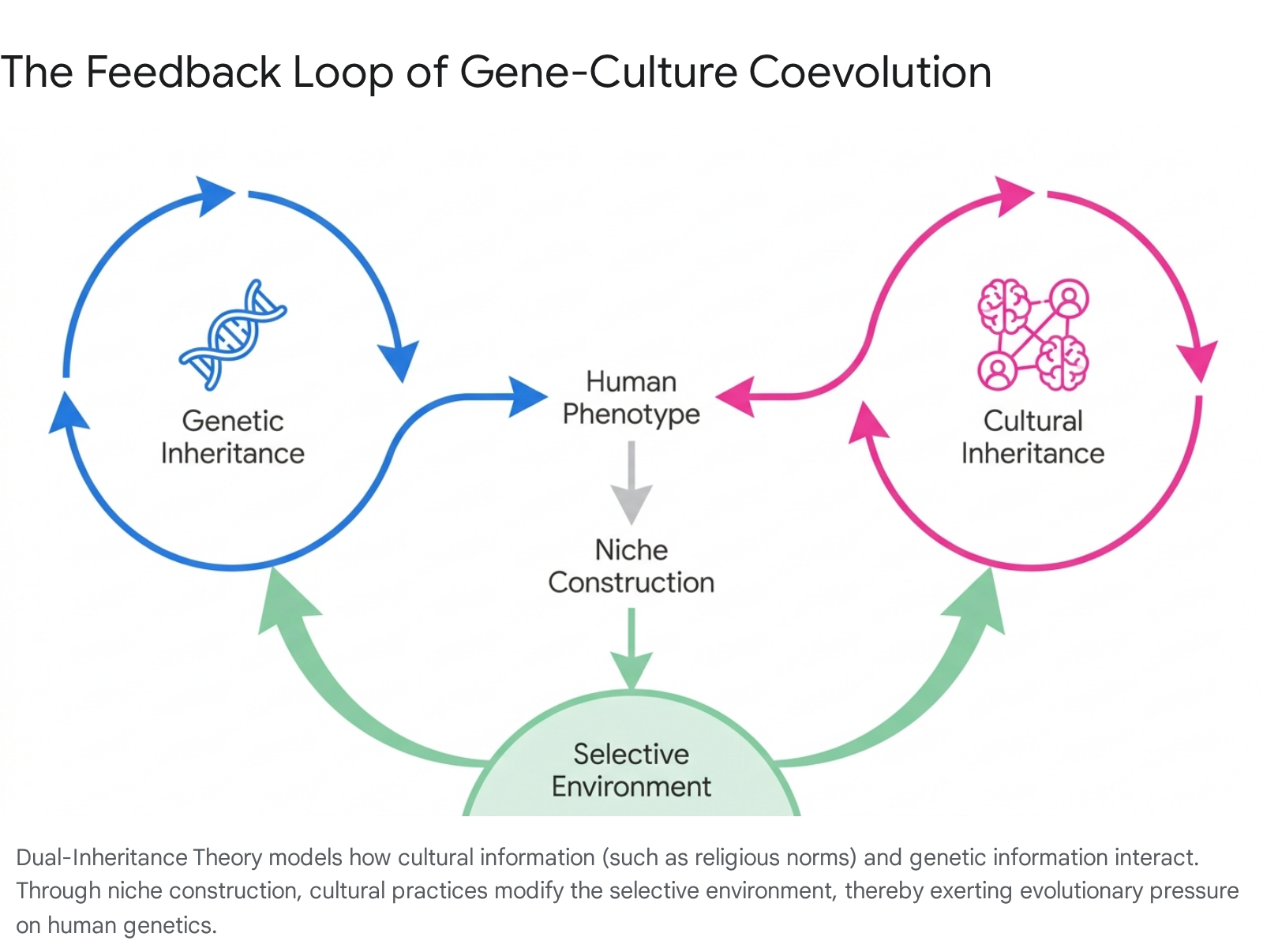
Religion functions as a profound form of human niche construction. By establishing moral norms, marital rules, and cooperative networks, religious cultures alter the demographic and selective landscapes of the populations that adopt them 2536.
For example, religious groups frequently institutionalize pronatalist norms that result in significant fertility differentials compared to secular populations 132. Mathematical models of cultural hitchhiking suggest that if a genetic allele predisposing an individual to receptivity toward social norms arises, it can rapidly proliferate through a population by riding the coattails of culturally transmitted, high-fertility religious practices 132. Even in models assuming high rates of defection from the religion, provided the fertility differential persists and religious individuals exhibit homophily in mating, the genetic predisposition toward norm-receptivity will eventually predominate 132. In this way, cultural practices can directly dictate the genetic trajectory of the species.
Deep Time Trajectories in Hunter-Gatherer Societies
Because modern major world religions are artifacts of the agricultural revolution, evolutionary anthropologists look to the deep historical record and contemporary hunter-gatherer societies to trace the baseline phenotypes of human religiosity. Applying phylogenetic comparative methods - techniques originally developed in evolutionary biology to trace the descent of species - researchers have reconstructed the evolutionary sequence of religious traits among human populations 333435.
Phylogenetic Sequencing of Early Religious Traits
A landmark phylogenetic analysis of 33 global hunter-gatherer societies sought to identify the ancestral character states of religion present in the most recent common ancestor of modern humans 3335. The analysis revealed that animism - the belief that inanimate objects, animals, and natural phenomena are imbued with spirit or intentionality - is the basal, oldest trait of human religion 3335. Animism aligns seamlessly with the cognitive by-product theory, acting as a natural extension of human agency detection without requiring complex theological frameworks 33.
Following animism, the phylogenetic data indicates a specific sequence of evolutionary emergence. Belief in an afterlife evolved next, providing the cognitive foundation for the subsequent evolution of shamanism 33. Shamanism, characterized by ritual practitioners entering altered states of consciousness to communicate with the spirit realm for healing or divination, likely provided early mechanisms for social integration and psychological coping 4243. Ancestor worship emerged later as an integrated evolutionary step, heavily dependent on the prior establishment of an afterlife belief 33.
| Evolutionary Sequence | Religious Trait | Functional Description in Early Societies | Prevalence in Sampled Hunter-Gatherers |
|---|---|---|---|
| 1 (Basal) | Animism | Attribution of spirit/agency to the natural world; derived directly from cognitive agency detection. | Universally present in ancestral populations. |
| 2 | Afterlife Beliefs | The conceptualization that human consciousness persists post-mortem; a prerequisite for spirit interactions. | ~79% |
| 3 | Shamanism | Ritual specialists entering altered states of consciousness to intermediate between the human and spirit realms. | ~79% |
| 4 | Ancestor Worship | Ritualized veneration of deceased kin; fosters intergenerational social cohesion. | ~45% |
| Outlier | High Gods | Belief in a singular creator deity; highly dependent on societal scale and unrelated to the sequential evolution of early traits. | ~39% (Active High Gods: ~15%) |
Crucially, the phylogenetic data demonstrates that beliefs in high gods (supreme creator deities) and active high gods (deities that intervene directly in human moral affairs) were absent in basal human societies 3334. Hunter-gatherer societies are fiercely egalitarian, and their religious cosmologies reflect this flat social hierarchy. Their spiritual narratives are frequently playful, immediate, and lack the hierarchical authoritarianism characteristic of later agricultural religions 334236. Rituals in these contexts often serve as localized mechanisms for controlling power and mitigating environmental uncertainty rather than enforcing cosmic morality 37.
Archaic Hominin Contributions
Recent hypotheses push the timeline of proto-religious cognition even further back, evaluating the archaeological and genomic data of archaic hominins, such as Homo neanderthalensis and Denisovans. Neanderthals exhibited complex behaviors involving mortuary practices, the use of pigments, and the creation of symbolic material culture long before sustained contact with Homo sapiens 383940.
While establishing direct causal links to formal religion is speculative, researchers propose that the cognitive pre-conditions for ritualization and symbolic interpretation existed in these archaic populations 3840. It is hypothesized that Neanderthals utilized localized ritualization to ensure the high-fidelity transmission of complex technical knowledge across generations, providing an explanation for the technological stability of the Middle Palaeolithic 40. Furthermore, genomic introgression - interbreeding between archaic and modern humans - may have contributed genetic variants influencing neural energy metabolism in the prefrontal cortex, subtly shaping the cognitive traits that underlie modern human social cohesion and agency detection 3839.
Sociopolitical Complexity and the Big Gods Hypothesis
As human populations transitioned from egalitarian foraging bands to massive, stratified agricultural empires, the nature of religion transformed radically. To explain this shift, evolutionary psychologists proposed the Big Gods hypothesis, which posited a direct causal relationship: beliefs in morally punitive, all-knowing deities were the primary evolutionary driver that allowed human societies to scale 414243.
The hypothesis relies on the logic that in small bands, humans cooperate because they are constantly monitored by kin and peers. In cities of thousands or millions, anonymity allows the free-rider problem to destroy cooperation 43. Big Gods essentially act as a supernatural surveillance mechanism. Because watched people tend to behave cooperatively, the constant threat of divine punishment suppresses cheating and enables trade and cooperation among genetically unrelated strangers, driving the expansion of civilization 424344.
Replication Failures and Methodological Corrections
While highly influential, the Big Gods hypothesis has faced severe empirical challenges. In recent years, researchers utilizing the Seshat Global History Databank - a massive repository of historical and archaeological data spanning 10,000 years of human history across hundreds of past societies - tested the causal direction of the hypothesis 4142.
A major 2019 analysis published in Nature demonstrated that the original hypothesis had the causal arrow backward. However, this paper was subsequently retracted due to methodological critiques from Beheim et al., who pointed out that the original study miscoded missing data (treating an absence of evidence for moralizing gods in the historical record as evidence of their definitive absence) 4145. Following this retraction, the research team conducted a rigorous re-analysis in 2022 and 2023, correcting the data management errors and employing more direct statistical methodologies 4144.
The corrected dynamic regression analyses confirmed the findings of the retracted paper: massive increases in sociopolitical complexity consistently preceded the emergence of moralizing gods 4142. In 10 out of 12 global regions analyzed, societies surpassed a strict sociopolitical complexity threshold (approximately a population of one million) long before Big Gods appeared in the historical record 4144.
| Evolutionary Variable | Predicted by Big Gods Hypothesis | Observed in Seshat Historical Data |
|---|---|---|
| Causal Driver of Complexity | Moralizing supernatural punishment allows societies to scale. | Agricultural productivity and inter-state warfare (e.g., cavalry) drive complexity. |
| Chronological Sequence | Big Gods emerge first, followed by rapid societal expansion. | Sociopolitical complexity threshold is reached first, followed by the emergence of Big Gods. |
| Rate of Societal Growth | Growth rates accelerate after the introduction of moralizing religion. | Sociopolitical complexity increases more rapidly before the arrival of moralizing religion. |
| Function of Religion | Religion serves to build massive societies from the ground up. | Religion serves to stabilize and legitimize large-scale hierarchies after they are formed. |
Instead of Big Gods driving complexity, the data indicates that both societal complexity and moralizing religions evolved as adaptive responses to shared evolutionary drivers - specifically, the expansion of agricultural productivity and the intense inter-state competition generated by warfare 414246. Standardized rituals that fostered collective identity appeared hundreds of years before moralizing deities. Ultimately, Big Gods were not the architects of vast human empires; they were a cultural consequence of them, utilized to stabilize and legitimize large-scale societal hierarchies after they had already formed 4243.
Religious Priming and Prosociality Debates
A central tenet of both adaptationist and gene-culture coevolution models is that religion increases prosocial behavior, such as cooperation, charity, and altruism. To test this empirically, cognitive and social psychologists have relied heavily on religious priming experiments, wherein subjects are implicitly or explicitly exposed to religious concepts and subsequently evaluated on their willingness to act generously or cheat in controlled laboratory settings 474849.
Meta-Analytic Contradictions and Publication Bias
A highly cited 2015 meta-analysis by Shariff et al., examining 93 studies and over 11,000 participants, concluded that religious priming exerted a robust, positive effect on prosocial behaviors 474950. The study found that while priming effectively increased generosity and reduced cheating among religious individuals, it had negligible effects on non-believers, suggesting the mechanism relies on the cognitive activation of culturally established norms rather than an innate neurological trigger 4750.
However, as the field of psychology underwent a broader reproducibility crisis, skeptics subjected the religious priming literature to rigorous re-analyses using advanced statistical tools designed to detect publication bias, such as Precision-Effect Testing and Precision-Effect Estimate with Standard Error 5152. These bias-corrected re-analyses concluded that the supposed positive effect of religious priming was driven entirely by publication bias and experimenter effects 51. According to the adjusted models, when correcting for unpublished null results, the effect of religious priming on prosocial behavior drops to zero or becomes slightly negative, leading critics to argue that definitive proof of religion's causal effect on prosociality requires large-scale, preregistered replication projects rather than standard meta-analyses 51.
Divergence in Measurement Methodologies
Attempting to resolve the impasse regarding religion's actual effect on behavior, a massive 2024 meta-analysis investigated 701 effects across 237 samples encompassing over 811,000 participants 53. The findings revealed a statistically significant but overall very weak relationship between religiosity and prosociality.
Crucially, the 2024 analysis discovered that the effect is heavily moderated by the type of measurement employed. When prosociality was measured via self-report surveys, the correlation with religiosity was significantly stronger. However, when prosociality was measured via direct behavioral observation, the effect collapsed to a marginal level 53.
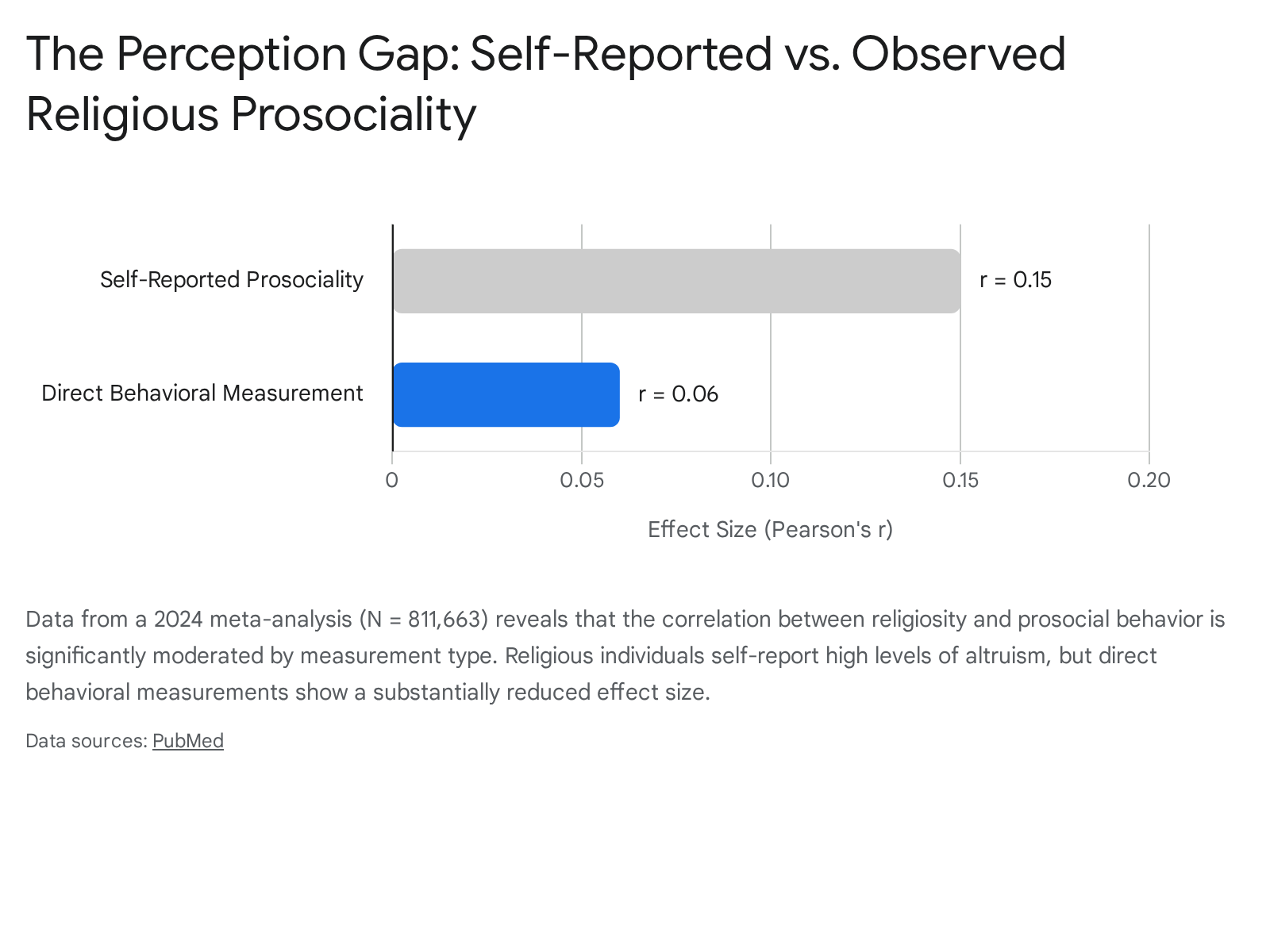
This massive discrepancy suggests that while religious individuals strongly view themselves as highly prosocial, and report their behaviors accordingly due to self-enhancement biases or theological expectations, their actual measurable behavior in anonymous or controlled settings is only marginally more altruistic than their secular counterparts 53.
Divergence of Abrahamic Monotheism from Basal Religion
When the general public conceptualizes religion, the paradigm is almost universally framed by the Abrahamic faiths - Judaism, Christianity, and Islam. However, from the perspective of evolutionary biology and anthropology, applying cognitive and evolutionary models tailored to deep-time hunter-gatherer environments directly to modern monotheism often creates severe epistemological category errors 9263662.
The evolutionary origins of religion focus on animism, shamanism, and local environmental spirit worship. These basal religious frameworks were profoundly embedded in the natural landscape, highly egalitarian, lack rigid orthodoxy, and prioritize immediate practical outcomes, such as healing and hunting success, over cosmic moral judgment 363754.
By contrast, the Abrahamic faiths are vast cultural superstructures that evolved relatively recently in human history, emerging from Proto-Central Semitic roots in the Levant roughly 3,650 to 5,800 years ago 5556. These traditions are characterized by strict monotheism, exclusive truth claims, an emphasis on human free-will, and a transcendent teleology that views the universe as a planned creation moving toward a definitive eschatological endpoint 55576758. Furthermore, beliefs regarding the relationship between religion and science within these monotheistic frameworks significantly influence modern sociopolitical attitudes, functioning as boundary markers for group identity and shaping views on institutional authority, public health, and the biological origins of mental illness 59.
Evolutionary models suggest that Abrahamic monotheisms functioned as powerful mechanisms of cultural evolution, allowing vast agricultural empires to unify disparate populations under a single, centralized theological and moral authority 565860. While the capacity to conceptualize a supreme deity relies on the underlying cognitive hardware of agency detection and theory of mind 4, the dense theological doctrines, scriptural exegesis, and highly formalized ritual boundaries of these traditions are not direct biological adaptations. They are advanced technologies of cultural transmission that evolved to manage sociopolitical complexity, existential anxiety, and large-scale demographic survival in the post-agricultural world 626162.
Religion as Memory
Because neither strict cognitive by-product nor group selection theories satisfy all parameters of religious evolution, novel hypotheses continue to emerge within the cognitive sciences. For example, recent theoretical work by Indologist Johannes Bronkhorst advances the Religion as Memory hypothesis 6364.
Bronkhorst argues that the cognitive state of early childhood - characterized by a pre-linguistic ineffability, a lack of distinct temporal duration, an unrecognizable reality, and an undifferentiated sense of self - parallels the phenomenological states achieved during deep religious absorption, mysticism, and ritual trance 636465. Under this framework, religious rituals and contemplative practices serve an evolutionary function by allowing adults to artificially recapture the psychological architecture of infancy. This regression provides profound psychological restoration and reinforces community bonds entirely independent of explicit doctrinal belief 6364. This perspective suggests that the evolutionary persistence of religion may be tied less to the utility of its supernatural claims and more to its ability to manipulate human consciousness back to a state of baseline cognitive security.
Conclusion
Evolutionary biology and cognitive science reveal that human beings have religion not as a single, isolated evolutionary event, but as the result of a highly complex, multi-tiered evolutionary process.
The baseline capacity for religious thought is undoubtedly rooted in human cognitive architecture. The necessity of surviving in a predator-rich, socially complex Pleistocene environment produced a brain highly tuned to detect invisible agents, assign purpose to random events, and process minimally counterintuitive concepts. However, these cognitive by-products alone do not constitute religion.
Once the cognitive raw materials were available, the forces of dual-inheritance and gene-culture coevolution weaponized them. Beliefs in an afterlife and shamanic rituals provided early hunter-gatherers with psychological resilience and localized social cohesion. As human populations expanded exponentially during the agricultural revolution, these basal religious traits were inadequate to maintain order among millions of anonymous strangers. Consequently, cultural evolution selected for Big Gods and highly formalized, exclusive monotheisms that operated as massive technologies of social control and cooperation. Ultimately, humans have religion because the biological hardware of the human brain provided the psychological spark, while the brutal evolutionary calculus of cultural survival provided the fuel.