
OpenAI Valuation and Computational Cost Curves
Initial Public Offering Context and Enterprise Valuations
The artificial intelligence sector has reached a critical structural inflection point as of mid-2026. Following confidential S-1 draft submissions to the U.S. Securities and Exchange Commission on June 8, 2026, by OpenAI and days earlier by its chief rival, Anthropic, public capital markets are being asked to absorb unprecedented enterprise valuations 1232. OpenAI closed a $122 billion funding round in March 2026, securing an $852 billion post-money valuation 25. Simultaneously, Anthropic secured a $965 billion valuation following a $65 billion Series H funding round, displacing OpenAI as the most highly valued private technology company in the global market 34.
These valuations demand a rigorous examination of the underlying unit economics and capital expenditure projections driving the sector. At $852 billion, OpenAI's valuation implies a revenue multiple of roughly 34x against its $25 billion annualized revenue run rate (ARR) 58. Anthropic's valuation implies a similar multiple against its projected ARR 34. For context, traditional enterprise software-as-a-service (SaaS) businesses in 2026 trade at a median multiple of approximately 7x forward sales, while even high-growth data infrastructure providers like Snowflake trade near 16x forward product revenue 9. The core question facing institutional investors is whether the computational cost curves governing artificial intelligence - specifically the relationship between training expenditures, inference efficiency, and induced demand - can justify these frontier model multiples, or if the sector is facing a structural profitability crisis heavily subsidized by sovereign wealth and circular financing.
The simultaneous public market debuts of OpenAI, Anthropic, and SpaceX represent an imminent capital absorption event totaling nearly $3.7 trillion in combined market value 3511. Public markets must determine whether the artificial intelligence industry is constructing the foundational utility layer of the next century's economy, or if the current financial architecture masks fundamental vulnerabilities in operating margins and physical infrastructure scalability.
Financial Performance and Operating Deficits
OpenAI's trajectory is defined by a deep decoupling of historic revenue growth from traditional software profitability timelines. Between early 2023 and early 2026, OpenAI's revenue grew from $2 billion to an estimated $25 billion ARR, representing sustained annualized growth of approximately 3.4x 56. The platform generates approximately $2 billion per month, bolstered by over 900 million weekly active users and the monetization of its enterprise and consumer tiers, with consumer subscriptions comprising roughly 85% of its revenue mix 578.
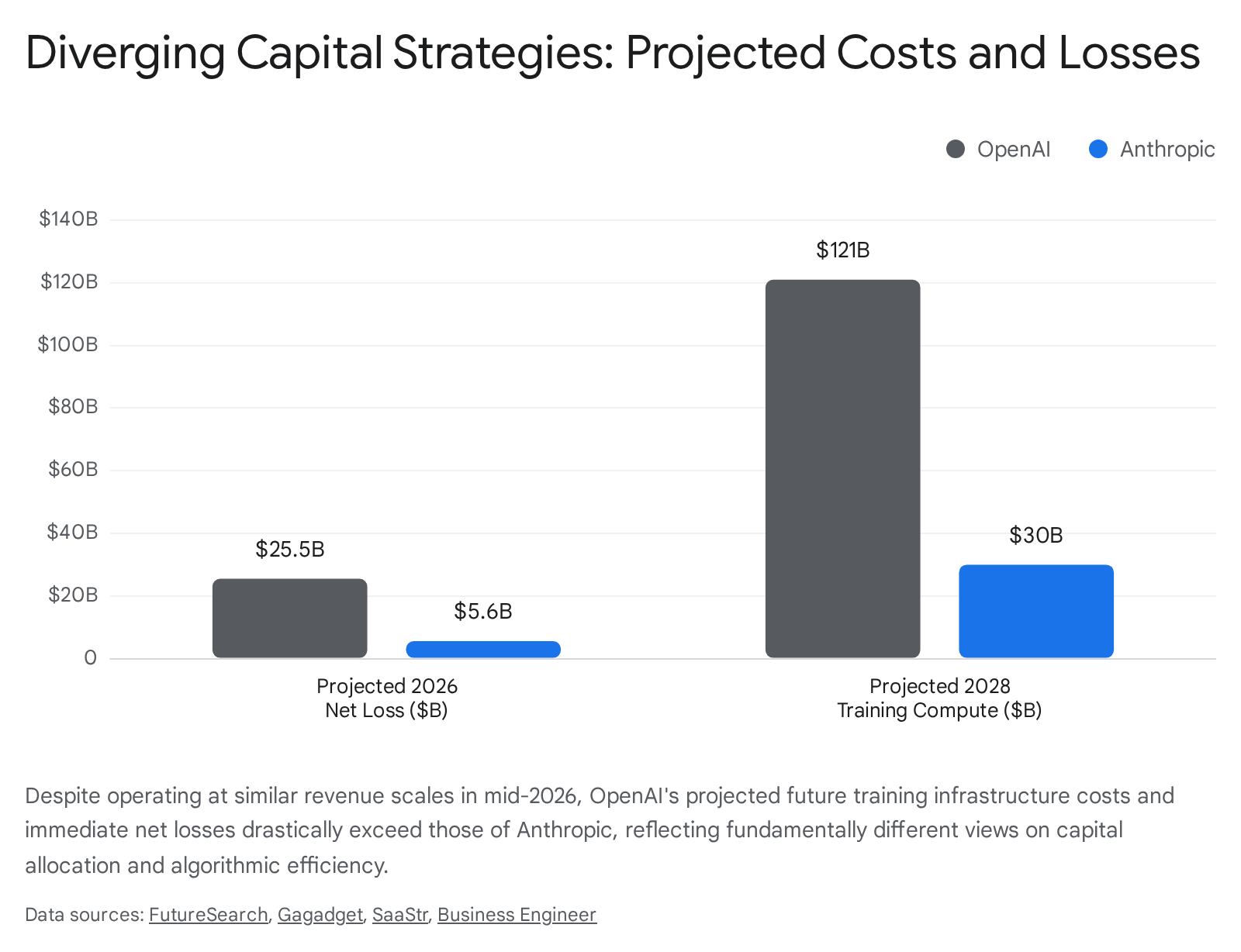
However, this top-line expansion masks deep operational deficits. During the first quarter of 2026, OpenAI reported an operating margin near -122%, effectively losing $1.22 for every $1.00 of revenue generated 15. While the heavily cited $14 billion projected loss for 2026 represents the company's non-GAAP internal forecast, it notably excludes critical non-cash expenses 816. When incorporating an estimated $7 billion to $10 billion in stock-based compensation - an absolute necessity to attract and retain scarce machine learning research talent - the true GAAP loss expands to a projected $25 billion to $26 billion 8.
Internal financial documents reveal that OpenAI does not anticipate becoming cash-flow positive until 2029 or 2030, at which point the company projects it will need to generate $125 billion in annual revenue to achieve breakeven 179. Between 2024 and 2029, aggregate negative free cash flow is projected to reach $143 billion 9. This burn rate exceeds the combined pre-profitability cash burn of Amazon, Uber, Tesla, and Spotify 9. The primary driver of this deficit is the sheer cost of computational infrastructure. In 2028 alone, OpenAI forecasts a compute spend of $121 billion, leading to an estimated single-year loss of $85 billion 819.
The Enterprise Revenue Shift
The fundamental assumption underpinning OpenAI's $852 billion valuation is continued market dominance. However, leaked financial metrics from the spring of 2026 reveal that Anthropic has forcefully closed the revenue gap. Historical data tracking the annualized revenue run rate growth trajectories of both companies illustrates this competitive inversion. In January 2024, OpenAI maintained an ARR of approximately $2 billion compared to Anthropic's $87 million 820. By December 2024, OpenAI reached $6 billion while Anthropic hit $1 billion 8. However, Anthropic's enterprise-first strategy yielded a staggering 10x annual growth rate, vastly outpacing OpenAI's 3.4x annual growth rate 68. This acceleration allowed Anthropic to reach $14 billion by February 2026, $19 billion by March, and $30 billion by April, officially crossing over and surpassing OpenAI's $25 billion run rate 7820. By late May 2026, Anthropic's ARR was reported to have exceeded $44 billion to $47 billion 34.
Anthropic's growth is largely driven by its business-to-business focus, with approximately 80% of its revenue derived from enterprise contracts 7. The primary catalyst for Anthropic's acceleration is Claude Code, an agentic coding product that generated over $2.5 billion in standalone annualized billings within nine months of its introduction 721. By April 2026, Anthropic held a 54% share of the enterprise coding market, compared to OpenAI's 21% 7. This dynamic indicates that while OpenAI established the consumer artificial intelligence category, the most lucrative and durable revenue streams are being captured by enterprise-focused models.
To contextualize the divergent financial and strategic positions of the two leading frontier model developers ahead of their anticipated initial public offerings, the following table summarizes key metrics.
| Financial Metric | OpenAI | Anthropic |
|---|---|---|
| Latest Private Valuation | $852 Billion | $965 Billion |
| Annualized Revenue Run Rate (Q2 2026) | ~$25 Billion | ~$30 Billion to $47 Billion |
| Projected 2026 Net Loss | $14 Billion (Non-GAAP) / ~$25B (GAAP) | ~$5.6 Billion |
| Core Revenue Driver | Consumer Subscriptions (~85%) | Enterprise / B2B (~80%) |
| Projected Year of Profitability | 2029 - 2030 | 2027 - 2028 |
| Peak Annual Training Compute Projection | ~$121 Billion (in 2028) | ~$30 Billion |
Source Data: Aggregated from The Wall Street Journal, FutureSearch, Morningstar, and SaaStr analyses 5487819.
Computational Cost Curves: Training Versus Inference
To determine whether multi-hundred-billion-dollar valuations are justified, it is necessary to model the underlying long-term unit economics of artificial intelligence. Computational costs in this sector are rigidly divided into two distinct phases: training, which is the initial, highly capital-intensive process of building the model, and inference, which represents the ongoing computational cost of generating outputs for end users.
Historically, the cost of running a single inference was minuscule, roughly equivalent to the square root of the compute required for training the model 10. However, because a frontier model is queried billions of times over its lifecycle, the aggregated lifetime cost of inference massively eclipses the one-time training cost. Industry analyses indicate that some models spend up to 90% of their total lifetime energy and operational expenditure on inference 1023. With consumer applications like ChatGPT processing an estimated 2.5 billion prompts daily by mid-2025, inference represents a permanent, utility-scale operational expenditure that scales directly with user adoption 2324.
The Optimality Tradeoff
Research from Epoch AI has formalized a mathematical tradeoff between training and inference compute, demonstrating that developers can independently vary the amount of compute spent in either phase without sacrificing final model performance 1011. Based on empirical observations across multiple techniques, including model pruning, repeated sampling, and Monte Carlo Tree Search, researchers established a rule of thumb. Saving approximately one order of magnitude (10x) in training compute generally requires increasing inference compute by one to two orders of magnitude (10x to 100x), and vice versa 10.
Because tokens processed during training are inherently more expensive than tokens processed during inference - due to the requirement of both forward and backward computational passes during training - optimizing this balance is critical 11. Epoch AI concludes that the optimal economic strategy for an AI laboratory is to spend roughly comparable amounts of total compute on training and inference to minimize total system costs while maintaining capability parity 11.
Unit Economics and the Token Economy
At the microeconomic level, the unit economics of inference are improving rapidly. Driven by algorithmic efficiency, smarter routing, and hardware optimization, the cost per token for a given level of artificial intelligence performance has been falling by roughly 10x every 12 months 12. OpenAI has successfully capitalized on this dynamic. The company's compute margin - defined as the revenue remaining after accounting for model-running costs for paid users - expanded dramatically from approximately 35% in early 2024 to nearly 70% by October 2025 1314.
This margin expansion was primarily achieved through the introduction of tiered modeling, such as routing low-complexity calls to lighter, more efficient networks like the GPT-4o-mini series 14. By cutting the inference burden drastically while maintaining enterprise subscription prices, OpenAI successfully decoupled usage volume from proportionate cost increases 14. Despite these impressive per-token cost reductions, total aggregate cash burn continues to rise, creating a paradoxical financial environment where unit margins improve while net losses accelerate 2314.
The Jevons Paradox in Computational Demand
The contradiction between rapidly falling inference costs and exploding overall cash burn is explained by a well-documented economic phenomenon known as the Jevons Paradox. First articulated by William Stanley Jevons in 1865 regarding coal efficiency in steam engines, the paradox observes that when technological progress increases the efficiency of a resource, total consumption of that resource tends to rise rather than fall, because lower costs make it economically viable for vastly more applications 2930.
In the context of artificial intelligence, as the cost of inference has dropped by over 90% since early 2023, the market has not consumed the same amount of compute for less money. Instead, demand has expanded exponentially through both intensive margins, where existing users consume more, and extensive margins, where entirely new users and applications enter the market 3031. Cheaper intelligence enables novel, highly intensive use cases: continuous agentic background tasks, automated software engineering pipelines, and massive-scale synthetic data generation for future model training 2132.
Financial institutions modeling this demand note that artificial intelligence compute exhibits a kinked demand curve. Above a certain price threshold, demand is relatively inelastic, reserved for mission-critical enterprise tasks 15. However, once efficiency drives the price below that threshold, the demand curve becomes nearly horizontal, meaning any increase in supply or reduction in cost is immediately absorbed by massive latent enterprise demand 15. Consequently, efficiency improvements are necessary to secure individual enterprise gross margins, but they are entirely insufficient for reducing total aggregate infrastructure capital expenditures. The macroeconomic implication is that the artificial intelligence sector will continue to absorb capital at a staggering rate, regardless of how efficient individual silicon chips become, validating the persistence of the multi-trillion-dollar infrastructure buildout.
Physical Infrastructure Constraints and the Stargate Project
The capital expenditures required to train and operate frontier artificial intelligence models have thoroughly decoupled from historic software industry norms, transitioning into heavy-industrial infrastructure economics. Goldman Sachs projects cumulative global capital expenditure on AI infrastructure will reach $7.6 trillion between 2026 and 2031, anchored by the rapid depreciation and relatively short four-to-six-year lifespan of advanced graphics processing units (GPUs) 16. The four primary hyperscalers - Amazon, Microsoft, Alphabet, and Meta - are forecast to commit between $700 billion and $725 billion to capital expenditures in 2026 alone, with roughly 75% allocated directly to infrastructure 1135.
Power Density and Liquid Cooling Bottlenecks
Despite access to virtually unlimited capital, the physical realities of the power grid dictate the pace of expansion. Compute scarcity is increasingly viewed by infrastructure developers not merely as a shortage of silicon, but as a shortage of the physical systems that support silicon: power generation, grid interconnection, and liquid cooling 36.
The International Energy Agency estimates that global data center electricity consumption was 415 terawatt-hours (TWh) in 2024, equal to roughly 1.5% of total global electricity use 37. By 2030, this baseline is projected to more than double to 945 TWh, growing at 15% annually 37. Furthermore, the power density of artificial intelligence servers has escalated dramatically. Between 2020 and 2025, server power density increased by a factor of 11, and is projected to rise an additional four times by 2027 37. This density generates intense localized heat, rendering older data centers obsolete without expensive liquid cooling retrofits, pushing the cost of next-generation data centers from a historic average of $10 million per megawatt to between $15 million and $20 million per megawatt 16.
Execution Risks: The Abilene Stargate Campus
The friction between financial ambition and physical limits is perfectly exemplified by the "Stargate" project. Structured as a joint venture involving OpenAI, Oracle, SoftBank, and the UAE-backed fund MGX, Stargate was designed to build up to 30 gigawatts of compute capacity in the United States by 2029, representing a potential $500 billion total investment 51739.
The flagship Stargate campus in Abilene, Texas, operated by Crusoe Energy Systems, initially went live with a 1.2 gigawatt capacity to support OpenAI workloads on Oracle Cloud Infrastructure 1339. However, plans to expand the facility to 2.0 gigawatts collapsed in early 2026 13. Hardware engineers reportedly struggled to harmonize natural gas turbine generation with the intense power demands of the GPU clusters, resulting in significant cost overruns 18. The cancellation of the expansion followed disputes over financing terms and shifting demand forecasting from OpenAI, signaling that the era of unbounded infrastructure scaling is facing severe execution and financing constraints 13.
Capital Market Absorption and Sovereign Wealth Financing
Bridging the gap between multi-billion-dollar operating losses and trillion-dollar valuations requires deep pools of patient capital. Traditional venture capital economics are mathematically insufficient to fund an industry requiring hundreds of billions in physical infrastructure before reaching cash-flow positivity. Consequently, Middle Eastern sovereign wealth funds have emerged as the dominant financiers of the global artificial intelligence buildout, viewing these investments as critical to their post-oil economic diversification strategies 4142.
State-backed entities from the Gulf Cooperation Council, which collectively manage over $4 trillion in assets, are aggressively deploying capital into platforms and data centers 42. Notable participants in this funding cycle include: * MGX (United Arab Emirates): A specialized technology fund formed by Mubadala and G42, MGX launched with a $100 billion mandate. It holds strategic stakes in both OpenAI and Anthropic, operates as a key equity partner in the Stargate infrastructure venture, and plans to deploy roughly $10 billion annually into frontier technology 174143. * Public Investment Fund (Saudi Arabia): The Saudi sovereign fund has invested heavily in SpaceX, xAI, and domestic capacity. Its technology subsidiary, Humain, announced a $3 billion deal with Blackstone in late 2025 to build up to 6 gigawatts of data center capacity domestically by 2034, partnering with Nvidia and AMD 4419. * Qatar Investment Authority: Managing $580 billion in assets, QIA has taken substantial positions in Anthropic and xAI, and has signaled heavy participation in the upcoming initial public offering cycle 542.
The willingness of sovereign wealth funds to anchor these mega-rounds effectively removes the immediate liquidity constraints that would normally force a cash-burning startup to compress its valuation. However, this dynamic also creates a form of circular financing. Hyperscalers and semiconductor manufacturers often invest directly into the model developers, who subsequently use those funds to purchase compute and hardware back from the investors 35. This structure obscures independent demand signals, tying the valuations of hardware providers, cloud hosts, and model developers into an interdependent financial loop 3520.
Valuation Multiples in the Context of Historical Bubbles
Pricing artificial intelligence companies requires reconciling their software-like gross margins with their heavy-industrial capital expenditures. At $852 billion against a $25 billion ARR, OpenAI is valued at roughly 34x forward sales. Anthropic, valued at $965 billion against an annualized run rate of $30 billion to $47 billion, trades at a multiple between 20x and 32x sales 534.
For context, the median forward revenue multiple for traditional enterprise SaaS businesses in mid-2026 stabilized at approximately 7x 921. High-growth infrastructure SaaS outliers command higher premiums, but rarely at the scale of frontier models. Snowflake, an essential data layer for enterprise workloads, traded at roughly 16x forward product revenue after accelerating its revenue growth to 34% 948. Palantir, recognized as an early platform beneficiary, commanded an elevated 80x trailing sales multiple 22.
To summarize the valuation landscape across the broader technology sector, the following table compares the revenue multiples of frontier models against established infrastructure providers.
| Entity | Primary Sector | Valuation / Market Cap | Est. Annual Revenue | Implied Revenue Multiple |
|---|---|---|---|---|
| OpenAI | Frontier AI Model | $852 Billion | ~$25 Billion | ~34x |
| Anthropic | Frontier AI Model | $965 Billion | ~$30 - $47 Billion | ~20x - 32x |
| Palantir | Enterprise AI Analytics | ~$135 Billion | ~$4.5 Billion | ~80x (Trailing) |
| Snowflake | Data Infrastructure | ~$96 Billion | ~$5.8 Billion (Guidance) | ~16x |
| Traditional SaaS | Various | N/A | N/A | ~7x (Median) |
Source Data: Multiples derived from public market data and private funding rounds as of mid-2026 5494822. Note: Market caps and revenues are rounded estimates based on available reporting.
The Bull and Bear Debate
The divergence between traditional multiples and frontier model valuations has sparked intense debate among institutional allocators. In late 2025, Morgan Stanley and Eaton Vance conducted internal analyses framing the bull and bear scenarios for this cycle 20.
The bull case conceptualizes the infrastructure buildout as a self-funding productivity supercycle. Proponents argue that global corporate profits, estimated at $5 trillion annually, provide massive reinvestment capacity 20. A mere 1% to 2% uplift in global profit margins resulting from automated productivity could generate $1 trillion in incremental earnings, theoretically justifying a $10 trillion investment base 20. Bulls also point out that, unlike the dot-com bubble where companies traded at astronomical multiples without revenue, today's leaders are generating tens of billions of dollars and possess the hyperscaler balance sheets to self-finance the transition 2351.
Conversely, the bear case highlights the severe monetization dilemma. Bears note that even optimistic revenue projections for companies like OpenAI fall drastically short of the $1.6 trillion in new capital required by the broader industry to build the necessary data centers 35. If the enterprise software market cannot absorb the cost of these models, the current financing structures could mirror the over-leveraged telecommunications infrastructure bubble of the early 2000s, resulting in stranded capital and severe valuation compression 20.
Regulatory Moats and the European Union Artificial Intelligence Act
While capital flows heavily into U.S.-based frontier models, international regulatory environments are inadvertently solidifying this oligopoly by raising barriers to entry for smaller competitors. The European Union's Artificial Intelligence Act, which phases into enforcement through 2025 and 2026, imposes extensive compliance requirements - including risk management audits, data governance mandates, and human oversight protocols - on systems classified as high-risk 2425.
The regulatory burden is disproportionately impacting small and medium-sized enterprises. A 2026 survey revealed that EU tech startups face compliance costs ranging from €160,000 to €453,000 annually 54. Furthermore, 60% of micro, small, and medium-sized enterprises reported delayed access to frontier models due to regulatory friction, leading to lost clients and suspended product launches 54.
Because building a globally competitive generative artificial intelligence model requires massive fixed costs for training, alongside immense legal and compliance overhead, the European Union legislation risks mirroring the outcome of the General Data Protection Regulation by consolidating market power in the hands of heavily capitalized incumbents 2627. As European startups are forced to rely on U.S. hyperscalers for compute and distribution to amortize these costs, the regulatory moat deepens 26. The inability of secondary players to absorb both compliance costs and the exponential cost of compute scaling serves to protect the market share of OpenAI and Anthropic, providing a localized justification for their premium valuations despite their severe operating losses.
Conclusion
The $852 billion valuation of OpenAI, set against a projected $25 billion GAAP net loss, represents a unique paradigm in modern financial markets. The valuation cannot be justified by traditional software-as-a-service metrics, nor by near-term cash flow projections, as the company operates with deeply negative operating margins and faces a staggering $121 billion infrastructure bill in 2028 alone.
Instead, the 34x revenue multiple is fundamentally an infrastructure bet. It is sustained by three distinct pillars. First, the Jevons Paradox of compute guarantees that as algorithmic efficiency drives unit inference costs down, total consumption will scale exponentially, expanding the total addressable market. Second, Middle Eastern sovereign wealth funds are acting as a vital bridge over the liquidity gap, providing hundreds of billions in patient capital to sustain the physical buildout. Finally, the sheer scale of capital required, combined with stringent international regulations like the EU AI Act, forms an impenetrable moat that prevents new entrants from challenging the duopoly.
However, execution risk remains severe. Anthropic's rapid ascent to a $30 billion to $47 billion annualized revenue run rate on a fraction of OpenAI's projected training cost proves that algorithmic efficiency and targeted enterprise deployment can outmaneuver brute-force capital scaling. Furthermore, physical constraints regarding grid power and liquid cooling - exemplified by the stalled expansion of the Stargate Abilene campus - threaten to delay the capacity required to realize these projected revenues. As the initial public offering cycle commences, it will serve as the ultimate test of whether public equities markets possess the depth and patience to finance the most capital-intensive industrial buildout of the digital age.